Specific distribution of lichens on
Dodonaea viscosa
L. in the restinga
area of Itapuã State Park in Southern Brazil
Suzana M. de A. Martins1,3 and Marcelo P. Marcelli2
Received: 23.09.2010; accept: 18.08.2011
ABSTRACT - (Specific distribution of lichens on Dodonaea viscosa L. in the restinga area of Itapuã State Park in Southern Brazil). The results of the specific distribution of lichens sampled on 30 small Dodonaea viscosa L. trees located in a restinga area on the banks of Lagoa Negra in Itapuã State Park, Rio Grande do Sul, State are presented. The difference in species diversity among the habitats was proved through similarity tests. The twig was the habitat that has presented the greatest floristic differentiation and the branches were similar to the trunks. Lichen communities vary depending on habitat conditioned to the bark roughness, which changes according to the age of the substrate.
Key words: diversity, habitat, lichen community
RESUMO - (Distribuição específica de liquens sobre Dodonaea viscosa L. no Parque Estadual de Itapuã no sul do Brasil). São apresentados os resultados de distribuição específica de liquens amostrados em 30 arvoretas de Dodonaea viscosa L. localizadas em uma área de restinga às margens da lagoa Negra no Parque Estadual de Itapuã, Rio Grande do Sul. Através dos testes de similaridade foi comprovada a diferença na diversidade de espécies entre os hábitats. O ramo foi o hábitat que apresentou maior diferença e os galhos apresentaram similaridade com o tronco. A comunidade liquênica varia dependendo do hábitat e está condicionada à rugosidade da casca, que se modifica em função da idade do substrato.
Palavras-chave: comunidade liquênica, diversidade, hábitat
1. Museu de Ciências Naturais da Fundação Zoobotânica do Rio Grande do Sul, Caixa Postal 1188, 90690-000 Porto Alegre, RS, Brazil 2. Instituto de Botânica, Caixa Postal 68041, 04045-972 São Paulo, SP, Brazil
3. Corresponding author: [email protected]
Introduction
Since preference for habitats and microhabitats is well-developed in lichens, small differences in chemical (pH and mineral contents) and physical factors (light, temperature, humidity, wind, substrate porosity, toughness and roughness, etc.) can explain species replacement (Hale 1955, Brodo 1973).
Authors such as Werth (2001) and Cáceres et al.
(2007, 2008) who studied factors that influence species
composition of epiphytic lichens, have concluded that the most important is the macroclimatic gradient followed by the spatial variation and substrate variation. Several authors agree that the microclimate has a greater influence on establishing epiphytic communities than the substrate, since the phorophyte is a non continuous variable, unlike the environmental ecological variables that usually establish gradients (Cornelissen & Gradstein 1990, Komposch & Hafellner 2000, 2003, Cáceres et al. 2007, 2008).
Hawksworth (1975) stated that variations in the presence of corticolous lichens depends more on the physical nature of the bark than on tree species. Young trees with smooth bark usually present only crustose forms, many of them with a very thin thallus. When the tree begins to age and the bark becomes rougher, other lichen forms appear, such as crustose species with thicker thallus or large foliose species, as well as fruticose ones.
Pedersen (1980) analyzed epiphytic lichens in oak forests and found a homogeneous lichen community on the four sides in young trees, while on the older trees the community composition on the trunk sides
was being modified. According to this author, these
changes may be related to trunk roughness and microclimate.
The epiphytic community differs more strongly depending on trunk height, although a difference was also found in the trunk communities on trunks of different ages (Ruchty et al. 2001).
Thus, therefore the substrate structure and the physical environmental characteristics are among the principal factors affecting lichen distribution on trunks. The physical-chemical characteristics of tree bark, such as texture, hardness, water retention, pH, macro and micro nutrient composition are essential for the establishment of the lichen community (Hale 1957, Pearson 1969, Brodo 1973, Jesberger & Sheard 1973, Hawksworth & Hill 1984, Marcelli 1996, Nash III 1996, Schmidt et al. 2001).
While knowledge on Brazilian tropical lichen ecology is rudimentary, a few quantitative studies have been published for South and Southeast region (Marcelli 1987, 1992, 1995, 1998, Käffer et al. 2007, 2009, 2010).
Brazilian restinga forests are formations rich in lichens species (Marcelli 1990, 1991), and there are few data on this subject. Therefore, knowing lichen diversity on Dodonaea viscosa L. in restinga areas of the Itapuã Park and verifying the lichen species distribution on it is a major contribution to lichen studies in these areas.
Material and methods
Study area - Itapuã State Park is located in the municipality of Viamão, at coordinates 50º 50' - 51º 05' W and 30º 20' - 30º 27' S, 57 km from the city of Porto Alegre and 60 km from the Atlantic Ocean. It has an area of 5,566 ha, with beaches, islands, lakes,
fields, dunes, restinga forests, and granite hills.
The park forms an island of high biodiversity and
shelters the fauna and flora of successive geological eras. The plant cover is much diversified, especially
due to determinant environmental factors, including not only coastal restinga forests, but also granite hills, a very distinct formation in which generally forests and grasslands occur with a great variety of
physiognomic-floristic types. On the top and the side
of the mountains, the frequent rocky outcrops are covered by many lichen species and mosses. Around some rocky outcrops small tree-shrub groups occur and the vegetation is strongly influenced by the Atlantic Rainforest.
In the broader geomorphologic or phytogeographic sense, restinga forests in Rio Grande do Sul approximately match the physiographic region named “Costa” and the Coastal-Plain geomorphologic province (Fortes 1959, Delaney 1965). The vegetation in this region mostly covers wind deposits represented
by fixed or movable dunes (Teixeira et al. 1986).
Field activities - Eleven four-day field trips were car -ried out: three excursions in May, June and December, 2003, in order to get acquainted with the area, select the phorophyte and acquire previous knowledge of the lichen species. The expeditions to obtain quantitative data were carried out in April, 2004 and in January, July and August, 2005.
As lichens are not seasonal, it was not necessary to distribute the collections throughout the year. In
order to verify sample sufficiency a collector`s curve
was made by relating the quantity of species sampled with the quantity of sampled phorophytes. At each phorophyte sampled new species were summed to
the total. The collection work was finished after the
analysis of 30 small trees, when the collector’s curve became stabilized.
Phorophyte - The selected phorophyte species was Dodonaea viscosa (Sapindaceae), popularly known as red-broom (“vassoura-vermelha”). This species was chosen for its wide distribution in the area and because it presents high lichen diversity and cover.
Dodonaea viscosa may vary from shrubs to small trees 3 to 8 meters high. It is a low land species (5-300 m) characteristic of restinga vegetation and banks near the coast and presents a wide and expressive dispersion along all of the Rio Grande do Sul State coast. It is a heliophyte and selective xerophyte species, very abundant, especially in restinga shrubby vegetation altered by man. In sandy soils, they usually form almost pure dense groupings (Reitz 1980).
Phorophyte standardization - Thirty individuals of D. viscosa were selected near Lagoa Negra place. The chosen shrubs were at least 2 m high with a 20 cm trunk circumference, for standardization.
The shrubs received a numbered identification
Phorophyte analysis - The sampling method used was an adaptation of the Rubber Method, which was devised to measure coverage and to count lichens around the trunk, collecting the coverage differences
already in the field, since it is automatically adapted
to several trunk circumferences (Marcelli 1987, 1992). The intention of this study was to sample linear lichen distribution from the base of the trunk to the twig extremities. For this, the method was adapted by replacing the rubber by a tape measure, which does not stretch and performs the count and size measurements directly in millimeters or centimeters, resulting in an extremely precise notation of each specimen presented along the measured extension. This method was named “Tape Measure Method” and its use is described below.
Lichens were observed, measured and noted in the
field, from the base of the trunk towards the top of the
small trees, up to the limit height of 1.20 m to 1.50 m.
When the first branching or branch appeared, after the
stipulated height, it was cut to be analyzed later in the laboratory, so that the sampling could reach the full length of all the twigs. The samples were standardized as much as possible, trying to collect twigs and/or branches at the same height; however there were cases of twigs that were more exposed to sun and dust, a variable that was impossible to control.
South, East, North and West oriented branches and twigs from every D. viscosa sampled were analyzed, as well as the same four sides of the trunks, determined by using a compass.
Species identification - For species identification,
standard lichenological procedures were used, which consist in morphological and chemical analysis, spot test and ultraviolet light test (Canêz 2005, Jungbluth 2006).
Samples were identified at the laboratory of the
Phanerogam Botany Section of the Museum of Natural Sciences at the Zoobotanical Foundation of Rio
Grande do Sul. Specific literature was also consulted for the identification of genera in some major groups,
such as Dodge (1964), Hale (1976), Arvidsson (1983), Jørgensen & James (1983), Sérusiaux (1983), Galloway (1985), Swinscow & Krog (1988), Moberg (1989), Scutari (1992, 1995), Elix (1994), Ribeiro (1998), Fleig (1997, 1999), Athi (2000), Eliasaro & Adler (2000), Brodo et al. (2001), Eliasaro (2001), Galloway (2001), Sipman (2002) and others several taxonomics words cited on Marcelli & Ahti (1998).
Data treatment - All data referring to each phorophyte were included in a Microsoft Excel sheet. This sheet
has details of each lichen specimen analyzed, on trunk, branch and twig.
Twigs, branches and trunks, they were considered as different habitats.
Specific diversity per habitat - In order to recog -nize similarity patterns of the epiphytic
commu-nity composition, the sample units were classified
according to present species and their abundance transformed by the natural logarithm + constant (log x + 1) through a cluster analysis, using Euclide-an distEuclide-ance as similarity measure Euclide-and the Minimum Variance as clustering method (Ward 1963).
In addition the specific diversities were compared
for all the habitats through the Kruskal-Wallis analysis of variance test (ANOVA) (H = 21.39, p < 0.005).
Results
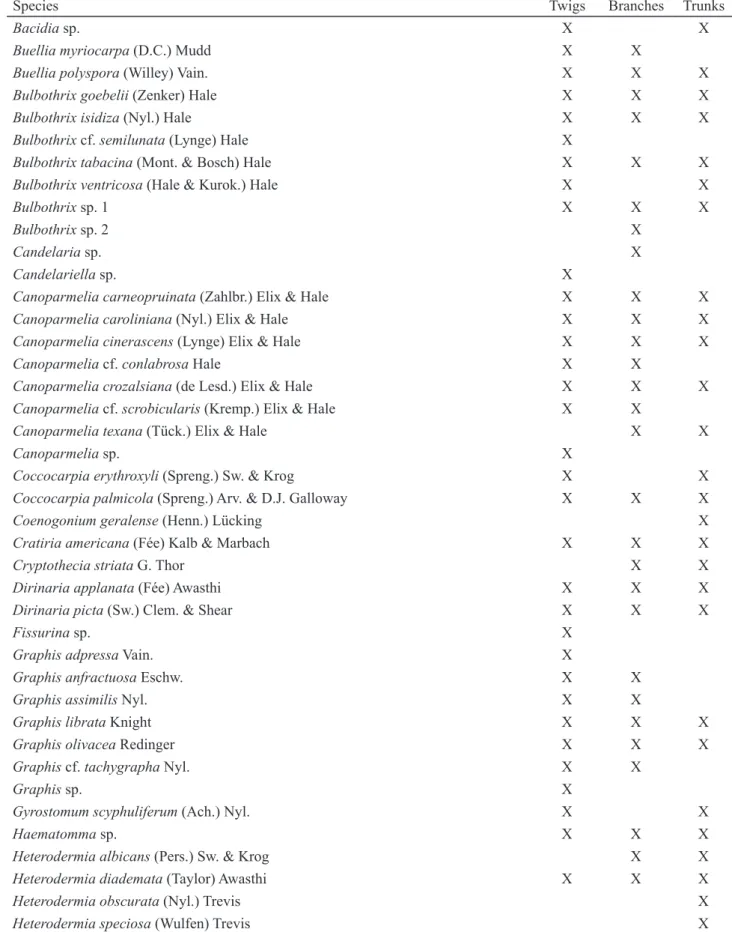
The 10,887 specimens found on the 30 phorophyte were distributed in 126 species, of which 104 occurred on twigs, 89 on branches and 89 on trunks (table 1). The greatest percentage of these were foliose lichens, followed by crustose and fruticose forms. Trunks presented the greatest percentage of species with foliose habit (79.16%) while species with crustose habit were concentrated on twigs (97.43%) and those with fruticose habit, although few, were distributed
throughout all three habitats (table 2, figure 1).
Table 3 shows that 16 species were restricted to twigs, 10 (62.5%) represented by crustose lichens,
five (31.2%), by foliose and one (6.7%) by fruticose.
Nine species were restricted to trunks, seven (77.8%) being foliose, one (11.1%) fruticose and one (11.1%) crustose. There were no species restricted to branches.
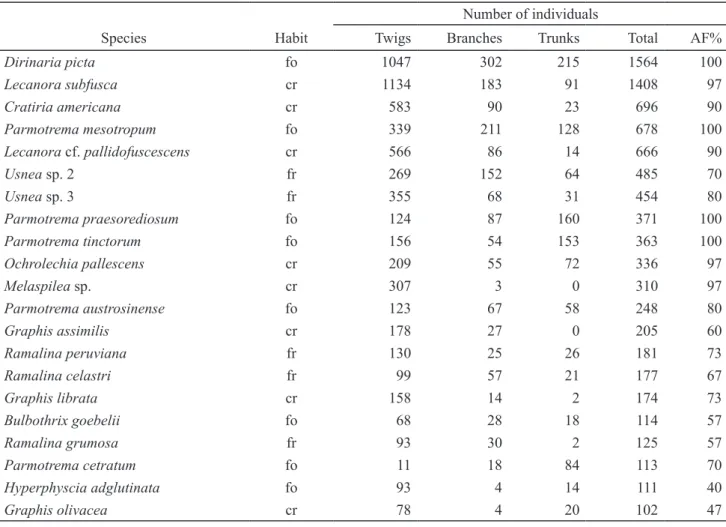
Twenty-one species contributed with more than 100 individuals each. All of them were more frequent on twigs, decreasing their number on branches, and consecutively on trunks; among these, Dirinaria picta,
Lecanora subfusca, Cratiria americana, Parmotrema mesotropum and Lecanora cf. pallidofuscescens counted more than 500 individuals (table 4).
Based on the cluster analysis (figure 2) and Kruskal-Wallis, the twig habitat presented the greatest difference between trunks and branches; the branches have presented similarity with the trunk
(table 5, figure 4).
Table 1. Total of species found on different habitats.
Species Twigs Branches Trunks
Bacidia sp. X X
Buellia myriocarpa (D.C.) Mudd X X
Buellia polyspora (Willey) Vain. X X X
Bulbothrix goebelii (Zenker) Hale X X X
Bulbothrix isidiza (Nyl.) Hale X X X
Bulbothrix cf. semilunata (Lynge) Hale X
Bulbothrix tabacina (Mont. & Bosch) Hale X X X
Bulbothrix ventricosa (Hale & Kurok.) Hale X X
Bulbothrix sp. 1 X X X
Bulbothrix sp. 2 X
Candelaria sp. X
Candelariella sp. X
Canoparmelia carneopruinata (Zahlbr.) Elix & Hale X X X
Canoparmelia caroliniana (Nyl.) Elix & Hale X X X
Canoparmelia cinerascens (Lynge) Elix & Hale X X X
Canoparmelia cf. conlabrosa Hale X X
Canoparmelia crozalsiana (de Lesd.) Elix & Hale X X X
Canoparmelia cf. scrobicularis (Kremp.) Elix & Hale X X
Canoparmelia texana (Tück.) Elix & Hale X X
Canoparmelia sp. X
Coccocarpia erythroxyli (Spreng.) Sw. & Krog X X
Coccocarpia palmicola (Spreng.) Arv. & D.J. Galloway X X X
Coenogonium geralense (Henn.) Lücking X
Cratiria americana (Fée) Kalb & Marbach X X X
Cryptothecia striata G. Thor X X
Dirinaria applanata (Fée) Awasthi X X X
Dirinaria picta (Sw.) Clem. & Shear X X X
Fissurina sp. X
Graphis adpressa Vain. X
Graphis anfractuosa Eschw. X X
Graphis assimilis Nyl. X X
Graphis librata Knight X X X
Graphis olivacea Redinger X X X
Graphis cf. tachygrapha Nyl. X X
Graphis sp. X
Gyrostomum scyphuliferum (Ach.) Nyl. X X
Haematomma sp. X X X
Heterodermia albicans (Pers.) Sw. & Krog X X
Heterodermia diademata (Taylor) Awasthi X X X
Heterodermia obscurata (Nyl.) Trevis X
Heterodermia speciosa (Wulfen) Trevis X
Species Twigs Branches Trunks Hyperphyscia adglutinata (Flörke) M. Mayrhofer & Poelt X X X
Hyperphyscia syncolla (Tuck.) Kalb. X X
Hypotrachyna degelii (Hale) Hale X X
Hypotrachyna imbricatula (Zahlbr.) Hale X
Hypotrachyna intercalanda (Vain.) Hale X X
Hypotrachyna livida (Taylor) Hale X X X
Hypotrachyna palmarum (Lynge) Hale X X
Hypotrachyna pustulifera (Hale) Skorepa X X
Lecanactis sp. X X
Lecanora concilianda Vain. X X X
Lecanora frustulosa (Dickson) Schaer. X X X
Lecanora cf. macrescens Vain. X X X
Lecanora cf. pallidofuscescens Vain. X X X
Lecanora subfusca (L.) Ach. X X X
Lecanora sulphurescens Fée X X X
Lecidea canorubella Nyl. X X
Lecidea cf. testaceoglauca Vain. X
Lecidea sp. X
Leptogium sp. X
Maronea sp. X
Melaspilea sp. X X
Micarea sp. X X
Myelochroa lindmanii (Lynge) Elix & Hale X X
Ochrolechia pallescens (L.) A. Massal. X X X
Parmelinopsis minarum (Vain.) Elix & Hale X
Parmotrema austrosinense (Zahlbr.) Hale X X X
Parmotrema catarinae Hale X X X
Parmotrema cetratum (Ach.) Hale X X X
Parmotrema eciliatum (Nyl.) Hale X X X
Parmotrema cf. epicladum (Hale) Fleig X X X
Parmotrema homotomum (Nyl.) Hale X X
Parmotrema conferendum Hale X X
Parmotrema haitiense (Hale) Hale X X
Parmotrema lobuliferum (C.H. Ribeiro & Marcelli) O. Blanco, A. Crespo, Divakar, Elix & Lumbsch
X X
Parmotrema pilosum (Stizenb.) Krog. & Sw. X X
Parmotrema recipiendum (Nyl.) Hale X X
Parmotrema subcaperatum (Kremp.) Hale X
Parmotrema subsumptum (Nyl.) Hale X X X
Parmotrema uruguense (Kremp.) Hale X X X
Parmotrema sp. X X
Table 1 (continuation)
Table 1 (continuation)
Species Twigs Branches Trunks
Parmotrema macrocarpum (Pers.) Hale X X X
Parmotrema madilynae A. Fletcher X X X
Parmotrema melanothrix (Mont.) Hale X X X
Parmotrema mesotropum (Müll.Arg.) Hale X X X
Parmotrema praesorediosum (Nyl.) Hale X X X
Parmotrema reticulatum (Taylor) M. Choisy X X
Parmotrema simulans (Hale) Hale X X
Parmotrema spinibarbe (Kurok.) Fleig X X X
Parmotrema tinctorum (Nyl.) Hale X X X
Parmotrema vainioi (A. L. Smith) Hale X X
Parmotrema yodae (Kurok.) Hale X
Parmotrema sp. X
Pertusaria ostiolata Dibben X X
Pertusaria sp. X
Phaeographis lobata (Eschw.) Müll. Arg. X X
Phaeographis cf. subtigrina (Vain.) Zahlbr. X
Physcia aipolia (Humb.) Fürnr. X X X
Physcia alba (Fée) Müll. Arg. X X X
Physcia crispa Nyl. X X X
Physcia poncinsii Hue X X
Physcia stellaris (L.) Nyl. X X
Porina sp. X
Punctelia constantimontium Sérus. X X
Punctelia sp. X
Pyxine cocoës (Sw.) Nyl. X
Pyxine subcinerea Stirt. X X
Ramalina cf. calcarata Krog & Sw. X X
Ramalina celastri (Spreng.) Krog & Sw. X X X
Ramalina complanata (Sw.) Ach. X X X
Ramalina cf. exiguella Stirt. X X X
Ramalina grumosa Kashiwadani X X X
Ramalina peruviana Ach. X X X
Ramalina cf. sprengelii Krog & Sw. X
Ramalina usnea (L.) Howe X X X
Ramalina sp. X
Ramboldia russula (Ach.) Kalb, Lumbsch & Elix X X X
Rinodina sp. X X X
Teloschistes exilis (Michx.) Vain. X X X
Teloschistes flavicans (Sw.) Norman X X X
Usnea sp. 1 X X X
Usnea sp. 2 X X X
Table 1 (continuation)
Species Twigs Branches Trunks
Usnea sp. 3 X X X
Usnea sp. 4 X X
Vainionora sp. X X
Verrucaria sp. X X X
Total 104 89 89
The most common foliose species found on the twigs were Dirinaria picta and Parmotrema mesotropum, which were fertile despite presenting small thalli. Their thalli sizes were larger on trunks, consequently increasing their coverage on that habitat.
Parmeliaceae occurred most among the foliose lichens, especially because of the Parmotrema species. Four species of this genus growed usually grouped: P. mesotropum, P. praesorediosum, P. tinctorum and P. austrosinense.
Trunks - Eighteen lichen species presented preference for the trunks. Nine were exclusive and the other nine had their greater number of individuals on this habitat. Among these species, only two are not foliose: Ramalina cf. sprengelii (fruticose) and Coenogonium geralense (crustose).
The trunk is the habitat with the roughest bark and by consequence probably has more humidity, which allows the occurrence of species that are more demanding of this factor.
Degelius (1964) considered the species that are more or less rare on trunks as late immigrants; these are fruticose and foliose species that do not belong to the typical twig community. It is quite possible that the nine species that were exclusive to trunks are late immigrants in the community of D. viscosa (table 6).
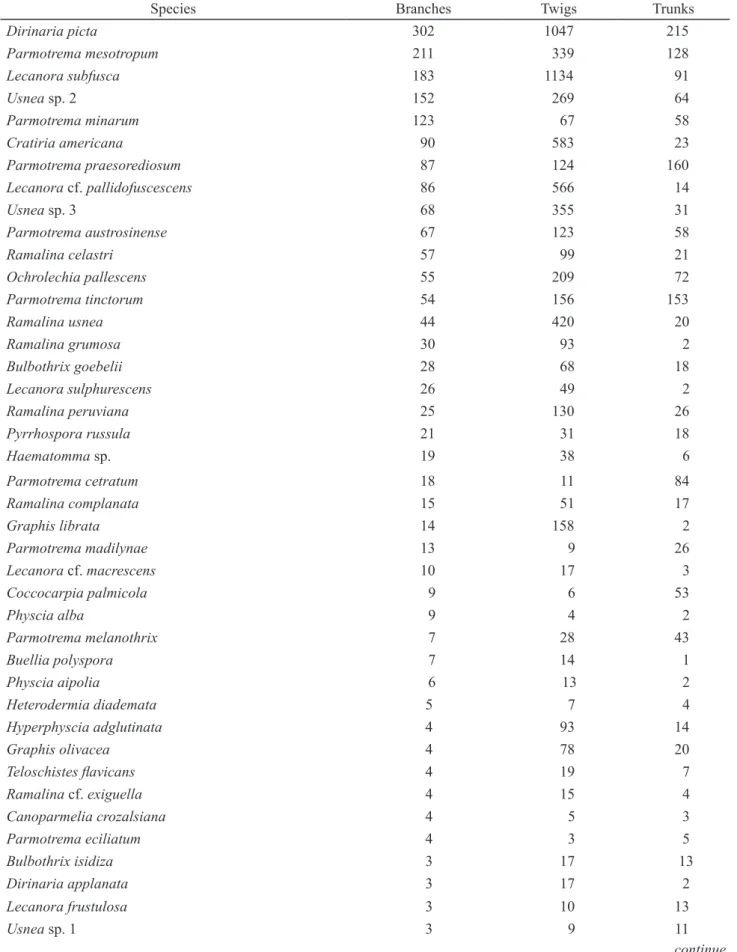
Branches - A total of 89 species were found on the branches, 50 of them growing both on twigs and on trunks, 17 in common with twigs and only 21 with trunks (table 7). According to the statistical tests of
specific diversity, this habit did not present significant
differences when compared to the twigs, but showed more similarity with the trunks.
None of the species demonstrated preference for the branches.
Twigs - A total of 104 species occurred on the twigs.
This is the habitat with the highest specific diversity
and where species have presented the greatest number of individuals.
Some species appeared on the terminal portions of twigs and continued up to the insertion of the twig on the branch; other species have appeared less frequently on certain points.
Species that develop on such extremities are considered as settlers; however some differences Table 2. Total number of species and number of species (ns) per habit found on the different habitats.
Habit Total number Twigs Branches Trunks
of species ns % ns % ns %
Foliose 72 52 72 49 68 57 79
Crustose 39 38 97 27 69 19 49
Fruticose 14 14 87 13 81 13 81
0 10 20 30 40 50 60
Foliose Crustose Fruticose
Ns
Twings Branches Trunks
Table 3. Species that have occurred only on twigs or trunks with their habit, where cr: crustose, fo: foliose and fr: fruticose.
Twigs Habit Trunk Habit
Graphis adpressa cr Heterodermia speciosa fo
Candelariella sp. cr Heterodermia obscurata fo
Fissurina sp. cr Hypotrachyna imbricatula fo
Graphis sp. cr Leptogium sp. fo
Lecidea cf. testaceoglauca cr Parmelinopsis minarum fo
Lecidea sp. cr Parmotrema sp. fo
Maronea sp. cr Punctelia sp. fo
Pertusaria sp. cr Ramalina cf. sprengelii fr
Phaeographis cf. subtigrina cr Coenogonium geralense cr
Porina sp. cr
Parmotrema subcaperatum fo
Canoparmelia sp. fo
Bulbothrix cf. semilunata fo
Parmotrema yodae fo
Pyxine cocoës fo
Ramalina sp. fr
may occur among the twigs of a same tree. These variations depend on the exposure to sun and dust (Degelius 1964).
As a general rule, young trees and the twigs extremities present a smoother bark and, because of this, are more appropriate to the establishment of crustose forms, many of them with a very thin thallus. When the tree begins to get old and the bark become rougher, other species begin to appear, as crustose forms of thicker thallus or big folioses and fruticoses.
On the terminal twigs of D. viscosa a great number of individuals with very small thalli (0.5 cm diameter) of Dirinaria picta occurred. Physcia crispa was also found, however in a smaller number.
Among the foliose species, Parmotrema mesotropum should be pointed out as the species of the genus with the greatest number of individuals on twigs. The individuals of P. mesotropum, even with a smaller thallus, were well developed, producing ascospores in the apothecia.
There were more foliose species than other groups in all habitats; however, the greatest numbers of individuals were of crustose forms, especially on the twigs.
Considering smooth surfaces, the crustose life forms start the succession. Although with a much reduced thallus, species such as Cratiria
americana, Graphis assimilis, G. librata, Lecanora cf. pallidofuscescens and L. subfusca presented a very abundant production of ascomata. These species, together with Dirinaria picta (foliose) were the most numerous on twigs.
Discussion
The habitats presented a great difference between them, and the branches presented similarity to the twigs and trunks, being characterized as a transition zone. It may be explained by the ageing of substrate and this fact is directly related to bark roughness, since, as time goes by, the branches begin to present similar surface characteristics to the trunk, turning it into an ecotone transition zone, with species that occur on twigs as well as on trunks. Since it is a transition zone, it is the habitat where the species replacement in response to their different environment occurs. The branches, older than the twigs, present a rougher
bark, more similar to trunks, which justifies the higher
similarity between these habitats.
Table 4. Species that have contributed with more than 100 individuals, number of presence on the habitats and absolute frequency. Habits – cr: crustose, fo: foliose and fr: fruticose.
Number of individuals
Species Habit Twigs Branches Trunks Total AF%
Dirinaria picta fo 1047 302 215 1564 100
Lecanora subfusca cr 1134 183 91 1408 97
Cratiria americana cr 583 90 23 696 90
Parmotrema mesotropum fo 339 211 128 678 100
Lecanora cf. pallidofuscescens cr 566 86 14 666 90
Usnea sp.2 fr 269 152 64 485 70
Usnea sp.3 fr 355 68 31 454 80
Parmotrema praesorediosum fo 124 87 160 371 100
Parmotrema tinctorum fo 156 54 153 363 100
Ochrolechia pallescens cr 209 55 72 336 97
Melaspilea sp. cr 307 3 0 310 97
Parmotrema austrosinense fo 123 67 58 248 80
Graphis assimilis cr 178 27 0 205 60
Ramalina peruviana fr 130 25 26 181 73
Ramalina celastri fr 99 57 21 177 67
Graphis librata cr 158 14 2 174 73
Bulbothrix goebelii fo 68 28 18 114 57
Ramalina grumosa fr 93 30 2 125 57
Parmotrema cetratum fo 11 18 84 113 70
Hyperphyscia adglutinata fo 93 4 14 111 40
Graphis olivacea cr 78 4 20 102 47
Table 5. Table of ANOVA for the relation between the species diversity and the habitats. Fonts of variations represent the habitats (base of the trunk, trunk and extremity of twigs). SS: Sum of squares, df: degrees of freedom, MS: Mean Squared, F: reason among the variances.
Species diversity
Font SS df MS F P
Habitats 704.570.173 2 352.285.086 5.167 0.007
Error 1.04 68.174.423
Species Twig Branch Trunk Habitat
Parmotrema melanothrix 28 2 43 fo
Parmotrema cetratum 11 18 84 fo
Parmotrema madilynae 9 13 26 fo
Coccocarpia palmicola 6 9 53 fo
Canoparmelia caroliniana 2 2 19 fo
Punctelia constantimontium 1 0 20 fo
Hypotrachyna degelii 2 15 fo
Hypotrachyna pustulifera 2 10 fo
Parmotrema reticulatum 1 30 fo
Parmelinopsis minarum 7 fo
Coenogonium geralense 4 cr
Hypotrachyna imbricatula 2 fo
Ramalina cf. sprengelii 2 fr
Heterodermia speciosa 1 fo
Heterodermia obscurata 1 fo
Leptogium sp. 1 fo
Parmotrema sp. 1 fo
Punctelia sp. 1 fo
Table 6. Species that have presented preference for the trunk with the individual’s number by habitat and their habit, where fo: foliose, fr: fruticose and cr: crustose.
Figure 3. Similarity in species diversity among branches, twigs and trunks, through ANOVA.
on the physical characteristics of the bark than on the phorophyte species. Trees with smooth bark and young trees in general present lichens of crustose habit; when the bark begins to become older and rougher, other species begin to appear.
According to Ruchty et al. (2001), with age and trunk development the process of colonization and competition begins, and there is species substitution changing all epiphytic life forms.
Hawksworth & Hill (1984) have found a low density of crustose species on older twigs, attributed to their inability to compete with the foliose species, which grow faster and cover them.
Table 7. Number of individuals of the 89 species found on the branches and their occurrence on twigs and trunks.
Species Branches Twigs Trunks
Dirinaria picta 302 1047 215
Parmotrema mesotropum 211 339 128
Lecanora subfusca 183 1134 91
Usnea sp. 2 152 269 64
Parmotrema minarum 123 67 58
Cratiria americana 90 583 23
Parmotrema praesorediosum 87 124 160
Lecanora cf. pallidofuscescens 86 566 14
Usnea sp. 3 68 355 31
Parmotrema austrosinense 67 123 58
Ramalina celastri 57 99 21
Ochrolechia pallescens 55 209 72
Parmotrema tinctorum 54 156 153
Ramalina usnea 44 420 20
Ramalina grumosa 30 93 2
Bulbothrix goebelii 28 68 18
Lecanora sulphurescens 26 49 2
Ramalina peruviana 25 130 26
Pyrrhospora russula 21 31 18
Haematomma sp. 19 38 6
Parmotrema cetratum 18 11 84
Ramalina complanata 15 51 17
Graphis librata 14 158 2
Parmotrema madilynae 13 9 26
Lecanora cf. macrescens 10 17 3
Coccocarpia palmicola 9 6 53
Physcia alba 9 4 2
Parmotrema melanothrix 7 28 43
Buellia polyspora 7 14 1
Physcia aipolia 6 13 2
Heterodermia diademata 5 7 4
Hyperphyscia adglutinata 4 93 14
Graphis olivacea 4 78 20
Teloschistes flavicans 4 19 7
Ramalina cf. exiguella 4 15 4
Canoparmelia crozalsiana 4 5 3
Parmotrema eciliatum 4 3 5
Bulbothrix isidiza 3 17 13
Dirinaria applanata 3 17 2
Lecanora frustulosa 3 10 13
Usnea sp. 1 3 9 11
Species Branches Twings Trunks
Parmotrema uruguense 3 1 2
Parmotrema conferendum 3 4 6
Physcia crispa 2 5 4
Canoparmelia cinerascens 2 4 5
Canoparmelia caroliniana 2 2 19
Verrucaria sp. 2 2 4
Rinodina sp. 1 13 1
Teloschistes exilis 1 3 8
Parmotrema spinibarbe 1 3 7
Bulbothrix tabacina 1 3 1
Bulbothrix sp. 1 1 3 1
Parmotrema subsumptum 1 1 3
Parmotrema cf. epicladum 9 28
Lecanora concilianda 7 13
Parmotrema homotomum 5 10
Hypotrachyna livida 4 11
Hypotrachyna intercalanda 4 7
Table 7 (continuation)
continue
Parmotrema macrocarpum 4 4
Parmotrema simulans 4 3
Canoparmelia cf. conlabrosa 4 2
Hypotrachyna degelii 2 15
Hypotrachyna pustulifera 2 10
Heterodermia albicans 2 4
Parmotrema reticulatum 1 30
Parmotrema catarinae 1 4
Canoparmelia carneopruinata 1 3
Canoparmelia texana 1 3
Hypotrachyna palmarum 1 3
Parmotrema pilosum 1 2
Bulbothrix sp. 2 1 1
Cryptothecia striata 1
Graphis assimilis 27 178
Myelochroa lindmanii 7 11
Physcia stellaris 5 17
Micarea sp. 5 7
Buellia myriocarpa 4 24
Lecidea canorubella 4 16
Melaspilea sp. 3 307
Graphis tachygrapha 3 8
Table 7 (continuation)
There was a change in the community structure related to competition for environmental conditions
and specific needs suitable for the establishment of
each species. The competition among these species causes a replacement that changes the community structure throughout the tree.
It is clear that the lichen community on D. viscosa varies conditioned to bark roughness that changes as the substrate ages. But this might not be the single factor responsible for the community
variation. Luminosity also appears to influence its
occurrence. A very detailed approach to microclimate
would be necessary in order for a precise clarification
on this subject.
Acknowledgements
The authors thank Dr. Robert Lücking for
confirming the crustose species identifications; the
Botanical Institute of São Paulo for the opportunity and data support; the Zoobotanical Foundation of Rio Grande do Sul for logistic support; the Forests and Protected Areas Department of the Rio Grande do Sul State Department of the Environment for authorizing this study to be developed in the park area; Natália Koch for making the abstract; Cleodir Mansan, Mariano Pairet and Alessandra B. Lemos for helping
during the field work.
Literature cited
Ahti, T. 2000. Cladoniaceae. Flora Neotropica Monograph 78: 1-362.
Arvidsson, L. 1983. Taxonomical studies in the lichen families Coccocarpiaceae and Pannariaceae. Göteborgs Universitet, Göteborg.
Brodo, I.M. 1973. Substrate ecology. In: V. Ahmadjian & M.E. Hale Jr. (ed.), The Lichens. Academic Press, New York, pp. 401-436.
Brodo, I.M., Sharnoff, S.D. & Sharnoff, S. 2001. Lichens of North America. Yale University Press, New Haven.
Canêz, L.S. 2005. A família Parmeliaceae na localidade de Fazenda da Estrela, município de Vacaria, Rio Grande do Sul, Brasil. Dissertação de Mestrado, Instituto de Botânica, São Paulo.
Cáceres, M.E.S., Lücking, R. & Rambold, G. 2007. Phorophyte specificity and stochasticity as determinants for species composition of corticolous crustose lichen communities in the Atlantic rain forest of northeastern Brazil. Mycological Progress, Tübingen 6: 117-136.
Cáceres, M.E.S., Lücking, R. & Rambold, G. 2008. Corticolous microlichens in northeastern Brazil: habitat differentiation between coastal Mata Atlântica, Caatinga and Brejos de Altitude. The Bryologist 111: 98-117
Cornelissen, J.H.C. & Gradstein, S.R. 1990. On the occurrence of bryophytes and macrolichens in different lowland rain forest types at Mabura Hill, Guyana. The Bryology 3: 29-35.
Degelius, G. 1964. Biological studies of the epiphytic vegetation on the twigs of Fraxinus excelsior. Acta Horti Gotoburguensis 27: 12-55.
Delaney, P.J.V. 1965. Fisiografia e geologia de superfície
da planície costeira do Rio Grande do Sul. Universidade Federal do Rio Grande do Sul, Porto Alegre.
Dodge, C.W. 1964. Some lichens of tropical Africa. Nova Hedwigia 12: 179-184.
Eliasaro, S. 2001. Estúdio taxonômico y floristico sobre las
Parmeliaceae sensu stricto (Ascomycota liquenizados) del segundo Planalto del Estado de Paraná, Brasil. Tesis de Doctor, Universidad de Buenos Aires, Facultad de Ciencias Exactas y Naturales, Buenos Aires.
Eliasaro, S. & Adler, M. 2000. The species of Canomaculina, Myelochroa, Parmelinella and Parmelinopsis (Parmeliaceae, Lichenezed Ascomycotina) from the “Segundo Planalto” in the State of Paraná, Brazil. Acta Botanica Brasilica 14: 127-139.
Species Branches Twings Trunks
Vainionora sp. 1 31
Phaeographis lobata 1 14
Pertusaria ostiolata 1 6
Physcia poncinsii 1 6
Parmotrema lobuliferum 1 4
Ramalina cf. calcarata 1 3
Canoparmelia cf. scrobicularis 1 1
Elix, J.A. 1994. Flora of Austrália. Lichens – Lecanorales 2, Parmeliaceae. Australian Biological Resources Study 55: 5-360.
Fleig, M. 1997. Os gêneros Parmotrema, Rimelia e Rimeliella (Lichenes-Ascomycotina, Parmeliaceae) no Rio Grande do Sul, Brasil. Tese de Doutorado, Universidade de São Paulo, São Paulo.
Fleig, M. 1999. O gênero Pseudocyphellaria (liquens) no Rio Grande do Sul, Brasil. Pesquisas Botânica, Porto Alegre 49: 163-179.
Fortes, A.B. 1959. Geografia física do Rio Grande do Sul.
Globo, Porto Alegre.
Galloway, D.J. 1985. Flora of New Zealand – Lichens. P. D. Hasselberg. Government Printer, Wellington.
Galloway, D.J. 2001. Lobariaceae. In: P.M. McCarthy (ed.). Flora of Australia. Volume 58A. Lichens 3. ABRS/ CSIRO, Melbourne, pp. 37-101.
Hale, M.E. 1955. Phytosociology of corticicolous
cryptogams in the upland forests of Southern Wisconsin. Ecology 36: 45-63.
Hale, M.E. 1957. Lectures notes Lichenology. West
Virginia University, Morgantown.
Hale, M.E. 1976. A monograph of the lichen genus
Bulbothryx Hale (Parmeliaceae). Smithsonian Contributions to Botany 32: 1-29.
Hale, M.E. 1983. The Biology of Lichens. 3 ed. Edward Arnold, London.
Hawksworth, D.L. 1975. Lichens – new introduction,
matter and supplementary. The Richmond Publishing, Cambridge.
Hawksworth, D.L. & Hill, D.J. 1984. The Lichen–
Forming Fungi. Blackie, New York.
Jesberger, J.A. & Sheard, J.W. 1973. A quantitative study and multivariate analysis of corticolous lichen communities in the Southern boreal forest of Saskatchewan. Canadian Journal of Botany 51: 185-201.
Jørgensen, P.M. & James, P.W. 1983. Studies on some
Leptogium species western Europe. Lichenologist
33: 483-485.
Jungbluth, P. 2006. A família Parmeliaceae (fungos liquenizados) em fragmentos de cerrados do Estado de São Paulo. Dissertação de Mestrado, Instituto de Botânica, São Paulo.
Käffer, M.I., Ganade, G. & Marcelli, M.P. 2007. Interação entre liquens e forófitos em quarto ambientes na FLONA de São Francisco de Paula. Revista Brasileira de Biociências 5: 216-218.
Käffer, M.I., Ganade, G. & Marcelli, M.P. 2009. Lichen diversity and composition in Araucaria forest and tree monocultures in southern Brazil. Biodiversity and Conservation 18: 3543-356.
Käffer, M.I., Marcelli, M.P. & Ganade, G. 2010. Distribution and composition of the lichenized mycota in a landscape mosaic of southern Brazil. Acta Botanica Brasilica 24: 790-802.
Komposch, H. & Hafellner, J. 2000. Diversity and vertical distribution of lichens in a Venezuelan tropical lowland rain forest. Selbyana 21: 11-24.
Komposch, H. & Hafellner, J. 2003. Species composition of lichen dominated corticolous communities: a lowland rain Forest canopy compared to na adjacent shrubland in Venezuela. Bibliotheca Lichenologica 86: 351-367.
Marcelli, M.P. 1987. Ecologia dos liquens dos manguezais da região Sul-Sudeste do Brasil, com especial atenção ao de Itanhaém (SP). Tese de Doutorado, Universidade de São Paulo, São Paulo.
Marcelli, M.P. 1990. Liquens de restingas e manguezais da Ilha do Cardoso. In: Anais do 2o Simpósio de
Ecossistemas da Costa Sul e Sudeste Brasileira, Águas de Lindóia, v. 3, pp. 382-392.
Marcelli, M.P. 1991. Aspects of the foliose lichen flora of
the southern-central coast of São Paulo State, Brazil. In: D.J. Galloway (ed.). Tropical lichens: Their systematics, conservation, and ecology. Systematics Association Special. Clarendon Press, Oxford, pp. 151-170.
Marcelli, M.P. 1992. Ecologia liquênica nos manguezais do Sul-Sudeste brasileiro. Bibliotheca Lichenologica 47: 1-310.
Marcelli, M.P. 1995. Habitat selection of epiphytic lichens on Rhizophoramangle in the mangroves of the Itanhaém river, São Paulo, Brazil. In: F.J.A. Daniels, M. Schultz & J. Peine (eds.) Flechten Follmann, Contributions to Lichenology in Honour of Gerhard Follmann. Geobotanical and Phytotaxonomical Study Group, Botanical Institute, University of Cologne, Cologne, pp. 533-541.
Marcelli, M.P. 1996. Biodiversity assessment in lichenized fungi: the necessary naive roll makers. In: C.E. Bicudo & N.A. Menezes (eds.). Biodiversity in Brazil: A first approach. Conselho Nacional do Desenvolvimento Científico e Tecnológico, São Paulo, pp. 93-107.
Marcelli, M.P. & Ahti, T. 1998. Recollecting Edvard August Vainio. Cetesb, São Paulo.
Moberg, R. 1989. The lichen genus Physcia in Central and South America. Nordic Journal Botany 10: 319-342.
Nash III, T.H. 1996. Photosynthesis, respiration,
productivity and growth. In: T.H. Nash III (ed.). Lichen Biology. Cabridge University Press, Cambridge, pp. 88-120.
Pearson, L.C. 1969. Influence of temperature and humidity
on distribution of lichens in a Minnesota bog. Ecology 50: 740-746.
Pedersen, I. 1980. Epiphytic lichen vegetation in an old oak wood, Kaas Skov. Botany Tidsskrift 75: 105-120.
Reitz, R. 1980. Sapindáceas. In: R. Reitz (ed.). Flora Ilustrada Catarinense. Herbário Barbosa Rodrigues, Itajaí, pp. 1-156.
Ruchty, A., Rosso, A.L. & McCune, B. 2001. Changes in epiphyte communities as the shrub, Acer circinatum develops and ages. The Bryologist 104: 274-281.
Schmidt, J., Kricke, R. & Feige, G.B. 2001. A
measurements of bark pH with a modified flathead electrode. The Lichenologist 33: 456-460.
Scutari, N.C. 1992. Estúdios sobre Pyxinaceae foliosas (Lecanorales, Ascomycotina) de la Argentina, IV: claves de los generos y las especies de la Provincia de Buenos Aires. Boletín Sociedad Argentina de Botanica 28: 169-173.
Scutari, N.C. 1995. Los macrolíquenes de Buenos Aires, I: Dirinaria, Heterodermia e Hyperphyscia (Physciaceae, Ascomycotina). Darwiniana 33: 149-176.
Sérusiaux, E. 1983. New data on the lichen genus Punctelia (Parmeliaceae). Nordic Journal of Botany 3: 517-520.
Sipman, H.J.M. 2002. Mason Hale’s key to Parmotrema, revised edition: key to wide-lobed parmelioid species occuring in Tropical America (genera Canomaculina, Parmotrema, Rimelia, Rimeliella). http://www.bgbm.org/sipman/keys/Neoparmo.htm (access in: 18.09.2006).
Swinscow, T.D.V. & Krog, H. 1998. Macrolichens of East Africa. British Museum of Natural History, London.
Teixeira, M.B., Coura-Neto, A.B., Pastore, U. &
Rangel Filho, A.L.R. 1986. Vegetação: As regiões
fitoecológicas, sua natureza e seus recursos econômicos - Estudo fitogeográfico. In: Levantamento de Recursos Naturais. Instituto Brasileiro de Geografia e Estatística, Rio de Janeiro 33: 541-620.
Ward, J.H. 1963. Hierarchical grouping to optimise
an objective function. Journal of the American Statistical Association 58: 236-244.
Werth, S. 2001. Key factors for epiphytic macrolichen vegetation in deciduous forests of Troms country, n o r t h e r n N o r w a y : h u m a n i m p a c t , s u b s t r a t e climate or spatial variation? Doctoral Thesis - Departament of Biology, Faculty of Science, University of Tronsø, Tronsø.
Wolf, J.H.D. 1993. Diversity patterns and biomass