1007
PSYCHO-SOCIAL PERCEPTIONS AND MANAGERIAL PREFERENCES OF WOMEN ENTREPRENEURS IN WESTERN ROMANIA
Săveanu Tomina
University of Oradea – Reserach Center for Adult Education Borza Adriana
University of Oradea – Center for Career Services
Our study aims at identifying correlations between preferences and psycho-social choices of entrepreneurs women, more precisely the effect of these characteristics on a given managerial strategy. Based on the data obtained through the administration of two types of questionnaires, we analyzed the relations (correlation) between social and psychological set of perceptions and managerial strategy. Social success and managerial performance are related with these perceptions and thus we can identify a significant conversion of mentalities determined by the governmental changes which took place in Eastern Europe after 1990. The data presented here are driven from the research conducted within the project ”Entrepreneurship and equality of chances. A inter-regional model of entrepreneurship training for women in western Romania” (POSDRU/9/3.1/S/5.).
Keywords: social preferences, managerial style, business performance, self-actualization JEL code: M00, M1, M21,O18
Women managers and the tradition of feminism in Romania
It is a generally accepted fact that, since antiquity, under social and cultural facets, the human performance evaluations are, in their most frequent expression, profoundly male centered. While during the mid 20th century, the feminist movements registered a significant growth this was not a reality in the Eastern Europe. After the Second World War, the collective imagery enhanced, due to the propagandistic effort of the communist regime, a model of “new feminism” which excluded any realism and significance.
The approaches of management starting from a certain typology of local mentalities, already has some tradition in the field literature. It is the object of thoroughly research based theories such as those of Geert Hofstede (Netherlands), Nancy Adler (SUA) or Gareth Morgan (Great Brittan)710 which developed theories on the so-called cross-cultural management noting the strong determinants of the national cultures impact on the managerial performance of firms. Following these approaches, our study propose the analysis of elements which can constitute an objective base of what we here call gender management. If there are significant differences between approaches of management determined by the cultural area where the entrepreneurial activity is taking place, we have sufficient arguments to consider that, regarding the managerial preferences of women there can be observed series of specificities.
Consequently, in order to understand the managerial choices of women entrepreneurs from Romania, we must consider the psycho-social context and the particularities of the local culture where she is working, even more as, due to the globalization of markets one can note the standardization of organizational structures and processes. The way people expect a leader to act and the way he or she is communicating the decisions is grounded in a social normative structure incorporated in culture. A schematic analysis of our subjects answers provides the opportunity to develop some considerations regarding the basic attitudes of women entrepreneurs from the western Romania. Based upon the psycho-sociological investigations on organizational culture
1008
and the women’s perceptions on managerial activity one could formulate a set of solutions oriented towards the improvement of regional entrepreneur activity conducted by women. One of the four fundamental cultural dimensions which articulate a society refers to the individual perception of social roles. On the dimension “male-female” one can identify numerous variations from one to the other extreme: as the extremists are generally weakly represented in the modern society, we should admit that in Romania, perceptions on the role of women are still significantly different then those from the Western European ones. The state of dependency of women on the men’s income (mostly in rural areas) supports the idea of gender inequality and contributes to role differences based on gender. Gender stereotypes are still consistent tracks for daily behavior not only in Romania. Not accidently some authors declare that the “women paths as top managers is paved with glass specifically with shivers” 711. The concept of glass ceiling refers explicitly to the fact that women access to managerial positions is possible until a certain point and stop at an apparently invisible level.
Even if we consider the gender related to cultural stereotypes such as think manager-think male, or we state the fact that women managers lack specific role models, one can note that these situations lead to discrimination when a woman wants to access top managerial positions. All studies argued and proved statistically that these barriers exist and are strongly resistant to changes. These resistances were recently explained in the frame of social identity theories. In leadership and the lack of accession of women in managerial positions, gender stereotypes are explained in the following manner: the members of the boards of companies (forms mostly by men) define group identity on several dimensions chosen for their relevancy and their accessibility – gender being the most frequently used demographic dimension of group identity in general. The central assumption of social identity theory is that, through membership in diverse types of social groups and through processes of social comparison people aim at increasing their self esteem (Cureu i Boro 2006, Cureu 2007)712. In this regard it is not random the fact that several studies confirm statistically that women managers which succeed in breaking the glass ceiling have better qualities and professional training then their male colleagues.
The collective predisposition towards a cliché social perception is not the problem of conservative societies. These predispositions derive from belonging to a certain group, depend on the social context, level of culture and the ideological choices of a person (Haslam 1999). European research on this field (Carla Millar, Nicolae Bibu, 1995) note the fact that in Romania at the level of entrepreneurial activities there is a strong tendency for accepting authority and a strong desire to reduce uncertainty regarding future associated with conformist attitudes as well as a high need for group membership.
More, regarding the perceptions of leadership abilities of women a national research713 relates the fact that 54% of respondents consider that man are more capable for leading than women, 46% that women are taught that leading is not the business of women, 68% that women are too busy with the household and lack the time for top managerial positions. Also, 39% of people consider that women do not access leadership positions because of their families, 43% declare that women have no enough self confidence, yet surprisingly the idea that men want women out of he competition has a strong support among the respondents (51%). As a conclusion, one can thus say that in Romania the main stereotype regarding women is that they should not be in leading position even if as a consequence of their lack of abilities, socio-political context or a matter of cultural tradition714.
711 Avram, Eugen, coord. & other,
Psihologie managerial-organizaĠională, Ed. Polirom, Iai, 2008, p. 127
712
Avram, Eugen, coord. & other, op. cit., Ed. Polirom, Iai, 2008, p. 129
713Barometrul de gen, conducted in 2000 at the request of Open Society Foundation. Sample of 1839
people with an accepted error of 2,3%
714
1009
Situational approach, social identity and managerial style
Based on studies regarding gender dependency of leadership styles it was proven that women managers are more oriented towards establishing and keeping interpersonal relations that towards the actual finalization of tasks and adopt more frequently transformational leadership models then men (Bass & Avolio 1992, 1994). If one accepts the idea that the main difference between leadership and management resides in the fact that the first is associated to the cognitive, imaginative and anticipative level, while the second with the action level715, one must admit that in Romania leadership seems to obtain more interest. The perpetuation of certain habits and the persistence of expectations regarding leadership models are legacies of the former centralist system in Romania. The labor force raised from a strongly centralized economic system expects from its leaders vision and trust towards success.
Our research is conceptually articulated on the perspectives of a school of thought on management which emphases the importance of relations between leadership and workers for increasing productivity. The School of human relations (Elton Mayo 1930) argues that managers should look to their organization as an opened system which interacts to its environment and which is formed by several intertwined subsystems (technical, social and administrative). Any malfunctioning of one of the subsystems produces disturbances of the functions of other parts of the system. Consequently, managers have the responsibility of controlling inputs from external environment (rules, contracts) as well as that of identifying ways to influent the environment.
Given the observation data and the finding of our analysis, we can assess that it is hard to legitimate from functional approach of Dougles McGregor’s (1970) idea to classify managers upon their perceptions of people and the behavior it generates. The goal of identifying a unique efficient managerial style (characteristic for 1970’s research) is in vain because it was proven that not only the negative (theory X) or positive (theory Y) perception of peoples allows comparisons between managerial practices and firm performances, but one must consider situational approaches. The situational approach focused on the fact that there is no universally efficient management as it depends on the stated objective, type of tasks, and type of people involved as well as the temporal frame.
Data and methods
The data presented in this paper is derived from the project „Entrepreneurship and equality of chances. A inter-regional model of entrepreneurship training for women in western Romania” (POSDRU/9/3.1/S/5.), conduced by prof. univ. PhD. Anca Dodescu, which had as one of the participant groups women entrepreneurs form six counties at the western border of Romania. Questionnaires were applied to 153 women from the cities of Oradea, Timioara, Arad, Baia Mare, Reia and Satu Mare. One of the instruments gathered information regarding perceptions of women managers, from which we analyzed here two questions: one on the perceived chances of success and the factors contributing to success. Business performance was measured through: profit, income and number of employees. Questions regarding the psycho-motivational profile were applied in two sequences allowing comparisons between two moments: begging and end of the training.
Interpretations of women preferences and managerial choices in western Romania
Regarding preferences of a managerial style our findings are consistent with the trend confirmed by the field literature. The re-test of this information reveals a decrease of authoritarian choices sustaining the statistically proven facts that women would choose a democratic style, oriented to employees more then men, which prefer a leadership model oriented towards tasks. (Bass and Avolio 1992, Druskat 1994, Eagly and Karau 2002). Women managers are more oriented to the
715
1010
socio-emotional facet of group dynamic unlike men which are more preoccupied by action and group coordination towards achievement of goals. Our results are consistent with the predictions of the theories of expectancy dependent on the perspective of the common identity role at the level of the Romanian society. This theory functions equally as a measure of the partial explanation of women discrimination in attaining top managerial positions.
Graphic no. 1. Leader style preferences, CT.
The analysis of the relationship between leadership style and business success reveled a significant association between leadership style and number of employees, in the sense that women with a greater number of employees prefer a rather authoritarian management. Even if our data seems to contradict the classical studies on this topic, we consider that it is possible to be the particular situation of the women in our sample which on the experience of working with a more employees choose a authoritarian style. There are several limits of this finding: first our data do not provide a comparative dimension as it is exclusively female (in other words it is possible that men would have even stronger preferences for authoritarian styles). Secondly, in our study we had only one question regarding the preference for leadership style and we have no evidence about the actual practices on specific dimensions of leadership. Thirdly, our sample is formed mainly by women entrepreneurs owning small firms, interested in training and participating actively in training programs. Consequently we consider that it is recommended to test this result on larger samples of entrepreneurs (female and male), with complex indexes of managerial styles.
Regarding the context which promotes managerial performance, our respondents reported balanced and realistic preferences that considered the nowadays economical and socio-political context.
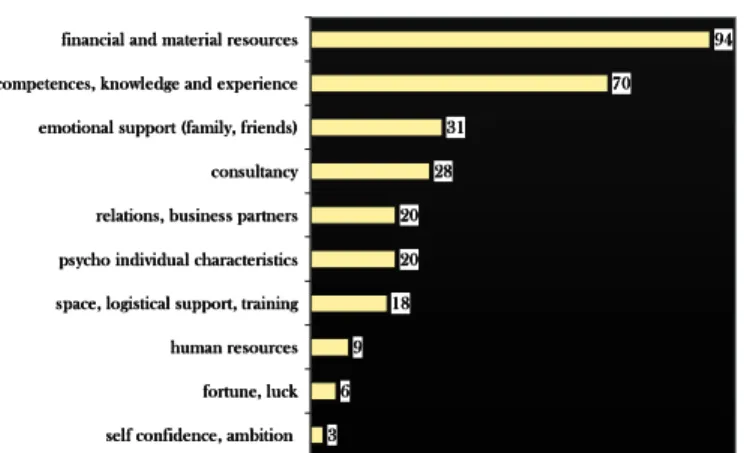
Graphic no. 2. Support needed for starting a business (total choices)
1011
Money, family support and expertise in the field are, according to the re-test results, the most important ingredients of success. We recorded a decreed in the subjective need of professionalism and expertise in the field, which could be explained as a re-evaluation of their own needs as a consequence of the training received as it is considered sufficient to overcome the lacks at personal managerial culture.
It is though interesting to note that, at the end of the Entrepreneurial courses, the most important factors are those further from the control of the entrepreneur: both resources and emotional support are external factors. In the same line of thought at the end of the training more persons attribute success to fortune and chance then in the begging of the courses.
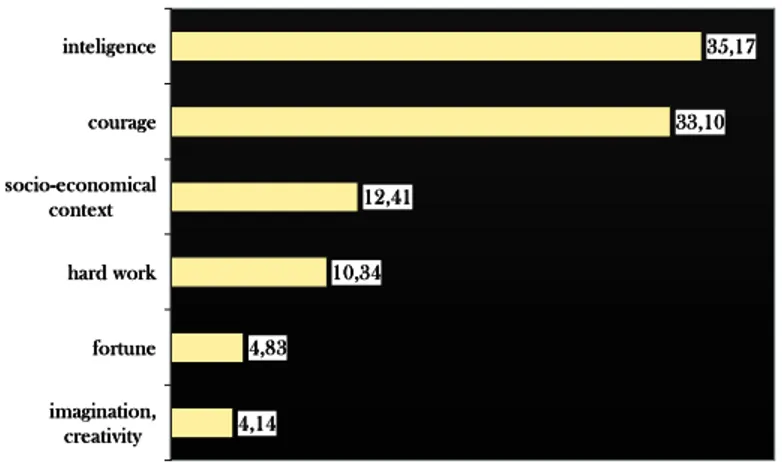
Regarding the qualities considered characteristics of a successful manager we consider again relevant to note that most the factors are under personal control. Thus, the most important two qualities are self confidence, courage, optimism and professional training. This picture is completed by characteristics referring to tenacity, perseverance and hard-work. The financial potential is considered less important along with honesty and creativity.
Graphic no. 3. Factors of success, CT
Conclusions
Overcoming gender stereotypes remains the preliminary condition of gender discrimination registered at the level of dominant public perception in Romania regarding managerial activity. The stereotype of women managers in our society must pass the judgment according to which for a woman to have success in business she should use means which have nothing to do with their competencies, professionalism and determination.716.
Our data lead us to the conclusion that women managers have a higher feeling of responsibility (from the analysis of selection questionnaires administered to 150 women we registered a significant frequency for true evaluations on items such as “we can not enjoy rest before we can fully deserve it” or “if in a shop I am given more change I always give back the difference”) and realism (strong disapproval with the sentence “I think I know how to solve most of the current international problems”). More, women managers prove in high degree empathy and choices for team work (counted as high approvals for sentences as “I participate with pleasure to commonly initiated actions”). One can appreciate that there are real reasons for optimism regarding the increase of the rate of success for women managers. Nevertheless we must consider the psycho attitudinal differences particular to the transformational managerial style as to highlight all qualities of women managers in a situational context.
716 There are known studies which attest the persistence of ideas such as: a woman may be successful if she
is beautiful, in the case of women it is very import their physical appearance, the way she dresses.
6XFFHVVLVGHWHUPLQHGILUVWO\E\ 6XFFHVVLVGHWHUPLQHGILUVWO\E\6XFFHVVLVGHWHUPLQHGILUVWO\E\ 6XFFHVVLVGHWHUPLQHGILUVWO\E\
LPDJLQDWLRQ LPDJLQDWLRQLPDJLQDWLRQ LPDJLQDWLRQ FUHDWLYLW\ FUHDWLYLW\ FUHDWLYLW\ FUHDWLYLW\ IRUWXQH IRUWXQH IRUWXQH IRUWXQH KDUGZRUN KDUGZRUN KDUGZRUN KDUGZRUN VRFLRHFRQRPLFDO VRFLRHFRQRPLFDO VRFLRHFRQRPLFDO VRFLRHFRQRPLFDO
FRQWH[W FRQWH[WFRQWH[W FRQWH[W
1012
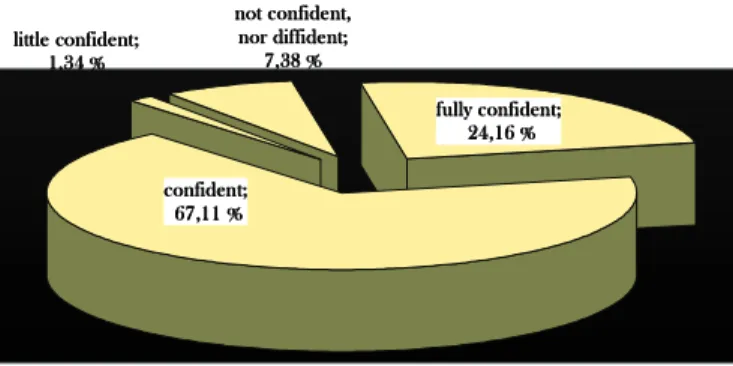
Graphic no. 4. Levels of trust in success
Women which participated in the project manifested trust in the available resources to achieving managerial objectives and obtained significant results and performances with their managerial plan. Upon graduating Entrepreneurial School 68 of them developed new services or products within their business, 60 of them raised their profit, 22 hired new personnel and 90 trained their personnel.
Given the stability of collective mentality we can estimate that change of content of social representation shared by the public regarding women managers will change in time not only by the legislative effect of the regulations that forbid gender discrimination, but mostly by concrete entrepreneurial actions through which women managers can perform in their career and may confirm from professional stand point.
References
1. Avram, Eugen, coord. & others, (2008), Psihologie managerial-organizaĠională, Ed. Polirom, Iai
2. Bass, B. and Avolio, B. (1992), „Transformational leadership a response to critique” în Avram, E:, coord. & alii, Psihologie managerial-organizaĠională, Ed. Polirom, Iai, 2008. 3. Bass, B. and Avolio, B. (1994), „Shatter the glass ceiling: Women may make better
managers”, Human resource Management
4. Barometrul de gen, conducted in 2000 at the request of Open Society Foundation 5. Bibu, Nicolae, A.(2003), Management comparat, Ediia III/a, Editura Mirton, Timioara 6. Cureu P., L. and Boro, S. (2006), InfluenĠa contextului social în dezvoltarea stereotipurilor
de genîn domeniul managementului, lucrare prezentat la prima conferin Conferin de psihologie social, Iai 22-24 septembrie.
7. Cureu P., L. (2007), Grupurile în organizaĠii, Polirom, Iai
8. Druskat, V. (1994), Gender and lesdearship style: Transformational and transactional leadership in Roman Catholic Church, Leadership Quarterly
9. Eagly, A. H. and Karau, S. J. (2002), Role congruity theory toward female leaders, Psychological review
10. Haslam, S.A & others (1999), Social identity salience and the emergence of stereotype consensus, Personality and Social Psychology Bulletin
11. Hofstede, Geert (1996) Managementul structurilor multiculturale, Software-ul gândirii, Editura Economic, Bucureti.
12. Trifu, Alexandru (2008), Universul multidimensional al deciziei, Ed. Economic, Bucureti 13. Singh and Vinnicombe (2004), Why so few Women in Top UK Boardrooms? Evidence and
Theoretical Explanations, Corporate Governance
+RZFRQILGHQWDUH\RXWKDWWKHUHVRXUFHVDYDLODEOHWR\RX +RZFRQILGHQWDUH\RXWKDWWKHUHVRXUFHVDYDLODEOHWR\RX +RZFRQILGHQWDUH\RXWKDWWKHUHVRXUFHVDYDLODEOHWR\RX +RZFRQILGHQWDUH\RXWKDWWKHUHVRXUFHVDYDLODEOHWR\RX
ZLOOHQVXUHWKHDFKLHYHPHQWRI\RXUJRDOV ZLOOHQVXUHWKHDFKLHYHPHQWRI\RXUJRDOVZLOOHQVXUHWKHDFKLHYHPHQWRI\RXUJRDOV ZLOOHQVXUHWKHDFKLHYHPHQWRI\RXUJRDOV
IXOO\FRQILGHQW IXOO\FRQILGHQW IXOO\FRQILGHQW IXOO\FRQILGHQW
FRQILGHQW FRQILGHQW FRQILGHQW FRQILGHQW OLWWOHFRQILGHQW OLWWOHFRQILGHQW OLWWOHFRQILGHQW OLWWOHFRQILGHQW
QRWFRQILGHQW QRWFRQILGHQWQRWFRQILGHQW QRWFRQILGHQW QRUGLIILGHQW QRUGLIILGHQWQRUGLIILGHQW QRUGLIILGHQW