Case Report
Introduction
Dextrocardia associated with situs inversus totalis is a rare condition, with an incidence of 1:10,000 in the general population1,2. It is characterized by the abnormal position of the heart (with the apex positioned on the right side) and viscera. However, most of the affected individuals can lead a normal life.
In dextrocardia, the primitive heart tube folds to the left in a specular image of the normal bulboventricular loop. Such condition is transmitted by autosomal recessive genes.
The association of situs inversus totalis and coronary atherosclerotic disease has the same incidence when compared to the general population. Thus, there are few reported cases in medical literature on myocardial revascularization in patients with such condition3-6.
Case Report
White Caucasian male patient, 63 years of age, with situs inversus totalis. The patient presents diabetes mellitus type II, systemic arterial hypertension (SAH) and congestive heart failure (CHF).
He had presented dyspnea on exertion for 4 years and
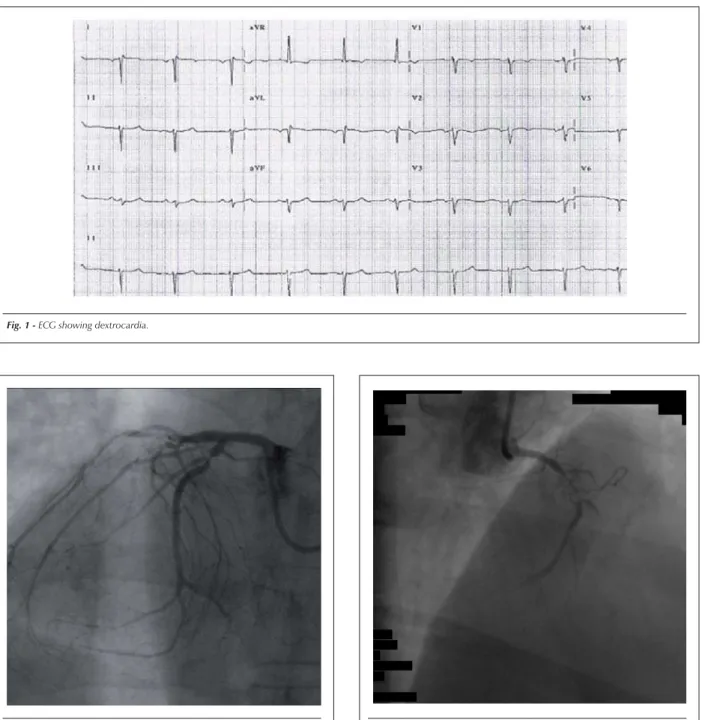
two weeks before the surgery he reported dyspnea on slight exertion associated to precordial pain, compatible with unstable angina. Data obtained from the electrocardiogram (ECG) showed typical dextrocardia with possible anterior wall ischemia (Figure 1).
The coronary angiography showed coronary atherosclerotic plaques, located in the anterior and posterior descending arteries, first diagonal branch, left marginal branch and right coronary artery (Figures 2, 3 and 4).
The surgery was carried out in order to promote the revascularization of the ischemic areas, with magna saphenous vein grafting and utilization of the right internal mammary artery (RIMA).
On February 17, 2004, the patient was submitted to the surgical intervention. After asepsis and antisepsis in the dorsal decubitus position and median thoracotomy, the patient was placed on extracorporeal circulation (ECC), adequately heparinized and in hypothermia at 32°C, which was kept for 96 minutes. A characteristic of this type of surgery is that the surgeon must be positioned on the patient’s left side, which facilitates the operation. The RIMA was anastomosed to the anterior descending artery. Additionally, magna saphenous vein grafting was used for the revascularization of the right coronary artery, left marginal branch, first diagonal branch and posterior descending branch.
The postoperative period was uneventful, with the patient presenting clinical improvement of the heart failure and left ventricular function.
Twenty days after the surgery, the patient was reassessed on an outpatient level and did not present dyspnea, with good general health status, no edema and HR of 80 bpm.
Six months after the surgery, the patient was again monitored and did not have complaints, presented good health status with BP = 110x70mmHg. The echocardiogram showed normal cardiac function. An angiotomography performed 32 months after the surgery showed all pervious grafts and no lesions (Figures 5, 6 and 7).
Discussion
The myocardial revascularization surgery in patients with dextrocardia, despite the scarcity of literature on the subject, has shown to be an efficient and viable method for reversing ischemic heart conditions. The present report confirms the benefits attained through the procedure.
It is worth mentioning that the only report on myocardial revascularization in a patient with situs inversus in the international medical literature written by Brazilian authors was that by Abensur et al5.
Key words
Dextrocardia; cardiac surgery; myocardial revascularization; situs inversus.
We report the case of a patient with dextrocardia and situs inversus totalis associated with obstructive coronariopathy in the anterior and posterior descending arteries, right coronary artery, first diagonal branch and left marginal branch. The patient underwent coronary artery bypass grafting surgery. This surgery has been rarely reported in literature and we found only one similar case in the national medical literature. The myocardial revascularization was carried out with the right mammary artery for the anterior descending artery. The saphenous vein anastomosed the aorta to the right coronary artery, left marginal branch, fist diagonal branch and posterior descending artery. The surgery was performed with extracorporeal circulation.
Myocardial revascularization in a patient with
situs inversus totalis
Paulo Manuel Pego-Fernandes, João Batista de Serro-Azul, Fernando Matheus, Bruno Shoiti Maehara
Instituto do Coração da Faculdade de Medicina da Universidade de São Paulo – FMUSP – São Paulo, SP, Brazil
Mailing address: Paulo Manuel Pego-Fernandes •
Av. Enéas de Carvalho Aguiar, 44 – Bloco II – 2ª andar – Cerqueira César – 05403-000 – São Paulo, SP – Brazil
E-mail: [email protected]
Manuscript received April 20, 2006; revised manuscript received November 8, 2006; accepted January 17, 2007.
Case Report
Pego-Fernandes et al Myocardial revascularization in a patient with situs inversus totalis
Arq Bras Cardiol 2007; 88(5) : e100-e103
Fig. 1 -ECG showing dextrocardia.
Fig. 2 -Coronary angiography of the left coronary artery.
The first report in the Brazilian literature was in 20027, but despite the fact this is not the first Brazilian report, it can be
considered the most complex procedure to date, considering the number of anastomoses performed.
Fig. 3 -Coronary angiography of the right coronary artery.
Case Report
Pego-Fernandes et al
Myocardial revascularization in a patient with situs inversus totalis
Arq Bras Cardiol 2007; 88(5) : e100-e103
Fig. 6 - Angiotomography showing detail of good perviability of the right mammary anastomosis to the anterior descending artery.
Fig. 4 -Ventricular systole showing dextrocardia.
Fig. 5 -Angiotomography showing the right mammary and saphenous vein grafting to the marginal left.
Case Report
References
1. Rosenberg HN, Rosenberg IN. Simultaneous association of situs inversus, coronary heart disease and hiatus hernia. Ann Intern Med. 1949; 30: 851-9.
2. Torgersen J. Genetic factors in visceral asymmetry and in the development and pathologic changes of lungs, heart and abdominal organs. Arch Pathol. 1949; 47: 566-93.
3. Moreno-Cabral RJ, Daily PO. Coronary bypass in dextrocardia. Chest. 1984; 85: 714.
4. Irvin RG, Ballenger JF. Coronary artery bypass surgery in a patient with situs
inversus. Chest. 1982; 81: 380-1.
5. Abensur H, Ramires JA, Dallan LA, Jatene A. Right mammary-coronary anastomosis in a patient with situs inversus. Chest. 1988; 94: 886-7. 6. Mesa JM, Aroca A, Frutos A, Centeno J, Silvestre J, Baset F. Situs inversus and
myocardial revascularization: case report. J Cardiovasc Surg (Torino). 1995; 36: 571.
7. Soncini da Rosa GR, Lemke VG, Lemke W, Madeira Neto J, Martins AAF, Kubrusly LF. Revascularização do miocárdio em paciente com situs inversus totalis. Rev Bras Cir Cardiovasc. 2002; 17 (4): 359-61.
Fig. 7 -Angiotomography showing right coronary artery bypass grafting.
Pego-Fernandes et al Myocardial revascularization in a patient with situs inversus totalis