Lack of accuracy of ventilatory indexes in predicting
extubation success in children submitted to
mechanical ventilation
Falta de acurácia dos índices ventilatórios para predizer sucesso
de extubação em crianças submetidas a ventilação mecânica
INTRODUCTION
Between 40% and 60% of children admitted to the pediatric intensive care unit (PICU) are submitted to mechanical ventilation (MV). Extubation failure (EF) is observed in 10% to 20% of these patients.(1-3) EF is deined as the need
for reinsertion of the tracheal tube and resumption of MV in the irst 48 hours after the tracheal tube has been removed.(3-5) EF has been associated with poor
Silvia Gatiboni1, Jeferson Pedro
Piva1, Pedro Celiny Ramos Garcia1,
Cinthia Jonhston1, Patrícia
Hommerding1, Flávia Franz1,
Lucien Gualdi1
1. Pediatric Intensive Care Unit – Hospital São Lucas, Pontifícia Universidade Católica do Rio Grande do Sul – PUC/RS, Porto Alegre (RS), Brazil.
ABSTRACT
Objectives: Between 10% and 20%
of children submitted to mechanical ventilation in the pediatric intensive care unit present extubation failure. Several ventilatory indexes have been proposed to predict extubation failure. he aim of this study was to analyze the accuracy of these indices in predicting successful extubation in children and to evaluate these variables according to the age of the patient and the speciic disease.
Methods: A prospective observational
study including all children submitted to mechanical ventilation in a Brazilian referral pediatric intensive care unit was conducted between August 2007 and August 2008. he tidal volume, maximal negative inspiratory pressure, rapid shallow breathing index and other ventilatory indexes were measured before extubation. hese variables were analyzed according to the extubation outcome (success or failure) as well as age and speciic disease (post cardiac surgery and acute viral bronchiolitis).
Results: A total of 100 patients were
included (median age of 2.1 years old). Extubation failure was observed in 13% and was associated with lower weight (10.3+8.1 Kg vs. 5.5+2.4 Kg; p=0.01).
We also evaluated the relationship between extubation failure and the main cause indicating mechanical ventilation: children who had received cardiac surgery (n=17) presented an extubation failure rate of 29.4% with a relative risk of 4.6 (1.2-17.2) when compared to children with acute viral bronchiolitis (n=47, extubation failure rate of 6.4%). he maximal inspiratory pressure was the only physiologic variable independently associated with the outcome. However, this variable showed a wide dispersion and lack of accuracy for predicting extubation success (sensitivity of 82% and speciicity of 55% for a cut point of -37.5 cmH2O predicting successful extubation). he same wide dispersion was observed with other ventilatory indexes.
Conclusion: he indexes for predicting
extubation success in children submitted to mechanical ventilation are not accurate; they vary widely depending on age, main disease and other clinical aspects. New formulas including clinical variables should be developed for better prediction of extubation success in children submitted to mechanical ventilation.
Keywords: Pediatric intensive care;
Respiration, artiicial; Intubation/ adverse efects; Respiratory insuiciency; Ventilator weaning
his study was conducted at Hospital São Lucas, Pontifícia Universidade Católica do Rio Grande do Sul – PUC/ RS, Porto Alegre (RS), Brazil.
Conlicts of interest: None.
Submitted on March 1, 2011 Accepted on May 23, 2011
Corresponding author:
Jeferson Pedro Piva
UTI Pediátrica – Hospital São Lucas - 5o andar.
Av. Ipiranga, 6690
CEP: 90610-000 - Porto Alegre (RS), Brazil.
outcomes, such as cardiopulmonary arrest, prolonged length of stay in the PICU, predisposition to hospital infections and increased mortality rates.(6-10) Risk factors
associated with EF include lower age (less than 24 months old), dysgenetic condition, chronic respiratory disorders, chronic neurologic conditions, prolonged hypoxia (shock or cardiopulmonary arrest) and the number of tracheal tube changes during the period on MV.(11-14)
EF in children occurs as a consequence of upper airway obstruction in a quarter of the cases. he leading causes of EF in pediatric patients comprise a heterogeneous group, which includes deterioration of pulmonary condition, cardiovascular failure, ventilatory musculature failure (fatigue), neurologic impairment and residual efects of sedatives.(1,5,6,8,11,12,14)
here are no speciic clinical signs that can accurately predict EF in children prior to withdrawing the tracheal tube. Several adult indexes have been proposed for predicting extubation success in children, including rapid shallow breathing index (RSBI), Compliance/rate/ oxigenation/pressure index CROP [dynamic compliance x maximal negative inspiratory pressure x (PaO2/PAO2) / respiratory rate] and maximum inspiratory pressure (MIP).(11,15-21) However, the exact cutof points of each
of these diferent indices to predict extubation success in children have not been clearly deined.(9,10,12)
he goals of this study were to analyze the accuracy of ventilatory indexes in predicting extubation success in children submitted to MV and to evaluate these variables according to age and speciic disease.
METHODS
Between August 2007 and August 2008, a prospective observational study was conducted in a PICU located in a referral and university-ailiated Brazilian hospital (Hospital São Lucas, Pontiicia Universidade Católica do Rio Grande do Sul, Porto Alegre (RS), Brazil). On average, 450 children are annually admitted to the 13 pediatric intensive care beds, with a mortality rate of 9%.(22) Close
to 60% of children admitted to the PICU are submitted to MV, and 50-60% of these are submitted to MV for longer than 24 hours.(11,22) his PICU is a regional referral center
for kidney transplants, neurosurgery and cardiac surgery. he local institutional Ethics and Research Committee approved this study and required that parents (or the legal guardian) signed the informed consent.
All infants and children (1 month old to 15 years old) admitted to the PICU during this period and submitted to MV for more than 24 h were eligible for the study.
Patients with tracheostomy were excluded. During the study, three models of ventilators were available: Siemens Servo 300, Siemens Servo i and Engströn GE Healthcare ventilator.
In this PICU, the preferred mode of ventilation is based on pressure control with synchronized intermittent mandatory ventilation coupled with pressure support. he weaning process and the precise moment of tracheal extubation were at the discretion of the medical staf without any interference from the main researcher (SG). he required general conditions for extubation were (a) that the patient be alert and awake (Ramsay 1-2) without (or minimal) sedatives and analgesic infusion; (b) improvement or resolution of the underlying cause of acute respiratory failure; (c) adequate gas exchange as indicated by a partial pressure of arterial oxygen (PaO2) higher than 60 mmHg while breathing with a fractional inspired oxygen (FIO2) of 0.40 or less, (d) a positive end-expiratory pressure (PEEP) less than 7 cmH2O, and (e) good response to the spontaneous breathing trial (SBT) on pressure support of 7 cmH2O for 30-60 minutes.(5,6,10,12)
Immediately after the medical staf determined that a child was ready to be extubated, the patient was maintained on mechanical ventilation with the same parameters previous to the spontaneous breathing trial, and the respiratory therapist was contacted to collect the following variables: a) MV parameters; b) relative risk (RR); c) minute volume (VE) through a ventilometer for one minute; d) tidal volume (VT), calculated by dividing VE by RR; e) RSBI, calculated by dividing RR by VT and indexed to the body weight [RSBI= (RR/ VT)/ weight];(23) f ) maximal inspiratory pressure (MIP)
and maximal expiratory pressure (MEP), measured with a digital manovacuometer. he most negative values of all ive parameters were used. After all measurements and regardless of index values, the tracheal tube was withdrawn, and the MV was stopped.
After removing the tracheal tube, the child continued receiving oxygen (2-4 liters/min) through nasal prongs. In this study, EF was deined as the requirement for tracheal tube reinsertion within 48 hrs after extubation. Based on the medical staf information and data obtained from the medical chart, the reasons for EF were classiied as a) upper airway obstruction and b) respiratory failure.
Sample size: based on our previous studies,(11,23) we
assumed an extubation failure rate of 15%. Adopting an alpha error of 5% and a 1-beta of 80%, it was estimated that a minimum number of 13 children in the extubation failure group would be appropriate for evaluating respiratory indexes regarding successful extubation. Considering our previous studies and the inclusion criteria, we estimate that a one-year period of study would be necessary to obtain the necessary number of children in both groups.
Student´s t test was used for comparing continuous variables with normal distribution, and the Mann-Whitney U test was used for variables with abnormal distribution. Possible associated factors related to extubation failure were measured using the univariate analysis (relative risk with the respective 95% conidence interval). he signiicant factors were selected and analyzed using the multivariate analysis, which was expressed as the odds ratio with the respective 95% conidence interval. he receiver operating characteristic (ROC) curve was used to verify the cutof point with better sensitivity and speciicity to predict extubation success.
he study was approved by the Ethics and Research committee of the São Lucas Hospital - PUCRS University (CEP 271/04)
RESULTS
During the study period, one hundred children submitted to MV [mean age= 25.8 + 41.9 years old; median
= 6.5 (IQ25-75% 3.0-27.3) years old] met the inclusion criteria and were prospectively evaluated. All candidates were evaluated without any loses. EF was observed in 13 children (13%), and 6 of them (46%) required that MV be reinstituted in the irst hour after tracheal withdrawal. he mean length of MV for the whole group was 7.3 +0.8 days (only 2 cases over 1 month on MV). Acute viral bronchiolitis was the main clinical diagnosis (47%).
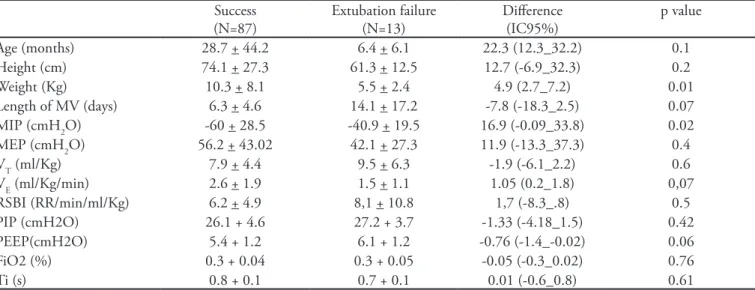
he rate of EF varied according to the main cause indicating MV. Children with acute viral bronchiolitis (AVB; n=47) had an EF rate of 6.4%, while children who had received cardiac surgery (n=17) had an EF rate of 29.4% [RR 4.6 (1.2-17.2); p=0.02]. EF was associated with lower weight (10.3+8.1 Kg vs. 5.5+2.4 Kg; p=0.01), but there was no diference regarding the mean age, height and duration of MV. he mean maximal inspiratory pressure measured immediately before extubation was much more negative in children who were successfully extubated than in the EF group (-60 + 28.5 cmH2O vs.
-40.9 + 19.5 cmH2O; p=0.02). In a regression model analysis, we observed that MIP and age were independent factors associated with extubation failure (p=0.015 and 0.012; respectively). Otherwise, we did not ind signiicant correlation between maximal inspiratory pressure and age (r2= 0.59; p=0.07).
he MV parameters (Peak Inspiratory Pressure -PIP; PEEP, FiO2 and Inspiratory Time iT) evaluated immediately before extubation did not show any diference between the two groups (Table 1).
Table 1 - Characteristics and physiologic respiratory measurements obtained immediately before extubation
Success (N=87)
Extubation failure (N=13)
Diference (IC95%)
p value
Age (months) 28.7 + 44.2 6.4 + 6.1 22.3 (12.3_32.2) 0.1
Height (cm) 74.1 + 27.3 61.3 + 12.5 12.7 (-6.9_32.3) 0.2
Weight (Kg) 10.3 + 8.1 5.5 + 2.4 4.9 (2.7_7.2) 0.01
Length of MV (days) 6.3 + 4.6 14.1 + 17.2 -7.8 (-18.3_2.5) 0.07 MIP (cmH2O) -60 + 28.5 -40.9 + 19.5 16.9 (-0.09_33.8) 0.02 MEP (cmH2O) 56.2 + 43.02 42.1 + 27.3 11.9 (-13.3_37.3) 0.4
VT (ml/Kg) 7.9 + 4.4 9.5 + 6.3 -1.9 (-6.1_2.2) 0.6
VE (ml/Kg/min) 2.6 + 1.9 1.5 + 1.1 1.05 (0.2_1.8) 0,07
RSBI (RR/min/ml/Kg) 6.2 + 4.9 8,1 + 10.8 1,7 (-8.3_.8) 0.5
PIP (cmH2O) 26.1 + 4.6 27.2 + 3.7 -1.33 (-4.18_1.5) 0.42
PEEP(cmH2O) 5.4 + 1.2 6.1 + 1.2 -0.76 (-1.4_-0.02) 0.06
FiO2 (%) 0.3 + 0.04 0.3 + 0.05 -0.05 (-0.3_0.02) 0.76
Ti (s) 0.8 + 0.1 0.7 + 0.1 0.01 (-0.6_0.8) 0.61
When the group with AVB (n=47) was analyzed exclusively, it was observed that even though this was a homogenous group with respect to age and clinical diagnosis, the results obtained for the physiologic respiratory measurements showed remarkable dispersion.
he mean MIP was -66.2 +29.9 cmH2O (Figure 1A),
and the rapid shallow breathing index showed the same high level of variability, making any prediction regarding extubation outcome diicult (Figure 1B).
here were 61 children under a year old who were extubated (70% male) with a mean duration of MV of 8.5 days. AVB was the main diagnosis in 42 (69%) patients, followed by post-cardiac surgery (8%), a group with diferent clinical diagnoses (15%) and another group with diverse post-surgery conditions (8%). he rate of EF in this group was 18% (11 children), and all cases of EF were due to worsening respiratory distress without any case of upper airway obstruction (according to the clinical diagnosis of the medical staf).
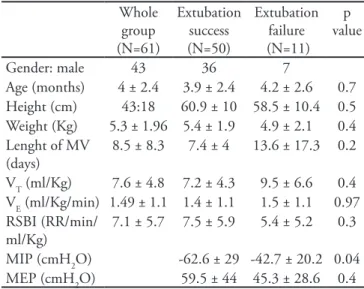
he maximal inspiratory pressure was the only ventilatory index in children under a year old that showed diference between children successfully extubated and those with EF (-62.6±29 cmH2O vs. -42.7±20.2 cmH2O; p=0.03) (Table 2). he area under the ROC curve for MIP was 0.7 with a sensitivity of 82% and speciicity of 55%
Ma
xi
ma
l
in
sp
ira
to
ry
p
re
ssu
re
(MI
P)
Extubation failure
Success extubation
Age (months) Age (months)
R
a
p
id
sh
a
llo
w
b
re
a
th
in
g
i
n
d
e
x
(R
SB)
Extubation failure
Success extubation for a cutof point of -37.5 cmH2O in predicting successful extubation (Figure 2).
1-A) he maximal inspiratory pressure (MIP) before extubation 1-B) he rapid shallow breathing index (RSBI) before extubation
Figure 1 - Maximal inspiratory pressure and rapid shallow breathing index before extubation in children with acute viral bronchiolitis (N=47).
Table 2 - Characteristics and physiologic ventilatory variables observed in children under a year old before tracheal extubation
Whole group (N=61)
Extubation success (N=50)
Extubation failure (N=11)
p value
Gender: male 43 36 7
Age (months) 4 ± 2.4 3.9 ± 2.4 4.2 ± 2.6 0.7 Height (cm) 43:18 60.9 ± 10 58.5 ± 10.4 0.5 Weight (Kg) 5.3 ± 1.96 5.4 ± 1.9 4.9 ± 2.1 0.4 Lenght of MV
(days)
8.5 ± 8.3 7.4 ± 4 13.6 ± 17.3 0.2
VT (ml/Kg) 7.6 ± 4.8 7.2 ± 4.3 9.5 ± 6.6 0.4 VE (ml/Kg/min) 1.49 ± 1.1 1.4 ± 1.1 1.5 ± 1.1 0.97 RSBI (RR/min/
ml/Kg)
7.1 ± 5.7 7.5 ± 5.9 5.4 ± 5.2 0.3
MIP (cmH2O) -62.6 ± 29 -42.7 ± 20.2 0.04 MEP (cmH2O) 59.5 ± 44 45.3 ± 28.6 0.4
DISCUSSION
In this study, the rate of EF (13%) was comparable to what has been reported in similar studies involving children submitted to mechanical ventilation.(3,5,6,11,22) In
the present study, EF was associated with lower weight. With respect to the primary diagnosis, children submitted to cardiac surgery showed a signiicantly higher EF rate than children with AVB [29.4% versus 6.4%, RR 4.6 (1.2-17.2)] as reported in several studies.(3,6,24,25) When
comparing the success and the failure groups, only one physiologic respiratory variable showed statistical signiicance: the mean maximal inspiratory pressure (MIP), which was much more negative in the success group than in the failure group. However, the non-uniform and wide dispersion of this variable afected its accuracy for predicting extubation success (sensitivity of 82% and speciicity of 55% for a cut point of -37.5 cmH2O in predicting successful extubation).
Accurate identiication of children on MV with a high risk for EF is one of the most pressing challenges in the ield of pediatric intensive care.(1-15) Removing tracheal
tubes from children who are not ready to sustain their own respiratory demands has been associated with several life
threatening problems, including sudden cardiorespiratory arrest, the need for an emergency tracheal intubation, a higher rate of acquired hospital infection, prolonged PICU stay, prolonged hospital stay and an increased mortality rate.(3,5,6,12,13)
As demonstrated in several studies, the EF is a result of several interacting factors, such as the child’s age, the duration of MV, the number of changes of the tracheal tube, heavy use of sedatives and cardiac and neurologic dysfunction.(5-8,11,13,14,25,26) Consequently, it is intriguing
that even though these variables are known to be associated with the worst prognosis of tracheal tube withdrawal, they are not taken in account in the various formulas and indexes used to predict extubation success/failure in children. Furthermore, it is unlikely that only one variable or index could accurately predict extubation success in a heterogeneous group of children submitted to MV.
To better evaluate the limitations of these indexes, we present in igure 3 the tidal volume of our patients measured immediately before extubation along with information regarding the cutof point indicated by diferent authors as accurate for predicting extubation success.(7,11,16,17) Using a tidal volume cutof point of 4
ml/Kg,(4,7,12,17) as a predictor of successful extubation in
children, its sensitivity and speciicity would be 16% and 85%, respectively. If a cutof point of VT<5,5ml/Kg(16) is
adopted, its sensitivity would be 31%, and its speciicity would 69%; however, if the tidal volume cutof point is set at 6 ml/Kg,(5) the sensitivity and speciicity would be
39% and 54%, respectively (Figure 3). 1 - Speciicity
ROC curve
Se
n
si
ti
vi
ty
Figure 2 - he maximal inspiratory pressure ROC curve for predicting extubation success in children under a year old.
1 Khan/96 1 Farias/98 2 Thiagarajan/99 3 Manczur/00
T
id
a
l
vo
lu
me
(ml
/kg
)
Success Failure
Patients
Figure 3 - he tidal volume measured in one hundred children in the moment before tracheal extubation.
he three horizontal lines represent the cutof points deined by diferent authors as accurate for predicting extubation success/ failure in children.
1.0
0.8
0.5
0.3
0
he limitations described above were also observed when diferent cutof points for two other indices were adopted. Assuming a cutof point of 8 rpm/ml/Kg(7,8,11,16)
using the rapid shallow breathing index as predictor of successful extubation would result in a sensitivity of 72% and speciicity of 23%.Adopting the cutof point of MIP ≤-50 cmH2O(9) to predict successful extubation would
result in a sensitivity of 57% and a speciicity of 69%. It is well known that physiological parameters vary widely in children. Depending on their physiologic reserve and host defenses, as well as the impact of the disease process, the variability of these parameters can be even higher. hus, it is not surprising that these indices are inaccurate and insensible in predicting extubation success in a pediatric population.
We are aware that our study presents some limitations. A) he weaning process and the tracheal tube withdrawal were based on medical indication rather than a strict protocol. However, it should be noted that in this case, the possible bias would result in an excessive number of extubation failures. Nevertheless, it did not occur in our study, where the rate of EF (13%) was in accordance with the lower acceptable number of EF reported in previous studies.(3,11,14) B) he sample size was not calculated for
comparison subgroups, such as just children with AVB, children under a year old, or the cardiac surgery group; obviously, these comparisons should be evaluated with caution; C) he restricted number of children with EF is also a limitation of this study. he small number of children with EF makes it diicult to calculate the accuracy of these indices in predicting extubation failure. Nevertheless, it is not an obstacle for calculating the sensitivity and speciicity for extubation success or for analyzing the wide variability of these parameters.
Considering the multiple aspects involved in tracheal extubation, it is unlikely that only one or two respiratory physiological variables would be able to predict the success or failure after tracheal tube removal.(14-18,26-28) As M. Tobin
stated, “As a practicing intensivist, nothing taxes my intellect more than the diicult-to-wean patient”.(26) If this
is true for adult patients, we might infer that withdrawing the tracheal tube from children submitted to mechanical ventilation represents an even greater challenge.
Recently, Harikumar demonstrated that the Tension-Time Index (TTI) is an accurate predictor of extubation outcome in a group of 80 ventilated children.(29) In this
study, TTI was measured simultaneously using two approaches: the (traditional) invasive measurement and a non-invasive method. Both measurements demonstrated good agreement and excellent capacity to predict the
extubation outcome in ventilated children. However, these results must be validated in other similar populations of children submitted to mechanical ventilation.
In conclusion, the actual formulas and indexes for predicting extubation success or extubation failure in children submitted to MV are not accurate. hey have a wide variability depending on age, primary disease and other clinical aspects. We suggest that the next step in this ield should be the development of indexes or formulas for predicting extubation success in children that include some of the variables considered here, such as weight, age, primary disease, nutritional status, neurologic disability, and the dose of neuromuscular blockers and analgesics/ sedatives used.
AKNOWLEDGEMENTS
his study was partially supported by the National (Brazilian) Researching Council - CNPq.
RESUMO
Objetivos: Entre 10% e 20% das crianças submetidas a
ven-tilação mecânica na unidade de terapia intensiva terão falha da extubação. Foram discutidos diversos índices ventilatórios para prever falha da extubação. O objetivo deste estudo foi analisar a acurácia destes índices para prever extubação bem sucedida em crianças e avaliar estas variáveis segundo a idade e doença especíica.
Métodos: Este foi um estudo prospectivo observacional que
incluiu todas as crianças submetidas a ventilação mecânica em uma unidade de terapia intensiva pediátrica de referência no Brasil realizado entre agosto de 2007 e agosto de 2008. Foram medidos antes da extubação o volume corrente, máxima pressão inspiratória negativa, índice de respiração rápida e supericial e outros índices ventilatórios. Estas variáveis foram analisadas segundo o desfecho da extubação (sucesso ou falha) assim como em relação à idade e doença especíica (pós-cirurgia cardíaca e bronquiolite viral aguda).
Resultados: Foram incluídos 100 pacientes (idade
especiicidade de 55% para um ponto de corte de -37,5 cmH2O para prever sucesso). A mesma ampla dispersão foi observada para os demais índices ventilatórios.
Conclusão: Os índices disponíveis para prever o sucesso da
extubação em crianças submetidas a ventilação mecânica não são acurados; eles têm uma ampla variabilidade que depende da idade, doença de base e outros aspectos clínicos. Devem ser
de-senvolvidas novas fórmulas que incluam variáveis clínicas para melhor previsão da extubação em crianças submetidas a venti-lação mecânica.
Descritores: Unidades de terapia intensiva pediátrica;
Res-piração artiicial; Intubação/efeitos adversos; Insuiciência respi-ratória; Desmame do respirador
REFERENCES
1. Edmunds S, Weiss I, Harrison R. Extubation failure in a large pediatric ICU population. Chest. 2001;119(3):897-900. 2. Epstein SK. Decision to extubate. Intensive Care Med.
2002;28(5):535-46.
3. Kurachek SC, Newth CJ, Quasney MW, Rice T, Sachdeva RC, Patel NR, et al. Extubation failure in pediatric intensive care: a multiple-center study of risk factors and outcomes. Crit Care Med. 2003;31(11):2657-64.
4. Farias JA, Frutos F, Esteban A, Flores JC, Retta A, Baltodano A, et al. What is the daily practice of mechanical ventilation in pediatric intensive care units? A multicenter study. Intensive Care Med. 2004;30(5):918-25.
5. Rothaar RC, Epstein SK. Extubation failure: magnitude of the problem, impact on outcomes, and prevention. Curr Opin Crit Care. 2003;9(1):59-66.
6. Baisch SD, Wheeler WB, Kurachek SC, Cornield DN. Extubation failure in pediatric intensive care incidence and outcomes. Pediatr Crit Care Med. 2005;6(3):312-8. 7. Khan N, Brown A, Venkataraman ST. Predictors of
extubation success and failure in mechanically ventilated infants and children. Crit Care Med. 1996;24(9):1568-79 8. Manczur TI, Greenough A, Pryor D, Raferty GF.
Comparison of predictors of extubation from mechanical ventilation in children. Pediatr Crit Care Med. 2000;1(1):28-32.
9. Baumeister BL, el-Khatib M, Smith PG, Blumer JL. Evaluation of predictors of weaning from mechanical ventilation in pediatric patients. Pediatr Pulmonol. 1997;24(5):344-52.
10. Farias JA, Alía I, Retta A, Olazarri F, Fernández A, Esteban A, et al. An evaluation of extubation failure predictors in mechanically ventilated infants and children. Intensive Care Med. 2002;28(6):752-7.
11. Fontela PS, Piva JP, Garcia PC, Bered PL, Zilles K. Risk factors for extubation failure in mechanically ventilated pediatric patients. Pediatr Crit Care Med. 2005;6(2):166-70. 12. Newth CJ, Venkataraman S, Willson DF, Meert KL,
Harrison R, Dean JM, Pollack M, Zimmerman J, Anand KJ, Carcillo JA, Nicholson CE; Eunice Shriver Kennedy National Institute of Child Health and Human Development Collaborative Pediatric Critical Care Research Network. Weaning and extubation readiness in pediatric
patients. Pediatr Crit Care Med. 2009;10(1):1-11.
13. Farias JA, Monteverde E. We need to predict extubation failure. J Pediatr (Rio J). 2006;82(5):322-4.
14. Randolph AG, Wypij D, Venkataraman ST, Hanson JH, Gedeit RG, Meert KL, Luckett PM, Forbes P, Lilley M, hompson J, Cheifetz IM, Hibberd P, Wetzel R, Cox PN, Arnold JH; Pediatric Acute Lung Injury and Sepsis Investigators (PALISI) Network. Efect of mechanical ventilator weaning protocols on respiratory outcomes in infants and children: a randomized controlled trial. JAMA. 2002;288(20):2561-8.
15. Yang KL, Tobin MJ. A prospective study of indexes predicting the outcome of trials of weaning from mechanical ventilation. N Engl J Med. 1991;324(21):1445-50. 16. hiagarajan RR, Bratton SL, Martin LD, Brogan TV,
Taylor D. Predictors of successful extubation in children. Am J Respir Crit Care Med. 1999;160(5 Pt 1):1562-6. 17. Farias JA, Alía I, Esteban A, Golubicki AN, Olazarri FA.
Weaning from mechanical ventilation in pediatric intensive care patients. Intensive Care Med. 1998;24(10):1070-5. 18. Farias JA, Retta A, Alía I, Olazarri F, Esteban A, Golubicki
A, et al. A comparison of two methods to perform a breathing trial before extubation in pediatric intensive care patients. Intensive Care Med. 2001;27(10):1649-54. 19. Hubble CL, Gentile MA, Tripp DS, Craig DM, Meliones
JN, Cheifetz IM. Deadspace to tidal volume ratio predicts successful extubation in infants and children. Crit Care Med. 2000;28(6):2034-40
20. Bousso A, Ejzenberg B, Ventura AM, Fernandes JC, Fernandes IC, Góes PF, Vaz FA. Evaluation of the dead space to tidal volume ratio as a predictor of extubation failure. J Pediatr (Rio J). 2006; 82(5):347-53
21. Chavez A, dela Cruz R, Zaritsky A. Spontaneous breathing trial predicts successful extubation in infants and children. Pediatr Crit Care Med. 2006;7(4):324-8.
22. Traiber C, Piva JP, Fritsher CC, Garcia PC, Lago PM, Trotta EA, et al. Proile and consequences of children requiring prolonged mechanical ventilation in three Brazilian pediatric intensive care units. Pediatr Crit Care Med. 2009;10(3):375-80
DR, Lukrafka JL, Rovedder PM. Factors associated with failure in ventilatory weaning of children undergone pediatric cardiac surgery. Rev Bras Cir Cardiovasc. 2008;23(4):501-6.
25. Manrique AM, Feingold B, Di Filippo S, Orr RA, Kuch BA, Munoz R. Extubation after cardiothoracic surgery in neonates, children, and young adults: one year of institutional experience. Pediatr Crit Care Med. 2007;8(6):552-5.
26. Tobin MJ. Remembrance of weaning past: the seminal
papers. Intensive Care Med. 2006;32(10):1485-93 27. Epstein SK. Weaning from ventilatory support. Curr Opin
Crit Care. 2009;15(1):36-43. Review.
28. Turner DA, Arnold JH. Insights in pediatric ventilation: timing of intubation, ventilator strategies, and weaning. Curr Opin Crit Care. 2007;13(1):57-63.