Original Article
Rev. Latino-Am. Enfermagem2015 Mar.-Apr.;23(2):283-90 DOI: 10.1590/0104-1169.0141.2553 www.eerp.usp.br/rlae
Copyright © 2015 Revista Latino-Americana de Enfermagem This is an Open Access article distributed under the terms of the Creative Commons Attribution Non-Commercial License (CC BY-NC).
This license lets others distribute, remix, tweak, and build upon your work non-commercially, and although their new works must also acknowledge you and be non-commercial, they don’t have to license their derivative works on the same terms.
Corresponding Author:
Alessandra Marcuz de Souza Campos Rua do Trabalho, 67, Apto. 51 Vila Independência
CEP: 13418-220, Piracicaba, SP, Brasil E-mail: [email protected]
1 Undergraduate student in Nursing, Faculdade de Enfermagem, Universidade Estadual de Campinas, Campinas, SP, Brazil. Schorlarship holder
from Programa Institucional de Bolsas de Iniciação Científica (PIBIC), Brazil.
2 RN graduated in Faculdade de Enfermagem, Universidade Estadual de Campinas, Campinas, SP, Brazil. Schorlarship holder from Programa
Institucional de Bolsas de Iniciação Científica (PIBIC), Brazil.
3 Post-doctoral fellow, School of Nursing, University of Texas, Health Science Center, San Antonio, TX, United States. Professor, Faculdade de
Enfermagem, Universidade Estadual de Campinas, Campinas, SP, Brazil. Schorlarship holder from Fundação de Amparo à Pesquisa do Estado de São Paulo (FAPESP), Brazil.
4 PhD, RN, Hospital da Mulher “Prof. Dr. José Aristodemo Pinotti”, Centro de Atenção Integral à Saúde da Mulher, Universidade Estadual de
Campinas, Campinas, SP, Brazil.
5 PhD, Professor, Faculdade de Enfermagem, Universidade Estadual de Campinas, Campinas, SP, Brazil.
Exclusive breastfeeding practices reported by mothers and the
introduction of additional liquids
Alessandra Marcuz de Souza Campos
1Camila de Oliveira Chaoul
2Elenice Valentim Carmona
3Rosângela Higa
4Ianê Nogueira do Vale
5Aim: To assess the concept of exclusive breastfeeding held by nursing women by comparing the
period they consider that they perform it and the infants’ age at the introduction of additional
liquids. Method: Cross-sectional descriptive study conducted with 309 women who delivered
babies at a university hospital in the interior of São Paulo, Brazil. The data were subjected to
descriptive analysis; the variables of interest were crossed using the non-parametric
Kruskal-Wallis test, the chi-square test and Fisher’s exact test. Results: Approximately 30% of the
women reported having introduced additional liquids before the infants reached aged six months
old, while asserting that they were performing exclusive breastfeeding. The following variables
were associated with early introduction of liquids: lack of employment (p = 0.0386), younger
maternal age (p = 0.0159) and first pregnancy (p = 0.003). Conclusion: The concept of exclusive
breastfeeding might not be fully clear to women, as they seem to believe that it means not to
feed the children other types of milk but that giving other liquids is allowed. These results show
that promotion of breastfeeding should take beliefs and values into consideration to achieve
effective dialogue and understanding with mothers.
Introduction
Exclusive breastfeeding (EB) means that an infant
receives only breast milk from his or her mother or a wet
nurse, or expressed breast milk, and no other liquids or
solids, with the exception of oral rehydration solution,
drops or syrups consisting of vitamins, minerals
supplements or medicines(1).
The World Health Organization (WHO) recommends
EB until the age of six months, and then to start adequate
and safe complementary feeding of other liquids and
foods, with continued breastfeeding up to 2 years of age
or beyond(1). One study conducted with 34,366 infants
in Brazilian state capitals and the Federal District found
that the prevalence of EB increased in recent decades
from a median duration of 23.4 days in 1999 to 54.1
days in 2008(2). However, regarding the prevalence
of six-month EB as recommended by the WHO, much
improvement is still needed.
Feeding additional liquids (water, tea, fruit juice,
etc.) to breastfed infants under six months old is a
common practice; however, even when sporadically
performed, this practice might result in reduced breast
milk intake and consequent decreases in milk extraction
and production, which might contribute to effects such
as premature weaning, lesser weight gain and increased
risk of diarrhea(1,3-4). Several diseases are associated
with non-EB, such as “necrotizing enterocolitis, diabetes,
allergies, pneumonia, among others”(4). Mothers might
believe that feeding liquids other than milk before
the age of six months is innocuous and helps to solve
problems such as colic, infant gas, or even thirst(3).
One study conducted at Basic Health Units (BHUs)
in Rio de Janeiro (n= 1,507 breastfeeding mothers)
found that maternal characteristics such as age, previous
experience with breastfeeding and marital status are
related with feeding liquids other than milk to infants
under six months of age(3).
According to the authors’ clinical experience, some
mothers believe they are performing EB even when they
report giving their babies additional liquids and eventually
also solid food concomitantly. This fact suggests that
nursing women do not properly understand the concept of EB, which might be related with their dificulty to maintain EB until six months of age.
The aim of the present study was to assess the
understanding of the concept of EB by nursing women
by comparing the period they consider that they perform
EB and the infant’s age at the introduction of additional
liquids and food.
Method
The data for the present cross-sectional
descriptive study were collected from June 2010 to
June 2011. All of the women admitted to a
rooming-in unit and who had previously delivered a child at a
teaching hospital in the interior of the state of São
Paulo were included in the study, while the mothers
who had delivered twins or whose infants exhibited
problems requiring intensive care for any duration
were excluded. As concerns ethical issues, the text of
the informed consent form was read, and the study
aims were explained to the participants, including full
assurance of anonymity, along with their right not to
participate in the study without this affecting the care
they would receive at the institution. The study was
approved by the research ethics committee of the
State University of Campinas (Universidade Estadual
de Campinas - Unicamp), ruling no. 773/2008 and
CAAE 0616.0.146.000-08.
A database was elaborated using Excel® that
included the mothers’ sociodemographic data (age,
marital status, educational level, occupation, number of
pregnancies and deliveries) the infants’ birth data (birth
weight, gestational age, gender and route of delivery),
breastfeeding-related variables (durations of total and
exclusive breastfeeding) and infant’s age at introduction
of additional liquids and food (water, tea, other types of
milk, fruit juice, and others).
Based on the comparison of variables “duration
of EB” and “age at introduction of liquids as reported
by the interviewed women”, three categories were
created: (1) true EB (no simultaneous use of any
other liquid); (2) EB plus the use of other types of
milk in addition to the breast milk; and (3) EB and
concomitant feeding of liquids of any type. Thirteen
forms were inconsistent due to missing data and were excluded from analysis; therefore, the inal sample consisted of 296 forms.
The duration of EB was established in the present
study based on the answers the mothers gave to the
following questions posed at the beginning of the
interviews: “How long did you breastfeed your child
after discharge from the rooming-in unit”?, “Throughout
the period of breastfeeding, did you also feed your child
other liquids/food in addition to breast milk?”, and “How old was your child when you irst introduced additional liquids/food?” The question on the duration of EB was
Descriptive analysis was performed next. The
quantitative variables corresponding to the three
aforementioned categories were compared by means of
the non-parametric Kruskal-Wallis test(5) to investigate
the presence of signiicant associations among them. In the cases in which the null hypothesis on the
Kruskal-Wallis test was rejected, the posttest(6) formulated by
author Patrick Giraudoux was performed using the
kruskalmc procedure in the pgirmness package of R
2.15.0.
The chi-square test(5) was used to investigate possible
associations between the aforementioned categories and
sample-related variables (mothers’ socioeconomic and
infants’ birth data); that test was used to investigate
associations between two categorical variables. Whenever
at least 20% of the cells had expected counts of less
than 5, Fisher’s exact test was used(7). The signiicance
level was set to 5% in all of the analyses, which were
performed using the statistical software SAS (Statistical
Analysis Software), version 9.2(8).
Results
Data were collected from 309 women, and 296
were included for statistical analysis. Despite all care to
ensure the greatest possible precision of the information
on EB duration and infant’s age at the introduction of
liquids other than breast milk collected at different
moments along the interviews, some forms had to be
excluded from analysis due to missing data that did not allow for classiication under any of the categories used to compare EB duration and the introduction of liquids
other than breast milk.
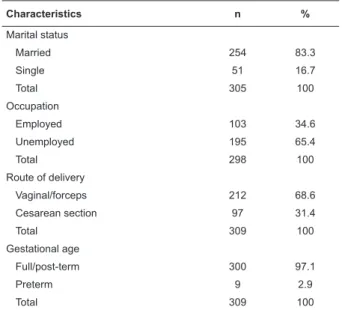
Most of the interviewees had attended elementary
school only, had a stable partner, had no employment,
and had given birth to healthy newborn infants by
vaginal/forceps delivery, as Table 1, below, shows
relative to the initial sample consisting of 309 women.
Table 1 – Distribution of the interviewed women per
educational level, marital status, occupation, route of
delivery, and child’s gestational age. Campinas, SP,
Brazil, 2011
Characteristics n %
Educational level
Elementary school 182 60.5
Secondary school 107 35.5
Higher education 12 4.0
Total 301 100
Characteristics n %
Marital status
Married 254 83.3
Single 51 16.7
Total 305 100
Occupation
Employed 103 34.6
Unemployed 195 65.4
Total 298 100
Route of delivery
Vaginal/forceps 212 68.6
Cesarean section 97 31.4
Total 309 100
Gestational age
Full/post-term 300 97.1
Preterm 9 2.9
Total 309 100
The average age of the women was 22.2 years old
(ranging from 13 to 37 years old; median = 22 years
old). On average, they had two pregnancies (median =
1), 1.7 deliveries (median = 1) and had attended 8.7
prenatal visits (median = 9). The average duration of EB
was 4 (± 2.3) months, thus falling short of the reported
time for the introduction of additional food, which was
4.4 (± 2.6) months on average. Table 2, below, describes
the quantitative variables assessed in the initial sample
consisting of 309 women.
Most interviewees (70%) reported to have fed the
infants breast milk only during the EB period, while 30%
reported to have introduced additional liquids, despite
stating that they performed EB: 8% reported the
introduction of other types of milk, and 22% reported
the introduction of liquids of any type (categories 1, 2
and 3, respectively), as Figure 1, below, shows:
8%
70% 22%
Category 1: Exclusive breastfeeding
Category 3: Breastfeeding plus concomitant use of other types of milk and/or liquids Category 2: Breastfeeding plus concomitant use of other types of milk
Figure 1 – Categories resulting from the comparison
of the duration of exclusive breastfeeding as reported
by the mothers and the addition of other liquids to the
children’s diet. Campinas, SP, Brazil, 2011
(continue...)
The types of liquids the mothers reported giving their
children during the alleged EB period were as follows:
water (18.6%), other milks (17.9%), tea (13.8%), fruit
juice (10.7%) and other liquids (3.5%). Comparison
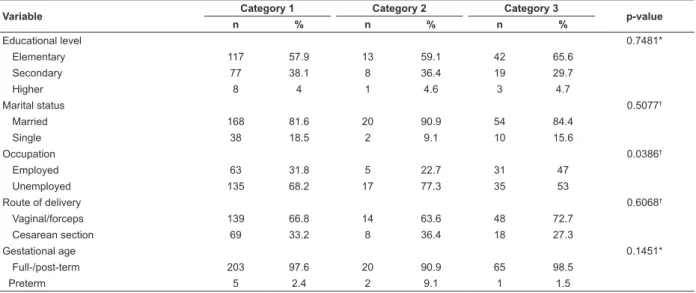
of the aforementioned categories to the qualitative
variables revealed that “occupation” was associated
with possible misunderstanding of the concept of EB
(p = 0.0386). Introduction of other types of milk was
most frequent among the women without employment
(77.3%), although those women reported to have
performed EB. Table 3, below, describes the comparison
between categories and qualitative variables.
There was a signiicant association between maternal age and the addition of other liquids concomitantly to
breastfeeding (p = 0.0159): younger mothers tended to
introduce other liquids earlier. Similarly, the association
between number of deliveries and the addition of other types of milk concomitantly to breast milk was also signiicant (p = 0.003): the introduction of other types of milk occurred earlier
among the primiparous mothers, as Table 4, below, shows: Table 2 – Distribution of the interviewed women per age, number of pregnancies, deliveries and prenatal visits,
duration of exclusive breastfeeding, and infants’ age at introduction of additional liquids. Campinas, SP, Brazil, 2011
Variable n Mean SD* Minimum Q1 Median Q3 Maximum
Age 309 22.2 4.8 13 19 22 25 37
No. pregnancies 309 2 1.3 1 1 1 3 8
No. deliveries 287 1.7 1.1 0 1 1 2 8
No. prenatal visits 246 8.7 3.3 0 7 9 11 18
Exclusive breastfeeding duration
(months) 307 4 2.3 0 2 4 6 24
Age at administration of liquids† 302 4.4 2.6 0 3 4 6 24
*Standard deviation; †in months
Table 3 – Comparison of qualitative variables to the categories resulting from the comparison between the duration of
exclusive breastfeeding as reported by the mothers and the addition of other liquids to the children’s diet. Campinas,
SP, Brazil, 2011
Variable Category 1 Category 2 Category 3 p-value
n % n % n %
Educational level 0.7481*
Elementary 117 57.9 13 59.1 42 65.6
Secondary 77 38.1 8 36.4 19 29.7
Higher 8 4 1 4.6 3 4.7
Marital status 0.5077†
Married 168 81.6 20 90.9 54 84.4
Single 38 18.5 2 9.1 10 15.6
Occupation 0.0386†
Employed 63 31.8 5 22.7 31 47
Unemployed 135 68.2 17 77.3 35 53
Route of delivery 0.6068†
Vaginal/forceps 139 66.8 14 63.6 48 72.7
Cesarean section 69 33.2 8 36.4 18 27.3
Gestational age 0.1451*
Full-/post-term 203 97.6 20 90.9 65 98.5
Preterm 5 2.4 2 9.1 1 1.5
*p-value on Fisher’s exact test; †p-value on the chi-square test
Table 4 – Comparison of quantitative variables to the categories resulting from the comparison between the duration of
exclusive breastfeeding as reported by the mothers and the addition of other liquids to the children’s diet. Campinas,
SP, Brazil, 2011
Variable Cat* n Mean SD† Min‡ Q1 Median Q3 Max§ p-value||
Age 1 208 22.2 4.8 13 19 22 25 37 0.0159
2 22 20 4.5 15 17 19 21 34
3 66 22.9 5 14 19 23 25 36
Discussion
The number of pregnancies and of deliveries exhibited signiicant differences between their mean and median values: 2 and 1 (pregnancies) and 1.7 and 1 (deliveries), respectively. These indings show that there is a range of these variables, and consequently, larger numbers of both women pregnant for the irst time and primiparous mothers, which denotes a greater inluence of these women on the results relative to categories two
and three.
Even while claiming to perform EB, 30% of the
interviewees reported feeding their children other
liquids in addition to breast milk, which suggests a lack
of understanding of the EB concept.
These indings are supported by the results of other studies; for example, one study conducted in Horizonte,
Ceará, with 120 parturient women found that although
89% of the participants admitted that the proper duration
of EB is six months, 14% of them contradictorily stated
that water and tea ought to be given also; 4.2% made
additional mention of fruit juice(9). Similarly, another
study (performed with 50 mothers in the interior of São
Paulo) found that most interviewees believed that giving
liquids and fruit before age six months old is appropriate
independently from breastfeeding(10). One study
conducted with 1,057 mothers from Laos, Southeast
Asia, to assess the prevalence of and the factors that inluence the use of breast milk (BM) substitutes provides further information on the limitations to EB; 20% of the
participants reported having introduced formula and
non-dairy products before six months of age (11).
In the present study, women without employment
reported feeding their infants other types of milk before
six months of age more often compared to formally employed women. This inding disagrees from the results of other studies(11-13), which found that staying at
home was a positive factor, i.e., favorable to successful
breastfeeding. Thus, one might hypothesize that the
women without employment are less informed and more susceptible to environmental inluences. Those mothers, along with the primiparous mothers (possibly
less experienced) are more prone to believe that feeding
other (non-human) types of milk is necessary or that
it does not interfere with EB. One study conducted
with 48 puerperal women from Uberaba, Minas Gerais,
found that 14.6% of the mothers believed that EB is
impossible, for which reason complementary feeding using milks other than BM is justiied(14).
Although primiparous mothers are more prone to
engage in breastfeeding, they usually tend to maintain
the practice over a shorter time(15) and to introduce
complementary feeding earlier(13).
The addition of various types of liquids along the
period the interviewees mistakenly believed to be of EB
exhibited a possible association with younger maternal age. This inding is corroborated by the results of other studies(1,12-13) and suggests that as a function of their
lack of experience, young mothers are more easily inluenced by relatives as concerns practices detrimental for breastfeeding(13).
Several factors might account for the decision of
mothers to start complementary feeding. The results
of qualitative studies conducted in Maranguape (Ceará,
Brazil)(16) and Cali (Cauca Valley, Colombia)(17) and of
a quantitative study (n=120) performed in Horizonte
(Ceará, Brazil)(9) include some of the mothers’ beliefs
invoked to justify the premature introduction of liquids
and food, including “lack of milk”, “weak milk” and that breast milk does not sufice to satiate the child’s hunger or thirst. Those studies further found that the mothers were inluenced by the children’s grandmothers to introduce other types of food at the time when
breastfeeding ought to be exclusive; that was particularly
the case of the primiparous mothers, due to their lack of
experience(9,16-17).
Variable Cat* n Mean SD† Min‡ Q1 Median Q3 Max§ p-value||
No. pregnancies 1 208 2 1.4 1 1 1 3 8 0.0703
2 22 1.4 0.7 1 1 1 2 3
3 66 1.8 1.1 1 1 1 2 5
No. deliveries 1 197 1.8 1.2 1 1 1 2 8 0.0030
2 21 1.1 0.4 0 1 1 1 2
3 58 1.7 1 1 1 1 2 5
No. prenatal visits 1 165 8.8 3.2 0 7 9 10 18 0.0906
2 21 7.3 3.6 0 5 8 10 13
3 51 9.2 3.2 0 7 10 12 14
The aforementioned qualitative study(17) found that
cultural beliefs might either favor (beliefs such as breast
milk makes the children stronger and more intelligent
and favors the mother-child affective bond) or hinder
(beliefs and misgivings such as children remain hungry
when they are given breast milk only; sunlight dries
the breasts; children must be given other types of milk
to avoid becoming “attached” to the mother’s breasts;
previous poor breastfeeding experiences involving nipple
sores; infants should be given substances like “bean extract”, which fortiies and/or cleanses their stomachs, among others) breastfeeding. Thus, breastfeeding is a
cultural practice encompassing multiple meanings and
behaviors in different communities(17).
Behavior is not only inluenced by intellectual knowledge but also by the beliefs and cultures present
in the women’s actual environment. For that reason,
knowledge does not always guarantee that breastfeeding
will be adequately performed.
Although the sample of the present study included
women that had previously delivered at least one child at
a maternity hospital known for promoting breastfeeding,
mistakes were detected in the actual practice of EB as
reported by the interviewees. Such mistakes included
premature and inappropriate introduction of other types
of milk and/or liquids before six months of age.
Mothers might possibly believe that giving liquids
before six months of age is innocuous and solves
problems such as colic, infant gas or even thirst(3). A
recent review published by The Cochrane Library on the
introduction of additional food and liquids to full-term
infants did not locate any study demonstrating that giving liquids is beneicial for newborn infants, in addition to describing possible risks(18) that are discussed below.
In the present study, water was the liquid most
often given by the mothers; the reason might be the
mothers’ belief that they should offer the children water
to quench their thirst, although according to the WHO,
several studies have shown that healthy infants do not need additional water during the irst six months if they are exclusively breastfed, even in a hot climate(1,18).
Thus, one might infer that for mothers, milk is food
suitable to satiate the infants’ hunger (but not their
thirst), while water is indispensable to keep them well
hydrated.
The risks associated with the addition of liquids
and food to the diets of infants under six months old
include the following: reduction of breast milk intake
(with the consequent reductions of all associated beneits); lower milk production (resulting from reduced
milk extraction); higher odds of shortening the duration of breastfeeding; dificulty establishing eficacious breastfeeding; and reduction of the mother’s conidence with parallel reinforcement of the negative belief that BM is insuficient(1,18-19). In addition, premature
complementary feeding exposes infants to food or device
contamination (i.e., bottles and nipples), in addition to
the risk of reactions to non-human proteins or food dyes
in processed foods. The latter risk is further reinforced
by the reduced intake of antibodies contained in breast
milk and the infant’s immaturity vis-à-vis the digestion
of complex substances(1,16,18).
Premature complementary feeding is associated with
an increased occurrence of anemia, infectious diseases
(gastrointestinal and respiratory ones in particular),
and growth problems(13). In addition, complementary
feeding might also have effects on mothers, including
breast engorgement, mastitis, faster return to fertility, impaired mother-child bond and inancial effects(18).
Stability of the parental bond has been described as a positive inluence on EB(1,13). Attendance of higher
education and performance of more than six prenatal
visits are factors associated with better knowledge
on breastfeeding, which tends to favor its practice
(12-13,15), while a low educational level is considered to be
an unfavorable factor(13). Nevertheless, the number of
prenatal visits (p = 0.0906), marital status (p = 0.5077)
and educational level (p = 0.7481) of the participants in
the present study seemed to exert neither positive nor negative inluences on EB.
Conclusion
The present study found that the practice of EB as
reported by a part of the participants had some elements
of confusion or was the fruit of a mistaken idea on what
exclusive breastfeeding actually means.
Younger, primiparous mothers and/or those without employment are possibly the ones with more dificulties engaging in EB, with water and non-breast milk being
the liquids most frequently given.
Although it is not possible to assert that women poorly understand the concept of EB, the indings call attention to the need for further studies on strategies to
improve the understanding of EB.
Final considerations
The present study represents a contribution
professionals to relect on both the comprehension of EB and the fact that its practice does not only involve
information but also different cultural beliefs. On those
grounds, nurses must strive to develop skills to identify
the beliefs associated with the practices of nursing
women on an individual basis and which of those beliefs
might or should be preserved, changed, restructured or
given new meanings.
Acceptance by professionals of women’s
intellectually or culturally based previous knowledge will
doubtlessly favor adherence to their recommendations.
In addition, professionals must recognize that EB demands an effort from mothers, as the dificulties are above the desire to introduce additional food before
the infant reaches six months of age. Professionals
also should be aware that crisis periods interfere with the women’s self-conidence relative to breastfeeding; thus, they must be ready to help the mothers, especially
during such occasions.
With this awareness, professionals can invest in strategies to promote EB, using scientiic foundations to educate adults and to establish receptive environments
where women, their partners and relatives can share
their beliefs, doubts and feelings.
One limitation of the present study arising from
its retrospective nature is that the data on the age at
which infants began to be fed additional liquids and
food depended exclusively on the mothers’ recollection.
Therefore, further (prospective) studies ought to be
performed to assess the women’s understanding of EB,
necessarily including the cultural beliefs associated with
its practice.
Acknowledgments
To team Rooming-in Care do Hospital e Maternidade
“Prof. Dr. José Aristodemo Pinotti” - CAISM/UNICAMP
especially the nurse Simone Stranghetti Jorge and to
Henrique Ceretta Oliveira, statistician from Faculdade
de Enfermagem, Universidade Estadual de Campinas,
Campinas, SP, Brazil.
References
1. World Health Organization (WHO). Infant and young
child feeding: model chapter for textbooks for medical
students and allied health professionals. Geneva: WHO;
2009.
2. Venâncio SI, Escuder MML, Saldiva SRM, Giugliani
ERJ. A prática do aleitamento materno nas capitais
brasileiras e Distrito Federal: situação atual e avanços.
J Pediatr. [Internet]. 2010 [acesso em: 25 março
2012]; 86(4):317-24. Disponível em: http://www.
scielo.br/scielo.php?script=sci_arttext&pid=S0021-75572010000400012&lang=pt&tlng=
3. Niquini RP, Bittencourt SA, Lacerda EMA, Oliveira
MIC, Leal MC. Acolhimento e características maternas
associados à oferta de líquidos a lactentes. Rev
Saúde Pública. [Internet]. 2010 [acesso em: 25
março 2012]; 44(4): 677-85. Disponível em:
h t t p : / / w w w . s c i e l o . b r / s c i e l o . p h p ? p i d = S 0 0 3 4
-89102010000400011&script=sci_abstract&tlng=pt
4. Parizoto GM, Parada CMGL, Venâncio SI, Carvalhaes
MABL. Tendência e determinantes do aleitamento
materno exclusivo em crianças menores de 6 meses.
J Pediatr. [Internet]. 2009 [acesso em: 25 março
2012]; 85(3):201-8. Disponível em: http://www.
scielo.br/scielo.php?script=sci_arttext&pid=S0021-75572009000300004&lang=pt&tlng=
5. Pagano M, Gauvreau K. Princípios de Bioestatística.
São Paulo: Ed. Thomson; 2004.
6. Siegel S, Castellan NJ. Non parametric statistics for
the behavioural sciences. New York: MacGraw Hill Int;
1988. p. 213-4.
7. Mehta CR, Patel NR. A network algorithm for
performing Fisher’s exact test in rxc contingency tables.
JASA. 1983;78(382):427-34.
8. SAS/STAT® User’s Guide, Version 9.2, Cary, NC, USA:
SAS Institute Inc.; 2008.
9. Nogueira CMR. Conhecimento sobre aleitamento
materno de parturientes e prática de aleitamento
cruzado na Unidade Hospitalar e Maternidade Venâncio
Raimundo de Sousa - Horizonte – Ceará [Internet].
[Dissertação]. Rio de Janeiro: Escola Nacional de Saúde
Pública Sergio Arouca; 2009 [acesso em: 12 dez 2013];
59 p. Disponível em: http://bvssp.icict.fiocruz.br/
pdf/25623.pdf.
10. Valezin DF, Ballestero E, Aparecido JC, Ribeiro
JF, Marinho PCM, Costa LFV. Instrumento educativo
sobre alimentação de lactentes – baseado nas
necessidades de conhecimento das mães. Rev Inst
Ciênc Saúde. [Internet]. 2009 [acesso em: 30 jul
2013]; 27(1):11-7. Disponível em: http://files.bvs.br/
upload/S/0104-1894/2009/v27n1/a002.pdf
11. Barennes H, Empis G, Quang TD, Sengkhamyong
K, Phasavath P, Harimanana A, et al. Breast-Milk
Substitutes: A New Old-Threat for Breastfeeding
Policy in Developing Countries. A Case Study in
a Traditionally High Breastfeeding Country. PLoS
7(2):e30634. Disponível em: http://www.plosone.
org/article/info%3Adoi%2F10.1371%2Fjournal.
pone.0030634
12. Sanches MTC, Buccini GS, Gimeno SGA, Rosa TEC,
Bonamigo AW. Fatores associados à interrupção do
aleitamento materno exclusivo de lactentes nascidos
com baixo peso assistidos na atenção básica. Cad Saúde
Pública. [Internet]. 2011 [acesso em: 30 julho 2013];
27(5):953-65. Disponível em: http://www.scielo.br/
pdf/csp/v27n5/13.pdf
13. Silva VMM, Joventino ES, Arcanjo DS, Veras JEGLF,
Dodt RCM, Oriá MOB, et al. Conhecimento de puérperas
acerca da amamentação - estudo descritivo. Online Braz J
Nurs. [Internet]. 2009 [acesso em: 30 julho 2013]; 8(3).
Disponível em: http://www.objnursing.uff.br/index.php/
nursing/article/view/j.1676-4285.2009.2452/538
14. Fonseca MO, Parreira BDM, Machado DC, Machado
ARM. Aleitamento materno: conhecimento de mães
admitidas no alojamento conjunto de um hospital
universitário. Cienc Cuid Saude. [Internet]. 2011
[acesso em: 30 julho 2013]; 10(1):141-9. Disponível
em: http://periodicos.uem.br/ojs/index.php/
CiencCuidSaude/article/view/11009/pdf
15. Volpato SE, Braun A, Pegorim RM, Ferreira DC,
Beduschi CS, Souza KM. Avaliação do conhecimento
da mãe em relação ao aleitamento materno durante o
período pré-natal em gestantes atendidas no Ambulatório
Materno Infantil em Tubarão, (SC). Arq Catarin Med.
[Internet]. 2009 [acesso em: 30 julho 2013];
38(1):49-55. Disponível em: http://www.acm.org.br/revista/pdf/
artigos/625.pdf
16. Frota MA, Casimiro CF, Bastos PO, Sousa OA
Filho, Martins MC, Gondim APS. Mothers’ knowledge
concerning breastfeeding and complementation food: an
exploratory study. Online Braz J Nurs. [Internet]. 2013
[acesso em: 30 julho 2013]; 12 (1):120-34. Disponível
em: http://www.objnursing.uff.br/index.php/nursing/
article/view/3890
17. Hernández L, Vásquez ML. Practices and beliefs about
exclusive breastfeeding by women living in Commune 5
in Cali, Colombia. Colomb Med. [Internet]. 2010 [acesso
em: 23 ago 2013]; 41(2):161-70. Disponível em:
http://www.scielo.org.co/pdf/cm/v41n2/v41n2a8.pdf
18. Becker GE, Remmington S, Remmington T. Early
additional food and fluids for healthy breastfed
full-terminfants. Cochrane Database of Systematic Rev.
2011;(12):CD006462. DOI: 10.1002/14651858.
CD006462.pub2.
19. Silva L, Elles M, Silva M, Santos I, Souza K, Carvalho
S. Social factors that influence breastfeeding in preterm
Received: Apr 2nd 2014
Accepted: Dec 4th 2014
infants: a descriptive study. Online Braz J Nurs.
[Internet]. 2012 [acesso em: 04 ago 2013];
11(1):40-52. Disponível em: http://www.objnursing.uff.br/index.