895
DEVELOPMENT AND VALI DATI ON OF A SCALE OF ATTI TUDES TOW ARDS ALCOHOL,
ALCOHOLI SM AND ALCOHOLI CS
Divane de Vargas1 Margarit a Ant onia Villar Luis2
Vargas D, Luis MAV. Developm ent and validat ion of a scale of at t it udes t owards alcohol, alcoholism and alcoholics.
Rev Lat ino- am Enfer m agem 2 0 0 8 set em br o- out ubr o; 1 6 ( 5 ) : 8 9 5 - 9 0 2 .
The obj ect ive of t his st udy was t he const ruct ion and validat ion of a scale t hat would m easure t he at t it udes towards alcohol, alcoholism and the alcoholic, called the Scale of Attitudes Towards Alcohol, Alcoholism and the Alcoholic. The face and content validations, as well as the factor analysis of the data obtained in a prelim inary t est w it h 144 nur sing st udent s r esult ed in a scale consist ing of 96 it em s, divided int o 5 fact or s: At t it udes t owards t he alcoholic person: care and int erpersonal relat ions; Et iology; Disease; Repercussions deriving from alcohol use/ abuse; Alcoholic beverages. The general scale present ed a consist ency level of 0.90. The result ing inst r um ent is concluded t o be a r eliable t ool t o ev aluat e at t it udes t ow ar ds alcohol, alcoholism and alcohol addict s.
DESCRI PTORS: alcoholism ; at t it ude; nurses, m ale
CONSTRUCCI ÓN Y VALI DEZ DE UNA ESCALA DE ACTI TUDES FRENTE AL ALCOHOL, AL
ALCOHOLI SMO Y AL ALCOHÓLI CO
Este estudio tuvo com o obj etivo construir y validar un instrum ento de m edida de Actitudes frente al Alcohol, al Alcoholism o y al Alcohólico: Escala de Act it udes frent e al Alcohol, al Alcoholism o y al Alcohólico. La validez aparente y de contenido del instrum ento, así com o el análisis factorial de los datos de su aplicación prelim inar a un t ot al de 144 est udiant es de enferm ería, result aron en una escala com puest a por 96 ít em s divididos en cin co f act or es ag r u p ad os b aj o el n om b r e d e Act it u d es f r en t e al alcoh ólico: el t r ab aj o y las r elacion es int erpersonales; la Et iología; la Enferm edad; las Repercusiones provenient es del uso/ abuso del alcohol; y, la Bebida alcohólica. La Escala general presentó una consistencia interna de 0,90; se concluyó que el instrum ento const ruido se m ost ró confiable para la evaluar las act it udes frent e al alcohol, al alcoholism o y al alcohólico.
DESCRI PTORES: alcoholism o; act it ude; enferm eros
CONSTRUÇÃO E VALI DAÇÃO DE UMA ESCALA DE ATI TUDES FRENTE AO ÁLCOOL, AO
ALCOOLI SMO E AO ALCOOLI STA
Est e est udo t eve com o obj et ivo const r uir e validar inst r um ent o de m edida de at it udes fr ent e ao álcool, ao alcoolism o e ao alcoolist a ( escala de at it udes fr ent e ao álcool, ao alcoolism o e ao alcoolist a) . A v alidação aparent e e de cont eúdo do inst rum ent o, bem com o a análise fat orial dos dados de sua aplicação prelim inar, r ealizada com am ost r a de 1 4 4 est udant es de enfer m agem , r esult ou num a escala com post a por 9 6 it ens divididos em cinco fat ores: at it udes frent e ao alcoolist a - o t rabalho e as relações int erpessoais; et iologia; doença; r eper cussões decor r ent es do uso/ abuso do álcool; a bebida alcoólica. A escala ger al apr esent ou consist ência int erna de 0,90. Concluiu- se que o inst rum ent o const ruído m ost rou- se confiável para avaliação das at it udes frent e ao álcool, ao alcoolism o e ao alcoolist a.
DESCRI TORES: alcoolism o; at it ude; enferm eiros
1 Ph.D., Facult y, Universit y of São Paulo School of Nursing, Brazil, e- m ail: [email protected]; 2 Full Professor, Universit y of Sao Paulo at Ribeirao Pret o College
of Nursing, WHO Collaborat ing Cent er for Nursing Research Developm ent , Brazil, e- m ail: m argarit @eerp.usp.br.
Artigo Original
Rev Lat ino- am Enferm agem 2008 set em bro- out ubro; 16( 5) : 895- 902 w w w .eer p.usp.br / r lae
I NTRODUCTI ON
T
h e h ist or y of alcoh olism is as an cien t as m an h im self an d, despit e h av in g r eceiv ed at t en t ionf r om Medicin e on ly af t er t h e m id- 1 9t h cen t u r y, it is
n ow aday s con f igu r ed as on e of t h e gr eat est pu blic
healt hcare problem s all over t he world. I t is est im at ed
t hat t his condit ion affect s 10% of t he global populat ion
a n d 1 2 . 3 % o f t h e B r a z i l i a n p o p u l a t i o n( 1 ). S u c h
p e r c e n t a g e s s e e m t o j u s t i f y t h e p r e s e n c e o f a
significant am ount of pat ient s wit h problem s t hat are
dir ect ly r elat ed t o alcohol and alcoholism in clinical,
surgical and em ergency hospit al unit s( 2), as well as in
pr im ar y h ealt h car e ser v ices( 3 ).
W h e n a n a l c o h o l i c s e e k s h e a l t h c a r e ,
regardless of t he place, it is likely t hat t his person will
k eep con t act w it h t h e n u r se an d t h e n u r sin g t eam .
Th er ef or e, t h e at t it u d es t h e p r of ession al p r esen t s
t owards t his pat ient can direct ly affect t he subsequent
r esu lt s of t h e t r eat m en t . Alt h ou g h t h e at t it u d es of
n u r ses t o w a r d s a l co h o l h a v e b een st u d i ed i n t h e
Un it ed St at es an d in som e Eu r op ean cou n t r ies f or
n ear ly f iv e d ecad es( 4 ), t h er e ar e f ew st u d ies ab ou t
t h e at t it u des of n u r ses t ow ar ds alcoh ol, alcoh olism
and t he alcoholics in Br azil. Of t hese, som e( 5) aim ed
at ev al u at i n g t h e m o st u su al i n st r u m en t s f o r t h e
m easurem ent of nursing at t it udes t owards t he t hem e.
The ot hers( 6- 7) aim ed t o evaluat e t he at t it udes of t hese
pr ofessionals t ow ar ds alcohol and t he alcoholics.
The m ost usual inst rum ent in Brazil t o m easure
t h e n u r ses’ at t it u d es is Seam an Man n ello Nu r ses’s
At t i t u d es Tow ar d Al co h o l an d Al co h o l i sm Scal e( 8 ).
Translat ed and validat ed in t he count ry( 5), it is a scale
consist ing of 30 it em s, dist ribut ed in five fact ors, which
cov er, am on g ot h er aspect s, t h e per cept ion s of t h e
alcoholics and t heir at t it udes t ow ar ds dr ink ing.
A br ief analy sis of t he r esult s obt ained w it h
t he applicat ion of Seam an Mannello in t he Br azilian
st udies( 6- 7) revealed, am ong ot her aspect s, t hat nurses
conceived alcoholism as a disease, and t hat alcoholics
w ere ill people, revealing posit ive at t it udes. How ever,
n e g a t i v e a t t i t u d e s w e r e p r e d o m i n a n t i n n u r s e s
r egar ding w or k ing w it h t his client ele( 6- 7, 9). When t he
aut hors( 5- 6) evaluat ed t he use of t his scale, t hey not ed
som e lim it at ion s. Am on g t h em , n ev er h av in g b een
p u b lish ed in t eg r ally ; f ew ex ist in g st u d ies ab ou t it s
p sy ch o m et r i c p r o p er t i es( 5 ) a n d t h e i n ex i st en ce o f
sat isf act or y st u dies on it s cr oss- cu lt u r al adapt at ion
f o r a p p l i c a t i o n i n B r a z i l( 1 0 ), w h i c h m a k e s i t
u n sat isf act or y f or u sage in t h e cou n t r y – t h e m ain
j u st if icat ion f or t h e con st r u ct ion of a n ew at t it u d e
scale( 11).
The classical t heories about at t it udes( 12) define
t his const ruct as predisposit ions. I n order t o respond
t o a given set of st im uli wit h a given set of answers,
an at t it ude can t hus be defined as an acquir ed and
last in g p r ed isp osit ion t o alw ay s act t h e sam e w ay
t o w a r d s a g i v en cl a ss o f o b j ect s, o r a p er si st en t
m ent al/ neural st at e of readiness t o respond t o a given
class of ob j ect s, n ot as t h ey ar e, b u t as t h ey ar e
con ceiv ed( 1 2 ).
Observing t he lack of inst rum ent s t o evaluat e
a t t i t u d e s t o w a r d s a l c o h o l , a l c o h o l i s m a n d t h e
alcoholics in t he Brazilian m arket , as well as t he lack
of cr oss- cu lt u r al adapt at ion st u dies of t h e av ailable
scales for applicat ion in Br azil, allied t o t h e lack of
scient ific product ion about t he at t it udes of healt hcare
pr ofessionals t ow ar ds alcohol and ot her psy choact iv e
su b st a n ce s, t h i s st u d y a i m e d t o b u i l d a sca l e o f
m easu r em en t t ow ar d s alcoh ol, alcoh olism an d t h e
alcoholics t hat would cover t he m ain set s of at t it udes
( m or al, disease, et h iologic, pr ofession al an d h u m an
f act or s) , as w el l as t est t h e f act or i al v al i d i t y an d
r eliabilit y of t he r esult ing inst r um ent .
METHOD
I t em const r uct ion
Fo r t h e co n st r u ct i o n o f t h e i t e m s o f t h e
in st r u m en t s, sev er al in t er v iew s w er e h eld w it h 3 0
nur ses, t en of t hese pr im ar y healt hcar e nur ses and
20 fr om hospit al unit s. This sam ple com posit ion w as
chosen t o apprehend t he percept ions of professionals
at t he t hr ee lev els of healt hcar e ( pr im ar y, secondar y
897
Th e in t er v iew s w er e sem i- st r u ct u r ed , w it h
t hree guiding quest ions: 1 – What is your opinion about
alcoholic beverages? 2 – What do you think about the
person who consum es alcoholic beverages? 3 – What
is it like to deal with alcoholics at work? The int erviews
last ed fr om 30 m inut es t o one hour, being r ecor ded
a n d t r a n scr i b e d i n t e g r a l l y a s so o n a s t h e y w e r e
concluded. The dat a w er e analy zed accor ding t o t he
t h eo r et i ca l f r a m ew o r k o f Co n t en t An a l y si s, w h i ch
or iginat ed nine t hem at ic cat egor ies. Fr om t hese, 225
st a t e m e n t s co n st i t u t i n g p o si t i v e ( f a v o r a b l e ) a n d
n e g a t i v e ( u n f a v o r a b l e ) i t e m s t o w a r d s a l c o h o l ,
alcoh olism an d alcoh olics w er e select ed. Th e it em s
w ere cait iously w rit t en, so t hat each w ould cont ain a
s i n g l e i d e a , f o r m i n g s h o r t , o b j e c t i v e a n d c l e a r
sen t en ces.
The et hical aspect s observed for t he execut ion
of t h is r esear ch w er e t h e ap p r ov al b y t h e Rev iew
Boar d of Hospit al das Clínicas, par t of Faculdade de
Medicina de Ribeirão Pret o/ Universidade de São Paulo,
a n d t h e si g n a t u r e o f t h e t er m o f co n sen t b y t h e
r esear ch su bj ect s.
Face/ Con t en t Validat ion
10 validat ors ( j udges) wit h experience in t he
t h em es of alcoh ol an d ot h er d r u g s w er e in v it ed t o
perform t he cont ent and face validat ion of t he result ing
i n st r u m en t . Th ese j u d g es w er e g i v en t h e t ask o f
analyzing t he 225 it em s or iginat ed in t he int er view s,
as w ell as v er if y in g w h et h er t h ey r ep r esen t ed t h e
hypot het ical universe of t he obj ect ( alcohol, alcoholism
an d alcoh olics) , b esid es an aly zin g t h e ad eq u acy of
t he it em s’ sem ant ic st r uct ur e. The j udges w er e also
asked t o relat e each it em t o t he fact or t hey believed
t o best represent t he t hem e it referred t o, rat ing it as
favorable ( posit ive) or unfavorable ( negat ive) . At t his
poin t , t h e agr eem en t bet w een t h e j u dges w as also
check ed, r egar ding t he r em ov al or changes in it em s
a n d f a ct o r s. At t h e e n d o f t h e co n t e n t a n d f a ce
validat ion, 165 it em s had rem ained in t he inst rum ent ,
or iginat ing fiv e fact or s.
Sem an t ic an aly sis
I n an at t em pt t o verify whet her t he proposed
i t em s an d i n st r u ct i o n s f o r f i l l i n g o u t t h e Scal e o f
At t it u des t ow ar ds alcoh ol, alcoh olism an d alcoh olics
– Escala de At it udes frent e ao Álcool, o Alcoolism o e
ao Alcoolist a ( EAFAAA) – w er e u n der st an dable, t h e
previous version of t he inst rum ent was applied t o t wo
gr ou ps of eigh t per son s each . Of t h ese, eigh t w er e
nurses in a public hospit al and eight were st udent s in
t h e last sem est er of a Nu r sin g cou r se in a p r iv at e
college. Th e par t icipan t s w er e ask ed t o f ill ou t t h e
in st r u m en t an d , at t h e en d , a d iscu ssion w as h eld
w it h each gr oup, w hen t he subj ect s w er e inv it ed t o
point out possible difficult ies in t he inst ruct ions or t he
t er m s pr esent in each it em .
Applicat ion Pr ocedu r es ( em pir ic collect ion )
Th e pr elim in ar y EAFAAA v er sion , con sist in g
of 1 6 5 it em s, w as ap p lied t o a p op u lat ion of 1 4 4
under gr aduat e Nur sing st udent s of t he last sem est er
in t wo different colleges, nam ed College A and College
B in t h is st u d y. Th is ap p licat ion w as p er f or m ed at
different m om ent s for bot h groups. 84 st udent s from
College A and 60 st udent s from College B com plet ed
t he scale, w it h bot h gr oups being int er v iew ed at t he
end of Novem ber, 2004. The age of t he respondent s,
pr edom inant ly w om en, v ar ied fr om 19 t o 51 y ear s.
The inst rum ent was present ed t o t he subj ect s
in a single book, cont aining t he 165 it em s dist ribut ed
random ly. The quest ions were t o be answered in a
5-point Likert scale, where t he st udent s should express
t heir opinion about each st at em ent , accor ding t o t he
following schem e: 1 = Tot ally disagree; 2 = Disagree;
3 = I ndifferent ; 4 = Agree; 5 = Tot ally agree) . Wit h
t he inst rum ent s filled out ( n = 144) , a dat abase was
creat ed wit h Statistical Package for the Social Sciences
v . 1 3 f or Win d ow s ( SPSS) so f t w ar e, an d t h en t h e
v er ificat ion of t he const r uct v alidit y w as st ar t ed.
Validat ion of t he const r uct
Ot her t echniques are fundam ent al t o confirm
t he v alidit y of psy chom et r ic t est s, in addit ion t o t he
co n t en t v a l i d a t i o n d escr i b ed b ef o r e( 1 3 ). On e su ch
Rev Lat ino- am Enferm agem 2008 set em bro- out ubro; 16( 5) : 895- 902 w w w .eer p.usp.br / r lae
Developm ent and validation of a scale of attitudes…
t ech n iqu e is t h e det er m in at ion of con st r u ct validit y,
i. e. t he fact or ial v alidit y, w hich consist s in v er if y ing
whet her t he it em s indeed represent t he psychological
const ruct int ended t o be m easured, which is t he case
of t he at t it udes. This verificat ion can be done by using
fact or analysis, and t he est im at ion of t he t est ’s int ernal
consist ency( 13). Fact or analy sis is defined as a gr oup
o f s t a t i s t i c a l t e c h n i q u e s , w h o s e o b j e c t i v e i s t o
r epresent or descr ibe a num ber of st ar t ing var iables,
fr om a low er num ber of v ar iables. Ther efor e, it is a
m ult iv ar iat e st at ist ical m et hod t hat aim s t o sim plify
t he dat a by reducing t he am ount of variables used t o
d e scr i b e a g i v e n o b j e ct( 1 4 ). Fa ct o r a n a l y si s a l so
produces a fact or loading for each it em , which shows
t he covar iance bet w een t he it em and t he fact or. The
closer t o 100% t he it em - fact or covariance, t he bet t er
t he it em( 13- 14).
Main com p on en t an aly sis w as ex ecu t ed t o
o b t a i n t h e EAFAAA f a ct o r s, w i t h a v a r i m a x d a t a
r ot at ion , im posin g t h e con f igu r at ion of f iv e f act or s.
Th i s p r e v i o u s i m p o si t i o n a i m e d t o m a i n t a i n t h e
ch ar act er ist ics pr oposed in t h e pr elim in ar y v er sion ,
originat ed during t he cont ent validat ion. When t he five
f act or s w er e d ef in ed t h r ou g h t h e m ain com p on en t
analysis, t he inspect ion of t he fact or loadings of each
it em was st art ed, and it em s wit h a fact or loading lower
t han 0. 40 w er e discar ded.
Reliabilit y analy sis ( I nt er nal consist ency )
The reliabilit y of a scale refers t o it s capacit y
t o p r esen t t h e sam e r esu lt s w h en ad m in ist er ed at
different t im es, in diverse sit uat ions and populat ions.
To be r eally ex act , t he t est needs t o appr oach unit y
( 0.90)( 13). Thus, Cronbach’s alpha t echnique was used
t o est im at e EAFAAA’s int ernal consist ence. Cronbach’s
a l p h a m e a s u r e s w h e t h e r a g r o u p o f i t e m s ( o r
v ar iab les) is r eally r elat ed t o a sin g le con st r u ct or
f act or. Th er ef or e, it is a coef f icien t of con sist en cy,
w h i c h a i m s a t t e s t i n g t h e p r o p o s e d i t e m s b y
det er m ining t he av er age cor r elat ion am ong t hem( 13).
The higher t he average correlat ion am ong t he it em s,
t h e h ig h er Cr on b ach ’s alp h a. Th u s, if t h e in t er n al
cor r elat ion am ong a giv en num ber of it em s is high,
t h a t m ea n s t h a t t h i s g r o u p o f i t em s o r v a r i a b l es
m easur es t he sam e const r uct .
RESULTS
Th e f ace an d con t en t v alid at ion p er f or m ed
by t he j udges result ed in t he elim inat ion of 60 out of
t he 225 init ial it em s of t he inst rum ent . This exclusion
was j ust ified by t he low agreem ent am ong t he j udges
on t he allocat ion of t he it em s in t he proposed fact ors.
The 165 rem aining it em s were grouped by t he j udges
int o fiv e fact or s: ( F1: The alcoholic per son; F2: The
alcoholic bev erage and alcoholism ; F3: Wor k ing and
r elat in g t o alcoh olics; F4 : Th e or igin or et iology of
alcoh olism ; F5 : Th e social r ep er cu ssion s of u sin g /
abu sin g alcoh ol) .
Th e con st r u ct v alidat ion pr ocedu r e t h r ou gh
m ain com ponent analysis and verificat ion of reliabilit y
r esu lt ed in t h e ex clu sion of an ot h er 6 9 of t h e 1 6 5
rem aining it em s from t he cont ent and face validat ion.
Th ese it em s h ad a f act or load in g low er t h an 0 . 4 0 ,
and, as such, were discarded. Wit h t he applicat ion of
t h ese ex clu sion cr it er ia, a fin al v er sion of t h e scale
was reached, com posed of 96 it em s dist ribut ed in five
fact or s: ( F1: The alcoholic per son: t he w or k and t he
int erpersonal relat ions; F2: Et iology; F3: Disease; F4:
The social repercussions of using/ abusing alcohol; F5:
Alcoh olic b ev er ag es) . Th is com p osit ion allow ed f or
t h e v e r i f i c a t i o n t h a t , a l t h o u g h t h e r e s u l t s h a d
confirm ed t he pert inence of som e fact ors in t he init ial
v e r s i o n o f t h e i n s t r u m e n t , o t h e r s l o s t t h e i r
ch ar act er ist ics or w er e r eallocat ed , d if f er en t f r om
t h o s e e l a b o r a t e d p r e v i o u s l y, a n d a n e w f a c t o r
( Disease) w as cr eat ed. This w as ex pect ed, because,
according t o specialist s( 13- 15), t his is one of t he result s
of t he fact or analy sis.
The reliabilit y t est of t he final 96- it em EAFAAA
v er sion r esu lt ed in a Cr on b ach ’s alp h a of 0 . 9 0 6 8 .
Regarding t he individual reliabilit y of t he fact ors, fact or
1 (The alcoholic person: the work and the interpersonal
relat ions) , pr esent ed t he highest index , w it h an (α)
co ef f i ci en t o f 0 . 9 1 7 8 . Th e o t h er f a ct o r s a l so h a d
899
m e t
I Content F1
s n o it a l e r l a n o s r e p r e t n i e h t d n a k r o w e h t : n o s r e p c il o h o c l a e h T
1 Alcohoilcsarepeoplewithoutilmits. 0.42
6 Alcohoilcshavenocommonsense. 0.41
1
1 Alcohoilcsarerude,aggressiveandhavenomanners. 0.46
6
1 Alcohoilcsareirresponsible. 0.63
1
2 Alcohoilcsarebothersomeandsitcky. 0.59
6
2 Alcohoilcsareviolentpaitents. 0.52
1
3 Alcohoilcsdrinkandarenotconcernedwithwhatwill . s d r a w r e t f a n e p p a h 0 4 . 0 6
3 Ibeilevethatpeoplewhodevelopalcohoilsmareweak. 0.43
1
4 Alcohoilcsdonotwanttotakecareofthemselves.
6
4 Alcohoilcscannotbetrusted.
0
5 Alcohoilcsareimmora.l 0.64
4
5 Alcohoilcshaveneverlearnedtheresponsibiilitesofadutl . e f il 1 5 . 0 8
5 Ibeilevethatalcohoilcsareguitlyoftheirheatlhcare . s m e l b o r p 0 4 . 0 1
6 Alcohoilcsareindividualswhodependonalcoholforany . g n i h t y r e v e d n a 0 4 . 0 3
6 Alcohoilsmisanirreparableaddiciton.
5
6 Thealcohoilcpaitentskeepreturningtotheheatlhcare . s m e l b o r p e m a s e h t h t i w e c i v r e s 3 4 . 0 7
6 Iconsideralcohoilcpaitentsasthemostdififcutltodeal . h t i w 0 6 . 0 9
6 Alcohoilcsarepaitentsnevergivefeedbackaboutthe . e v i e c e r y e h t e r a c 7 4 . 0 1
7 Alcohoilcsaredififcutltomakecontactwith. 0.50
3
7 Iamafraidofapproachingtheproblemofalcohoilsmwith . s t n e it a p e h t 5 4 . 0 5
7 Iamafraidofthealcohoilcs'aggressiveness. 0.42
6
7 IfeelfrustratedwhenIworkwithalcohoilcs. 0.40
7
7 Whenthepaitentdoesnotwanttocollaborate,itisbetter . p l e h o t g n i y r t t i u q o t 0 5 . 0 8
7 IdonotknowhowtoleadthesituaitonwhenIworkwith . s c il o h o c l a 0 4 . 0 9
7 tIisnecessarytorestrainalcohoilcstoprovideheatlhcare. 0.40
0
8 Ibeilevethatalcohoilcsoverburdenthenursingteam. 0.40
1
8 Imusttakecareofalcohoilcs,eveniftheydonotwantit.* 0.43
2
8 Whenalcohoilcsareconscious,theybecomelascivious. 0.52
3
8 Whenalcohoilcscometothehospitals,theyarealready . s g e l t s a l r i e h t n o 3 4 . 0 4
8 IamangrywhenIworkwithalcohoilcs. 0.50
5
8 AlcohoilcpaitentsneveracceptwhatItellthem. 0.40
6
8 Iseealcohoilcsasalostcause. 0.50
7
8 Alcohoilcsarepaitentswhodonotcooperatewiththe . t n e m t a e r t 0 5 . 0 8
8 Alcohoilcsaredififcutltotreat. 0.43
9
8 Alcohoilcpaitentsseekcareonlyatperipheralbasic . s t i n u e r a c h tl a e h 0 4 . 0 0
9 Alcohoilcsdonottaketreatmentseriously. 0.61
1
9 Iwouldratherworkwithalcohoilcsthanwithother * . s t n e it a p 0 6 . 0 2
9 Alcohoilcsdonotperformwellinanysectoroftheirilves. 0.48
3
9 Alcohoilcshavenowork. 0.40
4
9 Alcohoilsmisthelossofidenittyandmorailty. 0.40 5
9 Alcohoilcshaveaprecarious ilfesituaiton. 0.40
6
9 Manyalcohoilcsonlywanttoenjoyilfeandare . e l b i s n o p s e r r i 0 4 . 0 except for fact or 5 ( Alcoholic beverages), wit h an (α)
coefficient of 0. 4771.
Ta b l e 1 – EA FA A A Ps y c h o m e t r i c c h a r a c t e r i s t i c s
r esu lt in g f r om con st r u ct v alid at ion , São Pau lo, SP,
2 0 0 8
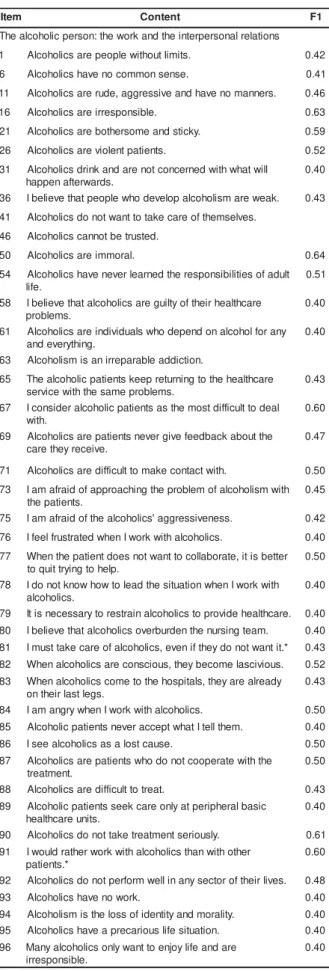
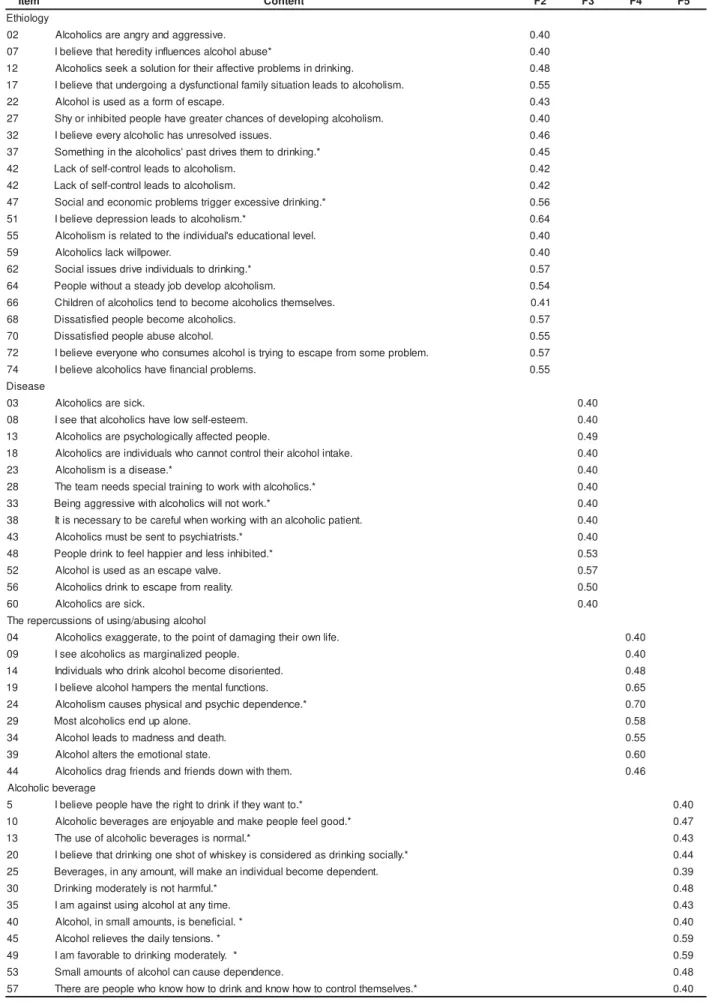
Tables 2 and 3 pr esent t he five fact or s t hat
const it ut e t he final EAFAAA version, as w ell as fact or
loadin g of t h eir com pon en t it em s, show in g t h at t h e
i t e m s t h a t r e m a i n e d i n t h i s v e r si o n p r e se n t e d a
sat isfact or y cor r elat ion w it h t heir r espect iv e fact or s.
Fact or 1, The alcoholic person: the work and the interpersonal relations, explains 23.2% of t he t ot al
variance, and is com posed of 42 it em s relat ed t o t he
percept ion, opinions and feelings t owards t he alcoholic
in div idu al, as w ell as t ow ar ds r elat in g an d w or k in g
wit h t he pat ient ( Table 2) .
Fact or 2, Et iology, includes 20 it em s t hat refer
t o co n cep t i o n s, o p i n i o n s a n d a t t i t u d es a b o u t t h e
et iology of alcoh olism . Cov er in g m en t al, m or al an d
biological factors attributed as causes of alcoholism , this
factor explains 11.4% of the total variance (Table 3).
Fact or 3, Disease, ex plains a 7. 1% var iance
and aggregat es 13 it em s t hat are relat ive t o at t it udes,
p er cep t i o n s an d f eel i n g s t o w ar d s al co h o l i sm as a
d i s e a s e . I t s i t e m s e x p r e s s o p i n i o n s a b o u t t h e
p s y c h o l o g i c a l c h a r a c t e r i s t i c s o f t h e a l c o h o l i c s ,
psychiat ric t reat m ent and professional handling during
t r eat m ent and healt hcar e ( Table 3) .
Fact or 4, The social repercussions of using/ abusing alcohol, ex plaining a 5.7% t ot al v ar iance, is
m ade u p of n in e it em s abou t at t it u des t ow ar ds t h e
m en t al an d social r ep er cu ssion s cau sed b y u sin g /
abu sin g alcoh ol, in v olv in g t h e in div idu al, t h e fam ily
and ot her social r elat ion spher es ( w or k , fr iendships,
et c) – ( Table 3) .
Fact or 5, Alcoholic beverages, explains 5.2%
of t he t ot al variance, and cont ains 12 it em s referring
t o opinions, feelings and act ions of t he pr ofessional
t ow ar d s alcoh olic b ev er ag es; con seq u en ces f or t h e
indiv idual w ho uses t hese bev er ages; lim it s bet w een
n or m al an d p at h olog ic d r in k in g , an d t h e ef f ect s of
alcohol on t he per son’s behav ior ( Table 3) .
Table 2 – Fact or loadings of t he it em s t hat com pr ise f act o r 1 : Th e al co h o l i c p er so n : t h e w o r k an d t h e int er per sonal r elat ions, São Paulo, SP, 2008
* Posit ive it em s Rev Lat ino- am Enferm agem 2008 set em bro- out ubro; 16( 5) : 895- 902
w w w .eer p.usp.br / r lae
Developm ent and validation of a scale of attitudes…
Vargas D, Luis MAV.
1 r o t c a
F Factor2 Factor3 Factor4 Factor5
e u l a v n e g i
E 9.35 4.02 2.41 2.69 2.47
e c n a i r a v
% 23.2 11.4 7.1 5.7 5.2
( a h p l
A α) 0.91 0.86 0.74 0.77 0.47
s m e t i 6 9 l a t o
Table 3 – Fact or loadings of t he it em s com posing fact ors: 2 - Et iology; 3 - Disease; 4 - The social repercussions
of using/ abusing alcohol; 5 - Alcoholic beverages. São Paulo, SP, 2008
m e t
I Content F2 F3 F4 F5
y g o l o i h t E
2
0 Alcohoilcsareangryandaggressive. 0.40
7
0 Ibeilevethatheredityinlfuencesalcoholabuse* 0.40
2
1 Alcohoilcsseekasoluitonfortheiraffecitveproblemsindrinking. 0.48
7
1 Ibeilevethatundergoingadysfuncitonalfamliysituaitonleadstoalcohoilsm. 0.55 2
2 Alcoholisusedasaformofescape. 0.43
7
2 Shyorinhibitedpeoplehavegreaterchancesofdevelopingalcohoilsm. 0.40
2
3 Ibeileveeveryalcohoilchasunresolvedissues. 0.46
7
3 Somethinginthealcohoilcs'pastdrivesthemtodrinking.* 0.45 2
4 Lackofsefl-controlleadstoalcohoilsm. 0.42
2
4 Lackofsefl-controlleadstoalcohoilsm. 0.42
7
4 Socialandeconomicproblemstriggerexcessivedrinking.* 0.56
1
5 Ibeilevedepressionleadstoalcohoilsm.* 0.64
5
5 Alcohoilsmisrelatedtotheindividua'lseducaitonalleve.l 0.40
9
5 Alcohoilcslackwillpower. 0.40
2
6 Socialissuesdriveindividualstodrinking.* 0.57
4
6 Peoplewithoutasteadyjobdevelopalcohoilsm. 0.54 6
6 Chlidrenofalcohoilcstendtobecomealcohoilcsthemselves. 0.41
8
6 Dissaitsifedpeoplebecomealcohoilcs. 0.57
0
7 Dissaitsifedpeopleabusealcoho.l 0.55
2
7 Ibeileveeveryonewhoconsumesalcoholistryingtoescapefromsomeproblem. 0.57
4
7 Ibeilevealcohoilcshave ifnancialproblems. 0.55
e s a e s i D
3
0 Alcohoilcsaresick. 0.40
8
0 Iseethatalcohoilcshavelowsefl-esteem. 0.40
3
1 Alcohoilcsarepsychologicallyaffectedpeople. 0.49
8
1 Alcohoilcsareindividualswhocannotcontroltheiralcoholintake. 0.40
3
2 Alcohoilsmisadisease.* 0.40
8
2 Theteamneedsspecialtrainingtoworkwithalcohoilcs.* 0.40
3
3 Beingaggressivewithalcohoilcswillnotwork.* 0.40
8
3 tIisnecessarytobecarefulwhenworkingwithanalcohoilcpaitent. 0.40
3
4 Alcohoilcsmustbesenttopsychiatrists.* 0.40
8
4 Peopledrinktofeelhappierandlessinhibited.* 0.53
2
5 Alcoholisusedasanescapevalve. 0.57
6
5 Alcohoilcsdrinktoescapefromreailty. 0.50
0
6 Alcohoilcsaresick. 0.40
l o h o c l a g n i s u b a / g n i s u f o s n o i s s u c r e p e r e h T
4
0 Alcohoilcsexaggerate,tothepointofdamagingtheirownilfe. 0.40
9
0 Iseealcohoilcsasmarginailzedpeople. 0.40
4
1 Individualswhodrinkalcoholbecomedisoriented. 0.48
9
1 Ibeilevealcoholhampersthementalfuncitons. 0.65
4
2 Alcohoilsmcausesphysicalandpsychicdependence.* 0.70
9
2 Mostalcohoilcsendupalone. 0.58
4
3 Alcoholleadstomadnessanddeath. 0.55
9
3 Alcoholatlerstheemoitonalstate. 0.60
4
4 Alcohoilcsdragfriendsandfriendsdownwiththem. 0.46
e g a r e v e b c il o h o c l A
5 Ibeilevepeoplehavetherighttodrinkiftheywantto.* 0.40
0
1 Alcohoilcbeveragesareenjoyableandmakepeoplefeelgood.* 0.47
3
1 Theuseofalcohoilcbeveragesisnorma.l* 0.43
0
2 Ibeilevethatdrinkingoneshotofwhiskeyisconsideredasdrinkingsocially.* 0.44 5
2 Beverages,inanyamount,willmakeanindividualbecomedependent. 0.39
0
3 Drinkingmoderatelyisnotharmfu.l* 0.48
5
3 Iamagainstusingalcoholatanyitme. 0.43
0
4 Alcoho,linsmallamounts,isbeneifcia.l* 0.40
5
4 Alcoholreilevesthedaliytensions.* 0.59
9
4 Iamfavorabletodrinkingmoderately. * 0.59
3
5 Smallamountsofalcoholcancausedependence. 0.48
7
5 Therearepeoplewhoknowhowtodrinkandknowhowtocontrolthemselves.* 0.40
901
DI SCUSSI ON
Du e t o t h e lack of av ailable in st r u m en t s t o
v er if y t h e at t it u des of n u r ses an d ot h er h ealt h car e
p r o f essi o n al s t o w ar d s al co h o l , al co h o l i sm an d t h e
alcoh olics, as w ell as in adequ acies in ex ist in g t ools
for use in Brazil, t he st udy was perform ed t o const ruct
a m easurem ent inst rum ent for t he t hem e, which would
b e ab le t o cov er t h e m ain at t it u d e g r ou p s ( m or al,
disease, et iologic, pr ofessional and hum an fact or s) .
Th e s c a l e , s t a r t e d w i t h 2 2 5 i t e m s , w a s
r e st r i ct e d t o 9 6 st a t e m e n t s i n i t s f i n a l v e r si o n ,
dist ribut ed int o five fact ors, wit h a reduct ion of nearly
t w o t i m e s a n d a h a l f t h e i n i t i a l a m o u n t . Th e
r esear cher s consider ed t his r esult as ideal( 11,13).
The five fact or s in t he final EAFAAA ver sion,
accor ding t o t he init ial obj ect iv e of t his st udy, aim ed
at building an inst rum ent t hat could m easure t he m ain
at t it u de gr ou ps, cov er f iv e dif f er en t aspect s of t h e
obj ect in quest ion, i.e.: The alcoholic person, t he work
and t he int er per sonal r elat ion w it h t his pat ient ; t he
et i o l o g y ; t h e d i sease; t h e so ci al r ep er cu ssi o n s o f
using/ abusing alcohol and alcoholic bev er ages.
Alt hough being init ially conceived t o m easure
t h e a t t i t u d e s o f n u r s e s a n d o t h e r h e a l t h c a r e
p r of ession als, it w as d ecid ed t h at t h e p r elim in ar y
v er sion of EAFAAA w ould be applied t o a populat ion
of nursing st udent s near graduat ion so t hat t he it em s
could be refined. This procedure w as adopt ed t o t est
t he r esult ing scale in t his public, due t o t he lack of
such st udies am ong nur sing st udent s( 10).
Wit h t he dat a obt ained fr om t his sam ple of
s t u d e n t s , t h e c o n s t r u c t v a l i d a t i o n w a s s t a r t e d ,
per for m ed t hr ough m ain com ponent analy sis w it h a
v a r i m a x r o t a t i o n . A t t h i s s t a g e , 6 9 i t e m s w i t h
sat ur at ion under 0. 40 w er e ex cluded. This ex clusion
crit erion was adopt ed when considering t hat even it em s
w i t h f a ct o r l o a d i n g 0 . 3 0 , co n si d er ed a d eq u a t e t o
com pose a fact or, m ust be discar ded in t he pr ocess
of building an inst rum ent , since an it em represent s a
fact or well when it s loading is equal t o or higher t han
0.50( 13). Mor eover, w it h t he exclusion of t hose it em s,
r eliabilit y for all fact or s incr eased.
Con sider in g t h at t h e pr ocess of in st r u m en t
validat ion should involve several int er- relat ed st udies,
aim in g at em p ir ical v er if icat ion , t h r ou g h st at ist ical
t est s, of t h e r elat ion b et w een t h e v ar iab les t o b e
m easu r ed( 1 5 ), t h e r eliabilit y in dex of t h e in st r u m en t
w as t est ed at t w o differ ent t im es. One inv olv ed t he
whole scale ( 96 it em s) , wit hout divisions, and t he ot her
w it h each f act or p r esen t ed in d iv id u ally. Th e w h ole
scale t est in g obt ain ed an im por t an t r eliabilit y in dex
(α) = 0.9068, which indicat es t hat t he scale seem s t o
m easu r e at t it u d es t ow ar d s alcoh ol, alcoh olism an d
t h e a l co h o l i cs, si n ce su ch a v a l u e i s co n si d e r e d
satisfactory for the obj ectives of this type of scale(13-14).
When t he r eliabilit y index of each fact or is analy zed
i n d i v i d u a l l y, sa t i sf a ct o r y r e l i a b i l i t y i n d e x e s w e r e
likew ise observed, i.e. equal or close t o 0.90, except
for fact or 5, which present ed an á coefficient = 0.4771,
indicat ing t he need for a bet t er com posit ion in or der
t o incr ease it s int er nal consist ency.
The final version of EAFAAA consist ed of it em s
t h at w er e p r ed om in an t ly n eg at iv e, i. e. 7 5 % of t h e
t ot al. The prevalence of negat ive concept ions t owards
alcoh ol an d alcoh olism in t h e n u r ses’ st at em en t s,
which generat ed t he it em s, can j ust ify t his fact . Being
predom inant ly negat ive, 72 EAFAAA it em s are orient ed
p o s i t i v e l y, w h i c h m e a n s t h a t , t h e h i g h e r t h e
disagr eem ent of t he subj ect s t ow ar ds t he it em , t he
m or e posit iv e t heir at t it udes ar e. Ther efor e, for t he
in t er pr et at ion of dat a collect ed w it h t h is scale, t h e
a n sw e r s t o t h e i t e m s sh o u l d b e ca l cu l a t e d w i t h
invert ed values, wit h t he scores com put ed as follows:
( 1= 5) , ( 2= 4) , ( 3= 3) , ( 4= 2) , ( 5= 1) . Consequent ly, high
scor es show posit ive at t it udes, w hile low scor es t end
t o r eflect negat ive at t it udes. The EAFAAA differ ent ial
over pre- exist ent inst rum ent s is t hat it allows for t he
ev alu at ion of at t it u des fr om t w o at t r ibu t es t h at ar e
not cont em plat ed in any pr ev ious inst r um ent , t o t he
au t h or ’s k n ow ledge: at t it u des t ow ar ds in t er per son al
relat ions wit h alcoholic pat ient s and at t it udes t owards
t h e r ep er cu ssi o n s o f al co h o l i sm i n t h e so ci al an d
per sonal cont ex t s. St ill, r egar ding t he adv ant ages of
t he inst rum ent present ed herein, it can be said t hat it
facilit at es t he applicat ion in Brazil, since it was built in
t he Por t uguese language.
CONCLUSI ON
EAFAAA w a s sh o w n t o b e r el i a b l e f o r t h e
evaluat ion of at t it udes t owards t he t hem e. The result s,
ach iev ed t h r ou g h p sy ch om et r ic an aly sis, sh ow ed a
Rev Lat ino- am Enferm agem 2008 set em bro- out ubro; 16( 5) : 895- 902 w w w .eer p.usp.br / r lae
Developm ent and validation of a scale of attitudes…
s a t i s f a c t o r y r e l i a b i l i t y ( a c c u r a c y ) i n d e x a n d
v a l i d i t y co m p r o v a t i o n , f o r a n i n st r u m en t t h a t h a s
n o t b e e n r e f i n e d y e t . A s s u c h , t h e r e s u l t i n g
i n st r u m en t ca n b e co n si d er ed g o o d , a n d t h er ef o r e
ca p a b l e o f e v a l u a t i n g a t t i t u d e s t o w a r d s a l co h o l ,
a l co h o l i sm a n d t h e a l co h o l i cs. I t s a p p l i ca t i o n i s
d esi r a b l e i n sa m p l es co n si st i n g o f n u r ses, a s w el l
a s o t h e r h e a l t h c a r e p r o f e s s i o n a l s , s i n c e i t w a s
l i m i t e d t o st u d e n t s o f t h e l a st se m e st e r i n t h i s
st u d y, ch a r a ct e r i z i n g t h e w o r k a s a p r e l i m i n a r y
ex p l o r a t i o n o f t h e p sy ch o m et r i c p r o p er t i es o f t h e
i n s t r u m e n t .
REFERENCES
1 . Ca r l i n i EA , Ga l d u r ó z JCF, N o t o A R, N a p p o SA . I I Levant am ent o dom iciliar sobre uso de drogas no Brasil, 2005. Brasília ( DF) : Cent ro Brasileiro de I nform ações Sobre Drogas Psi co t r ó p i ca s, SENAD – Se cr e t a r i a Na ci o n a l An t i d r o g a s, Pr esidência da República, Gabinet e de Segur ança Nacional; 2 0 0 6 .
2. Not o AR, Moura YG, Nappo AS, Galduróz JCF, Carlini EA . I n t er n ações p or t r an st or n os m en t ais e d e com p or t am en t o d e c o r r e n t e s d e s u b s t â n c i a s p s i c o a t i v a s : u m e s t u d o ep id em iológ ico n acion al d o p er íod o d e 1 9 8 8 a 1 9 9 9 . Br as Psi q u i at 2 0 0 2 ; 5 1 ( 2 ) : 1 1 3 - 2 1 .
3 . Aalt o M, Sep p a K, Kiian m aa K, Sillan au k ee P. Dr in k in g habit s and prevalence of heavy drinking am ong prim ary healt h car e ou t p at ien t s an d g en er al p op u lat ion . Ad d ict ion 1 9 9 9 ; 9 4 ( 9 ) : 1 3 7 1 - 9 .
4. How ard OM, Chung SS. Nurses’at t it udes t ow ard subst ance m i s u s e r s . I . S u r v e y s . S u b s t a n c e Us e & Mi s u s e 2 0 0 0 ; 3 5 ( 3 ) : 3 4 7 - 6 5 .
5. Pillon SC, Dunn J, Laranj eira RR. Nurses At t it udes Tow ards Alcoholism : Fact or analy sis of t hr ee com m only used scales São Pau l Med J 1 9 9 9 ; 1 1 6 ( 2 ) : 1 6 6 1 - 6 .
6. Vargas D, Labat e RC. At it udes de enferm eiros de hospit al ger al fr ent e ao uso do álcool e alcoolism o. Rev Br as Enfer m 2 0 0 6 ; 5 9 ( 1 ) : 4 7 - 5 1 .
7 . Nav ar r et e PR, Lu is MAV. Act it u d de la en f er m er a de u n com plej o hospit alar io en r elación al pacient e alcoholico. Rev
La t i n o - a m En f e r m a g e m 2 0 0 4 m a r ç o - a b r i l ; 1 2 ( n ú m e r o e sp e ci a l ) : 4 2 0 - 6 .
8 . Seam an J, Mannello T. Nur ses’ at t it udes t ow ar ds alcohol and alcoholism : t he Seam an- Mannello scale. Ar lingt on ( VA) : Nat ion al I n st it u t e on Alcoh ol Abu se an d Alcoh olism ; 1 9 7 8 . 9. Vargas D, Labat e RC. Trabalhar com pacient es alcoolist as: sat isfação de enferm eiros de hospit al geral. Rev Gaúch Enferm 2 0 0 5 ; 2 6 ( 2 ) : 2 5 2 - 6 0 .
10. Vargas D. A const rução de um a escala de at it udes frent e a o á l c o o l , a o a l c o o l i s m o e a o a l c o o l i s t a : u m e s t u d o p s i c o m é t r i c o . [ Te s e d e D o u t o r a d o ] . Ri b e i r ã o Pr e t o ( SP) : Escola de En fer m agem de Ribeir ão Pr et o/ USP; 2 0 0 5 . 11. St r einer DL, Nor m an GR. Healt h m easur em ent scales: a pract ical guide t o t heir developm ent and use. 3 ed. New York: Ox f or d Un iv er sit y Pr ess; 2 0 0 3 .
1 2 . Rosen b er g MJ, Hov lan d CI . At t it u d e, or g an izat ion an d c h a n g e : A n a n a l y s i s o f c o n s i s t e n c y a m o n g a t t i t u d e com pon en t s. New Hav en : Yale Un iv er sit y Pr ess; 1 9 6 0 . 1 3 . Pasq u ali L. Tax on om ia d os in st r u m en t os p sicológ icos. I n : Pa sq u a l i L, o r g a n i za d o r. I n st r u m e n t o s p si co l ó g i co s: m anual prát ico de elaboração. Brasília ( DF) : LabPAM- I BAPP; 1 9 9 9 . p . 2 7 - 3 5 .
1 4 . Ar t es R. Asp ect o s est a t íst i co s d a a n á l i se f a t o r i a l d e e s c a l a s d e a v a l i a ç ã o . Re v Ps i q u i a t r Cl ín 1 9 9 8 ; 2 5 ( 5 ) : 2 2 3 - 8 .
1 5 . Li t w i n ES . H o w t o a c c e s s a n d i n t e r p r e t s u r v e y p sy ch o m et r i cs. Th o u sa n d Oa k s ( CA) : Sa g e Pu b l i ca t i o n s; 2002. The sur vey k it ser ies, v. 8.