Corresponding Author:
2011 July-Aug.;19(4):994-1002
www.eerp.usp.br/rlae
Corresponding Author: Tereza Cristina Scatena Villa
Universidade de São Paulo. Escola de Enfermagem de Ribeirão Preto Departamento Materno-Infatil e Saúde Pública
Av. dos Bandeirantes, 3900 Bairro: Monte Alegre
CEP: 14040-902, Ribeirão Preto, SP, Brasil E-mail: [email protected]
Accessibility to tuberculosis treatment: assessment of health
service performance
Tiemi Arakawa
1Ricardo Alexandre Arcêncio
2Beatriz Estuque Scatolin
3Lúcia Marina Scatena
4Antônio Ruffino-Netto
5Tereza Cristina Scatena Villa
6The aim of this study was to assess the accessibility of patients to the treatment of tuberculosis in
Ribeirão Preto, countryside of São Paulo State. Evaluation study type, with a quantity approach.
Interviews with 100 patients initiated on anti-tuberculosis chemotherapy between 2006-2007
were conducted, using a structured questionnaire based on the Primary Care Assessment Tool
(PCAT). Data were analyzed through variance analysis. There was a positive feedback regarding to
organizational accessibility, however, the performance of health services has been unsatisfactory
in providing transportation vouchers and in addressing the need to use transport for displacement
to the health unit, resulting in indirect costs to patients. The services with the highest number
of patients treated were those with higher irregularity in the conduct of home visits, showing
that the availability of resources (human, material and time) and the organization of care may
influence the accessibility to treatment.
Descriptors: Tuberculosis; Directly Observed Therapy; Health Services Evaluation; Health
Services Accessibility.
1 RN. E-mail: [email protected].
2 RN, Ph.D. in Nursing, Professor, Escola de Enfermagem de Ribeirão Preto, Universidade de São Paulo, WHO Collaborating Centre for Nursing Research Development, SP, Brazil. E-mail: [email protected].
3 RN, Master’s Student, Escola de Enfermagem de Ribeirão Preto, Universidade de São Paulo, WHO Collaborating Centre for Nursing Research Development, SP, Brazil. E-mail: [email protected].
4 Professor, Departamento de Medicina Social, Universidade Federal do Triângulo Mineiro, MG, Brazil. E-mail: [email protected]. 5 Physician, Full Professor, Faculdade de Medicina de Ribeirão Preto, Universidade de São Paulo, SP, Brazil. E-mail: [email protected]. 6 RN, Ph.D. in Nursing, Full Professor, Escola de Enfermagem de Ribeirão Preto, Universidade de São Paulo, WHO Collaborating Centre for
Acessibilidade ao tratamento de tuberculose: avaliação de desempenho de serviços de saúde
O objetivo deste estudo foi analisar a acessibilidade dos pacientes ao tratamento de
tuberculose (TB) em Ribeirão Preto, cidade do interior paulista. Trata-se de estudo de
avaliação de serviços de saúde, de abordagem quantitativa. Foram entrevistados 100
pacientes que iniciaram o tratamento de TB entre 2006-2007, utilizando questionário
estruturado, baseado no Primary Care Assessment Tool (PCAT). Os dados foram
submetidos à análise de variância. Observaram-se avaliações positivas em relação à
acessibilidade organizacional, porém, o desempenho dos serviços de saúde foi pouco
satisfatório no oferecimento de vale-transporte e na necessidade da utilização de
transporte no deslocamento até à unidade de saúde, gerando custos indiretos aos
pacientes. Os serviços com maior número de doentes atendidos foram aqueles que
apresentavam maior irregularidade na realização de visitas domiciliares, demonstrando
que a disponibilidade de recursos (humanos, materiais e tempo) e a organização da atenção podem inluenciar na acessibilidade ao tratamento.
Descritores: Tuberculose; Terapia Diretamente Observada; Avaliação de Serviços de
Saúde; Acessibilidade aos Serviços de Saúde.
Accesibilidad al tratamiento de tuberculosis: evaluación de desempeño de servicios de salud
El objetivo de este estudio fue analizar la accesibilidad de los pacientes al tratamiento
de tuberculosis (TB) en Ribeirao Preto, ciudad del interior del estado de Sao Paulo.
Se trata de un estudio de evaluación de servicios de salud, con abordaje cuantitativo.
Fueron entrevistados 100 pacientes que iniciaron el tratamiento de TB entre
2006-2007, utilizando un cuestionario estructurado basado en el Primary Care Assessment
Tool (PCAT). Los datos fueron sometidos al análisis de varianza. Fueron observadas
evaluaciones positivas en relación a la accesibilidad organizacional, sin embargo,
el desempeño de los servicios de salud fue poco satisfactorio en el ofrecimiento de
ayuda de dislocamiento y en la necesidad de la utilización de transporte en el traslado
hasta la unidad de salud, generando costos indirectos a los pacientes. Los servicios con
mayor número de enfermos atendidos fueron los que presentaban mayor irregularidad
en la realización de visitas domiciliares, demostrando que la disponibilidad de recursos (humanos, materiales y tiempo) y la organización de la atención pueden inluir en la accesibilidad al tratamiento.
Descriptores: Tuberculosis; Terapia por Observación Directa; Evaluación de Servicios de
Salud; Accesibilidad a los Servicios de Salud.
Introduction
The World Health Organization (WHO) emphasizes
the importance of the organizational and health service
performance dimension in tuberculosis (TB) control
actions, stating that the problem is not in the forms of
detection and treatment, but rather in the way health
services are organized to detect and treat TB cases(1).
The DOTS (Directly Observed Therapy, Short-Course)
strategy, currently expanded by the STOP TB plan,
emphasizes this idea, as it constitutes a TB control
policy included in the health system instead of a simple
protocol with a clinical approach(2).
long-term disease(3). It is known that lack of adherence to TB
treatment, which lasts at least six months, represents
one of the most challenging aspects to control this
disease, because it leads to an increase in mortality,
incidence and multidrug-resistance ratios(4).
National and international studies show
that obtaining therapeutic success goes beyond pharmacological eficacy, involving obstacles to the continuity of health care during TB treatment, associated
with factors intrinsic to both treatment and patient and
with the way the service is organized for health care
delivery (5-6). In addition, there is the fact that treatment
adherence goes beyond the approach that reduces an
individual’s health needs to the clinical and biological aspects, as TB is directly associated with and inluenced by the social structure patients experience(7).
Accessibility is an important aspect that explains
variations in health service use and represents a relevant
dimension in health service performance and care
quality assessment research(8). Factors predisposing to
health service use or not affect an individual’s health
outcomes, and studying these factors enhances the
selection of strategies to adapt health services to
population requirements and health care demands(9).
Accessibility differs from the concept of access in terms
of the nature or quality of what is accessible, and it is deined as “entry, the act of entering”(10). The concept
of accessibility is broader than the concept of access,
going beyond the entry to services, because accessibility
is not restricted to the mere availability of resources at
a certain moment/place or the exclusive use of health services or not, although it also indicates the level of
adjustment between patient requirements and the
services used(11).
In this perspective, it is essential to know how
users evaluate the service they receive in order to rethink and intervene in the way services are organized, aiming at higher quality of care, because “any deinition of a health care system must consider the dimensions
of accessibility, so that theoretical advances related to sector organization can become practices in the services”(9).
The present study aimed to evaluate patient accessibility to TB treatment in different referral services
in Ribeirão Preto, an interior city in São Paulo state.
Methods
This quantitative assessment study was part of a multicenter project developed by the Operational
Research Area of the Rede Brasileira de Pesquisa em Tuberculose/REDE-TB (Brazilian Tuberculosis Research Network), conducted in ive priority cities for TB control in the Southeast and Northeast. According to the theoretical framework used, the dimension
of accessibility was categorized into organizational accessibility, economic accessibility and geographical
accessibility(11). Based on these categories, the following
indicators were constructed (Figure 1).
Category Indicators
Organizational accessibility
Represented by the obstacles that originate in the ways health services are organized, such as delays in obtaining a consultation and difficulties in setting up consultations. The guarantee of care continuity is also included in this dimension.
Medical consultation in less than 24 hours
Lack of medication during treatment
Mean waiting time for a follow-up medical consultation longer than 60 minutes
Ease to set up medical consultations for TB control
Home visit made during treatment
Public transport tickets provided
Basic food pack provided
Economic accessibility
Includes consumption of time, energy and financial resources to obtain health care; losses due to working days missed; treatment costs.
Working days or appointments missed due to medical consultations for TB
Transportation expenses to arrive at health service
Geographical accessibility
Related to the mean distance between the population and health services and to the reasons for individuals to seek a certain health service, in a certain location.
TB treatment conducted in the health service closest to the patient’s home
Use of motorized transportation to arrive at the health service
Figure 1 - Indicators constructed for this study.
This study was conducted in Ribeirão Preto, a large
interior city located in the West of São Paulo state. In this
city, health care for individuals with TB is provided by
specialized teams of the Programa Municipal de Controle
da TB (PCT – Municipal TB Control Program), working
997 Arakawa T, Arcêncio RA, Scatolin BE, Scatena LM, Rufino-Netto A, Villa TCS.
units and referral centers) situated in each of the ive existing health districts.
In total, four referral services (identiied as A, B, C and D) participated in the study. A population census of
individuals with TB undergoing treatment in the city was
previously conducted, resulting in 167 cases. Patients
with TB who were part of the city’s prison population,
non-residents of the city studied and those younger than
18 years were excluded. As a result, 100 individuals
undergoing treatment in the city’s referral services,
between 2006 and 2007, participated in the study.
Interviews were conducted with individuals using
a semi-structured questionnaire, based on instruments
included in the Primary Care Assessment Tool (PCAT),
validated in Brazil(12) and adapted to tuberculosis control
actions(13). This instrument contains questions about each
key dimension of Primary Health Care (gateway, access,
bond, coordination, family focus, range of services and professional qualiication). Questions allocated in the “access” and “service team” dimensions were considered to analyze treatment accessibility.
Each question of the questionnaire was responded
according to a Likert scale of pre-established possibilities,
in which values from 1 to 5 represented the level of
preference or agreement with statements. The indicators
constructed for each question corresponded to a mean
score, obtained by adding up all interviewed patients’
answers, divided by the total number of respondents. The performance of each indicator was classiied as follows: mean values around 1 and 2 – unsatisfactory
performance; values close to 3 – average performance;
and values around 4 and 5 – satisfactory performance.
Indicators were subsequently analyzed individually and
compared among the four health services. Data were
submitted to variance analysis (one-way ANOVA) to
evaluate treatment accessibility in referral services. The
assumption of equality of variance (homoscedasticity), required by ANOVA, was veriied with Bartlett’s test. Variance analysis was thus applied to the variables that
met the premises of independence, homoscedasticity
and normality. The non-parametric Kruskal-Wallis test
was applied to those variables that did not meet the
criteria for ANOVA use.
In all tests, statistical signiicance was set at 5%. In compliance with resolution 196/96, approval for this
research project was obtained from the Institutional
Review Board at the Ribeirão Preto College of Nursing
(Protocol 0762/2007) and the project was registered
in SISNEP/ CONEP – Conselho Nacional de Ética em
Pesquisa (National Research Ethics Council).
Results
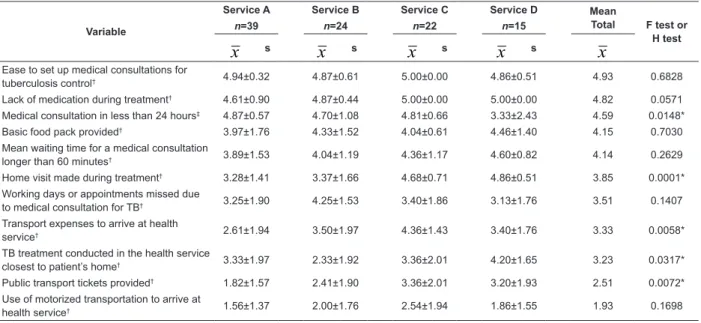
Table 1 - Means and conidence intervals of organizational, economic and geographical accessibility indicators of TB patients per health service and in the city (2006-2007)
Variable
Service A Service B Service C Service D Mean
Total F test or H test
n=39 n=24 n=22 n=15
x
sx
sx
sx
sx
Ease to set up medical consultations for
tuberculosis control† 4.94±0.32 4.87±0.61 5.00±0.00 4.86±0.51 4.93 0.6828
Lack of medication during treatment† 4.61±0.90 4.87±0.44 5.00±0.00 5.00±0.00 4.82 0.0571
Medical consultation in less than 24 hours‡ 4.87±0.57 4.70±1.08 4.81±0.66 3.33±2.43 4.59 0.0148*
Basic food pack provided† 3.97±1.76 4.33±1.52 4.04±0.61 4.46±1.40 4.15 0.7030
Mean waiting time for a medical consultation
longer than 60 minutes† 3.89±1.53 4.04±1.19 4.36±1.17 4.60±0.82 4.14 0.2629
Home visit made during treatment† 3.28±1.41 3.37±1.66 4.68±0.71 4.86±0.51 3.85 0.0001*
Working days or appointments missed due
to medical consultation for TB† 3.25±1.90 4.25±1.53 3.40±1.86 3.13±1.76 3.51 0.1407
Transport expenses to arrive at health
service† 2.61±1.94 3.50±1.97 4.36±1.43 3.40±1.76 3.33 0.0058*
TB treatment conducted in the health service
closest to patient’s home† 3.33±1.97 2.33±1.92 3.36±2.01 4.20±1.65 3.23 0.0317*
Public transport tickets provided† 1.82±1.57 2.41±1.90 3.36±2.01 3.20±1.93 2.51 0.0072*
Use of motorized transportation to arrive at
health service† 1.56±1.37 2.00±1.76 2.54±1.94 1.86±1.55 1.93 0.1698
*P values <0.05
† Parametric ANOVA (F test)
8
6
4
2
0
-2
C A B D
Referral services
3.36 3.33
2.33
4.20
Mean Mean±confidence interval Mean±confidence interval In the results described above, it could be observed
that the services in this study behaved similarly in terms of the following indicators: “ease to set up medical consultations for TB control” and “medications provided during treatment” (which patients rated as satisfactory); “basic food pack provided”, “mean waiting time for a medical consultation longer than 60 minutes” and “working day missed due to medical consultation” (rated as average); and “use of motorized transportation to
arrive at the health service” (rated as unsatisfactory). With regard to the distance between the referral
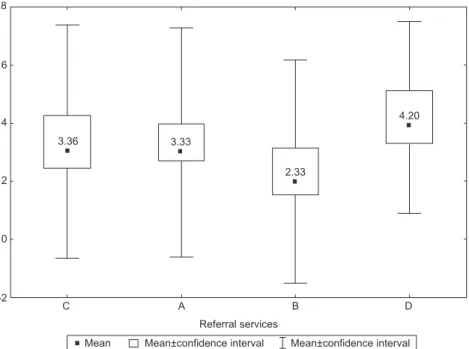
service and the patient’s home, there was a statistically signiicant difference in the behavior of services (Figure 2). By applying the comparison of means test (Tukey’s
test), it could be observed that service B obtained
the lowest scores when compared to service D, which
obtained the best performance. Service B covers the
largest area, serving a total of 136,906 inhabitants.
Figure 2 - Mean, conidence interval and standard deviation for the “TB treatment conducted in the health service closest to patient’s home” indicator, 2006-2007
With regard to public transport tickets, which
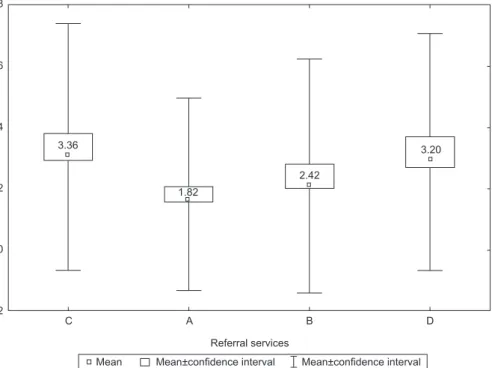
showed an unsatisfactory performance in this city, there was a statistically signiicant difference in the behavior of the four services studied, and Tukey’s test showed that services A and B provided this beneit more frequently. In total, 77% of patients from service A and 62.5% from
999 Arakawa T, Arcêncio RA, Scatolin BE, Scatena LM, Rufino-Netto A, Villa TCS.
Figure 3 - Mean, conidence interval and standard deviation for the “home visit made during treatment” indicator, 2006-2007
8
6
4
2
0
-2
C A B D
3.36
1.82
2.42
3.20
Referral services
Mean Mean±confidence interval Mean±confidence interval
With regard to home visits (HV) made to patients
during treatment, services C and D also obtained a satisfactory performance, where 82% and 93% of patients received HV, respectively. In contrast, an
unsatisfactory performance was observed in services A and B, where 28% and 25% of participants reported having never received HV, respectively.
7
6
5
4
3
2
1
0
-1
C A B D
4.68
3.28 3.37
4,87
Referral services
Mean Mean±confidence interval Mean±confidence interval
Discussion
When a health problem requires a service, the
health system should be organized in a way that
guarantees care is provided from the beginning and
that this care is continuous and capable of meeting the
needs of individuals who are seeking it(14). Readiness
to provide medical consultations, whether these are
control (monthly) or emergency consultations (until
24 hours), can indicate that referral services maintain
regular control consultations, guaranteeing follow-up of
TB treatment progress, in addition to assuring readiness
in other possible situations, enabling an individual in
need to receive care. The onset of adverse reactions to
drugs is a common situation affecting patients who are
beginning their treatment, a fact that implies special
care and attention from the responsible health team.
The waiting time for a medical consultation, rated as
satisfactory in this study, also represents an aspect that
promotes continuing care, because closeness of the
doctor-patient relationship and a more organized service
reduce this time(15).
Delays in the service and hours that are
incompatible with the patient’s work shifts can lead to
the patient’s need to miss a working day. The literature
emphasizes that the rigidity in the routine care of health
services aggravates TB patients’ economic and social dificulties(16-17). Tuberculosis treatment puts a signiicant
inancial burden on patients, many of whom do not have the conditions to afford additional expenses, as they
are responsible for the household income(18). When the
inluence of socioeconomic factors on adherence to TB treatment is recognized, the lack of beneits or support to cover transportation, housing and food expenses can
hinder the continuity of treatment, even when treatment
is cost-free(19). Providing support, such as public transport
tickets and basic food packs, requires that health
services be integrated with other social service practices and exempliies the interrelation between economic and organizational accessibility(20-21).
The fact that treatment of individuals with TB is
performed in a centralized way in referral services can
explain most organizational accessibility indicators’
positive performance. The PCT implemented in the health
services has its own specialized team, which works on an outpatient care basis, with speciic days and/or times for TB care. After patients join the PCT and begin their
treatment, this team directly provides care, thus helping with the sett-up of consultations and the service low in the context of health services.
However, concentrating care on treatment at referral
units can also entail obstacles, related to the distance between the patient’s home and the health service
where treatment is delivered, hindering geographical
accessibility. Nonetheless, it should be considered that only the distance to the health service may not be a
relevant barrier, as certain individuals prefer health services situated further away from their home, due
to the stigma associated with this disease(22). In spite
of this, this distance involves certain aspects, such as
the need to use motorized transportation to arrive at the health service and the resulting loss of time, energy
and money, which can create several obstacles. The
unsatisfactory or average performance of indicators like “use of motorized transportation to arrive at the health service”, “transportation expenses to arrive at the health service” and “TB treatment conducted in the health service closest to patient’s home” evidences a gap in the accessibility of TB patients undergoing treatment, which ends up causing health care deiciencies.
The results obtained from the HVs reveal this deiciency, where referral services attending a higher number of patients performed worst in terms of HVs.
When health services have an extensive area of coverage,
home visits become irregular. These results are similar to those of other studies on health services’ supervised
treatment performance(23-24). Professionals working for
health services that concentrate a great number of TB
patients and have a larger area of coverage reported greater dificulty to perform the DOTS strategy at home, due to their responsibility to supervise a large number of patients and to the need to go to these homes in a short
space of time(23).
Home visits require health services to reorganize their internal activities and to have a minimum structure
(vehicle, driver and supervising health professional), which are necessary for the development of TB treatment
activities at the patient’s home, at the same time as the continuity of activities conducted at the service is
guaranteed(25).
TB health care, including home visit planning,
should consider patients’ needs and preferences and the context they live in(25). In addition to the objective of
supervising drug intake, the fact should be emphasized
that home visits and direct observation of therapy comprise other aspects, such as the evaluation of
contacts and psychosocial support, which are essential for treatment adherence and disease prevention in the
family context.
However, performing according to a logic that
1001 Arakawa T, Arcêncio RA, Scatolin BE, Scatena LM, Rufino-Netto A, Villa TCS.
peculiarities and autonomy in view of the therapeutic process, can become a dificult task for health services, with a demand that surpasses their resources and
structure.
A single professional’s direct observation of patients
may be a type of intervention that only deals with the
access problem from the health service’s perspective.
Interventions in the context of organizational barriers,
which are limited to solving mechanical problems, do not
focus on the service’s commitment to and responsibility
for user autonomy and rights in the end.
Thus, TB control actions with a focus on the broad
concept of health requires that health system and
service management takes into account the combination
of integrated and specialized activities, with a view to
guaranteeing a care model that considers TB’s debilitating
nature. Good performance of health services in terms of
accessibility to treatment depends on a set of conditions, including continuous professional qualiication, guarantee of a minimum structure for teams to perform
and integration of efforts among different participants
responsible for TB control(24), aiming at the optimization
and adequacy of existing resources for the several needs
of TB patients.
To provide access to and care for all is a challenge
that is part of the new public health and primary health care paradigm. In the end, this task meets the speciic needs of TB actions, as diagnosis and eficient patient treatment are the primary basis for disease control.
Conclusions
Health services participating in patient treatment
follow-up, organized centrally and relying on specialized
teams, performed satisfactorily in relation to most
organizational accessibility indices. However, the present study identiied the existence of deiciencies in the management of indirect costs imposed on TB
patients, such as transportation expenses to the health service and insuficient availability of social support actions (such as public transport tickets and basic food
packs). Unsatisfactory performance in terms of the
distance between the unit performing direct observation
of therapy and the patient’s home and irregularity in
the availability of home visits to supervise treatment could be associated with operational dificulties in the organization of health care and team resources (human,
material and time).
The results emphasize the need for assessment
studies to redirect TB care practices, supporting the
development process of new strategies to identify
obstacles to patient care continuity.
References
1. World Health Organization. Tuberculosis control:
surveillance, planning, financing: WHO Report 1999. Geneva: World Health Organization; 1999.
2. Ogden J, Walt G, Lush L. The politics of ‘branding’ in policy transfer: the case of DOTS for tuberculosis
control. Soc Sci Med. 2003;57(1):179-88.
3. Organização Mundial da Saúde. Cuidados inovadores
para condições crônicas: componentes estruturais de ação: relatório mundial. Brasília: Organização Mundial
de Saúde; 2002. 105 p.
4. Volmink J, Garner P. Directly observed therapy for treating tuberculosis. Cochrane Database Syst Rev.
2003;(1):CD003343.
5. Munro S, Lewin S, Smith H, Engel M, Fretheim A,
Volmink J. Patient adherence to tuberculosis treatment: a systematic review of qualitative research. PLoS Med.
2007; 4(7):1230-45.
6. Villa TCS, Brunello MEF, Arcêncio RA, Sassaki CM,
Assis EG, Cardozo-Gonzalez RI. Fatores preditivos aos
resultados desfavoráveis no tratamento da tuberculose: revisão integrativa da literatura (2001-2005). Online
Braz J Nurs: [periódico na Internet]. jan 2008 ;(7). Disponível em: http://www.uff.br/objnursing/index.
php/nursing/article/view/j.1676-4285.2008.1098/288. 7. Terra MF, Bertolozzi MR. O tratamento diretamente
supervisionado (DOTS) contribui para a adesão ao tratamento da tuberculose?. Rev. Latino-Am.
Enfermagem. 2008;16(4):659-64.
8. Donabedian A. The effectiveness of quality assurance. Int J Qual H. Care. 1996;8:401- 7.
9. Hortale VA, Pedroza M, Rosa MLG. Operacionalizando as categorias acesso e descentralização na
análise de sistemas de saúde. Cad Saúde Pública. 2000;16(1):231-9.
10. Travassos C, Martins M. A review of concepts in health services access and utilization. Cad Saúde Pública.
2004;20(2):190-8.
11. Fekete MC. Estudo da Acessibilidade na Avaliação
dos Serviços de Saúde. In: Santana JP, Santos I,
Fekete MC, Galvão EA, Mandelli MJ, Penna MLF, et al., organizadores. Desenvolvimento Gerencial de Unidades
Básicas do Sistema Único de Saúde (SUS). Brasília (DF): OPS; 1997. p. 177-84.
12. Macinko J, Almeida C, Oliveira E, Sá P. Organization and delivery of primary health care services in Petrópolis,
13. Villa TCS, Ruffino-Netto A. Questionário para avaliação de desempenho de serviços de atenção básica
no controle da tuberculose no Brasil. J Bras Pneumol.
2009;35(6):610-2.
14. Starfield B. Atenção primária: equilíbrio entre
necessidades de saúde, serviços e tecnologia. Brasília:
Organização das Nações Unidas para a Educação, a
Ciência e a Cultura/Ministério da Saúde; 2002. 725 p.
15. Lima MB, Mello DA, Morais APP, Silva WC. Estudo
de casos sobre abandono de tratamento da tuberculose:
avaliação do atendimento, percepção e conhecimentos
sobre a doença na perspectiva dos clientes (Fortaleza,
Ceará, Brasil). Cad Saúde Pública. 2001; 17(4):877-85.
16. Dimitrova B, Balabanova D, Atun RA, Levicheva
V, Coker RJ. Health service providers perceptions of
barriers to tuberculosis care in Russia. Health Policy
Plan. 2006;21:265-74. 17. Jaiswal A, Singh V, Ogden J
et al. Adherence to tuberculosis treatment: lessons from
the urban setting of Delhi, India. Trop Med Int Health.
2003;8:625-33.
18. Ogden J, Rangan S, Uplekar M, Porter J, Brugha
R, Zwi A, et al. Shifting the paradigm in tuberculosis
control: Illustrations from India. Int J Tuberc Lung Dis.
1999;3(10):855-61.
19. Ramos DD, Lima MADS. Acesso e acolhimento aos
usuários em uma unidade de saúde de Porto Alegre, Rio
Grande do Sul, Brasil. Cad Saúde Pública.
2003;19:27-34.
20. Sagbakken M, Frich JC, Bjune G. Barriers and
enablers in the management of tuberculosis treatment
in Addis Ababa, Ethiopia: a qualitative study. BMC Public
Health. 2008; 8:11.
21. Khan, JD Walley, SN Witter, SK Shah and S Javeed
Tuberculosis patient adherence to direct observation:
results of a social study in Pakistan. Health Pol Plann.
2005;20(6):354-65.
22. Paixão LMM, Gontijo ED. Perfil de casos de tuberculose
notificados e fatores associados ao abandono, Belo
Horizonte, MG. Rev Saúde Publica. 2007;41(2):205-13.
23. Gonzales RIC, Monroe AA, Assis EG, Palha PF, Villa
TCS, Ruffino-Netto A. Desempenho de serviços de saúde
no tratamento diretamente observado no domicílio
para controle da tuberculose. Rev Esc Enferm USP.
2008;42(4):628-34.
24. Cardozo Gonzáles RI, Monroe AA, Arcêncio RA,
Oliveira MF, Ruffino-Netto A, Villa TCS. Performance
indicators of DOT at home for tuberculosis control in
a large city, SP, Brazil. Rev. Latino-Am. Enfermagem.
2008;16(1):95-100.
25. Vendramini SHF, Monroe A, Villa TCS. Tratamento
supervisionado no controle da tuberculose em uma
unidade de saúde de Ribeirão Preto: a percepção do
doente. Bol Pneumol Sanit. 2002;10(1):5-12.