MULTIPLE ASPECTS OF LANGUAGE IN DEMENTIA:
A COMPARISON BETWEEN DOMESTIC
AND INSTITUTIONAL CONTEXT
Os múltiplos aspectos da linguagem em processo demencial:
um comparativo entre contexto doméstico e institucional
Jayne Guterres de Mello(1), Michele Vargas Garcia(2), Elenir Fedosse(2)
(1) Universidade Federal de Santa Maria, UFSM, Santa Maria,
RS, Brasil.
(2) Curso de Fonoaudiologia e Programa de Pós-Graduação
em Distúrbios da Comunicação Humana na Universidade Federal de Santa Maria, UFSM, Santa Maria, RS, Brasil. Source of support: CAPES
Conlict of interest: non-existent
characterized by amyloid plaques and neuroibrillary
tangles¹, having also cortical atrophy and ventricular dilatation, conferred to the neural² loss.
The second most common type of dementia is the Vascular Dementia³ (VD), which is charac-terized by several secondary dementia syndromes to vascular compromises of the Central Nervous System (CNS), including pictures caused by brain damage, unique lesions in strategic places (injuries in thalamus, caudate nucleus, angular gyri and hippocampus); incomplete states, chronic changes of cerebral circulation (multiples infarcts),
extensive white matter lesions (subcortical), amyloid
angiopathy, and boards resulting from hemorrhagic Cerebral Vascular Accident, mainly aneurisms break
of the frontal lobes4.
The design adopted in this study, the family is considered a living system, in constant
INTRODUCTION
The dementia mainly affects the elderly and it is the leading cause of dependency and incapability in old age.
The Alzheimer Dementia (AD) is the most common of the dementias and it is characterized by the degenerative process that affects the hippo-campal formation, with a later compromise of cortical associative areas, and also is related to diffuse
neuronal injury and death, with pathological indings
ABSTRACT
Analyzing verbal expression and interpretation/comprehension and their underlying mechanisms
(hearing, body balance, voice and orofacial motricity) of two elder women with clinical case of dementia
– one living in family environment and other in an elderly Long Permanence Institution. Apresented two
elderly’ cases: a 85-year-old woman, with Alzheimer Dementia diagnosis, living with her husband and one of her daughters; and a 90-year-old woman, with Vascular Dementia diagnosis, living in a Long Permanence Elder Institution. A full speech, language and hearing evaluation took place, considering language in its many aspects (hearing, body balance, voice and orofacial motricity), in which were observed linguistic manifestations that depict less verbal production from the institutionalized elderly. Results obtained through hearing evaluation (acuity and processing) body balance, voice and orofacial
motricity revealed expected features in healthy aging process. The elderly’ organic-physiological
conditions were compatible with natural aging process, while linguistic-cognitive conditions appear
more compromised. Language operation shows similar features – expected in aging with demential
process – in both elderly, but the institutionalized elderly presents linguistic-cognitive manifestations more compromised. This report shows the convenience of speech therapist performance at aging with
dementia, as much in family as in institutional context.
As clinical history, we know that EV started the attendance in the clinic cited eight years ago, referring forgetfulness, when laboratory tests and computerized tomography scans were performed and EV was diagnosed with “mild dementia process”. Since then, further consultations were
marked, and the elderly was ive years without
attending, seeking care again three years ago, with the same complaint, more aggravated. During the last years monthly visits have been performed and the diagnosis of AD came two years ago.
IC, woman aged 90, is a resident of Santa Maria (RS, Brazil) in a home for the aged three years ago, single and childless. IC has completed elementary school, worked for short periods of time as a
secretary in the ofices of family and never married,
but was engaged to a young man with whom her father did not approve the marriage, because he was older and used to consume alcoholic beverages. As soon as the IC father died, her mother allowed the
marriage and then IC got engaged, but her iancé
died before the wedding. According to IC’s sister, her dream was to marry, have children and work as a teacher, which did not happen. The same sister also reported that IC was very angry and always used to
get into a ight with the whole family. IC has always
lived with her mother and when she died, went to live with a sister and then with another sister, until they decided (her and her family) that she would live in a home for the aged.
The information relating to the history of life of the elderly were collected in a conversation with their family members, held in order to know better the history of both, referring to personal, profes-sional and family life.
It is noteworthy that to diagnose dementia, the geriatric doctor of the out-patient clinic where the elderly surveyed perform monitoring requests
the following exams: computed tomography and laboratory exams (blood and thyroid hormones),
which is in accordance with what the literature4
meant to be suficient for the diagnosis of dementia
testing.
After completing the signatures of the informed consent for participation by the family responsible for the resident elderly in the home environment and the responsible for home for the aged, in the case of institutionalized elderly, both elderly were evaluated based on a script of evaluation that includes all areas of Speech, Language and Hearing Sciences. This script was developed by the researcher and allows knowing the conditions of the subject at all levels
of speech/speech, language and hearing sciences
competence (language, hearing, body balance, voice and orofacial motricity).
transformation, seeking to ensure continuity and psychosocial growth of its members. It is possible to see that changes in the economic, political, social, cultural aspects, among others, can bring repercus-sions to the people in the family as well. However, the growth of the elderly population has consequences that affect directly the services of social and health assistance of the elderly population, worsened with the precariousness of the health plans and the low retirement salary, and added to this, it is observed
that the members of the families have dificulties to
take care of their elderly, sending them to homes for the aged, old people’s homes or geriatric institutions. In front of this, it is considered important to conduct studies that analyze the conditions of elderly in both situations cited (in the family environment and at the home for the aged).
To achieve the purpose of a complete speech evaluation it starts from a set of knowledge coming
from different areas/disciplines; it is adopted, referring
to language, the perspective of the Discursive
Neurolinguistic (DN), developed by Coudry5, which
defends the direct or indirect participation of the verbal language in all cognitive processes (attention,
perceptions, gnosis, memories, praxias, languages,
and so on) considering them in its biological aspects, but also in their social-interactive aspects and historical-cultural as well.
Given the above, the objective of this study is
to analyze the expression and the interpretation/
verbal understanding and its underlying mecha-nisms (hearing, body balance, voice and orofacial motricity) of two old women with clinical picture of dementia – one of them living in a family environment and the other in a home for the aged.
PRESENTATION OF CASES
This study may be characterized as a ield
investigation, transversal, of qualitative character, case report, approved by the Ethics Committee of the University where it was developed (0324.0.243.000-11).
The studied cases are of EV, an elderly woman which resides with the husband and one of their daughters, and of IC, an old woman that resides in a home for the aged.
and Synthetic Sentence Identiication (SSI) only with
institutionalized elderly. With respect to the elderly living in family environment, only diotic and monotic were performed due to asymmetric hearing loss.
The tests are part of the book “Processamento Auditivo Central – Manual de Avaliação”, CD 1 and
CD 2, except for the sound localization test in ive
directions and MTVS and MTNVS tests, which are
performed with musical instruments in free ield6. The equipment used for the assessment of auditory processing was the audiometer of two channels Itera II coupled to the portable CD player CDP Toshiba 4147.
Yet in regard to auditory processing, it is also resorted to Long-Latency Auditory Evoked Potentials (LLAEP – P300), which was conducted with the equipment “SmartEP” from Intelligent Hearing Systems (IHS) of two channels. The test was conducted in a quiet room in semi-dark environment. The stimuli were presented through insert earphones ER-3A and the intensity of stimulus presentation ranged from 70 to 90 dB HL, according to the threshold of audibility, and 80dB in the case of EV and 90dB in the case of IC.
The body balance is given by tests of static and
dynamic balance and movement7 coordination,
beyond the Sensory Organization Test (SOT),
conducted by dynamic posturography8.
The perceptual evaluation of voice was in dialogue situation, it means, in the productive use
of the voice, and was also measured the Maximum Phonation Time (MPT) of the vowel /a/.
Regarding orofacial motricity, the structural and functional evaluation of the stomatognathic system
was performed, taking care of the aspects of extra
and intra-oral sensitivity, mobility, stress and posture of the articulators, chewing, swallowing, and breathing mode and type. Chewing and swallowing the solid consistencies (French bread) and liquid (water) were evaluated. Evaluating the dynamics of swallowing, including the detection of risk for dysphagia was also performed. The evaluation was initiated with swallowing saliva, followed by the pasty solid and liquid consistency.
RESULTS
Regarding the results for the assessment of oral
language, will be exhibited in frames excerpts of
dialogues between the researcher and the elderly. The assessment of oral language, as aforesaid,
was based on the perspective of DN5, highlighting
the work of cognitive-linguistic subjects, it means, the language was evaluated in its operation, from a semi-structured interview that addressed data:
personal and family identiication, the current
routine, preferences (what they like and what they do not like doing) and health conditions; narrative of an important fact of life and an actual fact; production of comments; interpretation of a proverb
(“Son of ish is ishy.”), resolving a syllogism (“My
mother has a blue blouse and I have a shirt the same color as hers. What is the color of my shirt?) and a problem of everyday life (“If you were on the street and started to rain, what would you do?”);
Identiication of space and time. It is considered that such linguistic expedients enable analysis of the following aspects: attention / concentration, gnosis
(body proprioception and perception of spatial and
temporal coordinates), praxias (facial gestures and
speech and hearing), memories (retrograde memory and current memory) and logical reasoning.
The meeting was ilmed and, subsequently, the
data were transcribed orthographically and analyzed
discursively, considering the context of their
production and interpretation of meaning, especially
the verbal comprehension and expression at different levels of organization (phonology, syntax,
semantics and pragmatics) and the non-verbal
expression.
With regard to the hearing, a hearing evaluation
was made including: visual inspection of the external
acoustic meatus; pure tone audiometry (PTA) and speech audiometry, in a soundproof booth, using
a digital two-channel audiometer, Fonix Hearing
Evaluator, Model FA 12 type I and earphones TDH-39P, Telephonics brand.
To assess auditory processing, the behavioral evaluation was performed, for which different tests were selected to be performed with each elderly, due to the difference in the results of the hearing assessment. Common to both elderly, the following
tests6 were performed: Sound Location Test in Five
Researcher: What is your name?
EV: It’s Gisela.
(EV’s daughter interrupts, saying: “Her name signed on the documents is Guísela *”)
EV: Yes! Guísela da Silva Costa.
* The irst name of EV was replaced by another who its a similar case (both have two pronunciations for
being from another language), to preserve the identity of the subject, as well as the surnames that were randomly altered..
Researcher: How old are you?
IC: I do not say!
Researcher: Do not say? Why?
IC: Because I do not want!
Researcher: You do not like anyone to know your age?
IC: No!
Researcher: That is okay! And the day that you were born? Can you tell?
IC: No!
Researcher: Not too? But with the day has no way of knowing the age! Only the day and month...
IC: (silence)
Figure 1 – Identity
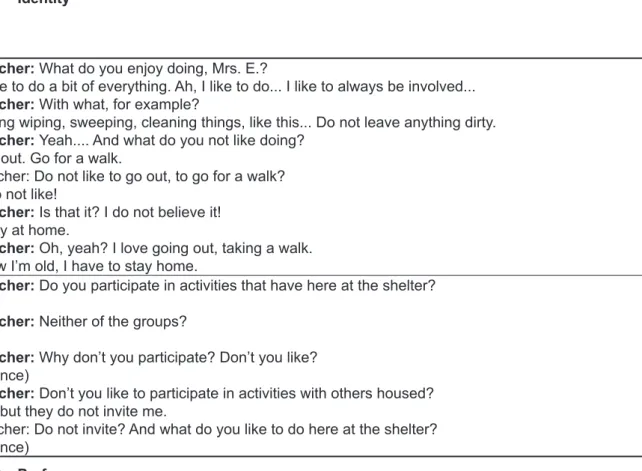
Researcher: What do you enjoy doing, Mrs. E.?
EV: I like to do a bit of everything. Ah, I like to do... I like to always be involved...
Researcher: With what, for example?
EV: Being wiping, sweeping, cleaning things, like this... Do not leave anything dirty.
Researcher: Yeah.... And what do you not like doing?
EV: Go out. Go for a walk.
Researcher: Do not like to go out, to go for a walk?
EV: I do not like!
Researcher: Is that it? I do not believe it!
EV: Only at home.
Researcher: Oh, yeah? I love going out, taking a walk.
EV: Now I’m old, I have to stay home.
Researcher: Do you participate in activities that have here at the shelter?
IC: No.
Researcher: Neither of the groups?
IC: No.
Researcher: Why don’t you participate? Don’t you like?
IC: (silence)
Researcher: Don’t you like to participate in activities with others housed?
IC: No, but they do not invite me.
Researcher: Do not invite? And what do you like to do here at the shelter?
IC: (silence)
Researcher: So, tell me something about your life, an important fact that you remember of your life.
EV: Oh! What is the fact... that I’m going to say?
Researcher: Something that you remember. An important fact that marked you...
EV: But tell you? I forgot everything!
Researcher: Really?!
EV: By God, I forgot everything!
Researcher: But I guarantee that something of life you remember! Some event...
EV: Only the children... of the births.
Researcher: Of the births?
EV: Birth, growth of them.
Researcher: Aham ...?
EV: From my old man too. I have ... I have six children ... Six or seven? Seven children...
Researcher: And what do you have to tell me about some fact, some important thing of your life?
IC: I have nothing.
Researcher: Nothing? Some event that you remember?
IC: (silence)
Researcher: Not even when you started working...? Of when you came here to the shelter...?
IC: (silence)
Researcher: There’s nothing you want to tell me?
IC: (silence)
Researcher: That is okay! Do you have children?
Figure 3 – Narrative
Researcher: And your health Mrs. E.? How is it?
EV: Oh! I am, I was ine now. A little pain or another, right...? And ... I... every little thing attacks me, right? Researcher: Aham...
EV: Because of what happened ... I was ... (interposition of the daughter’s speech: “shook”) shook, right?
Researcher: Yeah ... everyone, right?
EV: Oh, God! How many people died, right?
Researcher: Yeah... It was a huge tragedy, right?
Researcher: Are you feeling ine?
IC: I’m not! I’m not well... I’m not...
Researcher: Really?
IC: I am in treatment.
Researcher: Really? Of what?
IC: Of a lot of medicine that I take.
Researcher: Hm. And do you know what is this treatment for?
IC: (silence)
Researcher: How do you think is your health?
IC: (silence)
Researcher: How do you think is your health?
IC: It is bad!
Researcher: Is it? And have you talked to the nurse and the doctor about it?
IC: (silence)
Researcher: I told you I booked your appointment with Dr. M., right? Then there in the appointment with
the Doctor you have to explain everything you are feeling, okay?
IC: (silence)
Both elderly have hearing loss in both ears. The PTA held in EV revealed asymmetric hearing loss, being mild in Right Ear (RE) and moderate in Left Ear (LE). The audiometric curve was downward in both ears. Speech audiometry of EV revealed
Speech Recognition Index (SRI) of 88% awareness in the RE and 80% in LE. IC presents symmetrical
hearing loss moderately severe and also with
descending audiometric curve coniguration in both ears. The SRI showed 24% awareness in the RE and 36% in LE.
With regard to the auditory processing, both elderly showed ability to locate sounds within normality, but the temporal ordination for both verbal to non-verbal sounds, is changed in both cases. The temporal ability is markedly impaired in both elderly and as regards the frequency resolution, IC features within the normal range while EV has changed.
EV presented impaired auditory skills of
igure-background for verbal sounds and closing for verbal sounds.
CI presented results that relate proper functioning of the inter-hemispheric connections and corpus
callosum, however, had impaired auditory skill
igure-background for verbal sounds and association of auditory and visual stimuli, reiterating the changes
previously found in the ability of igure-background
for verbal sounds.
In P300, both elderly presented N1, P2 with
latencies within the expected range for age (N1
= 105 and P2 = 180 in the case of EV, N1 = 106 and P2 = 172 in the case of IC), showing auditory pathway functioning in level of primary auditory
cortex, associative area and temporal lobe.
Regarding P300, they did not show the potential, indicating absence of operation of hippocampal auditory pathway.
In tests of the static and dynamic balance EV showed a compromise only in the test of march, with deviation to the right with eyes closed. The other tests EV held with no particularities, as well
as IC, in all tests, without exception. In dynamic
posturography, EV presented underperforming in all positions of the test, highlighting the position VI (eyes open, cabin moving and unstable base),
in which EV decreased, demonstrating dificulties
in the integration of vestibular, visual and proprio-ceptive systems in SOT.
Researcher: What did you worked with?
IC: In an ofice.
Researcher: Oh, really? And what did you do there?
IC: I made forms for attendants.
Figure 5 – Occupation
The voices of EV and IC have similar character-istics, they are discrete breathiness and hoarseness, reduced loudness and pitch worsened. As for MPT, both elderly had values below normal (6.83 seconds in the case of EV and 7.05 seconds in the case of IC). All vocal characteristics were analyzed in vocal assessment as during the verbal interaction.
EV and IC showed little change with respect to orofacial motricity. Both have decreased cheeks, lips
and tongue tension and dental laws. EV performs
asymmetric chewing left and IC presented cough during the evaluation of the swallowing dynamics
in solid consistency. The results were conirmed
by observing everyday meal held by each elderly,
in order to observe the indings in situations of
everyday life.
DISCUSSION
Figure 1 shows data regarding the identity of
the elderly studied. The excerpt from the interview
with EV, which is part of this picture, addresses the issue related to her name. To ensure the identity of
the subject, the irst name was replaced by another,
which has similar characteristics, considering that
both names (the real name of EV and the ictitious
presented in this study) have two possible
pronun-ciations: the irst, equal the spelling, from another
language; and the second, brought to Portuguese language, transforming it into a more known name in this language. It is noteworthy that EV, when questioned about her name, immediately replied “Gisela”, even though her name, in the documents, is “Guísela”. This datum demonstrates that EV has
autonomy and authenticity to explain her desire to
be called by the name she prefers, although not with the pronunciation referring to the source language, which makes EV to appear as a subject with identity, because she imposes authenticity and has desires and values of her own, marked by the particularity of
her historical context.
Still dealing with the Figure 1, IC reports that does not want to reveal her age or date of birth, what
can be possibly explained by not knowing reporting
have the memory domain and in which she sees herself with greater prestige.
A sick person inluences other family members
and thus, the family is a living system that evolves and transforms over time. This can be observed in the case of EV, since the family (husband and daughters) engage with the diagnosis of EV, showing care and concern, but also qualify her as “forgotten” and sometimes unable to respond to the inquiries of the researcher, which makes her family occupy her turn in the interaction.
Unlike EV, IC remains silent and does not correspond to the negotiations conducted by the interlocutor, who makes use of strategies such as estrangement (IC says that she has nothing to tell) and the introduction of possible topics to start narrative. As IC keeps silence even after attempts at negotiation, the researcher chooses to respect the choice of the elderly and introduce another subject in the dialogue.
In Figure 4 were included passages in which the elderly talk about their health. We can note the difference between the discourses of EV and IC, since the former relates her physical unease with affective and emotional issues present in the interview (the interview was conducted a few days
after a tragedy happened in the city - referring to ire),
unlike IC, which shows knowing that is not in good health just by taking a lot of medicine, but demon-strates ignoring the health problems she presents.
In the irst part of the picture, related to the dialogue
between EV and the researcher, we can highlight
the dificulty of both to treat the subject brought by
EV - the aforementioned tragedy - mainly because it had happened very recently at the time of the
interview, this dificulty is marked by the repetition of the word “right”, expressed by the two interlocutors.
In what refers to the dialogue between IC and the researcher, when the researcher asks IC “of what” she is being treated, she does not answer the question and gives other information still part of the same theme – she answers the reason why refers to be in treatment (because taking medication). It is assumed that IC does not know the health issues that lead her to taking the medication, since she is institutionalized and usually only obey the orders of the health professionals who, being too busy,
not usually explain the treatments performed and
furthermore, her cognitive condition brings possible limitations to memorize the medications taken, as well as trigger the information requested.
With regard to attention and concentration, it is important to highlight that IC showed fatigue and
dificulty in maintaining attentive to dialogue during
all evaluations, especially the language one. At various times, IC reported being tired, not wanting common feature in aging and especially in dementia.
Furthermore, memory loss can also be related to the process of institutionalization, which does not favor the environment and interlocutors for effective use of language and other cognitive functions such as memory. You can also associate this commitment to the changes found in auditory processing, since the auditory memory and other auditory skills are
commonly altered in elderly9 as well as IC.
In Figure 2, when questioned about what they like to do, elderly respond very differently, being that
EV dialogues more signiicantly than IC. When EV
is positioned as someone active who likes to take care of the house, we can note the similarity with her past history, considering that she has always been a housewife and always took it as her responsibility to keep the house in order.
When she reports that does not like going out because she is old, EV suggests that leisure and fun
are exclusive of younger subjects, a characteristic
that may aggravate the process of social isolation seen in aging, since she prefers to stay at home than to socialize with other people in other
environ-ments. Still, EV expresses herself in a coherent
manner with her history and way of life, unlike IC, which remains silent when questioned, even after several attempts. The silence of IC is repeated several times in the interview, being followed by lost looks. It may be noted that when required, IC proves more retracted than when searching interaction. This silence can be interpreted as an obstacle in communication contributing to social isolation, and it can be interpreted as a feature of her linguistic-cognitive condition, due to the dementia process on which she is in, in view that this progressive degen-eration brings features such as the reduction of the initiative in communication, limiting the vocabulary
and the dificulty of linking ideas and providing accurate information, which explains her silence in
several moments of the dialogue.
In Figure 3, EV stands as “forgotten”, suggesting that she is taking on the role given to her by the family, of someone who has no memory. EV repro-duces the speech commonly used by the family, which characterizes her as such, which shows the feeling of inferiority, to be old, and the affection and
conidence in what is said by the family, especially
by younger members.
From inquiries made, EV does not start a narrative, but only introduces topics and comments. Still, EV makes a recollection of the past to remember how important were the births of their daughters, which
agrees with the literature10, which emphasizes that
It is important to highlight, that the features found in the evaluations cited above show hearing impairment related to natural aging process, as aforesaid, referring to presbycusis, regardless of cognitive condition.
The evaluated elderly showed no change in verbal production in relation to the
phonetic-phono-logical level, which corroborates the literature13
which states that language dificulties resulting
from dementia (particularly Alzheimer’s) rarely include phonetic-phonological aspects in language production. However, the same authors reported also on the phonetic-phonological aspects - now about understanding - that subjects with dementia can present inability to synthesize and process the information provided by speech, which meets this
study, in which the elderly presented dificulties in
auditory processing tests that assess these skills, as will be discussed below.
The literature14 puts the temporal ordering, for
example, as basic function for discrimination and
interpretation of speech, and also emphasizes the role of hemispheric integration and participation of other areas of the CNS to perform this task. Thus, the language is, of course, closely related to auditory processing and vice versa.
Auditory processing is a set of skills: sound detection, sound localization, temporal ordering,
auditory attention, auditory igure-background
binaural synthesis, binaural separation, auditory closure, auditory association, auditory memory, recognition, discrimination and time resolution. With respect to these skills, we can observe that EV and IC have the hearing ability of sound local-ization within the normal range, which agrees with a
study15 also found that normal in this skill assessed
in elderly.
However, are altered in both evaluated elderly skills: temporal ordering (both verbal sounds as for nonverbal sounds), temporal resolution, auditory
closure and igure- background for verbal sounds.
With regard to temporal auditory processing, this
study meets the literature16 referring deicit in perfor
-mance in the elderly temporal resolution.
In the case of closing and igure-background
for verbal sounds skills, one study17 that evaluated
speech recognition in noise in the elderly revealed that these, especially with hearing loss, as EV and IC, presented worse performance with relation
to speech perception in noise. Another study9
conducted with elderly 60-84 years old revealed that the age and degree of hearing loss were
signiicant (especially in the elderly over 80 years
old) in the results obtained in the assessment of
auditory processing, especially in closing and igure
background for verbal sounds skills, which can be to talk, asking how long it would take, demonstrating
a certain inattention during the interaction. During the other evaluations this feature was also noted, given that in the auditory processing evaluation, IC reported more than once that she was tired and had to take breaks for her to take some water and have some rest, to return to behavioral tests, considering that, while she was tired and inattentive, the results would be unreliable. This feature may be related to aging itself aggravated by dementia or personal characteristics of the elderly, since, according to the reports of her sister, IC has always been seen as an impatient, angry and inattentive person.
EV was always attentive to the interaction and participatory. Showed no tiredness during
evalua-tions and showed no dificulty in attention or concen -tration to perform the requested tasks.
With respect to logical reasoning, both elderly interpreted and solved the syllogism and the everyday problem used in the research correctly, although IC had a greater time to respond and asked to repeat the question, in the case of the syllogism.
It is known that aging is responsible for the degeneration of organs in the human body, and that hearing is also affected by this and, as stated earlier, it is intrinsically linked to the production and interpretation of oral language.
As stated in the classic literature11 the
presby-cusis, hearing loss caused by aging, is characterized as a sensorineural, bilateral and symmetric hearing loss. Furthermore, the presbycusis is also charac-terized by greater impairment at high frequencies. The present study is consistent with which states the literature with respect to aging (with or without disease), EV and IC have bilateral and sensorineural hearing loss with audiometric curve downward and in the case of IC, symmetrical hearing loss. However, EV presents asymmetric hearing loss, which disagrees with the characterization of
presby-cusis, but agrees partially with a study12 that found
hearing loss in approximately 67% of the evaluated
elderly and almost half of them have an asymmetric loss.
Regarding speech audiometry the literature11
indicates that speech intelligibility varies depending on the location and severity of hearing impairment, it is known that in subjects with cochlear impairment,
the values of maximum speech intelligibility are
generally consistent with the degree of sensitivity loss. However, in subjects with retrocochlear
impairment, the performance of maximum speech
health, without devoting care to social interaction.
The communication dificulties demonstrated by IC,
as the frequent silence in conversation, are then derived from the dementia, and may also be related to the results obtained in the auditory evaluation, since IC has hearing loss and changes in listening
skills, which inluences the reception and processing
of information and, consequently, enhances the
social isolation and negatively inluence the quality
of life12. Furthermore, when the role of the elderly
changes, the features of their language shall be considered, by many, as impaired. This would justify, especially in the face of the institutionalization, the conviction to a silent, isolated and introspective life, which demonstrates that the lack of dialogue in the institution affects communication, probably because the institutional care is more geared to the physical aspects than interactional. However, it is noted that these two features (hearing and institutionalizing changes) are only hypotheses for worsening the linguistic-cognitive conditions of IC which are mainly triggered by the dementing process, which, as stated
earlier, implies limitations in verbal expression (as limited vocabulary and dificulty of triggering ideas
and giving certain information).
With regard to the semantic aspects, not many
dificulties in conversation were observed, except for
the emergence of a paraphasia in IC speech (when she speaks “attendants” referring to “customers”,
in Figure 5). According to the literature13 dificulties
in semantic aspects can be explained by attention deicits as lexical access. But it is important to note
that in view of the DN, the paraphasia is also present in the speech of healthy individuals (elderly or not), albeit with less occurrence of the phenomenon that in pathological cases.
As for syntax, no relevant data that could be
characterized as a change, as the elderly showed no omission of grammatical morphemes and maintained the correct use of grammar classes
and syntactic ordering, for example, which corrobo -rates the statement that the syntactic component of language can be found preserved in cases of dementia, especially in the early stage, because this level of language tends to change in the later stages of dementia. One relevant fact to be considered is when the speech of IC starts with syntactic changes, and then performs a self-correction. When
asked about what the saying means “son of ish, goldish is” IC responds “son of the father ... father
like son out,” it means, IC realizes that the phrase was not well organized and syntactically performs a correction.
Regarding body balance, it is considered the relationship thereof with the cognitive functions, especially as regards the spatial perception. It observed in this study, since both EV as IC have
more than 80 years old and hearing loss in both ears.
Regarding the ability of frequency resolution, IC presented results within the normal range, while
EV presented results impaired. A study18
charac-terized the performance of elderly in the Frequency Standard Test and Length Standard Test and found that the higher the age the worst performance of the subjects, a higher correlation was found in Length Standard Test. It can be said that this research meets the above study, because it is observed that EV had impaired Frequency Standard Test, while both presented changes in the Length Standard Test, suggesting that advanced age may be related to these changes. But, occurred something not
expected with IC, which showed results within the
normal range in Frequency Standard Test and even
better results than EV. Were expected different
results because she has an advanced age (90 years old) and, as stated earlier, this is a determining factor for worsening of the results in these tests, also because she presented cognitive impairment and she is institutionalized. It is known that the lack of speakers and environments that favor the continued use of language and auditory skills would provide a worse outcome in hearing in the case of IC, especially in temporal resolution by great relationship with the interpretation of language. It is a feature of IC, which contradicts the studies available so far.
The LLAEP revealed alterations in both cases studied, since both IC and EV showed no P300. The literature states that there is a relationship between the latency of the waves, advancing age and the
AD19, which was not realized in this study, since the
two elderly presented N1, P2 with latencies within the normal range, even with ages advanced. However,
these results meet another study20 conducted with
19 elderly with complaints of dificulty in speech
understanding, the subjects also presented N1 and P2 with latencies within normal range. With regard to the relationship with cognitive impairment, there
is a study21 on elderly people with and without AD,
in which the results showed signiicant differences
between the two groups in behavioral tests (Dichotic Listening Test and Staggered Spondaic Word - SSW), but found latencies of P300 within normal in both groups, in disagreement with the present study, in which the elderly showed no P300.
The speech of IC appears more affected, possibly because the dementing process, which in itself already carries linguistic manifestation that tend to
social isolation, in this case may be exacerbated by
interlocutor28 sex, which may be observed in both older voice studied, which have aggravated pitch.
Other vocal characteristics attributed to the elderly population are: increasing hoarseness,
increasing breathiness and loudness reduced29. The
results of this study corroborate the studies cited above and also a survey of institutionalized elderly (such as IC) that found impaired voice quality by characteristics such as hoarseness, breathiness, reduced loudness, aggravated pitch and reduced MPT, the same characteristics observed in the voice of IC and EV. The reduced loudness can be
explained by the loss of ine control of the vocal
folds, the hearing loss, present in most of the elderly, including the elderly evaluated in this study, and also the relationship with the common features to the language of elderly, which is often seen as uninteresting by younger speakers, which makes
the elderly feel she is a not much attractive10
inter-locutor, conirming the aforementioned argument, that the interaction modiies the voice and therefore
it is important to make them interact with each other. Already in relation to MPT, comparing them with the
expected values for adults, we can note the clear
reduction that the aging process promotes in this
extent.
As regards the oral motricity, tooth loss is the most important aspect. Both elderly wear dentures (EV partial and IC total), being that EV presents asymmetric chewing, which may be related to dental
laws that are common in the elderly. Dental laws tend to cause dificulties in the joint, which is one of the levels (respiration, phonation and articulation /
resonance) of vocal production, which directly inter-feres with the way the subject is placed in the speech, given that the movement (phonoarticulatory) follows
purposes of signiicance. Thus, aspects of orofacial
motricity interfere in the way spoken language is
produced and so it is also important to relate them30.
The reduced tension of the cheeks, lips and tongue found in the two elderly studied, is also related to the production of oral language, and are also features commonly found in the aging process.
Still with regard to the orofacial motricity, specii -cally in the area of dysphagia, one can observe that EV did not show any clinical signs of laryngeal
penetration and/or laryngotracheal aspiration in
assessing the dynamics of swallowing. IC already had cough in the assessment of swallowing solid food, which can be considered a sign of the normal aging process of the swallowing mechanism, since some features (cough, multiple swallowing, decreased laryngeal elevation, slowed oral transit, etc.) may appear due to anatomical and physiological changes resulting from aging itself is noteworthy that the evaluations performed
(evidence of static, dynamic balance and movement coordination and the SOT) may be considered appropriate to assess the elderly, given that aging causes changes that go beyond the vestibular
system also comprising visual and proprioceptive22
systems. In evidence of static and dynamic balance,
elderly studied generally showed no changes except
EV in the march test with eyes closed, suggesting that the visual support is of paramount importance
to maintain the balance, conirming this statement
by SOT, in which EV decreased in the position that
had visual conlict. The results of this study agree
with a recent23 research, which found no alterations
in most elderly evaluated by means of the same
evidence, but disagree with another study24 found
that changes in most elderly patients, even without cognitive impairment.
The changes found in the SOT show that aging brings greater impairments in body balance in the elderly and is associated with dementia or not. The results of the evaluations of EV and IC corroborate studies that found impairment in body balance in elderly assessed by dynamic posturography, as well
as to the recent25 literature. This study also highlights
the greater impairment in visual preference and
visual system, which can be explained by the high occurrence of visual deicits in old age, conirming
that this injury is directly related to the body26
balance.
In addition, changes in body balance may be
related to dificulties in spatial orientation, which are
frequent in cases of dementia27, since it is common
to hear reports of relatives or caregivers stating that the elderly in dementia process tends to get lost in places with which was used, even in their own home. In this regard, both as EV and IC were able to correctly answer the date, time and place where they were at the time, being that EV answered correctly and instantly, while IC answered the questions with ease on day of week, time and location but asked for help to the researcher when asked about the date, month and year. This fact can be related both to the dementia process as the institutionalization process (since in the homes for the aged the day of the week is more important - in view of the weekly
activities - than the day of the month, for example).
even if the family occupies her space in the dialogue even before she stands as subject.
This study highlights that, in the process of institutionalization, the concern should go beyond physical health, should also encompass social interaction, because if there is not careful to keep the interaction, the consequences for the subjects
in dementing process will be signiicantly negative. Given the above, the study clariies for both
health professionals and for the families of the elderly, how important is the Speech, Language and Hearing Sciences performance in aging and dementing processes, since language keeps the subject alive in their interaction. Thus, it is stressed the need of Speech, Language and Hearing Sciences in therapeutic processes intervening in situations of domicile and home for the aged, in view of the improvement of organic-physiological condi-tions and linguistic manifestacondi-tions of aging subjects, particularly, in dementia process.
(called presbysphagia), not necessarily having a
relationship with dementia and / or other pathology.
FINAL CONSIDERATIONS
As previously mentioned, it is considered, in this study, that to improve communication and eating of elderly in dementia process, one must consider the language associated with its multiple aspects - hearing, body balance, voice and orofacial motricity - as are all correlated.
The organic-physiological conditions of the elderly were compatible with the natural aging process, while the cognitive-linguistic presented more compromised.
The functioning of language had similar
charac-teristics - expected to dementia in aging process - in both elderly. However, the elderly in family / domestic context (EV) instead of silencing as does
IC (institutionalized), relies on the other (family),
REFERENCES
1. Chaves MLF. Demência. In: Chaves MLF, Finkelsztejn A, Stefani MA. Rotinas em Neurologia e Neurocirurgia. Ed. Artmed, Porto Alegre, RS, 2008; P. 157-83.
2. Caramelli P, Barbosa MT. Como diagnosticar as quatro causas mais frequentes de demência? Rev. Bras. Psiquiatr. 2002;24(1):7-10.
3. Herrera E, Caramelli P, Nitrini R. Estudo epidemiológico populacional de demência na
RESUMO
Analisar a expressão e interpretação/compreensão verbal e seus mecanismos subjacentes (audição,
equilíbrio corporal, voz e motricidade orofacial) de duas idosas com quadro clínico de demência – uma vivendo em ambiente familiar e outra em uma Instituição de Longa Permanência para Idosos. São apresentados os casos de duas idosas: uma mulher de 85 anos, com diagnóstico de Demência
de Alzheimer, que reside com o marido e uma de suas ilhas; e uma mulher de 90 anos, com diag -nóstico de Demência Vascular, que reside em uma Instituição de Longa Permanência para Idosos. Realizou-se uma avaliação fonoaudiológica integrada, considerando a linguagem em seus múltiplos aspectos (audição, equilíbrio corporal, voz e motricidade orofacial), na qual foram observadas mani-festações linguísticas que retratam menor produção verbal por parte da idosa institucionalizada. Os resultados obtidos por meio das avaliações de audição (acuidade e processamento), equilíbrio corpo-ral, voz e motricidade orofacial revelaram características esperadas no processo de envelhecimento
saudável. As condições orgânico-isiológicas das idosas foram compatíveis com o processo natural
de envelhecimento, enquanto que as linguístico-cognitivas se apresentaram mais comprometidas. O funcionamento da linguagem apresentou características similares – esperadas para o
envelheci-mento em processo demencial – em ambas as idosas, porém, a idosa institucionalizada apresentou
manifestações linguístico-cognitivas mais comprometidas. Este estudo evidencia a conveniência da
atuação fonoaudiológica no envelhecimento, sobretudo, com demência, tanto no contexto familiar
quanto institucional.
16. Liporaci FD, Frota SMMC. Resolução temporal auditiva em idosos. Rev Soc Bras Fonoaudiol. 2010;15(4):533-9.
17. Caporali SA, Silva JA. Reconhecimento de fala no ruído em jovens e idosos com perda auditiva. Rev Bras Otorrinolaringol. 2004;70(4):525-32. 18. Parra VM, Iório MCM, Mizahi MM, Baraldi GS. Testes de padrão de freqüência e de duração em idosos com sensibilidade auditiva normal. Rev. Bras. Otorrinolaringol. 2004;70(4):517-23.
19. Pedroso RV, Fraga FJ, Corazza DI, Andreatto CA, Coelho FG, Costa JL et al. P300 latency and amplitude in Alzheimer’s disease: a systematic review. Braz J Otorhinolrayngol. 2012;78(4):126-32. 20. Cóser MJS, Cioquetta E, Pedroso FS, Cóser PL. Cortical Auditory Evoked Potentials in Elderly
with Dificulty in Speech Understanding Complaint.
Arq. Int. Otorrinolaringol. 2007;11(4):396-401. 21. Gonçales AS. Desempenho de idosos com e sem doença de Alzheimer em testes auditivos centrais: estudo comparativo [dissertação]. Ribeirão Preto (SP): Universidade de São Paulo, Faculdade de Medicina; 2010.
22. Konrad HR, Girardi M, Helfert R. Balance and aging. Laryngoscope. 1999;109:1454-60.
23. Scherer S, Lisboa HRK, Pasqualotti A. Tontura em idosos: diagnóstico otoneurológico e interferência na qualidade de vida. Rev.Soc Bras. Fonoaudiol. 2012;17(2):42-50.
24. Gorski lP, Andrade MS, De Conto J. Proposta de triagem do equilíbrio corporal aplicada a um grupo da terceira idade. Revista Salus-Guarapuava-PR. 2008;2(1):37-45.
25. Müjdeci B, Aksoy S, Atas A. Evaluation of balance in fallers and non-fallers elderly. Braz J Otorhinolaryngol. 2012;78(5):104-9.
26. Simonceli L, Bittar RMS, Bottino MA, Bento
RF. Peril diagnóstico dos idosos portador de
desequilíbrio corporal. Rev Bras Otorrinolaringol. 2007;68(6):772-7.
27. Hort J, Laczó J, Vyhnálek M, Bojar M, Bures J,
Vicek K. Spatial navigation déicit in amnestic mild
cognitive impairment. Proc Natl Acad Sci USA. 2007;104(10):4042-7.
28. Soares LT. Comparação do padrão vocal de idosos com e sem doença pulmonar obstrutiva crônica [dissertação]. São Paulo (SP): Universidade Federal de São Paulo, Curso de Distúrbios da Comunicação HUmana; 2001.
29. Souza LBR. Atuação Fonoaudiológica em Voz. Rio de Janeiro: Revinter, 2010.
30. Chun YSR. A voz na interação verbal: como a interação transforma a voz [tese]. São Paulo (SP): Pontifícia Universidade Católica de São Paulo, Curso de Linguística Aplicada e Estruturas da Linguagem; 2000.
cidade de Catanduva, Estado de São Paulo, Brasil. Rev. Psiq. Clin. 1998;25(2):70-3.
4. Bertolucci PHF, Okamoto IHO. Manual de consulta: doença de Alzheimer e outras demências. Ed. Lemos, São Paulo, SP. 2003.
5. Coudry MIH. Diário de narciso - Discurso e afasia: análise discursiva de interlocuções com afásicos. Martins Fontes, São Paulo, SP, 1988.
6. Pereira LD, Schochat E. Testes auditivos comportamentais para avaliação do processamento auditivo central. Pró Fono, São Paulo, SP, 2011. 7. Mangabeira Albernaz PL, Ganança MM. Vertigem. 2. ed. Moderna, São Paulo, SP, 1976.
8. Castagno LA. A new method for sensory organization tests: the foam-laser dynamic posturography. Rev. Bras de Otorrinolaringol. 1994;60(4):287-96.
9. Buss LH, Rossi AG, Buss CH, Oliveira RC. Desempenho nas habilidades auditivas de atenção seletiva e memória auditiva em um grupo de idosos
protetizados: inluência de perda auditiva, idade e
gênero. Rev CEFAC. 2013;15(5):1065-72.
10. Preti D. A Linguagem dos Idosos. Contexto, São
Paulo, SP, 1991.
11. Jerger S, Jerger J. Presbiacusia. In: Jerger S, Jerger J. Alterações auditivas: um manual para avaliação clínica. São Paulo: Atheneu, 1989. P.165-71.
12. Sousa MGC, Russo I. Audição e percepção da perda auditiva em idosos. Rev Soc Bras Fonoaudiol. 2009;14(2):241-6.
13. Mansur LL, Carhery MT, Caramelli P, Nitrini R. Linguagem e cognição na Doença de Alzhemer.
Psicologia: Relexão e Crítica. 2005;18(3):300-7.
14. Pinheiro ML, Musiek FE. Sequencing and temporal ordering in the auditory system. In: Pinheiro ML, Musiek FE eds. Assement of central auditory dysfuncion - foundation and clinical correlates. Baltimore: Willians & Wilkins; 1985. P. 219-38. 15. Pinheiro MMC, Pereira LD. Processamento auditivo em idosos: estudo da interação por meio de testes com estímulos verbais e não verbais. Rev. Bras. Otorrinolaringol. 2004;70(2):209-14.
Received on: May 29, 2014 Accepted on: August 22, 2014
Mailing address:
Jayne Guterres de Mello
Rua Cel Niederauer, 747/309 - Bairro Bom Fim
Santa Maria – RS – Brasil CEP: 97015-121