SOIL ORGANIC MATTER AS A FUNCTION OF NITROGEN
FERTILIZATION IN CROP SUCCESSIONS
Renato Yagi1; Manoel Evaristo Ferreira1*; Mara Cristina Pessôa da Cruz1; José Carlos Barbosa2; Luiz Alberto Navarro de Araújo1
1
UNESP/FCAV Depto. de Solos e Adubos, Via de Acesso Prof. Paulo Donato Castellane s/nº 14884900 Jaboticabal, SP - Brasil.
2
UNESP/FCAV - Depto. de Ciências Exatas. *Corresponding author <[email protected]>
ABSTRACT: The interdependence between the C and N cycles is reflected by the levels of soil organic matter (SOM). SOM and organic C levels in water soluble (C-WS) humic acids (C-HA), fulvic acids (C-FA), and humin fractions (C-H) were evaluated through the classic chemical fractionation method in samples of a Rhodic Eutrudox from a randomized blocks experimental design, with split-split-plots using five nitrogen sidedressing levels for corn (0; 60; 120; 180; and 240 kg ha-1
N) as the main treatment, two crop sequences (corn-corn and soybean-corn) as the secondary treatment, and two sampling depths (0 to 0.2 and 0.2 to 0.4 m) as a sub-subtreatment. Nitrogen fertilization did not affect SOM levels, but favored the synthesis of substances in the C-HA fraction. There was a quadratic effect of N rates on the C-WS and C-FA levels in the corn-corn succession. The soybean-corn succession resulted in larger SOM and organic C levels in the C-H fraction. Key words: humic acids, humin, urea, corn, soybean
MATÉRIA ORGÂNICA DO SOLO EM FUNÇÃO DE ADUBAÇÃO
NITROGENADA EM SUCESSÕES DE CULTURAS
RESUMO: A interdependência dos ciclos de C e N reflete-se nos teores de matéria orgânica do solo (MOS). Em um delineamento experimental em blocos casualizados, com parcelas sub-subdivididas, tendo como tratamento principal cinco doses de nitrogênio de cobertura na cultura do milho (0; 60; 120; 180 e 240 kg ha-1 de N), como tratamento secundário, as sucessões milho-milho e soja-milho, e como sub-subtratamento, duas profundidades de amostragem (0 a 0.2 e 0.2 a 0.4 cm), avaliaram-se os teores de MOS e de C orgânico nas frações solúvel em água (C-SA), ácidos húmicos (C-AH), ácidos fúlvicos (C-AF) e humina (C-H), por meio do método clássico de fracionamento químico, em um Latossolo Vermelho eutrófico, de textura argilosa. A adubação nitrogenada não afetou os teores de MOS, mas favoreceu a síntese de compostos da fração C-AH. Houve efeito quadrático das doses de N nos teores de C-SA e de C-AF na sucessão milho-milho. A sucessão soja-milho resultou em maiores teores de MOS e de C orgânico na fração humina.
Palavras-chave: ácidos húmicos, humina, uréia, milho, soja
INTRODUCTION
Amendment with organic residues is a longstanding practice to increase or preserve soil organic matter (SOM). Efforts have also been made to demon-strate that productivity increases due to mineral fertili-zation are sufficient to maintain SOM because of the in-corporation of crop residues (Kiehl, 1985). Some of the practices that may increase SOM contents are: establish-ment of pastures, reduced soil tillage, and adoption of crop rotation schemes with the inclusion of species that yield a great amount of residues, among others (Bayer & Mielniczuk, 1999). Decreased SOM is related to the use of inadequate agricultural management systems, and could be the result of low fertility, low production of resi-dues, excess tillage, and accelerated erosion; insisting on this error may render the system unfeasible from an
eco-nomic or environmental point of view (Mielniczuk, 1999).
en-sure greater amounts of N in the grain and total N accu-mulated by the plants, as compared to other countries (Vargas & Hungria, 1997).
Similarly to the use of legumes in cropping sys-tems, nitrogen sidedressing fertilization in annual crops such as corn can also be responsible for increased SOM contents, by increasing the amount of crop residues that return to the soil (Liang et al., 1998). In an experiment conducted for eight years in the USA, Varvel (1994) veri-fied that the increases in SOM contents with monocul-ture soybean or with soybean in rotation with either corn or sorghum were smaller than the increases obtained due to nitrogen sidedressing in corn or sorghum monocultures. The comparisons between corn production sys-tems, either as a monoculture or in rotation with soybean, fertilized or not with N, can be extended to SOM qual-ity, represented by the humic acids, fulvic acids, and hu-min fractions. Under reduced soil tillage, Nascimento et al. (1991) observed that corn grown in rotation with soy-bean had about 27% more C in the humic acids fraction than in monoculture corn. In the no-till system, Sousa & Melo (2003) observed higher C contents in the fulvic ac-ids fraction when growing corn in rotation with soybean, as compared with monoculture corn. With regard to ni-trogen fertilization, Tan et al. (1972) observed increased C contents in the humic acids fraction with variable N doses.
The humic acids, fulvic acids, and humin frac-tions, obtained by means of chemical fractionation, pos-sess peculiar characteristics that qualify SOM under sev-eral aspects. Among these characteristics, it is worth not-ing the great number of acid groupnot-ings in the humic and fulvic acids fractions, largely responsible for soil cation exchange and acid-base buffering capacities (MacCarthy, 2001), and the association of compounds in the humin fraction with soil mineral colloids, which impart resis-tance to biodegradation (Rice, 2001).
This work had the objective of evaluating the ef-fects of nitrogen sidedressing in corn when grown after previous cultivations with corn or soybean, on the amount and quality of the produced SOM.
MATERIAL AND METHODS
The experiment was carried out on a clayey-tex-tured (590 g kg-1
clay, 210 g kg-1
silt and 200 g kg-1
sand)
Rhodic Eutrudox, in a center pivot irrigated area in Morro Agudo, SP, Brazil (20º40’S, 48º15’W). The climate of the region, according to Köppen’s classification, is AW (tropical with a rainy summer, dry winter, and mean tem-perature in the coolest month higher than 18ºC). Oliveira & Prado (1987) classified the water and thermal regimes as udic and epithermal, respectively.
At a stage prior to the proper experiment, the area was tilled by means of a scarification with a five-shank scarifier, down to a depth of 30 cm, followed by one har-rowing with a 20-disk harrow and two harhar-rowings with a 44-disk leveling harrow. Following tillage, cultivations were made with corn (October 1998 to February 1999), bean (April to August 1999), and corn (September 1999 to February 2000). Then, the entire area was sampled at soil layers from 0 to 20, 20 to 40, and 40 to 60 cm, and 20 cores were collected from each layer in order to form a composite sample. The soil chemical analysis (Raij et al., 1987) is presented in Table 1.
Five nitrogen sidedressing rates were evaluated in corn as the main treatment in the plots, with two crop successions as the secondary treatment in the subplots and two depths as sub-subtreatments, in a split-split plot ran-dom block design with four replicates. In the secondary treatments, the two crop successions consisted of corn grown after corn (C-C) and corn grown after soybean (S-C). In the main treatment, N sidedressing was applied during the last corn cultivation, at rates of 0; 60; 120; 180; and 240 kg ha-1, as urea. The N sidedressing doses were applied at 14; 30; 46; and 57 days after emergence, when plants had 4; 8; or 12 leaves, and at tasseling, respectively. The sub-subplots consisted of soil layers from 0 to 20 cm and 20 to 40 cm.
By the time the secondary treatments were estab-lished, the soybean was sown before the corn (March and May 2000, respectively), in order to avoid corn shading over the soybean. After harvest, the soybean and corn plants were cut just above soil surface and chopped with a rotary hoe. Crop stubble incorporation was performed at tillage, by means of scarification and level harrowing, which, according to Bayer & Mielniczuk (1997), char-acterize reduced tillage. In October 2000, corn was sown as a last crop in all subplots. After harvesting this last corn crop, the soil from each sub-subplot was sampled in accordance to the procedure adopted for the initial soil sampling.
. h t p e
D P SOM* pHCaCl20.01molL-1 K+ Ca2+ Mg2+ H+Al SB CEC V
m
c mgdm-3 gdm-3 --------------------- mmol c dm
3
- --------------------- %
0 2
-0 92 23 5.9 2.8 43 12 25 58 83 70 0
4 -0
2 9 19 5.1 1.0 16 5 38 22 60 37 0
6 -0
4 5 16 5.2 1.0 17 4 31 22 53 42
Table 1 - Soil chemical analysis for the experimental area (February 2000).
At the end of the experiment, SOM fractionation and C determination in the organic fractions were per-formed for the soil samples of the 0 to 20 and 20 to 40 cm layers, according to methods described in Yagi et al. (2003). The SOM was fractionated according to its solu-bility in alkaline and acid media, with sodium hydroxide and sulfuric acid. C in the organic fractions was obtained by sulfochromic digestion and quantified by colorimetry. The organic matter fractions determination included: wa-ter-soluble organic carbon WS), humic substances (C-HS), fulvic acids (C-FA), humic acids (C-HA), and hu-min (C-H). The results were submitted to analysis of vari-ance and the means were then compared (Tukey at 5%). The N dose effects were analyzed by polynomial regres-sion.
RESULTS AND DISCUSSION
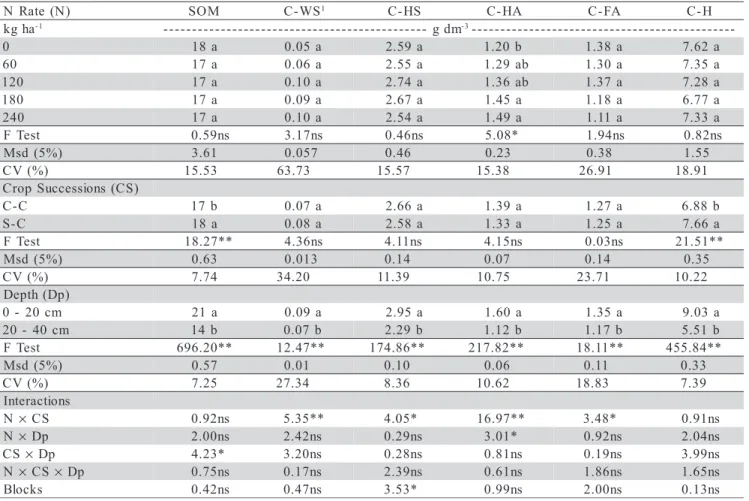
The soybean-corn succession presented higher SOM contents (P < 0.01) than the corn-corn succession, with a significant effect of the interaction between crop successions and sampling depths (Table 2). When the
ef-fects of this interaction are partitioned (Figure 1), the dif-ference between SOM contents in both crop successions was restricted to the depth from 0 to 20 cm, where the soybean-corn succession was higher than the corn-corn succession by about 2 g dm-3 (P < 0.05).
Table 2 - Soil organic matter (SOM) and organic C in the organic fractions, after nitrogen sidedressing and in corn-corn (C-C) and soybean-corn (S-(C-C) successions.
ns, * and **: non-significant, significant at 5 and 1% probability, respectively; C: Carbon; WS: water-soluble fraction; HS: humic substances fraction; HA: humic acids fraction; FA: fulvic acids fraction; H: humin fraction; Msd: Minimum significant difference; CV: Coefficient of variation. ) N ( e t a R
N SOM C-WS1 C-HS C-HA C-FA C-H
a h g
k -1 ---------------------------------------------- gdm-3---------------------------------------------
-0 18a 0.05a 2.59a 1.20 b 1.38a 7.62a 0
6 17a 0.06a 2.55a 1.29ab 1.30a 7.35a 0
2
1 17a 0.10a 2.74a 1.36ab 1.37a 7.28a 0
8
1 17a 0.09a 2.67a 1.45a 1.18a 6.77a 0
4
2 17a 0.10a 2.54a 1.49a 1.11a 7.33a t
s e T
F 0.59ns 3.17ns 0.46ns 5.08* 1.94ns 0.82ns ) % 5 ( d s
M 3.61 0.057 0.46 0.23 0.38 1.55 )
% ( V
C 15.53 63.73 15.57 15.38 26.91 18.91 ) S C ( s n o i s s e c c u S p o r C C
-C 17b 0.07a 2.66a 1.39a 1.27a 6.88 b C
-S 18a 0.08a 2.58a 1.33a 1.25a 7.66a t
s e T
F 18.27** 4.36ns 4.11ns 4.15ns 0.03ns 21.51** ) % 5 ( d s
M 0.63 0.013 0.14 0.07 0.14 0.35 )
% ( V
C 7.74 34.20 11.39 10.75 23.71 10.22 ) p D ( h t p e D m c 0 2
-0 21a 0.09a 2.95a 1.60a 1.35a 9.03a m c 0 4 -0
2 14b 0.07b 2.29 b 1.12 b 1.17b 5.51 b t
s e T
F 696.20** 12.47** 174.86** 217.82** 18.11** 455.84** ) % 5 ( d s
M 0.57 0.01 0.10 0.06 0.11 0.33 )
% ( V
C 7.25 27.34 8.36 10.62 18.83 7.39 s n o i t c a r e t n I
N× CS 0.92ns 5.35** 4.05* 16.97** 3.48* 0.91ns N× Dp 2.00ns 2.42ns 0.29ns 3.01* 0.92ns 2.04ns
S
C × Dp 4.23* 3.20ns 0.28ns 0.81ns 0.19ns 3.99ns N× CS× Dp 0.75ns 0.17ns 2.39ns 0.61ns 1.86ns 1.65ns
s k c o l
B 0.42ns 0.47ns 3.53* 0.99ns 2.00ns 0.13ns
13Ab 14Ab
20Ba 22Aa
11 13 15 17 19 21 23
1
SOM (g dm )-3
S-C C-C
0 - 20 cm
20 - 40 cm
The amount of residues yielded by soybean tops (7,950 kg ha-1 dry matter) was lower than those of corn (15,470 kg ha-1 dry matter) grown in the same season. In addition, there were about 136% more N in the dry mat-ter of the soybean in relation to the dry matmat-ter of corn, which suggests that the legume residues undergo faster decomposition. Although root dry matter yield was not determined, these data were estimated from results ob-tained by Buyanovsky & Wagner (1986), considering root: top ratios of 0.37 and 0.84 for soybean and corn, respectively, at the 0 to 20 cm depth. Thus, the theoreti-cal dry matter yields for soybean and corn roots were about 2,940 and 12,990 kg ha-1, respectively. With regard to dry matter yield in the tops of the last corn crop, the yield obtained after soybean was 278 kg ha-1 higher than that obtained after corn. In long-term experiments, a greater input of crop residues (Havlin et al., 1990; Varvel, 1994; Bayer & Mielniczuk, 1997) and lower soil tillage intensity (Bayer & Mielniczuk, 1997) are decisive fac-tors to increase SOM contents in cropping systems. How-ever, based on the data presented, the input of organic residues into the soil was not the factor responsible for the higher SOM contents verified in the soybean-corn succession.
Considering the amounts of residues added by the soybean and corn crops and the short experimental pe-riod evaluated in the present study, it is believed that the chemical composition of the organic residues from these two crops was the factor responsible for the higher SOM contents in the soybean-corn succession. The chemical composition analysis conducted by Broder & Wagner (1988) in the vegetative tops of soybean and corn plants corroborate this reasoning. Those authors observed that soybean and corn residues showed lignin concentrations of 119 and 56 g kg-1, respectively, that is, the soybean residues had approximately 113% more lignin than corn residues. Taking into account the dry matter yields for top plants, this would result in 945 and 866 kg ha-1 lignin, respectively, for soybean and corn plots.
N concentrations 126% higher and, theoretically, lignin concentrations 113% higher would result in a greater amount of basic substrate for the formation of hu-mus in the soybean-corn succession, according to the main humus synthesis pathway, among the four theories cited by Stevenson (1994). In this pathway, the polymer-ization of polyphenols from lignified sources to quino-nes, and the condensation of the latter with amino com-pounds, results in nitrogen polymers with complex struc-tures and which are resistant to biodegradation, charac-teristically similar to compounds of the C-HA fraction. Although no difference was observed between C-HA con-tents in the corn-corn and soybean-corn successions (Table 2), the higher yield of humic compounds, associ-ated with the clayey character of the soil under study (590 g kg-1 clay), still explain the higher SOM contents in the
soybean-corn succession. Compounds in the C-HA frac-tion can become complexed to mineral colloids and not be extracted with the alkaline solution, thus forming the humin fraction (C-H) of SOM (Hatcher et al., 1985; Rice 2001). This argument is supported by the fact that among the organic fractions, the only difference (P < 0.01) be-tween crop successions was observed for C-H contents, with an average value of about 13% between both soil depths (Table 2).
The C-H fraction represents compounds closely linked to soil mineral colloids; in addition to their charge density, relatively smaller than in other SOM humified fractions, the C-H fraction is highly cross-linked (Hayes & Himes, 1986), which imparts to the SOM a high resis-tance to degradation, so that a vast variety of enzymes or a single highly-versatile enzyme are required for an effective mineralization process (Rice, 2001). Also, ac-cording to Mendonça & Silva (2004), the mean residence time of organic compounds associated with the soil min-eral fraction is positively correlated with the surface area of the minerals. At last, the greater SOM stability in the soybean-corn succession explains the greater SOM con-tents found in them. Sousa & Melo (2003) did not ob-serve differences in SOM and C-H contents between a biennial corn-fallow-soybean-fallow succession and an annual corn-fallow succession, after four years of study in conventional and no-till systems. Gregorich et al. (2001), using the 13C solid-state nuclear magnetic reso-nance technique, observed greater amounts of aromatic C in soils of corn grown in rotation with legumes, in re-lation to monoculture corn, which suggests that a higher amount of compounds similar to or derived from lignin was supplied to the soil organic C in the first system.
In general, for both crop successions the C-H fraction was predominant in the SOM, followed by com-pounds from the C-HA and C-FA fractions, which had similar percentages, and by the C-WS fraction (Figure 2). In Brazilian clayey-textured Oxisols, the major part of the SOM consists of the C-H fraction (Volkoff et al., 1978; Nascimento et al., 1991; Mendonça & Rowell, 1994), while the proportion between the C-HA and C-FA frac-tions is variable, and a greater amount of C-FA is gener-ally observed in relation to C-AH (Volkoff et al., 1978; Nascimento et al., 1991; Mendonça & Rowell, 1994). In samples of a loamy-textured Typic Hapludox, Yagi et al. (2003) observed that the C-H fraction represented about 58% of SOM, and the C-HA fraction was predominant over the C-FA fraction. The higher C supplies found in more humified SOM fractions reflect the physical and chemical stability of organomineral complexes and of al-kaline-soluble humic substances (Bayer et al., 2002).
was not proportional to depth increase. While there was a decrease of about 33% in SOM from the 0 to 20 cm layer to the 20 to 40 cm layer, the percentages of de-crease of C-WS, C-HS, C-FA, C-HA, and C-H were about 22%, 22%, 17%, 30%, and 37%, respectively, in those layers. The differences in the amounts of C-HA and C-H in the SOM between the evaluated depths could be associated with the synthesis of compounds that make up those fractions in the layer nearest to the surface, due to the constant additions of crop residues, both before and during the experimental period. On the other hand, the compounds in the C-FA fraction are less polymer-ized, have a smaller molecular weight and, mainly, greater reactivity than the compounds in the C-HA frac-tion, due to the higher number of carboxylic groupings that exist in their structures (Stevenson, 1994), favor-ing complexation with sesquioxides and silicates, and consequently the protection against microbial attack and maintenance in the system (Mendonça & Rowell, 1994; Yagi et al., 2003).
A reduction was observed for the C-HA/C-FA ra-tio, from 1.18 at the 0 to 20 cm depth, to 0.96 at the 20 to 40 cm depth (Table 2), in a similar way as observed by Nascimento et al. (1991) and Mendonça & Rowell (1994), who also studied the effects of cultivations on the SOM fractions. The HA/FA ratio usually decreases with
depth (Stevenson, 1994), because of the greater mobility of compounds in the C-FA fraction in relation to those in the C-HA fraction in the soil (Mendonça & Rowell, 1994).
There was an interaction between nitrogen sidedressing and crop successions on the C-WS fraction (Table 2). Nitrogen fertilization did not affect the C-WS contents in the soybean-corn succession; the N effect was quadratic in the corn-corn succession, and the dose equivalent to 176 kg ha-1 N would lead to the maximum theoretical C-WS content of about 0.10 g dm-3, or the equivalent to 200 kg ha-1 of this form of organic C (Fig-ure 3). In the soybean-corn succession, the effect of N doses on the C-WS contents was null, probably due to the contribution of N from the legume residues. With re-gard to the mean C-WS contents in the soybean-corn suc-cession, nitrogen fertilization in the corn-corn succession increased C-WS contents at the doses of 120, 180, and 240 kg ha-1 N by about 15%, 24%, and 12%, respectively (Figure 3). The results obtained for this organic fraction could be the evidence of a priming effect, that is, theo-retically the application of inorganic nitrogen or fresh or-ganic material to the soil stimulates microbial activity and the mineralization of N forms present in SOM (Jansson & Persson, 1982). Water-soluble carbon reflects the ini-tial stage of degradation of organic residues in the soil, by which insoluble materials are hydrolyzed to amino ac-ids and soluble sugars (Sousa & Melo, 2003). However, Duda et al. (1999) previously observed a negative and sig-nificant correlation (r = -0.84*) between C forms ex-tracted with water, at a 1:2 soil:extractor ratio and min-eralizable carbon, obtained through an incubation assay, indicating that both are controlled by soil biological ac-tivity. Sousa & Melo (2003) found higher nitrogen con-tents in the SOM water-soluble fraction (N-WS), ex-tracted by a method similar to the one used in the present study, in treatments that included legumes in crop
rota-Figure 2 - Mean percentage distribution of C in the water-soluble (C-WS), humic acids (C-HA), fulvic acids (C-FA), and humin (C-H) fractions, in corn-corn (C-C) and soybean-corn (S-C) successions.
S-C
1% 12%
13%
74% C-C
1%
13%
14%
72%
C-WS
C-FA
C-HA
C-H
Figure 3 - Carbon in the water-soluble fraction (C-WS) as a function of nitrogen sidedressing, in corn-corn (C-C) and soybean-corn (S-C) successions. **significant at 1%.
u
n 0.02 0.04 0.06 0.08 0.10 0.12 0.14
0 60 120 180 240
C-C F=9.6801** R = 0.7902 y = 0.00000233x + 0.0008220x + 0.0267142 2
S-C y = 0.08
N Doses (kg ha )-1
C-WS
(g
dm
)
tion. According to the same authors, the compounds in the N-WS fraction are readily assimilable, or can be found in similar forms, and can be used as a source of energy by microorganisms, due to the limiting amount of C in those plants.
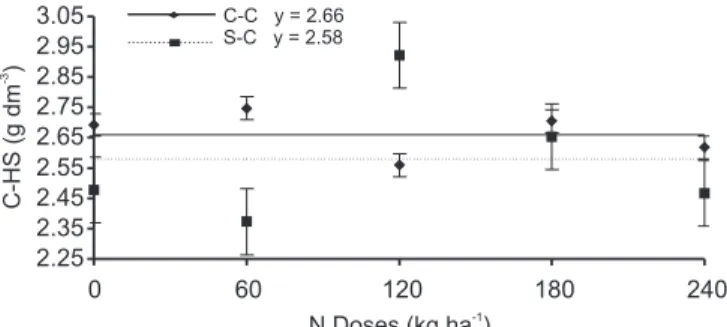
The carbon contents in the C-HS fraction were affected by the interaction between sidedressing N doses and crop successions (Table 2); the data could not be fit-ted to polynomial regression models (Figure 4). The un-defined trend for the C-HS contents could be associated with the distinct results obtained for the C-HA (Figure 5a) and C-FA (Figure 6) fractions, which make up this fraction.
Nitrogen sidedressing increased the mean C-HA contents (Table 2). An alternation between crop succes-sions at higher C-HA contents was observed in both suc-cessions (Figure 5a). Sousa & Melo (2003) did not ob-serve differences between C-HA contents at the depth from 0 to 20 cm, in the corn monoculture and soybean rotation production systems. Nascimento et al. (1991) studied soil tillage methods and cropping systems and observed an effect of the interaction of both factors on the C-HA contents in the 15 to 20 cm depth layer. Ac-cording to these authors, a combination between a plough/ scarifier and the soybean-corn succession, during four consecutive years, resulted in C-HA contents about 61% and 23% higher than in treatments with a heavy harrow and no-till in the same crop succession, respectively, and about 27% higher than monoculture corn and soil tillage using a scarifier.
For both crop successions, the effect of nitrogen fertilization on C-HA contents was quadratic, and maxi-mum theoretical contents of 1.49 g dm-3 C-HA at a dose of 149 kg ha-1 N in the soybean-corn succession, and of 1.67 g dm-3 C-HA at a dose of 240 kg ha-1 N in the corn-corn succession were observed (Figure 5a). The C-HA decrease in the soybean-corn succession after application of a 149 kg ha-1 N dose could be associated with the N supplied by the soybean crop residues. The urea-released ammonia may be complexed with phenols and quinones, producing compounds with similar characteristics to the compounds of the C-HA fraction (Stevenson, 1994) which in part could explain the obtained results. The pe-culiar characteristics of phenols and quinones complexed with ammonia include high chemical stability and resis-tance to microbial decomposition (Nommik & Vahtras, 1982). The results obtained in the present study are simi-lar to those reported by Tan et al. (1972), who observed a significant correlation (r = 0.82 **) between total ni-trogen contents in the soil and HA contents. The C-HA content was higher at the 0 to 20 cm layer, even as a consequence of total organic C content, and also in-creased as N doses inin-creased, at both depths (Figure 5b).
Figure 5 - Carbon in the humic acids fraction (C-HA) as a function of nitrogen sidedressing: a) in corn-corn (C-C) and soybean-corn (S-C) successions, and b) sampling depths. *and **significant at 5 and 1%, respectively.
Figure 6 - Carbon in the fulvic acids fraction (C-FA) as a function of nitrogen sidedressing, in corn-corn (C-C) and soybean-corn (S-C) successions. **significant at 1%.
Figure 4 - Carbon in the humic substances fraction (C-HS) as a function of nitrogen sidedressing, in corn-corn (C-C) and soybean-corn (S-C) successions.
1.00 1.10 1.20 1.30 1.40 1.50 1.60 1.70 1.80 1.90
0 60 120 180 240
N Doses (kg ha )-1
C-HA
(g
dm
)
-3
u
n
C-C F = 11.1314** R = 0.7997 y = 0.00001631x - 0.0025958x + 1.3552 2
S-C F = 14.1152** R = 0.7513 y = -0.00001969x + 0.0058803x + 1.0472 2
a)
0.90 1.10 1.30 1.50 1.70 1.90
0 60 120 180 240
N Doses (kg ha )-1
C-HA
(g
dm
)
-3
u
n b)
0 - 20 cm F = 6.9416* R = 0.7259 y = 0.0011625x + 1.4612
20 - 40 cm F = 31.5392** R = 0.9690 y = 0.0129166x + 0.96902
0.70 0.90 1.10 1.30 1.50 1.70
0 60 120 180 240
N Doses (kg ha )-1
C
-F
A(
gd
m
)
-3
u C-C F = 4.9138* R = 0.6624 y = 0.00001537x + 0.0020654x + 1.35322 2
n S-C y = 1.25
2.25 2.35 2.45 2.55 2.65 2.75 2.85 2.95 3.05
0 60 120 180 240
u
n
C-C y = 2.66 S-C y = 2.58
N Doses (kg ha )-1
C-HS
(g
dm
)
Nitrogen sidedressing only affected the C-FA contents in the corn-corn succession, where the values best fitted the quadratic regression model (Figure 6). The regression equation allowed us to observe that the maxi-mum theoretical C-FA content, about 1.42 g dm-3, would be obtained with the application of about 67 kg ha-1
N. In the treatment without nitrogen fertilization, the C-FA contents were similar in both crop successions, and ni-trogen fertilization promoted great variability in those contents between crop successions, alternating higher and lower contents at each fertilization level (Figure 6). In the no-till system, Sousa & Melo (2003) observed that corn grown in rotation with soybean presented higher C-FA contents at the depth from 0 to 5 cm, in relation to mo-noculture corn, while in the conventional system there was no difference between corn production systems. The unstable character of the compounds that make up this fraction, which sometimes present themselves as synthe-sis precursors, and sometimes as products from the de-composition of compounds that constitute C-HA (Tate III, 1987), and the fact that in the present study the carbohy-drates in this fraction were not separated (Stevenson, 1994), may justify why the results did not present a clear trend.
REFERENCES
BAYER, C.; MIELNICZUK, J. Características químicas do solo afetadas por métodos de preparo e sistemas de cultura. Revista Brasileira de
Ciência do Solo, v.21, p.105-112, 1997.
BAYER, C.; MIELNICZUK, J. Dinâmica e função da matéria orgânica. In: SANTOS, G.A.; CAMARGO, F.A.O. Fundamentos da matéria
orgânica do solo. Ecossistemas tropicais & subtropicais. Porto Alegre:
Gênesis, 1999. p.9-26.
BAYER, C.; DICK, D.P.; RIBEIRO, G.M.; SCHEUERMANN, K.K. Carbon stocks in organic matter fractions as affected by land use and soil management, with emphasis on no-tillage effect. Ciência Rural, v.32, p.401-406, 2002.
BRODER, M.W.; WAGNER, G.H. Microbial colonization and decomposition of corn, wheat and soybean residue. Soil Science Society
of America Journal, v.52, p.112-117, 1988.
BUYANOVSKY, G.A.; WAGNER, G.H. Post-harvest residue input to cropland. Plant and Soil, v.93, p.57-65, 1986.
CADISH, G.; OLIVEIRA, O.C.; CANTARUTTI, R.B.; CARVALHO, E.; URQUIAGA, S. The role of legume quality in soil carbon dynamics in savannah ecosystems. In: BERGSTRÖM, L.; KIRCHMANN, H.
Carbon and nutrient dynamics in natural and agricultural
ecosystems. Oxon: CAB International, 1998. p.47-70.
DUDA, G.P.; CAMPELLO, E.F.C.; MENDONÇA, E.S.; LOURES, J.L.; DOMINGOS, M. Avaliação de frações da matéria orgânica do solo para caracterização de áreas degradadas. Revista Brasileira de Ciência do
Solo, v.23, p.723-728, 1999.
GREGORICH, E.G.; DRURY, C.F.; BALDOCK, J.A. Changes in soil carbon under long-term maize in monoculture and legume-based rotation.
Canadian Journal of Soil Science, v.81, p.21-31, 2001.
HATCHER, P.G.; BREGER, I.A.; MACIEL, G.E.; SZVENYI, N.M. Geochemistry of humin. In: AIKEN, R.; MCKNIGHT, D.M.; WERSHAW, R.L. Humic substances in soil, sediment, and water.
Geochemistry, isolation and characterization. New York: John Wiley & Sons, 1985. p.275-302.
HAVLIN, J.L.; KISSEL, D.E.; MADDUX, L.D.; CLAASSEN, M.M.; LONG, J.H. Crop rotation and tillage effects on soil organic carbon and nitrogen.
Soil Science Society of America Journal, v.54, p.448-452, 1990.
HAYES, M.H.B.; HIMES, F.L. Nature and properties of humus-mineral complexes. In: HUANG, P.M.; SCHNITZER, M. (Ed.) Interactions of
soil minerals with natural organics and microbes. Madison: SSSA,
1986. p.103-158.
JANSSON, S.L.; PERSSON, J. Mineralization and immobilization of soil nitrogen. In: STEVENSON, F.J. (Ed.). Nitrogen in agricultural soils.
Madison: ASA; CSSA; SSSA, 1982. p.229-252.
LIANG, B.C.; GREGORICH, E.G.; MacKENZIE, A.F.; SCHNITZER, M.; VORONEY, R.P.; MONREAL, C.M.; BEYAERT, R.P. Retention and turnover of corn residue carbon in some eastern Canadian soils. Soil
Science Society of America Journal, v.62, p.1361-1366, 1998.
KIEHL, E.J. Fertilizantes orgânicos. Piracicaba: Ceres, 1985. 492p. MacCARTHY, P. The principles of humic substances. Soil Science, v.166,
p.738-751, 2001.
MENDONÇA, E.S.; ROWELL, D.L. Dinâmica do alumínio e de diferentes frações orgânicas de um latossolo argiloso sob cerrado e soja. Revista
Brasileira de Ciência do Solo, v.18, p.295-303, 1994.
MENDONÇA, E.S.; SILVA, I.R. Organic matter and properties of tropical soils. In: INTERNATIONAL MEETING OF IHSS, 12., São Pedro, 2004.
Humic substances and soil and water environment; proceedings.São
Carlos: Embrapa Instrumentação Agropecuária, 2004. p.607-608. MIELNICZUK, J. Matéria orgânica e a sustentabilidade de sistemas
agrícolas. In: SANTOS, G.A.; CAMARGO, F.A.O. Fundamentos da
matéria orgânica do solo. Ecossistemas tropicais & subtropicais. Porto
Alegre: Gênesis, 1999. p.1-8.
NASCIMENTO, E.J.; MOURA FILHO, W.; COSTA, L.M.; CRUZ, J.C.; REGAZZI, A.J. Dinâmica da matéria orgânica em um Latossolo Vermelho-Escuro distrófico, fase cerrado, submetido a diferentes sistemas de manejo. Revista Ceres, v.28, p.513-521, 1991.
NOMMIK, H.; VAHTRAS, K. Retention and fixation of ammonium and ammonia in soils. In: STEVENSON, F.J. (Ed.) Nitrogen in agricultural
soils. Madison: ASA; CSSA; SSSA, 1982. p.123-171.
OLIVEIRA, J.B.; PRADO, H. Levantamento pedológico semi detalhado
do Estado de São Paulo: quadrícula de Ribeirão Preto. Campinas:
EMBRAPA; IAC, 1987. 133p. (Boletim Científico, 7).
RAIJ, B. van; QUAGGIO, J.A.; CANTARELLA, H.; FERREIRA, M.E.; LOPES, A.S.; BATAGLIA, O.C. Análise química do solo para fins
de fertilidade. Campinas: Fundação Cargill, 1987. 170p.
RICE, J.A. Humin. Soil Science, v.166, p.848-857, 2001.
SOUSA, W.J.O.; MELO, W.J. Matéria orgânica de um Latossolo submetido a diferentes sistemas de produção de milho. Revista Brasileira de
Ciência do Solo, v.27, p.1113-1122, 2003.
STEVENSON, F.J. Humus chemistry: genesis, composition, reactions. 2.ed. New York: John Willey & Sons, 1994. 512p.
TAN, K.H.; BEATY, E.R.; McCREERY, R.A.; POWELL, J.D. Humic-fulvic acid content in soils as related to ley clipping management and fertilization. Soil Science Society of America Proceedings, v.36, p.565-567, 1972.
TATE III, R.L. Soil organic matter – Biological and ecological effects. New York: John Wiley & Sons, 1987. 340p.
VARGAS, M.A.T.; HUNGRIA, M. Fixação biológica do nitrogênio na cultura da soja. In: VARGAS, M.A.T.; HUNGRIA, M. (Ed.) Biologia
dos solos dos cerrados. Planaltina: EMBRAPA; CPAC, 1997.
p.295-360.
VARVEL, G.E. Rotation and nitrogen fertilization effects on changes in soil carbon and nitrogen. Agronomy Journal, v.86, p.319-325, 1994. VOLKOFF, B.; FLEXOR, J.M.; SANTA ISABEL, L.; SANTA ISABEL,
M. Natureza do húmus nos latossolos distróficos da Bahia. Revista
Brasileira de Ciência do Solo, v.2, p.59-63, 1978.
YAGI, R.; FERREIRA, M.E.; CRUZ, M.C.P.; BARBOSA, J.C. Organic matter fractions and soil fertility under the influence of liming, vermicompost and cattle manure. Scientia Agricola, v.60, p.549-557, 2003.