Effe ct o f asthm a se ve rity o n sym pto m
pe rce ptio n in childho o d asthm a
1Divisão de Pediatria, Hospital Darcy Vargas, São Paulo, SP, Brasil
Departamentos de 2Clínica Médica and 3Patologia, Faculdade de Medicina,
Universidade de São Paulo, São Paulo, SP, Brasil A.L.B. Cabral1,2,3,
G.M. Conceição3,
P.H.N. Saldiva3
and M.A. Martins2
Abstract
Individual ability to perceive airway obstruction varies substantially. The factors influencing the perception of asthma are probably numer-ous and not well established in children. The present study was designed to examine the influence of asthma severity, use of preven-tive medication, age and gender on the association between respiratory symptoms (RS) and peak expiratory flow (PEF) rates in asthmatic children. We followed 92 asthmatic children, aged 6 to 16 years, for five months. Symptom scores were recorded daily and PEF was measured twice a day. The correlations among variables at the within-person level over time were analyzed for each child and for the pooled data by multivariate analysis. After pooling the data, there was a significant (P<0.05) correlation between each symptom and PEF; 60% of the children were accurate perceivers (defined by a statistically significant correlation between symptoms and PEF across time) for diurnal symptoms and 37% for nocturnal symptoms. The accuracy of perception was independent of asthma severity, age, gender or the use of preventive medication. Symptom perception is inaccurate in a substantial number of asthmatic children, independently of clinical severity, age, gender or use of preventive medication. It is not clear why some asthmatic patients are capable of accurately perceiving the severity of airway obstruction while others are not.
Co rre spo nde nce M.A. Martins
Departamento de Clínica Médica FM, USP
Av. Dr. Arnaldo, 455, Sala 1216 01246-903 São Paulo, SP Brasil
Fax: + 55-11-3083-0827/3085-0992 E-mail: mmartins@ usp.br
Research supported by CNPq, FAPESP and PRO NEX-MCT.
Received June 11, 2001 Accepted January 2, 2002
Ke y wo rds
·Asthma
·Asthma severity
·Pulmonary function tests ·Symptom perception
·Childhood asthma
Intro ductio n
There is general agreement that symptom scores are unreliable as the only index of asthma severity because they are subjective, suffer psychological influences, vary accord-ing to lifestyle and may be reduced by the use of beta 2 agonists (1-3). Studies designed to assess asthma severity often demonstrate only a weak correlation between the degree of airway obstruction and the magnitude of asthma symptoms (1-3).
Inaccuracy of symptom perception can occur within two extremes of a spectrum:
In an attempt to overcome these prob-lems, the use of objective measures of air-flow obstruction has been advocated by sev-eral clinical guidelines (5-7). However, the ability to use a peak flow meter and the adherence to peak flow monitoring in chil-dren with asthma also require consideration. It is possible that not all asthmatics benefit from objective measures of airway obstruc-tion, since the good perceiver group could be adequately followed by the assessment of symptoms. Properly characterizing the good perceivers may simplify the follow-up of some asthmatic patients, helping them evalu-ate their symptoms, their importance and the appropriate action to take when their condi-tion deteriorates.
Most studies of asthma perception have been conducted on adult patients (1,3,8,9) and only a few have been performed on children in natural environments (2,10,11). Factors that might influence the perception of asthma symptoms such as gender, age, sex, asthma severity and use of medications have not been fully addressed in children.
The present study was designed to deter-mine if the perception of airflow obstruction during spontaneous changes in the severity of airway obstruction depends on asthma severity, sex, age or use of preventive medi-cation in children with asthma.
Patie nts and Me tho ds
Study subje cts
The Institutional Review Board approved the protocol and parents gave informed writ-ten consent for their children. The data for this study were obtained from a group of 92 asthmatic children aged 6 to 16 years, who had been admitted to a five-month program for asthmatic children at a center for physi-cal activities. All children had a physician diagnosis of asthma. These children were followed from May to September, corre-sponding to the autumn and winter seasons
of the southern hemisphere. During this pe-riod upper respiratory infections are frequent and the likelihood of variations in peak expi-ratory flow (PEF) rate is greater even for children with mild asthma.
There was no selection of patients, since all patients who manifested the desire to adhere to the study protocol were accepted. Patients were classified as having mild (N = 24), moderate (N = 34) and severe asthma (N = 34) according to the International Consen-sus Report on Diagnosis and Treatment of Asthma (5) based on the replies to a ques-tionnaire administered by an interviewer and on lung function tests. The questions in-quired about the frequency and intensity of symptoms, frequency of exacerbations, need for hospitalization, and medications used in the previous 12 months.
Some children were taking preventive medications (nedocromil, cromoglycate, in-haled beclomethasone) that were continued throughout the 5-month study; for episodes of exacerbations they received oral steroids.
Study de sign
-were scored individually using a binary code (0, absence, or 1, presence). The coding of symptoms was computed for the day and night. An additional estimator of symptom severity was obtained by summing each in-dividual code of symptoms recorded for the day period, which in our case ranged from 0 (minimum) to 3 (maximum). PEF rate in the morning (before the use of any medication) and in the evening were also recorded using
an Assess PEF meter (Health Scan, Cedar
Grove, NJ, USA).The importance of
record-ing symptoms and PEF was stressed durrecord-ing the classes and the diaries were used to teach the patient and their parents to recognize asthma control and early signs of an exacer-bation. Instructions were also given about the correct technique for obtaining a PEF reading. The best of three attempts was re-corded on each occasion. The diaries were completed with the help or under the super-vision of the parents. The best PEF was considered to be the maximal PEF reading achieved at any time during the study period. The use of medication was also recorded on the diary card.
D ata analysis
The correlation between symptoms and peak flow was calculated on a daily basis using the morning peak flow measurement. We used morning PEF since Reddel et al. (12) showed that the minimum morning prebronchodilator PEF over a week was the most useful index in the management of asthma. In addition, morning measurements of PEF had a smaller number of missing points in our series.
The children were classified into groups according to asthma severity (mild, moder-ate and severe), three age ranges (6 to 9 years, 10 to 11 years, and 12 to 16 years), gender, and use of preventive medication (yes or no).
In the first approach we examined the within-person correlations between
symp-toms and PEF for each patient (N = 92) separately to identify and account for indi-vidual differences in symptom perception accuracy. Individual multiple regressions of each symptom on the morning PEF were performed during each patients assessment, controlling for up to third-order autocorrela-tion using a generalized least-squares ap-proach. In order to model a possible varia-tion in PEF along the study period due to non-observed factors (such as non-linear change in age or height), a time variable (assuming values from one to the number of days of follow-up) as well as the squared time variable was included in the model.
Children showing no variability of the symptom under study were excluded from the respective analysis (Figure 1). A signifi-cant correlation between symptoms and PEF was defined by a negative coefficient, with the level of significance set at 0.05. Patients showing a significant correlation were con-sidered to be accurate perceivers. The pro-portion of individuals exhibiting a signifi-cant correlation was compared across the groups (defined by asthma severity, age, gen-der and use of preventive medication) by the chi-square test.
In the second approach we performed regression models similar to those described above but using all data pooled together. The dependent variable was the morning PEF and the independent variables were the stud-ied symptom, time, and squared time, plus a dummy variable for each child in order to model the variability in PEF due to differ-ences among children. This model was ini-tially adjusted for all the children and then for each group of patients described above. These analyses were performed using the AUTOREG procedure of the SAS statistical package (SAS Institute Inc., Cary, NC, USA).
Re sults
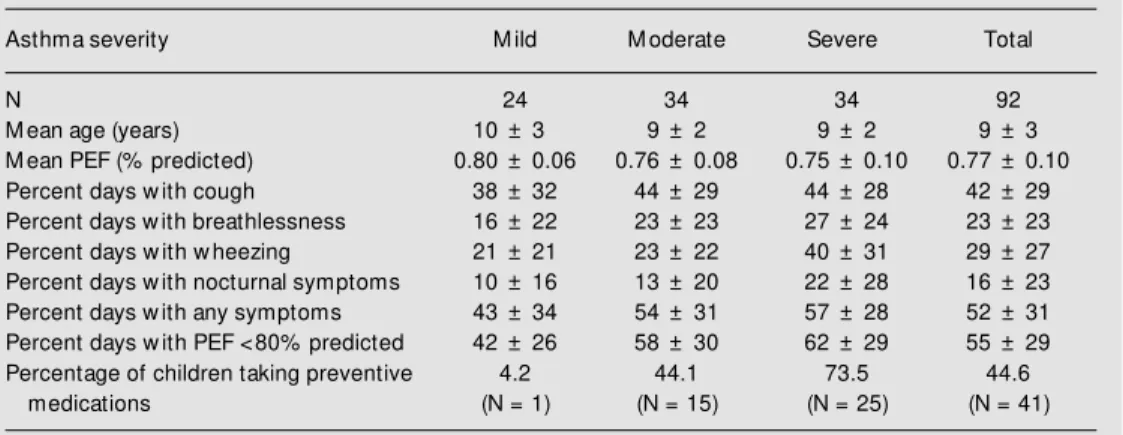
Only 48 (52%) children had at least 90 con-secutive days of observation, suggesting that the adherence to PEF monitoring decreases with time. There were no significant differ-ences between the groups of children that provided full and missing data with respect to asthma severity, age, sex and the number of accurate perceivers. The clinical charac-teristics of the children studied are presented in Table 1.
Figures 1-4 present the percentage of children exhibiting a significant correlation between perception of symptoms and PEF values according to asthma severity, gender, age or prescription of preventive medica-tions. A significant correlation was observed in 37.2, 37.8, 36.6 and 37.1% of the chil-dren, for cough, breathlessness, wheezing and nocturnal symptoms, respectively. When the diurnal symptoms were considered to-gether, the percentage of significant correla-tions increased to 59.8%.
Figure 1 shows the percentage of chil-dren exhibiting a significant correlation be-tween symptoms and PEF, divided into three groups according to asthma severity. We did not observe a significant influence of asthma severity on the percentage of children who showed a significant correlation between PEF values and cough (86 children studied, P = 0.09), breathlessness (N = 82, P = 0.52), wheezing (N = 82, P = 0.74), nocturnal
symptoms (N = 70, P = 0.10) or total diurnal symptoms (cough, breathlessness and wheez-ing, N = 87, P = 0.51).
We did not observe a significant influ-ence of gender on the percentage of children who showed a significant correlation be-tween symptoms and PEF values (Figure 2). Although more girls tended to have accurate perception, these differences did not reach statistical significance (P = 0.12, 0.12 and 0.24 for cough, breathlessness and wheez-ing, respectively). Furthermore, there was a similar percentage of boys and girls exhibit-ing a significant correlation between day-time symptoms and PEF (P = 0.89) and between nocturnal symptoms and PEF (P = 0.39).
The influence of age on perception of airway obstruction can be observed in Fig-ure 3. We did not observe any significant effect of age on the percentage of children with a significant correlation between PEF and cough (P = 0.90), breathlessness (P = 0.54), wheezing (P = 0.96), total diurnal symptoms (P = 0.45) or nocturnal symptoms (P = 0.45).
Figure 4 shows the data concerning the influence of the use of preventive medicine (nedocromil, cromoglycate or beclometha-sone) on the percentage of children who presented a significant correlation between symptoms and PEF values. There was a
ten-Table 1. Clinical characteristics of the children w ho participated in the study.
Asthma severity M ild M oderate Severe Total
N 24 34 34 92
M ean age (years) 10 ± 3 9 ± 2 9 ± 2 9 ± 3
M ean PEF (% predicted) 0.80 ± 0.06 0.76 ± 0.08 0.75 ± 0.10 0.77 ± 0.10
Percent days w ith cough 38 ± 32 44 ± 29 44 ± 28 42 ± 29
Percent days w ith breathlessness 16 ± 22 23 ± 23 27 ± 24 23 ± 23
Percent days w ith w heezing 21 ± 21 23 ± 22 40 ± 31 29 ± 27
Percent days w ith nocturnal symptoms 10 ± 16 13 ± 20 22 ± 28 16 ± 23
Percent days w ith any symptoms 43 ± 34 54 ± 31 57 ± 28 52 ± 31
Percent days w ith PEF <80% predicted 42 ± 26 58 ± 30 62 ± 29 55 ± 29
Percentage of children taking preventive 4.2 44.1 73.5 44.6
medications (N = 1) (N = 15) (N = 25) (N = 41)
Nig ht s
ym ptom s P e rc e n ta g e o f c h ild re n 70 60 50 40 30 20 10 Day sym ptom s Whe ezin g Bre athl essn ess Cou gh 6-9 years 10-12 years >12 years Total
Figure 3. Influence of age on the percent age of children t hat show ed a significant correlation betw een peak expiratory flow values and symptoms (P = 0.90, 0.54, 0.96, 0.45 and 0.45 for cough, breathlessness, w heez-ing, daytime symptoms and noc-turnal symptoms, respectively). Figure 1. Percentage of children w ith a significant correlation be-tw een symptoms and peak ex-piratory flow (PEF), divided into t hree groups according t o asthma severity. There w as no influence of asthma severity on the percentage of children w ith a significant correlation betw een PEF values and cough (86 chil-dren studied, P = 0.09), breath-lessness (N = 82, P = 0.52), w heezing (N = 82, P = 0.74), nocturnal symptoms (N = 70, P = 0.10) or total diurnal symp-tom s (cough, breathlessness and w heezing, N = 87, P = 0.51).
Nig ht s
ym ptom s P e rc e n ta g e o f c h ild re n 70 60 50 40 30 20 10 Day sym ptom s Whe ezin g Bre athl essn ess Cou gh M ild M oderate Severe Total Nig ht s
ym ptom s P e rc e n ta g e o f c h ild re n 70 60 50 40 30 20 10 Day sym ptom s Whe ezin g Bre athl essn ess Cou gh
Boys Girls Total
Figure 2. Influence of gender on the percentage of children that show ed a significant correlation betw een peak expiratory flow values and symptoms (P = 0.12, 0.12, 0.24, 0.89 and 0.39 for cough, breathlessness, w heez-ing, daytime symptoms and noc-turnal symptoms, respectively). dency for more children who used
preven-tive medications to exhibit a significant cor-relation between symptoms and PEF, al-though these differences did not reach statis-tical significance (P = 0.08, 0.16, 0.14, 0.08 and 0.24 for cough, breathlessness, wheez-ing, total diurnal symptoms and nocturnal symptoms, respectively).
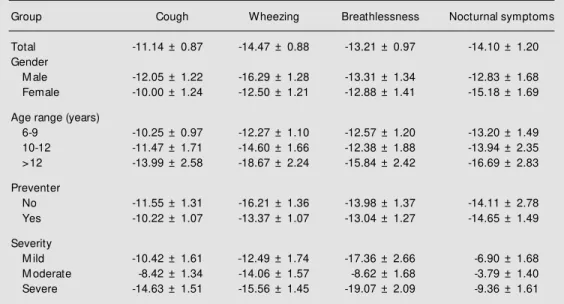
When the correlation coefficients between each asthma symptom and PEF values were calculated after pooling the data across pa-tients and observations and adjusting for autocorrelation, a significant correlation was observed between each symptom and PEF (P<0.05). The reduction of peak flow meas-ures associated with the presence of symp-toms were -11.14 l/min for cough, -14.47 l/min for wheezing, -13.21 l/min for breath-lessness and -14.10 l/min for nocturnal symp-toms. The coefficients calculated for each group of patients according to asthma sever-ity, age, gender and use of preventive medi-cations were similar within each group, sug-gesting that asthma severity, age, gender or use of a preventive medication had no effect on asthma perception (Table 2). These data confirmed the results of the individual anal-ysis.
D iscussio n
circa-dian rhythm (14), psychological factors such as negative emotions (15), and corticoster-oid treatment (16,17).
McFadden et al. (18) evaluated the rela-tionship between PEF and symptoms in asth-matics recovering from an acute attack and reported that patients became asymptomatic when PEF was on average 40-50% of the predicted value. Rubinfield and Pain (19) found that 15% of patients were unable to sense the presence of marked airway
ob-struction during methacholine-induced bron-choconstriction. Shim and William (9) sug-gested the concept of good and poor perceiv-ers of airway obstruction and showed a good group correlation between perceived changes in airway obstruction from day to day and measured changes in peak flow. Sly et al. (20) studied 14 children and found that they also were unable to accurately predict their degree of airway obstruction. They also ana-lyzed the accuracy of parental perceptions of their childs airway obstruction and found they were too unreliable. In the present study, we used a different approach than most of the previous studies. We considered accu-rate perceivers those children who presented a significant regression coefficient between PEF and symptoms. We observed that in 40% of the children studied there was no significant correlation between the presence of any diurnal symptom and PEF values and in 63% there was no correlation between nocturnal symptoms and PEF.
Some investigators have emphasized the influence of circadian rhythm on the accu-racy of symptom perception. Pfeiffer et al.
Nig ht s
ym ptom
s
P
e
rc
e
n
ta
g
e
o
f
c
h
ild
re
n
70
60
50
40
30
20
10
Day sym
ptom s
Whe ezin
g
Bre athl
essn ess Cou
gh
No Yes Total
Figure 4. Influence of the use of preventive medicine (nedocro-mil, cromoglycate or beclometh-asone) on the percentage of chil-dren that show ed a significant correlation betw een peak expi-ratory flow values and symp-toms (P = 0.08, 0.16, 0.14, 0.08 and 0.24 for cough, breathless-ness, w heezing, daytime symp-toms and nocturnal sympsymp-toms, respectively).
Table 2. M ultiple linear regression coefficients (l/min) w ith peak expiratory flow rate as dependent variable and symptoms as independent variables.
Group Cough Wheezing Breathlessness Nocturnal symptoms
Total -11.14 ± 0.87 -14.47 ± 0.88 -13.21 ± 0.97 -14.10 ± 1.20
Gender
M ale -12.05 ± 1.22 -16.29 ± 1.28 -13.31 ± 1.34 -12.83 ± 1.68
Female -10.00 ± 1.24 -12.50 ± 1.21 -12.88 ± 1.41 -15.18 ± 1.69
Age range (years)
6-9 -10.25 ± 0.97 -12.27 ± 1.10 -12.57 ± 1.20 -13.20 ± 1.49
10-12 -11.47 ± 1.71 -14.60 ± 1.66 -12.38 ± 1.88 -13.94 ± 2.35
>12 -13.99 ± 2.58 -18.67 ± 2.24 -15.84 ± 2.42 -16.69 ± 2.83
Preventer
No -11.55 ± 1.31 -16.21 ± 1.36 -13.98 ± 1.37 -14.11 ± 2.78
Yes -10.22 ± 1.07 -13.37 ± 1.07 -13.04 ± 1.27 -14.65 ± 1.49
Severity
M ild -10.42 ± 1.61 -12.49 ± 1.74 -17.36 ± 2.66 -6.90 ± 1.68
M oderate -8.42 ± 1.34 -14.06 ± 1.57 -8.62 ± 1.68 -3.79 ± 1.40
Severe -14.63 ± 1.51 -15.56 ± 1.45 -19.07 ± 2.09 -9.36 ± 1.61
(14) showed that the strongest correlation between dyspnea intensity and PEF occurred at 7 am and Weiss (21) reported that children complain more of breathlessness at night, irrespective of lung function. We found simi-lar results for the percentage of children with good perception, i.e., 59.8% for diurnal toms and only 37.1% for nocturnal toms. Our observations suggest that symp-tom perception in asthma is better during the day.
Roisman et al. (16) reported that patient perception of bronchoconstriction induced by bradykinin is related to eosinophilic in-flammation and to epithelial damage and could be improved by corticosteroid treat-ment. This observation was confirmed by Boulet et al. (17), who reported that patients using inhaled corticosteroids show a greater perception of methacholine-induced bron-choconstriction. In the present study, asthma perception was not significantly affected by the use of a preventive medication (most of the children on preventive treatment were receiving inhaled beclomethasone), although there was a clear tendency for children who used preventive medication to show better perception of symptoms. This discordant finding could be partially explained by the fact that we studied the perception of symp-toms during spontaneous airway obstruction while these authors studied perception dur-ing induced bronchoconstriction. Moreover, Boudreau et al. (22) did not observe a sig-nificant correlation between the ability to sense breathlessness during induced and spontaneous bronchoconstriction.
Perceptual inaccuracies may be related to chronic inflammation and loss of epithe-lium, gradually affecting the afferent infor-mation (23). Consequently, the worst accu-racy would be expected in severe asthma. Studies addressing this issue have come to discordant conclusions. Apter et al. (1) re-ported that patients with lower forced expi-ratory flow between 25% and 75% of the
vital capacity (FEF25-75) tended to be less
accurate perceivers. Chetta et al. (24) found that poor perception was associated with asthma severity and Bijl-Hofland et al. (25) reported that low baseline forced expiratory
volume in 1 s (FEV1) and high
hyperrespon-siveness were associated with a low percep-tiveness of bronchoconstriction. In contrast, Pfeiffer et al. (14) concluded that good and poor perceivers did not differ in terms of the severity or duration of asthma and Fritz et al. (11) reported that childrens perceptual ac-curacy of symptoms was not related to sever-ity. We have also shown that children with mild asthma were as inaccurate in symptom perception as children with severe asthma.
In our analysis, we did not include chil-dren who had no variability of the symptom under study, since our purpose was to deter-mine if there was a significant correlation between symptoms and PEF. However, the number of children excluded was very low (Figure 1). Only 48 (52%) children had at least 90 consecutive days of observation, suggesting that the adherence to PEF moni-toring decreases with time. We do not be-lieve that this fact influenced the results since we did not observe significant differ-ences between the groups of children who provided full and missing data with respect to asthma severity, age, sex or the number of accurate perceivers.
Teeter et al. (3) observed a significant but poor relationship between PEF and total asthma symptom score, but, when they ana-lyzed individual symptoms, the only indi-vidual relationship of statistical significance was between PEF and wheezing. They sug-gested that, in adults, wheezing is the asthma symptom most predictive of the level of airway obstruction. According to our data, no special self-reported symptom was a bet-ter predictor of airway obstruction since all symptoms had similar correlation coefficients and all presented a statistical significant re-lationship with PEF.
charac-terized as a distinct group based on gender,
age or baseline FEV1 (1,3,14,24,26). These
findings were confirmed in children by Fritz et al. (11) and in our study. On the other hand, Yoos and McMullen (10) reported that adolescents were more accurate perceivers than school-age children. There are no data directly addressing the age at which children can reliably monitor PEF. In the absence of reliable data, some authorities have adopted the position that PEF recordings should be interpreted with caution in children under the age of 7 or 8, particularly during exacer-bations of asthma (27). However, in our study the group of children aged 6 to 9 years had a similar percentage of accurate perceiv-ers as the older children.
In spite of a poor relationship between symptoms and objective measures of respi-ratory dysfunction, decisions about treat-ment are largely based on symptoms re-corded by the child and his/her parents. It is not easy to convince someone who has no symptoms to take a drug on a regular basis or to decrease medication when the patient does not report improvement. Charlton et al. (28) evaluated PEF and symptoms-only self-man-agement plans for asthma control and con-cluded that symptoms-only self-management can be effective in general practice. This
may not be the case for some children, espe-cially those with severe asthma, since they have a higher risk for deterioration. How-ever, we were unable to demonstrate that poor perceivers are more common among severe asthmatics as it might be expected due to habituation to chronic and more se-vere airway obstruction. In fact, it still re-mains unclear why some asthmatics are ca-pable of accurately perceiving airway ob-struction whereas others are not.
The present results suggest that asthma perception is inaccurate in a good proportion of asthmatic children regardless of asthma severity, age, use of preventive medication or gender. Children will benefit from regular monitoring of their pulmonary function rather than relying exclusively on their own per-ception of asthma severity. It is very impor-tant to find ways to improve the adherence to PEF monitoring, mainly in children with more severe forms of asthma.
Ackno wle dgm e nts
The authors thank Dr. Arden C. Pope III, from the Economics Department, Brigham Young University, Provo, Utah, for helpful advice concerning statistical analysis.
Re fe re nce s
1. Apter AJ, Affleck G, Reisine ST, Tennen HA, Barrow s E, Wells M , Willard A, Zu A & Wallack RL (1997). Perception of airw ay obstruction in asthma: Sequential daily analyses of symptoms, peak flow rate, and mood. Journal of Allergy and Clinical Immunology, 99: 605-612.
2. Sly PD (1997). Relationship betw een change in PEF and symptoms: questions to ask in pediatric clinics. European Respi-ratory Journal, 10: 80S-83S.
3. Teeter JG & Bleecker ER (1998). Relation-ship betw een airw ay obstruction and res-piratory symptoms in adult asthmatics. Chest, 113: 272-277.
4. Creer TL (1983). Response: self-manage-ment psychology and the treatself-manage-ment of
childhood asthma. Journal of Allergy and Clinical Immunology, 72: 607-610. 5. National Institutes of Health (NIH) (1992).
International Consensus Report on Diag-nosis and Treatm ent of Asthm a. Be-thesda, M D, USA, Publication No. 92-3091.
6. National Institutes of Health (NIH) (1995). Global Initiative for Asthma (GINA). Be-thesda, M D, USA, Publication No. 95-3659.
7. National Institutes of Health (NIH) (1997). Expert Panel Report 2: Guidelines for the Treatment and M anagement of Asthma. Bethesda, M D, USA, Publication No. 97-4051-a.
8. Reeder P, Dolce JJ, Duke L, Raczynski
JM & Bailey W C (1990). Peak f low meters: Are they monitoring tools or train-ing devices? Journal of Asthma, 27: 219-227.
9. Shim CS & William M H (1980). Evaluation of severity of asthma: patients versus phy-sician. American Journal of M edicine, 68: 11-13.
10. Yoos HL & M cM ullen A (1999). Symptom perception and evaluation in childhood asthma. Nursing Research, 48: 2-8. 11. Fritz GK, Klein RB & Overholser JC (1990).
Accuracy of symptom perception in child-hood asthma. Journal of Developmental and Behavioral Pediatrics, 11: 69-72. 12. Reddel HK, Salome CM , Peat J &
expi-ratory flow is most useful in the manage-ment of stable asthma? American Journal of Respiratory and Critical Care M edicine, 151: 1320-1325.
13. James AL, Caroll N, De Klerk N, Elliot J, M usk AW & Ryan G (1998). Increased perception of airw ay narrow ing in patients w ith mild asthma. Respirology, 3: 241-245.
14. Pfeiffer C, M arsac J & Lockhart A (1989). Chronobiological study of the relationship betw een dyspnea subjects. Clinical Sci-ence, 77: 237-244.
15. Janson C, Bjornsson E, Hetaa J & Boman G (1994). Anxiety and depression in rela-tion to respiratory symptoms and asthma. American Journal of Respiratory and Criti-cal Care M edicine, 149: 930-934. 16. Roisman GL, Peiffer C, Lacronique JG, Le
Cae A & Dusser DJ (1995). Perception of bronchial obstruction in asthmatic pa-tients. Relationship w ith bronchial eosi-nophilic inflammation and epithelial dam-age and the effect of corticosteroid treat-ment. Journal of Clinical Investigation, 96: 12-21.
17. Boulet LP, Turcotte H, Carteir A, M ilot J, Cote J, M aol JL & Laviolette M (1998).
Influence of beclomethasone and salme-terol on the perception of methacholine-induced bronchoconstriction. Chest, 114: 373-379.
18. M cFadden ER, Kiser R & Degroot WJ (1973). Acute bronchial asthma: relations betw een clinical and physiologic manifes-tations. New England Journal of M edi-cine, 288: 221-225.
19. Rubinfield AR & Pain M CF (1976). The perception of asthma. Lancet, 1: 882-884. 20. Sly PD, Landau LI & Weymouth R (1985). Home recording of peak flow rates and perception of asthma. American Journal of Diseases of Children, 139: 479-482. 21. Weiss JH (1966). M oodstates associated
w ith asthma in children. Journal of Psy-chosomatic Research, 10: 267-270. 22. Boudreau D, Styhler A, Gray-Donald K &
M artin JG (1995). A comparison of breath-lessness during spontaneous asthma and histamine-induced bronchoconstriction. Clinical and Investigative M edicine, 18: 25-32.
23. Barnes PJ (1986). State of art: neural con-trol of human airw ays in health and dis-ease. American Review of Respiratory Disease,134: 1289-1302.
24. Chetta A, Guerra G, Foresi A, Del Donno M , Chittolini B, M alorgio R, Castagnaro A & Olivieri D (1998). Personality profiles and breathlessness perception in outpa-tients w ith different gradings of asthma. American Journal of Respiratory and Criti-cal Care M edicine, 157: 116-122. 25. Bijl-Hofland ID, Cloosterman SG,
Folger-ing HT, Akkermans RP & van Schayck CP (1999). Relation of the perception of air-w ay obstruction to the severity of asthma. Thorax, 54: 15-19.
26. Kendrick AH, Higgs CM , Whitfield M J & Laszlo G (1993). Accuracy of perception of severity of asthma: patients treated in general practice. British M edical Journal, 307: 422-424.
27. Henry R, Sly P, Godfrey S, Van Asperen P, Le Souef PN, Smith G, Robertson I, Ro-bertson C & Phelan P (1991). Assessment and treatment of asthma in childhood. Journal of Paediatrics and Child Health, 27: 218-220.