Artigo Original
Maria Emilia Oliveira Maia1
Mariana Oliveira Maia2
Ana Cristina Côrtes Gama3
Mara Behlau1
Descritores
Voz Treinamento da voz Acústica da fala Disfonia Laringe Fonoterapia Keywords
Voice Voice training Speech acoustics Dysphonia Larynx Speech therapy
Correspondence address: Maria Emilia Oliveira Maia
Av. Contorno, 9636/405, Prado, Belo Horizonte (MG), Brasil, CEP: 30110- 936.
E-mail: [email protected] Received: 12/14/2010
Accepted: 10/4/2011
Research conducted at the Centro de Estudos da Voz – CEV – São Paulo (SP), Brazil. Conflict of interests: None
(1) Centro de Estudos da Voz – CEV – São Paulo (SP), Brazil. (2) Hospital Felício Rocho – HFR – Belo Horizonte (MG), Brazil.
(3) Speech-Language Pathology and Audiology Department, Universidade Federal de Minas Gerais – UFMG – Belo Horizonte (MG), Brazil.
exercise
Efeitos imediatos do exercício vocal sopro e som agudo
ABSTRACT
Purpose: To investigate the immediate effects of the high-pitched blowing vocal exercise. Methods: This is a comparative observational study. Participants were 46 women with ages between 25 and 45 years, who were divided into two groups: 23 individuals with vocal complaint (VCG), and 23 without vocal complaint (WVCG). The procedures included vocal auditory-perceptual analysis, acoustic analysis, videostroboscopy, and vocal self-assessment before and after ten repetitions of the high-pitched blowing vocal exercise. The auditory-perceptual analysis and the assessment of the laryngeal coniguration images were carried out by three speech-language pathologists, who performed the blind analysis of two vocal samples of each subject, marking the best sample. The acoustic parameters measured were fundamental frequency, jitter and shimmer in sustained vowel, and fundamental frequency in speech. For the vocal self-assessment, participants were asked the question: “How do you think your voice is after the exercise?”. Results: Both groups presented better voice quality in the auditory-perceptual analysis after the exercise. In the acoustic analysis, shimmer values reduced for both groups, and jitter values reduced only for the WVCG post-exercise. It was observed increase of the fundamental frequency in the VCG in the sustained vowel. The videostroboscopy showed better glottal closure and less vestibule involvement for both groups after the exercise. Vocal self-assessment indicated better voice emission post-exercise in the VCG. Conclusion: The high-pitched blowing vocal exercise produces positive im-mediate effects observed in auditory-perceptual, acoustic, and laryngeal analyses and in vocal self-assessment.
RESUMO
INTRODUCTION
Semi-occluded vocal tract exercises (SOVTE) have been used in clinical practice with the purpose to favor voice eco-nomy and eficiency. With the semi-occluded vocal tract it occurs the phenomenon of retrolex resonance, with whole area expansion from mouth to larynx, and the glottic production, that remain activated, tends to stabilize(2). Lips/tongue trill, bilabial fricatives, nasal sounds, straw phonation, irm glottal, labial constriction, and prolonged “b” are considered SOVTE and favor a clearer, easier to be produced voice, increasing source-ilter interaction(1-3).
Vocal exercises are used in speech therapy to enhance voice quality or to produce more appropriated muscle adjustments, acting under the intrinsic and extrinsic larynx muscles. They intend to reduce strain, to improve muscle balance and wave motion of vocal fold mucosa. The inal focus is to obtain a improvement in coordination between myoelastic and aero-dynamic larynx forces(4).
Some researches were made with the purpose to understand the vocal exercises effects, as to obtain evaluation data as for therapy. It is possible to quote researches involving reverse phonation technique(5) or inhaling phonation(6), the resonant me-thod(7), the vocal fry usage(8), and the sonorous tongue trill(9-11).
Speciically regarding SOVTE there is theoretical research about the consequence of stretching the vocal tract to improve economy in voice production. Besides, clinical analyses of some exercises strategies have been pointed out to the possi-bility of verifying immediate effects on voice of this exercise, however these effects are not always similar among subjects(13). An isolated exercise must not be used as treatment method, because it is not expected that it promotes deinitive changes in dysphonic cases. However, it is important to understand the possible immediate effects of this exercise on voice, as in patient perception as in muscle adjustments, since several vocal techniques propose vocal patters modiications and higher ba-lance of anatomical and physiological conditions of speaker(14).
Semi-occluded vocal tract exercises are included in pho-natory competence method, searching to promote a primary muscle adjustment(2), by a right position of vocal folds, stre-tching corresponding to voice frequency, and glottic resistance enough to oppose pulmonary air column force(15). Among the techniques of this method, the pitched blowing vocal exercise stands out from theoretical point of view, since would favor glottic closure without supra glottic involvement, and it may deactivate median compression of vestibular folds(2). So, the purpose of this research was to investigate the immediate effects of pitched blowing vocal exercise in female subjects, with and without vocal complaints.
METHODS
This is a comparative observational study with convenience sample, approved by the Ethics Committee of the Centro de Estudos da Voz (CEV), under the protocol number 2714/06. All the participants signed the informed consent, according to 196/96 CNS resolution.
Participants were 46 women with ages between 25 and 45 years (because this is the most stable voice period). So, it was eliminated any deviations related to vocal change or aging(16). The participants were divided into two groups: Vocal complaint group (VCG) – 23 women, aging from 25 to 45 years (mean 36.2 years), and control group, called Without vocal complaint group (WVCG) – 23 women, aging from 26 to 45 years (mean 32.5 years). The inclusion criteria in VCG were presence of diagnosed larynx lesion by otolaryngology evaluation; disturbance in voice quality evaluated by percep-tual analysis by a speech pathologist, and presence of vocal complaint reported by the participant. The inclusion criteria to WVCG were absence of larynx lesion in otolaryngology evalu-ation; neutral voice quality evaluated by perceptual analysis by a speech pathologist, and absence of vocal complaint reported by the participant.
In VCG it was observed in otolaryngology evaluation the following larynx disturbances: vocal nodules (nine partici-pants – 39.13%); vocal cyst (seven participartici-pants – 30.43%);
sulcus vocalis (four participants – 17.39%), and polyps (three participants – 13.04%). All had glottic slit in larynx evaluation. It was excluded from both groups, women having systemic diseases with voice impact, psychiatric diseases and/or neurolo-gic diseases. The participants of the research were recruited in otolaryngology and speech and language pathology clinic from Belo Horizonte. All the participants in VCG were searching for treatment due to vocal complaint. WVCG was built by the companion of the patient that searched for medical or speech pathologist treatment in the referred clinic. All the participants passed through perceptual, acoustic, videostroboscopy evalua-tions and self-evaluation of voice.
To perceptual and acoustic evaluation it were collected samples of sustained vowel / / and connected speech (counting numbers from one to ten), in habitual emission, with frequency and intensity self-selected. The participants remained seated during recordings. The collect occurred immediately before and after doing the pitched blowing exercise, using a radio-shack headset (unidirectional, with condenser, placed at 6 cm and 45º from mouth of the participant). The data were collected in a single section in a silent environment. The samples were recorded direct in the computer using Voxmetria software (CTS 2.6). It was discarded the beginning and the end of the sustained vowel in order that the less stable parts would not interfere in the analysis(1). The acoustic parameters selected were fundamental frequency (F0), jitter, and shimmer in sustained vowel and F0 in connected speech.
After the vowel and speech recording it was performed the larynx image examination with a Videostroboscopy Scott-LC-960, rigid optic of 9 mm, all by the same otolaryngologist physician. There was xylocaine-10% sprinkling to all the participants and they were requested to breathe trough mouth, and to produce the vowel / / effortless, sustaining the emission in frequency and intensity the closest to the habitual.
to a simpler kind of command and easier to be understood by the participants. After demonstration and little training, the participants initiated the exercise blowing air in a continuous low to palm. After, a pitched emission was added, preferentially high pitched, maintaining the air low and the lips in the blowing gesture, at the maximum phonation time. After ten repetitions, it was made new collect of speech sample and larynx image. Each participant answered to the following question: “How do you evaluate your voice after doing the exercise?” and each participant should choose between ive of the answers possi-bilities: easier voice/to phonate, better voice, easier and better voice, worse voice or none change on voice.
The speech samples and larynx coniguration images were analyzed by three speech and language pathologists, voice specialists, with minimum clinical expertise of three years. To verify the reliability intra-evaluator, it was repeated 10% of the samples.
To perceptual analysis, the sustained vowel and connected speech were edited in pairs, in a random recording order (pre/ post exercise). The evaluators must indicate the best fragment of the pair, regarding voice quality. They could still identify if the samples showed to be unchanged in cases of absence of modiications between fragments.
To larynx coniguration evaluation it was selected three pa-rameters: glottic closure, presence of slit, and larynx vestibule involvement during voice production. It was compared the two fragments of the subject, without the identiication at the moment of register. The evaluators must sign if the parameters remained unchanged, improved or worsened comparing both images.
The results were tabulated according to moment of collect: pre/post-exercise. It was performed statistical treatment of per-ceptual, videostroboscopy analysis and voice self-evaluation using Pearson Chi-Squared Test (comparison of answers pro-portion in pre and post-exercise conditions). In acoustic eva-luation, it was used the Wilcoxon test to compare the means of pre and post-exercise moments. It was adopted the signiicance level of 0.05 (5%).
RESULTS
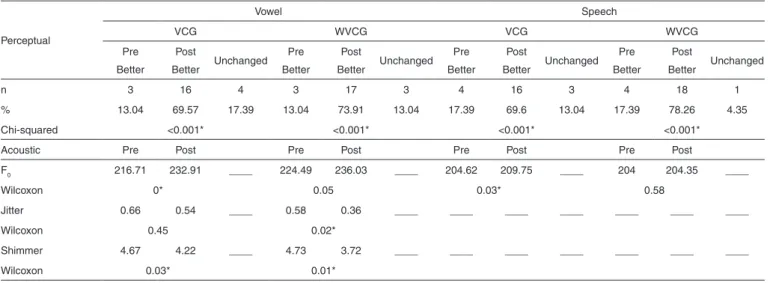
At perceptual analysis the presence of best emission was frequent at post vocal exercise moment to both groups. In acoustic analysis it is possible to verify that the vocal exercise promoted decrease in shimmer value to both studied groups. It was observed an increase in F0 in VCG to sustained vowel and connected speech tasks, and a decrease in jitter values in WVCG (Table 1).
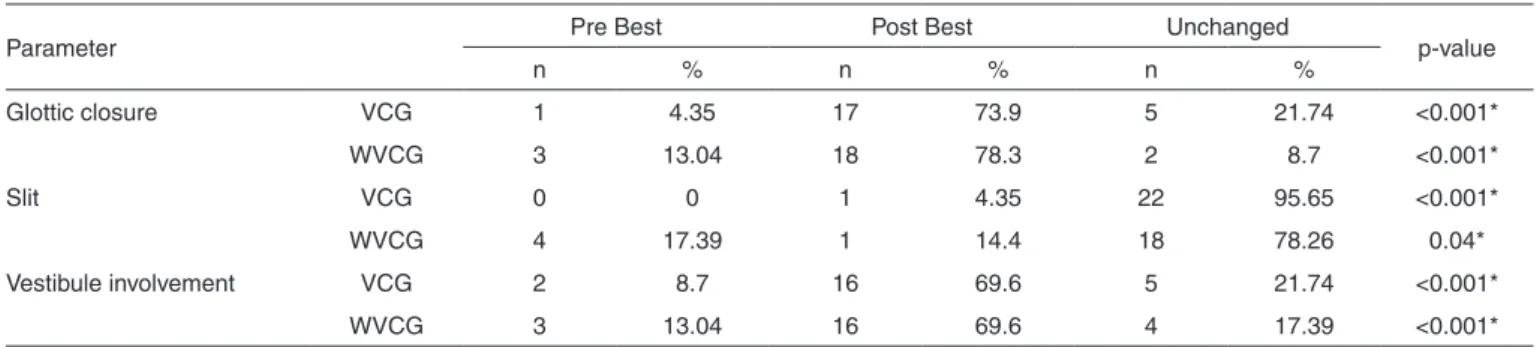
Videostroboscopy evaluation reveled improvement in glottic closure and lower larynx vestibule activation in post exercise moment to both groups. There were no changes regarding presence of glottic slit (Table 2).
Vocal self-evaluation data analysis showed positive effects of the exercise in VCG with a higher frequency of “easier and better voice” answer, standing out that the exercise improved voice quality and reduced the effort at emission (Table 3).
DISCUSSION
Semi-occluded vocal tract exercises (SOVTE) have been suggested by clinicians, singing teachers, voice coaches as a resource of vocal training and rehabilitation. Based on the assumption that vocal tract constriction alters intern pressure, modify glottic and vocal tract coniguration, and produce di-fferent acoustic patterns(1). Many descriptions show changes in vocal folds vibratory patterns with a high interaction between source and ilter(1-3,17), reducing phonotrauma possibility.
It was opted in this research to perform several analyses (perceptual, acoustic, videostroboscopy, and self-evaluation) in order to verify which of them the possible effects would be more evident. Usually the amount and frequency of doing a determined exercise prescribed in voice therapy is an option based on empirical rules(18). A research evaluating the time of making the sonorous tongue trill exercise in 15 men and 15 women without vocal complaint observed that in women group there was an improvement in perceptual analysis after three
Table 1. Perceptual and acoustic analysis pre and post high-pitched blowing vocal exercise
Perceptual
Vowel Speech
VCG WVCG VCG WVCG
Pre Better
Post
Better Unchanged Pre Better
Post
Better Unchanged Pre Better
Post
Better Unchanged Pre Better
Post
Better Unchanged
n 3 16 4 3 17 3 4 16 3 4 18 1
% 13.04 69.57 17.39 13.04 73.91 13.04 17.39 69.6 13.04 17.39 78.26 4.35 Chi-squared <0.001* <0.001* <0.001* <0.001*
Acoustic Pre Post Pre Post Pre Post Pre Post
F0 216.71 232.91 ____ 224.49 236.03 ____ 204.62 209.75 ____ 204 204.35 ____
Wilcoxon 0* 0.05 0.03* 0.58
Jitter 0.66 0.54 ____ 0.58 0.36 ____ ____ ____ ____ ____ ____ ____
Wilcoxon 0.45 0.02*
Shimmer 4.67 4.22 ____ 4.73 3.72 ____ ____ ____ ____ ____ ____ ____
Wilcoxon 0.03* 0.01*
* Significant values (p<0.05)
minutes of exercise, while in men group these modiications were observed after ive minutes. To both groups it was obser-ved the sensation of discomfort with the increase of exercise time. Another research(20) of the same researcher group evalua-ting the tongue trill result in 27 women with vocal nodules, of these ten women were also in placebo group, it was observed improvement of the perceptual voice quality parameters after ive minutes of exercise and in acoustic measures after seven minutes of exercise in vocal nodules group. The placebo group however did not have any perceptual or acoustic modiications. Time analysis of exercises in dysphonic and no dysphonic subjects needed to generate a voice quality and larynx function modiication is still incipient in literature and, future studies with control of voice quality types, larynx disturbances, gen-der, and age are important to a better comprehension of voice clinical conduction.
Several researches use perceptual or acoustic analysis as a criteria to verify the effect of an exercise(5-11,13). However more recently the focus of patient opinion has been considered central(19,21), since hardly a person adheres to a maneuver that causes discomfort. Besides these analyses, to verify the larynx condition must be done by visual analysis, since it is not pos-sible to identify exactly by perceptual evaluation the muscles adjustments used. So, multiple analyses considering diverse perspectives seem to be more complete solutions.
The results of perceptual analysis in sustained vowel and connected speech tasks showed improvement after doing the exercise to both groups, which suggests not having inluence of vocal complaint in such modiications. Therefore, the exer-cise provided improvement in voice pattern in general way,
probably due to contribution to a better source-ilter interaction. This interaction was elucidated by a research that simulated in a computer the vocal fold vibration and vocal tract model, favored by the increase in intra glottic pressure and median supra glottic(1).
The impedance combination by vocal fold adduction and epilarynx narrowing tube may provide a more eficient and economic voice(1). A research analyzing the vocal pattern mo-diication after SOVTE as straw phonation in women without vocal complaint concludes that there was improvement in voice emission in perceptual analysis after doing the exercise(13). Using straw the larynx sound may be easily monitored since it is not masked by lips trill(17).
In acoustic analysis, F0 values in sustained vowel and con-nected speech tasks increase after doing the exercise in VCG, suggesting that this favor F0 displacement to high pitch. The activated muscle in the exercise is cricothyroid, responsible to longitudinal tension in vocal fold, important factor in funda-mental frequency control. Its contraction promotes F0 lifting, that is, the production of higher pitched sounds(2).
Normal voice is classiied as a periodic signal with low ape-riodicity represented by the perturbation of sound signal indexes of fundamental frequency (jitter) and amplitude (shimmer)(22). Jitter values did not reduce after exercise in VCG. Probably dysphonia generated deviated jitter values and doing the exer-cise was not enough to reduce those values. The exerexer-cise did not reduce aperiodicity of frequency cycle by cycle. This was not observed in WVCG in which aperiodicity of frequency was not that high at initial moment and the exercise reduced the jitter value, therefore, decreasing aperiodicity. In shimmer evaluation the comparison between pre and post emissions showed differences to both groups. So, shimmer may receive positive inluences, more evident than jitter. It may say that vocal exercise reduced the shimmer value presented by the participants, independent of vocal complaint(2).
In larynx evaluation there was improvement in glottic closure and decreasing of larynx vestibule involvement post exercise to both groups. These data conirm the purposes of pitched blowing exercise(2). The adjustments occurred probably due to vestibular folds distance from median line, favoring the larynx muscle balance and deactivating median constriction of vestibule(2). There is a parallelism between vocal fold mucosa vibration and voice quality perceived and
Tabela 2. Videostroboscopy analysis pre and post high-pitched blowing vocal exercise
Parameter Pre Best Post Best Unchanged p-value
n % n % n %
Glottic closure VCG 1 4.35 17 73.9 5 21.74 <0.001*
WVCG 3 13.04 18 78.3 2 8.7 <0.001*
Slit VCG 0 0 1 4.35 22 95.65 <0.001*
WVCG 4 17.39 1 14.4 18 78.26 0.04*
Vestibule involvement VCG 2 8.7 16 69.6 5 21.74 <0.001*
WVCG 3 13.04 16 69.6 4 17.39 <0.001*
* Significant values (p<0.05) – Chi-square test after adjustment
Note: VCG = vocal complaint group; WVCG = without vocal complaint group
Table 3. High-pitched blowing vocal exercise effect self-evaluation
Self-evaluation VCG WVCG
n % n %
Easier voice 6 26.09 8 34.8
Better voice 4 17.39 2 8.7
Better and easier voice 9 39.13 0 0 No difference 4 17.39 13 56.52
p-value <0.001* 0.087
* Significant values (p<0.05) – Chi-square test after adjustment
as better is the vibration of vocal fold coverage as better voice quality is(23).
It was not observed difference in any of the groups regar-ding the presence of glottic slit. Not having changes in glottic closure might indicate that may be needed a higher number of exercises series and a higher execution time (days or weeks). Besides, VCG was pretty heterogeneous, with different kinds of larynx lesions, which may have diluted the exercise impact. New studies with speciic groups of patients and controlling the number of repetitions of the exercise, or making a longitudinal analysis, following through some training sections may help to clear this question.
In voice self-evaluation, it was observed in VCG the beneits of the pitched blowing exercise with a comfortable emission after doing it. This conirms that the exercise brought beneit to vocal emission luidity in this group, possible because it provided more comfort to phonate, stabilizing the emission (due to the whole area expansion of vocal tract, favoring glottic clo-sure, deactivating vestibule median constriction, and balancing larynx muscles)(1,2). It is important to highlight that the option “worse voice” was not signed by any of the participants of the studied groups.
Positive voice self-evaluation with an exercise is an im-portant factor to adherence to treatment that many times will require a long commitment, with behavioral changes and conti-nuous execution of the technique at home. These factors depend mainly on an alliance between speech therapist and patient. A qualitative research(24) had the purpose to document the patients perspective about barriers and facilitators in voice therapy. The authors concluded that the patients perceived vocal rehabilita-tion as an effective therapeutic procedure, but recognize that this is a process that requires effort to a new motor learning, besides the active self-regulation, and a good contact with the clinician. The patients reported that voice technique learning is useful, and the clinician had a fundamental inluence in the process, as source of support and encouragement(24).
A research evaluated the immediate effects of inger kazoo exercise (with a warning inger on the mouth, in central region, reducing sonorous air low) and straw phonation in women without vocal complaint(13). The results pointed out higher comfort at phonation with a clear, strong and easier voice. The prescription of these exercises has been done in several situations: negative supra glottic involvement, post-surgery of larynx lesions, reduction of impact between vocal folds, vocal improvement(2,17), and vocal warming up(2,17,25).
The pitched blowing exercise promoted positive changes in hearing, acoustic, larynx, and self-evaluation parameters. Future studies controlling different times in exercise execution and larynx disturbances are important to a higher comprehen-sion of the beneits of this vocal technique.
CONCLUSION
High-pitched blowing vocal exercise produces: improve-ment in voice quality in perceptual evaluation as for people without voice complaint as for dysphonics; modiications to different parameters for both groups in acoustic analysis;
improvement in glottic closure and less larynx vestibule in-volvement to both groups in larynx evaluation; and report of a better and comfortable sound emission in dysphonic subjects in voice self-evaluation.
REFERENCES
1. Titze IR. Voice training and therapy with a semi-occluded vocal tract: rationale and scientific underpinnings. J Speech Lang Hear Res. 2006;49(2):448-59.
2. Behlau M. Voz: o livro do especialista. Vol. 2. Rio de Janeiro: Revinter; 2005.
3. Behlau M, Oliveira G. Hand-over-mouth. In: Behrman A, Haskell J. Exercises for voice therapy. San Diego (CA): Plural Publishing; 2008.p.35-6.
4. Stemple JC, Lee L, D’Amico B, Pickup B. Eficacy of vocal function exercises as a method of improving voice production. J Voice. 1994;8(3):271-8.
5. Finger LS, Cielo CA. Aspectos fisiológicos e clínicos da técnica fonoterapêutica de fonação reversa. Rev Bras Otorrinolaringol. 2007;73(2):271-7.
6. Barata LF, Madazio G, Behlau M, do Brasil O. Análise vocal e laríngea na hipótese diagnóstica de nódulos e cistos. Rev Soc Bras Fonoaudiol. 2010;15(3):349-54.
7. Chen SH, Huang J, Chang W. The efficacy of resonance method to hyperfunctional dysphonia from physiological, acoustic and aerodynamic aspects: the preliminary study. Asia Pac J Speech Lang Hear. 2003;8(3):200-3.
8. Carrara E, Behlau M, Pontes PA, Tosi. Comparative analysis of laryngeal coniguration, perceptual auditory, spectrographic acoustic of vocal quality before and after emission in vocal fry. Folia Phoniatr Logop. 1992;44(1):1-2.
9. de Azevedo LL, Passaglio KT, Rosseti MB, Silva CB, Oliveira BF, Costa RC. Avaliação da performance vocal antes e após a vibração sonorizada de língua. Rev Soc Bras Fonoaudiol. 2010;15(3):343-8.
10. Guberfain J, Muller MM, Sarvat M. The perceptual, acoustics and laryngological analysis of tip of tongue sound vibration technique and it’s consequences in actors. In: World Voice Consortium. 2nd World Voice
Congress and 5th International Symposium of Phonosurgery. Scientiic
program. São Paulo; 1999. p.55.
11. Schwarz K, Cielo CA. Modiicações laríngeas e vocais produzidas pela técnica de vibração sonorizada de língua. Pró-Fono. 2009;21(2):161-6. 12. Titze IR, Laukkanen AM. Can vocal economy in phonation be increased
with na articially lengthened vocal tract? A computer modeling study. Logoped Phoniatr Vocol. 2007;32(4):147-56.
13. Sampaio M, Oliveira G, Behlau M. Investigação de efeitos imediatos de dois exercícios de trato vocal semi-ocluído. Pró-Fono. 2008;20(4):261-6. 14. Behlau M. Técnicas vocais. In: Ferreira LP, Lopes DM, Limongi SC.
Tratado de fonoaudiologia. São Paulo: Roca; 2005.p. 42-58.
15. Stevens K. Vocal-fold vibration for obstruent consonants. In: Gaufin J, Hammaberg B . Vocal fold phisiology: acoustic, perceptual and physiological aspects of voice mechanisms. San Diego (CA): Singular; 1991. p.29-36.
16. Alarcos A, Behlau MS, Tosi O. Computer acoustical analysis of senile voices. Folia Phoniatr. 1983;35:102.
17. Titze RT, Finnegan EM, Laukkanen AM, Jaiswal S. Raising lung pressure and pitch in vocal warm-ups: the use of low-resistant straws. J Singing. 2002;58(4):329-38.
18. Pa n n b a c ke r M . Vo i c e t r e a t m e n t t e c h n i q u es : a r ev i ew a n d recommendations for outcome studies. Am J Speech Lang Pathol. 1998;7(3):49-64.
19. Menezes MH, de Campos Duprat A, Costa HO. Vocal and laryngeal effects of voiced tongue vibration technique according to performance time. J Voice. 2005;19(1):61-70.
21. Kasama ST, Brasolotto AG. Percepção vocal e qualidade de vida. Pró-Fono. 2007;19(1):19-28.
22. Titze I. Toward standard. The G. Paul Moore Lecture. Toward standards in acoustic analysis of voice. J Voice. 1994;8(1):1-7.
23. Rosen CA, Anderson D, Murry T. Evaluating hoarseness: keeping your patient’s voice healthy. Am Fam Physician. 1998;57(11):2775-82.
24. van Leer E, Connor NP. Patient perceptions of voice therapy adherence. J Voice. 2010;24(4):458-69.