J of Evolution of Med and Dent Sci/ eISSN- 2278-4802, pISSN- 2278-4748/ Vol. 4/ Issue 84/ Oct. 19, 2015 Page 14675
SURGICAL MANAGEMENT OF PROXIMAL HUMERUS FRACTURES BY
PHILOS PLATTING
Anand Kumar1, S. B. Kamareddy2, Hanu Tej Adapureddi3
HOW TO CITE THIS ARTICLE:
Anand Kumar, S. B. Kamareddy, Hanu Tej Adapureddi. Surgical Management of Proximal (umerus Fractures by Philos Platting . Journal of Evolution of Medical and Dental Sciences 2015; Vol. 4, Issue 84, October 19; Page: 14675-14681, DOI: 10.14260/jemds/2015/2086
ABSTRACT: Proximal humerus fractures are common and debilitating injuries and incidence of them are increasing especially in elderly. Treatment of unstable, displaced, and comminuted fractures of the proximal humerus remains challenging. Various operative procedures are carried out, recent trend in internal fixation has moved on to locking plates. The goal of the study is to test the efficacy and functional outcome of PHILOS plating in proximal humerus fractures.To evaluate the incidence of complication that may occur with PHILOS plating in proximal humerus fractures. MATERIALS AND METHODS: It is a prospective study conducted in our institute from 2013 to 2015. The study purpose to include patients with proximal humerus fractures. Clinical and radiological evaluation done. Fractures classified using Neer s classification. Patients will undergo Open reduction internal fixation with philos plating for the sustained fracture under general anesthesia .Post-operative physiotherapy followed according to protocol. Patients will be followed up at 6 weekly intervals until fracture union and, at once at 1yr after the surgery. A minimum of 20 cases studied without any sampling procedure. RESULTS: In our study most common age group was 51-60 yrs and male:female ratio 3:1 and 55% were 2 part fractures were treated by philos plating final functional outcome is assessed with NEER’S score. 5(25%) of 20 patients had excellent results, 10(50%) had satisfactory results and 5(25%) had unsatisfactory results.All cases of unsatisfactory results were had complication and elderly patients. None of patients in our study were failure. CONCLUSION: In conclusion, fracture of the proximal humerus is still a debatable and controversial subject in orthopaedics. The common mode of injury in these fractures is fall on shoulder in elderly and RTA in young population, open reduction and internal fixation with LOCKING COMPRESSION PLATES has given good results and it is the implant of choice now a days.The advantages of locking plates are: Stable internal fixation, early mobilization, Functional restoration of the tuberosity can be obtained. Secondary reduction loss uncommon. Accurate anatomical restoration of the articular surface and tuberosity appear to be more important for the better functional outcome. An adequate surgical technique will minimize complications and an aggressive rehabilitation regime (active physiotherapy) will ensure the best possible result.
KEYWORDS: Proximal (umerus Fractures, Philos Plating, Neer’s Score.
J of Evolution of Med and Dent Sci/ eISSN- 2278-4802, pISSN- 2278-4748/ Vol. 4/ Issue 84/ Oct. 19, 2015 Page 14676 About 80-85% of proximal humeral fractures treated non-operatively, resulting in good functional outcomes. Where as in the 15% to 20% of displaced proximal humerus fractures it is noted that significant displacement, especially in comminuted fractures were associated with poor functional outcome, hence moving to surgical fixation for better results.3
However Significant controversy continues regarding the best methods of treating displaced proximal humerus fractures.4 Over the last 3 decades, various modalities of fixations have evolved for the proximal humerus fractures (trans osseous suturing, percutaneous pinning, tension band wiring, platting, rush nailing, arthroplasty). Of this proximal humerus inter locking plate is the implant of choice now for treatment of displaced proximal humerus fractures since they provide rigid anatomical fixation and more angular stability hence it permits early mobilization and good functional limb. The purpose of this study was to evaluate the functional and clinical outcomes of philos plating as a primary treatment for displaced proximal humerus fractures.
MATERIALS AND METHODS : Patients with fractures of proximal humerus admitted Basweshwar hospital attached to MR MEDICAL COLLEGE, Gulbarga will be taken up for study after obtaining the consent.
This is a prospective study from July 2014 to 2015.The study purpose to include patients with proximal humerus fractures admitted and examined according to protocol, associated injuries noted. Clinical and Radiological evaluation done. Fractures classified using Neer s classification. Routine investigation carried out to get fitness for surgery. Patients will undergo Open reduction internal fixation with philos plating for the sustained fracture under general anaesthesia. Post-operative physiotherapy followed according to protocol, to evaluate the functional outcome.
An Informed written consent is taken, preoperative planning is done. Patients were assessed radiologically and functionally. Patients will be followed up at 6 weekly interval until fracture union and, at once at 1yr after the surgery. A detailed observation is recorded using standard protocols. A minimum of 20 cases were studied without any sampling procedure.
Inclusion Criteria: Patients age >18years ,male and female patients, with two part, three part
and four part fracture of proximal humerus Neer’s classification .Patients who are willing to
J of Evolution of Med and Dent Sci/ eISSN- 2278-4802, pISSN- 2278-4748/ Vol. 4/ Issue 84/ Oct. 19, 2015 Page 14677 Exclusion Criteria: Children and adolescent patients <18yrs, assoiated humerus shaft fractures, acute infections, pathological fracture, fractures associated with neurovascular deficits.
DISCUSSION: We studied 20 adult patients of proximal humeral fracture of which most of the patients were brought to the causality or admitted through outpatient department basis, clinical history were elicited. Careful clinical examination of skeletal system and soft tissue injuries was
recorded. Radiographs were done. Arm was immobilized in a U’Slab and arm sling. Once patient’s
J of Evolution of Med and Dent Sci/ eISSN- 2278-4802, pISSN- 2278-4748/ Vol. 4/ Issue 84/ Oct. 19, 2015 Page 14678 All patents followed regularly and the following observations are made. In our series of twenty patients 3 are in the age group of 21-30(15%) 7 are in the age group of 31-40(35%), 3 are in the age group of 40-50(15%) 5 are in the age group of 51-60 (25%) and two are in the age group of 61-70(10%). The youngest patient is 25years and oldest is 70 years, the average age is 45 years. 14(70%) are male patients and 6(30%) are female patients. The ratio of Male to Female is M: F=2.3:1. The incidence is more in males is due to most cases in our study are young patients sustained fracture due to RTA The most common mode of injury observed in our series was road traffic accident. It accounted for 11 patients (55%).The next common cause was history of fall accounting for 8 patients (40%) and one patient had a history of assault (5%).In our study series the most
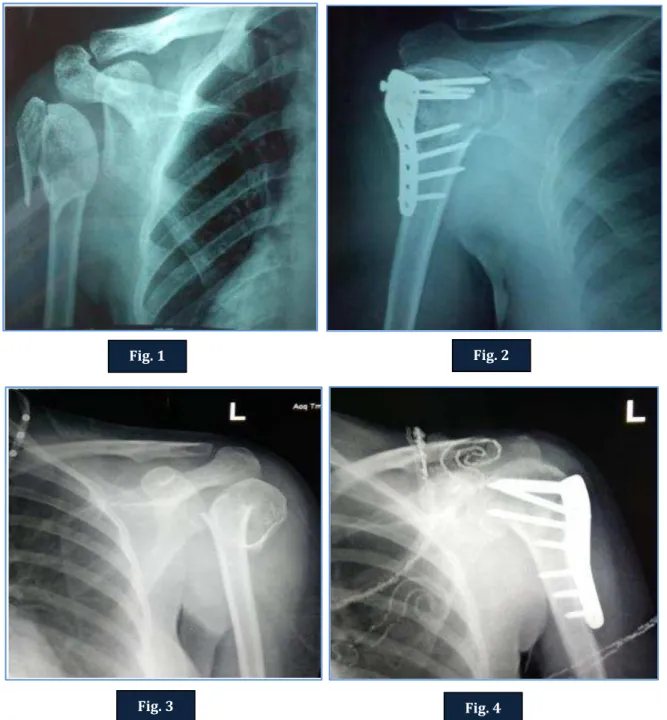
Fig. 1 Fig. 2
J of Evolution of Med and Dent Sci/ eISSN- 2278-4802, pISSN- 2278-4748/ Vol. 4/ Issue 84/ Oct. 19, 2015 Page 14679 common type of fracture observed was 2 part fracture accounting for 11 of 20 patients (55%).The next common being 3 part fracture accounting for 7 of 20 patients (35%). In one patient it is 4 part fracture (5%). The fracture dislocation was observed in one patient (5%).
In our present study fracture occurred on right side in 12(60%) patients and on left side in 8(40%) patients. In our study, we observed that the average time taken for fracture to unite is 12 weeks. In 8 of 20 patients it is 10weeks, among 6 patients it took 12 weeks, in 4 patients 14 weeks took to unite and in another 2 patients 16 weeks taken. During the follow up period 3 patients had shoulder stiffness (15%), 2 patient had plate impingement (10%). One (5%) patient had varus malunion which was 4 part fracture, one (5%) patient developed superficial wound infection, which is healed uneventfully with Antibiotics. There were no incidences of non-union and osteonecrosis of the proximal humerus in our study.
COMPLICATION NO OF CASES
SHOULDER STIFFNESS 3
PLATE IMPINGEMENT 2
VARUS MALUNION 1
POST OP INFECTION 1
The final results are evaluated by using NEER’S Score. )n our study the minimum score was 70 and maximum of 94. The average score is 82.6.
RESULTS: In our study final functional outcome is assessed with NEER’S score. 5 5% of 20 patients had excellent results, 10(50%) had satisfactory results and 5(25%) had unsatisfactory results. All cases of unsatisfactory results were had complication and elderly patients. None of patients in our study were failure. These results are consistent with other studies too.
STUDY Excellent Satisfactory Unsatisfactory Failure
AA MARTINEZ et al13 13(22.4%) 36(62%) 08(13.8%) 1(1.7%)
RICHARD J HAWKINS 08(53.3%) 06(40%) 00 01(6.7%)
STUDY SERIES 05(25%) 10(50%) 5(25%) 00
CONCLUSION: In conclusion, fracture of the proximal humerus is still a debatable and controversial subject in orthopaedics. Clinical evaluation, obtaining proper radiological views, age of the patient and activity levels holds the key for realistic approach and proper surgical management of these complex fractures. The common mode of injury in these fractures is fall on shoulder in elderly and RTA in young population, anatomical reduction is an essential and determines the outcome in surgical treatment of these fractures, open reduction and internal fixation with LOCKING COMPRESSION PLATES has given good results and it is the implant of choice now a days.
J of Evolution of Med and Dent Sci/ eISSN- 2278-4802, pISSN- 2278-4748/ Vol. 4/ Issue 84/ Oct. 19, 2015 Page 14680 tuberosities appear to be more important for the better functional outcome. An adequate surgical technique will minimize complications and an aggressive rehabilitation regime (active physiotherapy) will ensure the best possible result.
REFERENCES:
1. Court Brown CM, Caesar B. Epidemiology of adult fractures: A review Injury 2006; 37:691-697. 2. Terry Canale’s Campbell’s Operative Orthopaedics, Vol-3: 9th edition, 1998 Mosby Publishers,
USA Pg 2286-2296.
3. Steven. H. Rose Joseph Melton Bernard. F. Morrey et al Epidemiological features of humeral fractures Clin. Orthop-1982:168:24-30.
4. RL Sahu: Philos Locking plates in proximal humerus fractures literature review. The Internet Journal of Health. 2010 Volume 11.
5. Bigliani LU, Flatow EL, Pollock RG. Fractures of the proximal humerus In: Rockwood CA, Green DP, Bucholz RW, Heckman JD, eds. Fractures In adults. Philadelphia, etc: Lippincott-Raven, 1996: 1055-107.
6. Buchanan JJ. IV. Fracture through the anatomical neck of the humerus with dislocation of the head. Ann Surg 1908; 47:659-71.
7. Lous U., Bigiliani, Chapter 9 The shoulder, Vol-1 ed. Charles Rockwood, Frederick A. Fractures of proximal humerus. In Rockwood CA, Matsen. Philadelphia: W.B. Saunders, 1990: p278-334. 8. Neer CS. Displaced proximal humeral fracture: Part 1: Classification and evaluation. J Bone Joint
Surg (Am) 1970; 52-A: 1077-89.
9. Neer CS. Displaced proximal humeral fractures. Part )). Treatment of three part and four part
displacement . J Bone Joint Surg, 97 ; 5 A: 90-11.
10. Rizwan Shahid et al, proximal humerus fracture treated with lockingcompression plate Acta Orthop. Belg., 2008, 74, 60 2-608.
11. Kenneth A. egol, Crispin Cong, Michael Walsh et al, Early complication of proximal humerus fractures treated with locked plates, Jorthop trauma 2008; 22:159-164.
12. Felix Brunner, Christoph Sommer, Christian Bahrs et al Open Reduction and Internal Fixation of Proximal Humerus Fractures Using a Proximal Humeral Locked Plate: A Prospective Multicenter Analysis, J Orthop Trauma 2009;23:163–172.
13. AA Martinez et al. proximal humerus locking plate for proximal humerus fracture –
retrospective study journal of orthopaedic surgery 9; 17(1):10-4.
14. MA Fazal, FS (addad P()LOS plate fixation for displ aced proximal humeralfractures journal of orthopaedic surgery2009; 2009 17(1)15-8.
15. Sameer Aggarwal et al Displaced proximal humeral fractures: an )ndian experience with
locking plate . Journal of Orthopaedic surgery and research2010, 5:60.
16. Georg Osterhoff, Christian Ossendorf et al. The cal car screw in angular stable plate fixation of proximal humerus fractures-a case study . Journal of orthopedic surgery and research 2011, 6:50.
J of Evolution of Med and Dent Sci/ eISSN- 2278-4802, pISSN- 2278-4748/ Vol. 4/ Issue 84/ Oct. 19, 2015 Page 14681
AUTHORS:
1. Anand Kumar 2. S. B. Kamareddy 3. Hanu Tej Adapureddi
PARTICULARS OF CONTRIBUTORS:
1. Post Graduate, Department of
Orthopaedics, Basaveshwar Teaching and General Hospital.
2. Professor, Department of Orthopaedics, Basaveshwar Teaching and General Hospital.
3. Post Graduate, Department of
Orthopaedics, Basaveshwar Teaching and General Hospital.
FINANCIAL OR OTHER
COMPETING INTERESTS: None
NAME ADDRESS EMAIL ID OF THE CORRESPONDING AUTHOR:
Anand Kumar,
Post Graduate, Department of Orthopedics, Basaveshwar Teaching and General Hospital, Kalburgi.
E-mail: [email protected]