Challenges for Infants’ Home Care
: a Qualitative Study
Zeinab Hemati1, *Mahboobeh Namnabati21, Fariba Taleghani3
1
PhD Candidate of Nursing, Nursingand Midwifery Care Research Center, Faculty of Nursing and Midwifery, Isfahan University of Medical Sciences, Isfahan, Iran.
2
Assistant Professor, Nursing and Midwifery Care Research Centre, Faculty of Nursing and Midwifery, Isfahan University of Medical Sciences, Isfahan, Iran.
3
Professor, Nursing and Midwifery Care Research Centre, Faculty of Nursing and Midwifery, Isfahan University of Medical Sciences, Isfahan, Iran.
Abstract Background
Home care is an acceptable strategy for the relationship between family and healthcare team and implementation of healthcare interventions, and infants’ nurses could play an important role in enhancing the capability of families and promoting child health in this area. This study examined
challenges facing infants’ home care from nurses’ viewpoints in Iranian culture. Materials and Methods
A qualitative design was used to explain challenges facing infants’ home care from nurses’ viewpoints. Participants included 20 nurses’ working in the neonatal units of University hospitals in
Isfahan, Iran in 2015.Data collection was done by interviewing nurses working in neonatal units of Shahid Beheshti and Alzahra hospitals. All the data were analyzed by qualitative content analysis.
Results
Four main categories of "The need to warn the community", "Culture", “Need for security" and "legal support" were extracted from the participants' explanations, indicating the dimensions of challenges for infants’ home care.
Conclusion
Nursing policy makers and managers are able to help to facilitate home care and improve the infants’ health through correcting the infrastructure and eliminating current obstacles.
Key Words: Home care; Infants; Neonatal Intensive Care Unit; Nurse; Qualitative research.
*Please cite this article as: Zeinab Hemati, Mahboobeh Namnabati, Fariba Taleghani. Challenges for Infants’ Home Care: a Qualitative Study. Int J Pediatr 2016; 4(6): 1885-94.
*Corresponding Author:
Mahboobeh Namnabati, Assistant Professor, Nursing and Midwifery Care Research Centre, Faculty of Nursing and Midwifery, Isfahan University of Medical Sciences.
Email: [email protected]
1- INTRODUCTION
Family visit and working in the community is both a privilege and an advantage. In this environment, a nurse is placed within the most intimate space of an individual as a human (1). Home care and family visits, purposeful interaction, and effective strategies at home are aimed to promote and maintain the health of the patient and family, through which healthcare education can be transferred into the home(2). Recently in developed
countries, the families’ willingness to do
early discharge of infant and to continue its care at home has grown thanks to the promotion of their capabilities, increase in their knowledge of diseases, and the development of medical technology leading to more effective therapeutic
approaches(3). The program of infants’
home care is aimed to promote the health
and to facilitate the process of infants’
growth and development through training nurses (4). Also, the purposes of home
care may include family’s support for
providing security for infant, proper feeding, provision of environmental stimuli, family communication with healthcare providers, etc (5).
Continuation of care at home can improve
mothers’ health behaviors, increase
duration of breast feeding, and reduce the costs associated with treatment (6).
Infants’ home care interventions can
reduce 30-60% of infants' mortality (7). In this regard, findings of a study demonstrated, 74% of the infants who received home care by a nurse were completely breastfed compared to the control group (8). Moreover findings of another study indicated that, home care can play an important role in the growth and development of preterm infants and reduce the anxiety of their parents (9). Due to the parents’ need and infants’ nursing home care benefits, development of a regular schedule can lead to the safe transfer of infants from the hospital to the
home (10). Thanks to a very close relationship with families, nurses, using the proper techniques, are able to promote the ability of family members to help them overcome the health-related barriers after
infants’ discharge (11). The presence of nurses at home has remarkably enhanced provision of education about the infant’s condition and involvement of parents in the process of caretaking, and can lead to comforting the family, parents’ active participation in infant’s care, reducing the risk of nosocomial infections, and increasing their satisfaction(3). Therefore, since nurses are considered as the first line in management and coordination of neonatal care units and across whole community, enabling them to participate in community and to deal with a variety of conditions seem necessary (12).
Although the benefits of infants’ home care have repeatedly in the textbooks and literature, and home care is presently being considered as a care industry, continuation of care after discharge from hospital at home is not routine in Iran and the infants receive services of interest through repeated hospitalizations and referring healthcare centers, leading to stupendous costs for parents and health system (6). It also leads to the separation of mother and infant, and attachment process is disrupted (13). Therefore, the study of challenges of
infants’ home care by a qualitative
approach is necessary because it is believed that comprehensive and in-depth information could be introduced into nursing knowledge by qualitative, rather than quantitative, research. Qualitative research helps to completely and deeply
describe current challenges in infants’
nursing home care (14). The present study was conducted to explain the challenges
facing infants’ home care from nurses’
viewpoints in Iranian culture to a qualitative approach.
This qualitative study was conducted from March to September, 2015 (during 6 months).
2-1. Inclusion criteria
Inclusion criteria included over 6 month history of working in neonatal units. 2-2. Exclusion criteria
The exclusion criteria, was unwillingness to participate in the study.
2-3. Methodology
In this study, 20 nurses working in the neonatal units were enrolled by purposeful sampling. Research fields were neonatal units of University hospitals in Isfahan, Iran in 2015. Data were collected through individual and group interviews and the place of interview was decided to be neonatal units at the hospitals under study because it was convenient to participants. The duration of individual interviews was determined 30 to 60 minutes and group interviews 60 to 90 minutes. So that, three sessions of group discussion were attended by 12 neonatal nurses who were divided into three four-member groups. Interview started with open-ended questions such as:
"What is your opinion about infants’ home
care? and what are the advantages and disadvantages of home care?". The next question said "What is the role of the nurse
in infants’ home care? Finally, the
interview continued with exploratory questions till the saturation and repetition of data were achieved, so that no new code was derived in the last three interviews. All individual and group interviews were recorded on audiotape, transcribed verbatim and immediately analyzed.
2-4. Validity and Reliability
The credibility, dependability, fittingness, and conformability were considered as criteria of scientific rigor in qualitative research (16). One of the best ways to increase the reliability of data is long-term involvement of the researcher with the research subject, and since the researcher
was constantly interacting with the participants appropriately before and during the study, the reliability of data increased. For review, the generated codes and classes were reviewed by the experienced lecturers. They also commented on the rectitude of codes and classes. The participants were enrolled from all age groups, various working histories, and rotated or fixed working shifts to enhance the generalizability of the findings (17, 18).
2-5. Data analysis
Analysis of the data was run shortly after their generation by conventional content analysis. Conventional content analysis was used to subjectively interpret the content of textual data. This approach has been designed to describe phenomenon and researcher, instead of using pre-defined categories, utilizes the names and classes derived from data and gains new insight through a close relationship with and dipping into the data. Many qualitative studies have incorporated this approach to the design and analysis of the study (15). In the first phase, the researcher read the whole text to familiarize with the data. The researcher was immersed into the data to gain the ideas of the content, and wrote down generally the received data from interviews with frequent review of data. Secondly, the text was read line by line, and the phrases or words related to the concepts of interest were underlined.
After basic codes and subsequently conceptually similar codes were generated, they were assigned to a single cluster and semantically related clusters were assigned to a class. Then, similar classes were consolidated.
2-6. Ethical consideration
research process, ethical considerations such as oral informed consent to ensure anonymity, confidentiality of information, discontinuation of participation at any time, and the provision of ethical obligations were observed.
3-RESULTS
The participants in this study were 20 female nurses [head nurses (n=2), educational supervisors (n=1) and nurses
(n=17)] working in neonatal intensive-care units (NICUs) were aged 25 to 37 years. All participants had BS degree and history of working for at least 6 months and at most 20 years in the neonatal or neonatal intensive care units.
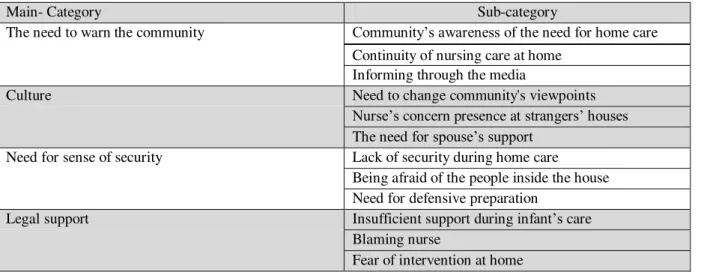
The study findings indicated that the
challenges of infants’ home care were
divided into 4 categories and subdivided into 12 subcategories (Table.1).
Table 1: Categories and subcategories challenges facing infants’ home care from nurses
Main- Category Sub-category
The need to warn the community Community’s awareness of the need for home care Continuity of nursing care at home
Informing through the media
Culture Need to change community's viewpoints
Nurse’s concern presence at strangers’ houses The need for spouse’s support Need for sense of security Lack of security during home care
Being afraid of the people inside the house Need for defensive preparation
Legal support Insufficient support during infant’s care Blaming nurse
Fear of intervention at home
3-1.The need to warn the community
Informing community about the issue of
infants’ home care after discharge plays an important role in reducing complications and infant’s returning to neonatal units. Lack of knowledge of nursing home care interventions can lead to complications in the patient after discharge.
A participant, in this regard, told: "The purpose of home caring by nurse must become clear to people, they should appreciate the job on which a nurse spent all this time-- if a nurse goes to a house and solves the problem of feeding, this number of families do not return to hospitals". The community’s perceptions of nursing interventions are confined to the hospital, and parents have no knowledge of the importance and benefits of nursing home care interventions. Through informing mothers about the benefits
derived from this growing industry at
infant’s hospital stay, nursing care skills
could be enhanced across the community. One of the participants, in this line, stated: "In many cases, informing families about nursing home care at ward is very good. They can explain for
them in the ward and clarify nurses’ role
in home care. Mother should know that nurse can go to home to assist her in feeding or bathing her infant".
Meanwhile, mass media play a crucial role in informing the community about the value of nursing home care. One of the nurses criticized: "So much they advertise for a simple salty snack on television, they advertise nothing for such
important issue, so that this work’s value
nurse can offer a mother specialized assistance at home".
The importance of the media's role in informing community about nurses’ role after patient discharge contributes to
reducing patients’ referring and increasing
nurses’ capability. Confinement of nursing
practice to clinical setting and lack of sufficient knowledge of the important role of nurses in the promotion of infants’ health after discharge is one of the important issues which nursing managers and professionals should satisfactorily address to mitigate this challenge and
enhance nurses’ capability. 3-2.Culture
For home care, culture and the change in
community’s attitude seem necessary. Culture of home care and the programs regarding decentralization from health centers to community and subsequently smaller unit, i.e. family, is an important issue which has not been adequately addressed in Iran. Academic education and scientific and clinical nursing is an important issue about which informing families is necessary to change their attitude. Recently, because of increased ability of nurses in all care dimensions,
community’s attitude has changed.
Therefore, informing community about
nurses’ empowerment for home care after patients’ discharge is an issue which can
change their attitude toward nursing interventions at home.
One of the nurses, in this regard, said:
"Nursing home care has been remained to be widely known in Iran. Understanding that a nurse comes for visiting infant to do specialized care is different from a babysitter. Infants’ nurse is an educated individual, it is important to clarify it". Another participant acknowledged: "Many times, when a nurse enters into a home, it’s enough for an acquaintance to see her. Nothing else is needed. Then, he/she wonders why she (nurse) has entered into this house".
The current culture among Iranian families and the important role of families with regard to the presence at unfamiliar
individuals’ homes is another issue
potentially contributing to the arguments regarding nursing home care. Lack of proper nursing position, especially at home, provides conditions leading to husbands not allowing their wives to go
others’ homes. Therefore, nurses may be unwilling to do home care. One of the nurses stated: "I went to change gastric tube of the child of a friend of mine—I wish my husband would not find out; if he
did, then he wouldn’t let me even go to the
hospital".
Since community has not yet become
sufficiently aware of nurses’ important
role in home care after patients’ discharge, informing community about such capability could help to change the Iranian
culture and community’s attitude toward it. 3-3. Need for security
Study findings indicated that one of the important challenges facing home care is
nurses’ sense of insecurity when being
present in an unfamiliar environment. Addressing security issues of nursing home care is a crucial issue which prevents some challenges for nurses. Therefore, attention to providing arrangements for
nurses’ presence to do home care
interventions, including security, is an issue which needs to be considered by nursing managers.
Nurses’ unawareness of the individuals in
a house and fear of entering into houses was one of the issues raised by the participants. The families with different socio-cultural characteristics and nurses’ unawareness of the individuals could lead to fear and unsatisfactory motivation in nurses to enter into a house.
One of the nurses, in this regard, acknowledged: "A very great risk you should take to enter into the house because you should always be careful a problem not to happen to you—we should be able to defend ourselves in emergency circumstances".
3-4.Legal support
Home care intervention requires legal support for nurse by national healthcare system, because it could increase nurses’ tendency and ultimately help to promote
infants’ health. Insufficient support for nursing home care for infants, by the participants' statements, could reduce
nurses’ tendency to do infants’ home care. One of the participants, in this line, stated:
"It’s enough for a nurse to go to a house
and a problem happen to a child, who supports [him/her]? Just some stress comes to you".
Infancy is a critical period, and infants are very vulnerable. If some problems happen to an infant during this period, the nurse may be considered as responsible for it and the lack of legal support for the nursing home care leads to some problems for nurses. One of the nurses stated: "A problem is enough for them to tell that this nurse came and did not know what to do for the problem that happened to my child. Then, just like other cases, the nurse is found guilty and supported nowhere". Another nurse acknowledged: "I put the child on gastric tube to feed; for several times it had no problem with feeding, but the next day [when] the mother fed it, the tube took out and the infant got cyanosis.
They told me you are guilty, [you] didn’t
put [the tube] on properly--Who would support me in this situation?"
Insufficient support for home care interventions could ultimately cause inadequate interest in nursing home care of the baby, because legal involvement, in case of an accident to infant and insufficient support for nurse, can lead to complications, which is both a threat to subsequent nursing home care and a factor to increase his/her individual and family stresses. In this regard, one of the participants told: "In our ward, if, God forbid, a problem would happen, all blame the nurse for that. Now, if she is going to go a house and do an intervention for a child and a problem would happen, then who supports [him/her]? No ones".
Therefore, legal support during home care is one of the arrangements which nursing policy makers should address adequately because failure to address this critical issue
could lead to disregard of nurses’
capabilities of enhancing their role in care in the community.
4-DISCUSSION
Today, nursing home care is an effort to meet the needs of many patients in the community; therefore, it requires the cooperation among health care team members. With such philosophy, home is a preferred setting for higher quality care as compared with hospital (19). The present study was an in-depth investigation and full description of challenges which nurses encounter in doing home care after infants’ discharge. Community members’
knowledge of nurses’ important roles in
nursing interventions was one of the issues highlighted by the participants. Given that the early years of life is an opportunity to
In developed countries, families’
willingness to discharge infant early and to continue its care at home has increased due
to the promotion of families’ capabilities
and their knowledge of medical technology leading to more effective and less risky therapeutic approaches(3). In Canada, preterm infants are transferred to home to continue treatment there and all care is conducted under the supervision of intensive care units, leading to increased
sense of competence in infants’ care in
parents and providing basic maternal and infant health promotion due to supporting them by healthcare team at home(21). Home care centers which date back to over 35 years ago in developed countries such as Canada (11), have increased the abilities of parents in infant care and hence have reduced repeated referring to hospitals. In recent years, the establishment of nursing counseling and service centers has been authorized in Iran with home care as one of the main defined duties. But, unfortunately many families are not aware of such centers and therefore refer public health centers or clinics for any problems. According to the statements by participants, informing parents is essential
during infants’ stay at hospital. Given the
media's important role in informing the public, families need to be informed by them. Media are the most powerful tool for the development and spread of ideas and the most efficient means to penetrate the culture and attitudes into the heart of communities. Mass media as an agent of transfer of values have a wide range of audience and all members of community, regardless of socioeconomic class, are under their influence (22).
Another main generated category was culture. Need for changing community’s
attitude towards nursing skills, nurses’ concern over colleagues’ and relatives’ thinking of attending strangers’ home, and the necessity of spouse’s support were the constructive subthemes of this theme. A
similar study reported no appropriate relationship between nurses and the people at home in caretaking, no standard of
visiting individuals at home, and nurses’
unwillingness to take care of the patients at farther homes as cultural challenges(23).
Moreover, a study reported nurses’ shame
for determining the cost of home care as a cultural challenge (24).
Therefore, given the current cultural challenge facing home care in Iran, the media not only could be helpful in giving
awareness to community’s individuals, but
also contribute importantly to changing the culture and attitudes towards nurses' capabilities. Culture of home care and the programs regarding decentralization from health centers to community and subsequently smaller unit, i.e. family, is one of the most important steps in the dissemination of this type of care (19). Since home care is a new issue in Iran and there is cultural resistance to nursing home care of infants, then focusing on reduction of this resistance, and according to statements by participants, is necessary. Generally, the existence of a coordinated and comprehensive program for culture of home care in Iran causes both the role of nursing counseling centers to be made more visible and the parents to appreciate the role of home care interventions in
infants’ health promotion more seriously.
Another derived theme was security required by nurses for home care. Communicating with the patient, commuting to his/her house, and maintaining security are some of the most important concerns of all nurses who work across community. Therefore, related safety precautions must be considered. Although following some guidelines to
increase nurse’s security such as having a
context in which compliance with professional standards should be considered to increase security.
Although the patient’s health status and
health interventions for patient and his/her family should be considered, nurses should
remember when they go to a patient’s
home, they are considered as guest and therefore should be completely polite to provide themselves with respect and security(19).
The participants’ statements confirm the importance of nurse’s security in doing
home care. For agencies of service offering in the United States, some
guidelines on how to maintain nurses’
security in home caring has been developed to facilitate care (25).
The findings of a study indicated that certain factors such as existence of guns in the home, verbal abuse, substance abuse, and fear of physical injury led to reduced safety of nurses while they were doing home care (26). Moreover, another study supported the management attention to risk and protective factors in caretaking of the patients at home (27).
The factors such as the presence of psychotic patients at home or doing home care in the neighborhoods where culprits are living have been reported as safety issues (28). Since there is no nursing home care of infants after discharge in Iran, there are not special guidelines consistent with
Iran’s current culture. Therefore, it is
necessary to codify such guidelines using the viewpoints of health professionals and nurses.
Finally, legal support for healthcare nursing interventions is one of legal issues, which in many cases is stressful for nurses
and patients. Nurses’ support and
explanation of the legal cases and providing appropriate solutions are necessary at the time of nursing home care for the infants (19). Although legal considerations in the home care of the
mother and infants are not much different from ethics and law in health settings, they should be followed more seriously as compared to medical centers due to developmental problems in infants and children and their parents.
Doing care without harm to the mother and infant by nurse during healthcare interventions is the first step to prevent legal conflicts (29). Fear of healthcare interventions and accidents for children and finally lack of support by system is a major obstacle which should be addressed. The findings from a qualitative study are unique to that study and cannot be generalized to a large population therefore the result may not be transferable to other settings. The findings of a study indicated that the ethical dilemma and no sufficient time for decision making and caring for patients independently were significant ethical challenges facing home care (30). The findings from a qualitative study are unique to that study and cannot be generalized to a large population. However, understanding the meaning of a phenomenon in a particular situation is useful for understanding similar phenomenon in a similar situation. Also, the small sample in this study is not necessarily representative of all Iranian nursing.
5-CONCLUSION
The change in attitude toward nurses’
role in healthcare interventions after infants discharge is one of the items emphasized by participants. Usually, nurses, midwives, physicians, and other members of healthcare team are unwilling
to be present at patient’s home, do not
programs of patients’ services offering. Besides that, some measures should be taken to promote the infants' health after discharge through provision of security, safety, and legal support for nurses.
6- CONFLICT OF INTEREST: None.
7-ACKNOWLEDGMENT
Hereby, we gratefully thank the support of Nursing and Midwifery Care Research Center in Isfahan University of Medical Sciences for funding this research project.
8-REFERENCES
1. Karen SL, Sharyn J. Community health nursing for the public health. 2th edition. Boston's and Bartlett publisher; 2009:956.
2. Maurer FA, Smith CM.
Community/public health nursing practice: Health for families and populations. 3rd ed. Philadelphia, PA: Elsevier; 2005: 250.
3. Committee on Fetus and Newborn. Hospital Discharge of the High-Risk Neonate. Journal of Pediatrics2008; 122(5):1119–26. 4. Donovan EF, Ammerman RT, Besl J, Atherton H, Khoury JC, Altaye M, et al. Intensive home visiting is associated with decreased risk of infant death. Pediatrics 2007; 119 (6): 1145-51.
5. Ogbuanu CA, Jones CA, McTigue JF, Baker SL, Heim M, Baek J, Smith LU, et al. A program evaluation of postpartum/newborn home visitation services in Aiken County, South Carolina. Public Health Nursing 2009; 26(1): 39-47.
6. Edraki M, Moravej H, Rambod M. Effect of Home Visit Training Program on Growth and Development of Preterm Infants: A Double Blind Randomized Controlled Trial. Int J Community Based Nurs Midwifery 2015; 3(1): 12–22.
7. Willis JR, Kumar V, Mohanty S, Singh V, Kumar A, Singh JV, et al. Impact of
community-based behavior-change
management on perceived neonatal morbidity: a cluster-randomized controlled trial in Shivgarh, Uttar Pradesh, India. J Trop Pediatr 2012; 58(4):286-91.
8. Askelsdottir B, Lam-de Jonge W, Edman G, Wiklund I. Home care after early discharge: Impaction healthy mothers and newborns. Midwifery 2013; 29:927–934. 9. Spencer-Smith MM, Spittle AJ, Doyle LW, Lee KJ, Lorefice L, Suetin A, et al. Long-term Benefits of Home-based Preventive Care for Preterm Infants: A Randomized Trial. Journal of Pediatrics 2012; 103(6):1094-1101.
10. Whyte RK. Safe discharge of the late preterm infant. Pediatric Child Health2010; 15(10):655-60.
11. Leifer G. Maternity Nursing: an introductory text, 10th Edition, Saunders; 2008.
12. Valizadeh L, Zamanzadeh V, Akbarbegloo M, Sayadi L. Importance and Availability of Nursing Support for Mothers in NICU: A Comparison of Opinions of Iranian Mothers and Nurses. Iranian Journal of Pediatrics2012; 22 (2): 191-96.
13. Valizadeh L, Namnabati M, Zamanzadeh V, et al. Factors affecting infant's transition from neonatal intensive care unit to home: A qualitative study. Iran J Nurs Midwifery Res 2013; 18(1): 71–8.
14. Burns N&Grove S. The practice of nursing research appraisal, synthesis and generation of evidence. 6th ed. St Louis: Saunders; 2009:50-62.
15. Hsieh HF, Shannon SE. Three approaches to qualitative content analysis. Qualitative Health Research 2005; 15: 1277-88.
16. Green B. Personal constructs psychology and content analysis. Personal Construct Theory &Practice 2004; 1: 82-91.
17. Vaismoradi M, Turunen H, Bondas T. Content analysis and thematic analysis: Implications for conducting a qualitative descriptive study. Nurs Health Sci 2013; 15(3):398-405.
18. Glaser BG. The future of Grounded theory. Qual Health Res 1999; 9: 836-45.
20. Edraki M, Moravej H, Rambod M. Effect of a home visit educational program on mortality and Morbidity of preterm newborn. Journal Shahid Sadoughi Univ Med Sci 2012; 19(6): 736-44.
21. Jefferies Ann L. Going home: facilitating discharge of the preterm infant. Pediatric child health 2014; 19(1):31-36.
22. Ballaard M, Gray M, Reilly J, Noggle M. Correlates of game screen time among males: Body, Physical activity and other media use. Eating behaviors 2009; 10(3): 161-67.
23. Corazzini K, Twersky J, White H, Hunt SR, Buhr GT, McConnell ES, et al. Implementing Culture Change in Nursing Homes: An Adaptive Leadership Framework. The Gerontologist 2015; 55(4):1-13.
24. Quadagno J, Stahl SM. Challenges in nursing home care: a research agenda. Gerontologist 2003; 43(2):4-6.
25. APNA. Nurse Home Visit (NHV) Guidelines. United State: Charltun; 2012; Available at: www.apan.asn.au.
26. Gershon RRM, Pogorzelska M, Qureshi KA, Stone PW, Canton AN, Samar SM, et al. Home health care patients and safety hazards in the home: preliminary findings.
Available at:
http://healthpolicy.ucsf.edu/people/robyn gershon#sthash.62N8nxQX.dpuf.
27. Geiger-Brown J, Muntaner C, McPhaul K, Lipscomb J, Trinkoff A. Abuse and violence during home care work as a predictor of worker depression. Home Health Care Serv Q 2007; 26: 59-77.
28. McPhaul K. Home Care Security. AJN 2004; 104(9):96.
29. Votroubek W, Tabacco A. Pediatric home care for nurses: a family- centered approach Boston tones and Bartlett. 3th edition. Boston, MA: Jones & Bartlett; 2010.
30. Bollig G, Schmidt G, Henrik Rosland J, Heller A. Ethical challenges in nursing homes – staff’s opinions and experiences with systematic ethics meetings with participation