Journal of Nuclear Physics, Material Sciences, Radiation and Applications Vol. 1, No. 2 February 2014 pp. 133–143
©2014 by Chitkara University. All Rights Reserved.
Extensions of Natural Radioactivity to 4
th-Type
and of the Periodic Table to Super-heavy Nuclei:
Contribution of Raj K Gupta to Cold Nuclear
Phenomena
BirBikram Singh1,*, Sushil Kumar2, Manoj K. Sharma3 and S. K. Patra4
1Department of Physics, Sri Guru Granth Sahib World University, Fatehgarh Sahib-140406, INDIA 2Chitkara University, Pinjore-Brotiwala Highway (NH-21A), Himachal Pradesh-174103, INDIA 3School of Physics and Materials Science, Thapar University, Patiala-147004, INDIA 4Institute of Physics, Sachivalaya Marg, Bhubaneswar-751005, INDIA
*E-mail: [email protected]
Abstract We have studied here the contribution of Indian Scientists associated with Prof. Raj K. Gupta to cold nuclear phenomena during the last almost four decades, which led to the discovery of fourth kind of natural radioactivity (also known as Cluster Radioactivity, CR) and to the extension of periodic table to super heavy nuclei. It is exclusively pointed out how the Quantum Mechanical Fragmentation Theory (QMFT) advanced by Prof. Raj K. Gupta and Collaborators led to the discovery of unique phenomenon of CR along with the predictions leading to the synthesis of super heavy elements. We have also mentioned the development of dynamical theories based on QMFT, the Preformed Cluster Model(PCM) and the dynamical cluster-decay model (DCM), to study the ground and excited state decays of nuclei, respectively, by Gupta and Collaborators. It is matter of great honor and pride for us to bring out this study to enthuse the young researchers to come up with novel ideas and have inspiration from the scientific contributions of Prof. Raj K. Gupta who is coincidentally celebrating his platinum jubilee birthday anniversary this year.
Keywords: Cluster model, low energy, super heavy elements, alpha decay
1. INTRODUCTION
Singh, B. Kumar, S. Sharma, M.K. Patra, S.K.
exceptional evidence of atomic nucleus as a continuous source of novel as well as unexpected phenomenon.
The studies built on the “cold reaction valleys’’have now led to the extension of the known Periodic Table of Elements up to Z=118 based on the concept of cold fusion. It was shown that the production of super heavy elements (SHE) need to choose suitable target-projectile combinations, and it is now accepted globally that the calculations of “cold reaction valleys’’ based on QMFT made possible the synthesis of all SHE.
The QMFT or the dynamical fragmentation theory is introduced briefly in Section II, followed by Section III with details on the phenomenon of CR and Section IV on the extension of Periodic Table to super heavy nuclei. The study is summarized in Section V. A brief report of this work was poster-presented at the DAE International Symposium on Nuclear Physics, BARC Mumbai, during December 2-6, 2013 [5].
2. THE DYNAMICAL FRAGMENTATION THEORY
The dynamical fragmentation theory or QMFT [1, 2], developed by Gupta and Collaborators, have been used to develop models of coupled motion in coordinates of relative separation R and mass asymmetry η, to study the ground state decay of nucleus and the decay of excited compound nucleus (CN). The dynamics of such decays have been studied extensively in [6, 7]. The Coulomb, nuclear proximity and the angular momentum dependent potentials are temperature dependent and include also the effects of deformations and orientations of the interacting nuclei. Thus, the ground state decay of nucleus as well as the decay of excited compound nucleus is worked out in terms of the following coordinates of the QMFT:
1. Relative separation coordinate R.
2. Deformation βλi, orientations θi(i=1,2)of two nuclei.
3. A mass asymmetry coordinate η=(A1-A2)/(A1+A2) and charge asymmetry coordinate ηZ=(Z1-Z2)/(Z1+Z2).
Then, in terms of these collective coordinates, for ground state decay (T=0 and l=0) of nucleus, with in the preformed cluster model (PCM) [6], the decay constant λPCMis defined as (in terms of barrier assault frequency ν0 , which is nearly constant ~1021s-1)
λPCM
T v P P
=ln2= 1 2
0 0 /
, (1)
and, using the partial wave analysis, for hot and rotating (T≠0 and l≠0) CN, within the dynamical cluster-decay model (DCM) [7], the CN decay cross-section is defined as
σ= π +
=
∑
k l l P P
lc
2 0
0
2 1
( ) , where k= 2 Ec m 2 µ .
Extensions of Natural Radioactivity to 4th-Type and of the Periodic Table to Super-heavy Nuclei: Contribution of Raj K Gupta to Cold Nuclear Phenomena Here, the penetrability P, refers to the R-motion, given by the WKB integral
P V R Qeff dR
R R
a h
=exp[−2
∫
{2 [ ( )− ]}1 2/ ] µ (3)
with V(Ra,T)=V(Rb,T)=TKE(T)=Qeff corresponding to the first turning point or effective Q-value of the decay process, and Ra=R1(η,T) + R2(η,T) + ∆R(η,T), where ∆R(η,T) is the only parameter of the model [6, 7].
The pre-formation probability [6, 7] is given by
P0= Bηη | [ ( )] | ( / ) ψ η Ai 2 2 A (4) which is obtained by solving Schrödinger equation in η
− ∂ ∂ ∂ ∂ + = 2 2 1 B B
VR T E
ηη ηη
ν ν ν
η η ( , )η ψ η( ) ψ η( ) (5)
where VR(η, T) is the fragmentation potential [7], defined as
V T V A Z T U T T
V R Z
R LDM i i
i
i i
c
( , ) [ ( , , )] [ ]exp( / )
( ,
η = + δ −
+ = =
∑
∑
1 2 1 2 2 0 2ii,β θλi, , )i T +V R AP( , ,i β θλi, , )i T +V R Al( , ,i β θλi, , )i T (6) Vc, VP and Vl are, respectively, the temperature-dependent Coulomb, nuclear proximity and angular momentum dependent potentials.
3. THE FOURTH KIND OF NATURAL RADIOACTIVITY
A. Cluster Radioactivity and PCM
Singh, B. Kumar, S. Sharma, M.K. Patra, S.K.
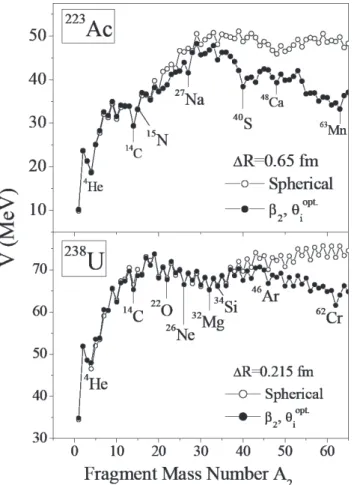
Figure 1: The fragmentation potentials for the parent nuclei 223Ac (upper
panel) and 238U (lower panel), taking all possible fragments as spheres
(open circles) and with quadrupole deformation β2 and cold “optimum” orientations θi
opt. (solid circles) at the best fitted ∆R values. The figure is based on Fig. 2 of PRC 80, 034317(2009).
To understand the CR phenomenon, the unified fission models (UFM) such as the analytic super-asymmetric fission model (ASAFM) [3], and PCM like that of Gupta and Collaborators [6] have been advanced. They differ from each other for their non-inclusion or non-inclusion of the preformation probability/ spectroscopic factor P0 of the cluster being preformed before penetrating the confining nuclear interaction barrier with certain penetration probability P.
Extensions of Natural Radioactivity to 4th-Type and of the Periodic Table to Super-heavy Nuclei: Contribution of Raj K Gupta to Cold Nuclear Phenomena
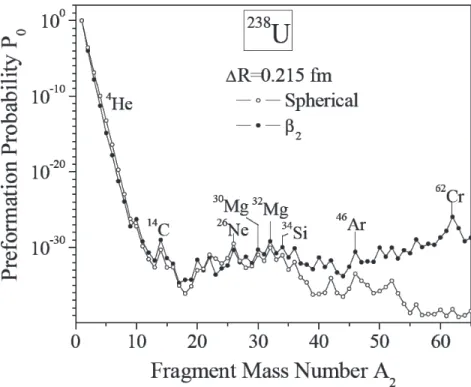
Figure 2: Same as for Fig. 1(lower panel, 238U), but for the preformation
probability P0. The figure is based on Fig. 3 of PRC 80, 034317 (2009).
considered as spheres (open circles) and, then, with quadrupole deformation β2 and cold “optimum” orientations θi
opt. (solid circles), at the best fitted ∆
R values. In Fig. 2 the preformation probability, P0, for 238U have been calculated. In these calculations [6], experimental data [11] have been compared nicely, while discussing the dynamics of the decay using PCM.
B. Cluster Radioactivity and RMFT
Singh, B. Kumar, S. Sharma, M.K. Patra, S.K.
zero density. We note in this figure that the low-density regions (referred to as clusters) occur in each case, for both the ground- and excited-state solutions. The important point is that the microscopic relativistic mean field (RMF) formalism, combined with an effective M3Y nucleon-nucleon interaction, supports the concept of preformation of clusters in nuclei, introduced by Gupta and collaborators in PCM for cluster radioactive decays. In Fig. 3, the P0c(emp) values from various parents (symbols) compared with the model calculations of Blendowske and Walliser [13] (solid line), and ones raised by the factors of 102 and 103 (dotted and dashed lines), respectively, quite reasonably.
4. EXTENSION OF THE PERIODIC TABLE TO SUPER HEAVY NUCLEI
The study of “cold reaction valleys” by Prof. Raj K. Gupta and collaborators, almost forty years ago, led to an idea of cold fusion (reaction partners) and succeeded in
Figure 3: The empirical preformation probability Pc emp 0
( )
for cluster decays from various parents (symbols) compared with the model calculations of Blendowske and Walliser[13] (solid line) and ones raised by the factors of 102 and 103 (dotted and dashed lines, respectively). The figure is based
Extensions of Natural Radioactivity to 4th-Type and of the Periodic Table to Super-heavy Nuclei: Contribution of Raj K Gupta to Cold Nuclear Phenomena
Figure 4(a): Fragmentation potential for the decay of 291115* compound
system formed in the 48Ca + 243Am reaction for θ
i opt.
at ECN* = 33.37 MeV and respective lmax values. (b) Same as for (a), but for the corresponding preformation probabilities P0. The figure is based on Fig.2 of PRC 87, 054610 (2013).
Singh, B. Kumar, S. Sharma, M.K. Patra, S.K.
Figure 5: Calculated cross sections for 2n-, 3n-, and 4n-evaporation channels of 48Ca + 243Am reaction as a function ofE
CN *
, compared with experimental data [16]. The error bars are also shown. The figure is based on Fig. 6 of PRC 87, 054610 (2013).
system formed in the 48Ca + 243Am reaction at E CN *
= 33.37 MeV calculated by Gupta and Collaborators. Here calculations have been made for spherical and deformed choices of fragments with optimum hot orientations θi
opt. and respective l
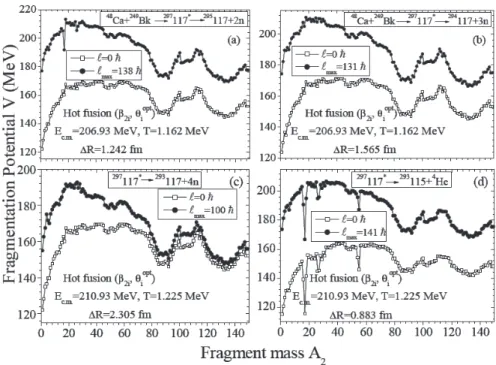
max values of 99 and 116 , respectively. The deformations are taken up to quadrupole β2i. In Fig. 4(b) corresponding preformation probabilities P0 have been calculated. The calculations for the cross sections for 2n-, 3n-, and 4n-evaporation channels of the reaction as a function of ECN* have been compared with experimental data [16], as shown in Fig. 5. The error bars are also shown here along with dashed line as guide to the eye. Similar calculations are shown in Fig. 6 and Fig. 7 but for 48Ca + 249Bk → 297117* reaction.
5.SUMMARY
Extensions of Natural Radioactivity to 4th-Type and of the Periodic Table to Super-heavy Nuclei: Contribution of Raj K Gupta to Cold Nuclear Phenomena
Figure 7: DCM calculated cross sections σ3n and σ4n+4He for the decay of
297117*, plotted as a function of E
CN
* and compared with experimental data [15]. The figure is based on Fig. 8 of PRC 85, 024604 (2012).
Figure 6(a-d) Fragmentation potentials for 48Ca + 249Bk →297117*for
various neutron-evaporation channel including the 4He decay channel.
Singh, B. Kumar, S. Sharma, M.K. Patra, S.K.
all the three cold processes: cluster radioactivity, cold fission and cold fusion. It also led to the development of dynamical theories (PCM and DCM) to successfully explain the ground-state as well as excited-state decay of nuclei. The DCM has been applied successfully to the decay of light, medium, heavy and super heavy mass compound nuclei. Here, a concept of preformed clusters in nuclei lead to a non-statistical description for the decay of a CN to light particles LPs (n, p and α-particle), the intermediate mass fragments IMFs (both light and heavy), fusion-fission FF and quasi-fission QF processes. Different mass regions of the Periodic Table show different combinations of these processes or any one of them as a dominant mode and DCM seems to provide a decent description of these decay modes. It is highly relevant to mention here that cold fission was also predicted on QMFT in 1975, but first observed in 1981. The whole concept of cold phenomenon in nuclear physics was first introduced by Prof. Raj K. Gupta and collaborators on the basis of QMFT. These are among the most substantial accomplishments of Indian Physics, and we owe them to Prof. Raj K. Gupta who celebrates his 75th birthday this year, dynamic as ever.
REFERENCES
[1] H. J. Fink, et al., Proc. Int. Conf. on Reactions between Complex Nuclei, Nashville, USA, June 10-14, 2, 21, (1974); Raj K. Gupta, et al., Proc. Int. School on Nucl. Phys., Predeal, Romania, 75, 1974; J. Maruhn and W. Griener, Phys. Rev. Lett. 32, 548, (1974).
[2] Raj K. Gupta, et al., Phys. Rev. Lett. 35, 353, (1975); Phys. Lett. 60 B, 225, (1976); Phys. Lett. 67B, 257, (1977); Z. Naturforsch 32a, 704, (1977); Z. Physik A 283, 217, (1977); Sovt. Jour. Nucl. Phys. 28, 160, (1978); Z. Physik A 281, 159, (1977); Sovt. Jour. Nucl. Phys. 8, 289, (1977); Fiz. Elem. Chastis. At. Yadra 8, 717, (1977).
[3] A. Sandulescu, et al., Sovt. Jour. Nucl. Phys. 11, 528, (1980). [4] H. J. Rose and G. A. Jones, Nature 307, 245, (1984).
[5] BirBikram Singh, Manoj K. Sharma and S. K. Patra, in Proceedings of the Int. DAE Symp. on Nucl. Phys. 58, 450, (2013).
[6] Raj K. Gupta, et al., in Proc. of the 5th Int. Conf. on Nuclear Reaction Mechanisms, Varenna, (Ricerca Scientificaed Educazione Permanente, Milano, 1988), p. 416; Phys. Rev. C 39, 1992, (1989); Phys. Rev. C 55, 218, (1997); Phys. Rev. C 79, 064616, (2009); Phys. Rev. C 80, 034317, (2009); Phys. Rev. C 82, 014607, (2010); Int. J. Mod. Phys. E
20, 1003, (2011).
[7] Raj K. Gupta et al., Int. Rev. Phys (IREPHY) 2, 369, (2008); Clusters in Nuclei, Lecture Notes in Physics, 818, 223, (2010), ed. C. Beck, Springer-Verlag; Proc. DAE Symp. OnNucl. Phys. 56, 474, (2011); 57, 550, (2012); Phys. Rev. C 85, 064602, (2012), 85, 024615, (2012); Phys. Rev. C 85, 024604, (2012); Phys. Rev. C 86, 034604, (2012); Phys. Rev. C86, 064610, (2012); Phys. Rev. C 86, 064611, (2012); Phys. Rev. C 87, 054610, (2013); Phys. Rev. C 88, 014615, (2013).
[8] Raj K. Gupta, in Heavy Elements and Related New Phenomena, World Scientific, Singapore,
Vol. II, p. 643, (1999).
[10] R. Bonetti and A. Guglielmetti, Romanian Reports in Physics 59, 301, (2007). [11] A. Guglielmetti, et al., J. Phys.: Conf. Ser. 111, 012050, (2008).
[12] S. K. Patra, et al., J. Phys. G: Nucl. Part. Phys. 34, 2073, (2007). [13] R. Blendowske and H. Walliser, Phys. Rev. Lett. 61, 1930, (1988). [14] S. Hofmann, et al., Nucl. Phys. News 14, No. 4, 5, (2004).
[15] Yu. Ts. Oganessian et al., Nucl. Phys. A 734, 109, (2004); Phys. Rev. C 83, 054315, (2011).
![Figure 3: The empirical preformation probability P 0 c emp ( ) for cluster decays from various parents (symbols) compared with the model calculations of Blendowske and Walliser[13] (solid line) and ones raised by the factors of 10 2 and 10 3 (dotted](https://thumb-eu.123doks.com/thumbv2/123dok_br/18310923.348746/6.852.224.730.160.565/figure-empirical-preformation-probability-compared-calculations-blendowske-walliser.webp)
![Figure 5: Calculated cross sections for 2n-, 3n-, and 4n-evaporation channels of 48 Ca + 243 Am reaction as a function of E CN* , compared with experimental data [16]](https://thumb-eu.123doks.com/thumbv2/123dok_br/18310923.348746/8.852.253.711.167.541/calculated-sections-evaporation-channels-reaction-function-compared-experimental.webp)