An Investigation of any Correlation amongst Cognitive
Styles, Cognitive Traits and Performance of learners for
developing a generalized Semantic Framework for
Adaptive Online Learning System
Md. Tanwir Uddin Haider1, M. P. Singh2 and U. S. Triar3
1
Department of Computer Science & Engineering National Institute of Technology Patna, Bihar, India
2
Department of Computer Science & Engineering National Institute of Technology Patna, Bihar, India
3
Department of Electrical Engineering National Institute of Technology Patna, Bihar, India
Abstract
This paper presents the results of experiment conducted to investigate the correlation, if any, between the learning style and cognitive traits which include working memory capacity of technical learners. Further, the experiment aimed to investigate the correlation between the learning style and performance of technical learners in web-based quizzes based on their styles over different subjects for making the generalized semantic framework for adaptive online learning system. The results indicate that the learners having learning style of active, sensing, intuitive, visual and global have good working memory capacity. Further, the learners having learning style of active, sensing, intuitive, and global shown better performance during web-based quizzes.
Keywords:
Learning Style, Cognitive Traits, Working Memory Capacity, Adaptive Online Learning System, Web-Based Quizzes.1.
Introduction
Generally, in technical institution students who get selected are highly talented and are generally from top ten percent in order of merit of the selection criteria. But it has been observed that during their degree program ten
to twenty percent of the student’s performance degrades
due to which they become academically deficient. That is why they are not being placed during their campus placement or even institute declares them as not fit for technical education. This is the loss to the technical institution. There are certain factors due to which their performance degrades. One of the factors which are most important that in conventional teaching we use to teach all the students in same style and in same flow as we
know that students have their own learning styles and their own memory capacity to understand.
This research work is motivated by our desire to identify that is there are any correlation between learning styles and cognitive traits which include working memory capacity of technical learners. Further, is there any correlation between learning styles and performance of technical learners in web-based quizzes based on their styles over different subjects that are offered in undergraduate and postgraduate level? This paper presents results of experiments conducted to correlate the learning styles and working memory capacity. Further, it also correlates the learning styles of learners with their performance.
This paper is organized in five sections. Section 2 describes the related work. Section 3 describes experiments and their results. Section 4 contains the conclusion and future work. Section 5 contains the Acknowledgement.
2.
Related Work
The term cognitive styles or learning styles has been widely used by educational theorists over the years. Learning style manifest as a preference for the method, by which one acquires, retrieves and retains information, which is independent of intelligence.
Garger and Guild [10] described learning style as “Stable and pervasive characteristics of an individual, expressed
as one approaches a learning task”. There have been
many characteristics of learning style preferences.
Felder-Soloman [2] proposed four dimensions of learning styles viz. active-reflective, sensing-intuitive, visual-verbal and sequential-global based on information processing model of the learner. The active learners prefer to learn by trying things out where as the reflective learners learn by thinking things through. The sensing learners are practical, concrete oriented and prefers facts and procedures whereas intuitive learners are innovative and prefers conceptualization and abstraction. The visual learners prefers visual representation where as verbal learners prefers written and spoken explanations. The sequential learners learn in small incremental steps where as the global learners learn in large leaps.
Bohlen and Ferrat [3] experimentally investigated whether end-user learning outcomes (i.e. achievement, efficiency and satisfaction) are affected by the methods of instruction, the user's learning style, or the combination of these two factors. The results indicated that the method of instruction alone and in combination with learning style makes a difference in some but not all measures of achievement, efficiency and satisfaction.
Lynda Thomas, et al. [4] examined correlations between preferred learning style and performance on both the examination and practical aspects of an introductory programming course. Students of different learning style were compared to their performance on the examination and the practical programming part of the introductory programming module. They have experimentally shown that there was significant difference in performance between groups of students having different learning styles.
Davis, et al. [5] investigated outcomes of first year English students under seven instructors where the learning style of the students was either matched, unmatched or partially matched to that of instructors. They found no significant differences in student outcomes among the groups.
Larsen [6] reported the results of students with different learning styles using interactive video instruction to learn the concepts of data communications. He found no
significant difference in student’s outcomes as a result of
different learning styles.
Aditya, et al. [9] investigated the relationships between learning styles, instruction methods and performance of learners. The result of investigation indicated that there is no significant difference in performance of students due
to different methods of instruction. Further, the online behavior and performance of students with different learning styles were different. Results of these experiments are pointer to the complexity of learning process and effect of instruction and evaluation methodologies.
Wnag Xioo Min, Cui Wei and Che Lei [11] presents a learning system which is able to achieve individual optimized access to learning resource by ontology technology and also provides friendly user interface by adaptive hypermedia.
Sabine Graf and Kinshuik [12] shows the relationship between different learning styles, in particular the Felder-Silverman learning styles model (FSLSM), and cognitive traits, in particular working memory capacity (WMC), can be used for identifying learning styles.
Shipin Chen and Jianping Zhang [13] presents an adaptive learning system, in essence, is a kind of online learning environment that supports the individual
learning. It changes the traditional “just put it on the web” approach, and provides the customized learning
according to the individual differences.
3.
Experiments
Three experiments were conducted for this research work. The first experiment was conducted to categories technical learners based on their learning styles and detecting working memory capacity of each learners who were participated in the learning styles test. The second experiment was conducted to investigate the correlation, if any, between the learning style and cognitive traits which include working memory capacity of technical learners and the third experiment was conducted to investigate the correlation between learning styles and performance of technical learners in web-based quizzes based on their styles over three different subjects offered in undergraduate and postgraduate level.
For the measurement of learning styles, we have used Index of Learning Style (ILS) instrument developed by Soloman and Felder [7]. It consists of forty-four questions each of having four alternative answers and is
available at
The ILS instrument has divided each dimension in twelve groups using numeric range from -11 to +11. Since the number of participants in most of the groups becomes very small, we decided to reduce the number of groups by merging them along each dimension. We decided to divide each dimension in two groups. Table 1 shows the number of students in each group. Some of the students have more than one style so it has been placed in both the learning styles.
Table 1: Number of students in each learning style
This experiment also uses web-OSPAN [14] for detecting working memory capacity which is one of the cognitive traits. In this, learners are required to perform simple mathematical operations and give the answer in true or false statement. After each mathematical operation, a word comes that is to be recalled after performing 2 to 6 mathematical operations. Each correct mathematical operation as well as each correct recalled word is stored in the database. The total number of recalled words gives the values of working memory capacity.
3.1
Correlation between Learning Styles and
Working Memory Capacity
This experiment was conducted to see the correlation between learners belonged to any specific learning style and their working memory capacity. There were Eighty Nine learners who belonged to B.Tech. and M.Tech. programme of National Institute of Technology Patna. The correlation has been done using SPSS (Statistical Package for the Social Sciences) software. It is a statistical analysis and data management software package that can take data from almost any type of file and use them to generate tabulated reports, charts, and plots of distributions and trends, descriptive statistics, and conduct complex statistical analyses.
The results indicate that the learners having learning style of active, sensing, intuitive, visual and global have good working memory capacity. For example Table 2 shows the Correlation between sensing learners and their working memory capacity.
Correlations
1.000 .714*
. .031
9 9
.714* 1.000
.031 .
9 9
Pearson Correlation Sig. (2-tailed) N
Pearson Correlation Sig. (2-tailed) N
sensing
WMC
sensing WMC
Correlation is significant at the 0.05 level (2-tailed). *.
Table 2: Correlation between sensing learners and their working memory capacity
3.2 Relationship between Learning Styles and
Performance of Learners
The performances of learners were tested on web-based quizzes based on their styles over different subjects. The web-based quizzes were conducted for three courses: Object Oriented Programming (OOP), Database Systems (DBS) and Advanced Data Structure & File Systems (ADFS). Object Oriented Programming (OOP) is being taught in B.Tech. third semester whereas Database Systems (DBS) course is a part of B.Tech. fifth semester. The subjects taught in third and fifth semesters are common to “Computer Science & Engineering” and
“Information Technology” streams of engineering.
Whereas the subject Advanced Data Structure & File Systems (ADFS) is taught in M.Tech first semester.
3.2.1
Participants
There were eighty nine students participated in web-based quizzes. Students participated in this quizzes were belongs to B.Tech. third semester, B.Tech fifth semester and M.Tech first semester students of National Institute of Technology Patna(NITP), Patna.
3.2.2
Web
-
based quiz
Web semantic has been introduced for the development of web-based quiz. The main technologies being used were PHP, Java Script and XML. The questions used in
this quiz were based on EDUCOM’s Instructional
data and their corresponding results report[16]. The specification enables the exchange of this item, assessment and results data between Learning Management Systems, as well as content authors, and content libraries and collections. The quiz is web-enabled application which needs only a web-browser on the client side.
In this web-based quiz participants were required to sign-in and then the system delivers one question at a time. The duration of the web-based quiz was ten minutes and had ten questions, each having four alternatives and only one answer was correct. A student was allowed to skip or answer the questions several times. The server was programmed to capture the clicking of students and to store in the MySQL database with information whether the click was write or wrong answer.
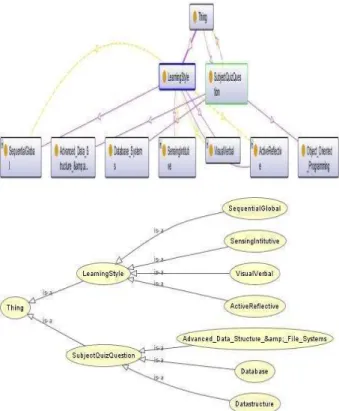
The web-based quiz was authored based on their learning styles. Our implementation provided for shuffling the order of questions, shuffling the alternative options, changing the data values in the questions or the alternatives answers, and generating semantically equivalent question. This was used to ensure that each student would receive a unique but semantically equivalent question. Figure 1 shows a partial snapshot of web-based quiz ontology on their learning styles with the classes and properties in the Protégé 2000 ontology editor [15].
Figure 1: A partial snapshot of web-based quiz ontology on their learning styles using Protégé 2000
3.2.3 Results
We analyzed the clicking pattern of each student. The performance was computed as a ratio of right clicks and total number of clicks. The performance of students categorized according to their learning styles in web-based quiz in different courses. The results indicates that the learners having learning style of active, sensing, intuitive, and global shown better performance during online quizzes. For example Table 3 shows the correlation between the sensing learners and their performance.
Correlations
1.000 .803**
. .009
9 9
.803** 1.000
.009 .
9 9
Pearson Correlation Sig. (2-tailed) N Pearson Correlation Sig. (2-tailed) N sensing
Performance
sensing Performance
Correlation is significant at the 0.01 level (2-tailed).
**.
Table 3: Correlation between the sensing learners and their performance
4.
Conclusion And Future Work
In this experiment it was found that in National Institute of Technology Patna more than fifty four percent learners belonged to visual learning style and the learners having learning style of active, sensing, intuitive, visual and global have good working memory capacity. Further, the learners having learning style of active, sensing, intuitive, and global shown better performance during online quizzes.
It is therefore concluded that active, sensing, intuitive, and global students benefited from the on-line teaching in National Institute of Technology Patna (NITP). Future plan is to design a generalized semantic framework for adaptive on-line learning based on cognitive traits.
5.
Acknowledgements
References
[1] Keefe, J.W. & Ferrell, B.G. (1990), “Developing a defensible learning style paradigm”, Educational
Leadership, 48 (2) pp. 57-61.
[2] Felder, Richard M. (1996), “Matters ofstyle”, ASEE
Prism, 6(4), 18-23.
[3] George A. Bohlen,Thomas W. Ferratt (1993), ”The effect of learning style and method of instruction on the achievement, efficiency and satisfaction of end-users
learning computer software”, Proceedings of the 1993 conference on Computer personnel research, 273-283,ACM Press.
[4] Lynda Thomas, Mark Ratclife, John Woodbury, Emma Jarman (2002), “Learning styles and performance
in the introductory programming sequence”, 33-37, ACM Press, New York, NY, USA.
[5] Davis, J.F,, Murrell, P,H. and Davis, T.M.(1988),
“On Matching Teaching Approach With Student 281
Learning Style: Are We Asking the Right Question?”,
Annual Meeting of Mid South Educational Research Association, Louisville, KY, ERIC Document 303859.
[6] Larsen, R. E. (1992), “Relationship of Learning Style to the Effectiveness and Acceptance of Interactive Video
Instruction”, Journal of Computer-Based Instruction
(19:1), pp. 17-21.
[7] Soloman, Barbara A., Felder, Richard M., “Index of
Learning Styles Questionnaire”, http://www.engr.ncsu.edu/learningstyles/ilsweb.html
[8] Colin Smythe, Eric Shepherd, Lane Brewer, and Steve Lay (2002), “IMS Question and Test
Interoperability: ASI Best Practice and Implementation Guide”, IMS Global Learning Consortium Inc.,
[9] Sinha Aditya K., Chaudhary B. D., (2004), “An investigation of relationship between Learning Styles, Instruction Methods and Performance of Learner”, 15th Annual AAEE conference, Toowoomba, Australia.
[10] Garger S., Guild P. (1984), “Learning Styles: The crucial difference”, Curriculam Review, 23(1), 9-12.
[11] Wnag Xioo Min, Cui Wei & Che Lei(2008),
“Research of Ontology-based Adaptive Learning System” , 2008 International Symposium on Computational Intelligence and Design, 366-370.
[12] Sabine Graf & Kinshuik (2010), “Using Cognitive Traits for Improving the Detection of Learning Styles”,
2010 Workshops on Database and Expert Systems Applications, 74-78.
[13] Shipin Chen and Jianping Zhang (2008). “The Adaptive Learning System based on Learning Style and Cognitive State”, 2008 International Symposium on Knowledge Acquisition and Modeling, 302-306.
[14] Web-OSPAN, 2007, Retrieved 22 February, 2007 from http://altrc.massey.ac.nz/~tylin/webOSPAN
[15] Protégé 2000: http://protege. Stanford.edu/, OILed:http://img.cs.man.ac.uk/oil, and OntoEdit: http://ontoserver.aifb.uni-karlsruhe.de/ontoedit.
[16] Colin Smythe, Eric Shepherd, Lane Brewer, and Steve Lay (2002), “IMS Question and Test Interoperability: ASI Best Practice and Implementation Guide”, IMS Global Lea