Accessibility of users with hypertension in the family
health strategy
Acessibilidade dos usuários com hipertensão arterial sistêmica na estratégia saúde da família
La accesibilidad de los usuarios con hipertensión arterial sistémica en la estrategia de salud de la familia
Erik Cristóvão Araújo de Melo1 Tânia Maria Ribeiro Monteiro de Figueiredo2 Maria Aparecida Alves Cardoso2 Neir Antunes Paes3
1. Federal University of Campina Grande.
Campina Grande - PB, Brazil.
2. State University of Paraíba.
Campina Grande - PB, Brazil.
3. Federal University of Paraiba.
João Pessoa - PB, Brazil.
Corresponding Author: Erik Cristóvão Araújo de Melo. E-mail: [email protected]
Submited on 06/20/2013. Accepted on 05/19/2014.
DOI: 10.5935/1414-8145.20150017
A
bstrActObjective: To evaluate the accessibility of hypertensive patients in the Family Health Strategy in Campina Grande/PB. Methods: This is a descriptive cross-sectional study, conducted with the hypertensive population enrolled in HiperDia (n = 17,658) from a sample of 382 users. An instrument adapted by Paes of the validated instrument to assess attention to TB proposed by Villa and Ruino-Neto was used. Results: It was obtained satisfactory results regarding the geographical accessibility: 4.10 (CI 95% [3.56 to 4.65], SD = 0.518) and economic: 4.10 (CI 95% [3.56 to 4.65], SD = 0.518). As for organizational accessibility: 3.46 (CI 95% [2.70 to 4.22], SD = 0.724) and socio-cultural: 3.42 (CI 95% [2.79 to 4.05], SD = 1.090), regular results were obtained. Conclusion: According to the satisfaction of the hypertensive patients in Campina Grande/PB provided access to family health strategy without geographic and economic barriers, but there were problems with the organizational and socio-cultural aspects.
Keywords: Hypertension; Accessibility to health services; Health services evaluation.
r
esumoObjetivo: Avaliar a acessibilidade dos usuários hipertensos na estratégia de saúde da família no Município de Campina Grande/PB. Métodos: É um estudo transversal e descritivo, realizado com a população de hipertensos cadastrados no HiperDia (n = 17.658) a partir de uma amostra de 382 usuários. Foi utilizado um instrumento adaptado por Paes do instrumento validado para avaliar a atenção para a tuberculose proposto por Villa e Ruino-Neto. Resultados: Obtiveram-se resultados satisfatórios referentes à acessibilidade geográica: 4,10 (IC 95% [3,56-4,65]; DP: 0,518) e econômica: 4,10 (IC 95% [3,56-4,65]; DP: 0,518). Quanto à acessibilidade organizacional: 3,46 (IC 95% [2,70-4,22]; DP: 0,724) e sóciocultural: 3,42 (IC 95% [2,79-4,05]; DP: 1,090), obteve-se resultados regulares. Conclusão: De acordo com a satisfação dos usuários hipertensos o Município de Campina Grande/PB proporcionou acesso à estratégia saúde da família sem barreiras geográicas e econômicas, porém apresentou problemas em relação aos aspectos organizacionais e sócioculturais.
Palavras-chave: Hipertensão; Acessibilidade aos serviços de saúde; Avaliação de serviços de saúde.
r
esumenObjetivo: Evaluar la accesibilidad de los pacientes hipertensos en la Estrategia Salud de la Familia, en Campina Grande/PB. Métodos: Se realizó un estudio descriptivo, transversal, realizado con la población de hipertensos inscritos en el HiperDia (n = 17.658) de una muestra de 382 usuarios. Se utilizó un instrumento adaptado por Paes, instrumento validado para evaluar la atención a la tuberculosis, propuesto por Villa y Ruino-Neto. Resultados: Los resultados obtenidos fueron satisfactorios en cuanto a la accesibilidad geográica: 4,10 (IC 95% [3,56-4,65], DE = 0,518) y económica: 4,10 (IC 95% [3,56-4,65], DE = 0,518). En cuanto a la accesibilidad organizacional: 3,46 (IC 95% [2,70-4,22], DE = 0,724) y socio-cultural: 3,42 (IC 95% [2,79-4,05], DE = 1.090), fueron detectados resultados regulares. Conclusión: De acuerdo con la satisfacción de los usuarios hipertensos, el municipio de Campina Grande les garantía buen acceso a la estrategia de Salud de la Familia, sin barreras geográicas o económicas. Sin embargo, ha presentado problemas en los aspectos organizacionales y socioculturales.
INTRODUCTION
The systemic arterial hypertension (SAH) is one of the most common diseases of the modern world and reaches, on average, 15% to 20% of the adult population. In Brazil there are about 17 million patients with hypertension; 35% of the population is more than 40 years old. The burden of disease represented by the morbidity and mortality of this clinical entity is very high and is being treated as a serious public health problem throughout the world for its magnitude, risk and diiculty of control1,2.
The Northeast region has 31.8% of individuals with hyper-tension, taking the city of Recife/PE on leadership of ranking with more than 29% of the population victim of the disease. The list also included João Pessoa/PB (23.9% of the population), Salvador/BA (23.4%), Natal/RN (22.6%) and Aracaju/SE (21.4%)3.
To succeed in reducing these indicators of the morbidity and mortality of SAH, the plan of reorganization of the attention to Arterial Hypertension and Diabetes Mellitus, operated by the
Family Health Strategy (FHS), has a fundamental role, needing the use of mechanisms that have as their purpose the imple-mentation of the fundamental principles and guidelines for the implementation of a universal, integral and unanimous system to the entire population4.
In this sense, the accessibility to health services contributes to this success, comprising one of the aspects of the supply of services relating to the ability to produce services and respond to the health needs of a given population, explaining the variations in the use of health services and population groups representing an important dimension in studies on equity in health systems5.
Considering the scarcity of studies in the advance of kno-wledge related to accessibility evaluation of health services, especially in the northeastern region and assistance to SAH focused on FHS, the objective is evaluating the accessibility of hypertensive users to the Family Health Strategy (FHS) in the municipality of Campina Grande/PB.
METHODS
Cross-sectional study, of descriptive character, of health services evaluation. Held in Family Health Basic Units (FHBU), during the period from August 2009 to March 2010. The muni-cipality of Campina Grande/PB, was one of the pioneers in the implementation of the Family Health Program (FHP) in 1994, with ive teams, occurring the implementation process, 92 teams arriving in 2011, totaling 85% population coverage.
The target population was registered in hypertensive Hiper-Dia Information System (System of Registration and Follow-up of Hypertensive and Diabetics) in 2006 and 2007, composed of 17,658 users. HiperDia is for the registration and follow-up of patients with hypertension and/or diabetes mellitus met in
ambulatory network of SUS, generating information for acqui-sition, dispensing and distribution of medicines regularly and systematically to all registered patients.
A representative sample was calculated, using a sampling procedure by conglomerates (in two successive stages), with probability proportional to size (PPS), reaching 420 hypertensive, generating a total of 14 hypertensive per team, however, after identifying some losses (change of address, deaths, etc.), the sample was of 382 hypertensive.
As inclusion criteria, FHBU who had number of registered hypertensive (2006 and 2007), sheets and charts of the users was chosen.
Users below 20 years old, unable to answer the question -naire by themselves and who performed the change described in the FHBU area during the registration period to the time of the interview were excluded.
It was used an instrument adapted for Paes6 to evaluate the
arterial hypertension services, based on a validated instrument to assess the tuberculosis proposed by Villa and Ruino-Neto7,
guided by Starield instrument5, to evaluate primary healthcare
in developed countries, consisting of 7 dimensions (access to diagnosis, access to treatment, adhesion/bond, cast of services, coordination, focus on the family, orientation to the community), totaling 100 variables. After their analysis, 40 variables relating to accessibility were chosen, grouped in 04 dimensions: geographic (07), economic (06), organizational (13) and sociocultural (14).
To evaluate the geographical accessibility, variables related at the onset of symptoms and during the consultation to SAH (health service nearest their home; diiculty to go to the health service and use of motorized transport to go to the health ser -vice) were observed.
The economic accessibility was evaluated by observing the variables related to the onset of symptoms and during the consultation SAH (use of motorized transport, waste of money with transport and loss of work shift or appointment to consult on health service).
Organizational accessibility was evaluated by observing va -riables related to the presence of professionals in the health unit in every working day of the week, hours of operation of the health service, wait times for servicing (over 60 minutes), appointment within 24 hours at the health unit, treatment, participation in groups, performance and receipt of requested examinations, reference and counter-reference.
The instrument was applied (structured questionnaire) throu -gh interviews with users, who answered questions, following up a range of possibilities for "Likert" (Never, Rarely, Sometimes, Often, Always), which attributed the value between 1 and 5. The categories "does not apply" were added, which assigned the value 0 (zero) and "don't know" or "not answered", where assigned the value 99.
A composite index was formed, general average, for each dimension of accessibility, through the sum of the average values of the questions. They were analyzed individually through the measures of central tendency and variability (mean, standard deviation and conidence interval).
Accessibility was classiied in results: satisfactory (≥ 4); regular (< 4 and ≥ 3) and unsatisfactory (< 3).
The data were organized into spreadsheets in Oice Excel 2003 and transferred to a database developed in IBM SPSS Statistics package 13.0. Then the identiication of normality was performed, by the Kolmogorov-Smirnov test. As normality of distri -bution was not observed, the non-parametric test Kruskall-Wallis (non-parametric ANOVA) was used. Once applied the tests to compare the diferences, by assigning a signiicance level of p < 0.05, a test known as multiple comparison "Dunn" was
carried out.
The study was approved by the Ethics Committee in Re -search of the Health Sciences Center of Federal University of Paraiba (UFPB), through the Protocol 0101, being in accordance to Resolution 196/96 of the Ministry of Health.
RESULTS
Geographic Accessibility
Table 1 shows that the geographical accessibility in general, obtained satisfactory results, considering the composite index, with an average of 4.01 (CI 95% [3.56-4.46]; SD: 0.427). However it presented regular results in variables that have addressed the onset of symptoms of SAH, having presented a variability (SD) for highest for related variables during query for SAH.
Economic Accessibility
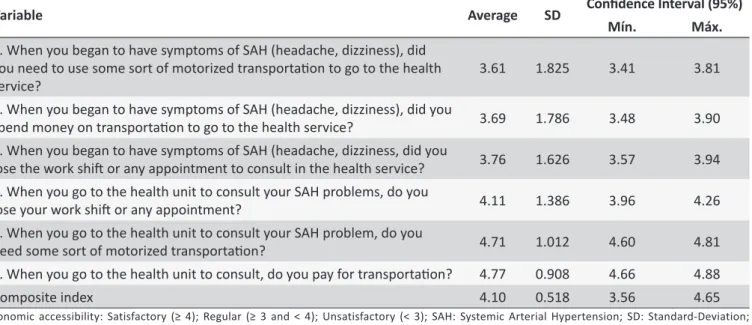
Table 2 shows that the economic accessibility in general, obtained satisfactory results, considering the composite index, with an average of 4.10 (95% CI [3.56-4.65]; SD: 0.518), featu-ring regular results in variables that have addressed the onset of symptoms of SAH, showing a variability (SD) for highest for related variables during query for SAH.
Organizational Accessibility
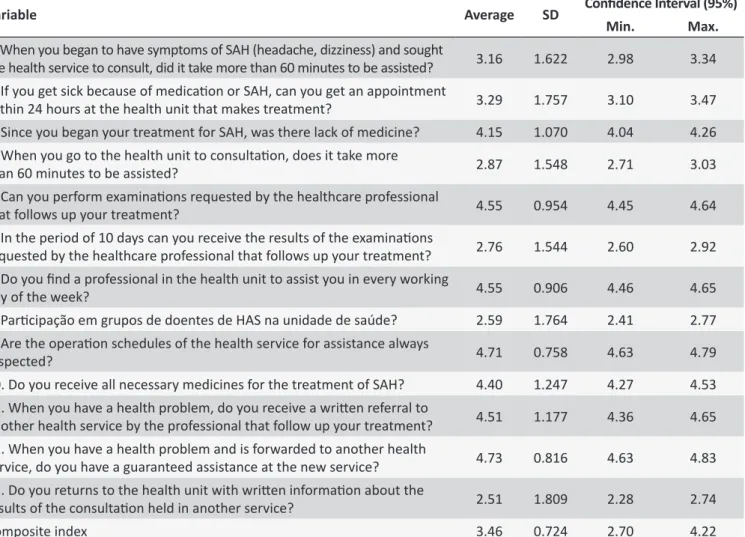
Table 3 shows that the organizational accessibility obtained regular result, with a composite index 3.46 (CI 95% [2.70-4.22]; SD: 0.724). It is observed that, for the most part, where the average indexes for items were below 4, the variability (SD) of responses were higher, than for the items whose indexes
stayed above 4, i.e. the smaller the average index, the greater the dispersion of answers.
Socio-cultural accessibility
Table 4 shows that sociocultural accessibility obtained regular result, with a composite index 3.42 (95% CI [2.79-4.05]; SD: 1.090). A satisfaction in relation to variables that have addressed communication between users and professionals. However unsatisfactory results were observed related to varia -bles that have addressed the involvement of professionals with the community and the family of the user.
DISCUSSION
The geographic and economic accessibility achieved in general, a satisfying composite index, providing easy to move without inancial expense to the health service, by coniguring the FHS as gateway health services network of the municipality for attention SAH.
The results shown are positive, because it features a greater demand of users by FHS, making the strengthening of primary care in controlling HAS advocated by health policies and progra-ms of primary care responsibility8.
The study confirms the Reorganization Plan of Care to Arterial Hypertension and Diabetes Mellitus in Brazil, which
includes its general objective as the establishment of guidelines and objectives for the reorganization of care to arterial hyperten-sion and diabetes in the Uniied Health System (SUS), through ensuring diagnosis and user binding to health units for treating and monitoring4.
The regular result presented by organizational accessibility through composite index was due to the behavior of the variables that have addressed various aspects.
Among them, the presence of professionals in the health unit in every working day of the week and the hours of operation of the FHBU, with satisfactory results. The study corroborated with what is advocated by the Ministry of Health, where all members of the FHS must have a load time of 40 hours per week, with the exception of medical professionals, and with the study presented in the vast majority of municipalities in northeastern Brazil, the FHS works in two daily shifts8,9.
Regarding the waiting time, the study showed regular results (onset of symptoms of SAH) and unsatisfactory (in consultation with the SAH), opposing other studies, which have shown good results and excellent in relation to waiting time for scheduled consultations on FHBU, but in relation to urgent consultations obtained 50.3% regular and good results10,11.
Table 1.
Average, Standard-Deviaion and Conidence Interval of geographical accessibility indexes of hypertensive
people registered in Hiperdia in the period of 2006-2007, Campina Grande/PB, 2011
Variable
Average
SD
Conidence Interval (95%)
Min.
Max.
1. When you began to have symptoms of SAH (headache, dizziness), did you
search the closest health service from home?
3.79
1.762
3.60
3.98
2. When you began to have symptoms of SAH (headache, dizziness) did you
have diiculty to go to the health service?
3.87
1.626
3.69
4.05
3. When you began to have symptoms of SAH (headache, dizziness), did you
need to use some sort of motorized transport to go to the health service?
3.61
1.825
3.41
3.81
4. Do the health unit workers follow up your treatment of SAH usually visit
you at home?
3.72
1.659
3.55
3.89
5. Do you do the treatment of SAH on a health service closer to home?
4.62
1.093
4.51
4.73
6. Do you have diiculty to go to the health unit to be consulted?
4.49
1.215
4.36
4.62
7. When you go to the health unit to consult your problem of SAH do you
need to use motorized transportaion?
4.71
1.012
4.60
4.81
Composite index
4.01
0.427
3.56
4.46
Geographical accessibility: Saisfactory (≥ 4); Regular (≥ 3 and < 4); Unsaisfactory (< 3); SAH: Systemic Arterial Hypertension; SD: Standard-Deviaion;
Min.: Minimum/Max.: Maximum. Source: Study held by Paes6.
Table 2.
Average, Standard-Deviaion and conidence interval of economic accessibility indexes of hypertensive people
in Hiperdia registered in the period 2006-2007, Campina Grande/PB, 2011
Variable
Average
SD
Conidence Interval (95%)
Mín.
Máx.
1. When you began to have symptoms of SAH (headache, dizziness), did
you need to use some sort of motorized transportaion to go to the health
service?
3.61
1.825
3.41
3.81
2. When you began to have symptoms of SAH (headache, dizziness), did you
spend money on transportaion to go to the health service?
3.69
1.786
3.48
3.90
3. When you began to have symptoms of SAH (headache, dizziness, did you
lose the work shit or any appointment to consult in the health service?
3.76
1.626
3.57
3.94
4. When you go to the health unit to consult your SAH problems, do you
lose your work shit or any appointment?
4.11
1.386
3.96
4.26
5. When you go to the health unit to consult your SAH problem, do you
need some sort of motorized transportaion?
4.71
1.012
4.60
4.81
6. When you go to the health unit to consult, do you pay for transportaion?
4.77
0.908
4.66
4.88
Composite index
4.10
0.518
3.56
4.65
Economic accessibility: Satisfactory (≥ 4); Regular (≥ 3 and < 4); Unsatisfactory (< 3); SAH: Systemic Arterial Hypertension; SD: Standard-Deviation;
Min.: Minimum/Max.: Maximum. Source: Study held by Paes6.
Through the opinion of users on access in another study, it was possible to verify the existence of a positive attitude in the face of SUS from the repeated references to the amenities found within the system to access the several types of services, from the basics, such as medical care, tests and medicines, until the access to resources of high complexity, such as transplants and more speciic medications. However, despite
the ease of access are identiied diiculties also scored, as the excess of people to be served and the scrapping of the health units, objectiied in the image of "queues" and "need to arrive at dawn to get the service"12.
Table 3.
Average, Standard-Deviaion and Conidence Interval of organizaional accessibility indexes of hypertensive
in Hiperdia registered in the period 2006-2007, Campina Grande/PB, 2011
Variable
Average
SD
Conidence Interval (95%)
Min.
Max.
1. When you began to have symptoms of SAH (headache, dizziness) and sought
the health service to consult, did it take more than 60 minutes to be assisted?
3.16
1.622
2.98
3.34
2. If you get sick because of medicaion or SAH, can you get an appointment
within 24 hours at the health unit that makes treatment?
3.29
1.757
3.10
3.47
3. Since you began your treatment for SAH, was there lack of medicine?
4.15
1.070
4.04
4.26
4. When you go to the health unit to consultaion, does it take more
than 60 minutes to be assisted?
2.87
1.548
2.71
3.03
5. Can you perform examinaions requested by the healthcare professional
that follows up your treatment?
4.55
0.954
4.45
4.64
6. In the period of 10 days can you receive the results of the examinaions
requested by the healthcare professional that follows up your treatment?
2.76
1.544
2.60
2.92
7. Do you ind a professional in the health unit to assist you in every working
day of the week?
4.55
0.906
4.46
4.65
8. Paricipação em grupos de doentes de HAS na unidade de saúde?
2.59
1.764
2.41
2.77
9. Are the operaion schedules of the health service for assistance always
respected?
4.71
0.758
4.63
4.79
10. Do you receive all necessary medicines for the treatment of SAH?
4.40
1.247
4.27
4.53
11. When you have a health problem, do you receive a writen referral to
another health service by the professional that follow up your treatment?
4.51
1.177
4.36
4.65
12. When you have a health problem and is forwarded to another health
service, do you have a guaranteed assistance at the new service?
4.73
0.816
4.63
4.83
13. Do you returns to the health unit with writen informaion about the
results of the consultaion held in another service?
2.51
1.809
2.28
2.74
Composite index
3.46
0.724
2.70
4.22
Organizaional acessibility: Saisfactory (≥ 4); Regular (≥ 3 and < 4); Unsaisfactory (< 3); SAH: Systemic Arterial Hypertension; SD: Standard-Deviaion;
Min.: Minimum/Max.: Maximum. Source: Study held by Paes6.
and there is a direct relationship between the unsatisfactory control of blood pressure of hypertension and low adherence to medicine treatment, providing a further framework and increa -sing spending on secondary and tertiary care. The public health service, in particular the FHS, is responsible for promoting free access to population2,13.
Studies conducted in the southern and northeastern regions of Brazil, viewed positive points, having a high prevalence of access to medicines of continuous use and receipt of medicines by 2/3 of the users to treat chronic diseases, as SAH14.
There was no satisfaction of users in relation to the partici -pation of groups for SAH. It becomes worrisome, because it is considered that the health education groups must be performed in an interactive way, integrating the professional group, causing users to be able to relect and criticize their reality, discussing the most common problems among themselves and exchange experiences. Health professionals must adapt the information to
the needs of individuals and the knowledge must low without the imposition of ideas, in order to facilitate the clariication of dou -bts, increase patient safety in the health team and characterize success in treating2.
The basic laboratory research and evaluation complement are indicated for all hypertensive individuals, being oriented to detect clinical or sub-clinical lesions with the goal of better cardio -vascular risk stratiication5. The study pointed to user satisfaction
with respect to his realization, but becomes unsatisfactory as regards the waiting time to receive the result.
Table 4.
Average, Standard-Deviaion and Conidence Interval of socio-cultural accessibility indexes of hypertensive
paients registered in Hiperdia in the period of 2006-2007, Campina Grande/PB, 2011
Variable
Average
SD
Conidence Interval (95%)
Min.
Max.
1. When you ask any quesion to the professional health unit, do you feel
embarrassed?
4.58
0.875
4.49
4.67
2. Do the health unit professional answers your quesions clearly?
4.57
0.835
4.49
4.66
3. Do the health professional give you enough ime for you to ask quesions
or concerns?
4.33
1.188
4.21
4.46
4. When consuling on health unit, do the professional talk about other
health problems?
3.81
1.552
3.65
3.97
5. Do the health unit professionals relate well with people in the community?
4.58
0.805
4.50
4.66
6. Have you ever thought about changing the unit because of the health
professionals?
4.47
1.160
4.34
4.60
7. Do the health professional of the unit explain the examinaions results?
4.17
1.383
4.02
4.31
8. Do the health unit professionals seek to meet people who live with you?
3.36
1.761
3.18
3.54
9. Do the professionals of the health unit talk with people who live with you
about SAH, lifestyle, treatment and other health problems?
2.70
1.783
2.52
2.89
10. Do the health professionals talk about the importance of the
involvement of your family in the treatment?
2.67
1.767
2.48
2.85
11. Do the health unit professionals talk about the importance of your
paricipaion and your family in the community insituions (churches,
neighborhood associaion, etc.) as a support to solve your health problems?
1.73
1.383
1.59
1.88
12. How oten do the health services develop acions on SAH with the
Churches, Neighborhood Associaions, schools, etc.?
1.57
1.154
1.45
1.70
13. Do the health unit professionals talk about the inluence of
family/friends/colleagues in your treatment?
2.25
1.651
2.08
2.42
14. Do the health unit professionals discuss with you on the results of
the consultaion on another service?
3.16
1.820
2.93
3.39
Composite index
3.42
1.090
2.79
4.05
Socio-cultural Accessibility: Saisfactory (≥ 4); Regular (≥ 3 and < 4); Unsaisfactory (< 3); SAH: Systemic Arterial Hypertension; SD: Standard-Deviaion;
Min.: Minimum/Max.: Maximum. Source: Study held by Paes6.
On socio-cultural accessibility, the results are viewed positi -vely, as there are user satisfaction when related to professional communication, and vice versa. The outcome is more favorable in the treatment when using familiar terms to the users' context. There is an opposite situation when using technical vocabularies, impacting considerably on the rise in the number of dissatisfac -tions with the treatment15.
For a user-professional relationship considered good, the following attributes are required: empathy, consideration and respect, conidence in the professionals, have their questions answered and their condition is discussed and explained, have the opportunity to participate in decisions about the treatment being recommended5.
Details of communication are small, often not valued as producers of meanings that give direction to relationships that
conigure links and enabling the production of care in meeting the needs and expectations of users. Thus, the cordiality becomes an important attribute in user satisfaction, being intrinsically related to the quality of user interaction and health professional and in turn on accessibility15.
There are several determinants for non-adherence to tre -atment, including the users' inappropriate relationship with the team, suggesting then guidance on the beneits of treatments including lifestyle changes, as well as detailed and understan -dable information to patients about the possible adverse efects of prescription of medicine and needs posology adjustments over time2.
primary care and community family health teams, seeking a trust relationship, care, respect and bond, ensuring the continuity of health actions and the longitude of care by strengthening popular participation and social control15.
The bigger sociocultural obstacles to accessibility and thus the health education refers to the vocational training of local community contexts detached, diiculty of the teams to act in front of the singularities of the users.
Study in Brazilian Midwestern cities corroborates with the results presented, showing unsatisfactory results if the community orientation and professional involvement with the family of users16.
In the study, there was dissatisfaction of the users regarding the role of professionals in relation to involvement with the family, opposed to the role of the FHS, which aims to meet the individual and the family of integral and continuous manner, developing actions for the promotion, protection and recovery of health. The FHS aims to promoting health with focus on the family, in their various contexts, difering in the way of caring for people centered on a biomedical model and come back only for the cure of the disease15.
It is necessary to understand two focus: the family health, concerning the state of health of the individuals who compose it and the functioning of the family, as one evaluative description of the functions and structures of family, writing a framework where the focus of the evaluation and assistance are both on individual health, as in the health of the family as a whole15.
It is understood here the family as the most constant health unit for its members. Thus, assistance to the family as the unit of care involves knowing how each family handles and identiies their strengths, their diiculties and their eforts to share the responsibilities and co-responsibility.
CONCLUSION
There are satisfactory results in geographical and economic accessibility, but regular results in organizational and socio-cultural accessibility, coniguring a health care that ensures assistance to users with hypertension, without or with reduction of barriers, subsidizing speciic programmatic actions aimed at the prevention and reduction of morbidity and mortality caused by SAH.
The findings showed ensuring the necessary care to hypertensive in the municipality of the study, aiming to obtain the eicaciousness of services SAH, having as purpose the establishment of a planning to subsidize speciic programmatic actions aimed at the prevention and reduction of morbidity and mortality caused by SAH.
The study supports the proposition of measures and interven-tion, enabling provision of guidelines and subsidies to managers and health professionals, so that the FHS become, actually, the gateway to the health care of hypertensive patients.
This shows the possibilities of building health service alternatives together with users, for most interventions con-sistent with the identiied problems and situations, aiming at
the improvement in the daily lives of health services, providing important advances in the ield of production of care and ma -nagement of health services.
We have to mention the limitations of the study, recognizing that there was a set of criticisms and limitations related to data collection. One of the most frequent criticism in relation to the researchers was the subjective aspect of the categories asked to users. Another limit found was in relation to the full availability of the users to receive the researchers at all times. Several visits were made to perform data collection of some users, but in some places, the researchers had to perform nightly visits, contributing to an increase in transport costs and risk for the researchers, because in some areas, it was not advised to nocturnal visit.
Another limitation encountered was the contact with the managements of the sanitary districts to the explanation of some significant differences in them. In some answers obtai -ned of these differences, however, in one of the managers, there was no concordance of the results, it is not possible to their explanation.
Based on the above, it is suggested to provide a satisfactory accessibility to hypertensive people, without barriers and diicul -ties, assuring the doctrinal principles of the Uniied Health System: universality, integrality and fairness, as well as the applicability of the Reorganization Plan of Care to Arterial hypertension and
Diabetes Mellitus in Brazil.
REFERENCES
1. Ministério da Saúde (BR). Secretaria de Atenção à Saúde. Departamen -to de Atenção primária. Prevenção clínica de doenças cardiovasculares, cerebrovasculares e renais. Brasília: Ministério da Saúde; 2006b. (Ca -dernos de Atenção primária; 1. Série A. Normas e Manuais Técnicos). 2. VI Diretrizes Brasileiras de Hipertensão Arterial. Arq. Bras. Cardiol. 2010;
95(1): 1-51.
3. Boing AC, Boing AF. Hipertensão arterial sistêmica: o que nos dizem os sistemas brasileiros de cadastramentos e informações em saúde. Rev. bras. hipertens. 2007; 14(2): 84-8.
4. Ministério da Saúde (BR). Organização Pan-Americana da Saúde. Avaliação do Plano de Reorganização da Atenção à Hipertensão Arterial e ao Diabetes Mellitus no Brasil. Brasília: Ministério da Saúde; 2004. 64 p.
5. Starield B. Atenção primária: equilíbrio entre necessidades de saúde, serviços e tecnologia. Brasília (DF): UNESCO, Ministério da Saúde; 2002.
6. Paes NA. Avaliação da efetividade no controle da hipertensão arterial sistêmica e associação com fatores de risco comparando a atenção do Programa de Saúde da Família e de Unidades Básicas de Saúde de municípios do Nordeste do Brasil. Edital: MCT/CNPq/MS - SCTIE - DECIT/MS No. 37/2008 - Processo No. 576671/2008-8, 2008. 7. Villa TCS, Ruino-Neto A. Questionário para avaliação de desempenho
de serviços de atenção básica no controle da TB no Brasil. J Bras Pneumol. 2009;35(6): 610-2.
8. Ministério da Saúde (BR). Portaria GM/MS n. 2027 de 25/05/2011. Dispõe sobre a carga horária dos proissionais médicos que compõem a ESF. Brasília (DF): Ministério da Saúde; 2011.
10. Gaioso VP; Mashima SM. Satisfação do usuário na perspectiva da aceitabilidade no cenário da saúde da família. Texto & contexto enferm. 2008;16(4): 617-25.
11. Martins GP. Avaliação dos serviços de atenção primária à saúde no município de Uberaba: acessibilidade, utilização e longitudinalidade da atenção [dissertação]. São Paulo (SP): Faculdade de Medicina de Ribeirão Preto, Universidade de São Paulo; 2008.
12. Pontes APM et al. O princípio de universalidade do acesso aos serviços de saúde: o que pensam os usuários? Esc Anna Nery. 2009 jul/set; 13(3):500-7.
13. Ministério da Saúde (BR). Secretaria de Atenção à Saúde. Departamento de Atenção primária. Hipertensão arterial sistêmica para o Sistema Único de Saúde. Brasília (DF): Ministério da Saúde; 2006a. 58 p. (Cadernos de Atenção primária; 15. Série A. Normas e Manuais Técnicos).
14. Paniz VMV et al. Acesso a medicamentos de uso contínuo em adultos e idosos nas regiões Sul e Nordeste do Brasil. Cad. Saúde Pública. 2008;24(2):267-80.
15. Ministério da Saúde (BR). Portaria GM/MS n. 648 de 28/03/2006. Política Nacional de Atenção primária, estabelecendo a revisão de diretrizes e normas para a organização da Atenção primária para o Programa Saúde da Família (PSF) e o Programa Agentes Comunitários de Saúde. Brasília (DF): Ministério da Saúde; 2006.