Arq
u
ivo
s
d
e
C
iê
n
ci
a
s
d
o
Ma
r
SHORT COMMUNICATION
SECOND REPORT OF THE OCCURRENCE OF GIANT
TIGER PRAWN, Penaeus monodon FABRICIUS, 1798
(CRUSTACEA: DECAPODA), IN RIO GRANDE DO NORTE
STATE, NORTHEAST BRAZIL
Segundo registro da ocorrência do camarão tigre gigante,
Penaeus monodon
Fabricius, 1798 (Crustacea: Decapoda), no
Estado do Rio Grande do Norte, Nordeste do Brasil
1 Instituto Federal de Educação, Ciência e Tecnologia do Rio Grande do Norte, Campus Macau. Rua das Margaridas, 300, Macau, RN
59500-000.
2 Grupo de Estudos em Ecologia e Fisiologia de Animais Aquáticos, Universidade Federal do Rio Grande do Norte, Av. Senador Salgado
Filho, 3000, Macau, RN 56078-970.
* Corresponding author: [email protected]
Edivan Morais de Souza Junior1, José Garcia Júnior1, Paulo Victor do Nascimento Araújo1*,
Carlos Eduardo Rocha Duarte Alencar2, Fúlvio Aurélio de Morais Freire2
ABSTRACT
In April 2012, a specimen of giant tiger prawn, Penaeus monodon, was captured by an artisanal bottom trawlboat on the northern continental shelf of Rio Grande do Norte State, northeastern Brazil. This specimen, a female, was collected from a 4-meter depth, had a partial total length of 249.6 mm and weighted 173 g. This is the second report
of P. monodon off the coast of Rio Grande do Norte, 11 years after the irst record, which suggests an ongoing southward
expansion of this species in northeastern Brazil.
Keywords: Penaeidae, Penaeus monodon, occurrence report, non-indigenous species, shrimp farming.
RESUMO
Em abril de 2012, um exemplar do camarão tigre gigante, Penaeus monodon, foi capturado por uma embarcação artesanal, utilizando rede de arrasto de fundo na região costeira da plataforma continental setentrional do Estado do Rio Grande do Norte, Nordeste do Brasil. O espécime, do sexo feminino, foi coletado a 4 metros de profundidade e possuía um comprimento total parcial de 249.6 mm e 173 g de peso total. Este é o segundo registro de P. monodon para o litoral do Rio Grande do Norte, 11 anos após o primeiro registro, o que sugere a expansão para o sul desta espécie no Nordeste do Brasil.
INTRODUCTION
Penaeus monodon Fabricius, 1798, is a prawn species belonging to the Penaeidae family. It is native from the western Indian Ocean and southeastern
Paciic Ocean, and has been recorded in southern
Japan, Korea, China, Taiwan, Philippines, Vietnam, Cambodia, Malaysia, Singapore, Indonesia, Papua New Guinea, Australia, Thailand, Myanmar, Bangladesh, Sri Lanka, India, Pakistan, Tanzania, Madagascar, South Africa andthe Red Sea (Motoh,
1981; FAO, 2012; Fuller et al., 2014). It is also known as
giant tiger prawn, because of its great size and the presence of brown and yellow-colored stripes along
its abdomen, carapace, lippers and appendices.
According to Holthuis (1980), this species inhabits the continental shelf, up to 100 meters deep, in predominantly sandy or muddy bottoms. It also shows outstanding ontogenetic distribution, with juveniles inhabiting the estuary and adults migrating to the sea. When adults, the individuals may reach a total length of 330 mm, with the females being larger than males (FAO, 2012).
Giant tiger prawn has been widely cultivated out of its natural distribution area, for instance, in both sides of Atlantic, so that populations have already settled in many locations as made up of individuals having escaped from shrimp farming ponds, namely sutheastern Atlantic (Sahel & West Africa Club, 2006; Global Biodiversity Information Facility, 2013),
northwestern Atlantic and Gulf of Mexico (Fuller et al.,
2014), Caribbean (Gómez-Lemos & Campos 2008), and the southwestern Atlantic, from Colombia to Brazil
(Coelho et al., 2001; Silva et al., 2002; Aguado & Sayegh,
2007; Cintra et al., 2011; Aguirre-Pabón et al., 2015).
According to Wakida-Kusunoki et al. (2013),
ecological impacts by the giant tiger prawn in non-indigenous environments are poorly known. However, considering that the species is a predator of limp-bodied invertebrates, and behaves more aggressively than native prawns, it may produce negative ecological effects, including higher consumption of small crab species, bivalves and gastropods; transmission of
pathogens; interspeciic competition for space and food,
interference with the behavior and/or reproductive
success, and direct predation of native prawns (e.g..,
Marte, 1980; De La Vega et al.,2004; Molnar et al., 2008;
Knott et al., 2012; Wakida-Kusunoki et al., 2013).
In the early 1980s, P. monodon was introduced
into Brazilian shrimp farms through the pioneer “Prawn Project”, developed by the government of Rio Grande do Norte State, which was considered particularly relevant for the development of shrimp
farming in the country (Lopes et al., 2009). Extensive
cultivations of P. monodon had a promising start but
soon several harvest failures occurred due to high
cost of feeds so that its rearing was deinitely
dismissed as economically unfeasible. Later on, this
species was replaced by Litopenaeus vannamei (Leão
et al., 2011), which presented more satisfactory qualities and productive results (Barbieri Júnior & Ostrensk Neto, 2001).
Several authors relate the pervasive presence of P. monodon off the Brazilian coast, from the states
of Amapá to São Paulo (e.g., Fausto-Filho, 1987;
Rodrigues et al., 2000; Coelho et al., 2001; Santos &
Coelho, 2002; Silva et al., 2002; Migotto & Marques,
2003; Tavares & Mendonça, 2004; Santos & Coelho,
2007; Instituto Hórus, 2009; Cintra et al., 2011; Silva &
Barros, 2011; Leão et al., 2011). In addition, there are
three anecdotal records of P. monodon off the coast of
Ceará State, in a westward position in relation to the one herein reported.
A project dealing with the occurrence of non-indigenous species on the continental shelf of
Northeast Brazil reported the irst specimen of
P. monodon off Rio Grande do Norte State, caught by shrimp trawler at 10 – 20 meters depth in the period
from April to July, 2001, but with no speciic location
given (Santos & Coelho, 2007).
Thus, the aim of this study was report the
second time, after about 11 years of their irst record, the conirmation of giant tiger prawns, P. monodon, invading the coast of Rio Grande do Norte, northeastern Brazil.
MATERIAL AND METHODS
In April 2012, a specimen of the giant tiger
prawn, P. monodon, was captured by an artisanal
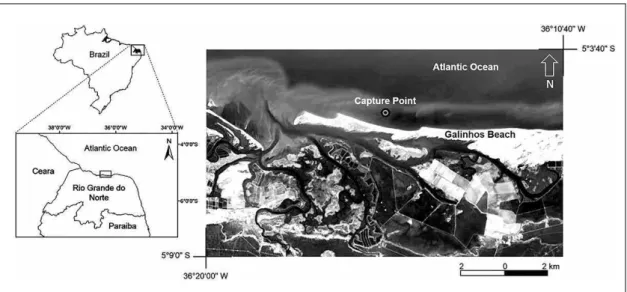
craft, by using a bottom trawl at the coastal region of northern shelf of Rio Grande do Norte, Galinhos county, northeastern Brazil (Figure 1). At the time of capture, trawling was being made at 05°05’17.4”S - 36°15’17.4’’W longitude, about 700 meters far from the Galinhos beach coastline, at 4-meters deep. The
sex of the animal was identiied by the presence of
the thelycum, and the partial measurements of total length (PTL), carapace length (PCL), carapace width (CW) and carapace depth (CD) were performed with the aid of a digital caliper ruler; total weight (TW) was obtained by using a digital precision scale. The
specimen was deposited in the scientiic collection of
RESULTS AND DISCUSSION
The female specimen of P. monodon was
captured in April. 2012, and measured 249.59 mm PTL, 75.43 mm PCL and 173 g TW (Table I; Figure 2).
The morphometric values obtained were close to
average ones found in the literature (e.g., Santos &
Coelho, 2002 e 2007; Cintra et al., 2011; Natarajan et
al., 2011; Wakida-Kusunoki et al., 2013; Fuller et al.,
2014). According to Motoh (1981), females of P.
monodon with carapace length greater than 47 mm and a structurally complete thelycum are sexually
mature and since the identiied individual possessed
these traits, it is possible that at least one spawning had already occurred.
Table I – Morphometric variables of a female specimen of Penaeus monodon collected off Rio Grande do Norte State, Northeast Brazil.
Variable (mm) Value
PTL 249,59
PCL 75,43
CW 40,30
CD 46,49
TW (g) 17,00
This is the second confirmed report of P.
monodon occurrence in the shore of Rio Grande do Norte, subsequent to its first occurrence, 11 years ago. Because both adult and juvenile individuals have been found on the coast of
northeastern Brazil (Coelho et al., 2001; Santos &
Coelho, 2002) it is certain that this animal is
reproducing and completing its entire life cycle in Brazilian waters.
Considering the records gathered here, it might
be inferred that the distribution of P. monodon in the
southwestern Atlantic goes from Colombia to São
Figure 1 - Location of the capture point of Penaeus monodon, off northern Rio Grande do Norte State, Northeast Brazil.
Paulo (Brazil), a coastline of approximately 10,000 km. This collection likely represents a southward expansion
of the known Atlantic population, a fact which is not
unexpected as larvae would be transported southward by the Brazil Current.
As of yet, there is no evidence of changing species composition in the biocensis caught by
artisanal isheries. There has been no effort to sample
or gather occurrence records in Brazil that could be used to determine the population structure of the species on the Brazilian coast. A more effective sampling effort might reduce the current geographic gaps in existing records. Studies from the region to the south of São Paulo could reveal the southern limit of the species and track its expansion. Finally, more studies are needed in order to investigate the dynamic establishment of the Brazilian coast.
REFERENCES
Abrunhosa, F.A. Curso técnico em pesca e aquicultura:
carcinicultura. Instituto Federal de Educação, Ciência e Tecnologia do Pará. Sistema Escola Técnica Aberta do Brasil - e-Tec Brasil, 79 p. Acessado em Junho de 2014.
Aguado, N.G. & Sayegh, J. Presencia del camarón
tigre gigante Penaeus monodon (Crustacea, Penaeidae)
en la costas del Estado Anzoátegui, Venezuela. Bol.
Inst. Oceanogr., v. 46, p.107–111, 2007.
Aguirre-Pabón, J.C.; Berdugo Jr., G.O. & Barandica, J.C.N. Genetic status, source and establishment risk
of the giant tiger shrimp (Penaeidae: Penaeus
monodon), an invasive species in Colombian
Caribbean waters. Acta Biol. Colom., v.20, n.1,
p.117-127, 2015.
Barbieri Júnior, R.C. & Ostrensk Neto, A. Camarões
marinhos: reprodução, maturação e larvicultura. Aprenda Fácil, Viçosa, 2001.
Cintra, I.H.A.; Paiva K.S.; Botelho, M.N. & Silva,
K.C.A. Presence of Penaeus monodon in the continental
shelf of the State of Pará, Northern Brazil (Crustacea,
Decapoda, Penaeidae). Rev. Ciên. Agr., v.54, n.3,
p.314–317, 2011.
Coelho, P.A.; Santos, M.C.F. & Ramos-Porto, M.
Ocorrência de Penaeus monodon Fabricius, 1798 no
litoral dos estados de Pernambuco e Alagoas
(Crustacea, Decapoda, Penaeidae). Bol. Téc. Cient.
CEPENE, v.9, p.149-153, 2001.
De La Vega, E.; Degnan, B.M.; Hall, M.R.; Cowley, J.A. & Wilson, J.K. Quantitative real time RT-PCR demonstrates that handling stress can lead to rapid increases of gill-associated virus (GAV) infection
levels in Penaeus monodon. Dis. Aquat. Organ., v.59,
p.195-203, 2004.
FAO. Species fact sheets: Penaeus monodon (Fabricius,
1798), in FAO Fisheries and Aquaculture Department,
2012. Accessed 09 Jun 2014.
Fausto-Filho J. Registro da captura de Penaeus
monodon Fabricius no litoral do estado do Maranhão,
Brasil (Crustacea: Penaeidae). Arq. Ciên. Mar,
Fortaleza, v.26, p.81-82, 1987.
Fuller, P.L.; Knott, D.M.; Kingsley-Smith, P.R.; Morris, J.A.; Buckel, C.A.; Hunter, M.E. & Hartman
L.D. Invasion of Asian tiger shrimp, Penaeus
monodon Fabricius, 1798, in the western north
Atlantic and Gulf of Mexico. Aquatic Invasions, v.9,
n.1, p.59–70, 2014.
Global Biodiversity Information Facility. Biodiversity
occurrence data published by: Senckenberg: Collection Crustacea – ZMB, 2013. Accessed through Global Biodiversity Information Data Portal, 2014.
Gómez-Lemos, L.A. & Campos, N.H. Presencia de Penaeus monodon Fabricius (Crustacea: Decapoda:
Penaeidae) em aguas de la Guajira colombiana. Bol.
Invest. Marit., v.23, p.221–225, 2008.
Holthuis, L.B. FAO species catalogue: shrimps and prawns of the world. An annotated catalogue of
species of interest to isheries. FAO Fish. Synop., Rome, v.1,n.125, 1980.
Instituto Hórus – Instituto Hórus de Desenvolvimento e Conservação Ambiental/The NatureConservancy. Base de dados sobre espécies exóticas invasoras em I3 N-Brasil, 2013. Accessed 09 Jun 2014.
Knott, D.M.; Fuller, P.L.; Benson, A.J. & Neilson
M.E. Penaeus monodon. USGS Nonindigenous
Aquatic Species Database, Gainesville F.L. Accessed 8 Jun 2012.
Leão, T.C.C.; Almeida, W.R.; Dechoum, M. & Ziller
S.R. Espécies exóticas invasoras no Nordeste do Brasil:
contextualização, manejo e políticas públicas. Centro de Pesquisas Ambientais do Nordeste e Instituto Hórus de Desenvolvimento e Conservação Ambiental, 99 p., Recife, 2011.
Lester, L.J. Developing a selective breeding program
for penaeid shrimp mariculture. Aquaculture, v.33,
p.41-50, 1983.
Lopes, R.M.; Coradin, L.; Pombo, V.B. & Cunha,
D.R. Informe sobre as espécies exóticas invasoras
Marte, C.L. The food and feeding habit of Penaeus monodon Fabricius collected from Makato River, Aklan, Philippines (Decapoda, Natantia). Crustaceana, v.38, p.225–236, 1980.
Migotto, A.E. & Marques, A.C. Avaliação do estado do
conhecimento da diversidade biológica do Brasil: invertebrados marinhos. Ministério do Meio Ambiente, 2003. Acesso em 09/06/2014.
Molnar, J.L.; Gamboa, R.L.; Revenga, C. & Spalding, M.D. Assessing the global threat of invasive species
to marine biodiversity. Front. Ecol. Environ., v.6, n.9,
p.485–492, 2008.
Motoh, H. Studies on the isheries biology of the giant
tiger prawn, Penaeus monodon in the Philippines. Technical Report n. 7, SEAFDEC, 128 p., 1981.
Rodrigues, E.S.; Barreto, O.J.S. & Perroni R.W. Penaeus monodon Fabricius (Crustacea, Decapoda,
Penaeidae) no estuário de Santos, in Resumos do
Congresso Brasileiro sobre Crustáceos, 186 p., São Pedro, 2000.
Sahel and West Africa Club. Exploring economic
opportunities in sustainable shrimp farming in West Africa: focus on South-South cooperation. Meeting Report - 2006. Organization for Economic Co-operation and Development. Accessed 09 Jun 2014.
Santos, M.C.F. & Coelho P.A. Espécies exóticas de
camarões peneídeos (Penaeus monodon Fabricius,
1798 e Litopenaeus vannamei Boone, 1931) nos
ambientes estuarino e marinho do Nordeste do
Brasil. Bol. Téc. Cient. CEPENE, v.10, n.1,
p.209-222, 2002.
Santos, M.C.F. & Coelho P.A. Crustáceos exóticos reproduzindo em águas costeiras do Nordeste do
Brasil. Bol. Téc. Cient. CEPENE, v.15, n.1, p.57-61, 2007.
Silva, E.C.S. & Barros, F. Macrofauna bentônica introduzida no Brasil: Lista de espécies marinhas e
dulcícolas e distribuição atual. Oecologia Australis,
v.15, n.2, p.326-344, 2011.
Silva, K.C.A.; Ramos-Porto, M. & Cintra, I.H.A.
Registro de Penaeus monodon Fabricius, 1798, na
plataforma continental do Estado do Amapá
(Crustacea, Decapoda, Penaeidae). Bol. Téc. Cient.
CEPNOR, v.2, n.1, p.75-80, 2002.
Tavares, M. & Mendonça Jr., J.B. Introdução de crustáceos exóticos no Brasil: uma roleta ecológica,
p.59-76, in Silva, J.S.V. &. Souza, R.C.C.L. (orgs.),
Água de lastro e bioinvasão. Interciência, 224 p., Rio de Janeiro, 2004.
Wakida-Kusunoki, A.T.; Rojas-González, R.I.; Gomzélez-Cruz, A.; Angel, L.E.A.; Sánchez-Cruz, J.L. & Tellez, N.A.L. Presence of giant tiger shrimp Penaeus monodon Fabricius, 1798 on the Mexican
coast of the Gulf of México. Bioinvasions Records, v.2,