Computer Waste Management Practices of
Internet Shop Owners in Ligao City,
Philippines
Arly B. Balingbing
College of Education, Arts and Sciences, Camarines Sur Polytechnic Colleges, Nabua, Camarines Sur, Philippines
Date Received: September 18, 2015; Date Revised: October 28, 2015
Asia Pacific Journal of Multidisciplinary Research Vol. 3 No. 4, 10-16 November 2015 Part IV P-ISSN 2350-7756 E-ISSN 2350-8442
www.apjmr.com
Abstract - This descriptive survey aimed to determine the computer waste disposal practices of internet shop owners in Ligao City. The data were gathered from fifteen (15) internet shop owners in the business district of Ligao City through questionnaire and informal interview. The statistical tools used were frequency count and weighted mean technique. The findings showed that among the fifteen (15) internet shops operated, computer sets available for use ranged from fifteen (15) to thirty (30) units. All internet shop attendants/staff are graduates of computer technician courses or are knowledgeable in computer hardware. Internet shops replace computer components/ parts twice a year. Actual waste disposal practices along storage and disposal are often practiced while actual computer waste disposal along collection is seldom practiced. The study revealed that internet owners do not utilize landfill in disposing computer waste. The Local Government Unit of Ligao City has a city ordinance on ecological solid waste management but there is no specific ordinance on computer waste management. The proposed activities can be used by LGU Ligao City in enhancing the existing city ordinance to address computer waste disposal management.
Keywords: computer waste, disposal practices, city ordinance
INTRODUCTION
Global warming is a problem that is taking place in the overall global landscape. Many researchers, scientists, and environmentalist are expressing concern about changes in the overall climate of the planet. Indeed, various programs and advocacies have been undertaken to address the worsening effect of this problem.
One of the many causes of the warming temperature is improper waste disposal. In the Philippines itself particularly in Metro Manila, an average of 3.2 kilograms of solid waste per day or 0.50 kg / capital / day was generated in 2011 among households [1]. The common types of waste materials generated were food spoils, kitchen waste, paper, PET bottles, metals and cans, boxes, cartons, glass bottles, plastics, and yard/ garden waste. On the other hand, 750-1500 grams of waste per household was generated in Cebu in 2011, 40% of which are organic wastes [2]. Other than households or residential, other sources of wastes are commercial (stores, hotels, restaurants, markets, office buildings), institutional
(schools, government center, hospitals, prisons), and municipal services (street cleaning, landscaping, parks, beaches, recreational areas) [3].
Among the solid wastes generated by the so-called municipal solid waste (MSW) generators (ibid) are computer or electronic wastes which has a yearly global production rate of 40 million metric tons [4]. Computer wastes are electrical or electronic devices which are discarded instead of reselling or reusing them [5]. Also known as e-waste, these products are nearing the end of their useful life and if finally discarded are considered dangerous [6]. Computer wastes in developed and developing countries eventually will cause serious health and pollution problems, although the latter are most likely to reuse and repair electronics [5].
electronic equipment [7]. Discarded computer monitors, televisions, stereos, copiers, fax machines, electric lamps, cell phones, audio equipment, and batteries, if improperly disposed, can leach lead and other substances into the soil and groundwater [6]. They also may contain contaminants like lead, cadmium, beryllium, or brominated flame retardants [8]. Many of these products can be reused, refurbished, or recycled in an environmentally sound manner so that they are less harmful to the ecosystem [6]. These scrap components, whether recycled or disposed may still involve significant risk to workers and communities so they should be managed with caution. Great care must be taken to avoid unsafe exposure in recycling operations and leaking of materials such as heavy metals from landfills and incinerator ashes.
Obsolete computers have been being collected by many organizations for years [9]. The United State Environmental Protection Agency had estimated that 45 million computers will had become obsolete annually by 2005. California, Massachusetts, and Minnesota have already outlawed the disposal of computer waste in landfills. In 2003 alone,23 States initiated legislation to address the mounting problem of computer waste. Most of the environmental concerns with computers lie with the monitor, specifically its cathode ray tube (CRT). Each colored monitor contains, on average, four to five pounds of lead which is considered hazardous waste when disposed of according to EPA standards. Computers also contain other hazardous materials including mercury, cadmium (a known carcinogen), and hexavalent chromium (shown to cause high blood pressure, iron-poor blood, liver disease, and nerve and brain damage in animals). The Utah Department of Environmental Quality estimates that 314 million computers will be thrown away by the end of 2004 containing 1.2 billion pounds of lead, 2 million pounds of cadmium, 1.2 million pounds of hexavalent chromium, and 400,000 pounds of mercury.
In a worst case scenario, (ibid), groundwater near a landfill can become contaminated. In a search for potentially responsible parties, a company that had disposed of computers at the site (identified by a control tag or manufacturer’s number) could be subject to potentially costly criminal and civil litigation. All of this could happen even if the organization had donated the equipment to a charity or paid a company to recycle it.
The increasing number of the production of computer units is the result of the increasing demand of their use in households, offices and companies and business establishments that require computers in their everyday operation. Among these target markets of computer manufacturers are Internet cafes or computer shops.
The first online café, named as Electronic Café, was established in South Korea in March 1988 in front of Hongik University in Seoul by Ahn Sang-Su and Keum Nuri [10]. When Electronic Café opened, it had two16-bit computers connected to online service networks through telephone lines. It served as the venue of offline meetings and activities of online service users. The opening of the online cafe in Korea was 2–3 years ahead of other developed countries. Computer cafés / shops in the whole world were established to cater the growing need of internet users to access data and information worldwide [11].
The Philippines’s first public Internet network got connected to the Internet in March 1994 via a 64 kbps link. The Philippine Network Foundation (PHnet), a consortium of private and public institutions, connected the country and its people to Sprint in the United States [12]. Since then, more Internet service providers have taken advantage of the situation and more businessmen have ventured into the lucrative internet café or computer shop operation business across the country.
In Ligao City, just like in any other parts of the country, the business of internet café is growing, and is considered booming. These computer shops may present many opportunities to businessmen, employees and the consumers but they, too, become source of computer wastes. Currently, the local government unit (LGU)is implementing City Ordinance No. N0. 2011-002 entitled, “Ligao City Ecological Solid Waste Management” [13]. But it is a very general ordinance on waste and ecological solid waste management and does not deal specifically with computer or e-waste management.
The findings of this study are deemed beneficial to: the students, for it will increase their awareness that computer wastes contribute to global warming; the parents, for the projects and programs of this study will serve an eye opener for them to actively participate in Local Government Unit on proper disposal of computer waste; the Local Government Unit, for it will serve as their basis for the preparation of local ordinances on computer waste disposal; and the future researchers, for it will provide a framework in conducting further researches on computer waste disposal.
OBJECTIVES OF THE STUDY
The main objective of this research is to determine the computer waste disposal practices of internet shop owners in Ligao City. Specifically, it aimed to determine: the number of computer sets available per internet shop, the number of times in a year that internet ownersreplace defective computer parts / component in their shops; their actual computer waste disposal practices along a) collection, b) storage, and disposal; the categories of the specific waste according to parts of computer and their respective mode of disposal; and the activities under the existing city ordinance on solid waste management which could be proposed to address the computer wastes.
METHODS
The study employed the descriptive method of research through the use of questionnaire–checklist in data gathering. This type of research describes what exists that may help to uncover new facts and meaning [14]. The purpose of descriptive research is to observe, describe and document aspects of a situation as it naturally occurs. This involves the collection of data that provides an account of individuals, groups or situations. Instruments that are used to obtain data in descriptive studies include questionnaire, interview, and observation. Furthermore, it is concerned with conditions or relationships that exist, opinions that are held, processes that are going on, effects that are evident, or trends that are developing [15]. It is primarily concerned with the present although it often considers past events and influences as they relate to current conditions. The researcher used the annual basis as to the frequency of disposal practices of internet owners. In terms of quantity, frequency count was utilized.
Instrument
The study utilized questionnaire–checklist as its main tools in data-gathering. The said questionnaire focused on the computer waste disposal practices of internet shop owners of Ligao City. Before the distribution of the questionnaire, a dry-run was conducted by asking ten internet shop owners in the town of Nabua, Camarines Sur to answer similar questionnaire so that the researcher may validate the content and the clarity of the questions. After the dry-run, the researcher requested permission from the internet shop owners of Ligao, City, to allow him to conduct the study. When permission was granted, the researcher coordinated with the respective internet staff/ assistant. The questionnaire used five (5) pre-determined indicators. The given scale was used to interpret and describe the result of the study: 4.51-5.00: Always Applied (Practiced computer waste disposal 100%); 3.51-4.50: More often Applied (Practiced computer waste disposal 75%-99%); 2.51-3.50: Often Applied (Practiced computer waste disposal 50%-74%); 1.51-2.50: Seldom Applied (Practiced Computer waste disposal 25%-49%); 1.00-1.50: Never Applied (Does not Practiced Computer waste disposal).
Respondents
The researcher requested the list of internet shops operating in Ligao City from the Office of the City Business and Licensing Center. Upon receiving the official document, the researcher directly coordinated with the internet shop owners of Ligao City. The respondents of the study are the fifteen (15) internet shop owners operating in the business center of Ligao City. The researcher gathered data from the authorized internet shops with mayor’s permit only. The nearby/adjacent barangays also have internet shop but were excluded in the study since the researcher focused only in the business center. Those shops that were excluded only have five or even less computer sets which are available to the public for a fee. Such number may not be considered essential to this study.
Data Analysis
RESULTS AND DISCUSSION
Table 1. Number of Computer Sets/ Units per Internet Shop
Internet Shop No. Number of Computer Sets/Units
Internet Shop 1 15 Internet Shop 2 25 Internet Shop 3 20 Internet Shop 4 25 Internet Shop 5 20 Internet Shop 6 15 Internet Shop 7 20 Internet Shop 8 30 Internet Shop 9 25 Internet Shop 10 20 Internet Shop 11 25 Internet Shop 12 25 Internet Shop 13 20 Internet Shop 14 15 Internet Shop 15 18
Total 318
Table 1 shows that there are fifteen (15) computer shops in the business center of Ligao city with a total of three hundred eighteen computer sets/units. Every internet shop has an average of twenty – one sets/units with five to eight printers available.
Table 2. Number of Times in A Year Internet Shop Owners Replace Defective Computer Parts/ Components
Internet Shop
Number of Times Internet Owner Replace Computer Parts/
Components
Internet Shop 1 2 Internet Shop 2 2 Internet Shop 3 3 Internet Shop 4 2 Internet Shop 5 2 Internet Shop 6 3 Internet Shop 7 2 Internet Shop 8 2 Internet Shop 9 2 Internet Shop 10 2 Internet Shop 11 2 Internet Shop 12 3 Internet Shop 13 2 Internet Shop 14 2 Internet Shop 15 2
Table 2 shows the number of times in a year the internet shop owners replace computer components/
parts. Internet shops#3, #6 and #12 replace defective units/ components three times a year while the remaining internet shops replace defective units/ components two times a year. Either the internet shop owners themselves or hired computer technicians who fix and conduct repair and maintenance to the computer units. Internet shop owners replace units in order for them to cope with the latest technology and to avoid complain from internet users who dislike low performance of their units. End-users prefer to use internet facilities with fast connectivity
Table 3. Actual Computer Waste Disposal Practices along Collection (Mode of Disposal)
Collection WM VI
1. Collects computer parts for business use.
2.53 Often
2. Collects entire units of unserviceable computer unit from shop for future use.
1.53 Seldom
3. Collects units of monitor, keyboard, mouse, printer for junk shops or to be sold
2.60 Often
4. Collects functional computer parts 2.63 Often 5. Source out computer parts for
needed for repair.
2.53 Often
Average Weighted Mean 2.36 Seldom
Table 3 shows that all five modes of collection are practiced “Often” except for No. 2 which is practiced “Seldom”. Almost all the Internet shop owners keep the entire units of unserviceable computer for future use which they eventually dismantle to get the components and the parts which can still be recycled. Over-all, the disposal of actual computer waste through collection is practiced “Seldom” since despite the fact that computer technology is fast-changing technology, computer shop owners still recycle parts which can be repaired for future use. Companies are upgrading software and hardware parts of their computers while some components are disposed.
Table 4. Actual Computer Wastes Disposal Practices along Storage (Mode of Disposal)
Storage WM Interpretation 1. Properly store computer
waste inside the shop.
1.72
Seldom
2. Store computer waste outside the shop.
3.00
Often
3. Store computer waste inside the house.
3.07
Often
4. Store computer waste in a separate bodega.
2.80
Often
5. Just Place the computer waste anywhere in the shop.
2.13
Seldom
Average Weighted Mean 2.54 Often
In addition, placing computer waste anywhere in the shop affects the ambiance. Internet users prefer to go to internet shops which are conducive for browsing, downloading and gaming. Storing computer wastes outside the shop and storing the computer wastes inside the house are practiced “Often”. Fourteen of the respondents have separate stockrooms or bodegas inside the house where they can store the computer wastes. This enables them to easily access any spare parts needed for minor repairs.
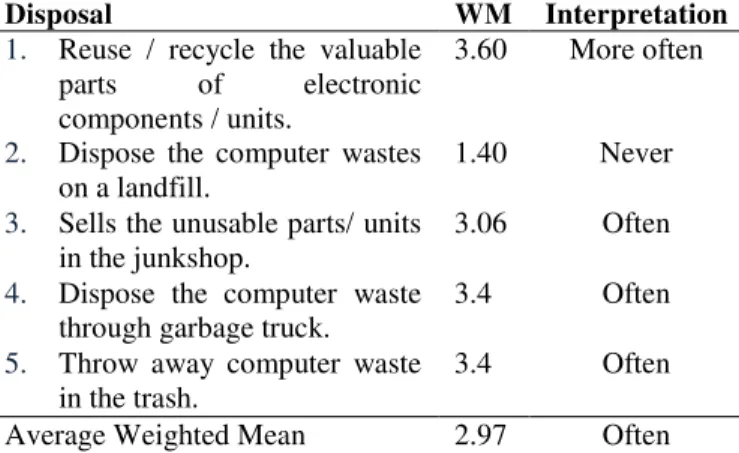
Table 5. Actual Computer Waste Disposal Practices along Disposal (Mode of Disposal)
Disposal WM Interpretation 1. Reuse / recycle the valuable
parts of electronic components / units.
3.60 More often
2. Dispose the computer wastes on a landfill.
1.40 Never
3. Sells the unusable parts/ units in the junkshop.
3.06 Often
4. Dispose the computer waste through garbage truck.
3.4 Often
5. Throw away computer waste in the trash.
3.4 Often
Average Weighted Mean 2.97 Often
Table 5 shows that reusing/recycling the valuable parts of computer unit is being practiced more often. Although some peripherals like connectors are needed for the computer units to be utilized with the set, other components/parts may still be reused. Disposing computer waste on a landfill is “Never” practiced. Internet owners confirm that this mode of disposal does not enable them to still reuse components that can still be functional in the future. After all, the main
objective for the recycling process of e–waste (computer waste) is to recover precious metals or valuable materials such as iron and steel, and minimize ground pollution of the leachate that may contain hazardous or toxic materials (16).
Table 6. Categories of the Specific Waste and Their Mode of Disposal
Category Reuse/
Recycle Sold Junk Total
Monitor 25 41 50 116 Keyboard 50 0 116 166 Mouse 46 0 100 146 Optical Drive 33 0 146 179 Mother Board 13 0 73 86 CPU Casing 15 43 15 73 Main Memory 0 0 97 97 Expansion Card 5 0 70 75 Hard Disk Drive 12 0 100 112 Others (computer
paper, Ink Cartridge, etc.,)
ND ND ND ND
199 84 767 1050 ND=No data
Table 6 presents the categories of specific waste according to the most common parts of the computer and their modes of disposal. Computer parts considered as wastes are monitor, keyboard, mouse, wire, optical drive, mother board, CPU, main memory, expansion card, hard disk drive, and power supply unit. These components may be repaired, replaced or classified as junk.
One of the qualifications needed to become an internet attendant or computer technician is being a graduate of a computer technician Course and possessing the skill in conducting preventive maintenance and repair. All staffs from the internet shops staff are knowledgeable in this field so they can easily categorize computer waste according to the parts of computer.
The data shows that the computer wastes are categorized into three modes of disposal as reuse/recycle, sold and junk. The fifteen internet shops have a total of 1050 pieces of computer components/parts, 199 pieces of which are for reuse/ recycle, 84 pieces are sold to junk shops and 767 pieces of assorted computer parts or components are considered junk.
upgrade their computer sets as often too so that users will continue going to their internet shop to browse, surf, email, and engage in computer games instead of going to other shops.
Proposed Activities under the City Ordinance on Solid Waste Management of Ligao City
At present, Ligao City has an existing ordinance called “Ligao City Ecological Solid Waste Management” or Ordinance No. 2011.-002. This ordinance adopts certain definitions, sections and provisions pursuant to and in accordance with Implementing Rules and Regulations of Republic Act (RA) No. 9003 otherwise known as the, “Ecological Solid Waste Management Act of 2000”, an act providing for an ecological solid waste management program in the Philippines (17).
In the city ordinance, computer wastes are categorized as consumer electronics wastes that include worn-out, and other discarded items such as radios, stereos, TV sets, computer sets, etc. The research found that the city has an existing Material Recovery Facility (MRF). Computer wastes are segregated but are only stored in a small stock room adjacent to the MRF. Hence, this research suggested to establish provision of stockroom adjacent to the Material Recovery Facility building; educational information and dissemination on proper handling/ disposing compute waste among internet owners and stakeholders of Ligao City; conduct of seminar-workshops for internet shop owners and households with computer sets on proper computer waste disposal management; and enhancement of Material Recovery Facility of LGU Ligao City. If possible, the MRF should be housed in a secured two–story elevated building which is safe from flood. In addition, only authorized persons must be allowed to open the stock room for other purposes.
CONCLUSION
There are 15 Internet shops operating in the business center of Ligao City, Philippines with 15 to 30 computer sets. All the internet assistant or staff personnel are graduate of computer technician and related courses. The internet shop owners replace computer parts or components twice a year. They practice the collection, storage and disposal of computer wastes. They collect the functional parts of the computers, store them in a separate stockroom and sell the unusable parts in junkshops. The specific
wastes are classified according to parts of computer, majority of which are considered as junk. Ligao City, Philippines has no concrete management program as to disposal of computer waste after segregation in.
RECOMMENDATION
Enhance the existing City Ordinance on Solid Waste and Ecological Management in order to address the computer waste of internet shop owners and households with computer sets; Benchmarks to other cities/ provinces in the Philippines on the best practices in disposing computer waste. Require all internet shop owners to attend yearly seminar workshops on proper computer waste disposal as a requirement for the renewal of their business permit. Conduct further research on how to dispose computer wastes properly, religiously and carefully so that these wastes will not contribute to climate change and harm people, pants and animals. Utilize the result of this research as a precursor in conducting further research on how to dispose computer waste in the Ligao City and in other cities and municipalities in Bicol region and in the Philippines.
REFERENCES
[1] Bernardo, A.C. (2010). Solid-waste management practices of households in Manila, Philippines. http://www.ncbi.nlm.nih.gov/pubmed/18991942. Accessed 10 January 2015.
[2] Premakumara, D.G.J. (2011). Survey of household solid waste generation and public awareness on waste separation and composting practices in Cebu City. Institute for Global Environment. Strategies. Japan.
[3] United Nation Environment Programme (2015). State of waste management in South East Asia. http://www.unep.or.jp/ietc/publications/spc/State_of _waste_Management/2.asp. Accessed 10 November 2014
[4] Huisman J. et al. (2008). Review of directive 2002/96 on waste electrical and electronic equipment (WEEE). Bonn. United Nations University.
[5] Electronics Take Back Coalition (2015). The
problem with electronics and e-waste.
http://www.electronicstakeback.com/resources/probl em-overview/. Accessed on January 15, 2015.
[6] Ramachandra, T.V. & Saira Varghese, K. (2004). Environmentally sound options for e-wastes management. ENVIS Journal of Human Settlements.
[8] Bagum, K.J.A. (2013). Electronic waste (e-waste) management in India: a review. Journal of Humanities and Social Science. p. 46. Vol 10. Issue 4.
[9] Meyer, M.J., Ella, W.A.E.Y., & Ronald, M. (2004). Disposal of old computer equipment. The CPA Journal. Vol. 74. No.7.
[10] Lee, Y.J. (2011). The rise of Hongdae as a center of culture. The Weekly Hankook. http://www.koreafocus.or.kr/design2/layout/content_
print.asp?group_id=103646. Accessed 20 January
2015.
[11] Korea Internet and Security Agency(2012). Cyber internet history museum. http://eng.i-museum.or.kr/jsp/sub02/article_list.jsp?no=2&pageI ndex=2#. Accessed 10 November 2014.
[12] Daguio, B. (1995). PHnet marks its first anniversary.
Computerworld.
[13] Ligao City Ecological Solid Waste Management(2011). City Ordinance No. 2011-002.
[14] Polit, D.F. & Hungler, B.P. (1999). Nursing research: principles and methods. 6th Ed. Philadelphia, Lippincott.
[15] Raagas, E. L. (2010). Understanding research concepts (with computer approaches to basic data analysis.
[16] Manalac, S. (2005). Electronics waste: a threat in the future.
[17] Ecological Solid Waste Management Act of 2000. RA. 9003.
Copyrights