Commercial Networks and
File-sharing Networks:
Competition or
Complementarity?
Thomas Le TexierVictor Dos Santos Paulino
Article Info:
Management Information Systems, Vol. 4 (2009), No. 2, pp. 041-055
Received 12 Jun 2008 Accepted 24 April 2009
UDC 004.623:004.7
Summary
Facing the massive popularity of file-sharing networks, producers and distributors see in digital consumption a threat to their own activity. This article aims to analyze if market organizational models and organizational models based upon the file-sharing activity may be either substituted or complementary. By underlining the importance of innovation in valuating the two activities, we show the existence of both positive and negative externalities whose overall effect underlines retroaction and interdependence between activities differing in their organizational models.
Key words
File-sharing networks; competition; complementarity; innovation
Introduction
The emergence of the Internet as a new transactional space has deeply changed the way consumers, producers and distributors interact, and has therefore led to several research tracks over the last decade. Studies focusing on analyzing the role of the Internet in traditional consumption patterns can be apprehended through two approaches. The first Internet-related evolution can be perceived through the advent of e-commerce, whether it may contribute to validating or not the traditional neoclassical hypotheses that are usually rejected in the case of the so-called ‘regular’ markets (Brynjolfsson & Smith, 2000; Baye, Morgan, & Scholten, 2004). The second Internet-related evolution is not only directly based on new patterns of consumption. Indeed, the development of new compression formats mark a significant step in the development of economic analyses related to the Internet, thus highlighting the transition to the ‘dematerialization era’ which leads to the wide spreading of digital files online and to new technological adoption issues (Shapiro & Varian, 1998; (Peitz & Waelbroeck, 2006a). As such, digital files (e.g., mp3 files) have become popular, inasmuch as systems facilitating the sharing of files from one user to another have been introduced and widely adopted. The success of digital files online, as far as adoption is concerned, has contributed to the success of such systems, namely ‘peer-to-peer’ networks or ‘file-sharing’ platforms.
Through the example of the Internet, the introduction of new channel allocations for goods
– whether they are material or immaterial – has lead to a fierce debate between traditional commercial-oriented players and less traditional ones. For instance, focusing on the new competition patterns that were likely to apply when the e-commerce got introduced in the mid-1990s, some contributions have shown that there exist common valuation mechanisms from which traditional and less traditional players can benefit. Such mutual valuation schemes may explain why an increasing number of traditional commercial-oriented players also slightly change their business models. Moreover, such ‘de alio’ firms (Dahlander, 2007) have taken part in the development of the Internet as a new transactional space to set up an e-commerce-based activity, while also remaining traditional – brick-and-mortar – players. Such mutual benefits can be perceived in the case of open source software development. Studies that have been carried out to analyze the success of the open source way of developing the source code have revealed that the distributive function of the Internet has played a major role in establishing ‘libre’ software solutions as credible software alternatives1
1
See Lerner & Tirole (2001) and Crémer & Gaudeul (2004) for an overall presentation of economic issues related to the open source software development model.
. The nature of the relationships
both private and public – patterns of development reflect that proprietary (i.e., commercial) and ‘libre’ (i.e., community-based) activities may be somewhat compatible for various purposes. Therefore, an increasing number of commercial players are nowadays likely to co-operate with external sources of innovation (e.g., open source communities) they previously used to compete with.
Although there are numerous economic-oriented studies analyzing the competition dynamics of both online and offline markets, as well as the increasing adoption of open source software solutions through their massive distribution on the Internet, the file-sharing activity has attracted less attention. Yet, the increasing number of users of peer-to-peer networks should lead one to consider such new consumption patterns, to fully appreciate the role of the Internet and the internauts in the shaping of both demand and supply functions. That is the reason why we focus on the nature of the relationships that are likely to exist or appear between traditional commercial players and such new entrants (i.e. peer-to-peer networks and their pools of users). In particular, as previously analyzed in other fields, this article aims to establish if peer-to-peer networks and traditional – commercial – market-based networks may corroborate substituted or complementary forms. To do so, we first present the main reactions the commercial players are likely to exhibit facing the increasing success of file-sharing networks. In particular, we stress that such reactions do not show friendly views towards the file-sharing activity and generally lead firms to intend to annihilate the peer-to-peer way of consuming. We consider that such strategies may be perceived as competitive strategies aiming at deterring new entrants from establishing both their model and digital offer (Section 2). Second, we underline that the file-sharing activity implies that specific costs have to be considered for the file-sharing consumption model to be sustainable (Section 3). As such, we show that this model structurally differs from that of the traditional commercial activity. Third, we suggest that the file-sharing activity may enhance that of traditional commercial players. Moreover, we show that there exist schemes of mutual content valuation for both types of players (i.e., commercial players and file-sharers) (section 4). Fourth, we insist on the role of innovative players on such asynchronous distributed patterns, as well as on the role of standardization policies on their shaping (Section 5). Section 6 concludes the paper.
1. The initiatives of traditional commercial players as competitive strategies
In a framework in which technical architectures do not exhibit legal-based weaknesses, peer-to-peer networks such as Napster used to show in the late 1990s, nowadays it appears difficult for commercial players to conduct lawsuits against the technical initiators of a file-sharing network. Indeed, although peer-to-peer networks and dedicated software may be used for illegal purposes, the conceptors of such systems may not be held responsible for fostering the distribution of illegal, i.e. pirate content. The industry of cultural goods has therefore changed its strategy and nowadays targets the users of file-sharing systems, whose access to such sharing platforms is facilitated by both the increase of broadband access speed and the decrease of access costs. As they currently see their levels of sales decreasing, the scope of response of the Majors – whether they are producers or distributors – is generally legal-oriented.
The impact of such legal ‘counter-attacks’ is twofold. Although they aim to dissuade some users from downloading and uploading illegal digital goods online, they also lead a part of internauts to mobilize in order to contest the scope of such practices that they consider to be more symbolic than efficient. The cultural goods industry has therefore to face not only individuals directly involved in file-sharing, but also internauts that perceive in such law suits disproportionate measures that are not compatible with their ideal of the Internet.
2.1. Legal aspects and related limitations
activities. Two reasons apply to state this suggestion.
The first reason is that it is generally difficult to clearly identify users that are active on such file-sharing platforms (Dagiral & Dauphin, 2005), as well as distinguishing digital goods users who initially bought from those that they did not. By taking into account the copyright law and the right for users to copy digital goods for personal purposes, it is then difficult to clearly see under which conditions it is legal or not for a user to download digital files. The second reason is that there are numerous digital files that are available on file-sharing networks and legal to acquire and consume, whoever the users are. This second reason thus refers to the difficulties for external observers (e.g. public authorities) to identify the nature of the content available on such platforms. In this context, the file-sharing activity gives rise to a twofold question, inasmuch as one would wonder how to clearly identify the users of peer-to-peer networks (e.g. their names and customer-related profiles), and, as a result, how to clearly distinguish digital goods that can be assimilated as pirate ones from those that can be assimilated as official ones. From a legal point of view, as the users – whether they are transmitters or receptors – of peer-to-peer networks appeared to be the only individuals responsible for acquiring digital goods for illegal purposes, nowadays it appears difficult to blame the peer-to-peer technology in itself. That is the reason why attention is paid to focusing on the users of such file-sharing platforms.
For this purpose, three main strategies are likely to be set up in order to limit the distribution of digital – potentially pirate – goods on peer-to-peer networks, namely anti-copy protection features (2.2), technical restrictions on the sharing of digital goods, and technical restrictions on the consumption of digital goods (2.3).
2.2. The failure of anti-copy protection features
Due to the legal limitations we have emphasized above, the Majors have intended to limit the content available on file-sharing networks by setting up anti-copy protection features on the original digital files that are likely to be copied and distributed on the Internet. Through this means, the commercial players belonging to the cultural goods industry thus intend to limit the transportability of cultural goods into digital forms. As such, anti-copy protection features aim to weaken the attractiveness of internauts for
peer-to-peer networks, by upstream influencing the content available. However, such protectionist measures, which can be adopted as precautionary policies, present limitations that are likely to be prejudicial to efficient applications. Indeed, anti-copy protection features may be somewhat paradoxically incompatible with the legal framework for which individuals may have the right to make copies for back-up purposes, provided that they own the original goods they wish to make a copy from. As such, anti-copy protection features have been blamed by technological users – internauts and non-internauts, because these may prevent individuals from getting full access to the technological features they have yet paid for.
Besides, anti-copy protection features are also criticized, since they are inefficient in the long run.
Indeed, communities of ‘crackers’2
Various attempts have been led by commercial actors to impact on the content available on file-sharing platforms. Anti-copy protection features are not the only ones that have been used by commercial players to find a way to make the file-sharing activity less attractive. For instance, there exist strategies aiming to provide files whose quality is doubtful on the networks. Some Majors have therefore voluntary diffused ‘fakes’ or corrupted digital files on peer-to-peer networks. Although such practices may have led to the failure of some peer-to-peer networks (e.g., FastTrack), community-based tools aiming to improve communication between users and feedbacks about the content available online tend to annihilate the scope of such pollutant-oriented practices. As the level of costs required for setting up an anti-copy protection system is only supported by producers belonging to the cultural goods industry, measures lead to limit both the quantity and quality of digital files available on peer-to-peer networks have limited effects, and show that peer-to-peer
devote time and efforts to find ways to bypass protection systems and diffuse unprotected digital goods online. Similarly to the ‘hacker’ communities, the implication of such communities may be explained by the existence of intrinsic motivations, which are based on honor-related principles. Besides, such intrinsic motivations are also stimulated by both competition dynamics that are likely to prevail between communities of crackers and their mutual aversion to the principles on which the commercial activities are based (Rehn, 2004).
2
networks have the organizational capabilities to manage external attacks.
2.3. Internet access and taxes
To prevent users from accessing peer-to-peer networks and acquiring digital – potentially pirate – goods, producers belonging to the cultural goods industry may decide to revert to locking the access to such networks technically. Two public documents have been published in 2004 to suggest that the illegal downloading activity might be limited through setting up technical mechanisms aiming to limit upload and download streams, rather than setting up legal-oriented repressive mechanisms (Bomsel & Le Blanc, 2004). In particular, the authors of these two documents state that upload streams and download streams – on which peer-to-peer networks are based to set their file-sharing activity – could be taxed so that users would not be motivated to use the Internet for either upload or download purposes. As such, the file-sharing activity would represent a costly activity, and users would be encouraged to legally acquire cultural goods, whether they are available in their digital or material form.
Such public documents and their underlying ideas have caused fierce reactions, in a framework in which one is currently looking for defining suitable policy-based measures to deter illegal digital files acquisition. Moreover, the application of such a tax-based policy would not be set according to the nature of the digital files downloaded and uploaded, as its scope would be universal, whether digital files are copyright-protected or not. Thus, such a universal scope would lead any internaut to support these tax-based policies, whether they use file-sharing networks for legal or illegal purposes. Practical questions are also at stake, inasmuch as the identity of the recipients of the tax is still unknown, as well as the amount they would collect from intensive sharing activities.
As opposed to anti-copy protection features, the costs that would have to be supported to set up such tax-based policies would not be supported by producers of the digital goods industry. From a technical point of view, it appears obvious that the Majors should benefit from such policies, since their activities are often perceived to be hindered by the file-sharing ones. Internet providers would also benefit from tax-based policies, because they would apply the setting up of these policies in the pricing of their services towards internet access customers. Players that would benefit from such
tax-based policies should be clearly identified and suitable redistributive schemes should be drawn for taxes to overcome potential losses deriving from the file-sharing activities. Many practical aspects remain then to be defined. In addition, the universal scope of such tax-based policies draws questions to understand if they are suitable to limit the ongoing massive adoption of the peer-to-peer network way of accessing and consuming digital goods (Bourreau & Labarthe-Piol, 2004). As such, policies aimed at preventing users from widely accessing file-sharing networks exhibit limitations that are likely to downplay their efficiency.
Besides, we have seen that the adoption of the non-commercial way of acquiring digital goods requires in some cases the digital files downloaded online to be ‘rematerialized’ on physical media (e.g. CD-R or DVD-R) for digital consumption to be more convenient. Tax-based policies can also be set up not only on both upload and download streams, but also on recordable materials aimed at ‘materializing’ digital content issued from peer-to-peer networks. The main aim of such policies is twofold. It aims first at indirectly taking benefit from the file-sharing activity and generating funds from it, while secondly aiming to limit consumption practices of illegal digital files. As an example, the French government has been applying since 2005 a tax-based policy whose goal is to tax any recordable physical media (e.g. CD-R, DVD-R, DVD+R, hard drives) and to dissuade users from massively distributing and exploiting digital files without taking into account copyright-related issues.
Again, the universal scope of such a policy – as far as it is based on the fact that any digital file stored on a physical medium is considered to be illegal – may contest its legitimacy. Moreover, such
a practice may be apprehended as an ex post
digital files available on peer-to-peer networks is likely to be difficult to reach.
2.4. Interpreting the answers of the digital goods industry – An economic viewpoint
In most cases, the various strategies the Majors are likely to apply have shown their limitations of preventing internauts from using peer-to-peer networks since the case of Napster. Whether they are policies justified by introducing a law and set up by public authorities by request of commercial players in the cultural goods industry, and whether they are somewhat likely to be assimilated to lobbying policies, precautionary policies or sanction-oriented policies aimed at preventing internauts from using file-sharing networks, all these types of policies highlight the organizational capabilities of peer-to-peer networks to efficiently respond to external – commercially initiated – attacks. Setting up such policies therefore appears as a measure taken by commercial players in order to crowd competitors out of the market of the cultural goods. Deterring such competitors is all the more a complex task because their organizational characteristics are atypical and their identities are unclear. The increasing number of users of peer-to-peer networks testifies that the failure of such various policies nowadays has led to preventing internauts from sharing files online. Moreover, such an increase tends to suggest that the demise of a peer-to-peer network depends on the lack of respect of the rules set by its shareholders to stimulate the file-sharing activity rather than policies driven by external players whose efficiency is unclear.
Setting up the policies we have presented above is often justified by the ‘free’ nature on which the pirate digital consumption is a priori perceived to be based. Such a dimension leads to defining peer-to-peer networks – main sources of diffusion of digital goods – as economic players that are perceived to have a strong comparative advantage compared to the Majors. The next section presents the cost-based structure that is borne by both ‘producers’ and consumers of the digital goods available on file-sharing platforms. Besides, it aims to estimate the legitimacy of the competitive policies we have pointed out and that are likely to have been developed so far.
3. The file-sharing activity and its related costs
According to the conventional wisdom, the access to a file-sharing network implies the access to an electronic space in which digital – legal or illegal – files are freely available, at no cost. Such a view is shared by the detractors of the file-sharing activity, who see in it an unfair and unethical alternative to the traditional commercial-based one. This criticism is based on a characteristic of the Internet that many have once strongly supported while nowadays refuting it, i.e., abundance and gratuitousness of the content available on the Internet. Building on such a viewpoint, the non-traditional commercially based alternative would then benefit from a strong advantage and would therefore be widely adopted, as consumers would be given the possibility to choose between goods for which they would have to pay and others – available on file-sharing networks – whose costs are nil.
However, we suggest that such a hypothesis should be verified in the case of the file-sharing activity. Indeed, although the cost required to acquire digital files technically may be low, it appears that there exist other types of constraints that have to be supported to acquire digital files. More precisely, we have developed a taxonomy of costs related to the file-sharing activity that are borne by both file-sharers who diffuse digital files online and those who acquire such goods. We distinguish four types of adoption costs, which are related to the way users get access to peer-to-peer networks and benefit from the services provided by file-sharing platforms.
3.1. A taxonomy of costs associated to the file-sharing activity
3.1.1. Production costs
The first group of costs refers to the efforts made by some individuals to create and put at disposal digital goods. Indeed, although the so-called ‘pirate’ digital goods are derived from original – ‘official’ – ones, such an alternative production requires time and specific technical capacities. As a consequence, the production of digital content that is eventually diffused on file-sharing networks implies costs whose levels cannot be considered to be nil. In practice, the fact that individuals may bear such costs for sharing purposes may be explained by various factors. According to both hacker and cracker ethics (Levy, 1984; Rehn, 2004), both altruism and reciprocity play a critical role in the provision of individual efforts, without any financial compensation. The individual burden of such costs may also be explained by factors that are likely to prevail in the case of open source software development, such as personal reputation-enhancement purposes (Dalle & Jullien, 2003; Franke & von Hippel, 2003). The consumption of the digital content available on file-sharing networks thus requires the support of production – creation-related – costs whose levels depend on the activities of both file-sharers and traditional commercial-based players. In this context, setting up sustainable relationships between file-sharers matters and the good running of peer-to-peer networks is likely to all the more lead users to create digital files and diffuse them. Here, the nature of the file-sharing network encourages users – and potentially content producers – to bear production costs.
3.1.2. Technical-based diffusion costs
The second category of costs related to the file-sharing activity refers to the technical costs needed for a user to both get and share digital files that are available on peer-to-peer networks. Concretely, these costs represent the costs users have to face to get access to the Internet with a high broadband access, as well as the costs related to the purchase of suitable reception materials needed to get access to the Internet (e.g., personal computer, dedicated software solutions) and storage devices (e.g., hard drives) to store the digital goods that are downloaded and shared on file-sharing networks. Although internauts are likely to pay for Internet access not only for file-sharing purposes but also for extra reasons – e.g., e-commerce purchasing and information accessing purposes – the speed of the broadband access conditions, the benefits that internauts may have from file-sharing networks, as
well their convenience of sharing files. That is the reason why internauts, as users of peer-to-peer networks, are likely to bear a higher level of equipment-related costs compared to those that are borne by internauts who exhibit a lower willingness to use file-sharing platforms. The level of equipment related to storage devices appears as a good indicator for identifying the willingness of an internaut to use or not to use file-sharing platforms. Indeed, as the exploitation of the digital goods derived from the file-sharing activity requires their ‘rematerialization’ on physical storage devices (e.g., CD-R, hard drives) so as to be more convenient to use, users that are likely to use file-sharing platforms can be seen as users whose levels of equipment – whether they are software and hardware – are high.
3.1.3. Learning costs
Learning costs represent the costs that are based on both the constraints and efforts made by users to master technically peer-to-peer access software solutions to the full, according to their individual expectations and needs. As we have already stressed in the first part of this chapter, the nature of the license terms under which access software solutions are released may have an impact on the level of such learning costs. Indeed, software solutions that are released under open source license terms (e.g., eMule, KaZaALite, µTorrent) are likely to enhance the release of versions that best meet the needs of users who are heterogeneous in their level of both technical software-related expertise and expectations. Learning costs are therefore closely linked to the various sets of specific uses potential users may exhibit (Ben Youssef, 2004). Learning costs also refer to the efforts made by users to efficiently use peer-to-peer access software. As such, learning costs may depend on the way external media (e.g., message boards) may interact with peer-to-peer networks (e.g., eDonkey2K and BitTorrent; see the first part of this chapter). By shedding light on such learning costs, we highlight the importance of the level of interconnectivity that may prevail between the users and the conceptors of file-sharing platforms.
3.1.4. Searching costs
their expectations. Searching costs take into account the amount of time that users dedicate to finding suitable digital files, as well as the amount of time that may be spent to download unsuitable digital files (e.g. low quality-based ones and fakes). The community-based services that exist on some peer-to-peer networks aim to decrease the level of such searching costs (Fetscherin, 2005). The existence of searching costs, as well as their levels, depends on the monitoring policies that are set by the initiators and users of file-sharing platforms. Although setting up monitoring policies may be high-leveled (e.g., DirectConnect), they may lead to dramatically decreased searching costs, provided that the expectations of the users cope with the scope of the file-sharing network they would like to get access to. The existence of searching costs related to the file-sharing activity, as well as setting up suitable mechanisms to decrease their level, reveals that peer-to-peer networks are based on hybrid organizational models. Moreover, as often observed in the case of commercial activities, mechanisms are set up so that users may face low-leveled searching costs. Nevertheless, one key distinction between the file-sharing activity and the traditional commercially based one is that file-sharers take part in community-based initiatives aimed at decreasing searching costs, whereas such initiatives are likely to be merely supported by firms in the case of the traditional commercial-based activity. Thus, the community-commercial-based dynamics on which the file-sharing activity is based tends to decrease the searching costs needed to get access and acquire appropriate digital files.
We have presented four types of costs that are likely to appear in the file-sharing activity. As such, we suggest that, contrary to the common belief, the file-sharing activity and its ensuing consumption-related issues cannot be considered to be free of charge. We next compare the nature of the costs we have identified in addition to these, which are likely to appear in the case of the commercial-oriented activity.
3.2. File-sharing and commercial activities and their related cost-based structures
Whereas technical costs are inherent to the uses made by each user and have a level that does not really differ from one user to another, learning costs and searching costs are not. Indeed, learning costs and searching costs depend on the level of expertise of each user. Such costs refer to the constraints that users have to face in order to get access to the digital files available on file-sharing
networks. As such, they appear as ‘conformity costs’, whose levels are ex ante directly set by the moderators and indirectly shaped by the users of the peer-to-peer network who perceive a disutility if they do not behave as the moderators would like to (Cunningham, Alexander, & Adilov, 2004). Therefore, it is not relevant to present any file-sharing network as a distribution channel that gives free access to a wide range of digital goods (e.g., streams of digital files). Users have to bear costs to acquire digital files. Whether they are direct or indirect, the costs implied by the collection of digital files may be sufficiently high-leveled to motivate some internauts not to use file-sharing platforms and rather buy related official products. The commercial and non-commercial ways of acquiring cultural goods differ in the needs. Users may have to ‘rematerialize’ digital content for it to conveniently be used. From a more general point of view, they emphasize that there exist two different organizational models. The traditional – commercially based – organizational model is a model for which commercial players drive the production activity to influence consumption patterns, whereas the file-sharing model is a model in which moderators contribute to the costs needed to match the behaviors of the users to the initial expectations of the conceptors of the network.
As such, we observe that the file-sharing model is based on an approach in which users play a major role not only in their acquisition function, but also in their ability to stimulate interaction and exchange between each other. As far as they appear to be both users and potential producers, file-sharers have a wider range of functions than those observed in the case of the traditional – commercial-based – activity according to which users appear to be considered as consumers/customers.
The alternative peer-to-peer way of adopting goods may therefore not be systematically preferred to the traditional – commercially based – one. The incentives of the internauts to purchase goods instead of downloading digital files are all the more higher-leveled as the users of file-sharing networks may fear the lawsuits that are likely to be
initiated by the Majors3
3
See the “Napster case” and the “Sarah S. Ward case”. See http://library.thinkquest.org/06aug/02220/measures-against-dci/lawsuits/index.html
, who perceive the
and use-based costs leads us to qualify the efficiency and legitimacy of the measures taken by the Majors towards the activity of peer-to-peer networks. The file-sharing activity is not cost-free, and the continuous development of sharing rules and mechanisms can be explained by the willingness of the file-sharers to decrease the level of such costs. As such, the cultural goods industry is faced with an atypical economic player who develops a specific organizational model in order to cut the costs related to his/her specific activity. The nature of the policies maintained by the producers of official digital goods may therefore be interpreted as the willingness of commercial players to crowd atypical competitors out of their market. Such a strategy is not only based on the fact that file-sharing may rely on an illegal activity, but also on the fact that the file-sharing consumption patterns have attracted a high number of users. Faced with the success of the file-sharing activity, one should wonder if the Majors should revise their purely offensive strategies or whether they should benefit from the development of peer-to-peer networks instead. To answer such a question, or at least to give preliminary insights, the next section presents the business opportunities commercial players may generate from the file-sharing activity.
4. Business opportunities and mutual valuation schemes
We present the business opportunities commercial players may derive from file-sharing – so-called ‘outlaw’ – activity. We present to what extent the file-sharing activity may condition that of the commercial players (4.1), as well as the commercial ways of generating profits from such external activities, whether they are legal or illegal (4.2). We then suggest that actual business strategies used to draw benefit from peer-to-peer networks are not fully suitable to generate sustainable gains (4.3). As such, the file-sharing and commercial activities may exhibit transversal relationships that can lead to mutually beneficial outcomes.
4.1. The file-sharing activity as a key explanation of the difficulties of the commercial players?
One of the reasons generally put forward to legitimize the offensive strategies employed by commercial players against peer-to-peer networks is that such an activity would generate a negative externality on the levels of sales for the producers
of cultural goods. To some extent, this point of view leads to present competition in the cultural goods industry as a zero-sum game, for which the losses of some players represent the gains of the other players. We suggest that this approach should be verified. The relationships between commercial players and the file-sharing activity should not only be evaluated under such restrictive – competition-based – dynamics, inasmuch as the development of the file-sharing activity sheds light on potential mutual valuation mechanisms. Moreover, there exist delayed commercial-oriented mechanisms through which commercial players may gain from ‘outlaw’ activities, whether they deal with legal or illegal aspects.
The paradoxical idea that there may exist positive externalities between the activities of commercial players and file-sharers comes from an observation made on the cultural goods industry. It corroborates results issued from economic analyses dealing with various forms of piracy and their impact on the profits reached by commercial players (Liebowitz, 1985; Conner and Rumelt, 1991; Takeyama, 1994). Thus, some economic studies led to measure the impact of the illegal downloading activity on the sales of products provided by cultural goods producers have revealed contrasting results. Detrimental effects are not always likely to appear and additional – independent – factors may also explain why the sales of commercial cultural goods decrease. For example, the limited level of incomes available to purchase cultural goods and the increasing offer of cultural goods may explain why the acquisition of digital – pirate – goods is likely to develop (Bourreau & Labarthe-Piol, 2004). Besides, on the supply side, the horizontal quality of cultural goods may also represent a key factor to explain the decrease of sales of official cultural goods. The propensity of each player to consume and the level of artistic creativity are also to be considered in order to partially explain the difficulties of the players of the cultural goods industry (Bourreau & Labarthe-Piol, 2004).
purposes, without paying for them. The second effect is called the ‘sampling effect’ and refers to a situation in which the users of file-sharing networks acquire pirate digital goods in order to estimate their quality, as well as the quality of the official digital goods they are derived from. Such an effect is then likely to be positive, due to the experience-oriented nature of cultural goods (Takeyama, 2002). The existence of such a positive effect is based on an intermediary consumption approach according to which the consumers of pirate digital files may eventually purchase the official versions of such goods, provided that experimenters are somewhat convinced of the quality of the digital goods provided by commercial players. As such, the fact that file-sharing networks may give access to illegal digital goods allows commercial players to advertise the quality of their supply on the market for cultural goods.
In a similar fashion, whereas some artists see a threat for their benefits and their creative efforts in the advent of the file-sharing activity, other artists see in peer-to-peer networks media aimed at promoting their work, an additional distribution channel along with the traditional commercial one provided by the Majors. By distinguishing the effects piracy and diffusion of illegal content may generate, two types of users can be depicted. The first category of users refers to the users of illegal digital goods that comprise digital pirate files for final consumption purposes. The second category of users refers to the users who acquire digital pirate files in order to deal with the uncertainty they are likely to be faced to when acquiring official experience goods. In this context, peer-to-peer networks do not only represent a gateway to digital goods, whether they are pirate or official. Moreover, file-sharing platforms have an intermediary role aimed at facilitating the matching of the demand for cultural goods expressed by potential consumers to the supply provided by the producers of official cultural goods (Peitz & Waelbroeck, 2004; Peitz & Waelbroeck, 2006b). The file-sharing activity is therefore likely to enhance commercial-based activities, because their users may eventually purchase the digital goods they have previously illegally acquired. Consumer loyalty-based strategies towards an artist or a product4
4
Some studies that have been carried out by the Pew Internet Life American institute reveal that 90% of musicians use the Internet to promote their works, and that nearly 60% of artists are likely to criticize the lawsuits that have been led by the Majors against the users of peer-to-peer networks (Madden & Rainie, 2005).
may also be developed by commercial
players to enhance their sales. Building on such strategies, resources invested in providing additional services (e.g., organizing concert tours) may then generate additional benefits that could not be gained by the so-called ‘outlaw’ organizations (Liebowitz, 2005). As such, one should observe that commercial entities may consider strategies that are based on intermediary consumption purposes rather than final consumption ones.
4.2. Complementarity and backward profit-oriented mechanisms
The benefits that the commercial players may draw from the file-sharing activity are not only based on the level of expected sales of official cultural goods following the intermediary consumption of pirate digital files. Although commercial players used to fight against the diffusion of compression formats (e.g. mp3, xvid) which enable internauts to easily get access to digital contents, some commercial players nowadays adopt alternative strategies which consist of providing hardware terminals for users to play digital files, whether they are legal or illegal. For instance, Apple Computer has launched its iPod in 2001 and enables users to conveniently play music files and video files. Sony, Philips and Pioneer provide DVD players that are compatible with both ‘official’ formats (e.g., DVD and CD) and less official formats (e.g., mp3, xvid, divx). Some commercial players therefore tend to tolerate piracy, since they can generate profits from the diffusion of pirate digital goods by providing hardware goods suitable for such digital contents to be easily read5
Suitable strategies can therefore be set up for . The main advantage of such a strategy is that hardware terminals are more complex and more expensive to replicate, due to their physical properties. By using this strategy, commercial players thus tend to make new profits from the sharing activity. Although the file-sharing activity may generate losses for commercial players, it may also lead them to create a new supply compatible with new the digital consumption patterns that are likely to appear with the emergence of peer-to-peer networks.
5
piracy to deliver secondary positive effects on the commercial activity. Moreover, the success of the activities resulting from piracy underlines that users have heterogeneous preferences for the goods they may purchase and the goods they may illegally acquire from peer-to-peer networks, whether it is for final consumption or intermediary consumption purposes. The development of piracy-based activities stresses that new commercial strategies should be set up. For example, commercial players may use price-based discrimination strategies so as to increase their profits by providing various prices to customers according to their willingness to consume cultural goods . Such strategies may alter the success of the file-sharing activity, as the increase of the acquisition patterns of pirate digital goods is likely to result from unsuitable pricing strategies which may lead users to acquire illegal digital content. As such, commercial players have to deliver solutions to the ‘price-quality’ trade-off with which potential customers are faced. In this framework, price-based discrimination strategies may hinder the diffusion of the digital goods issued from piracy-based activities. Besides, piracy can be used as a strategic tool by commercial firms to deter competitors from the market (Poddar, 2002). Therefore, we suggest that the detrimental effect of piracy on commercial activities should be verified, inasmuch as secondary effects are also likely to appear. Such secondary effects should be considered by commercial players and lead them to provide new products and services aimed at using the digital content available on peer-to-peer networks efficiently.
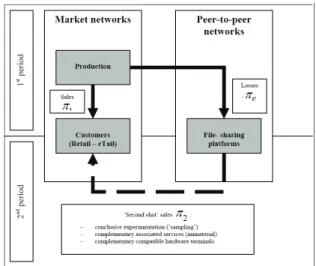
Commercial strategies and related profit-streams can be understood by as a two-step set of mechanisms. Although piracy-issued practices primarily appear to be detrimental to commercial activities, there exists a second step during which backward profit-based mechanisms are likely to appear. In this second step, commercial players generate profits from the file-sharing activity they are not able to control. The level of the profits reached by commercial players during this second step depends on both the quality of the digital goods that is estimated by the users of peer-to-peer networks and the mechanisms set by commercial players to generate backward-oriented profits. For example, Apple Computer nowadays generates profits by providing suitable hardware devices since 2001.
It appears that there exists a two-step mutual content valuation cycle that is based on the
complementary aspects of immaterial goods with some material ones. This cycle underlines the existence of relationships between commercial and non-commercial patterns of acquisition. In this framework, peer-to-peer networks play an intermediary role and tend to level to influence the way the commercial supply is valuated (i.e., adopted).
Figure 1 The two-step cycle of mutual content’s valuation
4.3. The failure of the commercial
transposition of the community-based models
The success of the file-sharing activity, as well as the benefits it may generate for the commercial activity, have naturally led some commercial players to take part in such a model. However, observations focusing on the commercial way of dealing with the file-sharing activity reveal quite disappointing results. Indeed, the purchase of Napster by Roxio Corporation in 2002 illustrates the willingness of the commercial players to appropriate the technology on which the file-sharing activity is based. However, the fact that commercial players intend to set up peer-to-peer networks by themselves which are compatible with the law for financial reasons presents two limitations.
one label to another, tends to complicate the setting up of a file-sharing activity suitable for commercial purposes.
The second limitation refers to the nature of individuals who participate in the building of peer-to-peer networks. Setting up a commercial-oriented peer-to-peer network requires bearing high-level coordination costs. In the case of commercial file-sharing platforms, these coordination costs have to be borne by the commercial players, whereas users and moderators are likely to bear such costs in the case of non-commercial peer-to-peer networks. In the case of commercial peer-to-peer networks, the way commercial players and users (i.e., customers) interact is not the same as in the case of non-commercial file-sharing platforms. Moreover, monitoring policies one may observe in the case of non-commercial peer-to-peer networks (see the first part of this chapter) are outweighed by financial compensations in the case of commercial file-sharing networks. As such, the lack of monitoring policies about the way the file-sharing activity is likely to be managed in a financial framework leads to not segmenting the supply of digital goods as sharply as it is in the case of non-commercial peer-to-peer networks. The digital content available on commercial peer-to-peer networks is thus not likely to be as valuated as it is on non-commercial file-sharing platforms. This is likely to decrease the level of expected profits to be reached in the second step of the cycle of mutual content valuation. The attempts made to adapt the model of file-sharing so as to cope with commercial-driven goals present limitations. These limitations are cost-based, as one should ask how to integrate the file-sharing activity in relevant business models. They give insights into understanding why the commercial file-sharing activity has not been widely adopted so far.
The failure of the ‘one-shot’ way of adapting the file-sharing activity for commercial purposes reveals that there are transversal relationships between commercial organizations (i.e., cultural goods suppliers) and non-commercial organizations (file-sharing networks and related communities). Therefore it appears difficult to switch from collective-based principles to profit-oriented ones. Suitable surrounding activities have to be found by commercial players to deliver higher-leveled profits. The relationships that commercial players and non-commercial organizations are likely to build show that their activities may deliver compatible outcomes. One key question is to identify the optimal strategies
that commercial players should set up in order to optimize their profits, by taking into account the file-sharing activity as well as that of potential commercial competitors. The architecture of the cultural goods industry may have to be redefined so as to integrate at best peer-to-peer networks as intermediaries stimulating commercial acquisition dynamics.
5. File-sharing, commercial activities and innovation
The commercial activity and the file-sharing activity both intend to be sustainable, whether it is for profit-based or community-based reasons. In this context, commercial players see in the file-sharing activity an unfair way of accessing digital contents that may be detrimental to their own activity, inasmuch as pirate digital acquisition is likely to level their profits down. As such, the file-sharing activity may be perceived as a key reason to understand why commercial players would not be motivated to innovate. The generalization of piracy-based practices would therefore lead to non-renewal of the supply of cultural goods suppliers.
5.1. The innovation of technological standards
standard prevailing on the market. For instance, Sony Corporation’s Betamax and the JVC’s vhs video-based formats used to compete on the home-based video market in the mid-1970s, until the vhs audio format eventually crowded out the Betamax format out of the market. In this context, one may distinguish two innovation-based aspects to identify dominant technologies. Firstly, a new format emerges from a pool of new potential technological formats. Secondly, the new format that was previously selected eventually replaces the technological standard that used to prevail so far (David, 1985; Arthur, 1989).
The development of compression formats and their technological diffusion would therefore only correspond to the foreseeable innovation of the technological standards that are likely to be overcome. Nevertheless, this new cycle is somewhat different to those which have previously been observed. Moreover, the producers of such new compression formats are new entrants on the market of cultural goods, who are likely to be confronted with the historical producers that used to innovate in order to establish their new standards and generate profits from it. The appearance of these new entrants on the market of cultural goods all the more attracts attention and fears that compression formats enable their users to produce derivate goods by themselves. Hence, the control of the distribution networks that historical commercial players used to handle nowadays appears to be threatened, inasmuch as they are not anymore able to fully control what is distributed online and offline for consumption purposes. As legal and technical answers have been found to be somewhat unfruitful, it has been suggested that commercial players should develop new production and distribution channels so as to benefit from the development of the new communication technologies (Cook & Wang, 2004)). To do so, commercial players should reconsider the way production, post-production, distribution and exploitation cycles are shaped, and should therefore abandon their traditional way of developing distribution schemes without considering distribution intermediaries (i.e., peer-to-peer networks). This new way of understanding production and exploitation cycles throughout digital-based distribution could represents an efficient response to the loss of control of diffusion channels that the historical players are nowadays facing. Besides, suitable versioning and price-based discrimination strategies could be set up through rebuilding commercial production and
distribution channels. The situation that commercial producers are confronted with is somewhat similar to that of the video-based standard competition between the Betamax and vhs formats. Commercial producers should overcome their inertia and their technophobia when technological innovations are not a priori beneficial to them, and develop new distribution and exploitation strategies. Such new strategic re-orientations reveal that external (i.e., non-commercial) innovative activities should be taken into account and integrated to relevant business models. To do so, the ‘one-shot’ adaptation of the file-sharing patterns for commercial purposes should be avoided, and production and valuation schemes should be redefined for new business opportunities and ensuing profits to be generated.
5.2. The role of innovation for
commercial players to control their distribution networks
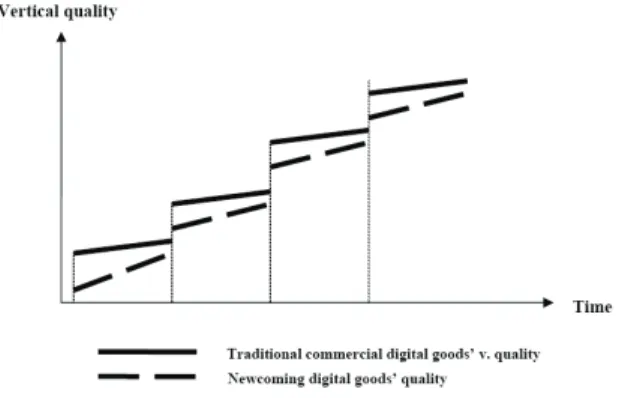
efforts to increase the quality of their own standards. The quality of the supply of the cultural goods is consequently likely to develop, whether they are commercially or non-commercially initiated.
However, the potential benefits that commercial players may reach from innovation strategies require their mobilization and their willingness to cooperate to efficiently establish their formats on the market and compete with non-commercial organizations. It seems that the establishing of such new relationships requires mutual efforts to be carried out to leave the competition scheme that commercial players have traditionally adopted. The case of the competition between the Blu-ray Disc – supported by Sony Corporation – and HD-DVD – supported by Toshiba – formats illustrates the difficulties for commercial players to cooperate. Although this standard competition has eventually led to the success of the Blu-ray Disc medium over the HD-DVD one in February 2008, it shows that such an upstream competition is detrimental to commercial players, as non-commercial formats have been launched in the meantime and are nowadays widely diffused (e.g., .mkv high definition video files). Upstream competition can be explained by the fact that commercially based players are driven by ‘winner-takes-all’ motivation. Nevertheless, these motivations do not seem to be suitable in a framework in which innovations can be generated by non-commercial players, as recent observations show that upstream competition is likely to be beneficial to establishing non-commercial standards and the development of the file-sharing activity.
Figure 2 The horizontal quality of commercial and non-commercial cultural goods and innovation patterns
The nature of the preferences that consumers have for the quality of cultural goods leads commercial players to innovate or not. The success
of such innovative initiatives partly depends on the constraints related to the way that commercial players adjust their activities and strategies. The development of the patterns of digital goods consumption highlights that it is difficult for commercial players to establish suitable relationships in a context in which they do not fully control the diffusion of cultural goods. It is therefore necessary to build new production and distribution strategies that are based on digital features so as to set up suitable both versioning and discrimination strategies. The development of new compression formats may stimulate commercial innovative initiatives provided that commercial players change their competitive way of interacting.
6. Conclusion
The file-sharing activity represents a new model of consumption that has attracted a high level of consumers. Factors aimed at explaining why peer-to-peer networks are popular are numerous. Reasons are not only technical, as the apparent illegal gratuitousness the file-sharing activity a priori
implies has been highlighted in order to explain the decrease of sales in the cultural goods industry.
Focusing on the way internauts have to use peer-to-peer networks to consume digital goods, we have set a taxonomy of costs that downplays the free nature of the file-sharing way of downloading files online. We have seen that commercial players have intended to restrict the activity of non-commercial organizations (i.e., peer-to-peer networks) by setting up offensive strategies that may be compared to competitive practices. Yet, we have stressed that the file-sharing activity may be beneficial to commercial players. The two-step cycle of mutual content valuation we have identified shows that commercial players can generate profits from piracy-based activities. The profits that commercial players can generate from the file-sharing activity nevertheless require setting up suitable business models. Commercial players therefore have to change their traditional way of producing and distributing cultural goods.
between the digital files that are available on peer-to-peer networks and the commercial cultural goods is likely to be low-leveled. Nevertheless, commercial players should innovate their way of cooperating for sustainable outcomes to be reached and fruitful innovative strategies to be delivered. Cooperation schemes have to be defined and upstream competition should be then avoided to establish new technological standards and attract customers whose preferences for quality are high. As the industrial landscape of cultural goods has evolved due to the advent of the Internet, since consumers nowadays play a role in the production process of digital goods, commercial players have to find means to find profitable alternatives to compensate their potential losses.
Such profitable alternatives are not easy to identify. We have pointed out that setting up commercial file-sharing platforms has led to disappointing results. This leads us to point out that commercial and non-commercial activities are not substituted, as the adaptation of the non-commercial file-sharing model for non-commercial purposes has revealed strong limitations. On the contrary, we show the existence of both positive and negative externalities whose overall effect emphasizes interaction between activities that differ in their organizational model. Indeed, the commercial activity has an impact on the non-commercial one, because the digital files that are available on file-sharing networks are usually derived from commercial, i.e. legal ones. Reciprocally, the file-sharing activity leads commercial players to revise their innovation strategies and their distribution schemes. Such bilateral relationships reveal that both activities are interdependent and that the industrial architecture of cultural goods is likely to evolve.
Our findings suggest that the file-sharing activity may be beneficial to the commercial one. For further research, it would be relevant to measure to what extent the so-called ‘outlaw’ (i.e., piracy-based) activities may be profitable to commercial activities. A key research track would be thus to investigate to what extent the introduction of peer-to-peer networks has a positive effect on the level of profits reached by traditional producers. Several frameworks are likely to be selected to deal with such issues. For instance, evidence shows that producers are likely to provide complementary hardware goods that are compatible with most of the digital goods available both offline and online, official or pirate ones. Mathematical modeling would enable us to better
understand the settings in which the distribution of non-authorized digital goods may be compatible with innovative industrial strategies, in a context in which producers provide both digital and hardware goods. We will present such modeling-based results in a future contribution.
We think that the file-sharing activity and its ensuing industrial economics applications open relevant fields for future research. One might investigate into these research tracks, while others – we hope – will be interested in pondering over this vast and fruitful topic.
References
Argentesi, E., Alvisi, M., & Carbonara, E. (2002). Piracy and Quality Choice in Monopolistic Markets. Retrieved March 12, 2008, from Social Science Electronic Publishing:
http://papers.ssrn.com/sol3/papers.cfm?abstract_id=341960
Arthur, B. (1989). Competing technologies, increasing returns and lock-in by historical events. Economic Journal , 99 (3), 116–131.
Baye, M., Morgan, J., & Scholten, P. (2004). Price dispersion in the small and in the large: evidence from an internet price comparison site. Journal of Industrial Economics , 52 (4), 463–496.
Ben Youssef, A. (2004). Les quatre dimensions de la fracture numérique. Réseaux , 22 (127-128), 181–208.
Bomsel, O., & Le Blanc, G. (2004). Distribution de contenus sur Internet : analyse économique des remèdes au contournement des droits de propriété intellectuelle. Paris: CERNA.
Bomsel, O., Charbonnel, J., Le Blanc, G., & Zakaria, A. (2004). Enjeux économiques de la distribution des contenus. Paris: CERNA.
Bounie, D., Bourreau, M., & Waelbroeck, P. (2005). Pirates or explorers? Analysis of music consumption in french graduate schools. Retrieved March 13, 2008, from Département de Sciences Économiques et Sociales (SES) de Telecom ParisTech:
http://ses.telecom-paristech.fr/bourreau/Recherche/p2p.pdf
Bourreau, M., & Labarthe-Piol, P. (2004). Le peer-to-peer et la crise de l’industrie du disque : une perspective historique. Réseaux , 22 (125), 17– 54.
Brynjolfsson, E., & Smith, M. (2000). Frictionless commerce? A comparison of internet and conventional retailers. Management Science , 46 (4), 563– 585.
Conner, K. R., & Rumelt, R. P. (1991). Software piracy – An analysis of protection strategies. Management Science , 37 (2), 125–139.
Cook, D. A., & Wang, W. (2004). Neutralizing the piracy of motion pictures: reengineering the industry’s supply chain. Technology in Society , 26 (4), 567–583.
Crémer, J., & Gaudeul, A. (2004). Some economics of the open-source software. Réseaux , 22 (124), 111-139.
Cunningham, B. M., Alexander, P. J., & Adilov, N. (2004). Peer-to-peer file sharing communities. Information Economics and Policy , 16 (2), 197–213. Dagiral, E., & Dauphin, F. (2005). P2P: from file Sharing to meta-information pooling. Communications et Stratégies , 59 (3), 35–59. Dahlander, L. (2007). Penguin in a new suit: a tale of how de novo entrants emerged to harness free and open source software communities. Industrial and Corporate Change , 16 (5), 913–943.
Dalle, J. M., & Jullien, N. (2003). ‘Libre’ software: turning fads into institutions? Research Policy , 32 (1), 1–11.
David, P. A. (1985). Clio and the economics of QWERTY. American Economic Review , 75 (2), 332–337.
Franke, N., & von Hippel, E. (2003). Satisfying heterogeneous user needs via innovation toolkits: the case of Apache security software. Research Policy , 32 (7), 1199–1215.
Gayer, A., & Shy, O. (2003). Copyright protection and hardware protection. Information Economics and Policy , 15 (4), 467–483.
Gensollen, M. (2006). La culture entre économie et écologie : l’exemple des communautés en ligne. In X. Greffe (Eds.), Création et diversité (pp. 285–312). Paris: La Documentation Française.
Gensollen, M., Gille, L., Bourreau, M., & Curien, N. (2004). Distribution de contenus sur Internet : commentaires sur le projet de taxation de l’upload. Retrieved March 12, 2008, from Département de Sciences Économiques et Sociales (SES) de Telecom ParisTech: http://ses.telecom-paristech.fr/p2p/documents/Fing_DistributionContenus1.pdf
Lerner, J., & Tirole, J. (2001). The open source movement: key research questions. European Economic Review , 45 (4-6), 819–826.
Levy, S. (1984). Hackers: Heroes of the Computer Revolution. New York: Anchor Press.
Liebowitz, S. J. (1985). Copying and indirect appropriability: photocopying of journals. Journal of Political Economy , 93 (5), 945–957.
Liebowitz, S. J. (2005). Pitfalls in measuring the impact of file-sharing. CESifo Economic Studies , 51 (2-3), 435–473.
Madden, M., & Rainie, L. (2005). Music and Video Downloading. Retrieved March 12, 2008, from Pew Internet:
http://www.pewinternet.org/Reports/2005/Music-and-Video-Downloading.aspx
Peitz, M., & Waelbroeck, P. (2006a). Piracy of digital products: a critical review of the theorical literature. Information Economics and Policy , 18 (4), 449–476.
Peitz, M., & Waelbroeck, P. (2004). The effect of internet piracy on music sales: cross-section evidence. Review of Economic Research on Copyright Issues , 1 (2), 71–79.
Peitz, M., & Waelbroeck, P. (2006b). Why the music industry may gain from free downloading – The role of sampling. International Journal of Industrial Organization , 24 (5), 907–913.
Poddar, S. (2002). Network externality and software piracy. Retrieved March 12, 2008, from United Nations University:
http://www.wider.unu.edu/stc/repec/pdfs/rp2002/dp2002-115.pdf
Rehn, A. (2004). The politics of contraband – The honour economies of the warez scene. Journal of Social-Economics , 33 (3), 359–374.
Robert, M. (2004). La discrimination par les prix : une stratégie de protection contre le piratage informatique. Working paper, Université de Montpellier, Montpellier.
Shapiro, C., & Varian, H. R. (1998). Information Rules: A Strategic Guide to the Network Economy. Cambridge: Harvard Business School Press. Takeyama, L. N. (2002). Piracy, asymmetric information and product quality. Retrieved March 12, 2008, from The Society for Economic Research on Copyright Issues: http://www.serci.org/2002/takeyama.pdf Takeyama, L. N. (1994). The welfare implications of unauthorized reproduction of intellectual property in the presence of network externalities. Journal of Industrial Economics , 42 (2), 155–166.
Yang, D., Sonmez, M., & Bosworth, D. (2004). Intellectual property abuses: how should multinationals respond? Long Range Planning , 37 (5), 459– 475.
Thomas Le Texier
Université de Nice GREDEG – CNRS
Sophia Antipolis 250, rue Albert Einstein F-06560 Valbonne Cedex
France
Email: [email protected]
Victor Dos Santos Paulino
Université de Nice Toulouse Business School 20 boulevard Lascrosses, BP 7010 F-31068 Toulouse Cedex 7 France