Bacteria associated with
Amblyomma cajennense
tick eggs
Erik Machado-Ferreira
1, Vinicius Figueiredo Vizzoni
1,2, Joseph Piesman
3,
Gilberto Salles Gazeta
2and Carlos Augusto Gomes Soares
11
Laboratório de Genética Molecular de Eucariontes e Simbiontes, Deptartamento de Genética,
Instituto de Biologia, Universidade Federal do Rio de Janeiro, Rio de Janeiro, RJ, Brazil.
2Laboratorio de Referência Nacional em Vetores das Riquetsioses,
Instituto Oswaldo Cruz, Rio de Janeiro, RJ, Brazil.
3
Centers for Disease Control and Prevention, Division of Vector-Borne Diseases,
Bacterial Diseases Branch, Fort Collins, CO, USA.
Abstract
Ticks represent a large group of pathogen vectors that blood feed on a diversity of hosts. In the Americas, the Ixodidae ticksAmblyomma cajennense are responsible for severe impact on livestock and public health. In the pres-ent work, we prespres-ent the isolation and molecular idpres-entification of a group of culturable bacteria associated withA. cajennense eggs from females sampled in distinct geographical sites in southeastern Brazil. Additional comparative analysis of the culturable bacteria fromAnocentor nitens, Rhipicephalus sanguineus and Ixodes scapularis tick eggs were also performed. 16S rRNA gene sequence analyses identified 17 different bacterial types identified asSerratia marcescens, Stenotrophomonas maltophilia, Pseudomonas fluorescens, Enterobacter spp., Micrococcus luteus, Ochrobactrum anthropi, Bacillus cereus and Staphylococcus spp., distributed in 12 phylogroups. Staphylococcus spp., especially S. sciuri, was the most prevalent bacteria associated with A. cajennense eggs, occurring in 65% of the samples and also frequently observed infectingA. nitens eggs. S. maltophilia, S. marcescens and B. cereus oc-curred infecting eggs derived from specific sampling sites, but in all cases rising almost as pure cultures from infected A. cajennense eggs. The potential role of these bacterial associations is discussed and they possibly represent new targets for biological control strategies of ticks and tick borne diseases.
Keywords:Amblyomma cajennense, tick eggs bacteria,Staphylococcus, Ixodidae.
Received: February 3, 2015; Accepted: May 25, 2015.
Ticks represent a large group of pathogen vectors that blood feed on a diversity of hosts, including amphibians, reptiles, birds and mammals. These Acari are divided into three families, Ixodidae (hard ticks), Argasidae (soft ticks), and the Nuttalliellidae (restricted to southern Africa) (Mihalcaet al., 2011). In the Americas, the Ixodidae ticks Amblyomma cajennenseare responsible for the transmis-sion and environmental maintenance of pathogens with public health relevance, including reports in southeastern Brazil (Lemos 2000; Walkeret al., 2000; Belongia, 2002; Krause, 2002; Galvãoet al., 2003; Guedes et al., 2005; Guglielmoneet al., 2006). The Cayenne tickA. cajennense can transmit several pathogens to a variety of animals and is considered the main vector ofRickettsia rickettsii, the etio-logical agent of Rocky Mountain Spotted Fever (Guedeset al., 2005).
Tick and tick borne disease control has been usually attempted or proposed by the use of a series of strategies aiming mostly on biological events to potentially impair tick feeding, pathogen transmission to mammal hosts (Al-len and Humphreys, 1979; Kotsyfakiset al., 2008; Piesman and Eisen, 2008; Rot et al., 2013; Garcia et al., 2014; Schwarzet al., 2014), and in some cases, to restrict tick molting events and pathogen maintenance during tick de-velopment (Oldset al., 2012; Calligariset al., 2013; Doan et al., 2013; Moreno-Cidet al., 2013; Rotet al., 2013). In-terestingly, studies on tick egg biology depicting possible strategies to improve egg health, integrity and development when exposed to natural environment, represent a poorly explored venue for the control of tick populations and asso-ciated pathogens. In fact, biological events, such as the pos-sible role of the egg microbiome on tick population dynamics or tick development, to our knowledge has never been investigated and no bacteria were previously isolated specifically from tick eggs. However, many studies have described bacteria isolated from adult ticks (Ixodes scapularis, Ixodes ricinus, Dermacentor reticulatus and
Send correspondence to Carlos A.G. Soares. Laboratório de Gené-tica Molecular de Eucariontes e Simbiontes, Departamento de Genética, Instituto de Biologia, Universidade Federal do Rio de neiro, Rua Professor Paulo Rocco s/número, 21941-617 Rio de Ja-neiro, RJ, Brazil. E-mail: [email protected].
Haemaphysalis concinna) collected in the U.S., part of Eu-rope and Australia (Martin and Schmidtmann, 1998; Mur-rellet al., 2003; Stojek and Dutkiewicz, 2004; Rudolfet al., 2009; Egyed and Makrai, 2014). In this scenario, we pres-ent the isolation and molecular idpres-entification of a group of culturable bacteria associated withA. cajennenseeggs from females sampled in distinct geographical sites in southeast-ern Brazil. Comparative analyses with other Ixodidae ticks, such asAnocentor nitens,Rhipicephalus sanguineusandI. scapularisis presented. Natural colonization of tick eggs with specific bacterium physiotypes is discussed and it may bring new insights to the control of tick populations and tick-borne diseases.
In this work, actively feeding adult females of A. cajennense were retrieved from horses in southeastern Brazil sites, including municipalities with notified spotted fever cases (Brazil government data -Ministério da Saúde, SINAN, http://dtr2004.saude.gov.br/sinanweb/ from 2001 to 2015). Sampled ticks were maintained in laboratory until oviposition. Field collected samples of A. nitens and R. sanguineusactively feeding on horses and dogs were also obtained for comparative analyses.I. scapularistick sam-ples were also analyzed and obtained from U.S. colonies maintained at the Vector-Host Laboratory (Division of Vector-Borne Disease, Center for Disease Control and Pre-vention, CDC) (Table 1). Tick samples were prepared by initial washing steps, including four successive washes with ethanol 70% (v/v), followed by morphological and taxonomic confirmative analyses. Engorged females were placed in glass vials and maintained at»93% relative
hu-midity, using a saturated solution of KNO3 in a growth
chamber at 26 °C and under a photoperiod of 14 h: 10 h (light: dark) until oviposition. The obtained egg masses were washed in ethanol 70% (v/v), air-dried and homoge-nized in 500mL of sterile PBS (phosphate buffered saline)
with sterile mortar and pestle. Each egg mass, from a single female tick, was split in two to four sub-samples to generate independent egg/PBS homogenates which were individu-ally plated for bacterial isolation.
Bacteria were isolated by direct streaking of 50mL of
the egg/PBS suspensions on LB (Luria-Bertani medium) agar plates, without any enrichment step to prevent compet-itive selection to occur. Replicas were incubated for 24 h at 30 °C and 37 °C. Bacterial colonies with the same morphol-ogy were purified in triplicates and directly inoculated into liquid LB medium for subsequent DNA extraction and stor-age at -80 °C. Bacterial genomic DNA extraction was rou-tinely performed using the DNeasy Blood and Tissue Kit (Qiagen, Germantown, MD) procedure and eluted in 100 mL of TE buffer. DNA integrity was analyzed by
agarose gel electrophoresis (data not shown).
The eubacterial 16S rRNA universal primers 27f, 338f, 907r and 1492r (Lane, 1991) were applied in PCR re-actions using the purified bacterial genomic DNAs. PCR conditions included 35 cycles of 94 °C for 1 min, 55 °C for
35 s and 72 °C for 1 min. PCR products from four inde-pendent reactions were directly purified with the GFX PCR DNA and Gel band purification kit (GE Healthcare, Buckinghamshire, UK), according to manufacturer’s in-structions. Purified PCR products were sequenced using the BigDye Terminator DNA sequencing kit (Applied Bio-systems, Foster City, Calif., U.S.A.) and analyzed in a Megabace 1000 DNA sequencer (Amersham Biosciences). Sequences were edited using SeqMan program (DNASTARinc package for Windows platform, 1989-1999), and the identities were obtained by BLAST analyses. Neighbor-joining phylogenetic reconstruction with the Kimura two-parameter correction model was used to obtain a better taxonomic resolution (Kimura, 1980).
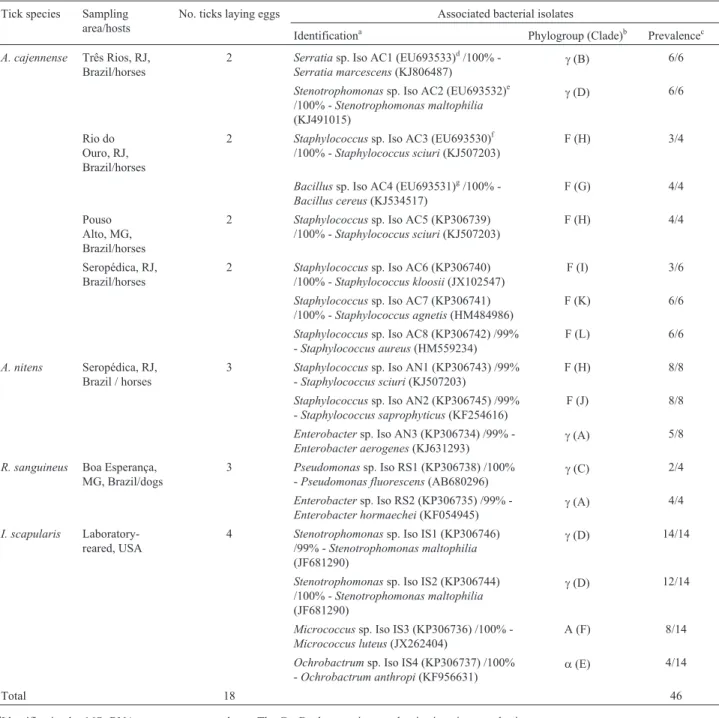
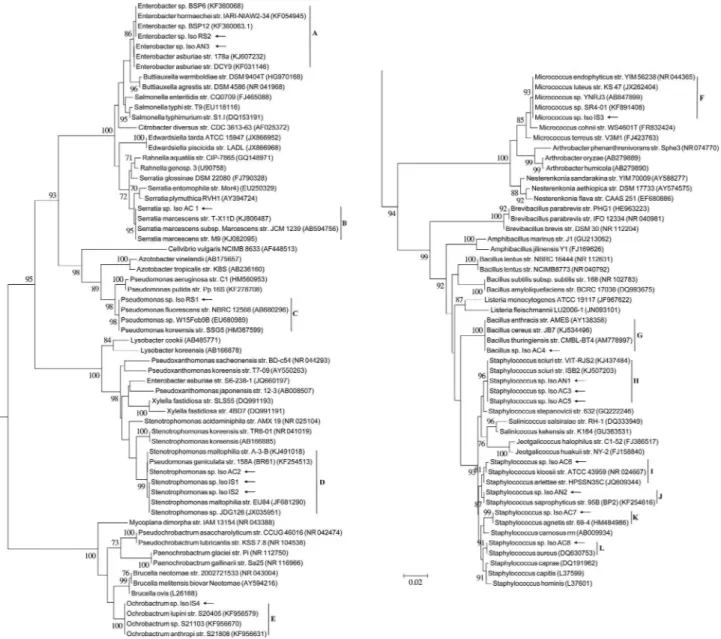
A total of 72 morphologically different colonies were visually grouped and isolated from a total of 46 egg mass samples, including 20 samples analyzed forA. cajennense from 4 sampling sites located in the states of Rio de Janeiro and Minas Gerais, Brazil, and 26 comparative samples of egg masses fromA. nitens,R. sanguineusandI. scapularis species. DNA sequence BLAST analyses grouped all iso-lates into a total of 17 bacterial types (named as “IsoAC1” to “IsoAC8”, “IsoAN1” to “IsoAN3”, “IsoRS1” and “IsoRS2”, “IsoIS1” to “IsoIS4”) belonging to eight bacte-rial genera (Table 1), distributed in 12 phylogroups of Firmicutes(Bacilli) (70% ofA. cajenennsesamples; ~47% of all samples), Gamma-proteobacteria (30% of A. cajennense samples; ~42% of all samples), Al-pha-proteobacteria(not inA. cajennensebut in ~5,5% of all samples) andActinobacteria(not inA. cajennensebut in ~5,5% of all samples) after 16S rRNA gene sequence anal-yses (Figure 1). Curiously, most tick egg samples present a restricted culturable bacterial richness, especially A. cajennensesamples which in some cases yielded isolation of a pure culture of the associatedStaphylococcus sciuriby direct plating of its egg/PBS homogenates.Staphylococcus was the most frequent genus of bacteria associated with all tick species tested, occurring in 65% of theA. cajenennse samples and 45% of all tested egg/PBS homogenates, espe-cially theS. sciuri(Clade H), which occurred in tick eggs sampled in different states of Brazil, both from Cayenne ticks sampled in the cities of Rio do Ouro (Rio de Janeiro state) and Pouso Alto (Minas Gerais state), and fromA. nitensobtained in Seropedica (Rio de Janeiro state). Staph-ylococcusspp. were also abundantly detected in a recent metagenomic assessment of bacteria inR. microplus, butS. sciuriwas only found associated to adult ticks of this spe-cies (Andreottiet al., 2011). Similarly to the isolates cul-tured fromA. cajennenseeggs, these authors also detected S. aureus, otherStaphylococcusspp.,Serratia marcescens, Stenotrophomonas sp. and Pseudomonas sp. in R. microplusegg samples.
samples and observed coinfecting the eggs from females collected in the Três Rios site. In addition, members of Stenotrophomonas sp. (Clade D) and phylogenetically close to the Cayenne tick isolates, were also observed in as-sociation withI. scapularisin the U.S.
Ticks can uptake and carry bacteria from their envi-ronment or from the skin surface of hosts and some of these bacteria are able to survive and replicate in ticks (Egyed and Makrai, 2014).S. sciuriis in fact considered common colonizers of dogs, cats, found in the skin of cattle and other
Table 1- Bacterial isolates obtained from each tick egg mass sample analyzed.
Tick species Sampling
area/hosts
No. ticks laying eggs Associated bacterial isolates
Identificationa Phylogroup (Clade)b Prevalencec
A. cajennense Três Rios, RJ, Brazil/horses
2 Serratiasp. Iso AC1 (EU693533)d/100%
-Serratia marcescens(KJ806487)
g(B) 6/6
Stenotrophomonassp. Iso AC2 (EU693532)e
/100% -Stenotrophomonas maltophilia
(KJ491015)
g(D) 6/6
Rio do Ouro, RJ, Brazil/horses
2 Staphylococcussp. Iso AC3 (EU693530)f /100% -Staphylococcus sciuri(KJ507203)
F (H) 3/4
Bacillussp. Iso AC4 (EU693531)g/100%
-Bacillus cereus(KJ534517)
F (G) 4/4
Pouso Alto, MG, Brazil/horses
2 Staphylococcussp. Iso AC5 (KP306739) /100% -Staphylococcus sciuri(KJ507203)
F (H) 4/4
Seropédica, RJ, Brazil/horses
2 Staphylococcussp. Iso AC6 (KP306740) /100% -Staphylococcus kloosii(JX102547)
F (I) 3/6
Staphylococcussp. Iso AC7 (KP306741)
/100% -Staphylococcus agnetis(HM484986)
F (K) 6/6
Staphylococcussp. Iso AC8 (KP306742) /99% -Staphylococcus aureus(HM559234)
F (L) 6/6
A. nitens Seropédica, RJ, Brazil / horses
3 Staphylococcussp. Iso AN1 (KP306743) /99% -Staphylococcus sciuri(KJ507203)
F (H) 8/8
Staphylococcussp. Iso AN2 (KP306745) /99% -Staphylococcus saprophyticus(KF254616)
F (J) 8/8
Enterobactersp. Iso AN3 (KP306734) /99%
-Enterobacter aerogenes(KJ631293)
g(A) 5/8
R. sanguineus Boa Esperança, MG, Brazil/dogs
3 Pseudomonassp. Iso RS1 (KP306738) /100% -Pseudomonas fluorescens(AB680296)
g(C) 2/4
Enterobactersp. Iso RS2 (KP306735) /99%
-Enterobacter hormaechei(KF054945)
g(A) 4/4
I. scapularis Laboratory-reared, USA
4 Stenotrophomonassp. Iso IS1 (KP306746) /99% -Stenotrophomonas maltophilia
(JF681290)
g(D) 14/14
Stenotrophomonassp. Iso IS2 (KP306744) /100% -Stenotrophomonas maltophilia
(JF681290)
g(D) 12/14
Micrococcussp. Iso IS3 (KP306736) /100%
-Micrococcus luteus(JX262404)
A (F) 8/14
Ochrobactrumsp. Iso IS4 (KP306737) /100% -Ochrobactrum anthropi(KF956631)
a(E) 4/14
Total 18 46
aIdentification by 16S rRNA gene sequence analyses. The GenBank accession number is given in parenthesis.
The identity percentage with the closest species is followed by slash; The most identical species name and GenBank accession number is also presented.
b
Phylogroup as follows: A= Actinobacteria; F = Firmicutes;a= Alpha-Proteobacteria;g= Gamma-Proteobacteria .
Clade code “A” to “N” refers to the clusters in the 16S rRNA gene based phylogenetic reconstruction presented in the Figure 1.
cPrevalence= No. positive egg-PBS suspension samples for a specific bacterial isolate/ Total No. of egg_PBS samples analyzed.
Each egg mass from a single female tick was splitted in 2 to 4 samples to generate independent egg_PBS homogenates. See text for details.
dPreviously annotated asSerratia marcescensstrain CS265 in the Genbank. e
Previously annotated asStenotrophomonas maltophiliastrain CS266 in the Genbank.
f
Previously annotated asStaphylococcus sciuristrain CS264 in the Genbank.
animals (Devrieseet al., 1984; Coxet al., 1985; Lilenbaum et al., 1999; Bagcigilet al., 2007; Andreottiet al., 2011; Coutoet al., 2011; Garbaczet al., 2013). In this work, sev-eral identified bacteria are not typically described as associ-ated with arthropods. The successive washes of the female ticks before oviposition, as previously performed in other tick associated bacteria study (Jutraset al., 2010), and tak-ing the fact that eggs were laid in the laboratory vials and subjected to an additional direct washing step, suggests that these bacteria are not casual soil or other environmental population accidently colonizing the tested egg samples, and could indeed represent active partners participating in specific aspects of tick physiology. It is interesting to men-tion that all bacterial isolates are able to secrete protease, as
determined by clearing zone formation by growths on LB agar plates containing 0.5% casein (Supplementary Mate-rial, Figure S1). This suggests that all isolated bacteria could contribute to ticks egg hatching processes, which should be assessed in further work. Also, a growing litera-ture indicates that arthropods containing associated bacte-ria increase the arthropod-resistance against parasites and/or pathogens (Gravotet al., 2000; Oliveret al., 2003; Hedges and Johnson, 2008; Teixeiraet al., 2008; Brownlie and Johnson, 2009; Koehler and Kaltenpoth, 2013; Koehler et al., 2013). The exposed tick eggs are vulnerable to envi-ronmental conditions and infection, mostly by soil microor-ganisms, is expected. Although not elucidated in the pres-ent work, we can speculate that the reduced amount of
bacterial types isolated from the eggs may indicate that those bacteria have outcompeted other bacterial types in these samples. If somehow ticks manage to select specific egg colonizing bacteria and mostly maintain bioactive me-tabolite producing bacteria, it would in fact represent a strategy for chemical defense to improve success of egg development, hatching and tick population fitness. Interest-ingly, most isolated bacterial species are members of phyloclades that include known antifungal, bacteriocins and bioactive metabolites-producing bacteria, such as S. sciuri(Clade H),S. maltophilia(Clade D),S. marcescens (Clade B),P. fluorescens(Clade C),M. luteus(Clade F),S. aureus (Clade L), B. cereus/B. thuringiensis (Clade G) (Gardner, 1949; Tagget al., 1976; Jakobiet al., 1996; Har-ris et al., 2004; Furushita et al., 2005; Pankewitz and Hilker, 2006; Banerjeeet al., 2011; Gutiérrez-Románet al., 2012; Liuet al., 2013), indicating their possible role on chemical protection of the exposed egg masses. S. marcenscesandB. cereusare also known to combat insects and nematodes, organisms that could represent predators of tick eggs (Sikorowski and Lawrence, 1998; Yoshidaet al., 2001; Dillon and Charnley, 2002; Nishiwakiet al., 2004). Additionally, the most frequentS. sciuriandS. maltophilia are also known as multidrug resistant bacteria (Stepanovic et al., 2006; Hauschildet al., 2007; Haenniet al., 2011; Bhargava and Zhang, 2012; Lozanoet al., 2012; Huanget al., 2013; Daviset al., 2014; García-Leónet al., 2014; Har-risonet al., 2014) and that would possibly support their high prevalence onA. cajennenseegg samples, as a conse-quence of their potential resistance to competing microor-ganisms or to other antimicrobial components on eggs sur-face or in the surrounding environment (Arrieta et al., 2006).
Some bacterial species isolated are also known to be pathogenic to arthropod hosts, as the Clade GB. cereus/B. thuringiensis. The Clade BS. marcenscesalso seems to be harmful to ticks, since it was already described that the wax from the eggs ofAmblyomma hebraeumhas antibiotic ac-tivity for their protection specifically against this bacterium (Arrieta et al., 2006). Nymphs, larvae and adult ticks of Amblyomma variegatum also present specific substances againstS. marcensces(Paviset al., 1994). This bacterium species is a known opportunistic pathogen of insects (Siko-rowski and Lawrence, 1998) and able to decrease egg hatching time of flies (Romeroet al., 2006). Some other bacterial isolates are also representatives of clades that in-clude potential pathogens to ticks, and it raises the possibil-ity that tick egg associated bacteria could also act on trans-generational immune priming, a process of maternal transfer of bacteria to increase the expression of immu-nity-related genes encoding antibacterial proteins in the emerging larvae, as described for some insects (Freitaket al., 2014). These possibilities should be tested in the future.
It is important to mention that the bacteria presented here were cultured and isolated, not only described at the
DNA sequence level. These bacteria, speciallyS. sciuri, are potential candidates for future paratransgenesis strategies, once they were easily isolated from tick eggs and reported infecting both nymph and adult ixodidae ticks of different species, including R. microplus, Ixodes holocyclus, I. ricinus,Dermacentor reticulatus,Haemaphysalis concina and Amblyomma fimbriatum (Martin and Schmidtmann, 1998; Murrellet al., 2003; Stojek and Dutkiewicz 2004; Rudolf et al., 2009; Andreotti et al., 2011). In paratransgenesis, arthropod associated bacteria are used as vehicles for expressing foreign genes to kill or reduce pathogen fitness in their arthropod vectors, representing an alternative strategy to reduce pathogen transmission (Beard et al., 1998). Taken together, the present description and isolation of tick eggs associated bacteria offer new targets and tools for biological control strategies of ticks and tick borne diseases.
Acknowledgments
This research was financially supported in part by the Brazilian federal agencies CNPq and CAPES.
References
Allen JR and Humphreys SJ (1979) Immunisation of guinea pigs and cattle against ticks. Nature 280:491-493.
Andreotti R, de Leon AAP, Dowd SE, Guerrero FD, Bendele KG and Scoles GA (2011) Assessment of bacterial diversity in the cattle tickRhipicephalus(Boophilus)microplusthrough tag-encoded pyrosequencing. BMC Microbiol 11:e6. Arrieta MC, Leskiw BK and Kaufman WR (2006) Antimicrobial
activity in the egg wax of the African cattle tickAmblyomma hebraeum(Acari, Ixodidae). Exp Appl Acarol 39:297-313. Bagcigil FA, Moodley A, Baptiste KE, Jensen VF and
Guar-dabassi L (2007) Occurrence, species distribution, antimi-crobial resistance and clonality of methicillin- and erythro-mycin-resistant staphylococci in the nasal cavity of domestic animals. Vet Microbiol 121:307-315.
Banerjee D, Chatterjee S, Banerjee UC, Guha AK and Ray L
(2011) Green pigment from Bacillus cereus M(1)(16)
(MTCC 5521): Production parameters and antibacterial ac-tivity. Appl Biochem Biotechnol 164:767-779.
Beard CB, Durvasula RV and Richards FF (1998) Bacterial sym-biosis in arthropods and the control of disease transmission. Emerg Infect Dis 4:581-591.
Belongia EA (2002) Epidemiology and impact of coinfections ac-quired from Ixodes ticks. Vector Borne Zoonotic Dis 2:265-273.
Bhargava KL and Zhang Y (2012) Multidrug-resistant
coagu-lase-negative Staphylococci in food animals. J Appl
Microbiol 113:1027-1036.
Brownlie JC and Johnson KN. (2009) Symbiont-mediated protec-tion in insect hosts. Trends Microbiol 8:348-354.
Couto N, Pomba C, Moodley A and Guardabassi L (2011) Preva-lence of meticillin-resistantStaphylococciamong dogs and cats at a veterinary teaching hospital in Portugal. Vet Rec 169:72.
Cox HU, Hoskins JD, Newman SS, Turnwald GH, Foil CS, Roy AF and Kearney MT (1985) Distribution of staphylococcal species on clinically healthy cats. Am J Vet Res 46:1824-1828.
Davis JA, Jackson CR, Ferdorka-Cray PJ, Barrett JB, Brousse JH, Gustafson J and Kucher M (2014) Carriage of methicillin-resistant staphylococci by healthy companion animals in the US. Lett Appl Microbiol 59:1-8.
Devriese LA, Nzuambe D and Godard C (1984) Identification and characterization of staphylococci isolated from cats. Vet Microbiol 9:279-285.
Dillon R and Charnley K (2002) Mutualism between the desert lo-cust Schistocerca gregaria and its gut microbiota. Res Microbiol 153:503-509.
Doan HT, Noh JH, Kim YH, Yoo MS, Reddy KE, Jung SC and Kang SW (2013) The efficacy of avermectins (ivermectin, doramectin and abamectin) as treatments for infestation with the tickHaemaphysalis longicornison rabbits in Korea. Vet Parasitol 198:406-409.
Egyed L and Makrai L (2014) Cultivable internal bacterial flora of ticks isolated in Hungary. Exp Appl Acarol 63:107-122. Freitak D, Schmidtberg H, Dickel F, Lochit G, Vogel H and
Vilcinskas A (2014) The maternal transfer of bacteria can mediate trans-generational immune priming in insects. Vir-ulence 15:547-554.
Furushita M, Okamoto A, Maeda T, Ohta M and Shiba T (2005)
Isolation of multidrug-resistant Stenotrophomonas
maltophilia from cultured yellowtail (Seriola quinqueradiata) from a marine fish farm. Appl Environ Microbiol 71:5598-5600.
Galvão MA, Mafra CL, Moron C, Anaya E and Walker DH (2003) Rickettsiosis of the genusRickettsiain South Amer-ica. Ann NY Acad Sci. 990:57-61.
Garbacz K, Zarnowska S, Piechowicz L and Haras K (2013) Staphylococciisolated from carriage sites and infected sites of dogs as a reservoir of multidrug resistance and methicillin resistance. Curr Microbiol 66:169-173.
Garcia GR, Gardinassi LG, Ribeiro JM, Anatriello E, Ferreira BR, Moreira HN, Mafra C, Martins MM, Szabó MP, de Miranda-Santos IK,et al.(2014) The sialotranscriptome of Amblyomma triste, Amblyomma parvumand Amblyomma cajennenseticks, uncovered by 454-based RNA-seq. Parasit Vectors 7:430.
Garcia-Leon G, Salgado F, Oliveros JC, Sanchez MB and Marti-nez JL (2014) Interplay between intrinsic and acquired resis-tance to quinolones inStenotrophomonas maltophilia. Envi-ron Microbiol 16:1282-1296.
Gardner JF (1949) An antibiotic produced byStaphylococcus aureus. Br J Exp Pathol 30:130-138.
Gravot E, Thomas-Orillard M and Jeune B (2000) Virulence vari-ability of the Drosophila C virus and effects of the micro-parasite on demographic parameters of the host (Drosophila melanogaster). J Invertebr Pathol 75:144-151.
Guedes E, Leite RC, Prata MC, Pacheco RC, Walker DH and Labruna MB (2005) Detection ofRickettsia rickettsiiin the tickAmblyomma cajennensein a new Brazilian spotted
fe-ver-endemic area in the state of Minas Gerais. Mem Inst Oswaldo Cruz. 100:841-845.
Guglielmone AA, Beati L, Barros-Battesti DM, Labruna MB, Nava S, Venzal JM, Mangold AJ, Szabo MP, Martins JR and Gonzalez-Acuna D (2006) Ticks (Ixodidae) on humans in South America. Exp Appl Acarol 40:83-100.
Gutiérrez-Román MI, Holguín-Meléndez F, Bello-Mendoza R, Guillén-Navarro K, Dunn MF and Huerta-Palacios G (2012) Production of prodigiosin and chitinases by tropicalSerratia marcescensstrains with potential to control plant pathogens. World J Microbiol Biotechnol 28:145-153.
Haenni M, Châtre P, Boisset S, Carricajo A, Bes M, Laurent F and Madec JY (2011) Staphylococcal nasal carriage in calves: multiresistantStaphylococcus sciuri and immune evasion cluster (IEC) genes in methicillin-resistantStaphylococcus aureusST398. J Antimicrob Chemother 66:1927-1928. Harris AK, Williamson NR, Slater H, Cox A, Abbasi S, Foulds I,
Simonsen HT, Leeper FJ and Salmond GPC (2004) The Serratiagene cluster encoding biosyntesis of the red antibi-otic, prodigiosin, shows species-and strain-dependent ge-nome context variation. 2004. Microbiology 150:3547-3560.
Harrison EM, Paterson GK, Holden MT, Ba X, Rolo J, Morgan FJ, Pichon B, Kearns A, Zadoks RN, Peacock SJ, et al. (2014) A novel hybrid SCCmec-mecC region in Staphylo-coccus sciuri. J Antimicrob Chemother 69:911-918. Hauschild T, Vukovic D, Dakic I, Jezek P, Djukic S, Dimitrijevic
V, Stepanovic S and Schwarz S (2007) Aminoglycoside re-sistance in members ofStaphylococcus sciurigroup. Microb Drug Resist 13:77-84.
Hedges LM and Johnson KN (2008) The induction of host de-fence responses by Drosophila C virus. J Gen Virol 89:1497-1501.
Huang YW, Hu RM and Yang TC (2013) Role of the pcm-tolCsm operon in the multidrug resistance of Stenotrophomonas maltophilia. J Antimicrob Chemother 68:1987-1993. Jakobi M, Winkelmann G, Kaiser D, Kempler C, Jung G, Berg G
and Bahl H (1996) Maltophilin: a new antifungal compound
produced by Stenotrophomonas maltophilia R3089. J
Antibiot 49:1101-1104.
Jutras BL, Liu Z and Brissette CA (2010) Simultaneous isolation of Ixodidae and bacterial (Borreliaspp.) genomic DNA. Curr Protoc Microbiol 1E.2.1-1E2.11.
Kimura M (1980) A simple method for estimating evolutionary rates of base substitutions through comparative studies of nucleotide sequences. J Mol Evol 16:111-120.
Koehler S and Kaltenpoth M (2013) Maternal and environmental effects on symbiont-mediated antimicrobial defence. J Chem Ecol 39:978-988.
Koehler S, Doubsky J and Kaltenpoth M (2013) Dynamics of symbiont-mediated antibiotic production reveal efficient long-term protection for beewolf offspring. Front Zool 10:e3.
Kotsyfakis M, Anderson JM, Andersen JF, Calvo E, Francischetti IM, Mather TN, Valenzuela JG and Ribeiro JM (2008) Cut-ting edge: Immunity against a “silent” salivary antigen of the Lyme vectorIxodes scapularisimpairs its ability to feed. J Immunol 181:5209-5212.
Lane DJ (1991) 16S/23S rRNA sequencing. In: Stackebrandt E and Goodfellow M (eds) Nucleic Acid Techniques in Bacte-rial Systematics. Wiley & Sons, Chichester, pp 115-175.
Lemos ERS (2000) Rickettsial diseases in Brazil. Virus Rev Res 7:7-16.
Lilenbaum W, Esteves AL and Souza GN (1999) Prevalence and antimicrobial susceptibility of staphylococci isolated from saliva of clinically normal cats. Lett Appl Microbiol 28:448-452.
Liu J, Chen P, Zheng C and Huang YP (2013) Characterization of maltocin P28, a novel phage tail-like bacteriocin from Stenotrophomonas maltophilia. Appl Environ Microbiol 79:5593-5600.
Lozano CL, Aspiroz C, Sáenz Y, Ruiz-García M, Royo-García G, Gómez-Sanz E, Ruiz-Larrea F, Zarazaga M and Torres C (2012) Genetic environment and location of the lnu(A) and lnu(B) genes in methicillin-resistantStaphylococcus aureus and other staphylococci of animal and human origin. J Anti-microb Chemother 67:2804-2808.
Martin PA and Schmidtmann ET (1998) Isolation of aerobic mi-crobes fromIxodes scapularis(Acari, Ixodidae), the vector of Lyme disease in the eastern United States. J Econ Entomol 91:864-868.
Mihalca AD, Gherman CM and Cozma V (2011) Coendangered hard-ticks: Threatened or threatening? Parasit Vectors 4:71.
Moreno-Cid JA, Pérez de la Lastra JM, Villar M, Jiménez M, Pinal R, Estrada-Peña A, Molina R, Lucientes J, Gortázar C, de la Fuente J and SUB/AKR Vaccine Study Group (2013) Control of multiple arthropod vector infestations with subolesin/akirin vaccines. Vaccine 31:1187-1196.
Murrell A, Dobson SJ, Yang X, Lacey E and Barker SC (2003) A survey of bacterial diversity in ticks, lice and fleas from Aus-tralia. Parasitol Res 89:326-334.
Nishiwaki H, Ito K, Otsuki K, Yamamoto H, Komai K and Matsuda K (2004) Purification and functional characteriza-tion of insecticidal sphygomyelinase C produced byBacillus cereus. Eur J Biochem 271:601-606.
Olds C, Mwaura S, Crowder D, Odongo D, van Oers M, Owen J, Bishop R and Daubenberger C (2012) Immunization of cat-tle with Ra86 impedesRhipicephalus appendiculatus nym-phal-to-adult molting. Ticks Tick Borne Dis 3:170-178.
Oliver KM, Russell JA, Moran NA and Hunter MS (2003) Facul-tative bacterial symbionts in aphids confers resistance to parasitic wasps. Proc Natl Acad Sci USA 100:1803-1807.
Pankewitz F and Hilker M (2006) Defensive components in insect eggs: are anthraquinones produced during egg develop-ment? J Chem Ecol 32:2067-2072.
Pavis C, Mauleon H, Barre N and Maibeche M (1994) Dermal
gland secretions of tropical bont tick, Amblyomma
variegatum(Acarina, Ixodidae) Biological activity on pred-ators and pathogens. J Chem Ecol 20:1495-1503.
Piesman J and Eisen L (2008) Prevention of tick-borne diseases. Annu Rev Entomol 53:323-343.
Romero A, Broce A and Zurek L (2006) Role of bacteria in the ovoposition behaviour and larval development of stable flies. Med Vet Entomol 20:115-121.
Rot A, Gindin G, Ment D, Mishoutchenko A, Glazer I and Samish M (2013) On-host control of the brown dog tick Rhipicephalus sanguineus Latreille (Acari, Ixodidae) by Metarhizium brunneum(Hypocreales, Clavicipitaceae). Vet Parasitol 193:229-237.
Rudolf I, Mendel J, Sikutova S, Svec P, Masaryková J, Novaková D, Bunkova L, Sedlacek I and Hubalek Z (2009) 16S rRNA gene-based identification of cultured bacterial flora from host-seeking Ixodes ricinus, Dermacentor reticulatus and Haemaphysalis concinnaticks, vectors of vertebrate patho-gens. Folia Microbiol 54:419-428.
Schwarz A, Tenzer S, Hackenberg M, Erhart J, Gerhold-Ay A, Mazur J, Kuharev J, Ribeiro JM and Kotsyfakis M (2014) A systems level analysis reveals transcriptomic and proteomic complexity in Ixodes ricinus midgut and salivary glands during early attachment and feeding. Mol Cell Proteomics 13:2725-2735.
Sikorowski PP and Lawrence AM (1998) Transmission of Serratia marcescens(Enterorobacteriaceae) in adult Helio-this virescens(Lepidoptera, Noctuidae) laboratory colonies. Biol Control 12:50-55.
Stepanovic S, Martel A, Dakic I, Decostere A, Vukovic D, Ranin L, Devriese LA and Haesebrouck F (2006) Resistance to macrolides, lincosamides, streptogramins, and linezolid among members of Staphylococcus sciuri group. Microb Drug Resist 12:115-120.
Stojek NM and Dutkiewicz J (2004) Studies on the occurrence of Gram-negative bacteria in ticks:Ixodes ricinusas a potential vector of Pasteurella. Ann Agric Environ Med 11:319-322. Tagg JR, Dajani AS and Wannamaker LW (1976) Bacteriocins of
gram-positive bacteria. Bacteriol Rev 40:722-756.
Teixeira, L, Ferreira A and Ashburner M (2008) The bacterial symbiont Wolbachia induces resistance to RNA viral infec-tions inDrosophila melanogaster. PLoS Biol 6:e2. Walker JB, Keirans JE and Horak IG (2000) The Genus
Rhipicephalus (Acari, Ixodidae): A Guide to the Brown Ticks of the World. Cambridge University Press, Cam-bridge, 647 pp.
Yoshida N, Oeda K, Watanabe E, Mikame T, Fukita Y, Nishimura K, Komai K and Matsuda K (2001) Chaperonin turned in-sect toxin. Nature 3:411.
Supplementary Material
The following online material is available for this article: Figure S1 - Detection of protease production by the tick eggs bacterial isolates.
This material is available as part of the online article from http://www.scielo.br/gmb.
Associate Editor: Célia Maria de Almeida Soares