RBCCV 44205-1634
DOI 10.5935/1678-9741.20150004
Analysis of immunostaining and western blotting
of endothelin 1 and its receptors in mitral stenosis
Análise da expressão imunohistoquímica e de western blotting da endotelina 1 e seus receptores na
estenose mitral
Sydney Correia Leão
1, MD; Michael R. Dashwood
2, PhD; Mateus Santana de Andrade
3; Nicolas
Nascimento Santos
3; Olivia Regina Lins Leal Teles
3; Williasmin Batista de Souza
3; Tania Maria
de Andrade Rodrigues
3, MD; MSc; PhD
1Universidade Federal de São Paulo (UNIFESP), São Paulo,SP, Brazil. 2Department of Clinical Biochemistry, University College London Medical
School, London, UK.
3Group of Molecular Anatomy, Universidade Federal de Sergipe, São
Cris-tóvão, SE, Brazil.
This study was carried out at Universidade Federal de Sergipe (UFS), São Cristovão, SE, Brazil.
Financial support CNPq and Fapitec.
Correspondence address: Sydney Correia Leao
Group of Molecular Anatomy- Universidade Federal de Sergipe Marechal Rondon Avenue b.b - Rosa Elze neighborhood - São Cristóvão, SE, Brazil Zip code: 49100-000
E-mail: [email protected]
Article received on April 25th, 2014
Article accepted on January 26th, 2015
Abstract
Introduction: Rheumatic Fever represents a serious public health problem in developing countries, with thousands of new cases each year. It is an autoimmune disease, which occurs in response to infection by streptococcus A.
Objective: The aim of this study was to evaluate the immu-nolabeling and protein expression for endothelin-1 and 3 (ET-1, ET-3) and its receptors (ETA, ETB) in rheumatic mitral valves. Methods: Immunohistochemistry was used to identify ET-1/ ET-3 and ETA/ETB receptors in rheumatic and control mitral valves. Quantitative analysis of immunostaining for ET-1/ET-3 and ETA/ETB receptors was performed. In addition, western blot analysis was carried out to assess protein levels in tissue samples.
Results: ET-1 and ETA receptor immunostaining
predomi-nated in stenotic valves, mainly associated with ibrotic regions, inlammatory areas and neovascularization. Quantitative anal -ysis showed that the average area with positive expression of ET-1 was 18.21±14.96%. For ETA and ETB, the mean expressed areas were respectively 15.06±13.13% and 9.20±11.09%. ET-3
did not have a signiicant expression. The correlation between
the expression of both endothelin receptors were strongly pos-itive (R=0.74, P=0.02), but the correlation between ET-1 and its receptor were negative for both ETA (R=-0.37, P=0.25), and ETB (R=-0.14, P=0.39). This data was supported by western blot analysis.
Conclusion: The strong correlation between ET-1 and its receptors suggests that both play a role in the pathophysiology of rheumatic mitral valve stenosis and may potentially act as biomarkers of this disease.
Descriptors: Rheumatic Fever. Mitral Valve Stenosis. Endo-thelin-1. Immunohistochemistry. Blotting, Western.
Resumo
INTRODUCTION
Mitral stenosis is an obstruction to blood inlow between
left atrium and left ventricle caused by some structural
ab-normality of the mitral valve, such as annular calciication
and chordal fusion[1,2]. Usually, mitral stenosis is of
rheumat-ic origin (more than 99% of cases). Rheumatrheumat-ic fever (RF)
is a recurring, inlammatory and autoimmune disease as a result of complications of infections by Lanceield group A β-hemolytic Streptococcus pyogenes. RF is rare in developed
countries but remains a disease with high prevalence in de-veloping countries, and is a major cause of acquired heart diseases in children and young adults, such as mitral or aortic stenosis[3-6]. It is estimated that more than 125000 people are
hospitalized per year in Brazil because of acute RF[7].
Endothelins are a family of peptides of which there are 3 isoforms: ET-1, ET-2 and ET-3, acting on 2 receptors: ETA and ETB. ET-1 is the form most produced by cardiac endo-thelium, being normally detected in low concentration in serum. It is related to the regulation of physiological func-tions including cardiovascular homeostasis[8]. However, in
higher concentrations, it acts as pathogenic mediator causing
vasoconstriction, ibrosis, inlammation and vascular hyper -trophy[9]. ETA receptors have a greater afinity for ET-1 and
are expressed in several cells in the cardiovascular system,
including smooth muscle cells and ibroblasts, whereas ETB
receptors are mainly expressed on endothelial cells and have
the same afinity for all three endothelin isoforms. The main
effects of ET-1 on ETA receptors are vasoconstriction, in-creased inotropism and mitogenesis; ETB receptors are
asso-Abbreviations, acronyms & symbols
BSA Bovine serum albumin
DMEM Dulbecco’s modiied Eagle’s medium ET-1 Endothelin-1
ET-3 Endothelin-3 ETA Endothelin receptor A ETB Endothelin receptor B
MPS Mucopolysaccharides PBS Phosphate buffered saline
RF Rheumatic fever
RNA Ribonucleic acid
UFS Universidade Federal de Sergipe
VA Valve area
ciated with endothelin-induced vasodilation via nitric oxide and prostacyclin release[10].
Some studies show gene expression of endothelin in heart valves of patients who underwent surgical valve re-placement[2,5,11,12]. The expression and synthesis of ET-1 is
increased by shear and turbulent forces that are likely to oc-cur in various forms of valvular dysfunction that impact on tissue structure and function[5]. This study aims to conirm the
presence and determine endothelin and its receptor levels in rheumatic mitral valves, the importance of this peptide and
how it might act as a biomarker in inlammatory processes
associated with cardiovascular diseases.
METHODS
This study focused on the quantitative analysis of immu-nostaining and western blotting of eleven mitral valves col-lected at Aracaju, SE, Brazil under local Ethics Committee approval (CAAE 2344.0.000.107.10). Additionally, we per-formed calcium determination on the mitral valves.
Seven mitral valve samples were obtained during heart valve surgeries in association with two major cardiovascular Surgery services located in the city of Aracaju. The control group consists of four samples from victims of fatal motor-cycle accidents which were obtained at the local Institute of Legal Medicine. At autopsy, valvular changes were not evi-denced; nor other signs that could be suggestive of acute or chronic rheumatic disease.
After gathering the samples, they were submerged in RNA stabilization solution made by BioAgency® and stored
proteica e imunohistoquímica para a endotelina-1 e 3 (ET-1 e ET-3) e seus receptores (ETA e ETB) em valvas mitrais reu-máticas.
Métodos: Imunohistoquímica foi utilizada para identiicar receptores de ET1/ET3 e ETA/ETB em valvas mitrais reumá-ticas e controles. A análise quantitativa da expressão
imunohis-toquímica para receptores de ET1/ET3 e ETA/ETB foi também efetuada. Adicionalmente, foi feita análise do western blot para mensurar níveis de proteínas em extratos tissulares.
Resultados: A expressão imunohistoquímica de ET-1 e de seu receptor predominou em valvas estenóticas, estando associada com
regiões ibróticas, áreas inlamatórias e neovascularização. A análise
quantitativa mostrou que a área média com expressão positiva para ET-1 foi de 18,21±14,96%. Para o ETA e o ETB, as áreas médias ex-pressas foram, respectivamente, 15,06±13,13% e 9,20±11,09%. ET-3
não teve uma expressão signiicante. A correlação entre a expressão
dos dois receptores de endotelina foi fortemente positiva (R=0,74, P=0,02); mas a correlação entre ET-1 e o seu receptor foi negati-va tanto para ETA (R=-0,37, P=0,25) como para ETB (R=-0,14, P=0,39). Estes dados foram conirmados pela análise do western blot. Conclusão: A forte correlação entre ET-1 e seus receptores
sugere que ambos têm papel importante na isiopatologia da es -tenose mitral reumática, podendo potencialmente atuar como biomarcadores desta doença.
in a -80°C freezer at the Morphology Department of UFS.
The samples were prepared as 5 μm sections that were
mounted on silanized microscope slides.
Epidemiological proile
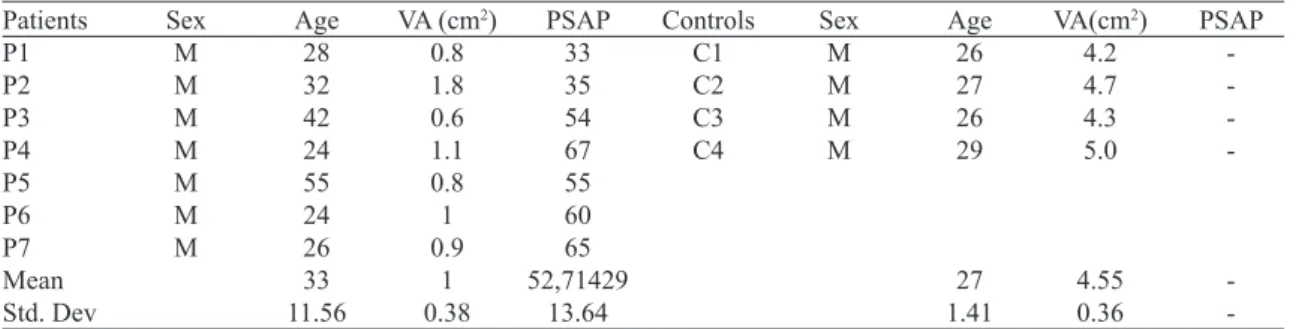
All the 7 patients who underwent surgical treatment be-tween the months of June 2012 and August 2012 were male, with documented evidence of rheumatic mitral stenosis, di-agnosed by echocardiographic exams associated with sero-logical tests (ASO) and clinical history of rheumatic fever. The mean age of the patients was 33±11.56 years. There were no deaths during surgery. Echocardiographic data from the valve area (VA) and pulmonary artery systolic pressure
(PASP) were obtained. The indings showed a mean valve
area of 1.0±0.38 cm2 and a mean PASP of 52.71±13.64
mmHg, as shown in Table 1. The mean age of the control group (four males) is 27±1.41 years old and the average mi-tral valve area measured at autopsy was 4.55±0.36 cm2.
Immunohistochemistry
Standard immunohistochemistry was performed on slide-mounted tissue sections using the Avidin-Biotin Com-plex Alkaline Phosphatase method (ABC-Alkaline Phos-phase kit, Vector Laboratories Inc, USA) following the man-ufacturer’s instructions as previously described[13].
The samples were dewaxed in xylene for 10 minutes, re-hydrated in decreasing concentration alcohol (100% to 50%) and immersed in distilled water. Then the slides were heated in full power microwave for 10 minutes in citrate buffer solu-tion pH 6 and washed in phosphate buffered saline (PBS). The histological sections were circled by wax pen to con-tain incubation solution. Blocking normal horse serum (10 minutes) and primary antibody (30 minutes), both in PBS solution, were added. After that, slides were gently washed in PBS for 3 times. Secondary antibody in PBS solution was added for 10 minutes and then the slides were gently washed for 3 times again. Sections were incubated in Vectastain®
ABC-AP reagent for 5 minutes. The sections were washed in PBS 3 times and incubated in alkaline phosphatase substrate solution 20 minutes. The slides were counterstained with
haematoxylin, tapwater was rinsed for 5 minutes, washed in distilled water 2 times, then dehydrated in increasing concen-tration alcohol (50% to 100%) and dewaxed in histoclear for 3 times of 5 minutes each. Vector® red substrate was used as
the chromogen of this reaction.
Antibodies and their dilution: Mouse anti-human mono-clonal antibody against endothelial cells (CD31, clone JC70A, 1:100, DakoCytomation, Denmark); rabbit anti-hu-man monoclonal antibody against ET-1 and ET-3 (1:250, R & D Labs), rabbit anti-human monoclonal antibodies against ETA and ETB receptors (both 1:200, Alomone Labs,
Isra-el) and AS02/Thy-1 for ibroblasts (1:200, DakoCytomation,
Denmark). Representative sections from each sample were also stained using haematoxylin and eosin.
Endothelin quantiication
Stained area measurement of each sample was performed using ImageJ software (National Institute of Health, Bethes-da, MD, USA). The method of measurement was based on calculating the mean value derived from the red channel of a red-green-blue (RGB) digital microphotograph of the stained sections. Using a color histogram module and the statistics of the red color distribution, the specimens under examination were compared. The higher the mean intensity on a scale of
0 to 255, the more positive the specimen is. Quantiication
was performed obtaining the mean intensity value of each
section stained by immunohistochemistry at 200x magnii -cation, including the samples stained with ASO2/Thy-1 to
identify ibroblasts. Thereafter, a ratio between the mean val
-ue in each sample for endothelins and the ibroblast was used
as a constitutive control. The measurement of stained areas was repeated by a second observer.
Western blot analysis
To examine biochemical and functional differences
be-tween control and ET-1 ibroblasts in mitral valves, we per -formed some western blot experiments, according previous protocols[14,15]. Fibroblasts were cultured and treated with
ET-1 in loating or ixed collagen gels as described above. Alternatively, ibroblasts were grown to conluence in Dul
-Table 1. Epidemiological proile of patients and controls. Patients P1 P2 P3 P4 P5 P6 P7 Mean Std. Dev Sex M M M M M M M Age 28 32 42 24 55 24 26 33 11.56
VA (cm2) 0.8 1.8 0.6 1.1 0.8 1 0.9 1 0.38 PSAP 33 35 54 67 55 60 65 52,71429 13.64 Controls C1 C2 C3 C4 Sex M M M M Age 26 27 26 29 27 1.41
VA(cm2) 4.2 4.7 4.3 5.0 4.55 0.36 PSAP
becco’s modiied Eagle’s medium (DMEM) with 10% fetal
calf serum and then serum starved in DMEM with 0.5% bo-vine serum albumin (BSA) for 24 h. After serum starvation, cells were stimulated with 100 nM ET-1 for 24 h with 0.5% BSA .Cell layer lysates were examined. Sodium dodecyl sul-fate-polyacrylamide gel electrophoresis was performed on 12% polyacrylamide gels, and the separated proteins were transferred onto nitrocellulose membranes at 30 V for 90 min. Membranes were blocked by incubation for 1 h with 5% nonfat milk in PBS containing 0.2% Tween 20, and antigens
were detected using speciic antibodies. Cell layer lysates (10 μg/sample) were probed using antibodies directed against
ET-1, ET-3 (R & D Labs) ETA and ETB (Alomone Labs, Israel), followed by incubation with appropriate horseradish peroxidase-conjugated bound secondary antibody (Jackson ImmunoResearch Laboratories).Signal was detected using the enhanced chemiluminescence protocol (Amersham Bio-sciences, Piscataway, NJ) as described by the manufacturer.
Calcium determination
The valve fragments were sent to the Laboratory of Ana-lytical Chemistry, Department of Chemistry (UFS) to deter-mine their inorganic calcium content. We also analyzed the control group. HCl was used to digest the samples, and the quantitative analysis of the inorganic calcium was performed via atomic absorption spectrometer (Varian® Atomic
Absorp-tion 240FS, Mulgrave, AUS).
Statistics
Statistical calculus was performed by measures of cen-tral tendency and variation. We also examined the correlation between expression of ET1 and its receptors. For correlation
analysis, we used Pearson’s correlation, with the signiicance
level of 5% (P value< 0.05). The results obtained was ana-lyzed by the software Microsoft Excel® 2007.
RESULTS
Immunohistochemistry
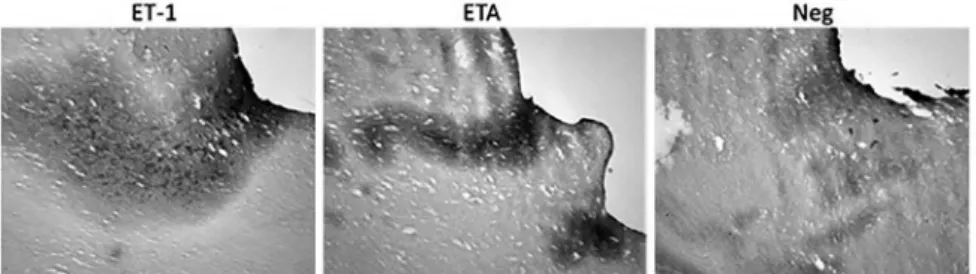
There was dense immunostaining in stenotic mitral valves, mainly for ET-1 and ETA receptors. This staining
was particularly evident at inlammatory regions and also in close proximity to calciied areas (Figure 1). At higher magniication more discrete, localized, immunostaining was
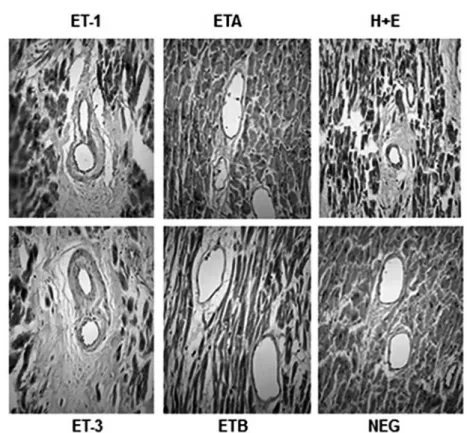
observed where ET-1 and ETA/B receptors were associated
with regions of ibrosis (ASO2/Thy-1 immunostaining), in
-lammation and neovascularization (CD31 immunostaining)
(Figure 2). In most samples there was no (or very weak) posi-tive immunostaining for ET-3. Endothelial ET-1 staining was observed in regions of neovascularization (Figure 2).
Quantitative analysis
Figure 3 shows the quantitative analysis for stained area measurement data as a ratio between mean values for
ET and ibroblast. The results of this quantitative analysis
for rheumatic versus control samples: ET-1 122%±13% vs. 129%±12; ETA 121%±7% vs. 118%±20%; ETB 121%±12% vs. 110%±16% (one control sample did not express ETB receptor). While quantitative analysis for ET showed that the average area with positive expression of ET-1 was 18.21±14.96%. For ETA and ETB, the mean expressed areas were respectively 15.06±13.13% and 9.20±11.09%. ET-3 had none or very weak expression. The correlation between the expression of both endothelin receptors were strongly posi-tive (R=0.74, P=0.02), but the correlation between ET-1 and its receptor were negative for both ETrA (R= -0.37, P=0.25), and ETrB (R=-0.14, P=0.39).
Here, quantitative data is expressed at ET/ET receptor
staining as a proportion of ibrotic regions. Where staining
is >100% additional staining was associated with other areas
such as neovascularization and inlammation; there are cases
where these regions overlap (e.g. neovascularization within
ibrotic regions).
Western blot analysis
The western blot analysis data generally supported the quantitative immunohistochemistry where ET-1 and ETA receptor protein expression were shown to be raised in RF/ stenotic mitral valves compared with controls. ETB receptor protein levels were low and a small rise in stenotic valves was observed while ET-3 expression was low and there was no difference between RF patients and controls (Figure 4).
Fig. 1 - ET-1 and ETA receptor immunostaining at inlammatory and calciied regions
Fig. 2 - Immunostaining of sections of stenotic valve from a patient with rheumatic fever.
Top left. ET-1 staining associated with ibrotic regions and neovascularization. Top middle. ETA receptor staining of ibrotic region and neovascularization.
Top right. H + E-stained section. Lower left. No ET-3 immunostaining.
Lower middle. ETB receptor immunostaining of ibrotic region and neovascularization.
Lower right. Negative control.
ET=endothelin; ETA=endothelin receptor A; ETB=endothelin receptor B
Fig. 3 - Results of quantitative analysis of ET-1 and ET receptors in mitral valves.
Data presented as ET/Thy ratio (percent ET/ET receptor staining associated with ibrosis) in mitral valves from patients with RF undergoing valve replacement (n=7) and control tissue (n=4).
Calcium determination
In fact, the group with mitral stenosis showed high levels of inorganic calcium, with an average of twenty-six times higher than the control group (Mitral Stenosis Group=8.1±1.6 vs. Control Group=0.3±0.2; P<0.05).
DISCUSSION
In this study we have shown that ETs and their receptors are present in mitral valves obtained from patients with RF under-going valve replacement surgery. Early indications for a role of ET-1 in patients with mitral valve stenosis were described by Kinoshita and colleagues[16] where plasma ET-1 concentrations
were higher in patients with mitral stenosis than in healthy vol-unteers. More recently, Chen et al.[17] measured plasma
concen-trations of ET-1 in patients with moderate-to-severe rheumatic mitral stenosis before and after percutaneous transluminal mi-tral valvuloplasty. While circulating ET-1 levels were elevated in patients with mitral stenosis the authors proposed that ET-1 release was due largely to increased systemic venous pressure and mechanical damage of the endothelium.
A protective role for ET-1 in rheumatic valvular patients with elevated pulmonary artery pressure has been proposed based on data from Huang et al.[18]. Here, patients who
under-went cardiac valvular replacement were studied to determine the perioperative changes of plasma ET-1 levels and disposi-tion of ET-1 in the pulmonary and systemic vasculature be-tween patients with elevated pulmonary artery pressure and patients with normal pulmonary artery pressure. While ET-1
concentration did not differ between the two groups of pa-tients, plasma ET-1 levels in the pulmonary artery and right
atrium were signiicantly higher in patients with high pul -monary artery pressure than those with normal pul-monary artery pressure. Before cardiopulmonary bypass there was a
signiicant pulmonary extraction of plasma ET-1 in patients
with high pulmonary artery pressure but this was not seen after bypass. Since there was no transpulmonary difference of plasma ET-1 concentration in patients with normal pulmo-nary artery pressure either before or after bypass the authors concluded that high levels of ET-1 in the pulmonary circuit and the pulmonary extraction of the ET-1 in patients with high pulmonary artery pressure might be a protective mech-anism for rheumatic valvular patients with elevated pulmo-nary artery pressure.
A study investigating the expression levels of ET-1 and ET(A) and ET(B) receptors in porcine mitral valves and
associating transcription levels to age, lealet location and
deposition of mucopolysaccharides (MPS) has been de-scribed[19] where transcription levels of ET-1 and ET(A)-R
were signiicantly higher in lealets from the ‘old’ compared with ‘young’ pigs whereas gene expression of ET(B)-R was
not associated with age, but increased in chordal insertion ar-eas compared with inter-chordal arar-eas. It was concluded that an age-related valvular degeneration occurs in porcine mitral
valve lealets and that ET-1 is involved via an action on both
ET(A) and ET(B) receptors.
Regarding a potential role of ET-1 in calciication, there is evidence that this peptide is involved in vascular calcii
-Fig. 4 - Western blot analysis of RF versus control mitral valve tissue extracts. Left. Representative blots for ET-1, ET-3, ETA and ETB receptors from control (Co) and rheumatic (Rh) mitral valve extracts. Right. Histograms of mean ± SD of pooled
REFERENCES
1. Moura EB, Gomes MR, Corso RB, Faber CN, Carneiro FP,
Pacheco YG. Ampliication of the genes that codify endothelin-1
and its receptors in rheumatic mitral valves. Arq Bras Cardiol. 2010;95(1):122-30.
2. Carabello BA, Paulus WJ. Aortic stenosis. Lancet. 2009;373(9667): 956-66.
Authors’ roles & responsibilities
SCL Final approval of the manuscript; conception and design; manuscript writing or critical review of its content
MRD Analysis and/or interpretation of data; conception and de-sign; operations and/or experiments conduct
MSA Analysis and/or interpretation of data; statistical analysis NNS Operations and/or experiments conduct; manuscript writing
or critical review of its content
ORLLT Operations conduct and/or experiments conduct; manuscript writing or critical review of its content
WBS Analysis and/or interpretation of data; operations and/or ex-periments conduct; manuscript writing or critical review of its content
TMAR Analysis and/or interpretation of data; inal approval of the manuscript; conception and design; operations and/or exper-iments conduct; manuscript writing or critical review of its content
cation based on a study using both an in vivo model and in vitro calciication of vascular smooth muscle cells (VSMCs) induced by beta-glycerophosphate[20]. In vitro, calcium
con-tent and Ca(2+) uptake were increased in calciied VSMCs,
compared with controls, but were decreased, compared with
calciied VSMCs in the presence of BQ123. In addition, ET-1
content in the medium and ET-1 mRNA in VSMCs was ele-vated compared with normal VSMCs. These results indicated an upregulated ET-1 gene expression as well as an increased
production of ET-1 in calciied aorta and VSMCs with BQ123 and bosentan signiicantly reducing vascular calcii -cation suggesting that ET-1 might be involved in
pathogene-sis of vascular calciication. Our study revealed marked ET-1
immunostaining of microvessels in rheumatic mitral valves that was paralleled by staining of both ETAR and ETBR, an
observation that may be of particular relevance to the calcii -cation occurring in these patients[21,22].
According other studies which found a positive correla-tion between ET-1 and ETA receptors with mitral stenosis in rheumatic patients, our study showed higher levels of ET-1 in rheumatic replaced valve samples in comparison to control
samples. But it should be understood that the results it to
more complex valve situations to the point of not allowing the plastic; with this, we can not assert that the results can be assumed as a general rule during the natural history of mitral stenosis.
3. Leão SC, Souto FM, Costa RV, Rocha T de F, Pacheco YG, Rodrigues TM. Gene expression of endothelin receptors in replaced rheumatic mitral stenotic valves. Rev Bras Cir Cardiovasc. 2012;27(4):512-9.
4. Leão SC, Lima MR, Nascimento HM, Octacilio-Silva S, Rodrigues TM. IL-10 and ET-1 as biomarkers of rheumatic valve disease. Rev Bras Cir Cardiovasc. 2014;29(1):25-30.
5. Costa LP, Domiciano DS, Pereira RMR. Características demográicas,
clínicas, laboratoriais e radiológicas da febre reumática no Brasil: revisão sistemática. Rev Bras Reumatol. 2009;49(5):617-22.
6. Carapetis JR. Rheumatic heart disease in developing countries. N Engl J Med. 2007;357(5):439-41.
7. Spina GS. Doença reumática: negligenciada, mas ainda presente e morta. Rev Med (São Paulo). 2008;87(2):128-41.
8. Brás-Silva C, Leite-Moreira AF. Efeitos miocárdicos da endotelina-1. Rev Port Cardiol. 2008;27(7-8):925-51.
9. Mayes MD. Endothelin and endothelin receptor antagonists i n s y s t e m i c r h e u m a t i c d i s e a s e . A r t h r i t i s R h e u m . 2003;48(5):1190-9.
10. Masaki T. Historical review: Endothelin. Trends in Pharmacol Sci. 2004;25(4):219-24.
11. Porto CC. Doenças do coração: prevenção e tratamento. 2ª ed. Rio de Janeiro: Guanabara Koogan; 2005.
12. Veinot JP. Pathology of inlammatory native valvular heart disease.
Cardiovasc Pathol. 2006;15(5):243-51.
13. Haque SU, Dashwood MR, Heetun M, Shiwen X, Farooqui N,
Ramesh B, et al. Eficacy of the speciic endothelin a receptor
antagonist zibotentan (ZD4054) in colorectal cancer: a preclinical study. Mol Cancer Ther. 2013;12(8):1556-67.
14. Shi-Wen X, Chen Y, Denton CP, Eastwood M, Renzoni EA,
Bou-Gharios G, et al. Endothelin-1 promotes myoibroblast
induction through the ETA receptor via a rac/phosphoinositide 3-kinase/ Akt-dependent pathway and is essential for the
enhanced contractile phenotype of ibrotic ibroblasts. Mol Biol
Cell. 2004;15(6):2707-19.
15. Shi-Wen X, Denton CP, Dashwood MR, Holmes AM, Bou-Gharios G, Pearson JD, et al. Fibroblast matrix gene expression and connective tissue remodeling: role of endothelin-1. J Invest Dermatol. 2001;116(3):417-25.
16. Kinoshita O, Yoshimi H, Nagata S, Ishikura F, Kimura K, Yamabe T, et al. Rapid increase in plasma endothelin concentrations during percutaneous balloon dilatation of the mitral valve in patients with mitral stenosis.Br Heart J. 1993;69(4):322-6.
irrelevance to left atrial and pulmonary artery pressures.Chest. 2004;125(2):390-6.
18. Huang CH, Huang HH, Chen TL, Wang MJ. Perioperative changes of plasma endothelin-1 concentrations in patients undergoing cardiac valve surgery. Anaesth Intensive Care. 1996;24(3):342-7.
19. Pedersen LG, Offenberg H, Moesgaard SG, Thomsen PD, Pedersen HD, Olsen LH. Transcription levels of endothelin-1 and
endothelin receptors are associated with age and lealet location
in porcine mitral valves. J Vet Med A Physiol Pathol Clin Med. 2007;54(3):113-8.
20. Wu SY, Zhang BH, Pan CS, Jiang HF, Pang YZ, Tang CS, et al.
Endothelin-1 is a potent regulator in vivo in vascular calciication and in vitro in calciication of vascular smooth muscle cells.
Peptides. 2003;24(8):1149-56.
21. Rajamannan NM, Nealis TB, Subramaniam M, Pandya S, Stock SR, Ignatiev CI, et al. Calcified rheumatic valve neoangiogenesis is associated with vascular endothelial growth factor expression and osteoblast-like bone formation. Circulation. 2005;111(24):3296-301.