RBCCV 44205-1618 DOI 10.5935/1678-9741.20140115
Twenty years of vasoplegic syndrome treatment
in heart surgery. Methylene blue revised
Vinte anos de tratamento da síndrome vasoplégica em cirurgia cardíaca. Azul de metileno revisado
Paulo Roberto Barbosa Evora
1, MD, PhD; Lafaiete Alves Junior
1, MD; Cesar Augusto Ferreira
1,
MD, PhD; Antônio Carlos Menardi
1, MD, PhD; Solange Bassetto
1, MD; Alfredo José Rodrigues
1,
MD, PhD; Adilson Scorzoni Filho
1, MD; Walter Vilella de Andrade Vicente
1, MD, PhD
1Department of Surgery and Anatomy, Faculdade de Medicina de Ribeirão
Preto da Universidade de São Paulo (FMRP-USP), Ribeirão Preto, SP, Brazil .
This study was carried at Faculdade de Medicina de Ribeirão Preto da Uni-versidade de São Paulo (FMRP-USP), Ribeirão Preto, São Paulo, Brazil.
Financial support: CNPq, FAEPA, FAPESP
No conlict of interest.
Correspondence address: Paulo Roberto Barbosa Evora
Rua Rui Barbosa, 367, apt. 15 - Centro, Ribeirão Preto, SP, Brazil. Zip code: 14015-120
E-mail: [email protected]
Article received on April 24th, 2014
Article accepted on October 12th, 2014 Abstract
Objective: This study was conducted to reassess the concepts established over the past 20 years, in particular in the last 5 years, about the use of methylene blue in the treatment of vaso-plegic syndrome in cardiac surgery.
Methods: A wide literature review was carried out using the data extracted from: MEDLINE, SCOPUS and ISI WEB OF SCIENCE.
Results: The reassessed and reafirmed concepts were 1) MB
is safe in the recommended doses (the lethal dose is 40 mg/kg); 2) MB does not cause endothelial dysfunction; 3) The MB effect appears in cases of NO up-regulation; 4) MB is not a vasocon -strictor, by blocking the cGMP pathway it releases the cAMP
pathway, facilitating the norepinephrine vasoconstrictor effect; 5) The most used dosage is 2 mg/kg as IV bolus, followed by
the same continuous infusion because plasma concentrations
sharply decrease in the irst 40 minutes; and 6) There is a possi -ble “window of opportunity” for MB’s effectiveness. In the last
ive years, major challenges were: 1) Observations about side effects; 2) The need for prophylactic and therapeutic guidelines,
and; 3) The need for the establishment of the MB therapeutic
window in humans.
Conclusion: MB action to treat vasoplegic syndrome is time-dependent. Therefore, the great challenge is the need, for the establishment the MB therapeutic window in humans. This
would be the irst step towards a systematic guideline to be fol -lowed by possible multicenter studies.
Descriptors: Methylene blue. Vasoplegic syndrome. Vasoplegia. Circulatory shock. Cardiac surgery. Nitric oxide.
Resumo
Objetivo: O presente estudo foi realizado com a inalidade de reavaliar conceitos estabelecidos em 20 anos, com ênfase nos últimos 5 anos, sobre a utilização do azul de metileno no trata-mento da síndrome vasoplégica em cirurgia cardíaca.
Métodos: Foram considerados dados da literatura utilizan-do-se três bases de dados (MEDLINE, SCOPUS e ISI Web of
INTRODUCTION
The vasoplegic syndrome (VS) concepts are a valu-able Brazilian contribution to cardiac surgery. Gomes[1-3]
described the syndrome and the MB treatment was pro-posed by Evora et al.[4-8]. VS is a constellation of signs and
symptoms: hypotension, high cardiac index, low systemic
vascular resistance, low illing pressures, diffuse bleeding
tendency, and sustained hypotension despite the use of high doses of vasoconstrictor amines. There is experimental and clinical evidence to show that the pathophysiology of VS is associated with endothelial dysfunction caused by
system-ic inlammation. The most important mediator is nitrsystem-ic ox -ide (NO) produced from L-arginine by polymorphonuclear blood cells. NO release is dependent on the expression of inducible nitric oxide synthase (iNOS). It has been demon-strated along the years, that the blockade of NO synthesis is associated with prohibitive morbidity and mortality by microcirculation impairment. This has led to the proposi-tion of using MB, a blocking of soluble guanylate cyclase (sGC), an enzyme whose expression is related to the
for-mation of cGMP, which is the inal messenger of the NO
pathway responsible for vasoplegia.
Although MB has been used for over 20 years in the treatment of VS, there are few quality clinical studies that would allow the treatment to become a protocol. Three stud-ies involving a higher number of patients deserve to be cited: 1) In 2003, Leyh et al.[9] reported, in Germany, 54 cases of
cardiac surgery patients not carrying bacterial endocarditis who had been treated with MB, with over 90% of the patients responding to the treatment. 2) Levin et al.[10-12], in Argentina, Resultados: Os conceitos reavaliados e reairmados foram:
1) Nas doses recomendadas o AM é seguro (a dose letal é de 40 mg/kg); 2) O AM não causa disfunção endotelial; 3) O
Abbreviations, acronyms & symbols
ARDS Acute respiratory distress syndrome cAMP Cyclic adenosine monophosphate
BBB Blood-brain barrier
CPB Cardiopulmonary bypass
GC Guanylate cyclase
IE Infective endocarditis
iNOS Inducible nitric oxide synthase LVAD Left ventricular assist device
MB Methylene blue
NO Nitric oxide
RVEDP Right ventricle end diastolic pressure sGC Soluble guanylate cyclase
VHS Valvular heart surgery
VS Vasoplegic syndrome
reported the incidence of 8.8% of VS in 638 patients. Among the 56 vasoplegic patients randomly receiving MB or pla-cebo, there was no mortality in the group treated with MB, and it was possible to discontinue vasoconstrictors in a short period time, with less consequential morbidity and mortality. In contrast, in the placebo group two deaths occurred and the use of amines lasted in average 48 hours, with a higher incidence of respiratory and renal problems. 3) From the pre-vention point of view, Ozal et al.[13], in Turkey, showed in a
prospective and randomized study that MB was associated to with lower incidence of vasoplegia and amines use.
In 2009, targeting MB for VS treatment in heart surgery,
we published a personal statement including ifteen years of
questions, answers, doubts and certainties. Some observa-tions can be applied to VS: 1) MB is safe in the recommend-ed doses (the lethal dose is 40 mg/kg). 2) The use of MB does not cause endothelial dysfunction. 3) The MB effect appears in cases of NO up-regulation. 4) MB is not a vasoconstrictor, by blocking the cGMP pathway it releases the cAMP path-way, facilitating the epinephrine vasoconstrictor effect. 5) It is possible that MB acts through this “crosstalk” mechanism
and its use as a drug of irst choice may not be right. 6) The
most used dosage is 2 mg/kg as IV bolus followed by the same continuous infusion because the plasma concentrations
sharply decrease in the irst 40 minutes. 7) Although there are no deinitive multicentric studies, the MB used to treat heart
surgery VS, at the present time, is the best, safest and cheap-est option. 8) But there is a possible 'window of opportunity’ for the MB’s effectiveness[14].
The above observations, dranw from 15 years, of use of MB, were presented in the introduction of this text as a
efeito do AM só aparece em caso de supra nivelamento do NO; 4) O AM não é um vasoconstritor, pelo bloqueio da via GMPc
ele libera a via do AMPc, facilitando o efeito vasoconstritor da
norepinefrina; 5) A dosagem mais utilizada é de 2 mg/kg, como bolus EV, seguida de infusão contínua porque as concentrações plasmáticas decaem fortemente nos primeiros 40 minutos, e; 6) Existe uma “janela de oportunidade” precoce para efetividade do AM. Nos últimos cinco anos, os principais desaios foram: 1) Observações de efeitos colaterais; 2) A necessidade de diretrizes, e; 3) A necessidade da determinação de uma janela terapêutica
para o uso do AM em humanos.
Conclusão: O efeito do AM no tratamento da SV é depen
-dente do tempo, portanto, o grande desaio atual é a necessidade do estabelecimento da janela terapêutica do AM em humanos.
Esse seria o primeiro passo para a sistematização de uma dire-triz a ser seguida por possíveis estudos multicêntricos.
Descritores: Azul de metileno. Sídrome vasoplégica. Vasoplegia.
reafirmation of concepts. However, the ultimate aims will be centered in the subsequent ive years (2009-2014).
The relevant literature review (1994-2008) will be updat-ed, emphasizing that the great majority of the articles are let-ters and case reports as well as and some excellent reviews. Most of the present discussion is based on our letters
moti-vated against the concept that MB is a rescue and not a irst
line therapy. This study was carried out to critically examine the use of MB in treating cardiac surgery VS, based on litera-ture data and 20 years of clinical and experimental experience, highlighting what has been going in the last 5 years. It was presented on the 22nd Annual Meeting of the Asian Society for
Cardiovascular and Thoracic Surgery (Istanbul – April 2014). The text will discuss the following points that address why the use of MB to treat cardiac surgery VS remains ques-tionable: 1) Observations about side effects; 2) Restrictions in using MB in cases of pulmonary hypertension and acute respiratory distress syndrome (ARDS); 3) The need for pro-phylactic and therapeutic guidelines, and; 4) The need for the establishment of the MB therapeutic window in humans.
METHODS
A wide review of literature and the authors' documented observations over a period of 20 years was carried out using the data extracted from: MEDLINE, SCOPUS and ISI WEB OF SCIENCE. The following combinations of key words
were adopted: 1) “Methylene blue and heart surgery” or; 2) “Methylene blue and cardiac surgery”. This combination of MB with rather generic keywords was intentional in the sense obtaining a wider view of the subject.
RESULTS
The previous ifteen years bibliographical survey (1994 -
2009) on the therapeutic use of MB, based on MEDLINE and SCOPUS database searches, revealed a total of 58 publications directly related to VS in cardiac surgery. Approximately 30 more
publications were added on the last ive years (2010 - 2014).
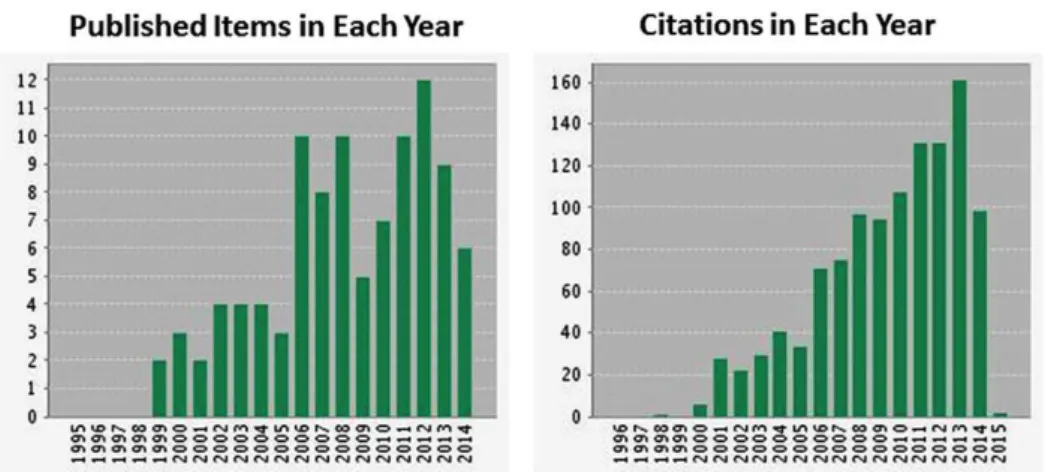
Concerning the number of publications, there are about 70 publications, showing an increasing trend in the number of publications and citations (Figure 1).
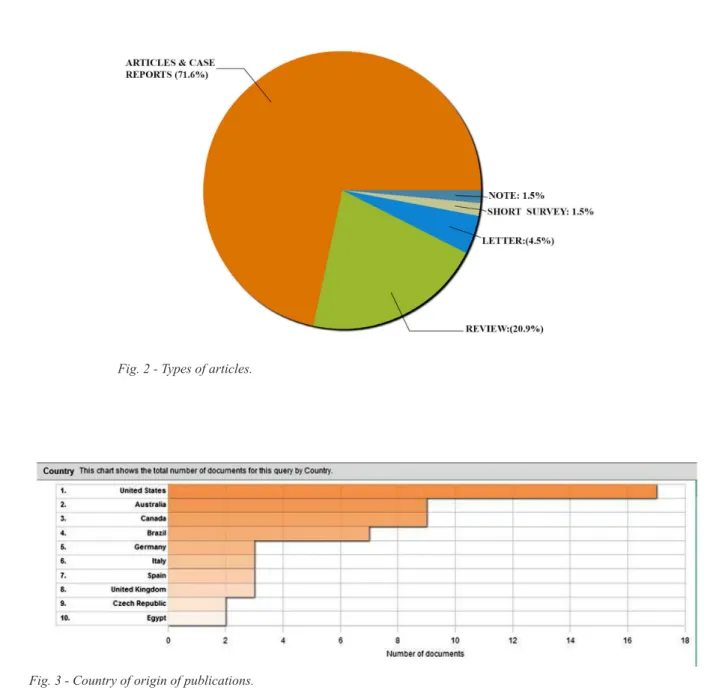
Concerning the type of articles, there is prevalence of article reports (50-70%), reviews (21%), and letters (11-18%) (Figure 2).
The country of origin of the publications is shown on Figure 3. DISCUSSION
It is crucial to emphasize the increasing number of
ci-tations. The prevalence of articles kept to the proile (case
reports, letters, and reviews). Regarding the country of origin of the publications, Brazil has been the sixth place in the last
ive years, dropping four positions in the rank.
Conceptual aspects
One problem still present when describing VS is the lack
of consistency in its deinition. There is neither a clear dei -nition, nor a single biomarker, and even the determination of nitrite/nitrate (NOx) failed to characterize the syndrome[15].
At present, clinical management of inlammatory va -soplegia associated to sepsis or anaphylaxis is
symptom-atic. Volume is expanded by administration of luids, and
low blood pressure is managed by administering positive inotropes and vasoconstrictors. This therapeutic approach is mainly associated with cyclic AMP (cAMP) and, many times the circulatory shock is refractory to high amines concentrations.
Methylene blue side effects (binomial eficiency/safety)
Methylene blue administration may also result in worsening of arterial oxygenation. The
pathophysiolo-gy thought to be responsible for this inding is that MB
leads to systemic vasoconstriction as well as pulmonary vasoconstriction. Impaired gas exchange in the lung and pulmonary hypertension are caused by this pulmonary va-soconstriction. The adverse pulmonary effects of MB may limit its use in patients with adult respiratory distress syn-drome. In addition, high-doses of MB may also result in
mesenteric bed constriction and compromise blood low in
mesenteric vessels[16].
More recently, MB has been shown to cause a serotonin
syndrome reaction in patients who are concomitantly taking serotonergic agents such as serotonin reuptake inhibitors. This is attributable to an inhibitory action of MB on mono-amine oxidase.
MB’s monoamine oxidase-inhibiting property and its abil-ity to display anxiolytic and antidepressant activabil-ity are likely the reason it was used to treat neuropsychiatric illnesses as ear-ly as 1989. The syndrome onear-ly occurs in a small percentage of patients and it is treatable with benzodiazepines and supportive care. Its incidence is less impeditive than the risk of untreated vasoplegia and potential end-organ injury and graft loss[17].
Weiner et al.[18] hypothesized that patients with
vasople-gia who were treated with MB were more likely to show increased postoperative morbidity and mortality. A multi-ple logistic regression model demonstrated that receiving MB was an independent predictor of in-hospital mortality. A propensity score matching the association with morbidity was also seen, but the relationship with mortality was not
found. The study identiied the use of MB treatment was
independently associated with poor outcomes. The authors concluded that, while further studies are required, a
thor-ough risk-beneit analysis should be applied before using
MB and, perhaps, it should be relegated to rescue use and
not as irst-line therapy[18].
It is remarkable that the risks are taking into more
con-sideration than the lifesaving beneits. As to the safety and ethical aspects of MB´s clinical use, it can be afirmed that
in recommended doses it is a safe drug (the lethal dose is 40 mg/kg). The accumulation of clinical experience has
test-ed the binomial eficiency/safety. These results show that intravenous infusion of MB seems to be safe. The indings
support clinical trials where MB was used to treat VS
af-ter coronary araf-tery bypass grafting with CPB on inlamma -tory response syndrome patients - SIRS and anaphylaxis. These results are not unexpected, especially when analyzed
in healthy animals, in which hemodynamics present ine,
but not total regulation under the control of NO. In these conditions, no action is expected when there is inhibition of guanylate cyclase by MB.
Methylene blue injection in a non VS carrier individual does not have hemodynamic effects in normal conditions. The MB effect appears only in the case of NO supra-regu-lation, and thus, spasm occurrence in coronary arterial grafts is unlikely. The risk of vasospasm and thrombosis of these
grafts require conirmation in vivo. The perception of safety is fully grounded in data set in studies in healthy animals that received MB in vivo. Although ischemic events were not evidenced in the ECG monitoring, normal endotheli-um-dependent and endothelium-independent vascular reac-tivity was determined by in vitro studies. With a wide safety range, these data support the assumption that, unlike the NO (L-NAME) synthesis inhibition, the injection in vivo does not cause endothelial dysfunction[4,14,19].
Methylene blue and endocarditis
Infective endocarditis is a life-threatening condition that occasionally necessitates emergency valve replacement.
Pa-tients with an ongoing systemic inlammatory response as a
result of infective endocarditis and those who require CPB for emergency valve replacement may demonstrate resistant hy-potension related to vasoplegia. It has a spectrum of clinical
presentation and is associated with a systemic inlammatory
response and the release of nitric oxide. Hemodynamically, it is characterized by arterial vasodilation, high cardiac output despite myocardial depression, and a decreased sensitivity of the heart and peripheral vessels to sympathomimetic agents.
Grayling et al.[20] described the irst case of methylene blue
used in the CPB prime and in the context of refractory hypo-tension in a patient undergoing valve replacement surgery for infective endocarditis, suggesting that methylene blue should be added to the CPB prime (2 mg/kg), and as a continuous in-fusion (0.25-2 mg/kg × h) to ameliorate the hypotension.
In a prospective, randomized, controlled, open-label, pilot study to evaluate the effects of continuous infusion of methylene blue (MB), on hemodynamics and organ func-tions in human septic shock, Kirov et al.[21] concluded that,
in human septic shock, continuously infused MB counteracts myocardial depression, maintains oxygen transport, and re-duces concurrent adrenergic support. Infusion of MB appears
to have no signiicant adverse effects on the selected organ
function variables.
Ozal et al.[13] prospectively studied whether
preopera-tive MB administration would prevent vasoplegic syndrome in these high-risk patients. Angiotensin-converting enzyme inhibitors, calcium channel blockers, and preoperative intra-venous heparin use are independent risk factors for cardiac surgery VS. They did not include septic endocarditis as a risk factor. The results suggested that preoperative MB admin-istration reduces the incidence and severity of vasoplegic syndrome in high-risk patients, thus ensuring adequate sys-temic vascular resistance in both operative and postoperative periods and shortening both intensive care unit and hospital
stays. This report may be the irst suggestion of the prophy -lactic use of MB prior to CPB.
The accentuated NO release that is induced by the
sys-temic inlammatory response associated with infective endo -carditis (IE) and cardiopulmonary bypass (CPB) may result in catecholamine refractory hypotension (vasoplegia) and increased transfusion requirement due to platelet inhibition. Cho et al.[22] aimed to evaluate the effect of prophylactic MB
administration before CPB on vasopressor and transfusion requirements in patients with IE undergoing valvular heart surgery (VHS). Forty-two adult patients were randomly as-signed to receive 2 mg/kg of MB (MB group, n=21) or saline (control group, n=21) for 20 min before the initiation of CPB. According Cho et al.[22], "the primary end points were
weaning from CPB and hemodynamic parameters serially recorded before and after CPB. The secondary endpoint was the comparison of transfusion requirements". The results of
the sudy showed that "there were no signiicant differences in
vasopressor requirements and hemodynamic parameters be-tween the two groups. The mean number of units of packed
erythrocytes, transfused per patient, was signiicantly less in
the MB group. The numbers of patients transfused with fresh frozen plasma and platelet concentrates were lesser in the MB group". The authors concluded that in IE patients undergoing VHS, prophylactic MB administration before CPB did not
confer signiicant beneits in terms of vasopressor require -ments and hemodynamic parameters, but it was associated
with a signiicant reduction in transfusion requirement[22].
Taylor & Holtby[23] have presented a case of refractory
hypotension in a child with native mitral valve endocarditis with cerebral complications in whom MB was less effective than previously described. Although these authors seemed disappointed with the effect of the MB on blood pressure, we believe that their case had an impressive evolution de-spite its severity. We disagree that obvious clinical improve-ment using MB was not evident in this case since most of the pharmacologic support to the circulation was necessary for a short time. In our opinion, the controversy about the use of MB to treat similar cases arises when one uses MB merely as a “last-minute vasopressor”. MB sometimes seems to work for this purpose and sometimes it does not, perhaps due the fact that, unlike many vasopressors, MB does not act through a membrane receptor. We believe that the pivotal action of MB is not exclusively the guanylyl cyclase blockage, result-ing in a cGMP release decrease. This blockage also enhanc-es the “crosstalk” between cyclic adenosine monophosphate (cAMP) and cGMP pathways, which facilitates the effect of the cAMP-dependent vasopressors. Many clinical reports in the medical literature, including sepsis treatment, substanti-ate that the guanylyl cyclase blockage seems to improve the effect of the vasopressors, shortening the length of pharma-cologic cardiovascular support. Another quite advantageous effect of MB is its capacity to reduce vascular permeability.
We operated on a drug-addicted young man with native
aortic valve endocarditis. The patient received a bilealet
valve prosthesis (St Jude Medical, Inc, St Paul, Minn). A high dose of norepinephrine was necessary to maintain a reason-able blood pressure during CPB. After weaning from CPB, he was hypotensive and had high cardiac output, low sys-temic vascular resistance, and pulmonary edema. The arterial oxygen saturation was below 80%, even though he was be-ing ventilated with 100% oxygen and positive end-expiratory pressure. We started MB in a continuous infusion in a way quite similar to that used by Taylor & Holtby[23], followed
by a bolus of 3 mg/kg (in 100 mL of 5% glucose in water) twice a day. Even though the mean arterial pressure did not in-crease, even with norepinephrine, the cardiac output gradually
decreased, and the systemic vascular resistance increased. In addition, the rapid resolution of lung edema, improving arteri-al oxygen saturation, was astonishing[19].
Methylene blue and heart transplant.
Grubb et al.[17] reported a case of a 60-year-old male with
history of nonischemic cardiomyopathy and end-stage heart failure who underwent placement of a left ventricular assist device (LVAD), replacement of a mechanical aortic valve with a porcine prosthesis complicated by multiple driveline infec-tions. Heart transplantation was the last option. During the op-eration, the authors reported: “episodes of hypotension during the extensive lysis of adhesions for LVAD removal. Intermit-tent boluses of phenylephrine were administered to maintain a
suficient mean arterial pressure. Subsequently, a MB 1-mg/kg
bolus followed by continuous infusion of 0.5 mg/kg per hour was administered. In the postoperative, the patient presented signals of serotonergic syndrome assumed as a consequence of the association of MB with antidepressants"[17].
This report has two crucial points 1) the alert to the possi-bility of serotonergic syndrome triggered by the association of MB with antidepressants, and; 2) the routine use of MB to
handle vasoplegia in the milieu of heart transplant. Koidis
et al.[24] reported the irst experience of vasoplegia treatment
with MB after heart transplantation and pointed that this drug deserves attention because of its catecholamine-saving ef-fect, thus preventing possible malperfusion. When searching
MEDLINE, Koidis’s report is the only reference on the use
of MB to treat vasoplegia associated to heart transplant. To prevent morbidity and mortality associated with VS, Grubb et al.[18] implemented an intraoperative protocol that
includes administration of MB for VS resistant to vasopres-sor drugs”. It is clear that they trusted the MB treatment since they concluded for it use while weighing the risks of sero-tonin syndrome[25].
Methylene blue as rescue therapy
Blacker & Whaler[26] reported a distributive shock case
during an on pump coronary artery bypass grafting with no response to MB. A possible explanation, was given based on Fernandes academic thesis using a mouse sepsis model, that evidenced three eight-hour windows of guanylate cyclase (GC) activity[27]. In the irst eight hours, there was increased
rescue therapeutic option is against the above mentioned con-cepts, and it is possible that MB does not act (second window), or acts too late (third window) when the circulatory shock is metabolically irreversible, presenting high lactate levels and intractable metabolic acidosis. It might be more sensible to consider MB not as a late rescue treatment, but as an adjuvant drug to be used precociously (window 1)[28,29].
Methylene blue use in pulmonary hypertension and/
or acute respiratory distress syndrome (ARDS)
The restriction to ARDS and pulmonary hypertension de-serve some comments. Global NO blockade can contribute to an increase in pulmonary vascular resistance, which worsens the pulmonary hypertension that can be associated with sep-sis. Trials that used high bolus doses of MB demonstrated an increase in pulmonary pressures, but this effect was absent in trials that used MB infusions. Some researchers have thus sug-gested that infusions at low doses should be always used for this reason. Simultaneous treatment with inhaled NO might also be considered for this side effect of NO inhibition. There is also evidence that MB attenuates the inhibition of mitochon-drial function as well as decreases acute lung injury in sepsis. In addition, Evgenov et al.[30,31] demonstrated that MB reduces
the increments in pulmonary capillary pressure, lung lymph
low, protein clearance, and pulmonary hypertension and ede -ma in endotoxemic sheep. Raikhelkar et al.[32] report a case of
the use of MB in a patient with acute right ventricular failure and vasoplegic shock after surgical pulmonary embolectomy. The authors discussed, based on the medical literature, that studies have reported MB to increase pulmonary artery pres-sures and pulmonary vascular resistance. These elevations in pulmonary vascular indices were noted to be clinically and
sta-tistically insigniicant. One may argue this small increase may
exacerbate RV dysfunction in susceptible individuals. This aspect of administration of MB has not been systematically
studied. The authors feel the beneits of augmentation of MAP
and coronary perfusion may offset small increases in the right ventricle end diastolic pressure (RVEDP)[32].
Methylene blue neuroprotection and cardiac arrest
Cerebral edema, increased blood-brain barrier (BBB) per-meability and neurologic injury, are observed early in ischemia induced by cardiac arrest. Upregulation of NO synthase (NOS) is associated with increased production of NO that induces breakdown of the BBB. It has been suggested that pretreat-ment with pharmacological agents that reduce NO excess or oxidative stress might reduce disruption of BBB permeability caused by ischemia/reperfusion injury. MB, a nontoxic dye and also a scavenger, recently proved to be a potential aid in resuscitation from cardiac arrest by attenuating oxidative,
in-lammatory, myocardial and neurologic injury[33-35].
Experimental investigations have proven the cardio-protective and neurocardio-protective effects of MB in a porcine
model of experimental cardiac arrest. The main physiolog-ical effects during reperfusion include systemic circulation
stabilization without signiicantly increasing total peripheral
resistance and moderately increasing cerebral cortical blood
low; a reduction of lipid peroxidation and inlammation, and
less anoxic brain and heart tissue damage[34,35].
One intriguing investigation studied the effects of cardiac arrest and CPR on BBB permeability and consequent neuro-logical injury. In addition, this investigation studied the MB effects on the maintenance of BBB integrity, and NO release in the cerebral cortex. In a piglet model of 12 minutes of cardiac arrest, the authors demonstrated a time-dependent in-crease of necrotic neurons, caused by ischemia and reperfu-sion. Moreover, the immunohistochemistry analysis indicat-ed less blood brain barrier disruption in the animals receiving MB, evidenced by decreased albumin leakage, water content and potassium, and less neuronal injury[34,35]. Similarly, MB
treatment reduced nitrite/nitrate ratio, iNOS expression, and nNOS expression. In summary, MB markedly reduced BBB disruption and subsequent neurologic injury. In addition to these cerebral morphologic effects, the exposure to MB was associated with a decrease of NO as measured by nitrate/ni-trite content and partial inhibition of NOS activity[34,35].
Induced mild hypothermia and administration of MB proved to have neuroprotective effects in CPR. However, induction of hypothermia is time consuming. A study was conducted to de-termine if the MB administered during CPR can enhance the neuroprotective effect of hypothermia. A piglet model of cardiac arrest with variable duration of CPR showed that the neuropro-tective effect of MB in combination with hypothermia was
sig-niicantly greater than the delayed hypothermia alone[36].
Effects of MB in cardiac arrest and CPR were investigat-ed. A pig model of cardiac arrest, comparing 12 min without CPR and 8 min of CPR, was employed to assess the addi-tion of MB to a hypertonic saline-dextran soluaddi-tion. Hemody-namic variables were slightly improved at 15 min, and MB, co-administered with a hypertonic-hyperoncotic solution, in-creased 4-hr survival, reducing neurologic injury[36].
MB could be used in association with hypertonic sodium chloride, but it precipitates. However, an alternative mix-ture of MB in hypertonic sodium lactate was developed and investigated, using the same piglet model, during and after CPR. This association could be used against reperfusion in-jury during experimental cardiac arrest, presenting similar effects as MB plus hypertonic saline-dextran[36].
There are no publications considering MB, VS and neu-roprotection, but the above concepts would be relevant con-sidering brain protection in cardiac surgery.
CONCLUSION
vaso-plegic syndrome, and (2) the use of MB as an early adjuvant
drug (window 1). Methylene blue use as a inal rescue thera -peutic option is against the above-mentioned concepts. There is the possibility that MB does not act (second window) or acts too late (third window) when circulatory shock is met-abolically irreversible, presenting high lactate levels and uncontrollable metabolic acidosis. Regardless of the strong limitations, pointed out by Weiner et al.[18], it would be more
sensible to consider MB, not as a late rescue treatment, but as an adjuvant drug to be used early (window 1), not just dis-missing its action. Perhaps, an easier concept to understand
than the “Window of Opportunity” deinition is that MB’s
action to treat vasoplegic syndrome is time-dependent. Many authors are reluctant to recommend early use MB given the unusually limited level of evidence at this time, and the potential adverse effects, encouraging trials that system-atically collect data to help address these issues. As emer-gency situations involving risk of death, circulatory collapse does not permit prospective randomized studies. Although
there are no deinitive multicenter studies, the use of MB to
treat VS, at the present time, is the most rational, safest, and cheapest option.
The data from this extended review leaves the impres-sion that the number and quality of publications do not
re-lect the frequency at which MB is used in clinical practice. Therefore, it the dificulty of conducting multicenter studies
is implied. The disclosure and possible consecration of this therapy will be passed on as verbal information and depend-ing on the increase of publications, in studies based on evi-dence. In the literature data and medical practice set, there is still certainty that the soluble guanylate cyclase blockage in distributive shock control remains underestimated.
Authors’ roles & responsibilities
PRBE Main author
LAJ Final approval of the manuscript CAF Final approval of the manuscript ACM Final approval of the manuscript SB Final approval of the manuscript AJR Final approval of the manuscript ASF Final approval of the manuscript WVAV Final approval of the manuscript
REFERENCES
1. Gomes WJ, Carvalho AC, Palma JH, Gonçalves Júnior I, Buffolo E. Vasoplegic syndrome: a new dilemma. Rev Assoc Med Bras. 1994;40(4):304.
2. Gomes WJ, Carvalho AC, Palma JH, Gonçalves I Jr, Buffolo E. Vasoplegic syndrome: a new dilemma. J Thorac Cardiovasc Surg. 1994;107(3):942-3.
3. Gomes WJ, Carvalho AC, Palma JH, Teles CA, Branco JN, Silas MG, et al. Vasoplegic syndrome after open heart surgery. J Cardiovasc Surg (Torino). 1998;39(5):619-23.
4. Evora PR, Rodrigues AJ, Vicente WV, Vicente YA, Basseto S, Basile Filho A, Capellini VK. Is the cyclic GMP system underestimated by intensive care and emergency teams? Med Hypotheses. 2007;69(3):564-7.
5. Andrade JCS, Batista Filho ML, Evora PR, Tavares JR, Buffolo E, et al. Utilização do azul de metileno no tratamento da síndrome vasoplégica após cirurgia cardíaca. Rev Bras Cir Cardiovasc. 1996;11(2):107-14.
6. Evora PR, Ribeiro PJ, de Andrade JC. Methylene blue administration in SIRS after cardiac operations. Ann Thorac Surg. 1997;63(4):1212-3.
7. Evora PR. Should methylene blue be the drug of choice to treat vasoplegias caused by cardiopulmonary bypass and anaphylactic shock? J Thorac Cardiovasc Surg. 2000;119(3):632-4.
8. Evora PR, Levin RL. Methylene blue as drug of choice for catecholamine-refractory vasoplegia after cardiopulmonary bypass. J Thorac Cardiovasc Surg. 2004;127(3):895-6.
9. Leyh RG, Kofidis T, Strüber M, Fischer S, Knobloch K, Wachsmann B, et al. Methylene blue: the drug of choice for catecholamine-refractory vasoplegia after cardiopulmonary bypass? J Thorac Cardiovasc Surg. 2003;125(6):1426-31.
10. Levin RL, Degrange MA, Bilbao J, Maccarone P, Martinez Traba M, Del Mazo CD. Sindrome vasoplegico postoperatorio: reversion con azul de metileno. Rev Argent Cardiol. 2000;68(4):593-5.
11. Levin RL, Degrange MA, Bilbao J. Sindrome vasoplejico en posoperatorio de cirujia cardiaca. Reduccion de la mortalidad mediante el empleo de azul de metileno. Rev Argent Cardiol. 2001;69(5):524-9.
12. Levin RL, Degrange MA, Bruno GF, Del Mazo CD, Taborda DJ, Griotti JJ, et al. Methylene blue reduces mortality and morbidity in vasoplegic patients after cardiac surgery. Ann Thorac Surg. 2004;77(2):496-9.
13. Ozal E, Kuralay E, Yildirim V, Kilic S, Bolcal C, Kücükarslan N, et al. Preoperative methylene blue administration in patients at high risk for vasoplegic syndrome during cardiac surgery. Ann Thorac Surg. 2005;79(5):1615-9.
14. Evora PR, Ribeiro PJ, Vicente WV, Reis CL, Rodrigues AJ, Menardi AC, et al. Methylene blue for vasoplegic syndrome treatment in
heart surgery: ifteen years of questions, answers, doubts and
certainties. Rev Bras Cir Cardiovasc. 2009;24(3):279-88.
15. Viaro F, Baldo CF, Capellini VK, Celotto AC, Bassetto S, Rodrigues AJ, et al. Plasma nitrate/nitrite (NOx) is not a useful biomarker to predict inherent cardiopulmonary bypass
16. Lo JC, Darracq MA, Clark RF. A Review of Methylene Blue Treatment for Cardiovascular Collapse. J Emerg Med. 2014;pii: S0736-4679(13)01095-0.
17. Grubb KJ, Kennedy JL, Bergin JD, Groves DS, Kern JA. The role of methylene blue in serotonin syndrome following cardiac transplantation: A case report and review of the literature. J Thorac Cardiovasc Surg. 2012;144(5):e113-6.
18. Weiner MM, Lin HM, Danforth D et al. Methylene blue is associated with poor outcomes in vasoplegic shock. J Cardiothorac Vasc Anesth. 2013 [Epub ahead of print]
19. Evora PR, Rodrigues AJ. Methylene blue revised. J Thorac Cardiovasc Surg. 2006;131(1):250-1; author reply 251.
20. Grayling M, Deakin CD. Methylene blue during cardiopulmonary bypass to treat refractory hypotension in septic endocarditis. J Thorac Cardiovasc Surg. 2003;125(2):426-7.
21. Kirov MY, Evgenov OV, Bjertnaes LJ. Combination of intravenously infused methylene blue and inhaled nitric oxide ameliorates endotoxin-induced lung injury in awake sheep. Crit Care Med. 2003;31(1):179-86.
22. Cho JS, Song JW, Na S, Moon JH, Kwak YL. Effect of a single bolus of methylene blue prophylaxis on vasopressor and transfusion requirement in infective endocarditis patients undergoing cardiac surgery. Korean J Anesthesiol. 2012;63(2):142-8.
23. Taylor K, Holtby H. Methylene blue revisited: management of hypotension in a pediatric patient with bacterial endocarditis. J Thorac Cardiovasc Surg. 2005;130(2):566.
24. Koidis T, Strüber M, Wilhelmi M, Anssar M, Simon A, Harringer
W, Haverich A. Reversal of severe vasoplegia with single-dose methylene blue after heart transplantation. J Thorac Cardiovasc Surg. 2001;122(4):823-4.
25. Evora PR. Methylene blue, serotonergic syndrome, and heart transplant. J Thorac Cardiovasc Surg. 2013;145(3):897.
26. Blacker SN, Whalen FX. Vasoplegic syndrome: does the timing of methylene blue matter? J Anesth Clinic Res. 2013;4:333.
27. Fernandes D, da Silva-Santos JE, Duma D, Villela CG,
Barja-Fidalgo C, Assreuy J. Nitric oxide-dependent reduction in soluble guanylate cyclase functionality accounts for early lipopolysaccharide-induced changes in vascular reactivity. Mol Pharmacol 2006;69(3):983-90.
28. Evora PR, José Rodrigues A, Celotto AC. “Methylene blue should
be relegated to rescue use and not as irst-line therapy” cannot
become a paradigm. J Cardiothorac Vasc Anesth. 2014;28(2):e11-2.
29. Evora PR. Methylene blue does not have to be considered only as rescue therapy for distributive shock. J Med Toxicol. 2013;9(4):426.
30. Evgenov OV, Sager G, Bjertnaes LJ. Methylene blue reduces lung
luid iltration during the early phase of endotoxemia in awake
sheep. Crit Care Med. 2001;29(2):374-9.
31. Evgenov OV, Evgenov NV, Mollnes TE, Bjertnaes LJ. Methylene blue reduces pulmonary oedema and cyclo-oxygenase products in endotoxaemic sheep. Eur Respir J. 2002;20(4):957-64.
32. Raikhelkar JK, Milla F, Darrow B, Scurlock C. Adjuvant therapy with methylene blue in the treatment of right ventricular failure after pulmonary embolectomy. Heart Lung Circ. 2011;20(4):234-6.
33. Wiklund L, Martijn C, Miclescu A, Semenas E, Rubertsson S, Sharma HS. Central nervous tissue damage after hypoxia and reperfusion in conjunction with cardiac arrest and cardiopulmonary resuscitation: mechanisms of action and possibilities for mitigation. Int Rev Neurobiol. 2012;102:173-87.
34. Wiklund L, Basu S, Miclescu A, Wiklund P, Ronquist G, Sharma HS. Neuro- and cardioprotective effects of blockade of nitric oxide action by administration of methylene blue. Ann N Y Acad Sci. 2007;1122:231-44.
35. Miclescu A, Sharma HS, Martijn C, Wiklund L. Methylene blue protects the cortical blood-brain barrier against ischemia/reperfusion-induced disruptions. Crit Care Med. 2010;38(11):2199-206.