DOI: http://dx.doi.org/10.5007/1980-0037.2016v18n4p411
1 Federal University of Santa Catarina. Biodynamics Research Group. Laboratory of Biomechanics. Florianópolis, SC. Brazil.
2 Federal University of Pampa. Applied Neuromechanics Research Group. Laboratory of Neuromecha-nics. Uruguaiana, RS. Brazil.
Received: 17 January 2016
Accepted: 04 July 2016
Inluence of saddle height and exercise intensity
on pedalling asymmetries in cyclists
Inluência da altura do selim e intensidade do exercício
sobre assimetrias na pedalada de ciclistas
Fernando Diefenthaeler1
Joscelito O Berneira1
Vanderson L Moro1
Felipe P Carpes2
Abstract – Pedaling asymmetries quantiied during stationary cycling, when cyclist body
positioning and intensity remain unchanged, may not fully reproduce the training and competition situations, in which cyclists experience diferent intensities and may opt for diferent saddle positioning aiming at power output optimization. Previous studies showed that torque and power can be asymmetric in cyclists. It is not clear whether changes in saddle height and exercise intensity may afect asymmetries. he aim of the present study was to determine pedaling asymmetries during cycling at diferent saddle heights and dif-ferent exercise intensities. Twelve competitive cyclists performed an incremental maximal test, a constant-load (“heavy” intensity domain), and a Wingate test. Constant load and the Wingate tests were repeated using three diferent saddle heights (reference and lower or higher by 2.5% of the distance from the pubic symphysis to the ground). Crank torque was recorded throughout the pedaling cycle. Asymmetry (higher torque for the preferred limb) was found in all saddle heights (p<0.001) in both intensities. Asymmetry index was similar across the saddle positions (p>0.05) in both intensities. Our results suggest that asymmetric cyclists present a consistent pattern regardless of small changes in the saddle height or in exercise intensity. For practical implication, cyclists producing asymmetric torque may be adapted to this condition so they are continuously exposed to asymmetric efort and overload on the lower limbs.
Key words: Exercise test; Posture; Cycling; Biomechanics; Injury.
Resumo – Assimetrias na pedalada quantiicadas durante o ciclismo estacionário, em que a
Pedaling asymmetry Diefenthaeler et al.
INTRODUCTION
Studies on pedaling asymmetries consider a constant body positioning sustained during short bouts of exercise mostly at ixed intensity. Although such investigations made a major contribution to the study of leg asym-metries in cycling, they did not consider the inluence of changing saddle position as representative of small adjusts that cyclists do to optimize power output during a training or competition1-7. Small changes in saddle
posi-tion are observed during cycling practice. During cycling to exhausposi-tion, cyclists change their sitting position (i.e. more forward position) when performing at high levels of efort8,9. When exercising at supra-maximal
eforts, altering the saddle position afects mean power output10,11, which
is not observed at sub-maximal intensities12. Another source of deviations
in performance is the inluence of changing saddle height on force-length muscle relations and therefore force output13,14. One could argue that
spe-ciic saddle positions could result in spespe-ciic adaptation in length muscle relations, as observed for rectus femoris torque in response to diferent range of motions experienced by cyclists and runners15. Surprisingly, the question
whether changes in saddle height position could inluence the magnitude of pedaling asymmetries seems not to be addressed by previous studies. Pedaling asymmetry is often analyzed in a single saddle position, which limits application of this information for a speciic race, for example, when cyclists are free to vary, even if by small amounts, the saddle position (i.e. during climbing and time-trials).
To address the efects of changing saddle height and exercise intensity on the magnitude of pedaling asymmetries, trained cyclists were evaluated assuming diferent saddle heights. he intensity of the exercise was also varied to determine efects of sub-maximal and supra-maximal intensity on pedaling asymmetries. Since cycling is an activity in which the motor pattern of pedaling is extensively repeated, the consistency of asymmetries during altered saddle positioning could suggest the occurrence of asym-metric performance in training and competition.
METHODOLOGICAL PROCEDURES
Participants
Twelve cyclists currently competing at regional and national level took part in this investigation. he mean and standard deviation age, height, body mass, body mass percentage, cycling experience, cycling training volume, maximal oxygen uptake (VO2max), and maximal power were 31.7 ± 5.9 years, 176.1 ± 6.1 cm, 73.8 ± 6.6 kg, 10.8 ± 2.9 %, 3.9 ± 4.1 years, 217.5 ± 103.2 km/week, 56.8 ± 3.8 ml·kg-1·min-1, and 316.4 ± 35.6 W, respectively.
each. On the irst day, participants completed anthropometric assessments, performed a maximal incremental exercise test, and a familiarization trial to the Wingate test. he incremental test was used to determine parameters related to aerobic capacity of the athletes. he expired respiratory gases were collected and analyzed using a Quark PFTergo metabolic system (Cosmed, Rome, Italy) calibrated in accordance with the manufacturers’ instruc-tions. VO2max was deined as the highest oxygen uptake (VO2) recorded over a 30 s period. Ventilatory threshold (VT) was determined using the ventilatory equivalent method16. Familiarization with Wingate included
a 15 s maximal trial. On testing days 2-4, participants performed a 6 min constant-load test followed by a repetition of the Wingate anaerobic test. Constant load and Wingate tests were repeated at diferent saddle heights (one height per day). he order of the saddle heights tested was randomized. he standard saddle position was deined as the individual preferential position assumed by the participants during training and competitions14.
his measure was taken from the own cyclist’s bicycle. he two additional saddle heights tested were obtained by changing saddle up or down by 2.5% of the distance from the pubic symphysis to the ground17. All tests
were performed in an electromagnetic braked cycle ergometer (Excalibur Sport®, Lode, Netherlands). Sitting position was individually adjusted
for each participant to correspond to their own bicycle with regards to horizontal position, saddle and handlebar heights.
Incremental test
he incremental test started at 100 W, with 30 W increments every 3 min until exhaustion18. Preferred cycling cadence was determined during the
two initial stages of the test and thereafter participants were instructed to maintain that cadence throughout the test. Exhaustion was deined as the moment in which the participant could not maintain the cycling cadence anymore18. All participants were equally and strongly encouraged
throughout the tests to perform to the best of their ability.
Constant-load test
he intensity of the constant-load test was determined using physiological parameters according to equation 1, and ensuring that all participants were exercising in the “heavy” intensity domain19.
(1)
Where: ∆50% corresponding to 50% of the difference between maximum oxygen uptake (VO2max) and oxygen uptake at ventilatory threshold (VO2@VT).
Pedaling asymmetry Diefenthaeler et al.
constant-load test. Participants cycled at their preferred cadence throughout the test. After the test, participants were allowed to rest for 10 min before start the Wingate test20.
30-s Wingate anaerobic test
For the Wingate test, athletes were instructed to remain seated on the saddle and to perform at maximal efort throughout the test11. he load
(resistance) used during the Wingate test was equivalent to 7.5% of the participant individual body mass21. Participants were verbally encouraged
to perform at maximal efort during the entire test. he test was followed by 3 min of active recovery cycling at 50 W.
Torque analyses
he preferred lower limb was veriied using the revised version of Waterloo Inventory22. Crank torque was measured every two degrees throughout the
pedaling cycle (0-360º) using instrumented crank-arms (LEM - Excalibur Sport®, Lode, Netherlands). Peak torque for each limb was deined as the
highest value measured between 0º and 180º (propulsive phase) of the pedaling cycle. he asymmetry index was calculated using equation 223,
which provides the magnitude and direction of bilateral asymmetry in relation to the preferred limb.
(2)
Where: AI means the percent asymmetry index considering the ratio between peak torque measurements taken for the preferred (P) and non-preferred (NP) limbs.
Statistics
Data are presented as mean and standard deviation. Data normality, sphericity and homogeneity of variances were tested using the Shapiro-Wilk, Mauchly and Levenetests, respectively. Peak crank torques were compared between lower limbs and saddle heights using analysis of variance (ANOVA) for mixed linear models (2 lower limbs x 3 saddle heights) for each intensity test (constant load and Wingate). Bonferroni correction for multiple comparisons was performed when necessary. For a saddle height efect and repeated-measures ANOVA with Bonferroni post-hoc was used to compare the diferent saddle heights.
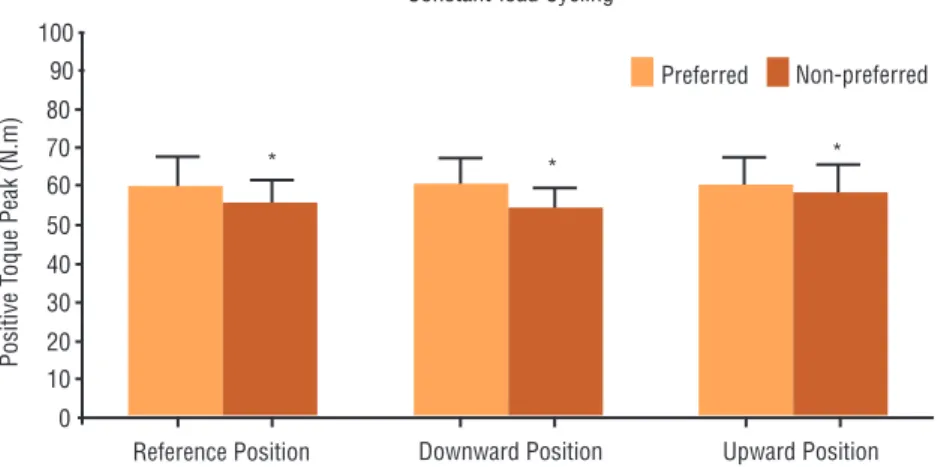
In the constant-load test signiicant asymmetry in favor of the preferred limb was found for the three saddle heights ([F(1,55)=16.83; p<0.001] Co-hen’s d=0.8, 1.1, and 0.2 for reference, downward, and upward position, respectively) (Figure 1). he diferent saddle heights did not inluenced peak torque produced by the preferred [F(2,22)=0.092; p=0.913)] and non-preferred [F(2,22)=3.243; p=0.58] limb.
Figure 1. Mean and standard-deviation peak torque for preferred and non-preferred lower limb for saddle in the reference, downward, and upward position in the constant-load cycling. *Difference between limbs (p<0.05).
Also during Wingate test signiicant asymmetry in favor of the pre-ferred limb was observed for all three saddle heights tested ([F(1,55)=16.83; p<0.001], Cohen’s d=0.9, 1.4, and 0.9 for reference, downward, and upward position, respectively (Figure 2). Peak torque during the Wingate test was similar between the three saddle heights for the preferred [F(2,22)=0.928; p=0.410] and non-preferred limb [F(2,22)=1.281; p=0.298].
Figure 2. Mean and standard-deviation peak torque for preferred and non-preferred lower limb for saddle in the reference, downward, and upward position in the Wingate test. *Difference between limbs (p<0.05).
Pedaling asymmetry Diefenthaeler et al.
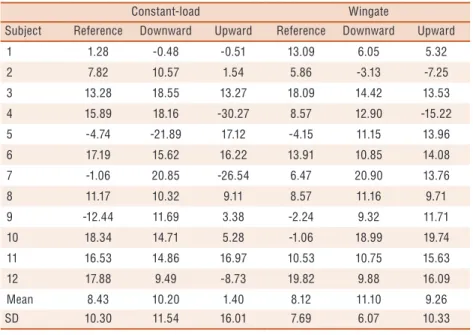
[F(2,22)=1.548; p=0.235] and Wingate test [F(2,22)=0.4586; p=0.6381]. During the constant-load test, asymmetry index ES values were Cohen’s d=0.2, 0.5, and 0.6 for reference, downward, and upward position, respectively. During the Wingate test, asymmetry index ES values were Cohen’s d=0.4, 0.1, and 0.2, for reference, downward, and upward positions, respectively.
Table 1. Individual, mean and standard-deviation of the asymmetry index in the three saddle heights at two exercise intensities evaluated.
Constant-load Wingate
Subject Reference Downward Upward Reference Downward Upward 1 1.28 -0.48 -0.51 13.09 6.05 5.32 2 7.82 10.57 1.54 5.86 -3.13 -7.25 3 13.28 18.55 13.27 18.09 14.42 13.53 4 15.89 18.16 -30.27 8.57 12.90 -15.22 5 -4.74 -21.89 17.12 -4.15 11.15 13.96 6 17.19 15.62 16.22 13.91 10.85 14.08 7 -1.06 20.85 -26.54 6.47 20.90 13.76 8 11.17 10.32 9.11 8.57 11.16 9.71 9 -12.44 11.69 3.38 -2.24 9.32 11.71 10 18.34 14.71 5.28 -1.06 18.99 19.74 11 16.53 14.86 16.97 10.53 10.75 15.63 12 17.88 9.49 -8.73 19.82 9.88 16.09 Mean 8.43 10.20 1.40 8.12 11.10 9.26 SD 10.30 11.54 16.01 7.69 6.07 10.33
DISCUSSION
Our main indings support the concept that pedaling asymmetry can be con-sistent across diferent saddle heights when cyclists performed at two diferent intensities. Our results are in accordance with previous reports showing asym-metries in crank torque are in favor of the preferred limb3,6,7. he asymmetries
observed across the diferent exercise intensities tested also elicited similar asymmetry indexes between trials with diferent saddle heights. From a practi-cal perspective, our data suggest that cyclists may be subject to asymmetric performance and loading when performing at preferred saddle position, and also when small deviations from the reference saddle height are experienced.
he results suggested that pedaling asymmetry is present regardless of the saddle position tested. Even though former investigations suggest that changing saddle position might afect peak and mean power output10,11,
few information is available concerning torque and torque asymmetry. Our results suggest that cyclists performing asymmetrically are highly consistent within their own pattern, which reinforces the possibility that they are also asymmetrical during training and competition.
A similar pedaling asymmetry was observed during both sub-maximal and maximal cycling trials. It has been suggested that torque asymmetry can be inversely associated with intensity during simulated time-trial competition6. However the results of the present study do not support the
intensity efect reported. he diferences in the outcomes between our study and the previous one6 may rely on the fact that while we used a constant
sub-maximal intensity, Carpes et al.6 performed a simulated competition,
in which participants were free to vary intensity during the trial.
An important question rising from the current results concerns the potential neuromuscular adaptations that might take place in asymmet-ric cyclists. To answer this question, a prospective or longitudinal study would be required. Furthermore, our results raise the question of whether correcting pedaling asymmetry can inluence performance. Although not clear concerning an efect on performance, it was previously suggested that, among runners, any change in movement technique aiming at improve symmetry should be carefully conducted, since mechanical overload to muscles and joints increase injury risk through increased stress to these tissues27,28. For cyclists, training the muscles that cross the hip joint could
contribute to decreases or even avoids lower limb asymmetries5. It is
im-portant to mention that quantiication of the index of efectiveness was not possible in our study, but such variable could signiicantly help to discuss implications of pedaling technique in regard of the asymmetries observed.
CONCLUSION
he results of the current study demonstrate that pedaling asymmetry in trained road cyclists can be consistent across diferent saddle heights and even at diferent cycling intensities. From a practical point of view, our data suggest that cyclists producing asymmetric torque may be adapted to this condition so they are continuously exposed to asymmetric efort and overload on the lower limbs.
Acknowledgements
he authors would like to thank the subjects who participated in this study and CNPq and Capes-Brazil for inancial support
REFERENCES
1. Cavanagh PR, Petak KL, Shapiro R, Daly D. Bilateral asymmetry in work output during cycling ergometer pedaling. Med Sci Sports Exerc 1974;6(1):80-1.
2. Daly DJ, Cavanagh PR. Asymmetry in bicycle ergometer pedalling. Med Sci Sports Exerc 1976;8(3):204-8.
3. Sargeant AJ, Davies CT. Forces applied to cranks of a bicycle ergometer during one- and two-leg cycling. J Appl Physiol Respir Environ Exerc Physiol 1977;42(4):514-8.
Pedaling asymmetry Diefenthaeler et al.
CORRESPONDING AUTHOR
Fernando Diefenthaeler Universidade Federal de Santa Catarina
Campus Universitário Trindade – Centro de Desportos, Laboratório de Biomecânica
Florianópolis/SC CEP: 88040-970 – Brasil
E-mail: [email protected]
5. Smak W, Neptune RR, Hull ML. he inluence of pedaling rate on bilateral asymmetry in cycling. J Biomech 1999;32(9):899-11.
6. Carpes FP, Rossato M, Faria IE, Mota CB. Bilateral pedalling asymmetry during a simulated 40-km cycling time-trial. J Sports Med Phys Fitness 2007;47(1):51-7.
7. Carpes FP, Rossato M, Faria IE, Mota CB. Inluence of exercise intensity on bilateral pedalling symmetry. Progress in motor control IV 2007;11(suppl):54-5.
8. Bini RR, Diefenthaeler F, Mota CB. Fatigue efects on the coordinative pattern during cycling: kinetics and kinematics evaluation. J Electromyogr Kinesiol 2010;20(1):102-7.
9. Bini RR, Senger DC, Lanferdini FC, Lopes ALC. Joint kinematics assessment during cycling incremental test to exhaustion. Isokinet Exerc Sci 2012;20(2):99-105.
10. Peveler WW, Pounders JD, Bishop PA. Efects of saddle height on anaerobic power production in cycling. J Strength Cond Res 2007;21(4):1023-27.
11. Peveler WW, Green JM. Efects of saddle height on economy and anaerobic power in well-trained cyclists. J Strength Cond Res 2011;25(3):629-33.
12. Bini RR, Diefenthaeler F, Carpes FP. Lower limb muscle activation during a 40km cycling time trial: Co-activation and pedaling technique. Int SportsMed J 2011;12(1):7-16.
13. Too D. Biomechanics of cycling and factors afecting performance. Sports Med 1990;10(5):286-03.
14. Diefenthaeler F, Bini RR, Laitano OL, Guimaraes ACS, Nabinger E, Carpes FP, et al. Assessment of the efects of saddle position on cyclists’ pedaling technique. Med Sci Sports Exerc 2006;38:S181.
15. Herzog W, Guimarães AC, Anton MG, Carter-Erdman KA. Moment-length relations of rectus femoris muscles of speed skaters/cyclists and runners. Med Sci Sports Exerc 1991;23(11):1289-96.
16. Reinhard U, Müller PH, Schmülling RM. Determination of anaerobic threshold by the ventilation equivalent in normal individuals. Respiration 1979;38(1):36-42.
17. Bini RR, Hume PA, Croft JL. Efects of Bicycle Saddle Height on Knee Injury Risk and Cycling Performance. Sports Med 2011;41(6):463-76.
18. Rossato M, Bini RR, Carpes FP, Diefenthaeler F, Moro AR. Cadence and workload efects on pedalling technique of well-trained cyclists. Int J Sports Med 2008;29(9):746-52.
19. Scheuermann BW, Hoelting BD, Noble ML, Barstow T. he slow component of O2 uptake is not accompanied by changes in muscle EMG during repeated bouts of heavy exercise in humans. J Physiol 2001;531(Pt 1):245-56.
20. Ferreira LF, Harper AJ, Townsend DK, Lutjemeier BJ, Barstow TJ. Kinetics of estimated human muscle capillary blood low during recovery from exercise. Exp Physiol 2005;90(5):715-26.
21. Bar-Or O. he Wingate anaerobic test. An update on methodology, reliability and validity. Sports Med 1987;4(6):381-94.
22. Elias LJ, Bryden MP, Bulman-Fleming MB. Footedness is a better predictor than is handedness of emotional lateralization. Neuropsychologia 1998;36(1):37-43.
23. Chavet P. Lafortune MA, Gray JR. Asymmetry of lower extremity responses to external impact loading. Hum Mov Scie 1997;16(4):391-06.
24. Hopkins WG. Measures of reliability in sports medicine and science. Sports Med 2000;30(1):1-15.
25. Carpes FP, Mota CB, Faria IE. On the bilateral asymmetry during running and cycling A review considering leg preference. Phys her Sport 2010;11(4):136-42.
26. Carpes FP, Diefenthaeler F, Bini RR, Stefanyshyn D, Faria IE, Mota CB. Does leg preference afect muscle activation and eiciency? J Electromyogr Kinesiol 2010;20(6):1230-6.
27. Vagenas G, Hoshizaki TB. Evaluation of rearfoot asymmetries in running with worn and new running shoes. Int J Sport Biomech 1988;4(3):220-30.