* Corresponding author.
E-mail: [email protected] (Cu. Cirak)
0102-695X/$ - see front matter © 2014 Sociedade Brasileira de Farmacognosia. Published by Elsevier Editora Ltda. All rights reserved. DOI: 10.1590/0102-695X20142413352
A R T I C L E I N F O
Article history:
Received 31 October 2013 Accepted 5 Mar 2014
Keywords: Hyperforins Hypericins Hypericum montbretii Phenolic compounds Wild populations
A B S T R A C T
In the present study, we investigated the variation in the content of seventeen secondary metabolites among Hypericum montbretii Spach., Hypericaceae, populations from five different growing zones in Turkey for the first time. The plants were collected at full flowering, and after they were dried at room temperature, they were assayed for chemical contents by HPLC. Chemical constituents of plants varied significantly among populations except for 2,4-dihydroxybenzoic acid which was accumulated at similar levels. Plants from population - 1 yielded the highest amount of hypericin and pseudohypericin (1.27 and 2.97 mg/g, respectively) while hyperforin and adhyperforin accumulations were the highest in plants from population - 2 (6.64 and 1.24 mg/g, respectively). (+)-Catechin and (-)-epicatechin were accumulated at significantly higher levels by plants of population - 4 (1.54 and 4.35 mg/g, respectively). The highest accumulation level of the rest compounds namely, chlorogenic and neochlorogenic acids, amentoflavone, hyperoside, isoquercitrin, quercitrin, quercetin, avicularin and rutin was reached in plants from population-5 (2.64, 4.37, 2.35, 10.26, 3.52, 4.37, 1.55, 1.56 and 20.54 mg/g, respectively). The pronounced chemical diversity between populations is discussed to possibly be the result of different environmental, morphological and genetic factors.
© 2014 Sociedade Brasileira de Farmacognosia. Published by Elsevier Editora Ltda. All rights reserved.
Original article
Changes in the content of bioactive substances among
Hypericum montbretii populations from Turkey
Cuneyt Cirak
a,*, Jolita Radusiene
b, Liudas Ivanauskas
c, Valdas Jakstas
c, Necdet Çama
Ô
aaOndokuz Mayis University, Vocational High School of Bafra, Samsun, Turkey bNature Research Centre, Institute of Botany, Vilnius, Lithuania
cMedical Academy, Lithuanian University of Health Sciences, Kaunas, Lithuania
Introduction
Hypericum montbretii Spach., Hypericaceae, is a perennial herb growing in damp or shady places among rocks in Northern Turkey as well as in Syria, the Balkans and Georgia. The plant has been used for the treatment of kidney stones, stomach disorders, ulcers and hemorrhoids as a decoction under the name “çay otu” in Turkish folk medicine (Altundag & Ozturk, 2011). H. montbretii has also great potential to be used for official
medicine with its well documented antidepressant (Can et al., 2011), antioxidant (Öztürk et al., 2009) and immunomodulating inhibitory (Demirkiran et al., 2013) activities.
present study we investigated the content variation of the above-mentioned compounds, as well as other newly identified bioactive substances such as, adhyperforin (4), neochlorogenic (6) and 2,4-dihydroxybenzoic (7) acids, amentoflavone (8), isoquercitrin (10), avicularin (13), (+)-catechin (15) and (-)-epicatechin (16) among five H. montbretii populations from different growing sites in Turkey for the first time.
Materials and methods
Plant material
The plant materials were described in our previous studies (Cirak & Radusiene, 2007; Cirak et al., 2008). The samples were authenticated by Dr. Samim Kayikci, Mustafa Kemal University, Faculty of Arts and Sciences, Department of Biology, Turkey. Voucher specimens were deposited in the herbarium of Ondokuz Mayis University Agricultural Faculty and voucher numbers of the collections are shown in Table 1.
Experimental procedures
The aerial parts of Hypericum montbretii Spach, Hypericaceae, plants representing a total of 30 shoots were collected at full flowering from five populations of Turkey (Table 1). The tops of 2/3 plants were harvested between 11 am and 13 pm and dried at room temperature (20° ± 2°C).
Preparation of plant extracts
Air-dried plant material was mechanically grounded using a laboratory mill until a homogenous powder was obtained. Samples of about 0.1 g (weighed with 0.0001 g precision) were extracted in 10 ml of 100% methanol by ultrasonication at 40°C for 30 min. The prepared extracts were filtered and kept in a refrigerator until analysis. The extracts for naphthodianthrones analysis were exposed to light from a xenon lamp (765 W/m2)
for 8 min to allow photoconversion of protohypericins into hypericins.
ingredients of Hypericum extracts that elicit antidepressant, antiviral, antitumoral and antimicrobial (Kasper et al., 2010) activities. However, population variability of constituents has not yet been studied in this species. Thus, in the
Populations Collection date Voucher nº Latitude (n) Longitude (E) Elevation (m) Mean temperature (°C)
Precipitation (mm)
Habitat
1 June 16, 2011 BMYO nº 4/1 41° 16 ′ 41° 33 ′ 500 10.01 850 Rocky and open
slopes
2 June 19, 2011 BMYO nº 4/2 40° 54 ′ 40° 28 ′ 800 14.10 535 Arid
pasturelands
3 June 20, 2012 BMYO nº 4/3 41° 52 ′ 39° 14 ′ 1720 11.00 825 Igneous slopes and rock ledges
4 June 15, 2011 BMYO nº 4/4 39° 54 ′ 37° 28 ′ 1500 15.17 525 and rock ledgesIgneous slopes
5 June 13, 2011 BMYO nº 4/5 41° 04 ′ 38° 06 ′ 2750 11.12 819 Rocky and open slopes Table 1
Geographical data and seasonal climatic conditions of Hypericum montbretii growing localities in Turkey.
10
7 8
1 2 3
4 5 6
9
11
12
13 14
HPLC analysis and identification
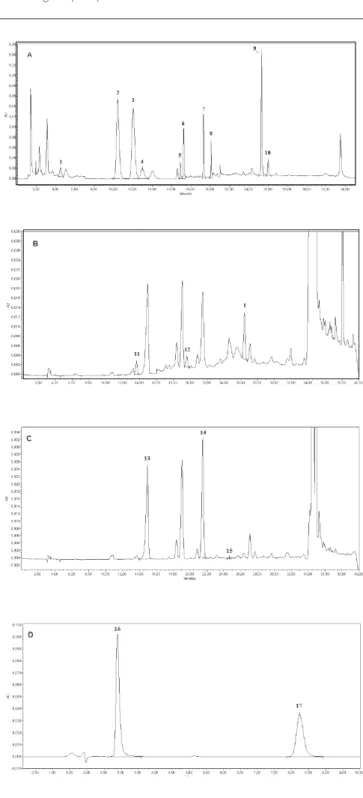
A Waters Alliance 2695 (Waters, Milford, USA) separation module system, equipped with Waters 2487 UV/Vis and Waters 996 PDA diode-array detectors, was used for HPLC analysis. Separation of flavonoids, epicatechin and hyperforins was carried out using a SunFire C18 column (3.5 μm, 150 mm × 3.0 mm i.d.; Waters, Milford, USA) with 10 mm guard-precolumn. The binary gradient elution was used for the detection of corresponding compounds. The mobile phase consisted of eluent A (water acidified with 0.3% phosphoric acid), and eluent B (acetonitrile containing 0.3% phosphoric acid). The elution profile was used as follows: 0-12 min 16% B, 12-18 min (B 16→53%), 18-18.1 min (B 53→97%), 18.1-29 min (B 97%), 29-30 min (B 97→16%). Flow rate was 0.6 ml.min-1 at a constant 25°C column temperature
and the injected volume was 10 µl. Detection was monitored at 270-360 nm.
The ACE C18 column (5.0 μm, 250 × 4.6 mm i.d.; MAC-MOD Analytical, Inc) with guard-precolumn was used for separation of phenolic acids, catechin and hypericins. The mobile phase of gradient elution of phenolic acids and catechin was composed of eluent A (water acidified with 0.5% glacial acetic acid), and eluent B (acetonitrile). The separation was performed using the following program: 0-30 min (B 5→35%), 30-36 min (B 35→90%), and 36-37 min (B 90→5%). The flow rate was 1.0 ml.min-1 at 25°C column temperature, injected volume 10 µl. Detection was performed at 277-324 nm.
Naphthodiantrones were analysed according to the modified pharmacopoeial method (Pharm. Eur., 2010). The mobile phase of isocratic elution consisted of ethyl acetate, aqueous 0.1 M sodium dihydrogen phosphate solution, adjusted to pH 2.0 using phosphoric acid and methanol (16:17:67% v/v). The flow rate was 1.0 ml.min-1 at 40°C
column temperature and volume of extract injected 20 µl. Detection was performed at 590 nm.
Quantification of compounds was carried out by the external standard method. Standard stock solutions were prepared freshly in methanol and diluted in six different concentrations to obtain a set of corresponding concentration ranges for the linearitystudy. Chromatogram peak areas of analytes on their absorption maxima: 270 nm for hyperforins; 277 nm for epicatechin and catechin; 290 nm for 2,4-dihydroxybenzoic acid; 324 nm for chlorogenic and neochlorogenic acids; 360 nm for flavonoids; and 590 nm for hypericins, were plotted against the known concentrations of the standard solutions to establish the calibration equations. The regression coefficients of all calibration curves were r2 ≥ 0.999 confirming linearity
of concentration ranges. The precision of the method was demonstrated for all analytes, since all relative standard deviations (RSD) values were lower than 5.0%.
Chromatographic peaks were assigned based on the retention time, UV spectra of the standard compounds using HPLC-DAD.
Solvents used were HPLC grade and purchased from Roth GmbH (Karlsruhe, Germany).Water was filtered through the Millipore HPLC grade water cartridge. Reference substances were purchased from ChromaDex (Santa Ana, USA), Sigma-Aldrich (Saint Louis, USA) and HWI Analytik GmbH (Germany).
Data analysis
Data for the content of each chemical were analysed using an ANOVA, and significant differences between mean values tested with the Duncan Multiple Range Test (p ≤ 0.01), using MSTAT-C statistical software.
Results and discussion
humifusum L., from different geographic regions of Tunisia by using eleven isozymic polymorphic loci and 166 RAPD markers. Combined chemical, molecular and morphological studies on the relationships between genetic and chemical diversities within and among species of Hypericum are currently ongoing (Nürk & Crockett 2011).
H. montbretii is a member of the section Drosocarpium Spach. To our knowledge, the chemical profiles of two other species from the section; Hypericum bithynicum Boiss. and Hypericum perfoliatum L., have been previously described (Cirak et al., 2007b; Smelcerovic et al., 2008). The comparison of the present results with previously published reports reveals that the three members of section Drosocarpium have a similar chemical profile, and include hypericin (1), pseudohypericin (2), hyperforin (3), rutin (14), chlorogenic acid (5), hyperoside (9), quercitrin (11) and quercetin (12). Among the chemicals, hypericins were reported to have an apparent taxonomic worth for the infrageneric classification of the genus Hypericum (Crockett & Robson, 2011). Because hypericin and pseudohypericin were not detected in members of the primitive sections and seem to be specific only for the taxa of phylogenetically more advanced sections (Kitanov, 2001). Thus, detection of hypericins as well as the other chemicals tested in H. montbretii in the present study solidifies the taxonomic standing of the section Drosocarpium within the genus Hypericum.
Conclusions
The present results indicate a considerable chemical variation among Turkish populations of H. montbretii. The chemical instability of the populations is a possibly due to different geographic origins and should be taken into account while processing the plant material for medicinal aims. Further multiple studies on the genetic and environmental reasons of the observed chemical diversity among wild populations are needed to make more substantial inferences. The accumulation of adhyperforin (4), neochlorogenic acid (6), 2,4-dihydroxybenzoic acid (7), amentoflavone (8), isoquercitrin (10), avicularin (13), (+)-catechin (15) and (-)-epicatechin (16) in H. montbretii was documented by us for the first time. The present data could also be helpful to explain the chemotaxonomical significance of the corresponding compounds as well as to serve as a phytochemical evaluation of H. montbretii.
Authors’ contributions
CC provided the idea. CC and NC performed the field studies and sampled the plant populations in their wild habitats. JR, LI and VJ performed the chemical analyses. CC performed the statistical data evaluation and JR prepared the figures. All authors participated in the writing of the manuscript and approved its content.
Conflicts of interest
The authors declare no conflicts interest.
R E F E R E N C E S
Afef, B., Chokri, M., Mohamed, B., 2012. Genetic structure of natural Tunisian Hypericumhumifusum L. (Hypericacae) populations as assessed by allozymes and RAPDs. Ind. Crop. Prod. 35, 217-223. Altundag, E., Ozturk, M., 2011. Ethnomedicinal studies on the
plant resources of east Anatolia, Turkey. Procedia Soc. Behav. Sci. 19, 756-777.
Bagdonaite, E., Martonfi, P., Repcak, M., Labokas, J., 2010. Variation in concentrations of major bioactive compounds in Hypericumperforatum L. from Lithuania. Ind. Crop. Prod. 35, 302-308.
Can, O.D., Ismail, I.B., Ozturk, Y., Ozturk, N., Erkara, I.P., Sagratinie, G., Ricciutellie, M., Vittorie, S., Maggie, F., 2011. New antidepressant drug candidate: Hypericummontbretti extract. Nat. Prod. Res. 25, 1469-1472.
Cirak, C., Radusiene, J., Sağlam, B., Janulis, V., 2007a. Variation of bioactive substances and morphological traits in Hypericum perforatum populations from Northern Turkey. Biochem. Syst. Ecol. 35, 403-409.
Cirak, C., Radusiene, J., Janulis, V., Ivanauskas, L., 2007b. Secondary metabolites in Hypericum perfoliatum: variation among plant parts and phenological stages. Bot. Helv. 117, 29-36.
Cirak, C., Radusiene, J., Janulis, V., Ivanauskas, L., ÇamaÔ, N., Ayan, A.K., 2011. Phenolic constituents of Hypericum triquetrifolium Turra (Guttiferae) growing in Turkey: variation among populations and plant parts. Turkish J. Biol. 35, 449-457. Cirak. C, Radusiene, J, Stanius, Z, ÇamaÔ, N, ÇalıÔkan, Ö, OdabaÔ,
M.S., 2012. Secondary metabolites of Hypericum orientale L. growing in Turkey: variation among populations and plant parts. Acta Physiol. Plant 34, 1313-1320.
Cirak, C., Radusiene, J., 2007. Variation of hyperforin in Hypericum montbretii during its phenological cycle. Nat. Prod. Res. 21, 1151-1156.
Cirak, C., Radusiene, J., Sağlam, B., 2008. Variation of bioactive substances in Hypericum montbretii during plant growth. Nat. Prod. Res. 22, 246-252.
Crockett, S.L., Robson, N.K.B., 2011. Taxonomy and
chemotaxonomy of the genus Hypericum. In: OdabaÔ MS, Cirak C (Eds) Hypericum. Medicinal Aromatic Plant Sci. Biotech. 5 (Special Issue 1), 1-13.
Demirkiran, O., Mesaik, M.A., Beynek, H., Abbaskhan, A., Choudhary, M.Q., 2013. Immunosupressive phenolic constituents from Hypericum montbretii Spach. Rec. Nat. Prod. 7, 210-219.
Kasper, S., Caraci, F., Forti, B., Drago, F., Aguglia, E., 2010. Efficacy and tolerability of Hypericum extract for the treatment of mild to moderate depression. Eur. Neuropsychopharm. 20, 747-765.
Kitanov, G.M., 2001. Hypericin and pseudohypericin in some Hypericum species. Biochem. Syst. Ecol. 29, 171-178. Nürk, N.M., Crockett, S.L., 2011. Morphological and
phytochemical diversity among Hypericum species of the Mediterranean Basin. In: Odaba
ş
MS, Cirak C (Eds) Hypericum. Medicinal Aromatic Plant Sci Biotech 5 (Special Issue 1), 14-28.Öztürk, N., Tunçel, M., Erkara, I.P., 2009. Phenolic compounds and antioxidant activities of some Hypericum species: A comparative study with H. perforatum. Pharm. Biol. 47, 120-127.
Pharmacopoeia Europea 2010. Directorate for the Quality of Medicine. European Pharmacopoeia 7th ed., Council of Europe, Strasbourg. 1241-1244.
Sirvent, T., Walker, L., Vance, N., Donna, G., 2002. Variation in hypericins from wild populations of Hypericum perforatum L. in the Pasific Northwest of the U.S.A. Econ. Bot. 56, 41-49. Smelcerovic, A., Zuehlke, S., Spiteller, M., Raabe, N., Özen, T.,