Bakhtiniana, São Paulo, 11 (2): 57-75, May/Aug. 2016. 57 http://dx.doi.org/10.1590/2176-457323516
The Promotional Discourse in Scientific Popularization Articles for
Young Readers /
O discurso promocional em artigos de divulgação
científica midiática para jovens leitores
Maria Eduarda Giering*
ABSTRACT
This paper deals with the presence of promotional discourse in scientific popularization texts published in Ciência Hoje das Crianças (CHC) magazine. Observing articles published in CHC, we verified the presence of a discursive aim of incitation directed at young readers. We hypothesized that the promotional discourse could be evidenced in those texts and investigated, in a corpus of 30 texts, the communicational and discursive characteristics of this discourse. The analysis results corroborated our hypothesis, once we found the presence of narrative and argumentative schemes as strategies to make the reader believe that he/she has to do something. We also observed an intention to provoke actions, through scientific popularization, that promote individual or social well-being, valorizing the scientific knowledge and establishing a relation between science and social life. The articles revealed hybridism of domains: scientific, mediatic, didactic, and promotional. We related the presence of promotional discourse to a Contextual Model of public communication of science.
KEYWORDS: Scientific Popularization; Media; Promotional Discourse; Hybridism; Contextual Model
RESUMO
Este artigo trata da presença do discurso promocional em textos de divulgação científica publicados na revista Ciência Hoje das Crianças (CHC). Ao observamos artigos publicados na CHC, verificamos a presença do fim discursivo de incitação (fazer-fazer) direcionado aos leitores jovens. Levantamos a hipótese de que neles encontra -se o discurso promocional e investigamos, num corpus de 30 textos, as características comunicacionais e discursivas desse discurso. Os resultados da análise confirmaram nossa hipótese, pois constatamos a presença dos esquemas narrativo e argumentativo como estratégias para fazer-crer o leitor com vistas ao fazer. Observamos também o intuito de, por meio da divulgação científica midiática, provocar ações que promovam bem-estar social ou individual, valorizando o saber da ciência e, dessa forma, estabelecendo relação entre ciência e vida social. Os artigos revelaram um hibridismo discursivo: científico, midiático, didático e promocional. Relacionamos a presença do discurso promocional ao Modelo Contextual de comunicação pública da ciência.
PALAVRAS-CHAVE: Divulgação científica; Mídia; Discurso promocional; Hibridismo; Modelo contextual
*
58 Bakhtiniana, São Paulo, 11 (2): 57-75, May/Aug. 2016. Introduction
An outstanding characteristic of the discourse of scientific popularization in
media, according to Charaudeau (2008), is the fact that, in contrast with the scientific,
didactic and mediatic discourses, it is not connected to a specific domain. It is always a
hybrid discourse that demands attention to its situational conditions of production. As
Charaudeau (2008) and studies by Giering e Souza (2012) have pointed out, the scientific
popularization in media (from now on DCM, the acronym for the Portuguese phrase
divulgação científica midiática) is situated in the intersection of at least three discourses:
the scientific, the mediatic and the didactic.
Investigating DCM articles directed to children and teens in the magazine Ciência
Hoje das Crianças, we have observed, in several examples, a peculiarity that is related to
the discursive aims of the texts. Some articles do not aim only at making-known
(informing) or making-understand (explaining) a scientific theme, but they also
encourage the reader, at the end of the article, to do something. This characteristic leads
us to postulate that, in certain contractual conditions in which DCM articles are found,
the promotional discourse also occurs.
For the purposes of this study, we are based on Charaudeau’s (2008; 2009; 2010)
postulates about the science mediatization discourse and the promotional.
For Charaudeau (2008), the discourse of science mediatization shares two
finalities: one of information (making-known) and one of captivation (raising interest),
common to the mediatic discourse. Differently from this, however, the DCM discourse
does not aim to raise an opinion, but to expose to the public knowledge facts already
established, as in the didactic discourse. The perspective is, indeed, wider: DCM tends to
be educative and cultural (though not always) and not instructional, as is common in the
didactic discourse. In the instructional discourse, knowledge is divulged in order to make
the addressee appropriate and reproduce it. In the case of the science mediatization
discourse, the linguist (CHARAUDEAU, 2008) explains that the perspective is educative
and cultural as it aims to sensitize, in a recreative way, a public for a specialized
knowledge with several citizen ends: interesting the young readers, preventing against
Bakhtiniana, São Paulo, 11 (2): 57-75, May/Aug. 2016. 59 We believe that, in view of these ends, a promotional discourse occurs in DCM
several times, if we take into account the communicational characteristics of this
discourse type.
The promotional discourse is one of the types of propagandist discourse,
characterized by instigating someone to do something, as Charaudeau (2010) claims. The
propagandist discourse can be present in several situations and in different discursive
genres, changing according to the type of legitimacy of the person who speaks, of the
nature of the speech object and of the place attributed to the addressee.
Among the types of propagandist1 discourse, we are interested in focusing on the
promotional one that, differently from the advertising, does not praise a brand. It aims to “prevent certain damages (the propagation of a disease), dissuade populations of acting in a certain way (not to smoke anymore), instigate the adoption of certain behaviors (the use of condoms)” (CHARAUDEAU, 2010, p.65).2 The linguist observes that the term
“promotional” perhaps is not the most adequate one, but, in the lack of a better one, denominates it this way although it is something that he could call a “prevention
campaign.”
According to Charaudeau (2010), there are three components of the promotional
discourse contract:
-The promoting instance, which is committed to the task of making-do, making-say or
making-think something to someone, even though it is not in the authority position to
oblige someone to execute an action, once it does not have a possibility of sanction. The
promoting instance does not present itself as a benefactor, but as an adviser;
- The speech object, which is presented as a collective benefit of reparation of a social
disorder and is placed as a social ideal. Charaudeau (2010) calls attention to the fact that
this last characteristic differentiates the speech objects of the promotional discourse from
the advertising discourse. In this last one, the object is presented as an individual
well-being, of a hedonic nature and without relation with ethical principles;
1 The other type of propagandist discourse, according to Charaudeau (2009), is the advertising discourse,
which is directed to the consumer, making circulate a value from the hedonic domain.
2Text in Portuguese: “prevenir certos flagelos (a propagação de uma doença), a dissuadir as populações de
60 Bakhtiniana, São Paulo, 11 (2): 57-75, May/Aug. 2016. - The public instance, which is civil and citizen, and not consumer. For Charaudeau (2010,
p.66), “it is morally led to must recognize itself in the stigmatized behavior and to must
want to follow certain model of behavior on behalf of a social solidarity.”3
The linguist elucidates it:
Lack, here, is considered a “bad thing” (drinking, smoking, getting fat, driving too fast). In advertising, on the contrary, lack is considered the absence of something potentially good (“you do not have seduction, prestige, strength, success”). Then, lack in promotion campaigns always represents a threat (serious consequences) and the addressee cannot pretend to be innocent. He must feel obliged to recognize that his state, or the others’, represents a social danger and he must stop himself from accepting an unwanted search. There is not a possible escape; he cannot be satisfied with being who he is, once he is engaged in an ethics of responsibility (Max Weber) (CHARAUDEAU, 2010, p.66).4
The DCM articles also inform the reader, a characteristic that leads us also to
observe the differences and similarities between the informative and the propagandist
discourses.
The instauration of collective actors is common to the types, although the goals of
each are different, as the linguist highlights (CHARAUDEAU, 2009). The informative
discourse aims at “making-know” in order to “make-know,” and information emanates
from a subject provider of the knowledge considered competent (verifiable source) and
of authority (informing is not a simple matter of wanting to inform). The addressee subject
of this discourse is someone, supposedly, who has no knowledge and who is placed in a position of “should-know.” In turn, as Charaudeau (2010) clarifies, the purpose of the propagandist discourse is the instigation to do something, that is, a “making-know” in order to “make-do” (make-say or make-think), parting from a subject that would like the other to execute any act, speech, or thought. Discursively, repercussions on the fact that
the subject who instigates the other to do something is not in an authority position are
3 Text in Portuguese: “ela é levada, moralmente, a dever reconhecer-se no comportamento estigmatizado
e a dever querer seguir certo modelo de comportamento em nome de uma solidariedade social.”
4Text in Portuguese: “A falta, aqui, é considerada uma “coisa ruim” (beber, fumar, engordar, dirigir em
Bakhtiniana, São Paulo, 11 (2): 57-75, May/Aug. 2016. 61 felt, for he/she cannot inflict a sanction on the other, being that the characteristic that
distinguishes it from the purpose of prescription. Considering that, the subject needs to
organize his/her discourse according to a double cognitive schema: narrative and
argumentative.
The narrative schema, according to the narrative organization mode
(CHARAUDEAU, 1992), proposes an implicit imaginary of search for the interlocutor,
by means of which they can assume, if they want, the hero role: “you have a lack that you
seek to fill in > you can/must go for the fill of this lack that you will benefit from > then,
here it is the search object that will allow you to fill in this lack” (CHARAUDEAU, 2009,
p.63).5 Placing the interlocutor in the possible position of hero is a way of seducing them.
The argumentative schema, in turn, aims to persuade the reader, imposing a mode
of reasoning and arguments, by which the reader is led to judge that the search concerns
them and that the means proposed by the producer is the best. In the promotional
discourse, the argumentation is oriented in order to make the addressee believe that they
and/or the society will be the beneficiary of the action proposed by the producer (subject).
The target subject receives, then, information that places them in a position of “should -believe” in order to “make-do” (make-say or make-think).
Considering the characteristics of the promotional discourse and the finding that
several articles from Ciência Hoje das Crianças (from now on CHC) have the purpose of
making-do, we investigate if in the texts of the corpus we organized – 31 texts from
different discursive genres published in the magazine (printed and electronic) between
June 2014 and April 2015 – the promotional discourse occurs, as Charaudeau postulates,
and the discursive route for instigating the readers to do something.
We justify the choice of CHC by the frequency in which texts with the aim of
making-do appear in this magazine: news, reports, question-answer texts; that is, several
published genres present this characteristic. A common aspect is the fact that the textual
producer, in general a scientist, instigates the reader to some kind of action, which
happens in the segment that is found in the last paragraph(s) of the CHC texts. This is not
a usual characteristic of the articles issued in other Brazilian commercial magazines of
5
62 Bakhtiniana, São Paulo, 11 (2): 57-75, May/Aug. 2016. scientific popularization directed to young readers, such as Superinteressante and Mundo
Estranho.6
In the analysis of the CHC texts, we investigate the present DCM contract,
verifying identity, theme, and discursive aim. We equally study the discursive route
established by the producer, who moves discursive strategies from “making-know” to “making-do” (making-say or making-think). Although influenced by the double finality of informing and captivating the reader and imbued with the authority that is attributed to
him/her by the scientific knowledge, he/she cannot oblige the reader to execute an action.
The Texts Analysis
In the 30 texts with the discursive aim of making-do, we identified (1)
characteristics of the communication contract: besides the discursive aim that served as
the criterion for the articles selection, we verify the knowledge area to which the text
belongs and the thematic involved. For the characterization of the type of action proposed
to the reader, we examined (2) the identity of the one who promotes the action, the type
of action suggested (search object) and the type of benefit that comes from the proposed
action. By investigating these particularities of the texts, we aimed to gather data for the
identification of the communicational circumstances in which the “making-do” discourse
occurs and of the possible characteristics of the promotional discourse. We also analyzed
(3) the general organization of the text and the discursive route that culminates with
making-do.
Submitting the texts to the analysis (1) and (2), we verified that, among the 31
texts analyzed, 15 have the discursive aim of informing in order to make-do an action of
collective benefit; the other 16 texts are characterized as informing in order to make-do
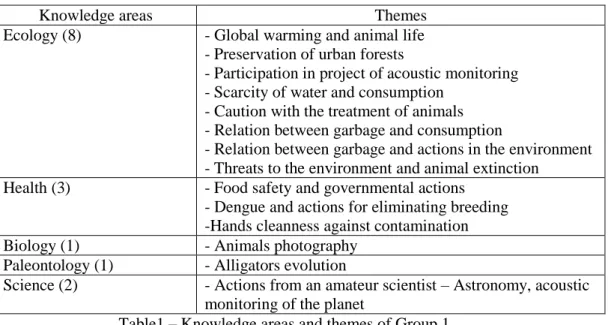
an action of individual benefit. The first ones belong to the areas of Ecology (8), Health
(3), Biology (1), and Paleontology (1), and two articles are inserted in an area that we call
Sciences, as they promote an amateur practice of science. Table 1 shows these
occurrences and describes the themes developed.
6
Bakhtiniana, São Paulo, 11 (2): 57-75, May/Aug. 2016. 63
Knowledge areas Themes
Ecology (8) - Global warming and animal life - Preservation of urban forests
- Participation in project of acoustic monitoring - Scarcity of water and consumption
- Caution with the treatment of animals - Relation between garbage and consumption
- Relation between garbage and actions in the environment - Threats to the environment and animal extinction
Health (3) - Food safety and governmental actions - Dengue and actions for eliminating breeding -Hands cleanness against contamination
Biology (1) - Animals photography
Paleontology (1) - Alligators evolution
Science (2) - Actions from an amateur scientist – Astronomy, acoustic monitoring of the planet
Table1 – Knowledge areas and themes of Group 1.
The 16 articles with discursive aim of informing in order to make-do an action of
individual benefit are divided in the following areas: Biology (3); Zoology (4); Health
(1); Physics (3); History (2); Botany (1); Chemistry (2). Table 2 shows the number of
these occurrences and describes the themes developed:
Knowledge areas Themes
Zoology (4) - Poliquetas
- Hippos - Jellyfishes
- Domestic animals diseases Physics (3) - Lightning and effects on nature
- Lightning formation
- The view in the underwater world Biology (2) - Crossing of fruit species
- The function of blinking eyes
History (2) - Leopoldina de Habsburgo and Pedro de Bragança’s wedding
- Possible discovery of Colombo’s ship Chemistry (3) - Food dehydration
- Chemical experience about sugar dissolution
Odontology (1) - Bruxism symptoms
Biology (1) - Marsh characteristics
Table 2 – Knowledge areas and themes of Group 2.
All articles were written by scientists, a relevant fact under the enunciative and
argumentative perspectives. The scientist identity gives the producer competency to
64 Bakhtiniana, São Paulo, 11 (2): 57-75, May/Aug. 2016. explaining something, the scientist rarely refers to the speech of a third person, once
his/her discourse is endowed with the power of science discourse, which legitimizes
his/her speech. On the other hand, the producer is not in an authority position that aims at
making-do, once he/she cannot oblige the reader to take any action. He is, thus, left with
the task of seducing the reader and arguing in favor of the suggested and recommended
action.
Considering, then, the communicational circumstances in which the make-do
discourses occur, we verified that in the texts with the discursive aim of informing in
order to make-do an action of social benefit, two types of lack or problem may be placed.
It can be either a wrong action that usually happens in society for which the reader is
presumably responsible (for example, giving food to animals in parks and urban forests),
or a problem of general order (for example, global warming, food security, or scarcity of
water). They can be minimized by an individual action with global repercussion (for
example, riding bikes in order to decrease greenhouse effect or decreasing consumption
in order to act on the causes of the excess of garbage in the planet). In all cases, the reader’s action is qualified by the textual producer as of a social repercussion, as the following pieces exemplify:
[…] Play your part. If each one gives the adequate destiny to the garbage they produce, the life quality of everyone gets much better (ROCHA; FONSECA, 2014, p.8). 7
[…] Since early childhood we need to get to know the most serious problems of the world and to try to do something to make it better. Nobody doubts that food safety is a serious topic. Don’t you agree? The doubt lies in what we can do in order to help people who suffer with the consequences of this problem. A possible way perhaps is to ask the legislators about their plans in this area, requiring their actions and to divulge, in whatever way we can, everything that is being done and what is not being done. Being a citizen involves demanding our rights! (MELO, 2014, p.8).8
7 Text in Portuguese: “[...] Faça a sua parte. Se cada um der o destino adequado ao lixo que produz, a
qualidade de vida de todos melhora muito.”
8 Text in Portuguese: “[...] Precisamos, desde cedo, conhecer os problemas mais graves do mundo e tentar
Bakhtiniana, São Paulo, 11 (2): 57-75, May/Aug. 2016. 65 We highlight the fact that the speech object of the texts refers mostly to some
scientific knowledge about the natural or social environment, belonging to different
knowledge areas.
In the texts of making-do with individual benefit, the problem placed is the reader’s ignorance about some theme from the scientist’s expert area (for example, about jellyfishes or hippos) and the action proposed is to bring an individual benefit (for
example, to observe lightning; to reject wrong ideas about animals, to visit a region). The
following examples illustrate it:
[…] Now, when a storm comes, you can observe the sky with other eyes. But remember of doing that inside your home, next to the window. And do not touch it, because, in case a lightning falls near your house, the metal may conduct electricity and you may get an electric shock (PINTO JUNIOR, 2015).9
Now that you already know this special environment, what do you think of planning a visit to Charco in order to get to know its live natural resources? (SARTORI, 2014).10
Considering the texts under the perspective of the characteristics of promotional
discourse according to Charaudeau (2010), we could observe some different aspects
between the two groups of texts. In the first group – the one in which the articles aim at
making-do for a collective benefit –, the action to be done repairs a social disorder; the
intention of leading the reader to participate in an “ethical ideality” is made clear (p.66).
For example, for the problem of the excess of garbage in the planet, the suggestion is to
decrease consumption; for the issue of animals’ extinction, the solution is to preserve the
forests. The textual producer places the reader in the position of a citizen who has the
civic obligation to act in favor of society or the planet.
In the texts of the second group, in turn, the “lack” to be corrected is related to the state of ignorance of the reader about a speech object that is part of a knowledge area
(characteristics of animals, vegetables, natural or chemical phenomena) or that is related
9 Text in Portuguese: “[...] Agora, quando surgir uma tempestade, você pode observar o céu com outros
olhos. Mas lembre-se de fazer isso de dentro de casa, próximo à janela, mas sem tocar nela, porque, caso um raio caia próximo da sua casa residência, o metal pode conduzir eletricidade e dar choque.”
10 Text in Portuguese: “[...] Agora que você já conhece este ambiente especial, que tal planejar uma visita
66 Bakhtiniana, São Paulo, 11 (2): 57-75, May/Aug. 2016. to health (bruxism, diseases in general); in this case, the reader, after getting the new
information, is encouraged to modify a personal situation. The new state of knowing,
thus, leads him/her to solve a personal problem by, for example, seeing a doctor, eating
fruits, observing natural phenomena under another perspective. In some texts, the
hypothetical situation is explicit:
[…] If you wake up with your mouth hurting, tell it to an adult you trust and ask to see a dentist. The early detection of the problem makes all the difference in the treatment. One of the most important steps to control bruxism is to use appliances in the format of your bite in order to protect your teeth while you sleep. This step reduces teeth abrasion and relieves muscle ache. It is also important to talk to a psychologist in order to feel more at ease and to better understand this situation, which is unpleasant, but temporary (ALMEIDA, 2014, p.14; our emphasis).11
Even though there are differences between the two groups of texts in relation to
the aim of “making-do,” we can claim that both point to the presence of promotional
discourse, once the articles have indistinctively educative and cultural perspectives,
instigating the reader to take an action that promotes life quality or social solidarity from
a specialized knowledge. Even if the second group instigates an individual action, this
action cannot be classified as hedonic, which is proper to advertising discourse, because
it does not place the reader as a consumer.
Studying the global organization of the texts and the discursive route which
culminates with making-do (item 3), we verified that the 31 articles of the corpus,
independently of their discursive genre, present a common general text plan. The textual
organization is composed of the title, contextualization (with or without the presentation
of the problem), detailed information (the new knowledge), encouragement towards an
action, and signature (scientist’s name and institution) in this sequence:
- the title, which is expressed several times in the form of a question or an exclamation,
takes the reader into account:
11 Text in Portuguese: “[...] Se você acorda com a boca dolorida, conte a um adulto de sua confiança e peça
Bakhtiniana, São Paulo, 11 (2): 57-75, May/Aug. 2016. 67
Good guy or bad guy? (BEL; AROUCA, 2014)12
The garbage that is mine is yours; it belongs to all of us! (ROCHA; FONSECA, 2014, p.6)13
Yellow balls – and what do you have to do with it? (MOLINA, 2015)14
- contextualization, in which the producer either schematizes a world that is supposedly
close to the reader’s reality or presents the article theme by means of a definition or a
problem. Several times, new questions instigate the reader:
Popsicle sticks, cans, soda caps, plastic cups, cookie wrappings, straws, bottles, food leftovers, nails, wires, and other objects. Have you recognized all this garbage yet? Yeah, this is a long list, and most of it can be found in the sand of the beach.
Where does all this garbage come from? The next time you go to the beach, take some time from your fun and observe: someone is eating a popsicle, drinking a soda, eating cookies and, to your surprise, throwing the packaging of these products on the sand. That’s terrible, huh?! [...] (ARAÚJO, 2014, p.12).15
Lixo [trash] comes from the Latin lix, which means ashes, indicating something that ends its cycle in a natural way. But the human species – look at us here again! – is the only one that is not capable of having its waste material entirely recycled by nature. In fact, it has not been like this all the time. We have gone through a long period of our history living in a harmonic way with natural environments. The point is that we also have come to dominate new production techniques, to consume in a larger scale and, consequently, to generate more garbage! Let’s understand this history better… [...] (ROCHA; FONSECA, 2014, p.6).16
Many people think that the Earth should be called the Water Planet once it has a larger area occupied by oceans than by solid ground. Yes, we really have a lot of water in our planet. The point is that most of it is
12 Text in Portuguese: “Mocinho ou vilão?”
13 Text in Portuguese: “O lixo que é meu, é seu, é de todos nós!” 14 Text in Portuguese: “Bolas amarelas – e você com isso?”
15 Text in Portuguese: “Palitos de picolé, latas, tampinhas de refrigerante, copos, embalagens de biscoitos,
canudos, garrafas, restos de comida, pregos, arames e outros materiais. Já reconheceu todo este lixo? Pois é, a lista é grande e a maior parte pode ser encontrada na areia da praia.
De onde vem tanto lixo? Da próxima vez que você for a praia, deixe suas brincadeiras de lado por um instante e observe: alguém chupando picolé, tomando refrigerante, comendo biscoito e, para sua surpresa, jogando as embalagens destes produtos na areia. Que horror, hein?! [...].”
16 Text in Portuguese: “Lixo vem do latim lix, que significa cinzas, indicando algo que termina seu ciclo de
68 Bakhtiniana, São Paulo, 11 (2): 57-75, May/Aug. 2016.
salt water, usually improper for consumption. When we say most of it, it really is most part, because if we divided all the available water of the Earth in 20 gigantic pools, 19 would be full of salt water and only one of these pools would be almost full of fresh water. In the fresh water part we also have to include the glaciers and polar caps. A brief history: fresh water available for living beings’ consumption is little. But wait: if it is like that, how is there still water in the planet? Good question! [...] (MIRANDA; GONZAGA; PEREIRA, 2014, p.7).17
- detailed information: description of the characteristics of the object or presentation of
the causes and/or consequences of the problem:
[…] These monkeys are used to having generalist habits – which means that their survival does not require too many demands, and therefore, they can live very close to urban centers. Thus, they feed in a diversified way – eating fruits, leafs, insects, eggs and small birds, for example – and can live in little preserved environments as long as they have a minimal structure for their survival.
However, noticing that there are monkeys living around us, we need to take some care. In general, people tend to get close to these animals (beyond necessary), giving them food and trying to have physical contact. This approximation is dangerous for them and for us. Do you want to know why? So take notes...
The food we consume may generate serious health problems in monkeys, such as diabetes, caries, and arterial hypertension. Besides, by getting used to our presence, monkeys may invade our homes to seek for food or even to attack people. The correct action is to admire them from a distance and not to feed them. You have to know that the forest gives them all the food they need!
The more we preserve urban forests, even the smallest ones, the more they will offer monkeys food and shelter and the more protected they will be. Moreover, the forest also needs monkeys, because they are seed dispersers. As they jump from branch to branch, they eat fruits and liberate seeds when defecating in different places of the forest, helping to make new vegetables germinate [...] (GRANDE; RIBEIRO, 2014, p.12).18
17 Text in Portuguese: “Muita gente acha que a terra deveria se chamar Planeta Água por ter uma área bem
maior de oceanos do que de terra firme. Sim, temos realmente muita água em nosso planeta. Acontece que a maior parte é de água salgada, normalmente imprópria para o consumo. Quando dizemos a maior parte é a maior parte mesmo, pois se dividíssemos toda a água disponível na Terra em 20 piscinas gigantescas, 19 estariam cheias de água salgada e apenas uma destas piscinas estaria quase cheia de água doce. Nessa parte de água doce ainda se incluem as geleiras e calotas polares. Resumo da história: a água doce disponível para consumo dos seres vivos é pouca. Mas, espera: se é assim, como é que ainda existe água no planeta? Boa pergunta! [...].”
18 Text in Portuguese: “[...] Esses macacos costumam ter hábitos generalistas - o que significa que sua
Bakhtiniana, São Paulo, 11 (2): 57-75, May/Aug. 2016. 69
[...] In Brazil and in the world, there are many people who need food - people who are starving. Then, doesn’t our planet have the capacity to produce food for seven billion people who currently live in it? Fortunately, it does. Some specialists claim that the world’s agricultural system has the capacity to feed 12 billion people.
So, why are there about one billion human beings starving in the entire world? The answer is the bad distribution of money in the countries, with models of government that have made few people become rich and lots of people remain poor. Among the poor people, there are still those in extreme poverty, which leads to the endangerment of people’s food safety and health [...] (ROCHA; FONSECA, 2014, p.7).19
- encouragement towards an action: in this final stage, the presence of a verb in the
imperative mode is common, and the projection of a future action occurs:
[…] If you want to keep monkeys as your neighbor, be a better neighbor to them! Spread around that it is not right to throw garbage in forests, cut down trees, pollute streams, mistreat animals and feed them. Following these steps, you will help to keep the forest preserved with more food and shelter for the animals.
As the saying goes, “Each monkey on its own branch!” (GRANDE; RIBEIRO, 2014, p.12).20
[…] Start separating the garbage in your own home and observe how you will reduce the quantity of waste you destine to the garbage truck collection. On the other hand, notice how it increases the amount of material that can be transformed by industries.
do necessário, fornecendo alimentos ou tentando um contato físico. Essa aproximação é perigosa, tanto para eles quanto para nós. Quer saber por quê? Pois anote... Os alimentos que consumimos podem gerar problemas graves de saúde nos macacos, como diabetes, cáries nos dentes e hipertensão arterial. Fora isso, ao se acostumarem com a nossa presença, os macacos podem invadir casas em busca de comida e até atacar as pessoas. A atitude correta é admirá-los de longe e não alimentá-los. Saiba que a mata oferece todo alimento de que os primatas precisam! Quanto mais conservarmos as florestas urbanas, por menores que elas sejam mais alimento e abrigo elas oferecerão aos macacos e mais protegidos eles estarão. Além disso, a mata também precisa dos macacos, porque eles são dispersores de sementes. Pulando de galho em galho, eles comem frutos e liberam sua semente pelas fezes em lugares diferentes da floresta, ajudando a fazer brotar novas plantas [...].”
19 Text in Portuguese: “[...] No Brasil e no mundo, são muitas as pessoas necessitadas de comida, passando
fome mesmo. Será, então, que nosso planeta não tem capacidade de produzir alimentos para os sete bilhões de pessoas que existem atualmente? Felizmente, sim. Alguns especialistas afirmam que o sistema agropecuário mundial tem capacidade de produção para alimentar 12 bilhões de pessoas. Ora, então por que há cerca de um bilhão de seres humanos padecendo de fome em todo o mundo? A resposta é a má distribuição de renda nos países, modelos de governo que têm levado poucos a ficarem ricos e muitos a ficarem pobres. Entre os pobres existe ainda a pobreza extrema, aquela que leva ao comprometimento da segurança alimentar e da saúde das pessoas [...].”
20 Text in Portuguese: “[...] Se você quer continuar tendo o macaco como seu vizinho, seja um vizinho
70 Bakhtiniana, São Paulo, 11 (2): 57-75, May/Aug. 2016.
These materials (paper, plastic, glass, and metal), if there is not a special collection on the streets, need to be taken to voluntary garbage stations. Play your part. If every one provides the adequate destination to the garbage one produces, the life quality of everyone gets much better (ROCHA; FONSECA, 2014, p.8).21
From the narrative point of view, the texts indistinctively place the reader in the position of “hero” who, from the “lack” presented by the producer, can/should seek a solution to the problem through the proposed action, thus characterizing him/her or the
society as the beneficiary. For example, if the search object is the reduction of water waste
and discarded pollutant substances, the reader’s action of saving water and not throwing
leavings down the drain can minimize the problems. If the theme is food safety, it can be
brought about by citizen action questioning the rulers about their plans for this area. In case of increasing people’s knowledge about animal’s characteristics, such as the armadillo, the reader can divulge the information that he/she reads in the article, according to the producer’s suggestion.
From the argumentative point of view, the stage of information about the new
knowledge is the base of making-believe. It is popularized scientific knowledge that
problematizes an everyday situation about which the reader did not have a critical view
or questions previous consensual knowledge considered wrong or partial. This new knowledge modifies the reader’s world perception and enables and instigates him/her to take an action that leads to social or individual benefit. The textual producer’s identity –
a scientist – legitimates the “making-know” and imposes the new knowledge as an
argument for “making-do.”
The issue that this knowledge raises is indispensable to the promotional discourse.
The producer does not limit him/herself to inform something; he/she implicates the
reader, leading to the idea that the reader, as he/she acquires the scientific knowledge,
becomes competent to take an action that is related to his/her everyday life. The reader
thus assumes the position of “hero”:
21 Text in Portuguese: “[...] Comece a separar o lixo da sua casa e repare com você vai reduzir a quantidade
Bakhtiniana, São Paulo, 11 (2): 57-75, May/Aug. 2016. 71
[...] In order to have an idea on the [medical] problems that occur in people, out of ten patients in Brazilian hospitals at least six are hospitalized because of diseases related to contaminated water. Most of them are children, just like you! Diarrhea, for example, is among the main causes of infant mortality in our country and may be caused by the consumption of contaminated water [...] (MIRANDA, GONZAGA, PEREIRA, 2014, p.8).22
Imagine the amount of information that comes to these centers daily! Also imagine an instrument that captures thousands of images in a day – just like spatial telescopes. Then, a new problem comes up: how does one process this large amount of information? There are not enough scientists to analyze all that! (MOLINA, 2015).23
We also highlight another characteristic of the texts, related to the goal of
making-believe and to the mediatic domain: one of provoking emotional effects in the reader
through rhetorical questions and exclamations, which can evoke acceptance or feelings
of repudiation:
[…] Where does all this garbage come from? The next time you go to the beach, take some time from your fun and observe: someone is eating a popsicle, drinking a soda, eating cookies and, to your surprise, throwing the packaging of these products on the sand. That’s terrible, huh?! [...] (ARAÚJO, 2014, p.12).24
Always present in most Brazilians’ dishes, beans have traveled with bag and baggage to Norway. Take it easy! You will not be short of one of the main ingredients of your lunch. Just a few grains of the most consumed types of beans in Brazil were sent to Svalbard Global Bank of Seeds, which is located in the European country (LUCARINY, 2015).25
22 Text in Portuguese: “[...] Para se ter uma ideia do problema no que diz respeito às pessoas, de cada dez
pacientes internados em hospitais brasileiros, pelo menos seis estão lá em consequências de doenças relacionadas com água contaminada. A maioria é como você, criança! A diarreia, por exemplo, está entre as principais causas de mortalidade infantil em nosso país e pode ser causada pelo consumo de água contaminada [...].”
23 Text in Portuguese: “Imagine a quantidade de informação que chega diariamente para estes centros!
Imagine, também, um instrumento que captura milhares de imagens por dia – como os telescópios espaciais. Aí surge um novo problema: como processar tamanho volume de informações? Não existem cientistas suficientes para analisar tudo isso!”
24 Text in Portuguese: “[...] De onde vem tanto lixo? Da próxima vez que você for a praia, deixe suas
brincadeiras de lado por um instante e observe: alguém chupando picolé, tomando refrigerante, comendo biscoito e, para sua surpresa, jogando as embalagens destes produtos na areia. Que horror, hein?! [...].”
25 Text in Portuguese: “Figura certa no prato da maioria dos brasileiros, o feijão viajou de mala e cuia para
72 Bakhtiniana, São Paulo, 11 (2): 57-75, May/Aug. 2016. The emotional effect is evidenced by the systematic use of the allocative modality
of discourse, aiming to influence the addressee directly and placing him/her in an
interlocutor position.
Conclusion
Observing the contractual characteristics of magazine CHC, we can point out at
least one reason to justify the incidence of promotional discourse in the articles: the social
identity of the authors, who are scientists, and of the addressees, young readers.
CHC is linked to Sociedade Brasileira para o Progresso da Ciência (SPBC)
[Brazilian Society to the Progress of Science], a civil entity with no lucrative ends and no
political-party affiliation. It is concerned with the defense of the scientific and
technological advance and the educational and cultural development of Brazil. The
magazine is published by Instituto Ciência Hoje, a civil society with no lucrative ends
either. It is linked to SBPC and is responsible for a series of publications and projects
about scientific popularization. CHC is freely circulated in Brazilian public schools.
The articles reveal the intent to provoke actions that benefit the addressees by
means of DCM, valuing science knowledge and establishing a relationship between
science and social life. It is a civic commitment by the scientists when writing scientific
popularization articles to the young addressees of the texts. The producer’s representation
of his/her readers shows them as people who, informed by scientific knowledge, can
exercise their citizenship in everyday life, taking beneficial actions.
Considering the results of our analysis, we can claim that the promotional
discourse is also present in DCM, even though it sometimes does not occur exactly as a “prevention campaign,” as Charaudeau (2010, p.65) has defined. This type of discourse in DCM occurs if the producer, based on scientific knowledge, presents a lack to the
readers and instigates them to take an action that fills in the lack (search object) and makes
them (or the society) beneficiary of this action.
The presence of the promotional discourse in DCM points to the models of public
communication of science, which seek to explain the relationships between science and
Bakhtiniana, São Paulo, 11 (2): 57-75, May/Aug. 2016. 73 found in the texts of the corpus and the type of scientific popularization we could
evidence.
There are models that propose one-way communication processes - from scientists
to society -, in which their key point is to disseminate information, and there are those
with dialogical processes of communication, in which the public’s participation and
active position are their focus of attention. Among them, we highlight two: Deficit Model
and Contextual Model. The first one is characterized by considering scientists as those who “own” knowledge in detriment of the public; the public sphere is considered ignorant (or in deficit) in relation to scientific topics of knowledge of facts that are relevant to
science and technology (MYERS, 2003; LEWENSTEIN; BROSSARD, 2006). In
Contextual Model, individuals do not receive the information as empty containers; on the
contrary, they process knowledge according to their own social and psychological
schemas (LEWENSTEIN; BROSSARD, 2006). In this perspective, Contextual Model
valorizes readers’ cultural experiences and previous knowledge at the same time it
recognizes that, when scientific or technological knowledge is part of the context of
someone who is getting close to it, the comprehension process is easier (LEWENSTEIN,
2003). For Lewenstein, the characteristics of Contextual Model allow its association to
specific areas, such as risk perception, risk and health communication, being these
contexts the means to communicate information.
Observing our texts, we believe that it is possible to associate them with the
Contextual Model. As we have seen, the producer, as he/she instigates readers to take an
action, explores consensual information and the experiences of readers in order to
contextualize the new information and thus to enable inferences required to lead the
readers to the action. Although scientists hold scientific knowledge, the discursive
process towards making-do valorizes readers, attracting them to the exercise of actions
that relate scientific knowledge with everyday life actions. The necessity to organize the
text with a double cognitive schema, narrative and argumentative, points to an active
addressee, which needs to be seduced and convinced by the producer.
It is also important to highlight the outstanding hybridism of discourses verified
in the texts that we analyzed. The science discourse is especially evidenced by the use of
specialized lexicon and by the assumed identity of the scientist; the didactic discourse
74 Bakhtiniana, São Paulo, 11 (2): 57-75, May/Aug. 2016. the mediatic discourse is revealed by the information and the strategies used to captivate
the young audience (making-feel); and, finally, the promotional discourse is evidenced
by the encouragement towards an action (making-do) and by the visible necessity to
organize narrative and argumentative schemas in order to seduce (making-feel) and
convince (making-believe) the addressees about the probable benefits they will reap from
the action that the text is encouraging them to take.
REFERENCES
ALMEIDA, J. R. Por que algumas pessoas têm bruxismo? Ciência Hoje das Crianças, Rio de Janeiro, n. 262, p.14, 2014.
ARAÚJO, F. V. de. Por que não devemos jogar lixo na areia da praia? Ciência Hoje das Crianças, Rio de Janeiro, n. 255, p.12, 2014.
BEL, M.; AROUCA, S. Mocinho ou vilão? Ciência Hoje das Crianças, Rio de Janeiro, 2014. Disponível em: [http://chc.cienciahoje.uol.com.br/mocinho-ou-vilao-2/]. Acesso em: 20 jan. 2015.
CHARAUDEAU, P. Grammaire du sens et de l’expression. Paris: Hachette, 1992.
_______. Du discours de vulgarisation au discous de médiatisation scientifique. La médiatisation de la science. Bruxelles: Éditions De Boeck, 2008.
_______. Il n´y a pas de société sans discours propagandiste. In: OLLIVIER-YANIV, C.; RINN, M. (Dir.). Communication de l’État et gouvernement social, Presses Universitaires de Grenoble, 2009. Disponível em: [http://www.patrick-charaudeau.com/Il-n-y-a-pas-de-societe-sans,169.html]. Acesso em: 12 mar. 2015.
_______. O discurso propagandista: uma tipologia. In: MACHADO, I. L.; MELLO, R. Análises do Discurso Hoje, v.3, Rio de Janeiro: Nova Fronteira (Lucerna) 2010, p.57-78, 2010.
CORREA, B. S. Por que piscamos. Ciência Hoje das Crianças, Rio de Janeiro, 2014. Disponível em: [http://chc.cienciahoje.uol.com.br/por-que-piscamos/]. Acesso em: 25 jan. 2014.
FIGUEIRA, M. Pingou, lavou. Ciência Hoje das Crianças, Rio de Janeiro, 2014, n.164 (Baú da CHC). Disponível em: [http://chc.cienciahoje.uol.com.br/pingou-lavou/]. Acesso em: 25 jan. 2015.
GIERING, M. E. Divulgação científica midiática para crianças e a visada de captação. Intersecções,Jundiaí, v. 1, p.85-97, 2014.
_______; SOUZA. J. A. C. de. Informar e captar: objetos de discurso em artigos de divulgação científica para crianças. In: CAVALCANTE, M. M.; LIMA, S. M. C. (Org.). Referenciação: teoria e prática. São Paulo: Cortez, 2013.
Bakhtiniana, São Paulo, 11 (2): 57-75, May/Aug. 2016. 75 KEISER, G. Segredos de Sua Majestade: você por dentro do diário da princesa Leopoldina! Ciência Hoje das Crianças, Rio de Janeiro, n. 256, p.2-5, 2014.
LEWENSTEIN, B.V. Models of public communication of Science and technology. Public Understanding of Science. Ithaca: Cornell University, 2003. Disponível em: [http://disciplinas.stoa.usp.br/pluginfile.php/43775/mod_resource/content/1/Texto/Lewe nstein%202003.pdf]. Acesso em: 23 maio 2015.
_______; BROSSARD, D. Assessing Models of Public Understanding. In: ELSI Outreach Materials U. S. Department of Energy Grant: Final Report. Cornell: Cornell University. 2006.
LUCARINY, L. Feijão protegido. Ciência Hoje das Crianças, Rio de Janeiro, 2015. Disponível em: [http://chc.cienciahoje.uol.com.br/feijao-protegido/]. Acesso em: 5 maio 2015.
MELO, A. C. C. de. Comida segura: o que é segurança alimentar? Ciência Hoje das Crianças, Rio de Janeiro, n. 263, p.7-9, 2014.
MIRANDA, J. C.; GONZAGA, G. R.; PEREIRA, M. M. E aí, a água vai acabar mesmo? Ciência Hoje das Crianças, Rio de Janeiro, n. 259, p.7-9, 2014.
MOLINA, E. C. Bolas amarelas – e você com isso? Ciência Hoje das Crianças, Rio de Janeiro, 2015. Disponível em: [http://chc.cienciahoje.uol.com.br/bolas-amarelas-e-voce-com-isso/]. Acesso em: 30 maio 2015.
MYERS, G. Discourse studies of scientific popularization: questioning the boundaries. Discourse Studies, v.5 (2), p.265-279. 2003.
PINTO JUNIOR, O. Você sabia que existem super-raios? Ciência Hoje das Crianças, Rio de Janeiro, 2015. Disponível em: http://chc.cienciahoje.uol.com.br/voce-sabia-que-existem-super-raios/. Acesso em: 23 jan 2015.
ROCHA, C. F. D.; SINERVO, B. O aquecimento global e os lagartos: uma ameaça de extinção! Ciência Hoje das Crianças, Rio de Janeiro, n. 258, p.14-17, 2014.
ROCHA, M.; FONSECA, C. S. O lixo que é meu, é seu, é de todos nós! Ciência Hoje das Crianças, Rio de Janeiro, n. 261, p.6-8, 2014.
SARTORI, A. L. B. Chaco, que lugar é este? Ciência Hoje das Crianças, Rio de Janeiro, n. 254, p.14, 2014.
SOUZA, J. A. C. Texto e discurso no infográfico de Divulgação Científica Midiática (DCM). Calidoscópio (Online), v. 11, p.229-240, 2013.
Translated by Êrica Ehlers Iracet – [email protected]
Received June 15,2015