Resumo
A norma voluntária de Sistema de Gestão Ambiental ISO 14001:2004 é pouco adotada entre pequenas empresas, apesar dos vários benefícios ambientais e operacionais que a norma pode trazer. Diversos autores têm incentivado pesquisas sobre as particularidades dessas organizações, de modo a identiicar fatores que possam incentivá-las a aprimorar seus sistemas gerenciais. Esse trabalho contribui para essa demanda, ao analisar os desaios ambientais e os níveis de atendimento à ISO 140001:2004 de três empresas mineradoras de pequeno porte localizadas em Minas Gerais, Brasil. Os dados para análise foram obtidos a partir da aplicação de um questionário e de uma lista de veriicação baseada na ISO 14001:2004. A análise dos dados mostrou níveis relativamente baixos de atendimento aos requisitos de sistemas de gestão ambiental proativos. As três empresas obtiveram, na lista de veriicação, índices de 8%, 46% e 56% de atendimento à norma. Ao analisar a estratégia ambiental das empresas, foi identiicado que duas das empresas lidam com desaios ambientais de maneira predominantemente reativa, enquanto a outra apresenta uma abordagem ambiental mais proativa. A partir dos resultados obtidos, é possível concluir que as empresas estudadas desconhecem a magnitude dos impactos que provocam no meio ambiente e, possivelmente, devido a esse fato, acabam desenvolvendo sistemas ambientais simplistas. O artigo conclui acentuando o valor de se aprimorarem sistemas de gestão ambiental em pequenas mineradoras.
Palavras-chave: Sistema de Gestão Ambiental (SGA), ISO 14001, mineração e minerais, pequenas empresas de mineração
Abstract
ISO 14001 is the world’s most successful environmental management system (EMS) standard. More than two hundred thousand organizations, mostly large corporations located in industrialized countries, have become ISO14001-certiied, hoping to improve their environmental, operational and reputational aspects. Nonetheless, the adoption of ISO 14001 by small organizations is still uncommon.
Environmental management
in small mining enterprises:
comparative analysis of three
Brazilian cases through the
lenses of ISO 14001
Gestão ambiental de pequenas mineradoras:
análise comparativa de três casos brasileiros
sob a ótica da norma ISO 14001
Miriam de Oliveira Baumbach
MSc, PROAMB/UFOP. [email protected]
José Francisco do Prado Filho
DSc, PROAMB/DEAMB/UFOP. [email protected]
Alberto Fonseca
PhD, PROAMB/DEAMB/UFOP. [email protected]
Accordingly, there has been a call for research on the particularities of small enterprises and their environmental management approaches. This article responds to this call, while analyzing the environmental challenges and EMSs of three small mining enterprises located in the state of Minas Gerais, Brazil. Data was collected through the application of a questionnaire and an ISO14001-based checklist. The analysis revealed low levels of ISO 14001 implementation across the sample. The three companies met 8%, 46% and 56% of the checklist items. Findings from the questionnaire suggest that two companies adopt a predominantly reactive approach to dealing with environmental challenges. The other company seems more aligned with a pro-active strategy. All three companies are not suficiently aware of their impacts on the environment: a fact that helps to explain the simplistic EMSs they currently have. The article concludes by highlighting the value of pursuing more sophisticated EMS for small mining companies.
Keywords: Environmental Management System (EMS), ISO 14001, mining and minerals, small mining enterprises
1. Introduction
Voluntary environmental manage-ment tools are becoming increasingly important for private companies, given the growing environmental pressures imposed by suppliers, customers, shareholders, investors and consum-ers. Among the world’s most used environmental management tool is the Environmental Management System (EMS) Standard of the International Organization for Standardization (ISO), known as ISO 14001:2004. This stan-dard - launched in 1996 and revised in 2004 - standardizes the management procedures needed to continually im-prove the environmental performance of an organization. ISO 14001 is based on the paradigm of PDCA (i.e. plan, do, check and act). The standard requires organizations to deine an environmen-tal policy and implement numerous operational and managerial procedures targeting environmental aspects and impacts. The standard also requires continual monitoring, maintenance and veriication of the EMS (ISO 2004). An EMS that meets the requirements of ISO 14001, supported by auditing bodies accredited by ISO, can obtain a cer-tiicate (Seiffert, 2006). In 2010, there were more than 250 thousand valid ISO 14001 certiicates worldwide; 1500 (0.6%) of which in Brazil (ISO, 2010).
ISO 14001 can bring many beneits to organizations, such as lower opera-tional costs, increased competitiveness, risk prevention, enhanced reputation, and improved environmental perfor-mance (D’Avignon, 1995; Fresner, 1998; Moreira, 2006; Nascimento and Poledna, 2002, Almeida et al., 2004). However, studies have shown that the pursuit of ISO 14001 is more common among large companies, because these entities suffer more environmental pressures from stake-holders and have more resources to react (Johanson, 1997, Miles et al., 1999, Chan and Li, 2001; Hillary, 2004). There has been a growing interest in programs and subsidies to promote ISO 14001 among small and medium-sized enterprises (SMEs), especially among those located in developing countries, like Brazil, where the costs of implementing ISO14001 are considered a barrier to its adoption (Am-menberg et al., 1999; ISO, 2006). Biondi et al. (2000) concluded that a growing number of SMEs are becoming interested in ISO14001. Similar indings were found more recently by Pombo and Magrini (2008) in Brazil. According to these au-thors, high costs have been a key barrier to the adoption of ISO 14001 among SMEs, although “these high costs can no longer be a barrier insofar as the company starts with a basic environmental
manage-ment system and gradually turn it into a more sophisticated system “(Pombo and Magrini, 2008, p. 2). The importance of more basic or simpliied EMSs has also been emphasized by Ammenberg et al. (1999) as a way to gradually promote sophisticated systems.
One of the key barriers to imple-menting EMSs among SMEs, even sim-pliied ones, is the fact there is still little information about the conditions and particularities of small enterprises and their respective environmental manage-ment systems. EMS effectiveness varies signiicantly according to organizational size, geographical regional and sectoral activity. Accordingly, there has been a call for further research on the characteristics of environmental management systems among SMEs in various contexts. Such information can help decision-makers to better plan the investments and actions necessary to improve EMSs. This paper contributes to illing this gap, while ex-ploring the characteristics of environmen-tal management systems in small mining companies located in emerging markets. More speciically, this article sought to analyze the levels of ISO 14001 compli-ance, as well as the challenges to managing environmental aspects in a sample of three small mining companies located in Minas Gerais, Brazil.
2. Materials and methods
This study analyzed three (3) small mining companies located in southeastern Brazil, within the historic mining region of Ouro Preto, in the state of Minas Gerais. These companies were selected
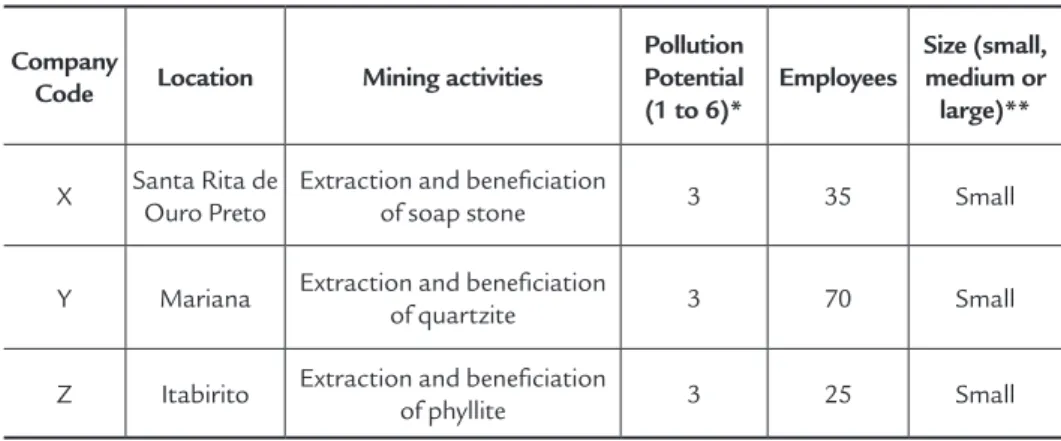
purpose-fully, because, apart from being small, they were not ISO 14001-certiied. Table 1 pro-vides further details about these companies. Data were collected through the application of a structured questionnaire
environmen-tal and managerial aspects. Each item of the questionnaire was analyzed through a rating scale of one (1) to ive (5), where one (1) meant that company was threatened by that aspect, and ive (5) meant that the aspect represented a growth opportunity for the company. Data were also collected through a checklist, adapted from Has-segawa (2007), in order to identify the
level of compliance of the company with ISO 14001:2004. The checklist had 96 questions covering the many requirements of that standard. The category of thematic questions of the checklist were represented by a letter of the alphabet, “A” to “Q”, totaling 17 categories. The criteria used to gauge compliance with the 96 ques-tions of the checklists were drawn from
Moreira (2006).
It is important to note that the questionnaire and the checklist were ap-plied through face-to-face interviews with representatives of the companies’ senior management. The accuracy and consis-tency of the data were later attested in vi-sual inspections undertaken by one of the authors in the premises of each company.
Table 1 Details of the three investigated mining enterprises.
Company
Code Location Mining activities
Pollution Potential (1 to 6)*
Employees
Size (small, medium or large)**
X Santa Rita de Ouro Preto
Extraction and beneiciation
of soap stone 3 35 Small
Y Mariana Extraction and beneiciation
of quartzite 3 70 Small
Z Itabirito Extraction and beneiciation
of phyllite 3 25 Small
*Pollution potential criteria are based on the Brazilian state regulation “Deliberação Normativa COPAM, DN 74/2004” (Minas Gerais, 2004). **Organizational size relects SEBRAE’s (2010) criteria.
3. Results and discussions
While the three companies had similar sizes and pollution potential, only two (2) items of the environmental challenge questionnaire yielded equal results (Table 2). These items are related to source of raw materials (Section 1.1) and energy consumption (item 1.5). There were 10 items that two of the three companies had similar responses (1.4, 2.2, 2.4, 2.5, 4.1, 4.2, 6.2, 7.1, 7.2 and 8.2), as it can be seen in Table 2. Overall, the diversity of responses sug-gests that the companies are challenged differently by environmental aspects: a fact that, as discussed below, is mirrored in their EMSs.
Thirteen out of the twenty re-sponses from companies X and Y were larger than three, i.e. the majority of their responses indicated these com-panies as environmentally friendly. Company Z, in turn, had nine responses greater than three. These indings relect the senior managers’ concern with either the environment or the environmental reputation of the company. The on-site inspections suggested low levels of environmental consciousness. The indings from the questionnaire also suggest that companies X and Z are adopting a reactive approach to coping with environmental challenges (Tilley, 1999). Both companies, despite their
differences, act primarily reacting to pressures from environmental agencies and their clients to improve environ-mental performance. In addition, these companies usually adopt end-of-pipe technological solutions. Company Y, however, while also claiming to react to government pressures, seemed more committed to developing and employing new, cleaner technologies. Company Y also showed a good effort to reduce its environmental impacts, primarily through water re-use. Therefore, one could argue that Company Y has a more proactive approach to dealing with its environmental challenges. As Tilley (1999) puts it, proactive irms have more positive and deliberate efforts to reduce environmental impacts. As a result, their environmental management tends to be more integrated into the organizational structure.
The application of the checklist revealed mixed levels of ISO 14001 compliance across the sample, as it can be seen in Table 3. The item “Objectives and Targets” is the only one that was not met by any company: a fact that suggests a disregard for continuous en-vironmental performance. Other cases in which two of the three companies had 0% of compliance were “Communica-tion” and “Emergency Preparedness
and Response.” This inding is not sur-prising, as these requirements are more commonly observed in companies with mature EMSs. The analysis revealed that none of the three companies met more than 60% of the ISO 14001 re-quirements. Such levels of compliance, according to Moreira (2006), mean that the companies are distant from implementing a formal goal-oriented EMS. Company X’s performance on the checklist was particularly low (8%), as the company’s environmental manage-ment has very few policies and proce-dures in place. The indings from the checklist show that many procedures need to be created and implemented (particularly in company X) for the purpose of bringing the analyzed EMSs closer to ISO 14001:2004 requirements.
Table 2
The Environmental Challenge Scan.
Aspects Environmentally Threatened Company Score Environmentally Friendly 1 2 3 4 5
Products
1.1 – Non-renewable raw materials XYZ Renewable raw materials 1.2 - Recyclable Z Y X Non-recyclable 1.3 – Waste re-use and/or
processing Z Y X
No waste re-use and/or processing 1.4 – High pollution YZ X Low pollution 1.5 – High energy consumption XYZ Low energy consumption
Processes
2.1 - Polluting Z X Y Non-polluting 2.2 – High generation of hazardous
wastes XZ Y
No generation of hazardous waste
2.3 – High energy consumption Y X Z Low energy consumption
2.4 – Ineficient resource use Z XY Eficient resource use
2.5 – Health hazards to workers YZ X No health hazards to workers
Environmental consciousness
3.1 – Consumers not
environmentally conscious Y X Z
Environmentally conscious consumers
Enviornmental standards
4.1 – Low-level standards X YZ High-level standards
4.2 – Non-compliance with
standards XZ Y
Strict compliance with standards Management
and staff commitment
5.1 – No commitment to
environmental issues Z Y X
High commitment to environmental protection
Skill level of staff
6.1 – Low skill levels X Y Z High skill levels
6.2 – Capacity and specialization in
old technologies XZ Y
Up to date education and technological skills
Research and development
(R&D)
7.1 – Low creativity Z XY High creativity
7.2 – Long development cycles Z X Y Short development cycles
Capital
8.1 – Capital shortage Y X Z Capital abundance
8.2 – No access to inancing Z XY Easy access to inancing
Source: Adapted from North (1992) and Donaire (2007).
Table 3
Compliance level against ISO 14001:2004 requirements.
ISO 14001:2004 Requirements Compliance Level (%) Company X Company Y Company Z
A Environmental policy 11 44 11
B Identiication of environmental aspects and impacts 0 50 67
C Identiication of legal and other requirements 0 100 100 D Environmental objectives, targets and programme(s) 0 0 0
E Resources, roles, Responsibility and authority 20 33 8 F Competence, training and awareness 33 66 89
G Communication 0 0 40
H Documentation 0 20 20
I Control of documents 0 63 62
J Operational control 0 40 20
K Emergency preparadness and response 0 75 0
L Monitoring and measurement 25 50 75
M Evaluation and compliance 0 0 100
N Nonconformity, corrective action and preventive action 20 80 80
O Control of records 0 50 100
P Internal audit 0 50 83
Q Management review 9 55 3
Total 8 46 56
4. Conclusions
This article explored the environ-mental challenges and management systems of three small mining companies located in Minas Gerais, Brazil, through the lenses of ISO 14001:2004. Findings from the application of a questionnaire and a checklist show that the three companies, despite their differences, are distant from implementing a formal goal-oriented EMS.
Data obtained through the applica-tion of the quesapplica-tionnaire suggest that com-panies X and Z have reactive approaches to dealing with environmental challenges, since both perform actions motivated primarily by government agencies. Data also suggest that Company Y has a more proactive environmental strategy, because, although also driven by government, this company plans and operates cleaner tech-nologies. These results are not surprising, since the literature has shown that small and medium-sized enterprises tend to have simplistic and reactive approaches to environmental management.
Findings form the application of the
checklist show that none of the three com-panies met more than 60% of the require-ments of ISO 14001:2004. Companies X, Y and Z had 8%, 46% and 56% levels of ISO 14001compliance, respectively.
It was found that Company Z per-formed better in the checklist, in spite of its reactive approach to dealing with environmental challenges. This apparent contradiction could be explained by the fact that the questionnaire and the check-list are not necessarily related. Managerial approaches and management systems can be contradictory, i.e. a company, regard-less of its managerial approach, can have high or low levels of management system implementation. Future research, how-ever, would be needed to conirm if this is the case with respect to the analyzed company.
Overall, the findings show that the three companies are unaware of the magnitude of their impacts on the envi-ronment: a fact that helps to explain the relatively simplistic EMS they currently
have. Findings, however, also suggest that the companies could gain signiicant managerial and performance benefits from continually enhancing their environ-mental policies, procedures and controls. Investments for such enhancements would probably be higher for Company X.
Findings presented here reflect mostly the senior managers’ answers to the questionnaire and checklist. Future studies should consider investigating how data collected through this method compares to data generated from indepen-dent on-site inspections. This comparison could shed light on potential response bias. Future studies should also consider investigating mining companies located in different regions. The companies analyzed here are located in one of Brazils’ most developed and competitive regions. This study, if undertaken in northern Brazil, could arguably reveal even poorer levels of environmental management proce-dures and policies among small mining enterprises.
5. Acknowledgements
The authors would like to express their gratitude to the companies’ manag-ers, who were all very kind, open and
help-ful during the research. The authors also thank CAPES and the Graduate Program in Environmental Engineering at UFOP
for the inancial support to this research.
6. References
ALMEIDA, J. R., MELLO, C. S., CAVALCANTI, Y. Gestão ambiental – planejamento, avaliação, implantação, operação e veriicação. 2ª Ed. revisada e atualizada. Rio de Janeiro: Thex Ed., 2004.
AMMENBERG, J., BORJESSON, B., HJELM, O. Joint EMS and Group Certiication: A Cost-effective Route for SMEs to Achieve ISO 14001. Greener Management International,v. 28, p. 23-31, 1999.
ASSOCIAÇÃO BRASILEIRA DE NORMAS TÉCNICAS. NBR ISO 14001: Sistema de Gestão Ambiental - requisitos com orientações para uso. Rio de Janeiro: ABNT, 2004.
BIONDI, V., FREY, M., IRALDO, F. Environmental Management Systems and SMEs.Greener Management International, v. 29, p. 55-69, 2000.
CHAN, K.-Y., LI, X.-D. A study of the implementation of ISO 14001 Environmental Management Systems in Hong Kong. Journal of Environmental Planning and Management,v. 44, n. 5, 2001.
D’AVIGNON, A. Normas ambientais ISO 14001:2004: como podem inluenciar sua empresa. Rio de Janeiro: CNI, DAMPI, 1995. 68p.
DONAIRE, D. Gestão ambiental na empresa. 2ª Ed. São Paulo: Atlas. 2007. FRESNER, J. Cleaner production as a means for effective environmental management.
Journal of Cleaner Production, v. 6, p. 171-179, 1998.
HASSEGAWA, B. K. F. Gerenciamento ambiental em estações de tratamento de água de médio porte: elaboração de um instrumento de análise ambiental e operacional com base na NBR ISO 14001:2004. Minas Gerais: Universidade Federal de Ouro Preto, 2007. (Dissertação de Mestrado em Engenharia Ambiental). HILLARY, R. Environmental management systems and the smaller enterprise. Journal
ISO. ABNT NBR ISO 14001: Sistema de Gestão Ambiental - requisitos com orientações para uso. Rio de Janeiro: Associacão Brasileira de Normas Técnicas (ABNT). 14001, 2004. 35 p.
______. Help for small businesses to implement ISO management system standards. 2006. Disponível em: <http://www.iso.org/iso/pressrelease.htm?reid=Ref995>. Acesso em: 06/06/2012.
______. Main indings of the 2010 ISO Survey. 2010. Disponível em: <http://www. iso.org/iso/iso-survey2010.pdf>. Acesso em: 06/06/2012.
JOHANSON, L. The Challenge of Implementing ISO 14001 for Small and Medium Enterprises: Surviving in the New Global Jungle. Environmental Quality Management,v. Winter, p. 9-19, 1997.
MILES, M. P., MUNILLA, L. S., MCCLURG, T. The impact of ISO 14000 environmental management standards on small and medium sized enterprises.
Journal of Quality Management,v. 4, n. 1, p. 111-122, 1999.
MINAS GERAIS. Deliberação Normativa n.º 74, de 09 de setembro de 2004 - Estabelece critérios para classiicação, segundo o porte e potencial poluidor, de empreendimentos e atividades modiicadoras do meio ambiente passíveis de autorização ou de licenciamento ambiental no nível estadual, determina normas para indenização dos custos de análise de pedidos de autorização e de licenciamento ambiental, e dá outras providências. Conselho Estadual de Política Ambiental (COPAM). Belo Horizonte. 2004.
MOREIRA, M. S. Estratégia e implantação do Sistema de Gestão Ambiental (modelo ISO 14000). Belo Horizonte: Ed. de desenvolvimento gerencial, 2006. 286p.
NASCIMENTO, L. F. M., POLEDNA, S. R. C. O processo de implantação da ISO 14000 em empresas brasileiras. In: ENCONTRO NACIONAL DE ENGENHARIA DE PRODUÇÃO, 21. Curitiba, 2002.
NORTH, K. Environmental business management: an introduction. Genebra: International Labour Organization (ILO), 1992.
POMBO, F. R., MAGRINI, A. Panorama de aplicação da norma ISO 14001 no Brasil.
Gestão & Produção,v. 15, n. 1, p. 1-10, 2008.
SEIFFERT, M. E. B. ISO 14001 Sistemas de Gestão Ambiental: implantação objetiva e econômica. São Paulo: Atlas, 2006.
SEVIÇO BRASILEIRO DE APOIO AS PEQUENAS E MICRO EMPRESAS.
Classiicação do porte da empresa. Disponível em <http://www.sebrae.com. br/uf/goias/indicadores-das-mpe/classificacao-empresarial/integra_bia?ident_ unico=97>. Acesso em 22/fev/2010.
TILLEY, F. J. Small-irm environmental strategy. The UK experience. Greener Management International, v 25, p. 67-80, 1999.