2014 July-Aug.;22(4):562-8 DOI: 10.1590/0104-1169.3453.2452 www.eerp.usp.br/rlae
Copyright © 2014 Revista Latino-Americana de Enfermagem This is an Open Access article distributed under the terms of the Creative Commons Attribution Non-Commercial License (CC BY-NC).
This license lets others distribute, remix, tweak, and build upon your work non-commercially, and although their new works must also acknowledge you and be non-commercial, they don’t have to license their derivative works on the same terms.
Corresponding Author:
Daniela Aparecida Morais Rua dos Violões, 116 Conjunto Califórnia I
CEP: 30850-540, Belo Horizonte, MG, Brasil E-mail: [email protected]
Daniela Aparecida Morais
2Daclé Vilma Carvalho
3Allana dos Reis Correa
41 Paper extracted from doctoral dissertation “Out-of-hospital Cardiopulmonary resuscitation: determinants of survivorship”, presented to Escola de
Enfermagem, Universidade Federal de Minas Gerais, Belo Horizonte, MG, Brazil.
2 PhD, RN, Serviço de Atendimento Móvel de Urgência, Belo Horizonte, MG, Brazil.
3 PhD, Associate Professor, Escola de Enfermagem, Universidade Federal de Minas Gerais, Belo Horizonte, MG, Brazil.
4 PhD, Adjunct Professor, Escola de Enfermagem, Universidade Federal de Minas Gerais, Belo Horizonte, MG, Brazil.
Objective: to analyze determinant factors for the immediate survival of persons who receive
cardiopulmonary resuscitation from the advanced support units of the Mobile Emergency
Medical Services (SAMU) of Belo Horizonte. Method: this is a retrospective, epidemiological
study which analyzed 1,165 assistance forms, from the period 2008 – 2010. The collected data
followed the Utstein style, being submitted to descriptive and analytical statistics with tests
with levels of significance of 5%. Results: the majority were male, the median age was 64
years, and the ambulance response time, nine minutes. Immediate survival was observed in
239 persons. An association was ascertained of this outcome with “cardiac arrest witnessed by
persons trained in basic life support” (OR=3.49; p<0.05; CI 95%), “cardiac arrest witnessed
by Mobile Emergency Medical Services teams” (OR=2.99; p<0.05; CI95%), “only the carry
out of basic life support” (OR=0.142; p<0.05; CI95%), and “initial cardiac rhythm of asystole”
(OR=0.33; p<0.05; CI 95%). Conclusion: early access to cardiopulmonary resuscitation was
related to a favorable outcome, and the non-undertaking of advanced support, and asystole,
were associated with worse outcomes. Basic and advanced life support techniques can alter
survival in the event of cardiac arrest.
Descriptors: Out-of-Hospital Cardiac Arrest; Cardiopulmonary Resuscitation; Emergency Medical
Services; Ambulances; Prehospital Care.
Out-of-hospital cardiac arrest: determinant factors for immediate
Introduction
Currently, the cardiovascular diseases constitute
the most important group of causes of death in Brazil.
Among these, the ischemic heart diseases stand out as
the principal causes of cardiac arrest (CA)(1).
For the assistance given to CA victims to be
effective, some actions are necessary, such as the early
recognition of the situation, the rapid activation of the
emergency medical system, and the swift undertaking
of cardiopulmonary resuscitation (CPR)(2).
In Brazil, there was a need for the organization of a
regionalized and hierarchized emergency care network,
which led to the implementation of the Mobile Emergency
Medical Services (SAMU, in Portuguese) in 2003(3).
The SAMU of Belo Horizonte (BH) attends many
cases of CA, according to a study undertaken in 2005,
which ascertained that this service’s advanced support
units (ASU) attended approximately 5,058 occurrences,
and that 30% of these were people with CA(3).
Taking into account the panorama of morbidity and
mortality of the cardiovascular diseases, associated with
the high number of attendances made by the
SAMU-BH for people with CA, this study was undertaken,
with the objective of analyzing determinant factors
for the immediate survival of people who received
cardiopulmonary resuscitation from the Advanced
Support teams of the Mobile Emergency Medical Services
of Belo Horizonte.
Method
This is an observational, retrospective study
undertaken based on the identiication and analysis of
1,165 records of pre-hospital attendances of people
aged over 18 years old, victims of CA with a probable
cardiac origin, who received CPR in an out-of-hospital
environment, attended by the ASU teams of
SAMU-BH, in the period between 01/01/2008 (the effective
implementation of the automated external deibrillator
in the basic support units of SAMU-BH) and 10/17/2010
(changes in the Guidelines for Cardiopulmonary
Resuscitation and Emergency Cardiovascular Care,
published in 10/18/2010). These were selected based
on the manual manipulation of 27,619 iles referent to
all of the attendances made by the ASU teams in the
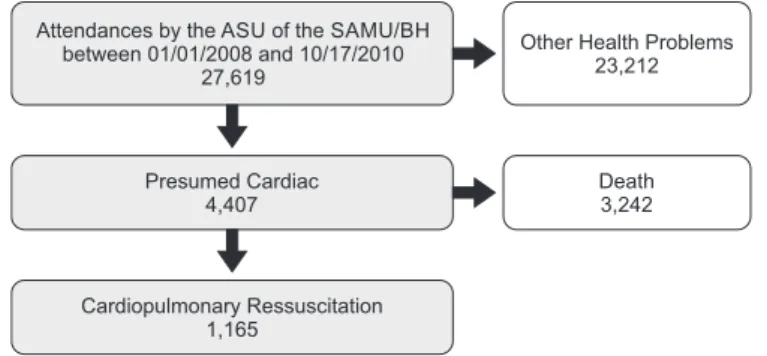
above-mentioned period. The lowchart for inclusion and
determination of the population is presented in Figure 1.
Figure 1 - Flowchart for determination of the attendances made to
victims of cardiac arrest who received cardiopulmonary resuscitation
from the Advanced Support teams of the Mobile Emergency Medical
Service of Belo Horizonte. Belo Horizonte, MG, Brazil, 2008-2010 Attendances by the ASU of the SAMU/BH
between 01/01/2008 and 10/17/2010 27,619
Presumed Cardiac 4,407
Cardiopulmonary Ressuscitation 1,165
Death 3,242 Other Health Problems
23,212
The data collection instrument was constructed
based on the Utstein style(4), a guide for international
use, already translated and validated in the Portuguese
language(5), created to guide and standardize studies in
the area of CA and thus to allow comparisons to be made
between the studies undertaken. The hospital records
from which the data were compiled were not formatted
with all the variables determined by the Utstein style(4),
with: sex, age, response time (time between the call to
Emergency Medicine Service (EMS) until the its arrival
on site), witnessed CA, irst monitored cardiac rhythm,
the CPR attempted prior to the arrival of the advanced
support teams, deibrillation, drugs and the return of
spontaneous circulation (ROSC) being the variables
used in the original instrument. The category of “not
Rev. Latino-Am. Enfermagem 2014 July-Aug.;22(4):562-8.
The data were collected by the researchers
themselves and were later subjected to statistical
analysis (descriptive analysis and logistic regression)
using the R software, version 2.15.0. Non-conditional
analysis (univariate) was undertaken with the level
of p<0.250 in order to undertake the multivariate
phase which considered p<0.050, used the stepwise
method and selected the following variables: sex,
age, ambulance response time, witnessed CA, CPR
initiated prior to the arrival of the advanced support
teams, the initial cardiac rhythm, the type of
intervention, deibrillation, and the use of epinephrine,
atropine sulfate, and amiodarone hydrochloride. The
explained variable (Y) was whether or not immediate
survival followed the CPR, being characterized by
the evidence of a palpable pulse or measurable
blood pressure in the patient following CPR, in a
pre-hospital environment, until the patient’s admission in a
hospital unit(4).
This study’s research project was approved by the
Ethics Committee of the Federal University of Minas
Gerais (Opinion N. 035.0.410.209-9).
Table 1 - Distribution of the characteristics of the attendances to people who received cardiopulmonary resuscitation
from the teams of the Advanced Support Units of the Mobile Emergency Medical Service of Belo Horizonte, by
period of call-out for Advanced Support Unit, witnessed cardiac arrest prior to the arrival of the Advanced Support
Unit, cardiopulmonary resuscitation prior to the arrival of the Advanced Support Unit, irst monitored cardiac rhythm, and deibrillation. Belo Horizonte, MG, Brazil, 2008-2010
Results
Of the sample studied, 58.9% of the people were
male. Nearly all the records (98.6%) recorded age,
which varied from 18 to 103 years old. The median age
was 64 years (SD=16.6), with 75.0% of the people
being aged up to 76 years old.
Comorbidities were recorded in 37.4% of the
records, and of these, in 37.6%, there were records of
two or more comorbidities. The highest percentage was
for systemic arterial hypertension (18.4%), followed
by heart disease (15.8%), diabetes mellitus (8.8%),
smoking (2.7%), and alcoholism (3.7%).
In relation to the ambulance response time, it was
ascertained that the record was present in 70.6% of the
records and that it varied from 1 to 69.0 minutes; the
median was nine minutes (SD=6.0), and in at least 75.0%
of the occasions it was below or equal to 13.0 minutes.
The characterization of the data on the period of
call-out of the ambulance, witnessed CA, CPR prior
to the arrival of the ASU, the irst monitored cardiac rhythm evaluated by the ASU teams and deibrillation is
presented in Table 1.
Variable n %
Period of call-out of Advanced Support Unit
Morning (06:00-11:59) 342 37.1
Afternoon (12:00-17:59) 253 27.5
Night-time (18:00-23:59) 217 23.6
Very early morning (00:00-05:59) 109 11.8
Not recorded 244 20.9
Witnessed cardiac arrest prior to the arrival of the Advanced Support Unit
Yes 161 29.1
Layperson 65 40.3
Teams of the Mobile Emergency Medical Services 73 45.4
Persons trained in basic life support 23 14.3
No 392 70.9
Not recorded 612 52,5
Cardiopulmonary resuscitation prior to the arrival of the Advanced Support Unit
Yes 565 66
Layperson 19 3.4
Persons trained in basic life support 546 96.6
No 291 34
Not recorded 309 26.5
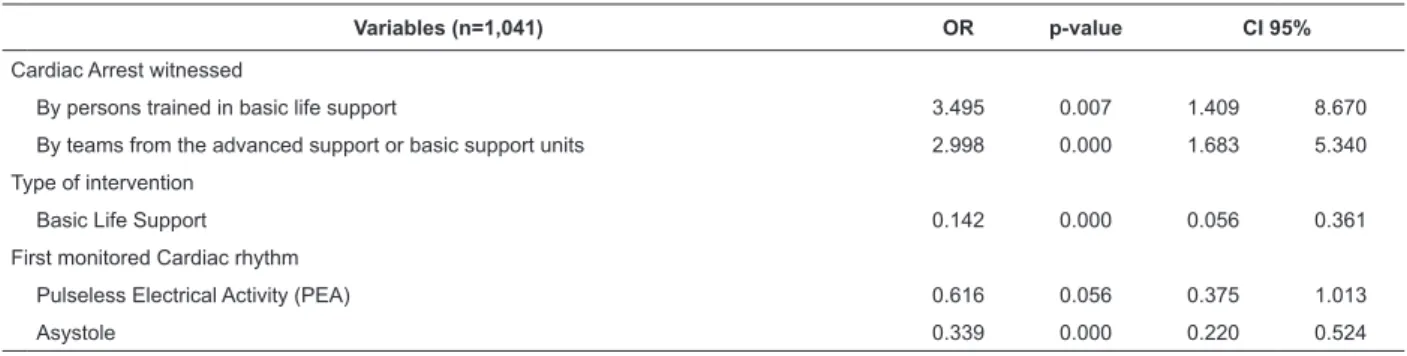
Variables (n=1,041) OR p-value CI 95%
Cardiac Arrest witnessed
By persons trained in basic life support 3.495 0.007 1.409 8.670
By teams from the advanced support or basic support units 2.998 0.000 1.683 5.340
Type of intervention
Basic Life Support 0.142 0.000 0.056 0.361
First monitored Cardiac rhythm
Pulseless Electrical Activity (PEA) 0.616 0.056 0.375 1.013
Asystole 0.339 0.000 0.220 0.524
Variable n %
First monitored cardiac rhythm
Ventricular ibrillation/Pulseless ventricular tachycardia 225 32.2
Pulseless electrical activity (PEA) 124 17.7
Asystole 350 50.1
Not recorded 466 40
Deibrillation
Yes 443 44.1
Automated External Deibrillator 103 23.3
Manual Deibrillator 188 42.4
Automated External Deibrillator and Manual Deibrillator 152 34.3
No 561 55.9
Not recorded 161 13.8
Table 1 - (continuation)
Table 2 - Multivariate model for persons who received Cardiopulmonary Resuscitation from the teams of the advanced
support units of the Mobile Emergency Medical Service of Belo Horizonte, according to immediate survival. Belo
Horizonte, MG, Brazil, 2008-2010
Source: Mobile Emergency Medical Service, Belo Horizonte, MG, Brazil
Source: Mobile Emergency Medical Service, Belo Horizonte, MG, Brazil
It stands out that in a considerable percentage of
iles (40.0%) the irst monitored cardiac rhythm detected
by the advanced support teams was not recorded.
In relation to the use of drugs, epinephrine was
administered to 68.7% of the people during CPR,
followed by atropine sulfate (55.9%) and amiodarone
hydrochloride (21.4%). Medications such as
vasopressin, lidocaine, sodium bicarbonate, calcium
gluconate, and magnesium sulfate, used with a lower
frequency, were grouped in a variable determined
“other medications” and which corresponded to 6.9%
of the cases.
Regarding the outcome of the assistance, in the
pre-hospital environment, the majority of the persons
(78.1%) died.
Table 2 presents the complete model, after the
stepwise method, with the variables selected to make
up the multivariate model.
In accordance with Table 1, it may be ascertained
that in the situations in which the CA was witnessed by
persons trained in basic life support (OR=3.5 p<0.05)
or by teams from the SAMU (OR=3.0 p<0.05) there
is a greater likelihood of immediate survival. However,
when only basic life support was undertaken (OR=0.14
p<0.05) or when the patient’s initial cardiac rhythm
detected by the advanced support teams was asystole
(OR=0.4 p<0.05) this chance was lower.
Discussion
It was veriied that the occurrence of CA in males
was 1.5 times greater than in females. In Brazil, four
studies on the occurrence of CA in the pre-hospital
environment – two in Belo Horizonte/Minas Gerais(3,6),
one in Araras/São Paulo(7) and another in Porto Alegre/
Rio Grande do Sul(8) have reported the occurrence of CA
Rev. Latino-Am. Enfermagem 2014 July-Aug.;22(4):562-8.
The median of 64 years of age found in this study
is in line with studies undertaken in two SAMU in Brazil,
in which medians of 63 and 66 years of age respectively
were found(7-8).
In relation to the morbid antecedents, it was
ascertained that of the iles in which this information
is recorded, systemic arterial hypertension, the
cardiac diseases and diabetes mellitus were the most
prevalent. However, the majority of the patients who
received CPR had no comorbidities reported, which
does not mean that they had none, as family members
or persons present at the time of the attendance
might not have known of the existence of the patient’s
health problems.
In the study undertaken in Araras/São Paulo, the
comorbidities mentioned above were also the most
prevalent; however, the most prevalent was heart
disease followed by systemic arterial hypertension and
diabetes mellitus(7).
The ambulance response time, that is, the time
which passed in minutes between the transmission
of the call to the team by the Dispatch Center until
the arrival of the ambulance in the speciied place is
one of the performance indicators for a pre-hospital
care service.
In this study, the median response time was
nine minutes. In comparing this variable with studies
undertaken previously in the same service, it may
be perceived that there was a reduction in the time
spent travelling, which, in 2007(3) was approximately
10.3 minutes, and was 10.4 minutes in 2010(6). One explanation may be the increase of the leet and of
advanced support equipment for care, which from 2007
to the time of the study increased by three, to six units.
The ambulances’ response times would probably have
been even lower if, in the last few years, the main streets
of the city of Belo Horizonte had not been undergoing
major rebuilding so that the city could host major
sporting events of an international scope. The majority
of the events attended by the advanced support teams
were in the morning period, suggesting that CA occurs
also in this period.
Studies report the relation of the period of the
day to the possibility of occurrences of CA. Authors
have veriied that there is a greater risk of a person
having a CA up to three hours after waking up than in
the other hours of the day. This is due to an increase in
blood pressure and cardiac frequency, which raises the
muscle tone, the viscosity of the blood and the platelet
aggregation(9-10).
The CA was witnessed by somebody (29.1%), in
the majority of cases this being by lay persons. A similar
situation was found in the studies undertaken in Araras/
São Paulo(7) and Porto Alegre/Rio Grande do Sul(8),
in which the authors reported 35.17% and 28.0%,
respectively.
CPR was undertaken prior to the arrival of the
advanced support teams, by members of the basic
support teams, who are people trained in basic life
support, and to a lesser degree by lay persons.
It is perceived that although the doctors of this
service provide telephone guidance for people on how
to proceed until the ambulance arrives, this guidance
is not always followed. Emotional imbalance due to the
situation, lack of appropriate skill for undertaking CPR,
and the possibility of the victim being a close relative
often stop lay persons from functioning appropriately(6).
It is extremely important to train people to be able
to act when faced with a CA, as undertaking CPR, until
the emergency medical service arrives, can increase the
victim’s chances of survival(11).
Ventricular ibrillation (VF) and ventricular
tachycardia without a pulse (VT), frequently, are the
rhythms found in persons with witnessed CA, as a result
of which it is extremely important that both CPR and
deibrillation should be undertaken at an early stage. The
chance of survival reduces by 7.0%-10.0% with each
minute of delay in deibrillation, and pulseless VF/VT can
deteriorate to asystole as time passes, but undertaking
CPR can prolong pulseless VF/VT, thus increasing the
chances of successful deibrillation(12).
The advanced support teams verify the cardiac
rhythm of the victim of CA during the irst approach on
the scene. This rhythm is not necessarily the same as
the initial rhythm in the CA, given that it is veriied some
minutes after the CA occurs, except in those cases of CA
witnessed by this team.
The use of epinephrine, atropine sulfate and
amiodarone hydrochloride was reported; these are
medications commonly used in assisting persons with
CA. Epinephrine is generally used in all the CA rhythms;
amiodarone, an antiarrhythmic, is only used in those
situations in which pulseless VF/VT does not respond to
the electric shock(1,13).
It is important to report that with the publicizing
of the Guidelines for Cardiopulmonary Resuscitation
and Emergency Cardiovascular Care in October 2010,
atropine stopped being the drug of choice for attending
CA(13). At the time of this study, however, it was used for
It is noted that the percentage of immediate
survival of the victims in this study was lower than that
identiied (25.1%) in 2005(3) in the same municipality.
However, it was similar to that found (20.0%) in the
study undertaken in Porto Alegre(8).
The most critical factor for patients with CA is
probably the time which passes between the start of the
collapse and the beginning of the treatment, and the
chance of survival is lower if this event is not witnessed
by anybody.
In this study, it was ascertained that the people
who had a CA which was witnessed by somebody trained
in basic life support, or by some member of the SAMU
team had a chance of immediate survival which was 3.5
and 2.9 times higher, respectively, when compared with
people whose CA was not witnessed by these groups.
However, the chance of immediate survival in people who
received only basic life support, or in whom the cardiac
rhythm of asystole was detected by the advanced support
teams, was respectively 7.0 and 3.0 times lower, when
compared with those persons who received – in addition
to basic support – advanced life support, or with those
people who had pulseless VF/VT as their initial cardiac
rhythm. These indings are in consonance with the
study also undertaken in the SAMU/BH, in 2005, which
showed an association between immediate survival, CA
witnessed by the care teams (OR=2.8 p<0.05), and
asystole as the initial rhythm (OR=0.4 p<0.05)(3).
Asystole is frequently considered a rhythm which
conirms death, rather than an arrhythmia to be treated,
as the results for survival are bleak(15).
It is important to emphasize that immediate survival
on its own does not imply the patient’s recovery, as there
are other factors which also inluence the outcome(16).
The principal limitations of this study are as follows:
the search for data after the occurrence of the events,
and access only to the information described in the
attendance forms – which may have contributed to the
absence of accurate information on important variables
such as: the exact place where the CA occurred (at
home, public highway, or other), the time when help was
requested by telephone, the duration of the resuscitation,
the time between collapse and deibrillation, and the interval between CA and the administration of the irst
dose of epinephrine. The absence of records of data
whose recording is mandatory according to service
protocols, such as the attendance times, the time when
the team was actioned, the time it arrived, and the
patient’s progression and destination all inluenced the
presentation of the results and the statistical analysis.
Conclusion
This study identiied some factors associated with
immediate survival. It stands out that CA witnessed by
a person trained in basic life support or by the care team
is favorable to the outcome; while “the undertaking of
basic life support alone” and “asystole as the initial
rhythm” are unfavorable.
These indings conirm the importance of having
a well-organized pre-hospital care service, structured
with trained teams, as well as the need for training and
providing guidance to the lay population regarding how
to proceed when faced with a person with CA.
Cardiac arrest is the most serious clinical
emergency and has the worst prognosis; however, it
can be a transitory stage, and is reversible, with the
possibility for patients to recover and return to their
activities. For this, it is important for studies on late
survival (discharge from hospital) and long-term survival
(following discharge) to be undertaken.
References
1. Gonzalez MM, Timerman S, Gianotto-Oliveira R,
Polastri TF, Canesin MF, Lage SG, et al. Sociedade
Brasileira de Cardiologia. I Diretriz de Ressuscitação
Cardiopulmonar e Cuidados Cardiovasculares de
Emergência da Sociedade Brasileira de Cardiologia. Arq
Bras Cardiol. 2013;101(2):Supl 3:1-221.
2. Brião RC, Souza EN, Castro RA, Rabelo ER. Cohort
study to evaluate nursing team performance in a
theoretical test after training in cardiopulmonary arrest.
Rev. Latino-Am. Enfermagem. 2009;17(1):40-5.
3. Morais DA, Carvalho DV, Timerman S, Gonzalez, MM.
Parada cardiorrespiratória em ambiente pré-hospitalar:
ocorrências atendidas pelo Serviço de Atendimento
Móvel de Urgência de Belo Horizonte. Rev Bras Clin Med.
2009;7:211-8.
4. Jacobs I, Nadkarniv BJ, Berg RA, Billi JE, Bossaet
L, Cassan P, et al. Cardiac arrest and cardiopulmonary
resuscitation outcome reports: update and simplification
of the Utstein Templates for resuscitation registries. A
statement for healthcare professionals from a task
force of the Internacional Liaison Committee on
Resuscitation (American Heart Association, European
Resuscitation Council, Heart and Stroke Foundation of
Canada, InterAmerican Heart Foundation, Resuscitation
Councils of Southern Africa). Circulation. 2004;
63(21):3385-97.
5. Garcia AM. Tradução para o português e validação
Rev. Latino-Am. Enfermagem 2014 July-Aug.;22(4):562-8.
Received: Aug. 23rd 2013 Accepted: May 20th 2014
ressuscitação cardiopulmonar no atendimento
pré-hospitalar: Utstein Style [dissertação de mestrado].
São Paulo: Escola de Enfermagem da Universidade de
São Paulo; 2007. 43 p.
6. Corrêa AR. Incorporação do desfibrilador externo
automático no Serviço de Atendimento Móvel de
Urgência de Belo Horizonte, resultados preliminares
[dissertação de mestrado]. Belo Horizonte: Escola de
Enfermagem da Universidade Federal de Minas Gerais;
2010. 71 p.
7. Costa MF. Retorno da circulação espontânea com
uso do desfibrilador externo automático em vítimas
de parada cardiorrespiratória atendidas pelo SAMU do
município de Araras no período de 2001 a 2007 [tese
de doutorado]. São Paulo: Escola de Enfermagem da
Universidade de São Paulo; 2007. 191 p.
8. Semensato G, Zimerman L, Rohde LE. Avaliação
inicial do Serviço de Atendimento de Urgência na cidade
de Porto Alegre. Arq Bras Cardiol. 2011;96(3):196-204.
9. Brooks SC, Schmicker RH, Rea TD, Aufderheide TP,
Davis DP, Morrison LJ. Out-of-hospital cardiac arrest
frequency and survival: Evidence for temporal variability.
Resuscitation. 2010;81(2):175-81.
10. Nakanishi N, Nishizawa S, Kitamura Y, Nakamura T,
Matsumuro A, Sawada T, et al. Circadian, weekly, and
seasonal mortality variations in out-of-hospital cardiac
arrest in Japan: analysis from AMI-Kyoto Multicenter
Risk Study database. Am J Emerg Med. 2011;
29(9): 1037-43.
11. Sasson C, Rogers MA, Dahl J, Kellermann AL.
Predictors of survival from out-of-hospital cardiac
arrest – a systematic review and meta-analysis. Circ
Cardiovasc Qual Outcomes. 2010;3(1):63-81.
12. Monteleone PP, Borek HA, Althoff SO. Electrical
therapies in cardiac arrest. Emerg Med Clin North Am.
2012;30(1):51-63.
13. Neumar RW, Otto CW, Link MS, Kronick SL,
Shuster M, Callaway CW, et al. Part 8: Adult advanced
cardiovascular life support: 2010 American Heart
Association Guidelines for cardiopulmonary resuscitation
and emergency cardiovascular care. Circulation.
2010;122(18 Suppl 3):S729-67.
14. American Heart Association. 2005 American
Heart Association Guidelines for Cardiopulmonary
Resuscitation and Emergency Cardiovascular Care.
Part 7.4: monitoring and medications. Circulation.
2005;112(Suppl 24):78-83.
15. Engdahl J, Holmberg M, Karlson BW, Luepker R,
Herlitz J. The epidemiology of out-of-hospital sudden
cardiac arrest. Resuscitation. 2002;52(3):235-45.
16. Booth CM, Boone RH, Tomlinson G, Detsky AS. Is
this patient dead, vegetative, or severely neurologically
impaired? Assessing outcome for comatose survivors of