J. Shobana et al. IRJP 2 (7) 2011 112-115
IRJP 2 (7) July 2011
Page 112-115
INTERNATIONAL RESEARCH JOURNAL OF PHARMACY
ISSN 2230
–
8407
Available online http://www.irjponline.comResearch Article
STUDY ON PRESCRIBING PATTERNS OF ANTIBIOTICS USED IN THE
MANAGEMENT OF VARIOUS INFECTIOUS DISEASES IN ANDRAPRADESH
M.Preeth
2, J.Shobana
1*
1Department of Hospital and Clinical Pharmacy, Bharat Institute of Technology - Pharmacy, Mangalpally (V) Ibrahimpatnam, Rangareddy Dist, A.P, India
2
Department of Pharmacology, JKK Muniyaraja Medical Research Foundation – College of Pharmacy, Namakkal Dist, Tamilnadu, India
Article Received on: 20/05/11 Revised on: 21/06/11 Approved for publication: 05/07/11
*Shobana John, Email: [email protected]
ABSTRACT
This study examined the pattern of physicians' prescription of antibiotics and its possible effects on infectious diseases as well as physicians' compliance with recommended guidelines. Records of 110 patients (67 males and 43 females) aged 20-89 years (mean: 52.6±14.6) and patients suffering with various Infectious diseases at Krishna Institute of Medical Sciences, over a period of 9 months were randomly selected. Information on antibiotics prescriptions was recorded. The patients were distributed into different age groups. Patients less than 18 years were excluded from the study.
Of the 110 patients studied, 6.3% (07) were on monotherapy and 92.7% (102) on combination therapy. Of the patients on combination therapy, 51.81% (57), 34.54% (38) and 6.3% (07) were on 2, 3 and more than three drugs, respectively. The present study reveals that, Dual therapy Cilastin+Imipenem combination was maximally used in the management of various types of Infectious diseases. In triple therapy Ceftrioxone was used frequently along with Cilastin and Imipenem combination, Likewise 57.14 percent of Piperacillin+Tazobactum combination was used with Cilastin+Imipenem combination in patients taking more than three antibiotics.
Our results are consistent with the previously observed benefits of antibiotics combination therapy, and demonstrate an apparent higher efficacy of Cilastin+Imipenem monotherapy than dual therapy in various infectious diseases in the study population. Major limitations of this work include its retrospective nature and the inability to determine the actual patients' adherence to therapy
KEY WORDS: Prescribing pattern, Cilastin, Imipenem, infectious diseases.
INTRODUCTION
The discovery of compounds with antimicrobial activity was a major advancement in medicine and patient care. These compounds provide doctors with an adjunctive therapy to patients own immune system the principal and perhaps best defense for fighting infectious diseases.1 Antibiotics are the most frequently prescribed drugs among hospitalized patients especially in intensive care and surgical department. Programs designed to encourage appropriate antibiotic prescriptions in health institutions are an important element in quality of care, infection control and cost containment.2-5 Principles of good prescribing are based on sound knowledge and understanding of the Pathophysiology of disease to be treated, and the knowledge6, 7 of risks and benefits of the medicine. Irrational prescribing is a habit, which is difficult to change. Various factors which contribute to irrational prescribing include; lack of unbiased source of information, uncertainty about diagnosis, limited
experience, aggressive drugs promotion by
pharmaceutical industry and patients demand etc.
J. Shobana et al. IRJP 2 (7) 2011 112-115
IRJP 2 (7) July 2011
Page 112-115
pattern systems of various medications especially antibiotics in order to make sure the usage of antibiotics in a rational way. The serious complications and unwanted reactions reported due to inappropriate prescribing of antibiotics, has been found to be increasing predominantly. Hence, these consequences made us to urge in carrying out the study.
MATERIALS AND METHODS
This is a prospective observational study was carried out for a period of 9 months in 110 hospitalized patients by scrutinizing the inpatients case sheets in KIMS Hospital, Secunderabad, Andrapradesh, India. Records of 110 patients (67 males and 43 females) aged between 20-89 years (mean: 52.6 ±14.6) were selected by simple random sampling technique. All the patients treated with Antibiotics for various infections, admitted in Intensive care unit of KIMS hospital, patients who were willing to participate, were included in the study.
Patients below the age of 18 years and patients who are not willing to participate in the study were excluded. Patients were divided into different groups according to their age and sex. Data for the present study was collected by scrutinizing inpatient case sheets. The data collected was analyzed for the prescribing patterns of antibiotics and demographic profile of the patients. The patients enrolled in the study were grouped based on the number of Antibiotics prescribed.
Group 1-Monotherapy-Single Antibiotic was used, Group 2-Dual therapy-Two Antibiotics were used, Group 3-Triple therapy-Three Antibiotics were used and Group 4- More than three Antibiotics were used.
Data are presented as mean ± standard deviation, while categorical data are presented as percentages.
RESULTS AND DISCUSSION
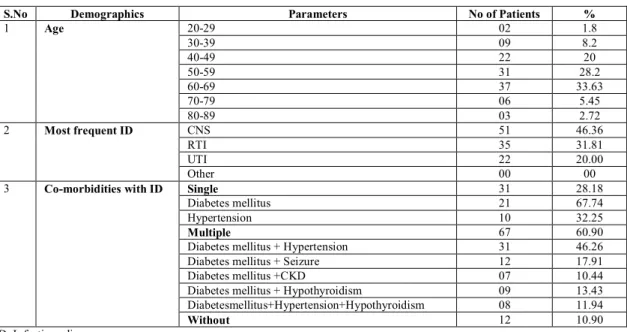
The mean age of patients was 52.3 ± 14.6 years. Of the 110 patients studied, maximum number were in males 67 (60.90%) than females 43 (39.09 %). Careful literature reveals that there is no correlation between gender and occurrence of infections. The most frequent infectious diseases are CNS Infections (46.36%), Urinary tract infections (31.81%), Respiratory Tract Infections (20%). The results revealed that majority of the patients were found with multiple co morbidities with infectious diseases, out of total population 67 patients were found with multiple co morbidities, in this, 31 patients were found with Diabetes mellitus + Hypertension followed by 12 patients with Diabetes mellitus + Seizure, 9 patients with Diabetes mellitus + Hypothyroidism and 8 patients with Diabetes mellitus + Hypertension + Hypothyroidism. Diabetes mellitus was found to be present in 21 patients out of 31 patients having single co morbidity and 10 patients with Hypertension. (Table 1)
Of the 110 patients studied, 6.3% (07) were on monotherapy and 92.7% (102) on combination therapy. Of the patients on combination therapy, 51.81% (58), 34.54% (38) and 6.3% (07) were on 2, 3 and more than three drugs, respectively. The results revealed that the maximum numbers of patients i.e. 58 were underwent dual therapy, 38 patients with triple therapy and 7 patients of each were underwent with More than three and Monotherapy respectively. In order to find out the prevalence of Infectious diseases the age range was divided as per the need. During the study, the maximum number of patients i.e. 37 (33.63 %) was found to be in the age group of 60-69 years.
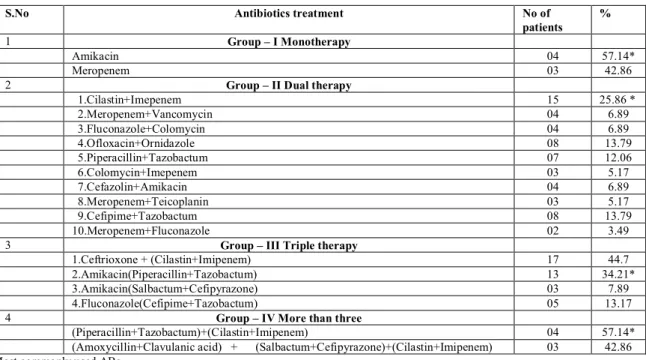
The most frequently prescribed antibiotics as Monotherapy was Amikacin (57.14%) and Meropenem (42.85 %), likewise in dual antibiotic therapy Cilastin+Imipenem combination were used frequently (25.86%) and least used combination was Meropenem+Fluconazole (3.49%). In triple therapy Ceftrioxone + (Cilastin+Imipenem) combination were used in 17 (44.7%) patients, Fluconazole (Cefipime+Tazobactum) combinations were used only in 5 (13.17 %) patients. 4 (57.14%) patients were treated with 4 antibiotics which were found in two fixed dose combination followed by 3 (42.86 %) patients treated with 6 antibiotics which were found in Three fixed dose combinations, that combinations are (Piperacillin+Tazobactum)+(Cilastin+Imipenem) and Amoxicillin + Clavulanic acid) +(Salbactum + Cefipyrazone)+(Cilastin+Imipenem) (Table – 2).
The proportion of patients on combination therapy in the current report (51.81%) is consistent with the value which was found already by researcher, the high prescription rate of combination therapy may be due to the high prevalence of patients with severe and moderate infectious diseases, and the presence of co-morbid diseases, particularly diabetes mellitus. These findings are consistent with the recent trends advocating the use of combination therapy as a first line treatment for many infectious diseases. Our observational study revealed that patients on combination therapy had significantly higher reduction in symptoms for Infectious Diseases than those on monotherapy at the same time it may create lot of further complications esp. in geriatric population. In the current study we were unable to determine the actual drug adherence.
CONCLUSION
J. Shobana et al. IRJP 2 (7) 2011 112-115
IRJP 2 (7) July 2011
Page 112-115
antibiotics in the study population was demonstrated. The present study was restricted only for a period of 9 months so therefore the exact prescription pattern cannot be revealed, in order to do so the study should be carried out for a long period of time.
ACKNOWLEDGEMENTS
We are grateful to the support given to us by the staff of the Krishna institute of Medical sciences Secunderabad. Also, we are grateful to acknowledge the help of the drug information centre, Bharat Institute of Technology –
Pharmacy, in searching of the relevant literature for this study.
REFERENCES
1. Blondeau JM. Appropriate Antibiotic Use: Past lessons provide future directions. In: International congress and symposium series 251; Low DE, The Royal Society of Med. Press Ltd; USA, 2001; pp 1-2.
2. Goldman DA, Weinstein RA, Wenzel RP. Strategies to prevent and control the emergence of antimicrobial resistant micro-organisms in hospital JAMA; 1996; 275: 234-49.
3. Stevenson RC, Blackman SC, Williams CL, Bartzokas CA.
Measuring the saving attributable to an antibiotic prescription policy. J Hosp Infect; 1988; 11: 16-25.
4. Lesar TS, Briceland LL. Survey of antibiotic control policies in university-affiliated teaching institutions. Ann Pharmacotherapy; 1996; 30: 31-4.
5. Strum W. Effects of a restrictive antibiotics policy on clinical efficacy of antibiotics and susceptibility patterns of organisms. Eur J Microbiol Infect Dis; 1990; 9: 381-9.
6. Grahame-Smith DG, Aronson JK. Principles of prescribing and how to write prescriptions, Oxford textbook of clinical pharmacology and drug therapy, 3rded New York: Oxford University Press, 2002; 173-88.
7. Reid JL, Rubin PC, Whiting B. Drug prescription: Legal and practical aspects. In: Reid JL, Rubin PC, Whiting B, editors. Lecture notes on clinical pharmacology. 5th ed. London: Blackwell Science Ltd; 1998.
8. Johnson TD. Free Offers of Antibiotics Raise Concern for Some
in Public Health: Resistance Feared. Nations Health, 2009; 39, 2. 9. Henry FC. General Principles of Antimicrobial Therapy, In: Goodman and Gilman's The Pharmacological Basis of Therapeutics 11th Ed; Laurence L. (ed), McGraw Hill Medical Publishing Division; USA, 2006; PP 1095-1109.
10.Stephen HZ. Minimizing of Development of Resistance with Appropriate Antimicrobial Use In: International congress and symposium series 251; Low DE, The Royal Society of Med, Press Ltd; USA, 2001; 21-27
11.Oshikoya KA, Chukwura HA. Evaluation of outpatient paediatric drug prescriptions in a teaching hospital in Nigeria for rational prescription, Paediatr Perinat Drug Ther, 2006; 7:183-8 12.Nwolisa CE, Erinaugha EU, Ofoleta SI. Prescribing practices of
doctors attending to under fives in a children's outpatient clinic in Owerri, Nigeria J Trop Pediatr, 2006; 52:197-200.
Table No: 1. Demographic Data
S.No Demographics Parameters No of Patients %
1 Age 20-29 02 1.8
30-39 09 8.2
40-49 22 20
50-59 31 28.2
60-69 37 33.63
70-79 06 5.45
80-89 03 2.72
2 Most frequent ID CNS 51 46.36
RTI 35 31.81
UTI 22 20.00
Other 00 00
3 Co-morbidities with ID Single 31 28.18
Diabetes mellitus 21 67.74
Hypertension 10 32.25
Multiple 67 60.90
Diabetes mellitus + Hypertension 31 46.26 Diabetes mellitus + Seizure 12 17.91 Diabetes mellitus +CKD 07 10.44 Diabetes mellitus + Hypothyroidism 09 13.43 Diabetesmellitus+Hypertension+Hypothyroidism 08 11.94
Without 12 10.90
J. Shobana et al. IRJP 2 (7) 2011 112-115
IRJP 2 (7) July 2011
Page 112-115
Table No: 2. Prescribing Pattern of Antibiotics
S.No Antibiotics treatment No of
patients %
1 Group – I Monotherapy
Amikacin 04 57.14*
Meropenem 03 42.86
2 Group – II Dual therapy
1.Cilastin+Imepenem 15 25.86 *
2.Meropenem+Vancomycin 04 6.89
3.Fluconazole+Colomycin 04 6.89
4.Ofloxacin+Ornidazole 08 13.79
5.Piperacillin+Tazobactum 07 12.06
6.Colomycin+Imepenem 03 5.17
7.Cefazolin+Amikacin 04 6.89
8.Meropenem+Teicoplanin 03 5.17
9.Cefipime+Tazobactum 08 13.79
10.Meropenem+Fluconazole 02 3.49
3 Group – III Triple therapy
1.Ceftrioxone + (Cilastin+Imipenem) 17 44.7 2.Amikacin(Piperacillin+Tazobactum) 13 34.21* 3.Amikacin(Salbactum+Cefipyrazone) 03 7.89 4.Fluconazole(Cefipime+Tazobactum) 05 13.17 4 Group – IV More than three
(Piperacillin+Tazobactum)+(Cilastin+Imipenem) 04 57.14* (Amoxycillin+Clavulanic acid) + (Salbactum+Cefipyrazone)+(Cilastin+Imipenem) 03 42.86 *Most commonly used ABs