WHY DOES LANGUAGE MATTER? EVIDENCE FROM EU AND
MERCOSUR TRADE
Sandra Ribeiro1 Maria João Ferro2
ABSTRACT
International trade has been increasing not only due to globalization, but also due to the economic integration process of the past century. However, there are still some barriers that hinder international trade and one of those can be the different languages spoken by both trading partners. Therefore, language may influence the choice of an international trading partner, since it can increase or decrease transaction costs. On the other hand, the creation of trading blocs, such as the European Union (EU) and the Southern Common Market (Mercosur), has enabled national economies to profit from regional trade networks. In this paper we look at the relationship between Portuguese exports and the dominant language in the destination country, while also analysing the influence of belonging to these two trading blocs. Taking a closer look at Portuguese data, we conclude that language similarity plays a relevant role in the choice of international trading partners, as does belonging to the EU.
Keywords: International trade, Language barriers, Multilingualism, Economics of language.
JEL Classification: F14
1. INTRODUCTION
International trade has been steadily growing not only due to globalization in general, but also due to the increasing economic integration of the past century. The creation of trading blocs, such as the European Union (EU) and the Southern Common Market (Mercosur), has enabled national economies to profit from regional trade networks. Communicating within a wider market, however, implies facing certain barriers that hinder trade between different countries, and one of these ― certainly the biggest one ― is language, or better still, the different languages spoken in foreign markets.
Formal relationships between the EU and the Latin American countries that comprise Mercosur date back to the early formation the European Economic Community (EEC) with the Treaty of Rome signed in 1957. As early as that, the Member States of the EEC started to establish and intensify trade and economic relations with Latin American countries, supporting regional Latin American integration processes and entering into cooperation agreements with the regional groups that had formed in the region (Pinto, 2008). In the 1970’s some advances were made regarding the relations between the EEC and Latin America. According to Saraiva (2004), that group of European countries was interested in finding and securing new markets for their exports and investment, while simultaneously guaranteeing access to raw materials; Latin-Americans, in turn, were undergoing a process of diversification of foreign partners and wished to find other options besides the United States. However, and as Saraiva stresses, these relationships remained only intentions that were not materialized at the time.
Only three decades later, did the EU formally initiate freed trade negotiations with Mercosur. However, these negotiations that had started in 1995 with the EC-Mercosur Cooperation Agreement3 with the purpose of promoting free trade, investment, economic cooperation, and political dialogue between the two organizations were suspended in 2004, to be resumed only in 2010.
1
Universidade Autónoma de Lisboa/OBSERVARE and Instituto Superior de Contabilidade e Administração de Lisboa (ISCAL), [email protected].
2 Instituto Superior de Contabilidade e Administração de Lisboa (ISCAL) and Centro de Linguística da Universidade Nova de Lisboa (CLUNL), [email protected]
3
Foreign trade between the EU and Mercosur countries represents almost as much as foreign trade between the EU and the remaining Latin American countries as a whole. The EU was the first trading partner of Mercosur and is still its main investor. According to data provided by the World Bank, the EU ― Mercosur’s main trading partner ― was responsible for around 19.8% of Mercosur’s foreign trade in 2013. However, Mercosur was only the eighth trading partner of the EU in terms of the global market.
Considering the important and undeniable trade relationship between the EU and Mercosur and taking into account language barriers that may hinder international trade, this paper seeks to explore the role of language in international trade, with particular emphasis on the two trading blocs presented above, since Portuguese is an official language in both of them given that Portugal belongs to the EU and Brazil belongs to Mercosur. Our aim is to analyse trade between Portugal and Mercosur, and Portugal and the EU, focusing on whether language similarity (the fact that two countries share the same or a very similar language) has a positive influence on the volume of Portuguese exports to those countries. Our study was based on the following three main hypotheses:
H1: Portuguese exports are higher to countries that belong to the EU.
H2: Portuguese exports are higher to countries that belong to Mercosur.
H3: Considering only EU Member States, Portuguese exports are higher to those where language similarity with Portuguese can be identified.
In order to test the above-mentioned hypotheses, we have analysed data regarding trade between Portuguese companies and the 98 main countries to which these companies export. This paper is divided into eight sections. After this introduction, the first section contains a brief overview of language policies in the EU and Mercosur. After that, we offer some comments on the trade relationships that Portugal has with the two trading blocs we are focusing on ― the EU and Mercosur. The next section describes what we mean by language similarity and why that is important when it comes to international trade. Following this, we detail the study we have carried out, starting by describing the gravity model of trade, characterizing the variables we used, and ending with a discussion of the results we obtained. At the end of this paper, we offer some final remarks and new avenues of research.
2. LANGUAGE POLICIES IN THE EU AND MERCOSUR
2.1 Language policies in the EU
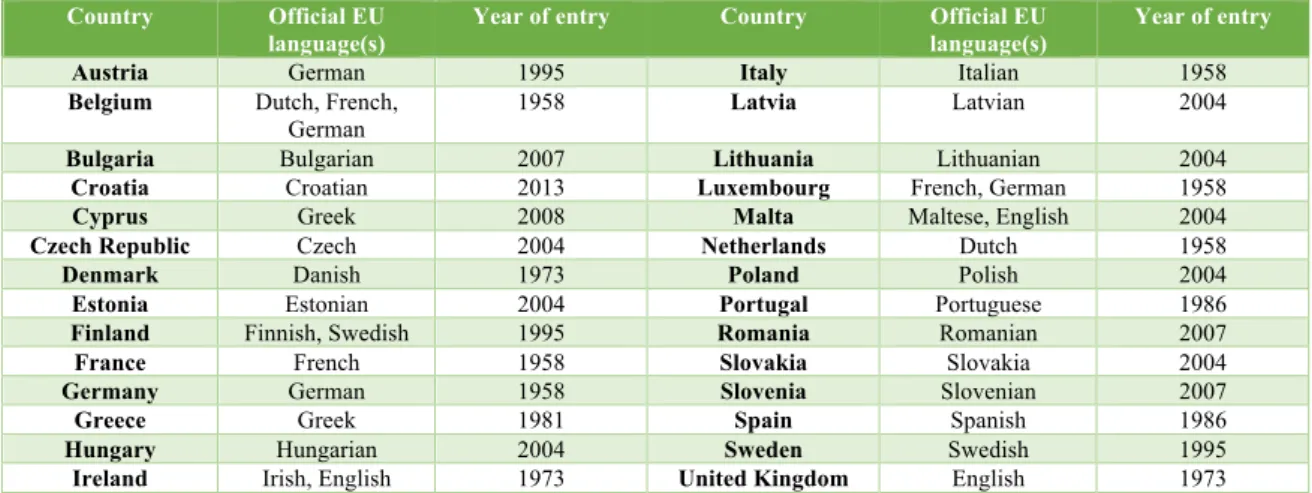
The EU currently has 24 official and working languages stemming from its language policy that relies on adding the necessary new language(s) whenever a new Member State is accepted. Starting from the first initial group of four official and working languages used in the European Coal and Steel Community and the subsequent European Economic Community (EEC) into which it evolved ― Dutch, French, German, and Italian ― by the time the Treaty on the European Union was signed in Maastricht in 1992, this group included twelve languages, with the addition of Danish, English, Finnish, Greek, Irish, Portuguese, Spanish, and Swedish. After these languages were added to the group of official and working languages of European institutions, as more countries were accepted into the EU, this number increased, although the EU has less official languages than Member States (28 at the moment) because some of these Member States share common languages ― e.g. Austria and Germany share German as their respective sole official language, but German also has the status of official language in Belgium and Luxembourg; these latter two countries also share French as their official language, which is logically the official language of France; and Belgium has a third official language, Dutch, which it shares with the Netherlands. This goes to show that these six countries (Austria, Germany, Belgium, Luxembourg, France, and Netherlands) contribute with only three languages (German, French, and Dutch) for the number of official EU languages.
languages in which the Treaty is drafted is recognised as an official language in one or more of the Member States of the Community’. The remaining articles of this regulation grant the citizen’s right to address community institutions in the official language of their country, to receive a reply in that same language, and to have access to community legislation in that language via the Official Journal of the Community, which is to be drafted in the official languages of the community (four at the time, as we have seen).
Table 1 below presents an overview of the official EU languages of the current 28 members of the EU, and their respective year of entry.
Table 1. Member countries of the EU by alphabetical order
Country Official EU
language(s)
Year of entry Country Official EU
language(s)
Year of entry
Austria German 1995 Italy Italian 1958
Belgium Dutch, French, German
1958 Latvia Latvian 2004
Bulgaria Bulgarian 2007 Lithuania Lithuanian 2004 Croatia Croatian 2013 Luxembourg French, German 1958 Cyprus Greek 2008 Malta Maltese, English 2004 Czech Republic Czech 2004 Netherlands Dutch 1958
Denmark Danish 1973 Poland Polish 2004
Estonia Estonian 2004 Portugal Portuguese 1986 Finland Finnish, Swedish 1995 Romania Romanian 2007
France French 1958 Slovakia Slovakia 2004
Germany German 1958 Slovenia Slovenian 2007
Greece Greek 1981 Spain Spanish 1986
Hungary Hungarian 2004 Sweden Swedish 1995
Ireland Irish, English 1973 United Kingdom English 1973 Source Based on data provided by the EU’s official website (Europa.eu). Last update 01/05/2017.
The number of official languages of the EU, however, could be much higher, since some of its Member States have more than one official language. Article 8 of Council Regulation No. 1 of the EEC states that ‘If a Member State has more than one official language, the language to be used shall, at the request of such State, be governed by the general rules of its law’. This implies that for a language to become an official language of the EU, the Member State has to make such a request. This restriction has left out, for example, Luxembourgish, which has been official in Luxembourg since 1984. Nonetheless, some regional languages, such as Basque, Catalan, and Galician spoken in Spain, and Scottish Gaelic, and Welsh, spoken in the United Kingdom, have attained the status of co-official languages of the EU by request of Spain and the United Kingdom, respectively.
2.2 Language policies in Mercosur
In Latin America, the economic integration process dates back to 1948, when the Economic Commission for Latin America and the Caribbean (ECLAC) was created in order to promote customs union by introducing the concept of regional cooperation. Subsequently, the Latin American Free Trade Association (LAFTA) was created in 1960 with the aim of forming a free trade zone.
the population’ (Hamel, 2004: 118). Although these data are from 2003, Campos (2016: 871) confirms GDP numbers, stating that Brazil holds ‘a privileged position as the dominant economy, holding around 71% of the share of Mercosur GDP, while Argentina held 26%, Uruguay 2%, and Paraguay 1%’.
Joining countries whose official languages are Spanish and Portuguese, Mercosur ‘is a unique attempt of cultural integration and geolinguistic dynamics in the whole region’ (Hamel, 2004: 116). In line with Council Regulation No. 1 of the EEC, Article 17 of the Mercosur Free Trade Agreement, the founding document signed in 1991, establishes that ‘The official languages of the common market shall be Spanish and Portuguese, and the official version of its working documents shall be that drafted in the language of the country in which each meeting takes place’. The respect for the member’s official language and the promotion of multilingualism within the bloc are therefore at the core of this trade union, reflecting the importance of language not only for identity and cultural reasons, but also in the very specific case of trade dealings. Later on, in 2006, the Ministers of Culture of Mercosur suggested the incorporation of Guaraní as one of the official languages of the bloc, admitting that it is the official language of one of the members of Mercosur (Paraguay amended the status of Guaraní from national language to official language of the country in 1992) and recognizing that it is one of the historical languages of Mercosur. However, most services are only provided in Portuguese and Spanish and not in Guaraní, as is the case of Mercosur’s website (http://www.mercosur.int) since Guaraní is not considered a working language. Table 2 below presents an overview of the official languages spoken in Mercosur’s founding members plus Venezuela and Bolivia.
Table 2. Founding members of Mercosur plus Venezuela and Bolivia
Member Official language(s) Area
(sq km)
Population (inhabitants)
Argentina Spanish 2,780,400 43,886,748
Bolivia Spanish plus 36 indigenous languages (including Guaraní)
1,098,581 10,969,649
Brazil Portuguese 8,515,770 205,823,665
Paraguay Spanish and Paraguayan Guaraní 406,752 6,862,812
Uruguay Spanish 176,215 3,351,016
Venezuela Spanish 912,050 30,912,302
Source Based on data provided by the CIA World Factbook. Population data estimated for July 2016.
As we can gather from the information contained in Table 2 above, Bolivia has a very unique language policy, since Article 5(I) of the Plurinational State of Bolivia's Constitution establishes that:
The official languages of the State are Spanish and all the languages of the rural native indigenous nations and peoples, which are Aymara, Araona, Baure, Bésiro, Canichana, Cavineño, Cayubaba, Chácobo, Chimán, Ese Ejja, Guaraní, Guarasu'we, Guarayu,
Itonama, Leco, Machajuyai-kallawaya, Machineri, Maropa, Mojeñotrinitario, Mojeño -ignaciano, Moré, Mosetén, Movima, Pacawara, Puquina, Quechua, Sirionó, Tacana,
Tapiete, Toromona, Uruchipaya, Weenhayek, Yaminawa, Yuki, Yuracaré and Zamuco.
Article 5(II) further declares that
The Pluri-National Government and the departmental governments must use at least two official languages. One of them must be Spanish, and the other shall be determined taking into account the use, convenience, circumstances, necessities and preferences of the population as a whole or of the territory in question. The other autonomous governments must use the languages characteristic of their territory, and one of them must be Spanish.
between the languages that are considered official in both these organizations is uneven ― in the EU, English and French are the de facto working languages in many instances, while Portuguese has had some difficulties in ascertaining its role in Latin America. Historically, Spanish has enjoyed greater prestige than Portuguese as a cultural, economic, educational, and scientific language in Latin America, while ‘Portuguese was considered to be a less important language for international communication in the view of the Hispanic countries’ (Hamel, 2004: 118). However in recent years, and particularly through the action of the working group on language policies, a plurilingual education has increasingly been offered to citizens in Mercosur’s member countries, promoting Spanish in Brazil and Portuguese in the remaining members of the organization.
3. SOME COMMENTS ON THE TRADE RELATIONSHIPS BETWEEN PORTUGAL AND THE EU AND PORTUGAL AND MERCOSUL
There are many barriers to international trade, and the wider the market where trading possibilities occur, the largest those barriers will be. In this study, we wanted to analyse the physical barriers imposed by the distance that separates two countries that are involved in a trading relationship, as well as the language barriers that result from communication difficulties that arise when the trading partners do not share the same language.
Communication plays a vital role in the establishment of trading relationships ― after selecting the destination country and the adequate trading partner, the company will have to communicate effectively with that partner in order to establish and maintain the commercial relationship, while also being able to deal with that partner in case any problem arises and it has to engage in legal procedures if and when that need arises. In all these cases, and in the after-sales process, communication ― and consequently language ― is essential. Therefore, when both trading partners do not share the same language, a trade barrier will be imposed and it will imply an added cost to be added to the commercial transaction. Conversely, when both partners share the same language, or even a similar language, negotiations between the trading partners will be easier and consequently trade between these partners will increase. Therefore, language similarity contributes to decrease transaction costs, eliminating the need to hire some sort of intermediary. Several authors have stressed the importance of sharing a common language or a similar one to facilitate trade and even when it comes to the selection of foreign trading partners (see, for example Fidrmuc & Fidrmuc, 2016, and Adserà & Pytliková, 2015).
Portugal’s main trading partners have always been European countries (even before Portugal was accepted as a Member State of the EEC) mostly due to the physical proximity between European countries, although the language similarity that Portugal shares with the countries where a Romance language is spoken ― such as Spanish, French, and Italian ― may also play a part. However, we would like to highlight that when Portugal accessed the EEC in 1986, the market share of some Portuguese products significantly decreased in their traditional markets, such as the United Kingdom, Germany, and France, but European countries were still Portugal’s main trading partners due to the increase in the overall volume of Portuguese exports for the set of countries that belonged to that trading bloc at the time. Additionally, it is also important to highlight that before this date, Portugal did not have significant trading relationships with Latin American countries nor was there any significant Portuguese investment in those countries. The exception was understandably Brazil, a country with which Portugal has always maintained close relations mostly due to the former colonial ties that exist between both countries.
In the 1990’s Portuguese trade increased greatly, which worked as the main engine of economic growth of the country. Table 3 below shows the evolution of Portuguese trade in the past eleven years, contrasting exports and imports, and showing the balance of trade.
72%
28% EU
Outros
Table 3. Portuguese international trade of goods and services
Source Based on data provided by Statistics Portugal/Pordata.
The EU is the world leader in terms of international trade and it is the largest exporter of goods and services as well as the largest importer from over one hundred countries. As we have mentioned above, the EU Member States are Portugal’s most important trading partners. As seen on Images 1 and 2 below, the EU represented around 70% of the total Portuguese exports and imports of goods in 2013 (the year of our study).
Source Based on data provided by Statistics Portugal/Pordata. Source Based on data provided by Statistics Portugal/Pordata.
Given the linguistic similarity, the cultural proximity, and the historical ties that exist between Portugal and Brazil and the other Latin American countries, there have always been important commercial relationships between them. However, the trading relationship between Portugal and Mercosur was enhanced when Portugal became a member of the former EEC, which furthered the exchanges between Portugal (and Spain) and Latin American countries (Pinto, 2008).
Considering the countries that form Mercosur, Brazil has always been the main trading partner of Portugal, not only because both countries share the same language, but also due to all the historical and cultural relationships that have tied them throughout the centuries. In fact, of the 30% of Portuguese exports whose country of destination was not in the EU, around 10% were directed at Mercosur.
4. LANGUAGE SIMILARITY AND BILATERAL TRADE
The importance of language to trade is studied within the field of the ‘economics of language’, a concept defined in the 1960’s by Jacob Marschak (1965). Besides international trade, the economics of language also studies how the language(s) spoken by an individual may influence his/her income, particularly in the context of immigration. We have explored this concept elsewhere (see Ferro & Costa, 2016; Ferro & Ribeiro, 2016), but we would like to highlight the insights that the economics of language can bring to international trade.
Among other relevant concerns, the choice of a foreign trading partner has to take into account how partners are going to communicate with each other. Nowadays, technology has greatly facilitated communication across vast distances with the growing access to e-mail, instant messaging services, and even social media. However, language differences still pose a problem in many respects. Let us take the following example: a Portuguese company wishes to communicate with a foreign trading partner based on a country where Portuguese is not widely spoken. In this case, and having eliminated the possibility of communicating in Portuguese, four other strategies may be employed:
i. Each partner may speak his/her language and be understood by the other, who, in turn, will answer in his/her own language ― this is called intercommunication and would be, up to a certain point, possible between Portuguese and Spanish speakers; however, it is not a widely 1996 2001 2006 2007 2008 2009 2011 2012 2013 2014 2015
Exports 25 063 37 502 49 854 54 896 56 223 47 588 61 595 64 372 68 587 70 747 74 064
Imports 31 729 51 119 63 419 67 796 72 993 59 427 68 048 64 204 65 455 68 781 70 950
Balance of trade
-6 666 -13 617 -13 564 -12 900 -16 770 -11 839 -6 452 169 3 132 1 965 3 114
70%
30% EU
Outros
used option due not only to cultural aspects tied with the attitude of Spanish speakers towards Portuguese, but also with the different phonological structure of both languages that clearly makes it harder for Spanish-speaking people to understand spoken Portuguese (particularly European Portuguese);
ii. The trading partners may agree to communicate using one of their respective languages; although English has been gaining momentum as a foreign language in Portugal for the past fifty years, French still is one of the most widely spoken languages in the country (European Commission, 2012) besides belonging to the same language group (Romance language group), and is therefore a viable option for Portuguese companies to communicate with companies based in one of the 29 territories where French is an official language, specifically France, Belgium, and Luxembourg in the EU, but also outside the EU, in territories such as parts of Canada and Switzerland, and in many African nations;
iii. In the absence of a common shared language the trading partners may use a third language, one that is foreign to both of them but in which they can make themselves understood, which may be a lingua franca in their activity sector or in the region where they operate; for a Portuguese company, that language will most probably be English, which is the most widely spoken and learned language in Portugal presently (European Commission, 2012; Eurostat, 2015);
iv. If none of the above direct communication options is possible, a mediator will have to be engaged, and that may be a language professional (such as a translator or interpreter) or someone who acts in that specific market as an intermediary.
When used to explain international trade gravity models usually include some language variable that may correspond to the official languages(s) of the country and/or other widely spoken languages in that country, such as national or regional languages or even widely spread foreign languages. Several studies have already established the relationship between a common language and the volume of trade between two countries (see, for example, Helliwell, 1998; Mélitz, 2008; Egger & Lassmann, 2012; Mélitz & Toubal, 2014).
However, in the absence of a shared common language, even speaking similar languages may act as a facilitator, i.e., when two languages share many common traits (such as Portuguese and Spanish, for example), the speakers of one language will need a lower investment to learn the other language and therefore language policies that promote that may have a positive impact on international trade. Several methods to assess language similarity may be found in the literature, from which we would like to highlight the results of foreign language tests analysed by Chiswick & Miller (2005) in order to create a language similarity table; the Language Barrier Index created by Lohman (2011); Levenshtein’s distance proposed by Isphording & Otten (2013); or the division between open circuit languages and direct communication languages as put forward by Mélitz (2008). All these methods to assess language similarity have the same goal of quantifying language similarity so that it can be used in econometric models as a variable aiming at analysing international trade and therefore going beyond the variable that identifies the same official language shared by both countries, which was used initially.
We have created a method to classify language similarity based on language criteria, specifically etymological criteria, based on which we divided languages according to the language family to which they belong. Since our starting point were Portuguese exports to two trading blocs (EU and Mercosur), we only needed three groups based on the language similarity classification we propose and therefore we divided the countries’ official languages into three groups: Romance languages, Germanic languages, and Other.
5. THE GRAVITY MODEL OF TRADE
distance between them, which is considered one of the most important aspects that indicate the existence of trade barriers.
The basic gravity model correlates the volume of exports between two countries Tij and the economic weight of those two countries as measured by the Gross Domestic Product (GDP) of exporter and importer (GDPiGDPj) and the cost of trade between them, represented by the distance that separates them, Dij (models (1) and (2)), in which i and j indicate the countries. Models (1) and (2) represent the initial model:
Tij = f
GDP!GDP!
D!" (1)
Tij = β0 (GDPi . GDPj)β1 . Dijβ2. eε (2)
The gravity model was first used to analyse international trade in depth, and its theoretical framework was explored by Anderson (1979), Helpman and Krugman (1985), and Kalirajan (1999). The ease of implementation of this model as well as the success it has had in the explanation of trade flows have increased its usage. Therefore, the initial model has been increasingly improved and expanded with several variables that intend to explain bilateral trade. To the initial basic variables considered in the model (GDP and distance) several other variables were added, such as population, GDP per capita (Bergstrand, 1990), and the area of the country.
Most of the models that deal with international trade based on gravity models have expanded the scope of the model and explained exports between two countries depending not only on the variables considered in the basic model, but also on a set of binary variables aiming at measuring ‘qualitative factors’. These variables are called dummy variables and their aim is to introduce a qualitative factor in the study, assigning 1 when the factor/situation is verified and 0 otherwise.
So that these non-quantitative factors can be considered in the explanation of bilateral trade relations, binary variables were also used with the purpose of representing the characteristics of the county, such as cultural proximity, language (Endoh, 1999; Breuss, & Egger, 1999; Nitsch, 2000; Feenstra, 2002), cultural similarity, belonging to the same trading bloc (Breus & Egger, 1999), whether the countries share their borders, or whether there has been a former colonial relationship (Glick & Rose, 2002), among others.
We would like to highlight that the gravity model equation implies taking the logarithms of its variables, which originates, for example, in its expanded form, a log-log model, such as the following equation:
Ln(Tij) = β0 + β1 Ln (GDPi GDPj) + β2 LnDij + β3 Langij + β4 Contij + β5 RTAij + β6 ComColij
+ εij (3)
Where i and j represent the countries and the variables are defined as:
T – volume of trade (considering only exports, only imports, or both) between the two countries;
GDP – real GDP; D – Distance;
Lang – dummy variable that is 1 when i and j share a common language and 0 otherwise; Cont – dummy variable that is 1 when i and j share a common border and 0 otherwise; RTA – dummy variable that is 1 when i and j belong to a free trade area and 0 otherwise; Comcol – dummy variable that is 1 when i and j have had a former colonial relationship and 0 otherwise.
one another. Nascimento and Júnior (2013) argued that dummy variables might be used to capture more than the simple effect of a trading bloc or a trade agreement and can actually be used to capture a number of factors related to the History of the countries or their policies.
6. METHODOLOGY OF THE PRESENT STUDY
Based on the gravity model and aiming at analysing the volume of Portuguese exports, we have used international trade data for 2014 provided by Statistics Portugal (INE) that correspond to real data for 2013. We have analysed data from the 98 main countries of destination where the trading partners of Portuguese companies are based, considering the countries with which the volume of exports was over 10,000 million euros in 2013.
Since the Ordinary Least Squares (OLS) method is the most widely used econometric technique to perform the estimation of specification coefficients in the gravity model in its log-log form, we chose to use it in the present study. The multiple linear regression of the gravity model has been widely used in the past forty years and has proven to be empirically robust since it has broad explanatory power (Kepaptsoglou, Karlaftis & Tsamboulas, 2010).
Therefore, the explained variable in our model is an economic variable that translates the logarithm of the volume of exports between Portugal and a foreign trading partner.
The impact of all the explanatory variables will be analysed with the global significance test (Test F) and the individual significance test (Test T) always considering a significance level of 5%. We have also obtained the value of the determination coefficient (R2); however, and since we did not consider any other potentially relevant variable in our analysis to explain the volume of exports of a country (given that our main aim was to analyse the effect of language similarity), we counted on a reduced value for that.
6.1 Characterization of the variables
We used different types of variables in the regressions we performed:
• Economic: such as the volume of exports between Portugal and a foreign trading partner, real GDP, and whether the trading partner belongs to the same trading bloc;
• Linguistic: specifically the existence of ‘language similarity’ between Portugal and the country to which it exports and the language group to which the official language of the foreign trading partner belongs;
• Geographic: in this case, the distance that separates Portugal from a trading partner.
Data on the volume of exports were obtained though the statistics on international trade published by Statistics Portugal (INE); data regarding real GDP of the different countries were obtained at the official website of the World Bank (www.worldbank.org) characterizing real GDP PPP (purchasing power parity) to prices of 2011 of all the 98 countries included in the study.
We have considered the distance between Portugal and a trading partner in all the models, represented by the kilometres that separate Portugal’s capital, Lisbon, from the capital of the trading partner obtained at a language calculator tool (http://pt.distance.to/), not only due to the explanatory capacity that such variable is expected to have, but also in order to add to the quality of the analysed relationship. Given that we have used the logarithmic variable, the value estimated for this parameter will represent the elasticity of the volume of exports in relation to an absolute geographical distance. We expect the coefficient of this variable to be negative, since it constitutes a barrier to trade given that the greater the distance between two countries, the larger the barrier to the trading relationship will be.
those countries that have Spanish as an official language, which reflects the linguistic similarity between the two languages; and (iii) the countries whose official language is English, and thus we are able to capture the effect of the foreign language that is more widely studied and spoken in Portugal.
Thus, the variable UEProxLingj is a dummy variable that is 1 when country j, a EU Member State,
has Portuguese, Spanish or English as an official language and 0 otherwise.
In line with Ferro and Ribeiro (2016), we have considered the dummy variables Rj, Gj and Oj to identify respectively, the Romance language family, the Germanic language family, and Other families. Since we were interested in isolating the two language families that are more relevant to Portuguese foreign trade, taking into consideration the classification of Portuguese but also the language policies of the country regarding the teaching and learning of foreign languages, we classified the remaining languages as belonging to the group Other, thus eliminating the need for a more detailed classification.
Our aim was to analyse whether there is a direct relation between Portuguese exports to a given country and the language group to which the official language of that country belongs. Therefore, variable Rj is 1 when the country has a Romance language as an official language (and 0 otherwise), and Gj when country j has an official Germanic language. In case any of these variables is 1, variable Oj is 0; conversely, the latter is 1 when the country’s official language does not belong to any of these language families. However, econometrically, this group cannot be used together with the other two variables, since it would cause multicollinearity given the linear relationship that exists between the three independent variables.
7. RESULTS
Based on these data, we have studied the relationship between the volume of Portuguese exports to its 98 main trading partners worldwide in 2013, considering whether these countries belonged to the EU or Mercosur and the language similarity between the official language of these countries and Portuguese, in order to find evidence to test our initial hypotheses.
We started by analysing regression (4) in order to clarify whether the fact that the trading partner (taking into consideration the 98 countries analysed) belonged to the EU influences the volume of Portuguese exports:
Ln(Tij) = β0 + β1 UE+ β2 LnDij + εij (4)
Through the results of the estimation of model (4) (attached as Table 4), we may conclude that, as expected, the fact that the country belongs to the EU has a positive impact on the volume of Portuguese exports and the increased distance has a negative impact on the volume of Portuguese exports, making it decrease by 0.584% for each 1% increase to the number of kilometres. This enabled us to verify H1: Portuguese exports are higher to countries that belong to the EU.
We have amplified the previous model by adding the ‘Mercosur’ variable, which is 1 when the country belongs to Mercosur and 0 otherwise, and which originated regression (5):
Ln(Tij) = β0 + β1 UE+ β2 LnDij + β3 Mercosur + εij (5)
The results obtained in the regression (attached as Table 5) have allowed us to consolidate the conclusions reached in the previous model, since we can state that when a country belongs to the EU it has a positive impact ― even higher than in the previous model ― on the volume of exports and therefore we have strengthened H1. We also concluded that the effect of distance has a negative impact on the volume of exports making them decrease even further, now by 0.621% for each 1% increase to the number of kilometres.
comprise this bloc may function as a barrier to trade; however, the language similarity between these countries might be taken advantage of to promote the volume of trade.
We created a new model (model 6) that intends to conclude on the effect of the impact of language similarity between two countries on the volume of exports (using the Proxling variable) within countries that belong to the EU, and on the effect of real GDP PPP to prices of 2011 for all the 98 countries considered, which originated the following model:
Ln(Tij) = β0 + β1 UEProxLingj + β2 LnDij + β3 LnGDP + εij (6)
By analysing the results of this model (attached as Table 6), we conclude that the quality of the models increases with the introduction of the possibility of the country belonging to the EU, together with what we called language similarity. Thus, we strengthen the positive effect of language similarity to Portuguese exports, an effect that increases when the country belongs to the EU. Additionally, GDP also has a positive effect on the volume of exports, which is in accordance with the initial assumptions of the gravity model.
Taking into consideration only the countries that belong to the EU trading bloc, we have organized them according to the language family to which their official language corresponds, in order to study model (7) below. We would like to highlight that in the case of countries (whether EU Member States or not) that have more than one official language, we chose the official language that has a larger number of speakers to use in our model based on data provided by the CIA World Factbook.
As referred previously, in line with Ferro and Ribeiro (2016), we considered the dummy variables Rj, Gj and Oj to identify respectively the Romance language family, the Germanic language family, and Other families. Our aim was to analyse whether there is a direct relationship between Portuguese exports to a given country and the language group to which the official language of the country belongs.
Ln(Tij) = β0 + β1 Rj + β2 Gj + β3 LnDij + εij (7)
By analysing the results obtained with this model (attached as Table 7), we concluded that the model is overall explanatory and that all the variables have explanatory power. Additionally, these results allow us to stress some points that seem relevant to us:
1. There is a direct relationship between the volume of Portuguese exports and the fact that the destination country has a Romance official language. Since this is also the language group to which Portuguese belongs, this result was expected, given that when two countries share the same language or a very similar one, the language barrier is blurred or even deleted and consequently the transaction costs tend to be lower. Thus, we found evidence for H3 since taking into consideration all the EU Member States the volume of Portuguese exports is higher to countries whose official language is similar to Portuguese.
2. Although with a smaller impact than the Romance group, the Germanic language group also has explanatory capacity. This is tied with the fact that one of Portugal’s main trading partners is the United Kingdom, whose official language, English, is a Germanic language.
3. Although with a smaller explanatory capacity in view of the previous models, distance causes a lower effect on the volume of exports. This situation may be justified by the fact that distance between countries that belong to the EU is not large and therefore its impact is not as significant.
8. FINAL REMARKS
makes communication between speakers of these languages easier. In this scenario, any given native speaker of Portuguese will be able to communicate with speakers from any Mercosur country. Although some work has already been done to foster the dissemination of Portuguese and Spanish throughout all the countries that belong to Mercosur, more should be done in order to promote trading relationships.
We believe that our study contributes to the literature on Portuguese foreign trade, drawing attention to the relationship between Portuguese exports and the language spoken in the country of destination. In order to test the hypotheses identified in the Introduction, we have analysed trade data regarding Portuguese exports to companies based on the 98 main countries to which those exports are targeted. We concluded, as expected, that language is not the only determinant to foreign trade and that although it plays a relevant part in the choice of commercial partners, its relevance is underestimated in the context of Portuguese foreign trade.
In the future, we intend to expand our analysis and include not only the exports of goods, but also imports and services. We believe that our work may be used to inform language policies aiming at promoting stronger relationships between countries that comprise Mercosur, the Community of Portuguese Language Speaking Countries (CPLP), and even African Union (AU) profiting from one of Portugal’s greatest assets, the Portuguese language, which is one of the official languages of each of these three institutions.
ACKNOWLEDGEMENTS
This research was partially developed with the support of FCT - Fundação para a Ciência e Tecnologia, as part of the project Centro de Linguística da Universidade Nova de Lisboa - UID/LIN/03213/2013.
REFERENCES
Adserà, A., & Pytlikova, M. (2015). The role of language in shaping international migration. The Economic Journal, 125(586), F49-F81.
Aitken, N. D. (1973). The Effect of the EEC and EFTA on European Trade: A temporal cross-section analysis. The American Economic Review, 63(5), 881-892.
Anderson, J. E. (1979). A theoretical foundation for the gravity equation. The American Economic Review, 69(1), 106-116.
Bergstrand, J. H. (1990). The Heckscher-Ohlin-Samuelson model, the Linder hypothesis and the determinants of bilateral intra-industry trade. The Economic Journal, 100(403), 1216-1229. Bolivia (Plurinational State of)'s Constitution of 2009. [26-04-2017]. Available at WWW:
<https://www.constituteproject.org/constitution/Bolivia_2009.pdf>
Breuss, F., & Egger, P. (1999). How reliable are estimations of East-West trade potentials based on cross-section gravity analyses? Empirica, 26(2), 81-94.
Campos, G. L. (2016). From success to failure: Under what conditions did Mercosur integrate? Journal of Economic Integration, 31(4), 855-897.
Chiswick, B. R., & Miller, P. W. (2005). Linguistic distance: A quantitative measure of the distance between English and other languages. Journal of Multilingual and Multicultural Development, 26(1), 1-11.
CIA (2013). The World Factbook 2013-14. Washington, DC: Central Intelligence Agency. [26-04-2016]. Available at WWW: <https://www.cia.gov/library/publications/the-world-factbook/index.html>.
Council Of The European Economic Community (1952). Regulation No 1 determining the languages to be used by the European Economic Community, Official Journal of the European Communities, series I, volume 1952-1928, 59.
Egger, P. H., & Lassmann, A. (2012). The language effect in international trade: A meta-analysis. Economics Letters, 116(2), 221-224.
European Commission (2012) Europeans and their languages. Special Eurobarometer 386. Directorate-General for Communication. [29-03-2016]. Available at WWW: < http://ec.europa.eu/public_opinion/archives/ebs/ebs_386_en.pdf >.
Eurostat (2015). News release, 164/2015. Eurostat Press Office. [25/03/2016]. Available at WWW: < URL: http://ec.europa.eu/eurostat/documents/2995521/7008563/3-24092015-AP-EN.pdf > Feenstra, R. C. (2002). Border effects and the gravity equation: Consistent methods for estimation.
Scottish Journal of Political Economy, 49(5), 491–506.
Ferro, M. J., & Costa, R. (2016). The economic value of language. In O. Gomes & H. F. Martins (Eds.). Advances in applied business research: The L.A.B.S. Initiative (pp. 187-216). New York: Nova Publishers.
Ferro, M. J., & Ribeiro, S. (2016). The role of language in international trade: How does language affect the choice of foreign trading partners? In. S. N. de Jesus & P. Pinto (Eds.). Proceedings of the International Congress on Interdisciplinarity in Social and Human Sciences (pp. 608-621). Universidade do Algarve, Faro, 5 and 6 May, 2016.
Fidrmuc, J., & Fidrmuc, J. (2016). Foreign languages and trade: Evidence from a natural experiment. Empirical Economics, 50(1), 31-49.
Floroiu, M. (2014). Mercosul: Latin-American Union. Public Administration & Regional Studies, 1(13), 26-33.
Glick, R., & Rose, A. K. (2002). Does a currency union affect trade? The time-series evidence. European Economic Review, 46(6), 1125-1151.
Hamel, R. E. (2004). Regional blocs as a barrier against English hegemony? The language policy of Mercosur in South America. In J. Maurais & M. A. Morris (Eds.). Languages in a globalising World (pp. 111-142). Cambridge: Cambridge University Press.
Helliwell, J. F. (2000). How much do national borders matter? Washington: Brookings Institution. Helpman, E., & Krugman, P. R. (1985). Market structure and foreign trade: Increasing returns,
imperfect competition, and the international economy. Cambridge, MA & London: The MIT Press.
Isphording, I. E., & Otten, S. (2013). The costs of Babylon: Linguistic distance in applied economics. Review of International Economics, 12(2), 354-369.
Kalirajan, K. (1999). Stochastic varying coefficients gravity model: An application in trade analysis. Journal of Applied Statistics, 26(2), 185-193.
Kepaptsoglou, K., Karlaftis, M. G., & Tsamboulas, D. (2010). The gravity model specification for modeling international trade flows and free trade agreement effects: A 10-year review of empirical studies. The Open Economics Journal, 3, 1-13.
Lohmann, J. (2011). Do language barriers affect trade? Economics Letters, 110(2), 159-162. Marschak, J. (1965). The Economics of Language. Behavioral Science, 10(2), 135-140. Mélitz, J. (2008). Language and foreign trade. European Economic Review, 52(4), 667-699.
Mélitz, J., & Toubal, F. (2014). Native language, spoken language, translation and trade. Journal of International Economics, 93(2), 351-363.
Nascimento, F., & Júnior, D. P. (2013). A evolução do modelo gravitacional na economia. Revista Saber Humano: Revista Científica da Faculdade Antonio Meneghetti, 3(4), 163-175.
Nitsch, V. (2000). National borders and international trade: Evidence from the European Union. Canadian Journal of Economics, 33(4), 1091-1105.
Pinto, M. S. (2008). Os interesses de Portugal no contexto das relações União Europeia: Mercosul. Cadernos de Estudos Latino-Americanos, 4,111-129.
Polak, J. J. (1996). Is APEC a natural regional trading bloc? A critique of the ‘gravity model of international trade’. The World Economy, 19(5), 533-543.
Saraiva, M. (2004). A União Europeia como ator internacional e os países do Mercosul. Revista Brasileira Política Internacional, 46(1), 84-111.
Southern Common Market (Mercosur) Agreement (1991). [26-04-2017]. Available at WWW: < https://idatd.cepal.org/Normativas/MERCOSUR/Ingles/Treaty_of_Asuncion.pdf>.
APPENDICES
Table 4. Results of the estimation of model (4) Explanatory variables Ln Exports
OLS Coefficient Standardized coefficient (Beta)
Constant 15,954
(2,014)
---
UE 0,863
(0,396)
0,24
LnDij -0,584
(0,233)
-0,275
F = 12,542
Table 5. Results of the estimation of model (5) Explanatory variables Ln Exports
OLS Coefficient Standardized coefficient (Beta)
Constant 16,224
(2,034)
---
UE 0,875
(0,396)
0,243
LnDij -0,621
(0,237)
-0,292
Mercosur 0,668
(0,697)
0,089
F = 8,661
Table 6. Results of the estimation of model (6) Explanatory variables Ln Exports
OLS Coefficient Standardized coefficient (Beta)
Constant 15,563
(1,702)
---
UEProxLing 0,634
(0,251)
0,235
LnDij -0,788
(0,199)
-0,376
LnPIB 0,078
(0,027)
0,263
F = 12,828
Table 7. Results of the estimation of model(7) Explanatory variables Ln Exports
OLS Coefficient Standardized coefficient (Beta)
Constant 19,873
(5,388)
---
Rj 2,532
(0,843)
0,565
Gj 1,566
(0,574)
0,425
LnDij -1,137*
(0,679)
-0,284
F = 10,297 R2 = 0,553