Time standards of nursing in the Family Health Strategy: an observational study
* Extracted from the thesis “Planejamento da força de trabalho de enfermagem na Estratégia de Saúde da Família: indicadores de carga de trabalho”, Universidade de São Paulo, Escola de Enfermagem, 2014. Prêmio Destaque USP 2015 Award-winning.
1 Universidade de São Paulo, Escola de
Enfermagem, Departamento de Orientação Proissional, São Paulo, SP, Brazil.
2 Universidade de São Paulo, Escola de
Enfermagem de Ribeirão Preto, Ribeirão Preto, SP, Brazil.
ABSTRACT
Objective: To determine time standards for interventions and activities conducted by nursing professionals in Family Health Units (FHU) in Brazil to substantiate the calculation of work force. Method: his was an observational study carried out in 27 FHU, in 12 municipalities in 10 states, in 2013. In each unit, nursing professionals were observed every 10 minutes, for eight work hours, on ive consecutive days via the work sampling technique. Results: A total of 32,613 observations were made, involving 47 nurses and 93 nursing technicians/assistants. Appointments were the main intervention carried out by nurses, with a mean time of 25.3 minutes, followed by record-keeping, which corresponded to 9.7%. On average, nursing technicians/assistants spent 6.3% of their time keeping records and 30.6 intervention minutes on immunization/vaccination control. Conclusion: he study resulted in standard times of interventions carried out by the FHU nursing team, which can underpin the determination of nursing staf size and human resource policies. Furthermore, the study showed the panorama of interventions currently employed, allowing for the work process to be reviewed and optimized.
DESCRIPTORS
Primary Health Care; Community Health Nursing; Public Health Nursing; Health Manpower; Workload.
Time standards of nursing in the Family Health
Strategy: an observational study*
Padrões de tempo médio das intervenções de enfermagem na Estratégia de Saúde da Família: um estudo observacional
Estándares de tiempo medio de las intervenciones de enfermería en la Estrategia de Salud de la Familia: un estudio observacional
Daiana Bonfim1, Fernanda Maria Togeiro Fugulin1, Ana Maria Laus2, Marina Peduzzi1, Raquel Rapone Gaidzinski1
How to cite this article:
Bonfim D, Fugulin FMT, Laus AM, Peduzzi M, Gaidzinski RR. Time standards of nursing in the Family Health Strategy: an observational study. Rev Esc Enferm USP. 2016;50(1):118-26. DOI: http://dx.doi.org/10.1590/S0080-623420160000100016
Received: 10/01/2015 Approved: 12/14/2015
ORIGINAL ARTICLE DOI: http://dx.doi.org/10.1590/S0080-623420160000100016
Corresponding author: Daiana Bonfim
Escola de Enfermagem da USP Av. Dr. Enéas de Carvalho Aguiar, 419 Cerqueira César
INTRODUCTION
here are few studies on how nursing professionals spend their working time in primary health care units. On the other hand, there is a notorious need for information to underpin managerial decision making, both in terms of workforce planning and when analyzing and implementing changes in nursing practices, in accordance with advances proposed for healthcare models.
In Brazil, primary health care (PHC) has grown via the Family Health Strategy (FHS). Between 1981 and 2008, the search for primary care services by Brazilians increased approximately 450%(1). In 2011, 95% of Brazilian
munici-palities and 53% of the Brazilian population were covered by the FHS(2).
In the FHS, teams are multiprofessional and composed at the least by a general practitioner or physician specialized in family health or a family and community physician, a general nurse or nurse specialized in family health, a nursing technician or assistant, and four community health agents. Dental professionals are sometimes part of this multiprofes-sional team, and include general or amily health surgeon-dentists and a dental assistant and/or technician. hese pro-fessionals hold 40-hour working weeks at the FHS, with the exception of medical professionals, whose workload can be re-distributed among other municipal health services(3).
his team is responsible for 4,000 people at the most, be-ing that the recommended average is 3,000. his number is calculated by respecting equity criteria and has recently changed to 2,000 people per team(4).
Several studies have described positive evidence of the implementation of the FHS(5-6). However, they emphasize
that one of the greatest obstacles to its efective consolida-tion lies in the quantitative and qualitative lack of profes-sionals prepared to deal with the new attributions required by this care model(7).
Furthermore, the parameters recommended nationwide regarding the FHS staf size do not always meet local epi-demiological characteristics and the demands of the health surveillance model(8). herefore, predicting the necessary
number of professional to meet the demands of a family health unit (FHU) is not an easy task.
Workforce planning in health is a broad and complex issue, which involves not only a technical process, but also a political and ethical one. he latter depends on values that relect the political, economic and social choices that are at the basis of a healthcare system. Such planning re-quires seeking balance between available workforce and that necessary to carry out health services. Estimating the number of professionals and the skills needed in order to reach health policies and goals requires a systematic process, which requires monitoring, ongoing assessment, and evi-dence to underpin the process, with reliable and accessible data on the work conducted by professionals.
he mean time of care to meet the needs of users, fami-lies and the community is the central variable in health staf-ing methods. However, many measures of time are based only on the professional judgment or experience. here is a
lack of studies that use objective and empirical time mea-sures of interventions/activities carried out by the FHS.
Current methods such as the Workload Indicators of Staing Need (WISN)(9), proposed by the World Health
Organization (WHO), have been employed in health or-ganizations in several countries, advancing the proposal of workforce planning for all team members, which indicates great promise for its applicability in the FHS. Its main vari-able is based on time standards, i.e., the time needed for a trained, qualiied and motivated professional to conduct an intervention or activity according to satisfactory profes-sional standards under the conditions and circumstances of each location(9).
Before this scenario, the aim of the present study was to determine time standards of interventions/activities carried out by nursing professionals in FHU in Brazil in order to substantiate workforce calculation.
METHOD
his was an observational study conducted via the work sampling technique. It is recommended that in research on time of work of health professionals, data be collected from services that follow good practices. hus, for this study, we chose an intentional sample, based on the following crite-ria: geographic location, the presence of a complete family health and dental health team, having received a great as-sessment in the irst cycle of the Primary Care Access and Quality Improvement Program (PMAQ-AB).
In order to ensure greater comparability of performance among teams, the PMAQ considered the diversity of so-cioeconomic, epidemiological and demographic scenario, in addition to diferences between participating municipali-ties and speciicimunicipali-ties of the responses demanded from local health systems, classifying each municipality into diferent strata considering social, economic and demographic as-pects. To this end, an index from zero to ten was created, composed of ive indicators: gross domestic product (GDP) per capita (weight 2), percentage of the population with health insurance (weight 2), percentage of the population who beneit from the government’s Family Grant (Bolsa Família) program (weight 1), percentage of the population living in extreme poverty (weight 1) and demographic den-sity (weight 1)(10).
Demographic socioeconomic strata were deined as fol-lows: Stratum 1 (score lower than 4.82 and population up to 10,000); Stratum 2 (score lower than 4.82 and population up to 20,000); Stratum 3 (score lower than 4.82 and popu-lation up to 50,000); Stratum 4 (score between 4.82 and 5.4 and population up to 100,000 and municipalities with a score lower than 4.82 and a population between 50,000 and 10,000); Stratum 5 (score between 5.4 and 5.85 and popu-lation up to 500,000; and municipalities with scores lower than 5.4 and population between 100,000 and 500,000); and Stratum 6 (population over 500,000 or score equal or greater than 5.85)(10).
Time standards of nursing in the Family Health Strategy: an observational study
nursing technicians/assistants who were present at the time of data collection and agreed to participate in the survey. Nurses who worked exclusively in management positions were excluded from the sample.
Prior to data collection, a ield visit was conducted with the goal of planning data collection logistics, presenting the study to FHU professionals and clarifying that at no point was the quality of service provision being assessed, as that had already been done by PMAQ and the unit in focus had been considered of excellence. During the entire data col-lection process, this premise was reinforced, thus minimiz-ing the reactivity of professionals to the direct observation of their work.
he minimum ratio of ield researchers, considering the minimum team proposed for FHU, consisted of one super-visor and one observer for every six professionals. Priority was given to arrangements in which the observer accompa-nied the same professional category and the same profes-sionals throughout the entire data collection period.
he observers did not establish prior contact with FHU professionals. Observations were non-participant and pro-fessionals were only asked questions about activities when something was not clear to the observers.
Data were collected through structured, non-participant observation and the interventions and activities were re-corded every ten minutes, throughout the entire work shift at the unit (8 hours per day), for a full workweek (5 days) between March and October 2013.
he instrument used to gather data was developed and validated for a FHS team (physician, nurse, surgeon-den-tist, nursing technician/assistant, dental technician/assis-tant, and community health agent). Data were collected on the time of 39 health interventions, unit related activities, standby time and absences. his instrument was encoded and computerized, which allowed us to record the observa-tions on tablets(11).
he observers consisted of nurses who underwent 20 hours of theoretical and practical training. Interobserver reliability was conducted during data collection.
For interventions conducted outside the FHU, such as home visits or community groups, the observers did not accompany the professional, only recording the amount of time spent at the intervention. To ensure better control, the professionals were asked to inform their observers about when they were leaving and when they returned. Conversa-tions among professionals inside the oices were presumed to be of professional nature.
Researchers were provided with the following manda-tory material: a lab coat with “researcher” written on it, a badge and a tablet. Observers had the right to a one-hour lunch break and other breaks for personal needs, being cov-ered by the ield supervisor as the facilitator, ensuring a good data collection process and carrying out the reliability test.
his study was approved by the São Paulo School of Nursing research ethics committee (no. 170278) and the municipal secretariats of health. All procedures abided by the guidelines set forth in National Health Council Resolu-tion no. 466, of December 2012.
he data were statistically analyzed by strata, grouped from 1 to 4, 5 and 6, considering the total number of FHU sampled in Brazil. his was done to ensure greater equity to the comparison between FHUs, in addition to providing time parameters that could be applied to diferent realities.
he following adjustments were made to calculate the mean time of interventions/activities:
Standby time was distributed proportionally among in-terventions that involve time waiting for late and absent users, or when professionals are scheduled for that type of care, as commonly occurs in the immunization room. Inter-ventions that received this additional time were: assisting in tests/procedures, attending to spontaneous demands, con-sultations, immunization/vaccination control, outpatient procedures and home visits.
Personal time was distributed among all of the care in-terventions and activities and associated activities, as the literature has shown the importance of such time in issues regarding workers’ health and job satisfaction.
he times for each intervention/activity according to professional category were obtained by the following equa-tions:
Equation 1:
TO = NO × 10 min
TO = Time of Observation for each intervention/activity; NO = Number of observed samples.
*10 minutes refers to the interval of time used in the work sampling technique.
Equation 2:
TP i =
TOi + TERi + TPRi
NOi Where:
TPi = Mean time of intervention i; TO
i = Total time of observation for intervention i; TERi = Standby time apportioned to intervention i; TPR
i = Personal and apportioned time for intervention/activity i; NOi = Number of observations for i.
For the following interventions: educational actions for health professionals; administration of medications; provid-ing physician with support; assistprovid-ing in tests/procedures; breastfeeding assistance; attending to spontaneous demand; consultations; immunization/vaccination control; urgency/ emergency care; outpatient procedures; promotion of edu-cational actions; venous puncture; venous blood sampling; administration meetings; health surveillance; and sharing information on care provided; the variable NOi correspond-ed to the number of records regarding the same user or the same activity, i.e., the frequency of the intervention and not of the sample.
In order to ensure a better assessment of the mean time of home visit interventions, NOireferred to the number of visits conducted and not the number of samples observed.
RESULTS
One hundred and forty professionals (nurses and nurs-ing technicians/assistants) were observed throughout the Brazilian territory, producing a total of 32,613 observations. Of these: 10,669 (33%) were in municipalities from strata 1 to 4; 4,415 (13%) from stratum 5, and 17,529 (54%) in stratum 6. In 15% of the total number of observations, we conducted reliability tests, which resulted in 79% of in-terobserver agreement.
Most of the nurses who participated in the study were women (91%) between the ages of 30 and 39 (47%), with graduate-level specialization degrees (92%) in public/col-lective health (38%), followed by family and community medicine (13%). In terms of professional experience, 32% had between 10 and 15 years, 34% had 5 to 10 years with PHC and 47% had worked at the FHU for 1 to 5 years.
Regarding nursing technician/assistant participants, most were women (91%), between 30 and 49 years old, with complete elementary, secondary or technical educa-tion (84%). Furthermore, most presented 5 to 10 years of professional experience (26%), and experience with PHC and FHU, respectively, of 1 to 5 years (33% and 42%).
Of the 27 observed FHU, 48% (13) belonged to strata 1 to 4; 11% (3) to stratum 5 and 41% (11) to stratum 6, with urban coverage (81%), but also mixed (7%) and rural (11%). here was a predominance of one team per unit (52%), with the greatest variety of number of teams present in stratum 6. Most FHU were teaching units (93%).
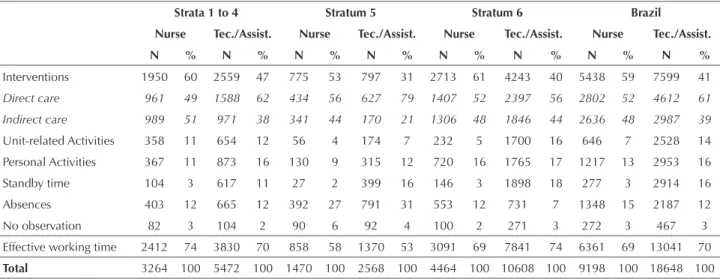
After excluding the percentage of observations conduct-ed simultaneously for reliability testing, we analyzconduct-ed 27,846 of distributed observations, as shown in Table 1.
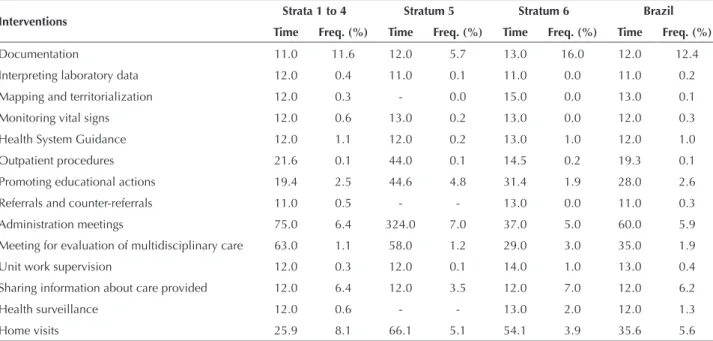
Tables 2 and 3 present the frequency and mean time of observed interventions.
Table 2 – Mean time in minutes and probability of occurrence (%) of interventions conducted by FHU nurses – Brazil, 2015.
Interventions Strata 1 to 4 Stratum 5 Stratum 6 Brazil
Time Freq. (%) Time Freq. (%) Time Freq. (%) Time Freq. (%)
Educational actions for health professionals 24.0 0.6 174.0 6.3 67.0 2.0 73.0 2.1
Administering medication 12.0 0.1 - - 13.0 0.0 13.0 0.1
Supporting students 11.0 0.4 13.0 0.9 11.0 2.0 12.0 1.0
Assisting in tests/procedures 14.0 0.3 - - 20.0 1.0 19.0 0.6
Attending to spontaneous demands 30.8 8.5 32.1 5.5 16.1 7.5 23.3 7.5
Appointment 32.4 7.1 36.7 13.4 19.4 14.2 25.3 11.6
Community Disease Management 11.0 0.0 12.0 0.3 - - 12.0 0.1
Immunization/vaccination control 24.0 1.3 27.0 0.2 29.0 0.0 25.0 0.7
Infection control 12.0 0.0 11.0 0.3 12.0 0.0 12.0 0.1
Supply control 11.0 0.6 - - 12.0 1.0 12.0 0.5
Organizing work processes 11.0 2.9 11.0 1.7 12.0 5.0 12.0 3.7
Developing administrative processes/routines 13.0 0.8 - 0.0 13.0 0.0 13.0 0.3
Table 1 – Distribution of interventions/activities conducted by nurses and nursing technicians/assistants, by demographic socioeco-nomic strata, between March and October 2013 – Brazil, 2015.
Strata 1 to 4 Stratum 5 Stratum 6 Brazil
Nurse Tec./Assist. Nurse Tec./Assist. Nurse Tec./Assist. Nurse Tec./Assist.
N % N % N % N % N % N % N % N %
Interventions 1950 60 2559 47 775 53 797 31 2713 61 4243 40 5438 59 7599 41
Direct care 961 49 1588 62 434 56 627 79 1407 52 2397 56 2802 52 4612 61
Indirect care 989 51 971 38 341 44 170 21 1306 48 1846 44 2636 48 2987 39
Unit-related Activities 358 11 654 12 56 4 174 7 232 5 1700 16 646 7 2528 14
Personal Activities 367 11 873 16 130 9 315 12 720 16 1765 17 1217 13 2953 16
Standby time 104 3 617 11 27 2 399 16 146 3 1898 18 277 3 2914 16
Absences 403 12 665 12 392 27 791 31 553 12 731 7 1348 15 2187 12
No observation 82 3 104 2 90 6 92 4 100 2 271 3 272 3 467 3
Effective working time 2412 74 3830 70 858 58 1370 53 3091 69 7841 74 6361 69 13041 70
Total 3264 100 5472 100 1470 100 2568 100 4464 100 10608 100 9198 100 18648 100
*Tec./Assist.: Nursing technician/assistant. ** Direct care: care provided directly to users, families/ and communities; Indirect care: care provided away from users, families and communities, but in their beneit; Unit-related activities: those that can be executed by other professional categories, but are assigned to health professionals; Standby
time: when professionals are available for care provision, waiting for users and/or professionals who are not present at the time of observation, either due to absence and/or
tardiness of users and/or professionals, lack of demand, or the other professional is busy with another activity; and Absences: when the professional leaves the unit to perform activities unrelated to the FHU.
Time standards of nursing in the Family Health Strategy: an observational study
Table 3 – Mean time in minutes and probability of occurrence (%) of interventions conducted by FHU nursing technicians/assistants – Brazil, 2015.
Interventions Strata 1 to 4 Stratum 5 Stratum 6 Brazil
Time Freq. (%) Time Freq. (%) Time Freq. (%) Time Freq. (%)
Educational actions for health professionals 26 0.70 135 2.30 87 2.00 66 1.40
Administering medication 12.8 1.10 13,9 2.30 13,5 1.50 13.4 1.50
Supporting students 12 0.30 - 0.00 14 0.20 13 0.30
Supporting physicians 12 0.10 19 0.10 19 0.10 18 0.10
Assisting in tests/procedures 48.2 0.60 48.1 1.00 14.6 1.50 23 1.20
Attending to spontaneous demands 15.8 0.10 39 1.60 30.2 0.90 32.2 0.80
Electrolyte control 12 0.00 13 0.50 12 0.10 12 0.10
Immunization/vaccination control 39.3 6.50 39 10.20 21.1 5.20 30.6 6.20
Infection control 13 1.40 15 0.40 14 2.00 13 1.40
Supply control 13 2.30 15 1.60 13 5.00 13 3.60
Organizing work processes 12 1.30 - - 13 1.00 13 1.00
Urgency/emergency care 38 0.10 - - 11 0.00 20 0.10
Developing community health 12 0.10 - - 14 0.00 13 0.10
Developing administrative processes/routines 13 0.20 - - 13 0.00 13 0.10
Documentation 13 9.50 14 3.20 13 11.00 13 9.30
Risk identiication - 0.00 14 0.20 13 1.00 13 0.40
Monitoring vital signs 13.1 5.60 12.8 3.90 13 4.00 13 4.50
Health System Guidance 13 1.50 14 1.80 13 2.00 13 1.50
Outpatient procedures 44.1 1.60 40.9 1.30 20.2 2.30 27.8 1.90
Promoting educational actions 25.1 1.00 24.6 0.30 28.6 1.70 27.6 1.30
Venous puncture: venous blood sampling - - - - 12.5 1.60 12.5 0.90
Referrals and counter-referrals 13 0.80 - - 13 0.00 13 0.30
Administration meetings 60 1.70 - - 88 2.00 74 1.40
Meeting for evaluation of multidisciplinary care 62 0.20 - - 44 2.00 45 1.00
Safety supervision 13 0.10 - - 13 0.20 13 0.20
Institutional transportation 14 1.00 - - 13 0.00 14 0.40
Sharing information on care provided 13 3.30 15 1.60 13 3.00 13 3.00
Health surveillance 12 0.20 15 0.30 12 1.00 13 0.40
Home visits 48.5 10.20 71.6 2.00 39.7 2.30 47.7 4.60
Interventions Strata 1 to 4 Stratum 5 Stratum 6 Brazil
Time Freq. (%) Time Freq. (%) Time Freq. (%) Time Freq. (%)
Documentation 11.0 11.6 12.0 5.7 13.0 16.0 12.0 12.4
Interpreting laboratory data 12.0 0.4 11.0 0.1 11.0 0.0 11.0 0.2
Mapping and territorialization 12.0 0.3 - 0.0 15.0 0.0 13.0 0.1
Monitoring vital signs 12.0 0.6 13.0 0.2 13.0 0.0 12.0 0.3
Health System Guidance 12.0 1.1 12.0 0.2 13.0 1.0 12.0 1.0
Outpatient procedures 21.6 0.1 44.0 0.1 14.5 0.2 19.3 0.1
Promoting educational actions 19.4 2.5 44.6 4.8 31.4 1.9 28.0 2.6
Referrals and counter-referrals 11.0 0.5 - - 13.0 0.0 11.0 0.3
Administration meetings 75.0 6.4 324.0 7.0 37.0 5.0 60.0 5.9
Meeting for evaluation of multidisciplinary care 63.0 1.1 58.0 1.2 29.0 3.0 35.0 1.9
Unit work supervision 12.0 0.3 12.0 0.1 14.0 1.0 13.0 0.4
Sharing information about care provided 12.0 6.4 12.0 3.5 12.0 7.0 12.0 6.2
Health surveillance 12.0 0.6 - - 13.0 2.0 12.0 1.3
Home visits 25.9 8.1 66.1 5.1 54.1 3.9 35.6 5.6
DISCUSSION
his type of study is new in Brazil, and its importance lies in the diversity and national extent of the studied re-alities, both in quantity of observations and the identiica-tion of frequencies of intervenidentiica-tions/activities carried out by nursing professionals. his allows for a more realistic and objective calculation of mean time of interventions and consequently, workload at the FHU.
he results show that nurses spend more time during their work shifts on direct and indirect care interventions and absent periods than nursing technicians/assistants. However, the technical staf spent more time on associated activities, personal activities and waiting time.
In contrast with nurses, nursing technicians/assistants presented greater diversity and amplitude in the number of low-frequency activities. In turn, nurses conducted fewer interventions at higher frequencies.
Interventions such as consultations, attending to spon-taneous demands, and home visits were among the most frequent activities and compose the characteristic triad of the care provision dimension. hey represent a signiicant portion of the workload of FHU nurses. Furthermore, these practices have the potential to broaden the access of users to the service, humanizing care and functioning as a device to reorganize the work process(12).
Direct care provided by nurses in FHU from strata 1 to 4 were more focused on attending to spontaneous demands and making home visits and lesser so on appointments when compared to FHU in strata 6. For the most part, smaller municipalities are more receptive to spontaneous demands, but have not yet incorporated nursing appoint-ments to the routine of FHU nursing practices.
In contrast, among FHU from strata 6, appointments and attending to spontaneous demands stood out as the most common interventions, with a higher percentage of oc-currence when compared to other strata. On the other hand, interventions such as home visits and promoting educational actions presented lower percentages, from which we can in-fer that more developed and/or higher population munici-palities allocate most of the nurses’ direct interventions on clinical care and less on external and educational activities.
he nursing technician/assistant category is rarely de-scribed in the literature. We observed that a quarter of their working time was spent on direct care and, even though there were no studies available for comparison, we believe that the proportion observed must be reviewed given the work dynamics of these professionals, whose potential is underexplored. heir practices should be re-organized in the direction of care comprehensiveness(13-14).
In Brazil, immunization/vaccination control and the ad-ministration of medication are conducted mostly by nursing technicians/assistants. Nurses are not usually responsible for these activities, and when they are, they take up approxi-mately 0.1% of their working time.
Relections must be conducted on how to make the practice of nursing technicians/assistants more efective in light of this category’s potential in collective health actions.
It is also worth emphasizing the importance of nurses in the management, organization and coordination of the work process and clinical care.
Indirect care interventions compose a signiicant part of the workload. he results showed that nurses spend up to ive times more time than nursing technicians/assistants in administration meetings and organizing work processes, even when they do not work exclusively with unit management.
he results showed that documentation was one of the most frequent interventions conducted by nurses and nurs-ing technicians/assistants. However, the values presented by studies conducted in other contexts, such as surgical centers, nursing homes, and community centers in the U.S. showed higher percentages(15-17).
We also emphasize the importance of the indirect care pro-vided to users, families and communities, reinforcing the idea that much of what is done by the nursing staf is invisible(18).
Sharing information on care provided was among the most frequent indirect care interventions, which we believe indicates a positive and important result, as it strengthens communication, work relationships between team profes-sionals, and collaborative practices. his intervention was more frequent in strata that presented a higher percentage of time spent on spontaneous demands.
Regarding educational actions for health profession-als, nurses dedicated a higher percentage of time on this intervention when compared to technicians/assistants. However, units from strata 1 to 4 represented only 0.6% for both categories. Evaluators who participated in the PMAQ observed the insuiciency of professional training programs or ongoing health education actions that support the good development of teams(19).
Several studies have indicated the need for ongoing edu-cation aimed at nursing professionals, recommending great-er investment. In particular, nursing assistants complain of the scarcity of courses, which are ofered only sporadically. Furthermore, when they are ofered, such programs address themes that do not correspond to the real needs of their routine work processes and are considered a hindrance to the quality development of their activities(13-14,20).
he small participation of nursing technicians/aids in multidisciplinary care assessment meetings portrays the ab-sence of these professionals when planning and discussing care, reinforcing their institutionalized technical role. he role of these professionals within the family health team must be reconsidered.
he mobilization of adequate nursing care resources is a concern for nursing managers worldwide. hus, variables such as mean time of nursing activities are essential, given that the authors consider that understanding the workload of nurses is crucial to the staf planning(21).
he use of mean times and/or socioeconomic and de-mographic strata in Brazil in order to determine nursing staf size enables projections that are in accordance with the population of coverage areas and consequently, closer to the reality of municipalities and the proposal of the FHS.
Min-Time standards of nursing in the Family Health Strategy: an observational study
istry of Health proposes three consultations/hours, i.e., 20 minutes per consultation(22). According to the Nursing
In-terventions Classiication (NIC), the mean time of an ap-pointment is between 46 and 60 minutes(23), longer than that
found in this study. However, it is worth mentioning that the times suggested by the NIC taxonomy(23) are based on the
opinions of professionals, which tend to be higher than mea-sured values. Other than the NIC, we found no research that ofered data for us to compare the time of other interven-tions and activities conducted in PHC and especially FHS. Unit-related activities represented 7% of the nurses’ working time in Brazil, and the double of that for nursing technicians/assistants. herefore, it is crucial to discuss is-sues and conduct studies regarding administrative support professionals in FHU. In so doing, health professionals can dedicate their working time to users, families and com-munities, and units can count on qualiied and dedicated administrative support for such functions.
Standby time is an activity that is scarcely found in the literature, as it is not usually considered a category of analy-sis. It is also more characteristic among non-hospital servic-es, such as outpatient and primary health care units. here was a high percentage of standby time in the FHU among nursing technicians and assistants, as these professionals are restricted to schedules. hus, optimizing their working time in daily practice and ofering dynamic, attractive and acces-sible services/activities to the community proves diicult.
We also found no references in the literature describ-ing periods of absence durdescrib-ing the workday, observed and demonstrated only by this study. However, it is important to emphasize that such period of absences observed in the FHU goes against primary health care guidelines(3) and
in-terfere directly in the amount of efective working time. Measuring nursing workload and the use of data rela-tive to time spent on activities not related to care allows us to understand the meaning of efective working time and productivity in health services. Furthermore, it rep-resents an important management tool. Time spent wait-ing and absent from the unit durwait-ing work hours could be used to beneit users. In so doing, the productivity of both professional categories could be elevated to approxi-mately 80%.
A study showed that access, resolvability, and universal coverage are issues that walk hand in hand with profes-sional productivity. Precarious health practices provided by professionals contribute to the low usage of health services by vulnerable populations, and improved performance could increase such use(24).
he results of this study present possibilities for debate and relections about the work process and efective work of FHU nursing teams.
his study has some limitations. he restricted amount of data found in the literature about the proportion of time spent on users, families and communities in PHC and FHU make it diicult to discuss which proportions would be more appropriate and efective for PHC/FHU care pro-vision and how these could contribute to improving the outcome and access to such services. However, the results of the present study are a reference for future studies on human resource management in health.
CONCLUSION
he data on the mean time spent on nursing care in-terventions presented in this study are new to the reality of Brazilian primary health care. hey are essential elements to determine FHU nursing staf size and can be applied in dif-ferent methods. Furthermore, this study advances the propo-sition of mean intervention times, considering the diversity of practices and realities of FHU in the national level.
We also emphasize this study’s contribution to the knowl-edge on nurse staf sizing in PHC via the FHS, a topic pre-viously explored in nursing only in the context of Brazilian hospital units. However, further studies are needed, such as on correlations between time and professional proile, char-acteristics of the FHU environment, regional and community indicators, support services such as Family Health Support Centers (NASF), cost analysis, and studies that encompass the nature of activities, type of interaction (telephone, com-puter, type of professional) and professional competence.
his study provides a panorama of the interventions and activities currently developed by FHS nursing professionals. herefore, its results can be used to optimize the workforce and work processes in these units.
he time parameters identiied here can be applied to workforce planning methods in local, municipal, state, and national contexts. his is an important management tool for the nursing category; however, this technique can be expanded to investigate all of the professional categories that compose the FHS.
he application of these results to other national scenar-ios enable comparisons between workloads and staf sizes and, therefore, the identiication of the accurate level of imbalance of the FHU workforce in Brazil. hus, the ind-ings presented represent a relevant reference to underpin decision-making processes and inluence workforce plan-ning policies in Brazil.
RESUMO
vacinação. Conclusão: O estudo fornece padrões de tempos das intervenções realizadas pela equipe de enfermagem em USF, subsidiando a aplicação de métodos de dimensionamento de proissionais de enfermagem e políticas públicas de recursos humanos. Além disso, apresenta o panorama das atuais intervenções desenvolvidas, possibilitando revisão e otimização do processo de trabalho.
DESCRITORES
Atenção Primária à Saúde; Enfermagem em Saúde Comunitária; Enfermagem em Saúde Pública; Recursos Humanos em Saúde; Carga de Trabalho.
RESUMEN
Objetivo: Determinar estándares de tiempo de las intervenciones/actividades por los profesionales de enfermería en Unidades de Salud de la Familia (USF) en Brasil, para subsidiar el cálculo de la fuerza de trabajo. Método: Estudio observacional, llevado a cabo en 27 USF, 10 estados, 12 municipios, el año de 2013. En cada Unidad los profesionales de enfermería fueron observados cada diez minutos, durante ocho horas de trabajo, en cinco días consecutivos, por medio de la técnica de muestreo del trabajo. Resultados: Fueron observados 47 enfermeros y 93 técnicos/auxiliares de enfermería, lográndose el total de 32.613 observaciones. La principal intervención llevada a cabo por las enfermeras fue la consulta, con tiempo medio de 25,3 minutos, seguida de documentación, que correspondió al 9,7%. Los técnicos/auxiliares de enfermería utilizaron, en promedio, el 6,3% en documentación y 30,6 minutos en la intervención control de inmunización/vacunación. Conclusión: El estudio suministra estándares de tiempos de las intervenciones realizadas por el equipo de enfermería en USF, subsidiando la aplicación de métodos de dimensionamiento de profesionales de enfermería y políticas de recursos humanos. Además, presenta el panorama de las actuales intervenciones desarrolladas, posibilitando una revisión y optimización del proceso de trabajo.
DESCRIPTORES
Atención Primaria de Salud; Enfermería; Enfermería en Salud Comunitaria; Enfermería en Salud Publica; Recursos Humanos en Salud; Carga de Trabajo.
REFERENCES
1. Paim J, Travassos C, Almeida C, Bahia L, Macinko J. The Brazilian health system: history, advances, and challenges. Lancet. 2011;377(9779):1778-97.
2. Rasella D, Harhay O M, Pamponet ML, Aquino R, Barreto ML. Impact of primary health care on mortality from heart and cerebrovascular diseases in Brazil: a nationwide analysis of longitudinal data. BMJ. 2014;348:g4014.
3. Brasil. Ministério da Saúde; Secretaria de Atenção Básica, Departamento de Atenção Básica. Politica Nacional de Atenção Básica (PNAB). Brasília; 2012.
4. Brasil. Ministério da Saúde. Portaria n. 2355, de 10 de outubro de 2013. Altera a fórmula de cálculo do teto máximo das Equipes de Saúde da Família [Internet]. Brasília 2013 [citado 2015 nov. 18]. Disponível em: http://bvsms.saude.gov.br/bvs/saudelegis/gm/2013/ prt2355_10_10_2013.html
5. Guimarães T, Alves J, Tavares M. Impacto das ações de imunização pelo Programa Saúde da Família na mortalidade infantil por doenças evitáveis em Olinda, Pernambuco. Cad Saúde Pública. 2009;25(4):868-76.
6. Pereira C, Roncalli A. Impacto da Estratégia Saúde da Família sobre indicadores de saúde bucal: análise em municípios do Nordeste brasileiro com mais de 100 mil habitantes. Cad Saúde Pública. 2012;28(3):449-62.
7. Marques D, Silva E. A Enfermagem e o Programa Saúde da Família: uma parceria de sucesso? Rev Bras Enferm. 2004;57(5):545-50.
8. Pierantoni C, Varella T, Santos M, Silva L. Indicadores de carga de trabalho para proissionais da Estratégia de Saúde da Família. In:
Pierantoni C, Dal Poz MR, França T. O trabalho em saúde: abordagens quantitativas e qualitativas. Rio de Janeiro: CEPESC/IMS/UERJ; 2011.
9. World Health Organization. WISN – Workload Indicators of Stafing Need: user’s manual [Internet]. Geneva: WHO; 2010 [cited 2015
Nov 22]. Available from: http://apps.who.int/iris/bitstream/10665/44414/1/9789241500197_users_eng.pdf
10. Brasil. Ministério da Saúde; Secretaria de Atenção à Saúde, Departamento de Atenção Básica. Programa de Melhoria do Acesso e da Qualidade da Atenção Básica (PMAQ): manual instrutivo. Brasília; 2012.
11. Bonim D, Pereira MJB, Pierantoni CR, Haddad AE, Gaidzinski RR. Tool measuring workload of health professionals in Primary Care:
development and validation. Rev Esc Enferm USP. 2014;49(n.spe 2). In press.
12. Takemoto M, Silva E. Acolhimento e transformações no processo de trabalho de enfermagem em Unidades Básicas de Saúde de Campinas. Cad Saúde Pública. 2007;23(2):331-40.
13. Shimizu H, Dytz J, Lima M, Moura A. A prática do auxiliar de enfermagem do programa saúde da família. Rev Latino Am Enfermagem. 2004;12(5):713-20.
14. Ogata M, França Y. Nursing assistant performance in the Family Health Strategy. Acta Paul Enferm. 2010;23(4):506-11.
15. Possari JF, Gaidzinski RR, Lima AFC, Fugulin FMT, Herdman TH. Use of the nursing intervention classiication for identifying the workload
of a nursing. Rev Latino Am Enfermagem. 2015;23(5):781-8.
16. Anderson D, St. Hilaire D, Flinter M. Primary care nursing role and care coordination: an observational study of nursing work in a community health center. Online J Issues Nurs [Internet]. 2012 [cited 2013 Dec 10];17(2):3. Available from: http://www.ncbi.nlm.nih. gov/pubmed/22686111
17. Delleield ME, Harrington C, Kelly A. Observing how RNs use clínical time in a nursing home: a pilot study. Geriatr Nurs. 2012;33(4):256-63.
18. Walker K, Donoghue J, Mitten-Lewis S. Measuring the impact of a team model of nursing practice using work sampling. Aust Health Rev.
Time standards of nursing in the Family Health Strategy: an observational study
19. Fausto M, Fonseca H. Rotas da atenção básica no Brasil: experiências do trabalho de campo PMAQ-AB. Rio de Janeiro: Saberes; 2013.
20. Feitosa L, Feitosa J, Coriolano M. Conhecimentos e práticas do auxiliar de enfermagem em sala de imunização. Cogitare Enferm. 2010;15(4):695-701.
21. Morris R, MacNeela P, Scott A, Treacy P, Hyde A. Reconsidering the conceptualization of nursing workload: literature review. J Adv Nurs. 2007;57(5):463-71.
22. Brasil. Ministério da Saúde; Secretaria de Políticas de Saúde, Departamento de Atenção Básica. Parâmetros para programação das ações básicas de saúde. Brasília; 2001.
23. Bulechek G, Butcher H, Dochterman J. Classiicação das Intervenções de Enfermagem. Rio de Janeiro: Elsevier; 2010.