Maria Alicia Domínguez Ugá
Miguel Murat Vasconcellos Sheyla Maria Lemos Lima
Margareth Crisóstomo Portela
Silvia Gerschman
Departamento de Administração e Planejamento. Escola Nacional de Saúde Pública. Fundação Oswaldo Cruz. Rio de Janeiro, RJ, Brasil
Correspondence:
Maria Alicia Domínguez Ugá Fundação Oswaldo Cruz
R. Leopoldo Bulhões, 1480, sala 709 – Manguinhos
21041-210 Rio de Janeiro, RJ, Brasil E-mail: [email protected] Received: 4/14/2008
Revised: 4/3/2009 Approved: 4/14/2009
Mechanisms of microregulation
of private hospitals by health
plan operators
ABSTRACT
OBJECTIVE: To analyze the mechanisms employed by health plan operators for microregulation of clinical management and health care qualiication within care-providing hospitals.
METHODS: A nation-wide cross-sectional study was carried out. The universe consisted of hospitals which provided care to health plan operators in 2006. A sample of 83 units was selected, stratiied by Brazilian macroregion and type of hospital. Data were obtained by means of a questionnaire administered to hospital managers.
RESULTS: Microregulation of hospitals by health plan operators was minimal or almost absent in terms of health care qualiication. Operator activity focused predominantly on intense control of the amount of services used by patients. Hospitals providing services to health plan operators did not constitute health micro-systems parallel or supplementary to the Sistema Único de Saúde (SUS - Brazilian National Health System). The private care-providing hospitals were predominantly associated with SUS. However, these did not belong to a private care-provider network, even though their service usage was subject to strong regulation by health plan operators. Operator intervention in the form of system management was incipient or virtually absent. Roughly one-half of investigated hospitals reported adopting clinical directives, whereas only 25.4% reported managing pathology and 30.5% reported managing cases. CONCLUSIONS: Contractual relationships between hospitals and health plan operators are merely commercial contracts with little if any incorporation of aspects related to the quality of care, being generally limited to aspects such as establishment of prices, timeframes, and payment procedures.
DESCRIPTORS: Supplemental Health, organization & administration. Health Maintenance Organizations. Contract Services, standards. Hospital Services. Hospitals, Private.
INTRODUCTION
by HMOs (Health Maintenance Organizations), known as “network” models, and one staff model), identiied factors that quantitatively and qualitatively limited service supply and inluenced medical care. These included restricting access to covered services and instituting pre-approval policies.
A study carried out by Davis & Schoen (1998),2 evaluating physician satisfaction under managed care, indicated that care provided under the auspices of such systems was considered as low-quality by the profes -sionals involved. Two-thirds of physicians reported having problems with restrictions to length of hospital stay, and 50% admitted having dificulties obtaining authorization to hospitalize patients. Moreover, 41% of physicians stated that time spent with patients decreased in the last three years, whereas only 7% reported the opposite.
In Brazil, a recent study (Ministério da Saúde, ANS, 2005)a investigated this issue among a convenience
sample of important companies in the supplementary health sector. According to this study, major points in the relationship between managed care organiza -tions and providers were payment flow (defaults and coverage denials), orthesis and prosthesis use, and incorporation of high-cost technologies, among other issues. The authors conclude that “we may be experiencing a technological transition in the health care sector, […] now no longer characterized by the incorporation of technology into the care process, but instead by an attempt to capture medical autonomy through sophisticated managerial mechanisms that lead to the adoption of an administrative, rationalizing logic [...]”.
This discussion also relects a peculiar moment in the regulatory efforts of the Agência Nacional de Saúde Suplementar (ANS – National Supplementary Health Agency). During the tenure of the Superintendência de Seguros Privados (SUSEP – Superintendence of Private Insurance), regulation of managed care organizations was virtually restricted to monitoring, i.e., assessing whether companies had the inancial capacity to fulill their contractual obligations. The ANS introduced a wider-ranging approach to regulation of this segment, which included a concern with the extent coverage offered by health plans, recently expanded by the creation of the Programa de Qualiicação da Saúde Suplementar (Supplementary Health Qualification Program).b Thus, the ANS has begun to monitor also the quality of services provided by health plans, based on indicators of the structure, process, and results of health care practice.
a Ministério da Saúde, Agência Nacional de Saúde Suplementar. Duas faces da mesma moeda – Microrregulação e modelos assistenciais na saúde suplementar. Série A. Normas e Manuais Técnicos. Regulação e Saúde 4. Rio de Janeiro: Ministério da Saúde, 2005.
b Ministério da Saúde. Agência Nacional de Saúde Suplementar. Programa de qualificação de saúde suplementar. [cited 2009 Aug 16] Available from: http://www.ans.gov.br/portal/site/_qualificacao/pdf/apresentacao_final.pdf
c Mendes EV. Os sistemas de serviços de saúde: o que os gestores deveriam saber sobre essas organizações complexas. Fortaleza: Escola de Saúde Pública do Ceará; 2002.
The relationships established between managed care organizations and service providers include form of contract, remuneration, and non-inancial regulatory systems (such as presence of a gatekeeper, restricted use of certain intermediary services, adoption of pre-approval practices, among others). Such relationships interfere with the health care model by inducing or preventing more integral patient care, and may therefore inluence care quality.
Clinical management is understood as “a system whose goal is to ensure that optimal clinical patterns are reached and constantly perfected in order to improve the quality of clinical practice. Noteworthy among the instruments of clinical management are: auditing of clinical procedures, clinical proiling, disease manage -ment, case manage-ment, and clinical protocols”.c The aim of the present study was to analyze microre -gulation of clinical management and health care quali-ication within care-providing hospitals by managed care organizations.
METHODS
We carried out a cross-sectional study of data obtained in a nation-wide survey. The study universe was the set of 3,817 private hospitals that provided care to managed care organizations, deined by cross-refe -rencing the databases of the ANS and Cadastro de
Prestadores de Serviços a Planos de Saúde (Registry of Health Insurance Care Providers) with that of the National Registry of Health Care Facilities (CNES), in July 2006.
Based on this universe, we selected a sample stratiied by the ive Brazilian geographical macroregions and by type of hospital (general or specialized). Allocation of the total sample size into natural strata was propor -tional to the number of beds in each natural stratum. In order to increase the eficacy of the sample in each natural stratum, the Hedlin algorithm (Hedlin, 2000)3 was used to determine the cutoff point (number of beds) between a take-all and a take-some stratum, so as to minimize variance in the number of beds given a previously ixed sample size in the natural stratum. Sample size was 83 units.
As a data collection instrument, we constructed a ques -tionnaire addressing the following dimensions: • installed capacity and care productivity of the
provider;
• practices and structures for assuring and monitoring the quality of provided care;
• organizational and care-related aspects considered in the regulation of providers by managed care organizations;
• mechanisms, practices, and incentives used in the process of regulation of providers by managed care organizations; characterization of the contracting process between provider and care organization, including negotiations, formalization, follow-up mechanisms, and incentives, among others; • satisfaction of providers with the regulation prac
-tices of managed care organizations;
• perception of providers of the role of ANS in regu -lating the supplementary health sector.
In addition to structured questions, the questionnaire also included an open question where hospital managers were allowed to freely manifest their opinions regarding their relationship with managed care organizations. Data collection took place between September and December 2006, by means of an interview with the directors of the 83 hospital units. Field researchers were trained for this activity. Data were entered by the resear -chers into an electronic form and submitted digitally to a database constructed especially for the project. Data were processed using SAS software.
The study was approved by the Research Ethics Committee of the Escola Nacional de Saúde Pública,
Fundação Oswaldo Cruz.
RESULTS
The set of private hospitals that provide care to managed care organizations was composed mostly of small-scale units, almost half of which were of high complexity. The majority (72.0%) of these private hospitals also provided care to the public system.
The largest care organization concentrated on average more than half of the income of each hospital, showing a strong concentration of the income from services provided in the hands of managed care organizations. A substantial fraction of hospitals had special areas and/or services that increased their competitiveness; among such services, the most commonly mentioned was traumatology and orthopedics. However, in most
hospitals, such specialization did not translate into a role as a reference center within the service network, since fewer than half of (46.5%) the hospitals reported being part of a provider network managed by a managed care organizations. Of the hospitals that were part of a managed care organization-based network, 74.1% had some form of referral service, and 65.5% reported refer -ring patients to other hospitals in this same network.
With regards to care practices and microregulation by managed care organizations, adoption of clinical guide -lines was more frequent in hospitals that provided more complex care (general or specialized hospitals with an ICU). Guidelines were used primarily for treating acute myocardial infarction, cerebrovascular accidents, labor and delivery care, diabetes, nosocomial infections, and arterial hypertension. The presence of clinical guidelines should be kept in perspective, however, given that physician adherence to these procedures was low, as was the dissemination of these guidelines among patients.
The role of managed care organizations as managers of the care system was incipient or almost absent. Approximately half of (51.6%) the hospitals reported adopting clinical guidelines, whereas only 25.4% of the study universe reported managing diseases, and 30.5%, managing individual cases. Such practices were not found to be induced by managed care orga -nizations: all 1,961 hospitals which adopted clinical guidelines did so because of the hospitals own policies, independently of external demand (93.5% of cases) or in response to initiatives by speciic medical groups/ services (6.5% of cases).
The role of managed care organizations in terms of inducing disease management was also minor, these companies accounting for 7.9% of hospitals that adopted this practice. In the majority of cases (73.2%), presence of disease management was due to internal policies and independent of external demand, whereas in 30.4% of cases it was a response to initiatives by speciic medical groups or services. These two scena -rios were not mutually exclusive.
Case management, in its turn, was adopted by 1,158 hospitals, and was likewise not induced by managed care organizations: 93.8% of hospitals adopted this practice due to their own policies, regardless of external demand, and in certain cases, also by initiative of speciic medical groups or services.
services (50% of cases). The same was true for studies of variations in medical practice: of the 842 hospitals that adopted such practices, only one did so as a result of induction by a managed care organization. In the majority of cases (86.6%), this practice was adopted because of the hospitals own policies, and/or (less frequently) in response to initiatives by speciic medical groups or services.
Moreover, more speciic indicators of the quality of care management revealed a low frequency of practices such as recommending coronary reperfusion during acute myocardial infarction and follow-up after breast cancer diagnosis and after cervical and prostate cancer screening.
Thus, care qualiication practices were a result primarily of initiatives by the hospital management or by speciic medical groups, without the interference of managed care organizations.
Table 1 presents data on the extent to which selected structures and practices for assuring and monitoring care quality are induced by managed care organiza-tions. In the majority of cases (ranging from 73.4% to 100.0%), such practices were adopted by the hospital’s own initiative, with organizations playing a minimal role, if any, in this process.
Substantial induction by managed care organizations was only detected with respect to establishment of infection control committees, with (8.1%) or without (13,2%) active search, and or committees for
systematically auditing hospital deaths (7.6%). There was a low but detectable level of induction with respect to the establishment of systematic medical ethics committees (4.5% of hospitals), systematic user satis -faction surveys (4.4%), and, pharmacy and therapeutics committees (4.1%).
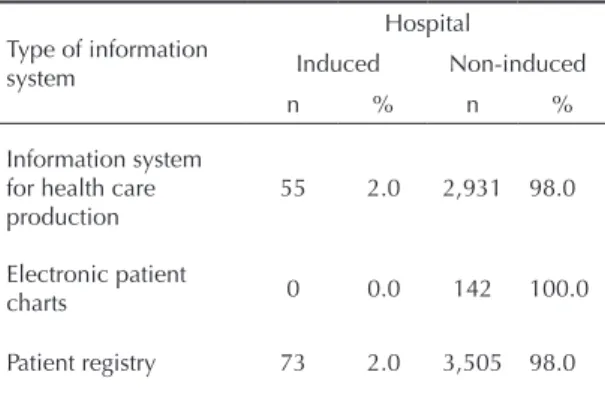
Table 2 presents data on the inluence of managed care organizations on the health care information systems available to the hospitals. The overwhelming majority (98.0%) of hospitals that had information systems for managing health care data had implemented such systems by their own initiative. Likewise, none of the 142 hospitals with electronic patient charts reported having implemented these systems by recommenda-tion of a managed care organizarecommenda-tion. Patient registries, available in 3,578 hospitals, were predominantly imple -mented by initiative of the units themselves; in only 2% of these cases was there an inluence of a managed care organization in this process.
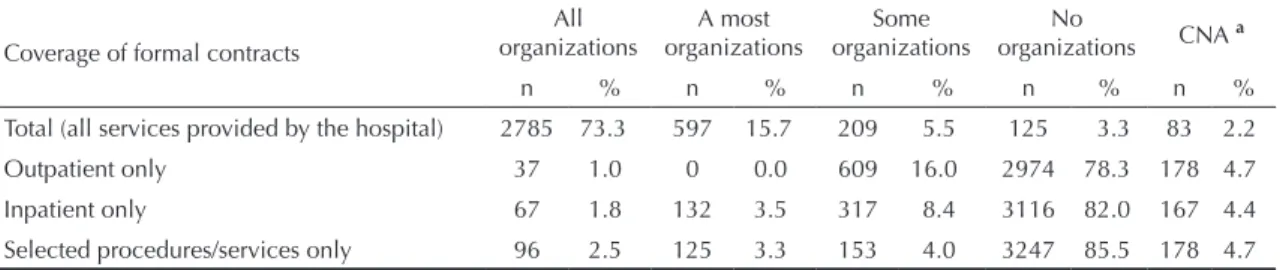
As to the contracting of services, 91.2% of hospitals had formal contracts with all managed care organizations; of these, 76.4% were by prior negotiation and 18.5% were by technical visit (Table 3). These two mecha -nisms were not mutually exclusive. Few hospitals had verbal agreements or no contract with managed care organizations (alternatives presented as distinct in the questionnaire), corresponding to a very small fraction of the organizations to which services were provided. Table 4 shows that 94.5% of hospitals drew formal contracts that included all hospital services; of these,
Table 1. Distribution of hospitals with structures and practices for assuring and monitoring care quality according to induction by managed care organizations. Brazil, 2006.
Structures and practices for assuring and monitoring health care quality
Hospital
Induceda Non-inducedb CNAc
n % n % n %
Pharmacy and therapeutics committee 77 4.1 1818 95.9 0 0.0
Systematic medical records review committee 0 0.0 1722 87.5 247 12.5
Non-systematic medical records review committee 0 0.0 631 100.0 0 0.0
Infection control committee with active search 191 8.1 1722 73.4 433 18.5
Infection control committee without active search 131 13.2 795 79.8 70 7.0
Systematic death review committee 76 7.6 741 73.7 188 18.7
Non-systematic death review committee 0 0.0 526 93.4 37 6.6
Systematic bioethics committee 76 4.5 1433 84.5 187 11.0
Non-systematic bioethics committee 0 0.0 782 86.2 125 13.8
Systematic user satisfaction committee 77 4.4 1667 95.6 0 0.0
Non-systematic user satisfaction committee 0 0.0 1120 99.9 1 0.1
a Induced corresponds to the total number of hospitals that implemented the committee due to demand from one of the 5 main
managed care organizations and demand from another organization.
b Non-induced corresponds to the total number of hospitals that implemented the committee independently of external demand
and by initiative of medical groups or services.
73.3% did so with all organizations. Few hospitals drew contracts for only some services, such as only outpatient (17%), only inpatient (13.7%), or only for certain procedures (9.8%). Therefore, roughly 80% of hospitals did not draw formal contracts with organiza -tions for only part of their services.
For the majority of hospitals, the fraction of claims denied coverage by organizations was below 10%, with an average of 8%; 30% of hospitals could not recover over half of the denied claims in 2006.
Regarding price increases, 43% of hospitals would adjust the prices of services provided to managed care organizations on an annual basis.
The form of payment most often employed by organi-zations was by individual medical procedure or by a per service fee. Other modes – such as global budgets, capitation, or treated case (package) – were found to occur only rarely. Thus, only a few hospitals (131) were paid by all organizations on a “per treated case” basis, and only 77 hospitals (not necessarily exclusive of the former 131) were paid by capitation by only a few managed care organizations. Moreover, 303 hospitals reported being paid by most organizations based on global budgets.
DISCUSSION
Analysis of the contractual relationships between hospital providers and managed care organizations showed a strong tendency to formalize these rela -tionships. However, these are merely commercial contracts, with little if any incorporation of aspects related to the quality of contracted care. Contracts were limited, in their almost entirety, to the deinition of values, timeframes, and procedures for payment or payment units. Thus, hospitals reported an inexistence or low prevalence in contracts of criteria for denying coverage, requirement for qualitative and quantitative indicators, criteria for indicating certain procedures (use of clinical guidelines), curricular information on health care professionals, and other indicators that are fundamental for organizations to exert health care regulation that is beneicial to their clients.
Similarly, managed care organizations seemed uncon -cerned with the infrastructure of provider hospitals, or with the quality of the provided care. Thus, there was an almost complete absence of basic committees necessary for ensuring appropriate health care quality (bioethics, death auditing, infection control). Little importance was given to legal requirements, such as those of the National Registry of Health Care Facilities, Sanitary Surveillance, and the Qualiication System of the National Supplementary Health Agency.
Our present data should be placed in context, given that they express only the perceptions of managers of hospi-tals that provide services to managed care organizations. However, our data indicates that microregulation of provider hospitals by organizations ranges from very low to virtually absent with respect to quality of health care. Formation of care networks was also given little importance, since fewer than half of hospital providers were part of an organization-established network. The indings of the present study agree with the results of a study carried out by the Brazilian Ministry of
Table 2. Distribution of hospitals with health care information systems according to induction by managed care organizations. Brazil, 2006.
Type of information system
Hospital
Induced Non-induced
n % n %
Information system for health care production
55 2.0 2,931 98.0
Electronic patient
charts 0 0.0 142 100.0
Patient registry 73 2.0 3,505 98.0
Table 3. Distribution of hospitals according to status and type of commercial relationship with managed care organizations. Brazil, 2006.
Mode of commercial relationship
All organizations
Most organizations
Some organizations
No
organizations CNAa
n % n % n % n % n %
Formal contract 3465 91.2 263 6.9 0 0.0 0 0.0 71 1.9
Prior negotiation 2903 76.4 297 7.8 132 3.5 321 8.5 144 3.8
Technical visit 703 18.5 597 15.7 1720 45.3 565 14.9 214 5.6
Verbal agreementb 0 0.0 0 0.0 261 6.9 3467 91.2 71 1.9
No contractb 0 0.0 0 0.0 154 4.1 3574 94.1 71 1.9
a Could not answer
1. Borowsky SJ, Davis MK, Goertz C, Lurie N. Are all health plans created equal? The physician’s
view. JAMA. 1997;278(11):917-21. DOI: 10.1001/
jama.278.11.917
2. Davis K, Schoen C. Assuring Quality, Information, and
Choice in Managed Care. Inquiry. 1998;35(2):104-14.
3. Hedlin D. A procedure for stratification by an extended
Ekman rule. J Off Stat. 2000;16(1):15-29.
REFERENCES
Health/ANS,a which found microregulation of hospi
-tals by managed care organizations to be centered on controlling or enforcing hospital and medical practice, directing the clientele towards preferred providers, and controlling excessive use of the “system” by insurance holders.
Likewise, we conclude from the present study that hospitals that provide services to managed care
organizations do not constitute health care microsys-tems parallel to SUS. In effect, what seems to exist is an extensive body of hospital providers – most of which are afiliated to SUS – that are not perceived as belonging to a network of private providers, but which are subject to extensive regulation by managed care organizations when it comes to service usage.
a Ministério da Saúde, Agência Nacional de Saúde Suplementar. Duas faces da mesma moeda – Microrregulação e modelos assistenciais na saúde suplementar. Série A. Normas e Manuais Técnicos. Regulação e Saúde 4. Rio de Janeiro: Ministério da Saúde, 2005.
Table 4. Distribution of hospitals according to the coverage of formal contracts with managed care organizations. Brazil, 2006.
Coverage of formal contracts
All organizations
A most organizations
Some organizations
No
organizations CNA a
n % n % n % n % n %
Total (all services provided by the hospital) 2785 73.3 597 15.7 209 5.5 125 3.3 83 2.2
Outpatient only 37 1.0 0 0.0 609 16.0 2974 78.3 178 4.7
Inpatient only 67 1.8 132 3.5 317 8.4 3116 82.0 167 4.4
Selected procedures/services only 96 2.5 125 3.3 153 4.0 3247 85.5 178 4.7