INTRODUCTION
Corresponding author: Msc. Enny Santos da Paixão. Instituto de Saúde Coletiva/UFBA. Rua Basilio da Gama s/n, Canela, 40110-040 Salvador, Bahia, Brasil.
Phone: 55 71 3336-0695; Mobile: 55 71 9647-5619
e-mail: [email protected]
Received 4 May 2015
Accepted 23 June 2015
Trends and factors associated with dengue
mortality and fatality in Brazil
Enny Santos Paixão
[1], Maria da Conceição Nascimento Costa
[1],
Laura Cunha Rodrigues
[2], Davide Rasella
[1], Luciana Lobato Cardim
[1],
Alcione Cunha Brasileiro
[1]and Maria Gloria Lima Cruz Teixeira
[1][1].Instituto de Saúde Coletiva, Universidade Federal da Bahia, Salvador, Bahia, Brasil. [2]London School of Hygiene and Tropical Medicine, London, United Kingdom.
ABSTRACT
Introduction: Studies that generate information that may reduce the dengue death risk are essential. This study analyzed time trends and risk factors for dengue mortality and fatality in Brazil from 2001 to 2011. Methods: Time trends for dengue mortality and fatality rates were analyzed using simple linear regression. Associations between the dengue mortality and the case fatality rates and socioeconomic, demographic, and health care indicators at the municipality level were analyzed using negative binomial regression. Results: The dengue hemorrhagic fever case fatality rate increased in Brazil from 2001 to 2011 (β=0.67; p=0.036),
in patients aged 0-14 years (β=0.48; p=0.030) and in those aged ≥15 years (β=1.1; p<0.01). Factors associated with the dengue case fatality rate were the average income per capita (MRR=0.99; p=0.038) and the number of basic health units per population (MRR=0.89; p<0.001). Mortality rates increased from 2001 to 2011 (β=0.350; p=0.002).Factors associated with mortality were
inequality (RR=1.02; p=0.001) high income per capita (MRR=0.99; p=0.005), and higher proportions of populations living in urban areas (MRR=1.01; p<0.001). Conclusions: The increases in the dengue mortality and case fatality rates and the associated socioeconomic and health care factors, suggest the need for structural and intersectoral investments to improve living conditions and to sustainably reduce these outcomes.
Keywords: Dengue. Mortality. Fatality. Trend. Social determinants.
Globally, dengue is the most important arboviral disease, because the incidence of infections has increased in recent decades, it has a wide geographic spread, and it can progress to serious and lethal forms; it has been prominently placed among the world’s major health problems(1).
The fi rst dengue epidemics associated with deaths were reported in the Americas in 1980, and, since then, the numbers
of dengue-related deaths have increased continuously(2). During
the fi rst decade of the 21st century, half of the dengue related deaths in South America occurred in Brazil(3). Until 2006, and unlike dengue in Southeast Asia, this viruses was more common in adults in Brazil. In 2007, a marked shift in its age distribution had occurred, and it mostly affected children, among whom there was a higher incidence of severe cases(4). This shift in the age
distribution reversed in 2010, when dengue cases predominately occurred among those who were aged over 15 years(5). Despite these trends and shifts, few studies have investigated the mortality or case fatality rates, or changes in the age profi les of dengue patients.
Since 2007, the number of dengue - related deaths in Brazil has gradually increased, with the mortality rate increasing from 0.01/100,000 people in 2000 to 0.4/100,000 people in 2010, when the dengue hemorrhagic fever (DHF) case fatality rate reached 12%, which was the highest rate recorded in this decade(5). Among the Latin American countries, Brazil has made the greatest effort to control dengue fever (DF) and reduce its fatal outcomes(6). Between 2001 and 2005, the cost of dengue to Brazil was estimated at US$322 million, with approximately 3% of this amount spent on deaths, which, on average, led to the loss of 1,391.68 years of potential life(7). Despite recent advances
in Brazil’s health care system, problems remain that must be tackled. Specifi cally, social position strongly infl uences access to use and quality of health care services(8) (9).
METHODS
dengue mortality and the DHF case fatality rate, and to identify the factors associated with the mortality and the case fatality rates in Brazil from 2000 to 2011.
Study design
Two different analyses were carried out in this study. First,
time series analyses of dengue (DF + DHF) mortality and DHF
fatalities were undertaken for Brazil as a country and for the regions, from 2000 to 2011, in which the years were used as the units of analysis. Secondly, a cross-sectional ecological study of the spatial aggregates was under taken to analyze the
risk factors for dengue (DF + DHF) mortality and fatality for the period from 2008 to 2011 that used the municipalities as
the units of analysis.
Data sources
Information about dengue fever and DHF deaths was gathered from the Mortality Information System [Sistema de Informação sobre Mortalidade (SIM) - Dados do Sistema Único de Saúde (DATASUS)], and deaths classifi ed under the codes A90 and A91 using the 10th Revision of the International Classifi cation of Diseases (ICD)-10 were considered.
Information about dengue fever and DHF cases was gathered
from the Notifi able Diseases Information System [Sistema de
Informação sobre Agravos de Notifi cação (SINAN) - DATASUS].
The National Register of Health Facilities (Cadastro Nacional de Estabelecimentos de Saúde) was used to determine the number of health units.
Staff from the Brazilian Institute of Geography and Statistics [Instituto Brasileiro de Geografia e Estatística (IBGE)] determined the population numbers and the socioeconomic indicators for each municipality and year.
Outcomes defi nitions
For the trends, the dengue mortality rate was defi ned as the
number of dengue deaths, which included deaths from DHF and dengue fever, from SIM, divided by the population numbers from IBGE, for each year and municipality from 2000 to 2011.
The DHF fatality rate was defi ned as the number of DHF deaths
from SIM divided by the DHF case numbers from SINAN, for each year and municipality from 2001 to 2011.
For the risk factor analysis, The dengue mortality rate was
defi ned as the sum of the number of deaths caused by dengue,
which included DHF and dengue fever deaths, from SIM
from2008 to 2011, divided by the sum of the population from IBGE from 2008 to 2011. The dengue case fatality rate was defi ned as the sum of the number of deaths caused by dengue,
which included DHF and dengue fever deaths, from SIM from
2008 to 2011, divided by the sum of the number of cases of
dengue from SINAN during the same period.
We used different case fatality indicators to estimate the trends and risk factors, because we used the same formula as the Brazilian Ministry of Health to estimate the case fatality
rate, which was the numbers of DHF deaths divided by the
notifi ed DHF cases, to facilitate comparisons with other studies.
However, for the analysis of the risk factors, information may
have been lost if the denominator comprised notifi ed DHF cases
only, because the municipalities only notify DHF cases when all the criteria established by the World Health Organization in 1997 are met(11). Therefore, deaths from DHF may have been attributed to dengue fever.
Temporal trend analysis
The annual case fatality rates, including the overall rates and
those for people aged 0-14 years and ≥15 years, for DHF and the dengue mortality rates (per 100,000 inhabitants) between 2000
and 2011 for Brazil and the large geographic regions within Brazil
were plotted on graphs and their fl uctuations analyzed. The trends
were estimated using simple linear regression analysis and the calendar year as the independent variable. This regression analysis
generates a β coeffi cient; hence, for each year we would expect a specifi c unit increase (positive β) or decrease (negative β) in
the dengue mortality or DHF fatality rates. Autocorrelation was evaluated using the Durbin-Watson statistic, and when a value that was > 2 determined it was present, the Prais-Winsten method was applied to treat self-correlated residuals(12).
Analysis of associated factors
All of the Brazilian municipalities that reported at least one
dengue case between 2008 and 2011 were included in this study.
These years were selected because 74% of all recorded deaths from dengue were concentrated with in this period.
Mean (annual) dengue mortality and fatality rates from 2008 to
2011 were used to smooth the effects of epidemics and distortions that resulted from small numbers of dengue -related deaths.
The health care variables analyzed, namely, the numbers of basic health units per 1,000 inhabitants, the numbers of hospital beds per 1,000 inhabitants, and the numbers of physicians per 1,000 inhabitants, were the mean values for the four years considered in this analysis. The socioeconomic and demographic variables included the Gini index, which measured the inequality of the income distribution within the population (where a value of 0% represents perfect equality and a value
of 100% implies perfect inequality), the average income per
capita, the percentage of the population that was living in urban households with a garbage collection service (% urbanization
rate) that was determined as the percentage of the population
living in urban areas compared with the total population, and
the illiteracy rate (%), all of which were collected as part of the
Census that gathered data on socioeconomic variables at the municipal level in 2010. These variables were selected based on the literature(13) and on data availability.
As the dependent variables are represented by rates, the
regression models that best fi tted these distributions were
the Poisson and negative binomial regression models(14). However, the Poisson model assumes equality between the mean and the variance, which was not met by these data as they
RESULTS
Akaike information criterion (AIC) and the Bayesian information criterion (BIC). These criteria supported the use of
the negative binomial model. The AIC was used in this modeling
approach because it provided the best fi t for cross-validation in
the larger data sets and it was easier to implement. To control
for excess zeros in the distribution of the rates, the zero-infl ated
negative binomial regression model was tested, and the AIC and BIC statistics were calculated to determine which model had
the best fi t. Ultimately, the classic negative binomial regression model produced a better fi t.
All of the statistical analyses were performed using Stata Statistical Software: Release 10 (Stata Corp LP, College Station,
TX, USA).
Ethical considerations
Although this study used anonymized secondary data at an aggregate level, it was approved by the Ethics Committee of the Public Health Institute of the Federal University of Bahia (Comitê de Ética do Instituto de Saúde Coletiva da Universidade da Federal da Bahia) CAAE: 15103713.1.0000.5030.
From 2001 to 2011, 4,995,546 dengue cases were reported in Brazil, and, of these, 0.4% received a diagnosis of DHF or dengue shock syndrome (DSS); there were 3,156 deaths, of which, 60.5% were classifi ed as being caused by DHF/DSS. The remaining 39.5% of the deaths were classifi ed as being caused by dengue fever. The Southeast and Northeast regions of Brazil accounted for over 70% of all fatal cases, while the southern region accounted for less than 2% of all fatal cases.
Trends in dengue hemorrhagic fever fatality and dengue mortality
During the period studied, the DHF case fatality rate in Brazil increased by 0.67 (β) per year (p=0.03). The mean value of this indicator was 8.2%, which ranged from 3.5% in 2001
0 5 10 15 20 25 30 35
2001 2002 2003 2004 2005 2006 2007 2008 2009 2010 2011
D
H
F
le
th
a
li
ty
ra
te
(%
)
Brazil North Northeast Southeast Central-west
FIGURE1 - Temporal evolution of DHF fatality rates in Brazil and its large regions from 2001 to 2011. DHF: dengue hemorrhagic fever. to 11.8% in 2011. These rates were high across Brazil, and they
were mainly seen in the North (10.7%) and Southeast (8.6%) regions. The lowest rate was in the Central-West region (7.9%).
Figure 1 shows that an upward trend in the fatality rate was observed in all regions, but this trend was only statistically
signifi cant in the Southeast region (β=1.17; p=0.03).
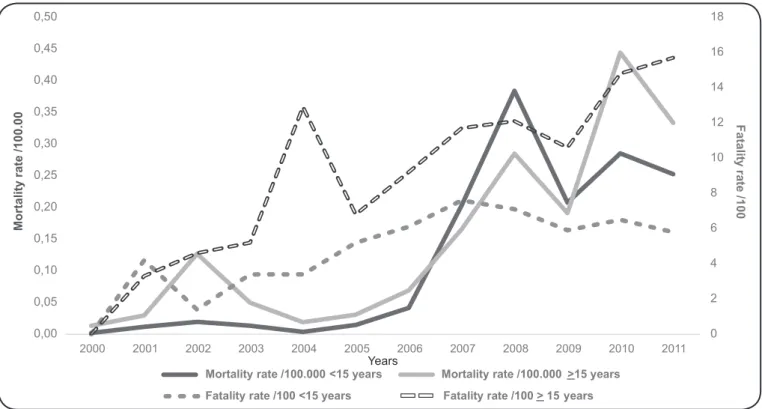
The DHF case fatality rate was at its highest among
individuals aged 15 years or over (average 23.4%), and especially among those aged 80 years and over. Among those
who were younger than 15 years of age, those under 1 year of age experienced notably higher case fatality rates, with a
mean rate of 8.2%, which ranged from zero deaths from 2001
to 2004 and in 2006, to 25% in 2005. Figure 2 shows that in both age groups, the increases in the DHF case fatality rates
were statistically signifi cant (β =1.1; p < 0.01 for those aged 15 years or over, and β = 0.48; p = 0.03 for those aged 0-14 years).
The mean annual dengue mortality rate from 2000 to 2011 was 0.14/100,000 inhabitants, which ranged from 0.01/100,000 inhabitants in 2000 to 0.41/100,000 inhabitants in 2010, with
peaks observed in 2002 and 2008. The increasing trend for mortality was signifi cant (β=0.02; p=0.001). The
Central-West region had the highest dengue mortality rate in 2010
(1.4/100,000 inhabitants). This region also exhibited the largest upward trend (β=0.077; p=0.01), followed by the northern region (β=0.059; p<0.01). In the southeastern and northeastern
regions, the increase was 0.03/100,000 inhabitants per year
(p<0.05). Figure 3 shows that the Southern region recorded
the lowest number of deaths (52), the lowest mean mortality rate (0.01/100,000 inhabitants), and the smallest upward trend (β=0.004, p=0.02).
Until 2006, those aged over 15 years had a higher risk
of death from dengue (average 0.04/100,000 inhabitants), especially those aged 80 years and older (mean 0.2/100,000 inhabitants). From 2007 to 2009, those who were younger than 15 years had higher mortality rates (0.2/100,000 inhabitants),
especially in the Northeastern region where this distribution
0 2 4 6 8 10 12 14 16 18
0,00 0,05 0,10 0,15 0,20 0,25 0,30 0,35 0,40 0,45 0,50
2000 2001 2002 2003 2004 2005 2006 2007 2008 2009 2010 2011
F
a
ta
lit
y
ra
te
/1
0
0
M
o
rt
a
li
ty
ra
te
/1
0
0
.0
0
Mortality rate /100.000 <15 years Mortality rate /100.000 >15 years Fatality rate /100 <15 years Fatality rate /100 > 15 years
FIGURE 2 - Temporal evolution of dengue mortality and fatality rates in Brazil from 2000 to 2011 according to the study’s age groups.
persisted until 2010. In the Southeastern region, this reversal
was only observed in 2008. The Central-West and Northern
regions showed no substantial changes in the age distributions of the mortality rates. In 2010, this indicator was higher among
those aged over 15 years (0.4/100,000 inhabitants). Within this group, those aged 80 years and older were the most affected by dengue mortality (2.8/100,000 inhabitants in 2010). For those
aged under 15 years, the highest rates of dengue mortality were
observed among children during the fi rst year of life. Upward trends in the dengue mortality rates (β=0.03) were observed for those who were younger than 15 years (p=0.07) and for those aged 15 years and over (p=0.04). In the Figure 2, among those who were younger than 15 years, the dengue mortality peak
occurred in 2008, while for those aged 15 years and over the
dengue mortality peak occurred in 2010.
The upward trends in DHF case fatality dengue mortality were maintained when the epidemic years were excluded from the series, excepted the trend for the dengue mortality rate in
the southern region became statistically insignifi cant.
Factors associated with dengue mortality and fatality
Of the 5,565 Brazilian municipalities, 4,843 reported at least one dengue fever case between 2008 and 2011, and these were
included in the analysis of the factors associated with dengue mortality and fatality.
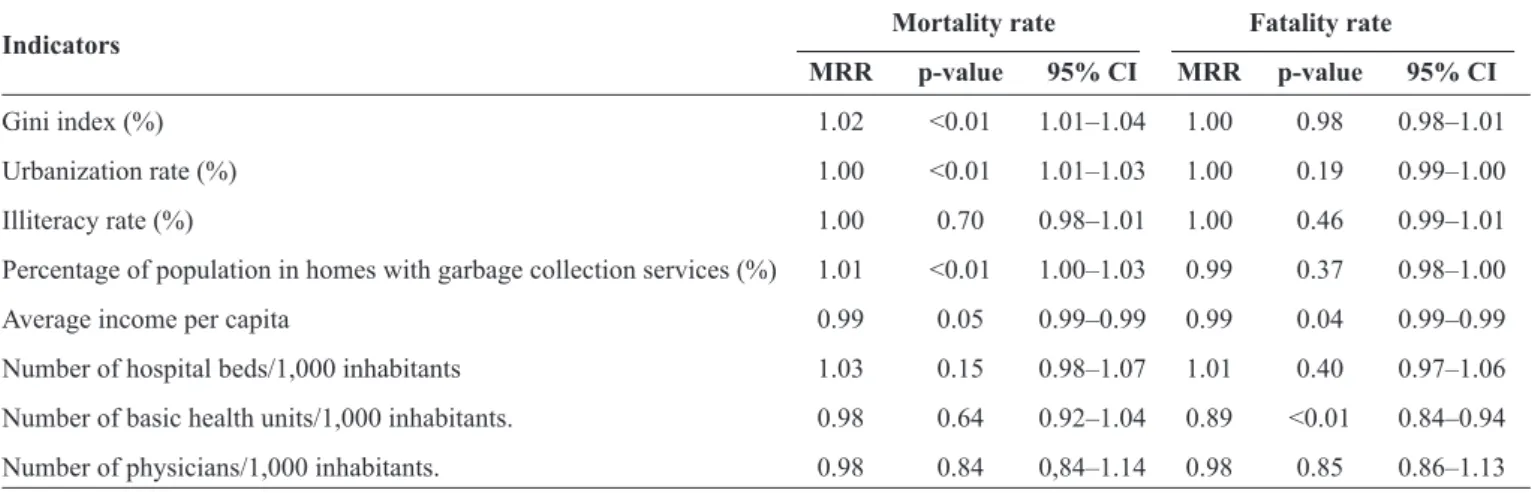
Dengue mortality (Table 1) was statistically associated with the socioeconomic and urbanization indicators; hence, it increased as the Gini index increased or worsened [mortality
rate ratio (MRR) =1.02; p<0.01], and a 1% increase in the Gini
index determined a 2% increase in the dengue mortality rate. The MRR increased as the proportion of the population that
lived in urban areas increased (MRR=1.01; p<0.01), and as the
percentage of the urban population that had garbage collections
increased (MRR=1.01; p<0.01), but it decreased as the income per capita increased (MRR=0.99; p=0.05). Among the variables related to health care, none were statistically signifi cant, but these were retained in the fi nal model because they had been defi ned apriori based on the theoretical background.
Table 1 shows that the dengue case fatality rate was inversely
associated with the average income per capita (MRR=0.99; p=0.05) and with the number of basic health units (MRR=0.89; p<0.01). Other variables related to health care were not statistically signifi cant, but they were retained in the model because they were defi ned a priori due to the theoretical background.
DISCUSSION
The risk of death from dengue in Brazil increased signifi cantly between 2000 and 2011, and this trend was present in all of the regions and in all of the age groups analyzed. In 2011, dengue mortality had increased 39-fold compared with that in 2000, and the DHF case fatality rate had doubled. These fi ndings confi rm that the severity of dengue epidemics is increasing in Brazil, as suggested by the reported increase hospitalization rates(15).
FIGURE 3 -Temporal evolution of dengue mortality rates in Brazil and its large regions from 2001 to 2011.
TABLE 1 -Mortality rate ratio obtained from multivariate negative binomial regression analysis of the associations between dengue mortality and fatality rates and socioeconomic, demographic, and health care indicators for the municipalities in Brazil that reported at least one case of dengue (n = 4,843) from 2008 to 2011.
Mortality rate Fatality rate Indicators
MRR p-value 95% CI MRR p-value 95% CI
Gini index (%) 1.02 <0.01 1.01–1.04 1.00 0.98 0.98–1.01
Urbanization rate (%) 1.00 <0.01 1.01–1.03 1.00 0.19 0.99–1.00
Illiteracy rate (%) 1.00 0.70 0.98–1.01 1.00 0.46 0.99–1.01
Percentage of population in homes with garbage collection services (%) 1.01 <0.01 1.00–1.03 0.99 0.37 0.98–1.00
Average income per capita 0.99 0.05 0.99–0.99 0.99 0.04 0.99–0.99
Number of hospital beds/1,000 inhabitants 1.03 0.15 0.98–1.07 1.01 0.40 0.97–1.06
Number of basic health units/1,000 inhabitants. 0.98 0.64 0.92–1.04 0.89 <0.01 0.84–0.94
Number of physicians/1,000 inhabitants. 0.98 0.84 0,84–1.14 0.98 0.85 0.86–1.13
MRR: mortality rate ratio; CI: confi dence interval.
0 0,1 0,2 0,3 0,4 0,5 0,6 0,7 0,8 0,9 1 1,1 1,2 1,3 1,4 1,5
2000 2001 2002 2003 2004 2005 2006 2007 2008 2009 2010 2011
D
e
n
g
u
e
m
o
rt
a
li
ty
ra
te
(/
1
0
0
,0
0
0
in
h
a
b
it
a
n
ts
)
Brazil
North
Northeast
Southeast
Central-west
South
not reached in any of the years studied. Even in countries such as Singapore, where all suspected dengue patients are admitted for appropriate and timely treatment, the DHF case
fatality rates reached 7.1% and 8.2% during the 2005 and
2007epidemics, respectively(17) (18), which are similar to Brazil’s
mean case fatality rate (8.2%). The case fatality indicator
is, of course, very sensitive to the choice of denominator. If all cases of dengue are used as the denominator, regardless of their clinical types, the case fatality rate becomes 1% or
less, as observed in Singapore in 2007 (0.27%)(18). In Brazil,
the offi cial statistics only used cases that were classifi ed as
having DHF as the denominator, which is in contrast to many countries. In addition to overestimating the case fatality rate, this difference complicates comparisons with other countries.
This raises the question of whether the goal of reducing the DHF case fatality rate to less than 1% is indeed feasible using DHF as the denominator given the current level of therapeutic knowledge.
With respect to the factors that determine the dengue mortality and DHF case fatality rates, the negative association
with the average income per capita is a consistent fi nding. Better
socioeconomic and health conditions have been recognized as protective factors against death, particularly from infectious diseases(18) (19) (20). Only the number of primary health care units was associated with lower case fatality rates, which suggests that access to primary care health professionals may reduce the DHF case fatality rate. However, the role of primary care in reducing the risk of death when the disease is present should be investigated more thoroughly.
Moreover, the quality of the care provided must be a risk factor. The observed absence of associations between lethal outcomes because of dengue and supplies of hospital beds and physicians in the municipalities strengthens this assertion, and is
consistent with fi ndings that point to the low-resolution abilities of a signifi cant proportion of Brazilian hospitals(21). However, it
is diffi cult to determine the infl uence of the quality of medical care from studies that are based on data from death certifi cates.
The number of primary care units was not associated with dengue mortality. Mortality is a function of the disease incidence and the case fatality rate. The lack of an association with mortality
probably refl ects the fact that primary health care is unlikely to
reduce the incidence of this disease. The association between dengue mortality and the Gini index, which measures social inequality, can be explained by the large social and environmental disparities that exist in the Brazilian municipalities(22), which may contribute to the formation of substandard aggregations that facilitate the spread of dengue(23) (24) and increase the numbers of infected individuals with in these populations. In addition, there is evidence of associations between the Gini index and the prevalence of cardiovascular disease(25) and asthma(26), which are comorbidities that are considered risk factors for death from dengue fever and for more serious forms of dengue(27) (28) (29) (30). No studies have examined the relationship between the Gini index and dengue mortality rates, but investigations in to the spatial distribution of dengue fever incidence have determined that this index is geographically associated(23).
The limitations of this study include the fact that it was conducted using secondary data. Hence, its results may have been underestimated through underreporting and errors regarding the causes of death. These errors may be the
consequence of the diffi culties associated with diagnosing the
disease, which have been highlighted in a study(31) that used the linkage method to compare the SIM and SINAN databases. The unavailability of some indicators, including those associated with the quality of health care, the prevalence of co-morbidities, and the seroprevalence of dengue in the population, represents an obstacle to improving the detection of associations. Moreover, ecological studies that examine the aggregate spaces are subject to the effects of the aggregation of areas, spatial autocorrelations, and the multicollinearities of some of the predictor variables that can alter the effects of each of these factors. Thus, the results should not be extrapolated to individuals, because even though individuals might live in the same city, they will not have equal risks. However, despite this non-equivalence, one must recognize that producing the disease and death involves the mediation of factors that include living conditions that are determined by socioeconomic, environmental, and demographic factors. Therefore, if the target of interest is the population, one should seek to capture the results of these interactions, because this knowledge can be a valuable management tool for more
effective decision making within each specifi c situation.
Ecological studies on dengue fever mortality and living conditions are scarce in the literature, but an interesting investigation involving Latin American and the Caribbean countries revealed the existence of a relationship between
dengue fever mortality and socioeconomic indicators(10). Our study was similar to this study, but we analyzed a broader set of dengue fever socioeconomic- and healthcare-related determinants
in a country with a uniform notifi cation system and a higher
number of units for analysis, and, consequently, our study has a higher statistical power. Moreover, using the municipalities as the unit for analysis rather than the country guarantees a uniform distribution of the variable values within the units and a lower possibility of ecological fallacy-related biases. The magnitude of dengue fever epidemics is increasing(32), and there is a risk that severe forms will continue to occur as this frequency increases. Therefore, while seeking to control dengue fever epidemics, the feasibility of reducing the mortality and case fatality rates represents a particular challenge in the short term.
Our results show that in low-to-middle income countries such as Brazil, efforts to control the negative outcomes associated with dengue fever will require the implementation of structural and intersectoral investments aimed at improving the socioeconomic and living conditions of the population.
The authors declare that there is no confl ict of interest.
CONFLICT OF INTEREST
FINANCIAL SUPPORT
REFERENCES
Thanks to Coordenação de Aperfeiçoamento de Pessoal de Nível Superior that provided technical support for the development and implementation of this study.
1. World Health Organization (WHO). Dengue and severe dengue.
Fact sheet n° 117 (Internet), 2014 (updated 2014 March; cited 2014 July 22). WHO; 2014. (Accessed 2014 September). Available at:
http://www.who.int/mediacentre/factsheets/fs117/en/
2. Guzmán MG, Kouri G. Dengue in the American Region. An update, 2002. Lancet Infect Dis 2002; 2:33-42.
3. Pan American Health Organization (PAHO). Dengue hemorrhagic
fever (DHF) in the Americas, by Country: number of reported
cases of dengue and Figures for 2010 (to week noted by each
country. (Internet). PAHO; 2010 (Acessed 2014 August). Available
at http://www.paho.org/
4. Teixeira MG. Few characteristics of dengue’s fever epidemiology in Brazil. Rev Inst Med Trop São Paulo 2012; 54:1-4.
5. Ministério da Saúde. Sistema de Informação de Agravos de
Notifi cação (Internet). Brasília: Ministério da Saúde. (Acessed 2014 January). Available at http://dtr2004.saude.gov.br/sinanweb/
6. Ministério da Saúde. Análise da situação das doenças
transmissíveis no Brasil no período de 2000 a 2010 (Internet). Brasília: Ministério da Saúde. (Acessed 2014 June) Available at:
http://portalsaude.saude.gov.br/portalsaude/arquivos/pdf/2013/ Fev/21/saudebrasil2011_parte1_cap3.pdf
7. Suaya JA, Shepard DS, Siqueira JB, Martelli CT, Lum LC, Tan LH, et al. Cost of dengue cases in eight countries in the Americas and Asia: a prospective study. Am J Trop Med Hyg 2009;
8. Instituto Brasileiro de Geografi a e Estatística (IBGE). Pesquisa Nacional por Amostra de Domicílios: Um panorama da saúde
no Brasil. Acesso e utilização de serviços, condições de saúde e
fatores de risco e proteção à saúde. Rio de Janeiro: IBGE; 2008 (Accessed 2014 April). Available at http://bvsms.saude.gov.br/bvs/
publicacoes/pnad_panorama_saude_brasil.pdf
9. Pavão AL, Coeli CM, Lopes CS, Faerstein E, Werneck GL, Chor D. Uso de serviços de Saúde segundo a posição socioeconômica em trabalhadores de uma universidade pública. Rev Saude Publica
2012; 46:98-103.
10. Diaz-Quijano FA, Waldman EA. Factors associated with dengue mortality in Latin America and the Caribben, 1995-2009:
An Ecological study. Am J Trop Med Hyg 2012; 86:328-334.
11. World Health Organization (WHO). Dengue hemorrhagic fever:
Diagnosis, Treatment, Prevention and Control. Geneva: WHO; 1997. 12. Bruin J. Newtest: command to compute new test. UCLA:
Academic Technology Services, Statistical Consulting Group.
(Accessed 2014 July). Available at: http://www.ats.ucla.edu/stat/
stata/ado/analysis/
13. Instituto Brasileiro de Geografi a e Estatística (IBGE). Censo
demográfi co 2010. Características da População e dos domicílios. Rio de Janeiro: IBGE; 2010. (Accessed 2014 June). Available at:
http://www.ibge.gov.br/home/estatistica/populacao/censo2010/ caracter isticas_da _ populacao/default_caracter isticas_da _ populacao.shtm
14. Hilbe JM. Negative binomial regression. New York: Cambrige University Press, USA; 2011.
15. Costa MCN, Barreto FR, Coelho, G, Teixeira MG. Change in the epidemiologic pattem in occurrence of dengue and dengue hemorragic fever in Brazil. J Epidemiol Community Health 2011: 65:A361.
16. Fundação Nacional de Saúde (FUNASA). Programa Nacional de
Controle da Dengue (PNCD). Brasília: FUNASA; 2002.
17. Koh BK, Ng LC, Kita Y, Tang CS, Ang LW, Wong KY, et al. The 2005 dengue epidemic in Singapore: epidemiology, prevention
and control. Ann Academy Med 2008; 37:538-545.
18. Ler TS, Ang LW, Yap GSL, Ng LC, Tai JC, Jamesb L, et al. Epidemiological characteristics of the 2005 and 2007 dengue epidemics in Singapore - similarities and distinctions. WPSAR 2011; 2:24-29.
19. Nguyen K-H, Jimenez-Soto E, Dayal P, Hodge A. Disparities in child mortality trends: what is the evidence from disadvantaged states in India? the case of Orissa and Madhya Pradesh. Int J Equity Health 2003; 12:45.
20. Tusting LS, Willey B, Lucas H, Thompson J, Kafy HT, Smith R, et al. Socioeconomic development as an intervention against malaria:
a systematic review and meta-analysis. Lancet 2013; 382:963-972.
21. Wu SH, Woo J, Zhang X-H. Worldwide socioeconomic status and stroke mortality: an ecological study. Int J Equity Health 2013; 12:42. 22. Vecina Neto G, Malik AM. Tendências na assistência hospitalar.
Cienc Saude Coletiva 2007; 12:825-839.
23. Rasella D, Aquino R, Barreto ML. Impact of income inequality on life expectancy in a highly unequal developing country: the
case of Brazil. J Epidemiol Community 2013; (Internet). (Accessed 2014 September). Available at: http://jech.bmj.com/content/
early/2013/04/30/jech-2012-201426.short
24. Teixeira TRA, Cruz OG. Spatial modeling of dengue and socio-environmental indicators in the city of Rio de Janeiro, Brazil. Cad Saude Publica 2011; 27:591-602.
25. Flauzino RF, Souza-Santos R, Oliveira RM. Dengue, geoprocessing, and socioeconomic and environmental indicators: a review. Rev Panam Salud Publica 2009; 25:456-461.
26. Siegel M, Luengen M, Stock S. On age-specifi c variations in
income-related inequalities in diabetes, hypertension and obesity.
Int J Public Health 2013; 58:33-41.
27. Da Cunha SS, Pujades-Rodriguez M, Barreto ML, Genser B, Rodrigues LC Ecological study of socio-economic indicators and prevalence of asthma in schoolchildren in urban Brazil. BMC Public Health 2007; 7:205-211.
28. Guzmán MG, Alvarez M, Rodriguez R, Rosario D, Vásques S, Vald L, et al. Fatal dengue hemorrhagic fever in Cuba, 1997. Int J Infect Dis 1999; 3:130-135.
29. Leo YS, Thein T, Fisher DA, Low JG, Oh HM, Narayanan RL,
et al. Confi rmed adult dengue deaths in Singapore: 5-year
multi-center retrospective study. BMC Infect Dis 2011; 11:123.
30. Figueiredo MAA, Rodrigues LC, Barreto ML, Lima JWO, Costa MCN, Morato V, et al. Allergies and diabetes as risk factors for dengue hemorrhagic fever: results of a case control study. PLoS Negl Trop Dis 2010; 4:1-6.
31. Moraes GH, Duarte EC. Análise da concordância dos dados de mortalidade por dengue em dois sistemas nacionais de informação em saúde, Brasil, 2000-2005. Cad Saude Publica 2005; 25: 2354-2364.
32. Teixeira MG, Costa MCN, Barreto F, Barreto ML. Dengue: