Overview of systematic reviews – a new type of study. Part II
Overview de revisões sistemáticas – um novo tipo de estudo. Parte II
Valter Silva
I, Antonio Jose Grande
II, Alan Pedrosa Viegas de Carvalho
III, Ana Luiza Cabrera Martimbianco
IV, Rachel Riera
VBrazilian Cochrane Center in collaboration with Postgraduate Program on Internal Medicine and Therapeutics (PGMIT) and Emergency
Medicine and Evidence-based Medicine, Department of Medicine, Escola Paulista de Medicina, Universidade Federal de São Paulo
(EPM-Unifesp), São Paulo, Brazil
ABSTRACT
CONTEXT AND OBJECTIVE: Overviews of Systematic Reviews (OoRs) are a new type of study in which multiple evidence from systematic reviews (SRs) is compiled into an accessible and useful document. The aim here was to describe the state of the art and critically assess Cochrane OoRs that have been published.
DESIGN AND SETTING: Descriptive study conducted at a research center.
METHODS: The OoRs identiied through the ilter developed in Part I of this study were evaluated in ive domains: methodological quality; quality of evidence; implications for practice; general proile of OoRs; and length of work.
RESULTS: All 13 OoRs included had high methodological quality. Some OoRs did not present suicient data to judge the quality of evidence; using sensitivity analysis, the quality of evidence of the OoRs in-creased. Regarding implications for practice, 64% of the interventions were judged as beneicial or harm-ful, while 36% of them showed insuicient evidence for judgment. It is expected (with 95% conidence interval) that one OoR will include 9,462 to 64,469 patients, 9 to 29 systematic reviews and 80 to 344 primary studies, and assess 6 to 21 interventions; and that 50 to 92% of OoRs will produce meta-analysis. The OoRs generated 2 to 26 meta-analyses over a period of 18 to 31 months.
CONCLUSION: The OoRs presented high methodological quality; the quality of evidence tended to be moderate/high; most interventions were judged to be beneicial/harmful; the mean length of work was 24 months. The OoR proile adds power to decision-making.
RESUMO
CONTEXTO E OBJETIVO:Overviews de revisões sistemáticas (OoRs) representam um novo tipo de estudo que compila múltiplas evidências de revisões sistemáticas (SRs) em um documento acessível e útil. O ob-jetivo foi de descrever o estado da arte e avaliar criticamente as OoRs Cochrane publicadas.
DESENHO E LOCAL: Estudo descritivo realizado em centro de pesquisa.
MÉTODOS: As OoRs identiicadas através do iltro desenvolvido na parte I deste estudo foram avaliadas por cinco domínios: qualidade metodológica, qualidade da evidência, implicações para a prática, peril geral das OoRs e tempo de execução.
RESULTADOS: As 13 OoRs incluídas apresentaram alta qualidade metodológica. Algumas OoRs não apre-sentavam dados suicientes para julgar a qualidade da evidência; com a análise de sensibilidade, a quali-dade evidência nas OoRs aumentou. Implicações para prática foram julgadas como benéicas ou danosas em 64% das intervenções; em 36% das intervenções há evidências insuicientes para o julgamento. É esperado (com intervalo de coniança de 95%) que uma OoR inclua 9.462 a 64.469 pacientes, 9 a 29 re-visões sistemáticas e 80 a 344 estudos primários, e avaliem entre 6 e 21 intervenções; que 50 a 92% das OoRs realizem metanálise. As OoRs geraram entre 2 e 26 metanálises em um período de 18 a 31 meses.
CONCLUSÃO: As OoRs apresentam alta qualidade metodológica; a qualidade da evidência tende a ser alta/moderada; as intervenções, em sua maioria, foram julgadas como benéicas/danosas; o tempo de execução foi de 24 meses em média. O peril das OoRs potencializa a tomada de decisão.
IBSc. Specialist in Cardiac Rehabilitation, Obesity and Statistics and Doctoral Student in the Postgraduate Program on Internal Medicine and Therapeutics, Escola Paulista de Medicina, Universidade Federal de São Paulo (EPM-Unifesp), São Paulo, Brazil.
IIBSc, MSc. Doctoral Student in the Postgraduate Program on Internal Medicine and Therapeutics, Escola Paulista de Medicina, Universidade Federal de São Paulo (EPM-Unifesp); Volunteer Research Assistant at the Brazilian Cochrane Center, São Paulo, Brazil.
IIIBSc, MSc. Specialist in Rehabilitation and Cardiac Physiotherapy and Doctoral Student in the Postgraduate Program on Internal Medicine and Therapeutics, Escola Paulista de Medicina, Universidade Federal de São Paulo (EPM-Unifesp); Volunteer Research Assistant at the Brazilian Cochrane Center, São Paulo, Brazil. IVBSc. Specialist in Orthopedics and Doctoral Student in the Postgraduate Program on Internal Medicine and Therapeutics, Escola Paulista de Medicina, Universidade Federal de São Paulo (EPM-Unifesp); Volunteer Research Assistant at the Brazilian Cochrane Center and Preceptor at EPM-Unifesp, São Paulo, Brazil. VMD, MSc, PhD. Rheumatologist and Professor at Escola Paulista de Medicina, Universidade Federal de São Paulo (EPM-Unifesp); Coordinator at Brazilian Cochrane Center, São Paulo, Brazil.
KEY WORDS:
Review [publication type].
Study characteristics [publication type]. Decision making.
Evidence-based practice. Evidence-based medicine.
PALAVRAS-CHAVE: Revisão.
Características dos estudos. Tomada de decisões.
INTRODUCTION
Overviews of Systematic Reviews (OoRs) are a new type of study that has been proposed by the Cochrane Collaboration in order to compile multiple evidence from systematic reviews (SRs) into a single document that is accessible and useful. Each OoR focuses on a problem or medical condition for which two or more SRs have addressed potential interventions and their outcomes.1-6
One SR rarely addresses all potential interventions for a con-dition, and healthcare policymakers may have diiculty in ind-ing, evaluatind-ing, comparing and summarizing the information from all the relevant SRs.3,4 hus, the main objective of OoRs is to
serve as a friendly front end for the Cochrane Collaboration with regard to healthcare decision-making. he relevant SRs are inte-grated and/or summarized into a single document, i.e. an OoR. his, in theory, allows the reader to have access to an integrated summary of a long list of studies included in Cochrane SRs.1-6
herefore, the primary audience for OoRs are healthcare deci-sion-makers, such as healthcare professionals, policymakers and informed consumers who, through the Cochrane Library, seek evidence on treatments for various health conditions.1,2
he irst part1,2 of this series of three articles on OoRs focused
on the growth of publications with the best level of evidence avail-able for healthcare decision-making. It provided justiications for implementing this new type of study, as well as deining who the target audience are. Furthermore, a ilter was created and applied in order to search for speciic OoRs in the Cochrane Library.
his second part of the series continues to address this topic by describing the state of the art (state of knowledge) of Cochrane Collaboration OoRs, through a critical assessment of Cochrane OoRs. In Part III, a new hierarchy for the pyramid of evidence will be proposed, taking this new type of study into consideration.
OBJECTIVE
To critically assess Cochrane Overviews of Systematic Reviews, through analyzing the characteristics, approaches and method-ological aspects of this type of study.
METHODS
his descriptive study was conducted at the research center of a federal university in Brazil and within one of its postgraduate study programs.
We performed a search for OoRs in the Cochrane Library, as described in Part I1,2 of this series. he lowchart for the OoRs
is shown in Figure 1. he inclusion criteria were that the studies needed to be OoRs and to have been published in the Cochrane Database of Systematic Reviews, which is one of the six directo-ries of the Cochrane Library.7 Protocols for Cochrane OoRs that
have been published were excluded.
Ater OoR selection, two of the present authors (VS and AJG) read them, extracted data and assessed the quality. Diferences in data collection information were resolved by reaching a consensus.
he data extracted from each OoR were organized using a speciic form that sought information on the research question and objective, date of search, number of studies included, partic-ipants, interventions, main outcome, methodological quality of the review, quality of evidence and authors’ conclusion.
We used ive items to critically assess the OoRs: (1) meth-odological quality, using the AMSTAR tool (Assessing the Methodological Quality of Systematic Reviews);8 (2)
qual-ity of evidence, assessed using the GRADE tool (Grades of Recommendation, Assessment, Development and Evaluation) or any other method reported through OoRs; (3) implica-tions for practice (the evidence conirms that the interven-tion presents beneits; the evidence conirms that the inter-vention presents harm/risk; or absence of evidence for a recommendation); (4) general proile of OoRs included (patients/OoR, SRs/OoR, studies/OoR, interventions/OoR, meta-analysis/OoR and search strategy); (5) Length of work, i.e. the time taken to publish the OoR (in years), obtained from the date of registration of the title (via Archie), date of publica-tion of the protocol (via the Cochrane Library) and date of pub-lication of the OoR (via the Cochrane Library).
Data synthesis was performed using descriptive statistics. Contingency tables were used to summarize dichotomous data as frequencies and proportions. Quantitative data were summa-rized using the mean and standard deviation. Sensitivity analysis were performed to assess the robustness of the results.
RESULTS
he search ilter for OoRs that was developed in Part I1,2 of this
study was updated, validated9 [sensitivity = 1.00 (95% CI = 0.86
to 1.00); speciicity = 0.99 (95% CI = 0.99 to 1.00)] and used (on November 5, 2013). hrough this process, 1207 titles were retrieved, of which 95% were excluded because they had not been published in the Cochrane Database of Systematic Reviews. Ninety-three references were checked, but 52 of these were sys-tematic reviews and were excluded; and another 26 potential
OoRs10-35 were excluded because they were at the protocol stage.
At the end of the selection process, 13 OoRs26,35-46 were included,
were used for data extraction and were critically assessed.
Figure 1 presents the PRISMA (Preferred Reporting Items for Systematic Reviews and Meta-Analysis) lowchart for the OoRs.
he characteristics of the thirteen OoRs26,35-46 included in
this study are described in detail in Appendix 1, which includes the main conclusions from the approaches used in each study. he synthesis on the data extracted from these 13 OoRs,26,35-46
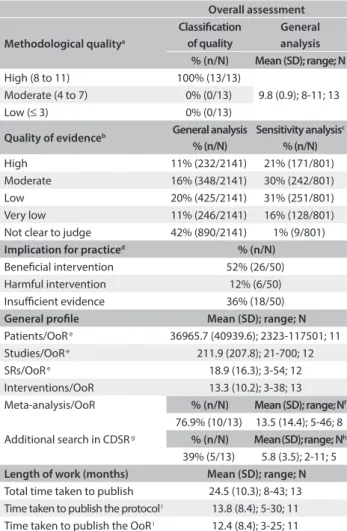
All the OoRs that were included26,35-46 had high
methodologi-cal quality, reaching between 9 and 11 points out of the 11 points possible in AMSTAR (Table 1). However, some OoRs lost points regarding methodological quality for the following reasons: they did not record the protocol36 or, if it was cited, did not make it
available;38 they only included searches in the Cochrane Database
of Systematic Reviews (CDSR);26,35-37,39,43,44,46 they did not consider
the quality of evidence in formulating conclusions;46 they were
unable to “meta-analyze” the data;40,42,43,46 and they did not assess
the risk of bias among the reviews included.36
With regard to judging the quality of evidence, it was found that many categories/studies were unclear, and thus the proportion of the categories/studies that presented high-quality evidence was low. If the OoRs40,42,46 in which more than 10% of the studies/categories could not
be clearly judged regarding the quality of evidence were excluded, the proportion of studies/categories that were of high quality doubled. he sensitivity analysis drastically altered the proportions of the other cat-egories regarding the quality of evidence (Table 1).
hrough the outcome of implications for practice, we found that about 64% of the interventions were judged to be beneicial or harmful. However, there was insuicient evidence to judge the interventions in 36% of them (Table 1).
Regarding general factors, with a 95% conidence interval, we expect that each new OoR will include between 9,462 and 64,469 patients, between 9 and 29 SRs and between 80 and 344 primary studies, and will assess between 6 and 21 interventions. Between 50 and 92% of OoRs that pool data qualitatively will generate between 2 and 26 meta-analyses. Additional details are analyzed in Table 1.
Studies identiied in the Cochrane Library
(n = 1,207) Studies not published in Cochrane Database of Systematic Reviews
(n = 1,114) Studies identiied in the Cochrane
Database of Systematic Reviews
(n = 93) Studies excluded because they were
not OoRs (n = 52)
OoRs excluded because they were
protocols (n = 25)10-34
OoRs assessed for inclusion (n = 41)
OoRs included for analysis (n = 13)26,35-46
Figure 1. Preferred Reporting Items for Systematic Reviews and Meta-Analysis lowchart for Cochrane Overviews of Systematic Reviews (OoRs).
Table 1. Overall assessment of Cochrane Overviews of Systematic Review (OoRs)
Overall assessment
Methodological qualitya
Classiication of quality
General analysis % (n/N) Mean (SD); range; N High (8 to 11) 100% (13/13)
9.8 (0.9); 8-11; 13 Moderate (4 to 7) 0% (0/13)
Low (≤ 3) 0% (0/13)
Quality of evidenceb General analysis % (n/N)
Sensitivity analysisc % (n/N) High 11% (232/2141) 21% (171/801) Moderate 16% (348/2141) 30% (242/801)
Low 20% (425/2141) 31% (251/801)
Very low 11% (246/2141) 16% (128/801) Not clear to judge 42% (890/2141) 1% (9/801) Implication for practiced % (n/N) Beneicial intervention 52% (26/50) Harmful intervention 12% (6/50) Insuicient evidence 36% (18/50)
General proile Mean (SD); range; N
Patients/OoR e 36965.7 (40939.6); 2323-117501; 11 Studies/OoR e 211.9 (207.8); 21-700; 12 SRs/OoR e 18.9 (16.3); 3-54; 12 Interventions/OoR 13.3 (10.2); 3-38; 13 Meta-analysis/OoR % (n/N) Mean (SD); range;Nf
76.9% (10/13) 13.5 (14.4); 5-46; 8 Additional search in CDSR g % (n/N) Mean(SD);range; Nh
39% (5/13) 5.8 (3.5); 2-11; 5 Length of work (months) Mean (SD); range; N Total time taken to publish 24.5 (10.3); 8-43; 13 Time taken to publish the protocol i 13.8 (8.4); 5-30; 11 Time taken to publish the OoR i 12.4 (8.4); 3-25; 11
aAMSTAR conducted;8bfrequency based on the number of outcomes or
studies assessed; cOoRs41,43,48 in which more than 10% of the studies/categories
could not be clearly judged regarding the quality of the evidence were excluded from the sensitivity analysis; djudgments based on main outcome
conclusion; esome data could not be determined (patients/OoR,39,41 SRs/
OoR42 and studies/OoR41), even by looking for results tables in the OoRs or
SRs included, thus reducing the number of OoRs in the analysis; fstudies in
which no meta-analysis was conducted37,41,43-45 were not included; gCDSR is the
abbreviation for Cochrane Database of Systematic Reviews; honly OoRs39,41-43,46
in which additional searches in the CDSR were conducted were included in the analysis; ithe protocols for these OoRs37,39 were not found in the Cochrane
Library or in Archie, thus reducing the number of OoRs in the analysis; SD = standard deviation; range = minimum to maximum; SR = systematic review.
Most of the OoRs (62%) conducted searches for systematic reviews only in the Cochrane Database of Systematic Reviews (CDSR). However, those that conducted external searches, in addition to searching in the CDSR, used between one and ten databases (Table 1).
Only 23% (3/13) of the OoRs did not identify the study type in the title. he same also occurred in the protocols for OoRs (6/28).
DISCUSSION
he Cochrane Collaboration’s OoRs are supervised by one of the 16 methods groups, the Comparing Multiple Interventions Methods Group. his methods group of the Cochrane Collaboration was established in 2004 and initially was called the Umbrella Reviews Working Group.47
Other milestones during the development of the OoRs methodology occurred in 1996, 1997, 1998 and 2005. Between February 1997 and December 1998, the irst series of OoRs,48-51
four reviews relating to pregnancy were published as a partner-ship between researchers from the UK Cochrane Centre and the World Health Organization. In 1996, Julian Higgins and Anne Whitehead published the irst article to describe the standard Bayesian approach towards multiple-treatment meta-analysis (MTM).52 In 2005, in the 13th Cochrane Colloquium in
Melbourne, Georgia Salanti made a presentation on MTM meth-odology,53 co-authored with Julian Higgins and Valeria Marinho.
his won the prize for best oral presentation and helped to popu-larize the technique.
In this context, the present systematic review describes how far the knowledge of the select group of Cochrane OoRs26,35-46
published in the CDSR has reached. Although we only included 13 OoRs,26,35-46 these studies published in the CDSR by the
Cochrane Collaboration stand out through their methodologi-cal rigor. his was highlighted in two studies54,55 that compared
the methodological rigor of Cochrane systematic reviews with non-Cochrane systematic reviews. On January 24, 2011, in rec-ognition of the contribution to healthcare that the Cochrane Collaboration has made,56 the World Health Organization lauded
the Collaboration as a non-governmental organization, with a seat in the World Health Assembly and voting rights, in order to help manage healthcare worldwide.
As examples of Cochrane systematic reviews,54,55 all the OoRs
included in this review35-46 had high methodological quality
and therefore less risk of bias, according to the results obtained through AMSTAR.8 However, the reasons why not all the OoRs
included obtained the maximum score need to be discussed: 1. he protocols for two OoRs36,38 were not found in the
Cochrane Library or in Archie, even though one of them cited the protocol.38 Registration of the protocols for OoR,
just as for clinical trials and systematic reviews, allows assess-ment of methodological quality, provides transparency in conducting the study and minimizes occurrences of publica-tion bias or selective reporting of outcomes.
2. Eight OoRs26,35-37,39,43,44,46 restricted the search to only one
database, i.e. the CDSR. Moreover, we did not consider this
to be a potential source of bias, taking the view that the search methods for systematic reviews in the CDSR are rig-orous and comprehensive (including no restrictions on date, publication status or language), and therefore that there was a high probability of including all the relevant primary studies. 3. Four OoRs40,42,43,46 could not match any of the systematic
reviews included in their quantitative data synthesis, through either direct or indirect meta-analysis, and therefore summa-rized and integrated the evidence qualitatively.
4. One OoR36 did not evaluate or discuss the risk of publication
bias among the systematic reviews included.
Although AMSTAR8 was developed to assess the
method-ological quality of systematic reviews, it needs to be borne in mind that many of the items that it assesses are also present in OoRs, even though OoRs are diferent studies. hus, AMSTAR8
can be considered to be an analogous tool for assessing OoRs, in which external validity is preserved. Development of an instru-ment for judging the methodological rigor and consistency of OoRs will be important for reducing the uncertainties in deci-sion-making from these studies.
One challenge identiied in the present study was the lack of standardization in the method for assessing the quality of evi-dence. OoRs26,35-46 have used various methods of assessment
(e.g. GRADE,57 Cochrane risk of bias tool,58,59 Jadad et al.,60 or
even review-speciic criteria) or, when using the same method, have described it in diferent ways, thereby making the judg-ment uncertain. In this context, two OoRs40,42 can be highlighted.
Despite the high methodological quality of the study by Ryan et al.,40 it only described how the systematic reviews included had
assessed the quality of evidence, thus making it diicult to assess this outcome. Many studies (890/2141) may not have made judg-ments regarding the quality of evidence. In the second of these OoRs, Jones et al.42 used the Cochrane risk of bias tool58,61 to
assess the quality of the evidence in Cochrane reviews, while for non-Cochrane reviews they used Jadad et al.60 Despite the
difer-ences in the concepts of quality of evidence and methodological quality (which were not among the objectives of this discussion), these authors reported the proportion of studies that presented high quality. hus, the description was not suiciently clear or standardized for a judgment to be made regarding the overall quality of evidence.
To assess the quality of evidence, the most consistently used method among the OoRs assessed26,35-46 was the GRADE
approach.57 Basically, this tool classiies evidence into four levels:
an important impact on the estimated efect and change the results; and (4) very low quality — there is no certainty in the estimated efect. In the GRADE approach to the classi-ication of evidence, the assessment can be lowered or raised according to certain methodological factors. Methodological limitations, inconsistent results, imputations of evidence, imprecision of results and publication bias diminish the quality of evidence. he magnitude of the efect, controlling for con-founders and dose-response gradients are methodological fac-tors that may raise the level of evidence.
Even though there has been criticism regarding the lack of methodological rigor in this type of study,62,63 all the Cochrane
OoRs35-46 assessed methodological quality, thus allowing
judg-ment of the efects of interventions based on the main outcomes found. About two-thirds of the OoRs26,35-46 presented evidence to
judge how beneicial or harmful the main outcomes were. hese results are based on various systematic reviews and thus inte-grate and summarize evidence from several interventions relat-ing to a given condition, from a high number of clinical trials and patients. he evidence in these OoRs26,35-46 was released over
a period of about two years from the time of registration of the title to the date of publication. In the future, it will be important to also determine the time taken to update the OoRs.
Furthermore, comparing the results from this descriptive systematic review of published studies with other OoRs62,63 that
assessed this new type of study, the Cochrane OoRs seem to have higher quality and methodological rigor than non-Cochrane OoRs. To reduce the inconsistency of OoRs, it is important that authors follow the existing methodological recommendations.3,5,61
When extracting data, attention was drawn to two factors: (1) three studies37,39,43 did not declare the type of study, i.e.
“over-view of re“over-views” (there was a similar proportion with regard to protocols for OoRs: 6/28), which may be a limiting factor in that it becomes more diicult for readers to easily identify the type of study; (2) Singh et al.41 only included primary studies from
the list of references of systematic reviews and conducted search strategies in bibliographic databases.
Another feature that may pose a challenge in conducting this type of study is the complex statistical methods required for integrate and summarizing the evidence. he methodolog-ical basis for network meta-analysis, also known as multiple-treatment meta-analysis and mixed-multiple-treatment comparisons, was established in 1996.52 In view of the challenge of
imple-menting these statistical techniques, a special issue of Research Synthesis Methods was published on this topic in 2012 (see volume 3, number 2). For researchers who wish to conduct an OoR, it is highly recommended that the information pro-vided by the Cochrane Comparing Multiple Interventions Methods Group, the Multiple-Treatment Meta-analysis website
<http://www.mtm.uoi.gr/> and the special issue of Research Synthesis Methods should be consulted.
his new type of study certainly attracts everyone’s attention, as demonstrated from data in Evidence-Based Child Health.5
In 2009, OoRs were downloaded 3.05 times more than other types of study. here has also been a tendency towards growth of this frequency over the years (2006 versus 2009), by a rate of 1.84 times. he importance of this type of study can be under-stood through the great interest of its audience.
Despite the limitation of the small number of OoRs included and the absence of some information that could not be obtained, it could be seen that this type of study presents the following potential benefits: (1) it allows consumers to know about and understand the concepts and application of such studies and their ability to integrate and summarize var-ious interventions for a disease or health condition; (2) for healthcare policymakers, summarizing all interventions into a single document allows them to keep up to date in the era of information globalization1,2 and, thus, this type of study serves
as a friendly front end for healthcare decision-making based on the best available evidence, thereby changing professional practice and healthcare policies; and (3) it allows researchers to address the gaps, weaknesses and strengths of each study and think about future research strategies based on what still needs to be explored.
In Part III, a new hierarchy for the pyramid of evidence will be proposed, taking this new type of study into consideration.
CONCLUSION
OoRs have high methodological quality and high quality of evi-dence, as assessed in general. Moreover, about two-thirds of the conclusions had suicient evidence to judge that the implications for practice were either beneicial or harmful. In order to do this, the mean length of work required was 24 months.
he proile of OoRs reduces uncertainty in decision-making. his new type of study demonstrates the ability to compile mul-tiple evidence from systematic reviews in one handy and useful document that is able to address all potential interventions for a condition, thereby allowing decision-makers to locate, evaluate, compare and summarize the evidence from systematic reviews or primary studies.
Although OoRs are able to integrate and summarize multiple interventions for a problem in a single document, there is still a need to standardize the methods for this new type of study.
REFERENCES
2. Silva V, Grande AJ, Martimbianco ALC, Riera R, Carvalho APV. Overview de revisões sistemáticas – um novo tipo de estudo. Parte I: Por que e para quem? [Overview of systematic reviews - a new type of study. Part I: Why and for whom?] Diagn Tratamento. 2012;17(4):195-200. 3. Becker LA, Oxman AD. Chapter 22: Overviews of reviews. In: Higgins
JPT, Green S, editors. Cochrane Handbook for Systematic Reviews of Interventions Version 5.1.0. The Cochrane Collaboration; 2011. Available from: http://handbook.cochrane.org/chapter_22/22_ overviews_of_reviews.htm. Accessed in 2014 (Apr 9).
4. Becker LA. Cochrane Overviews of Reviews. Available from: https:// www.socialtext.net/overviews/cochrane_overviews_of_reviews. Accessed in 2014 (Apr 9).
5. Thomson D, Russell K, Becker L, Klassen T, Hartling L. The evolution of a new publication type: Steps and challenges of producing overviews of reviews. Research Synthesis Methods. 2010;1(3-4):198-211. Available from: http://onlinelibrary.wiley.com/doi/10.1002/ jrsm.30/abstract. Accessed in 2014 (Apr 9).
6. Salanti G, Becker L, Caldwell D, et al. Evolution of Cochrane Intervention Reviews and Overviews of Reviews to better accommodate comparisons among multiple interventions. Report from a meeting of the Cochrane Comparing Multiple Interventions Methods Groups; Milan. March 2011. Available from: http://cmimg.cochrane.org/sites/ cmimg.cochrane.org/iles/uploads/CMIMG%20summary%20of%20 meeting%20Milan%20March%202011.pdf. Accessed in 2014 (Apr 9). 7. The Cochrane Library. About the Cochrane Library. Available from: http:// www.thecochranelibrary.com/view/0/AboutTheCochraneLibrary.html. Accessed in 2014 (Apr 9).
8. Shea BJ, Grimshaw JM, Wells GA, et al. Development of AMSTAR: a measurement tool to assess the methodological quality of systematic reviews. BMC Med Res Methodol. 2007;7:10.
9. Silva V, Puga MES, Grande AJ, et al. Search filter for retrieving overviews of systematic reviews in The Cochrane Library. In: 21st Cochrane Colloquium, Auckland, 2013. Available from:
http://2013.colloquium.cochrane.org/abstracts/search-filter-retrieving-overviews-systematic-reviews-cochrane-library. Accessed in 2014 (Apr 9).
10. Amato L, Del Giovane C, Ferri M, et al. Acceptability, eicacy and safety of pharmacological interventions for cocaine dependence: an overview of Cochrane reviews. Cochrane Database of Systematic Reviews. 2012;(3):CD009696. Available from: http://onlinelibrary. wiley.com/doi/10.1002/14651858.CD009696/abstract. Accessed in 2014 (Apr 9).
11. Brown J, Farquhar C, Dias S. Endometriosis: an overview of Cochrane Reviews. Cochrane Database of Systematic Reviews. 2012;(1):CD009590. Available from: http://onlinelibrary.wiley.com/ doi/10.1002/14651858.CD009590/abstract. Accessed in 2014 (Apr 9). 12. Cahill K, Stevens S, Perera R, Lancaster T. Pharmacological
interventions for smoking cessation: an overview and network meta-analysis. Cochrane Database Syst Rev. 2013;(5):CD009329.
13. Cates CJ, Wieland LS, Oleszczuk M. Safety of regular formoterol or salmeterol in adults with asthma: an overview of Cochrane reviews. Cochrane Database of Systematic Reviews. 2013;(1):CD010314. Available from: http://onlinelibrary.wiley.com/doi/10.1002/14651858. CD010314/abstract. Accessed in 2014 (Apr 9).
14. Disler RT, Inglis SC, Davidson PM. Non-pharmacological management interventions for COPD: an overview of Cochrane systematic reviews. Cochrane Database of Systematic Reviews. 2013;(2):CD010384. Available from: http://onlinelibrary.wiley.com/ doi/10.1002/14651858.CD010384/abstract. Accessed in 2014 (Apr 9). 15. Dumville JC, O’Meara S, Bell-Syer SEM. Dressings for treating foot ulcers in people with diabetes: an overview of systematic reviews. Cochrane Database of Systematic Reviews. 2013;(4):CD010471. Available from: http://onlinelibrary.wiley.com/doi/10.1002/14651858.CD010471/ abstract. Accessed in 2014 (Apr 9).
16. Evans JR, Virgili G, Gordon I, et al. Interventions for neovascular age-related macular degeneration. Cochrane Database of Systematic Reviews. 2009;(1):CD007650. Available from: http://onlinelibrary. wiley.com/doi/10.1002/14651858.CD007650/abstract. Accessed in 2014 (Apr 9).
17. Filippini G, Del Giovane C, Vacchi L, et al. Immunomodulators and immunosuppressants for multiple sclerosis: a network meta-analysis. Cochrane Database of Systematic Reviews. 2011;(1):CD008933. Available from: http://onlinelibrary.wiley.com/doi/10.1002/14651858. CD008933/abstract. Accessed in 2014 (Apr 9).
18. Guay J, Choi P, Suresh S, et al. Neuraxial blockade for the prevention of postoperative mortality and major morbidity: an overview of Cochrane systematic reviews. Cochrane Database of Systematic Reviews. 2012;(9):CD010108. Available from: http://onlinelibrary. wiley.com/doi/10.1002/14651858.CD010108/abstract. Accessed in 2014 (Apr 9).
19. Hazlewood GS, Barnabe C, Tomlinson G, Marshall D, Bombardier C. Methotrexate monotherapy and methotrexate combination therapy with traditional and biologic disease modifying anti-rheumatic drugs for rheumatoid arthritis: A network meta-analysis. Cochrane Database of Systematic Reviews. 2013;(1):CD010227. Available from: http://onlinelibrary.wiley.com/doi/10.1002/14651858.CD010227/ abstract. Accessed in 2014 (Apr 9).
20. Hughes RAC, Lunn MPT, Frost C, van Schaik IN. Treatments for chronic inlammatory demyelinating polyradiculoneuropathy (CIDP): an overview of systematic reviews. Cochrane Database of Systematic Reviews. 2013;(2):CD010369. Available from: http://onlinelibrary. wiley.com/doi/10.1002/14651858.CD010369/abstract. Accessed in 2014 (Apr 9).
22. Lockhart P, Holland NJ, Swan I, Teixeira LJ. Interventions for Bell’s Palsy (idiopathic facial paralysis). Cochrane Database of Systematic Reviews. 2011;(2):CD008974. Available from: http://onlinelibrary.wiley.com/ doi/10.1002/14651858.CD008974/abstract. Accessed in 2014 (Apr 9). 23. Moore RA, Derry CJ, Derry S. Sumatriptan (all routes of
administration) for acute migraine attacks in adults: an overview of Cochrane reviews. Cochrane Database of Systematic Reviews. 2011;(5):CD009108. Available from: http://onlinelibrary.wiley.com/ doi/10.1002/14651858.CD009108/abstract. Accessed in 2014 (Apr 9). 24. Moore RA, Derry S, McQuay HJ. Topical analgesics for acute and
chronic pain in adults. Cochrane Database of Systematic Reviews. 2010;(7):CD008609. Available from: http://onlinelibrary.wiley.com/ doi/10.1002/14651858.CD008609/abstract. Accessed in 2014 (Apr 9). 25. Moore RA, Wifen PJ, Derry S, et al. Non-prescription (OTC) oral
analgesics for acute pain - an overview of Cochrane reviews. Cochrane Database of Systematic Reviews. 2013;(10):CD010794. Available from: http://onlinelibrary.wiley.com/doi/10.1002/14651858.CD010794/ abstract. Accessed in 2014 (Apr 9).
26. O’Connell NE, Wand BM, McAuley J, Marston L, Moseley GL. Interventions for treating pain and disability in adults with complex regional pain syndrome. Cochrane Database Syst Rev. 2013;(4):CD009416.
27. Ota E, Souza JP, Tobe-Gai R, et al. Interventions during the antenatal period for preventing stillbirth: an overview of Cochrane systematic reviews. Cochrane Database of Systematic Reviews. 2012;(1):CD009599. Available from: http://onlinelibrary.wiley.com/ doi/10.1002/14651858.CD009599/abstract. Accessed in 2014 (Apr 9). 28. Roqué i Figuls M, Martínez García L, Martinez-Zapata MJ, et al.
Interventions for treating overweight or obesity in adults: an overview of systematic reviews. Cochrane Database of Systematic Reviews. 2013;(8):CD010665. Available from: http://onlinelibrary.wiley.com/ doi/10.1002/14651858.CD010665/abstract. Accessed in 2014 (Apr 9). 29. Shah PB, Meleveedu R, Elayaraja S, James S, Sathiyasekaran BWC.
Interventions for treating community-acquired pneumonia: an overview of Cochrane systematic reviews. Cochrane Database of Systematic Reviews. 2011;(10):CD009343. Available from: http:// onlinelibrary.wiley.com/doi/10.1002/14651858.CD009343/abstract. Accessed in 2014 (Apr 9).
30. Shah PB, Meleveedu R, James S, Elayaraja S, Sathiyasekaran BWC. Interventions for treating hospital-acquired pneumonia: an overview of Cochrane systematic reviews. Cochrane Database of Systematic Reviews. 2011;(10):CD009370. Available from: http://onlinelibrary.wiley. com/doi/10.1002/14651858.CD009370/abstract?deniedAccessCusto misedMessage=&userIsAuthenticated=false. Accessed in 2014 (Apr 9). 31. Udell JE, Drahota A, Dean TP, Sander R, Mackenzie H. Interventions for
preventing falls in older people: an overview of Cochrane Reviews. Cochrane Database of Systematic Reviews. 2011;(4):CD009074. Available from: http://onlinelibrary.wiley.com/doi/10.1002/14651858. CD009074/abstract. Accessed in 2014 (Apr 9).
32. Visser J, McLachlan MH, Fergusson P, Volmink J, Garner P. Supplementary feeding for food insecure, vulnerable and malnourished populations - an overview of systematic reviews. Cochrane Database of Systematic Reviews. 2013;(6):CD010578. Available from: http://onlinelibrary. wiley.com/doi/10.1002/14651858.CD010578/abstract. Accessed in 2014 (Apr 9).
33. Welsh EJ, Spencer S, Saba T, Evans DJ, Fowler SJ. Interventions for bronchiectasis: an overview of Cochrane systematic reviews. Cochrane Database of Systematic Reviews. 2013;(2):CD010337. Available from: http://onlinelibrary.wiley.com/doi/10.1002/14651858.CD010337/ abstract. Accessed in 2014 (Apr 9).
34. Wifen PJ, Derry S, Moore RA, et al. Antiepileptic drugs for neuropathic pain and ibromyalgia – an overview of Cochrane reviews. Cochrane Database Syst Rev. 2013;11:CD010567.
35. Singh JA, Christensen R, Wells GA, et al. Biologics for rheumatoid arthritis: an overview of Cochrane reviews. Cochrane Database Syst Rev. 2009;(4):CD007848.
36. Keus F, Gooszen HG, van Laarhoven CJ. Open, small-incision, or laparoscopic cholecystectomy for patients with symptomatic cholecystolithiasis. An overview of Cochrane Hepato-Biliary Group reviews. Cochrane Database Syst Rev. 2010;(1):CD008318.
37. Amato L, Minozzi S, Davoli M. Eicacy and safety of pharmacological interventions for the treatment of the Alcohol Withdrawal Syndrome. Cochrane Database Syst Rev. 2011;(6):CD008537.
38. Flodgren G, Eccles MP, Shepperd S, et al. An overview of reviews evaluating the efectiveness of inancial incentives in changing healthcare professional behaviours and patient outcomes. Cochrane Database Syst Rev. 2011;(7):CD009255.
39. Moore RA, Derry S, McQuay HJ, Wifen PJ. Single dose oral analgesics for acute postoperative pain in adults. Cochrane Database Syst Rev. 2011;(9):CD008659.
40. Ryan R, Santesso N, Hill S, et al. Consumer-oriented interventions for evidence-based prescribing and medicines use: an overview of systematic reviews. Cochrane Database Syst Rev. 2011;(5):CD007768. 41. Singh JA, Wells GA, Christensen R, et al. Adverse efects of biologics: a
network meta-analysis and Cochrane overview. Cochrane Database Syst Rev. 2011;(2):CD008794.
42. Jones L, Othman M, Dowswell T, et al. Pain management for women in labour: an overview of systematic reviews. Cochrane Database Syst Rev. 2012;3:CD009234.
43. Payne C, Wifen PJ, Martin S. Interventions for fatigue and weight loss in adults with advanced progressive illness. Cochrane Database Syst Rev. 2012;1:CD008427.
44. Farquhar C, Rishworth JR, Brown J, Nelen WL, Marjoribanks J. Assisted reproductive technology: an overview of Cochrane Reviews. Cochrane Database Syst Rev. 2013;8:CD010537.
46. Cahill K, Stevens S, Perera R, Lancaster T. Pharmacological interventions for smoking cessation: an overview and network meta-analysis. Cochrane Database Syst Rev. 2013;5:CD009329.
47. Becher L, Thomson D, Caldwell D. Addressing multiple treatments I: Cochrane Overviews. Available from: http://cmimg.cochrane.org/ sites/cmimg.cochrane.org/iles/uploads/Becker%20-%20Intro%20 to%20Overviews%20Keystone.pdf. Accessed in 2014 (Apr 9). 48. Gülmezoglu M, de Onis M, Villar J. Efectiveness of interventions
to prevent or treat impaired fetal growth. Obstet Gynecol Surv. 1997;52(2):139-49.
49. de Onis M, Villar J, Gülmezoglu M. Nutritional interventions to prevent intrauterine growth retardation: evidence from randomized controlled trials. Eur J Clin Nutr. 1998;52 Suppl 1:S83-93.
50. Villar J, Gülmezoglu AM, de Onis M. Nutritional and antimicrobial interventions to prevent preterm birth: an overview of randomized controlled trials. Obstet Gynecol Surv. 1998;53(9):575-85.
51. Kulier R, de Onis M, Gülmezoglu AM, Villar J. Nutritional interventions for the prevention of maternal morbidity. Int J Gynaecol Obstet. 1998;63(3):231-46.
52. Higgins JP, Whitehead A. Borrowing strength from external trials in a meta-analysis. Stat Med. 1996;15(24):2733-49.
53. Salanti G, Higgins J, Marinho V. How to determine the best treatment: a mixed-treatment-comparisons meta-analysis (MTM) of trials of topical luoride therapies for the prevention of dental caries [abstract]. In: Proceedings of the XIII Cochrane Colloquium; 2005 Oct 22-26; Melbourne, Australia; 2005. Available from: http://cochrane.bvsalud.org/ doc.php?db=cmr&id=CMR-7814&lib=COC. Accessed in 2014 (Apr 9). 54. Collier A, Heilig L, Schilling L, Williams H, Dellavalle RP. Cochrane
Skin Group systematic reviews are more methodologically rigorous than other systematic reviews in dermatology. Br J Dermatol. 2006;155(6):1230-5.
55. Moseley AM, Elkins MR, Herbert RD, Maher CG, Sherrington C. Cochrane reviews used more rigorous methods than non-Cochrane reviews: survey of systematic reviews in physiotherapy. J Clin Epidemiol. 2009;62(10):1021-30.
56. Bero L, Ghersi D. Making systematic reviews global. Cochrane Database Syst Rev. 2011;(8):ED000020.
57. Schünemann HJ, Oxman AD, Vist GE, et al. Chapter 12: Interpreting results and drawing conclusions. In: Higgins JPT, Green S, editors. Cochrane Handbook for Systematic Reviews of Interventions Version 5.1.0. The Cochrane Collaboration; 2011. Available from: http:// handbook.cochrane.org/chapter_12/12_interpreting_results_and_ drawing_conclusions.htm. Accessed in 2014 (Apr 9).
58. Higgins JPT, Altman DG, Sterne JAC. Chapter 8: Assessing risk of bias in included studies. In: Higgins JPT, Green S, editors. Cochrane Handbook for Systematic Reviews of Interventions Version 5.1.0. The Cochrane Collaboration, 2011. Available from: http://handbook. cochrane.org/chapter_8/8_assessing_risk_of_bias_in_included_ studies.htm. Accessed in 2014 (Apr 9).
59. Carvalho APV, Silva V, Grande AJ. Avaliação do risco de viés de ensaios clínicos randomizados pela ferramenta da colaboração Cochrane [Assessment of risk of bias in randomized controlled trials by the Cochrane Collaboration tool]. Diagn Tratamento. 2013;18(1):38-44. 60. Jadad AR, Moore RA, Carroll D, et al. Assessing the quality of reports
of randomized clinical trials: is blinding necessary? Control Clin Trials. 1996;17(1):1-12.
61. Smith V, Devane D, Begley CM, Clarke M. Methodology in conducting a systematic review of systematic reviews of healthcare interventions. BMC Med Res Methodol. 2011;11(1):15.
62. Pieper D, Buechter R, Jerinic P, Eikermann M. Overviews of reviews often have limited rigor: a systematic review. J Clin Epidemiol. 2012;65(12):1267-73.
63. Hartling L, Chisholm A, Thomson D, Dryden DM. A descriptive analysis of overviews of reviews published between 2000 and 2011. PLoS One. 2012;7(11):e49667.
*The Portuguese version of this manuscript was published in the journal Diagnóstico & Tratamento, Volume 19, Issue Number 1, 2014
Acknowledgements: The authors VS, APVC, ALCM and AJG thank Coordenação de Aperfeiçoamento de Pessoal de Nível Superior (Capes) for granting scholarships
Sources of funding: None
Conlict of interest: None
Date of irst submission: December 24, 2013
Last received: April 24, 2014
Accepted: May 6, 2014
Address for correspondence: Antonio José Grande Centro Cochrane do Brasil
Universidade Federal de São Paulo (Unifesp) Rua Pedro de Toledo, 598
Vila Clementino - São Paulo (SP) CEP 04039-001
Appendix 1. Characteristics of Cochrane Overviews of Systematic Reviews (OoRs) that were included.
Singh et al.35
Review question/objective: What are the eicacy and safety of biologics for rheumatoid arthritis?
Search methods: Search date up to May 30, 2009. Databases: Cochrane Database of Systematic Reviews. Studies included: Six Cochrane systematic reviews.
Participants: Adults 18 years or older, with rheumatoid arthritis meeting the 1987 American College of Rheumatology (ACR) classiication criteria for rheumatoid arthritis.
Interventions:
Biological disease-modifying anti-rheumatic drugs (DMARDs) (including abatacept, adalimumab, anakinra, etanercept, infliximab, rituximab and other biological DMARDs) used alone in standard approved doses or in combination with other biological/traditional DMARDs, compared with placebo alone or with placebo plus biological/traditional DMARD.
Main outcomes:
ACR50, deined as 50% improvement in both tender and swollen joint counts and 50% improvement in three of the following ive variables: patient overall assessment, physician overall assessments, pain scores, Health Assessment Questionnaire (HAQ) score and acute-phase reactants: erythrocyte sedimentation rate (ESR) or C-reactive protein (CRP). ACR50 was chosen because clinical and statistical evidence shows that this is the preferred endpoint for contemporary rheumatoid arthritis clinical trials; withdrawal due to adverse events was used as a proxy measurement of safety.
Quality of the OoR: High quality (10 points in AMSTAR).
Quality of the evidence: The results were graded as ‘moderate’ using the GRADE approach.
Authors’ conclusion:
In the absence of direct comparisons of biological DMARDs in patients with rheumatoid arthritis, practitioners are faced with a dilemma when choosing biological DMARDs. Anakinra was less eicacious than the other ive biologics and etanercept led to lower withdrawal rates due to adverse events, compared with adalimumab, anakinra and inliximab. Future randomized controlled trials should use direct head-to-head comparisons of biological agents in patients with rheumatoid arthritis.
Keus et al.36
Review question/objective: What is the eicacy of diferent techniques for cholecystectomy for patients with symptomatic cholecystolithiasis? Search methods: Up to Issue 4, 2009 (CSDR and DARE).
Studies included: Three systematic reviews.
Participants: Patients sufering from symptomatic cholecystolithiasis.
Interventions: Only surgical treatments. Three diferent techniques for cholecystectomy were recognized: open, small-incision and laparoscopic cholecystectomy.
Main outcomes: Mortality; complications (including subcategories); symptom relief. Quality of the OoR: High quality (8 points in AMSTAR).
Quality of the evidence: The overall quality of the randomized trials included varied given that most of the trials had several methodological deiciencies.
Authors’ conclusion:
No statistically signiicant diferences in the outcome measurements of mortality and complications were found between open, small-incision and laparoscopic cholecystectomy. There were no data on symptom relief. Complications from elective cholecystectomy are high. The quicker recovery of both laparoscopic and small-incision cholecystectomy patients, compared with patients undergoing open cholecystectomy, justiies using these two approaches. Research should concentrate on outcomes that are relevant to patients instead of focusing on outcomes that are of interest mainly to surgeons.
Amato et al.37
Review question/objective: What are the eicacy and safety of pharmacological interventions for treating Alcohol Withdrawal Syndrome? Search methods: December 30, 2010.
Studies included: Five systematic reviews.
Participants: Alcohol-dependent patients diagnosed in accordance with appropriate standardized criteria.
Interventions: Pharmacological interventions alone or in combination with other drugs or placebo; and other pharmacological interventions.
Main outcomes:
Alcohol withdrawal seizures; alcohol withdrawal delirium; alcohol withdrawal symptoms as measured using pre-speciied scales (such as the CIWA-Ar score); craving as measured using validated scales; adverse events; and severe, life-threatening adverse events.
Quality of the OoR: High quality (10 points in AMSTAR).
Quality of the evidence: The majority of study results were graded as very low or low quality using the GRADE approach.
Authors’ conclusion:
Between the four treatments considered, benzodiazepines showed a protective benefit against alcohol withdrawal symptoms, in particular seizures. Further studies should test alternative drugs, and should investigate which benzodiazepine performed best for treating alcohol withdrawal syndrome and the relative dose-response effect.
Flodgren et al.38
Review question/objective: What is the impact of inancial incentives on professional behavior and patient outcomes? Search methods: January 2010.
Studies included: Four systematic reviews.
Participants:
Physicians, dentists, nurses and allied healthcare professions (such as physiotherapists, speech therapists, etc.) involved in providing direct patient care. Healthcare providers could be targeted individually or at the level of the organization within which they worked.
Interventions:
Payment for working for a speciied time period (e.g. a salary or sessional payment); payment for each service, episode or visit (fee-for-service); payment for providing care for a patient or speciic population (e.g. capitation); payment for providing a pre-speciied level or change in activity or quality of care (e.g. target payments or bonuses); and mixed and other systems (comprising more than one of the above groups, or not classiiable).
Main outcomes:
Measurements of healthcare professionals’ clinical behavior such as the rates of performing preventive actions, diagnosis and treatment (e.g. immunization, blood pressure measurement, prescription and referral); measurements of health service use by patients, such as participation rates in immunization schemes or mammography screening programs; healthcare costs, either combined with measurements of healthcare professional behavior, quality of care or health outcomes to produce measurements of eiciency, or uncombined; including costs of (i) introducing the incentives; (ii) the transaction; (iii) the information systems required to implement the inancial incentive; and (iv) monitoring.
Quality of the OoR: High quality (10 points in AMSTAR).
Quality of the evidence: The results were graded as low to moderate using interpretations of the studies included in the systematic reviews.
Authors’ conclusion:
Financial incentives may be efective in changing healthcare professional practice. The evidence has serious methodological limitations and is also very limited in its completeness and generalizability. There is no evidence regarding the efect of inancial incentives on patient outcomes. Future studies should use robust designs and include bias, data and economic evaluations.
Moore et al.39
Review question/objective: What is the eicacy of pharmaceutical interventions for acute pain in adults after surgery? Search methods: Not stated.
Studies included: 35 systematic reviews.
Participants: Adult participants with pain of at least moderate intensity that became established after surgery.
Interventions: Mild analgesics, such as paracetamol, and non-steroidal anti-inlammatory drugs (NSAIDs) such as ibuprofen and celecoxib; weaker opioids such as codeine; and strong opioids such as oxycodone and fentanyl.
Main outcomes: Total pain relief (TOTPAR); remedication time; and adverse events. Quality of the OoR: High quality (10 points in AMSTAR).
Quality of the evidence: The quality of the evidence was good.
Authors’ conclusion:
The major implication for practice is the knowledge that there is a body of reliable evidence about the eicacy of 46 drug/dose combinations for treating acute pain. There will be few circumstances in which such a body of information exists in such a clinically homogenous dataset, and it might appear to be an ideal opportunity to test new methods for meta-analysis, like network meta-analysis.
Ryan et al.40
Review question/objective: What are the efects of consumer-oriented interventions for evidence-based prescribing and medicine use? Search methods: Up to issue 3, 2008 (CSDR and DARE).
Studies included: 37 systematic reviews.
Participants: Consumers, deined as any person using medicine(s), who might be patients, careers, or both, and targeted as individuals or as a group. Healthcare professionals who prescribed or monitored medicines were also included.
Interventions:
Providing information or education; facilitating communication and/or decision-making; acquiring skills and competencies; supporting behavioral change; support; minimizing risk or harm; improving quality; and consumer system participation.
Main outcomes:
Consumer-oriented outcomes, such as knowledge and understanding, skills acquisition and health status and wellbeing; provider-oriented outcomes, including knowledge and understanding and evaluation of care; health service-oriented outcomes, including service use outcomes and costs.
Quality of the OoR: High quality (10 points in AMSTAR).
Quality of the evidence:
Overall, the studies included were of variable methodological quality and this may in some cases have predisposed the results to bias. Where reviews had obvious methodological shortcomings, attempts were made to adjust for this by downgrading the efectiveness statements.
Authors’ conclusion:
What is clear from this accumulated evidence is that there is no single approach that appears efective across all clinical situations or for all outcomes. Similarly, not all complex interventions are more efective than simple strategies for improving the use of medicines. Further research is needed on a range of additional interventions, in order to improve safe and efective medicine use by and for consumers.
Appendix 1. Continuation
Appendix 1. Continuation
Singh et al.41
Review question/objective: What are the adverse efects of biologics? Search methods: January 2010.
Studies included: 46 open-label extension studies; 160 randomized controlled trials. Participants: Adults (aged 16 years or older) with any disease (except HIV/AIDS).
Interventions:
Abatacept, adalimumab, anakinra, certolizumab pegol, etanercept, golimumab, inliximab, rituximab and tocilizumab alone or in combination with other therapies for any medical condition (other than HIV/AIDS), compared with any other therapy or placebo.
Main outcomes: Number of serious adverse events; withdrawals due to adverse events; number of adverse events; number of serious infections; tuberculosis; leukemia or lymphoma; and congestive heart failure.
Quality of the OoR: High quality (11 points in AMSTAR).
Quality of the evidence: The results were graded as ‘moderate’ using the GRADE approach.
Authors’ conclusion:
The indings should be interpreted with caution, given the study limitations. In short-term randomized controlled trials (median duration six months), the overall use of biologics was associated with a statistically signiicantly higher risk of total adverse events, withdrawals due to adverse events, serious infections and tuberculosis reactivation, compared with the control. There is an urgent need for more research regarding the long-term safety of biologics and comparative safety of diferent biologics.
Jones et al.42
Review question/objective: What are the eicacy and safety of non-pharmacological and pharmacological interventions to manage labor pain? Search methods: Up to issue 5; 2011 (CSDR and DARE).
Studies included: 18 systematic reviews. Participants: Women in pain during labor.
Interventions:
Hypnosis; biofeedback; intracutaneous or subcutaneous sterile water injection; immersion in water; aromatherapy; relaxation techniques (yoga, music or audio); acupuncture or acupressure; massage, relexology and other manual methods; transcutaneous electrical nerve stimulation (TENS); inhaled analgesia; opioids; non-opioid drugs; local anesthetic nerve blocks; and epidural anesthesia.
Main outcomes:
Pain intensity; satisfaction with pain relief; sense of control during labor; satisfaction with childbirth experience; efect (negative) on mother/baby interaction; breastfeeding; assisted vaginal birth; cesarean section; adverse efect; admission to special care baby unit/neonatal intensive care unit; Apgar score less than seven at ive minutes; and poor infant outcomes over long-term follow-up.
Quality of the OoR: High quality (10 points in AMSTAR).
Quality of the evidence: Most of the ifteen Cochrane systematic reviews presented a low risk of bias. Most of the three non-Cochrane review scores had a low risk of bias.
Authors’ conclusion:
Most methods for non-pharmacological pain management are noninvasive and appear to be safe for the mother and baby. However, their efectiveness is unclear because of the limited high-quality evidence. There is more evidence conirming that pharmacological methods are eicacious, but these also have better-known adverse efects. Thus, epidural analgesia provides efective pain relief but at the cost of increased medical intervention, including increased incidence of instrumental vaginal birth. Further trials are needed, particularly for non-pharmacological methods of pain management.
Payne et al.43
Review question/objective: What is the eicacy of the interventions used in managing fatigue and/or unintentional weight loss in adults with advanced progressive illness?
Search methods: Up to issue 8; 2010 (CSDR and DARE). Studies included: 27 systematic reviews.
Participants: Adults aged 18 years or older with an advanced progressive illness that is known to have clinically signiicant fatigue and/or weight loss in the latter stages of illness.
Interventions: Pharmacological interventions and non-pharmacological interventions.
Main outcomes: Clinically signiicant improvements in fatigue and/or unintentional weight loss; improvements in quality of life among people who have fatigue and/or unintentional weight loss; and withdrawals due to adverse events.
Quality of the OoR: High quality (9 points in AMSTAR).
Quality of the evidence: Only one review was judged to present high quality and the authors were unable to judge the remaining reviews.
Authors’ conclusion:
There is a lack of robust evidence for interventions to manage fatigue and/or unintentional weight loss in the advanced stage of progressive illnesses such as advanced cancer, heart failure, lung failure, cystic ibrosis, multiple sclerosis, motor neuron disease, Parkinson’s disease, dementia and AIDS. Researchers could improve the methodological quality of future studies by blinding the outcome assessors. Adopting uniform reporting mechanisms for fatigue and weight loss outcome measurements would also enable opportunities for meta-analysis on small studies.
Cahill et al.46
Review question/objective: What are the eicacy and safety of pharmacological interventions designed to support attempts to quit smoking? Search methods: Up to volume 11; 2012 (CDSR).
Studies included: 12 systematic reviews.
Participants: Adult smokers who were undergoing any pharmacological treatment for quitting smoking.
Interventions:
Interventions included nicotine replacement therapy (NRT), antidepressants (bupropion and nortriptyline), nicotine receptor partial agonists (varenicline and cytisine), anxiolytics, selective type A cannabinoid receptor antagonist (rimonabant), clonidine, lobeline, dianicline, mecamylamine, nicobrevin, opioid antagonists, nicotine vaccine and silver acetate; alone or in combination. Main outcomes: Withdrawal from smoking for six months or more, reduction in symptoms of relapse and reduction of the desire to smoke. Quality of the OoR: High quality (11 points in AMSTAR)
Quality of the evidence: High quality; 81% of the reviews included were classiied as having low risk of bias and all were of high quality in AMSTAR.
Authors’ conclusion:
The eicacy of treatments with bupropion and varenicline has been well established by high-quality evidence. There is little evidence on cytisine and nortriptyline, but the present results indicate that they also improve the chances of quitting smoking. The proiles of adverse events are less deined and depend more on monitoring and surveillance systems than on data from clinical studies.
O’Connell et al.26
Review question/objective: What is the eicacy of any intervention used to reduce pain and dysfunction in adults with complex regional pain syndrome? Search methods: Up to October 2011 in the DARE, MEDLINE, EMBASE, CINAHL, LILACS and PEDro databases.
Studies included: 19 systematic reviews.
Participants: Adults with complex regional pain syndrome.
Interventions: Any intervention to reduce pain, dysfunction, or both, in patients with complex regional pain syndrome. Main outcomes: Pain intensity or severity; dysfunction with serious adverse events.
Quality of the OoR: High quality (11 points in AMSTAR).
Quality of the evidence: Low or very low for most studies, using GRADE.
Authors’ conclusion:
There is low or very low quality evidence regarding the eicacy of various therapies for chronic regional pain syndrome. Both the positive and the negative evidence needs to be interpreted with caution. This evidence does not help in clinical decision-making.
Cates et al.45
Review question/objective: How safe is regular formoterol or salmeterol as monotherapy or as combination therapy for children with asthma? Search methods: Up to volume 5; 2012 (CDSR).
Studies included: Six systematic reviews. Participants: Children with asthma.
Interventions:
1. Regular formoterol monotherapy versus placebo 2. Regular salmeterol monotherapy versus placebo
3. Regular formoterol in combination with inhaled corticosteroids (ICS) compared with same dose of ICS 4. Salmeterol in combination with regular ICS, compared with same dose of ICS
5. Regular formoterol versus regular salmeterol
6. Regular formoterol in combination with ICS versus salmeterol in combination with ICS.
Main outcomes: Mortality from all causes or non-fatal serious adverse events. Asthma related to non-fatal adverse events and death or asthma unrelated to non-fatal adverse events.
Quality of the OoR: High quality (11 points in AMSTAR)
Quality of the evidence: High quality using AMSTAR and low risk of bias using the risk of bias tool.
Authors’ conclusion:
Monotherapy with formoterol or salmeterol is no longer advocated in guidelines. If separate inhalers for long-action beta agonist (LABA) and ICS are used, children who are at risk should stop taking ICS and continue taking LABA. Regular combination therapy is likely to be safer than monotherapy in children with asthma, but it cannot be said that the combination is risk-free. It is likely that three out of every 1000 children will sufer a serious nonfatal adverse event over a three-month period, using the combination therapy, in comparison with ICS. This is currently the best estimate for the risk of using combination LABA among children, and it has to be balanced with the symptomatic beneit obtained for each child.
Farquhar et al.44
Review question/objective: What procedures and treatment options are available to infertile couples undergoing assisted reproductive technology? Search methods: Up to 2012 (CDSR).
Studies included: 54 systematic reviews.
Participants: Women with endometriosis, women with previous low response or recurrent pregnancy loss and couples undergoing cycles of frozen embryo replacement, donation cycles, or both.
Interventions: Comments from in vitro fertilization (IVF) and intracytoplasmic sperm injection (ICSI).
Main outcomes: Birth, clinical pregnancy, multiple pregnancy, ovarian hyperstimulation syndrome and abortion. Quality of the OoR: High quality (11 points in AMSTAR).
Quality of the evidence: 47 reviews presented high quality in AMSTAR.
Authors’ conclusion: This overview can be used in writing guidelines for fertilization with the goal of improving clinical practice.
GRADE = Grading of Recommendations Assessment, Development, and Evaluation; AMSTAR = A Measurement Tool to Assess Systematic Reviews; DARE = Database of Abstracts of Reviews of Efects.