○ ○ ○ ○ ○ ○ ○ ○ ○ ○ ○ ○ABST RAC T○ ○ ○ ○ ○ ○ ○ ○ ○ ○ ○ ○ ○ ○ ○ ○IN T RO D U C T IO N○ ○ ○ ○ ○ ○ ○ ○ ○ ○
Erectile dysfunction, defined in 1992 by a National Institutes of Health Consensus Panel1 as the persistent inability to attain or maintain an erection sufficient for satisfactory sexual function, has recently been the focus of public attention due to the development of a novel effective oral therapy.2 T he term “impotence” with its derogatory and non-specific meaning was then substituted by the more precise term of erectile dysfunction. This sexual disorder is a common problem affecting the well-being of aging men, as recent population based studies indicate that 30 to 56% of men aged 40 to 70 years old have some degree of erectile dysfunction.3-9 Within this age range, it has been estimated that 18 million men in the United States10 and 9 million men in Brazil are affected by some degree of erectile dysfunction.11 Although not life-threatening, erectile dysfunction should not be regarded as a benign disorder, as it can have a strong negative effect on interpersonal relationships, well-being and quality of life.12
Epidemiological data on erectile dysfunction used to be relatively scant, but recent phar-macological advances that offer significant therapeutic potential for the treatment of male erectile disorder2,13,14 have sparked professional and public interest in this sexual dysfunction, and have generated a wealth of data on this topic.3-9 Population-based data concerning the prevalence, determinants, and consequences of erectile dysfunction from different countries may be very useful, as societies that differ ethnically, culturally, and economically may also differ with respect to potential risk factors for erectile dysfunction. The
present study has attempted to determine the prevalence of erectile dysfunction and its potential demographic, medical and lifestyle correlates in southeast Brazil by using data from a population-based survey. It has also addressed the role of age-related health indexes and sociocultural predictors as determinants of erectile dysfunction.
○ ○ ○ ○ ○ ○ ○ ○ ○ ○ ○ ○ ○ ○M ET H O D S○ ○ ○ ○ ○ ○
Study Sample
The study sample consisted of respondents to a cross-sectional mail survey of health status and lifestyle variables among men aged 40 to 70 years old, conducted between October 1999 and March 2000. In an attempt to increase the response rate, we used an in-person delivery strategy to distribute the questionnaires. This approach will be the focus of a separate manuscript. In summary, questionnaires were distributed by College students (study pro-moters) to men aged 40 to 70 years. First, they briefly explained to the potential participant how important the study was, emphasizing the anonymous nature of the survey and its brevity. Then, each subject who agreed to participate received a sealed package containing a ques-tionnaire in a preaddressed stamped envelope and a letter stating the purposes of the study and thanking him for participating. The men were instructed to complete the questionnaire alone and then drop the envelope in a mailbox. There were 131 study promoters, with each one distributing five questionnaires on average. Out of 718 subjects invited, 659 (91.2%) agreed to participate and 342 of them eventually mailed the questionnaire back (a response rate of 47.6%).
• Elaine Bestane Bartolo
• João Antônio Saraiva Fittipaldi
of erectile dysfunction in
Santos, southeastern Brazil
Epidemiology and Statistics Unit, Gonçalo Moniz Research Center,
Oswaldo Cruz Foundation, Salvador, Bahia, Brazil.
O
ri
gi
n
a
l
A
rt
ic
CON TEX T: Recent po pulatio n-based surveys suggest that the prevalence o f erectile dysfunctio n is between 3 0 % and 5 6 % amo ng men o ver the ag e o f 4 0 . Mo st o f these studies, ho wever, are fro m the United States o r Euro pe. W e need estimates o f erectile dysfunctio n fro m samples o f Brazilian po pulatio ns, as so cieties that differ ethnically, culturally, and e c o no mic a lly ma y a lso d iffe r w ith re sp e c t to po tential risk facto rs fo r erectile dysfunctio n.
O BJECTIVE: To determine the prevalence o f erectile dysfunctio n and its po tential co rrelates.
SETTIN G: Santo s, State o f São Paulo .
DESIGN : Cro ss-sectio nal study.
PARTICIPAN TS: A po pulatio n-based sample o f men ag ed 4 0 -7 0 years. O ut o f 7 1 8 men invited, 3 4 2 (4 7 .6 %) returned a co mpleted questio nnaire.
M AIN M EASUREM EN TS: Da ta o n d e mo g ra p hic va ria b les, medic a l histo ry, lifestyle ha b its a nd deg ree o f erectile dysfunctio n.
RESULTS: The prevalence o f any deg ree o f erectile dysfunctio n was 4 5 .9 % (minimal, 3 3 .9 %; mo derate, 8 .5 %; co mplete, 3 .5 %) and increased with age. In bivariate age-adjusted analyses co mparing men with no erectile dysfunctio n o r minimal erectile dysfunctio n with tho se with mo dera te o r c o mplete erec tile dysfunctio n, histo ries o f diabetes o r hypertensio n, depressive sympto ms, heavy smo king and o besity were sig nificantly asso ciated with increased pre-valence o f erectile dysfunctio n, whereas mo derate alco ho l co nsumptio n was inversely asso ciated with erectile dysfunctio n. In the multivariate mo del, age was a stro ng predicto r o f erectile dysfunctio n, while histo ry o f dia b etes o r hypertensio n a nd hea vy smo king remained sig nificantly asso ciated with increased prevalence o f erectile dysfunctio n.
CON CLUSION : W e fo und hig her prevalence o f erectile dysfunctio n (4 5 .9 %) amo ng men o lder than 4 0 years o ld in Braz il. The variables asso ciated with erectile dysfunctio n may alert physicians to patients who are at risk o f erectile dysfunctio n as well as o ffer clues to the etio lo g y o f erectile dysfunctio n. Physicians sho uld ro utinely ask their patients abo ut sexual health and erectile dysfunctio n.
Data Collection
Data were collected via a self-administered standardized questionnaire that included items on demographics, modifiable lifestyle charac-teristics, general health (self-reporting of medical conditions), sexual behavior, satisfaction with sex
life, frequency of intercourse and penile erections. Presence of depression symptoms was assessed by the shortened (five-item) Center for Epide-miological Studies Depression Scale (CES-D), with scores ranging from 5 to 20, higher scores denoting more depressive symptoms.15 With
regard to erectile dysfunction assessment, the subjects were requested to choose one category that best described them, such as always, usually, sometimes or never being able to achieve and maintain an erection satisfactory for sexual performance. The answers were then used to classify the respondents into one of the follo-wing categories: none, minimal, moderate or complete erectile dysfunction, respectively. Thus, erectile dysfunction presence was assessed by the individual himself in terms of a single global question derived directly from the erectile dysfunction definition proposed at the National Institutes of Health Consensus conference.1 The statistical validation of this subjective approach was established in the Massachusetts Male Aging Study calibration study.16 In addition, Derby et al.17 validated the use of a single self-assessment question against two well-established erectile dys-function measures, the International Index of Erectile Function18 and the Brief Male Sexual Function Inventory.19
Statistical Analysis
In all bivariate and multivariate analyses, erectile dysfunction was categorized as “none” or “minimal” versus “moderate” or “complete”. For each independent variable, crude and age-adjusted bivariate odds ratios (OR) and 95% confidence intervals (CI) were calculated. Statistical significance (two-tailed p-value ≤ 0.05) was assessed by x2 for categorical variables and by Student’s t-test and ANOVA for continuous variables. In the multivariate logistic regression, full models were made to fit, and then non-significant (p > 0.1) variables were eliminated in a stepwise backward elimination algorithm, with the least significant being first, in order to determine the final model. Exceptions were made for the medical variables, which were forced into the model as being of primary interest in the study.
○ ○ ○ ○ ○ ○ ○ ○ ○ ○ ○ ○ ○ ○ ○R ESU LT S○ ○ ○ ○ ○
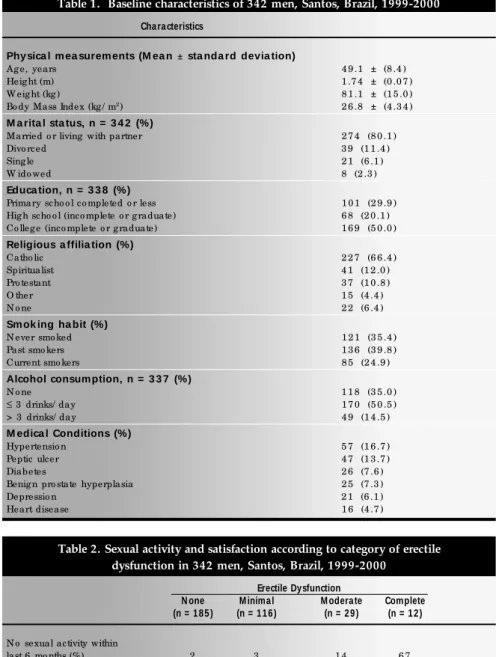
Selected demographic, medical, and lifestyle characteristics of the study population are presented in Table 1. The mean age (stan-dard deviation) of men in our sample was 49.1 (8.4) years. The participants in our study had higher educational attainment than the average for Brazilian men.20 The frequency distribution of age, religion and marital status in our sample was comparable to that found in Brazil.20 T he most common medical conditions reported included hypertension in 16.7%, gastrointestinal ulcer in 13.7% and diabetes in 7.6% (Table 1). Most responders were sexually active, with 315 (92.1%) men
Table 1. Baseline characteristics of 342 men, Santos, Brazil, 1999-2000
Cha ra cteristics
Phy sica l m ea surem ents (M ea n ± sta nda rd devia tion)
Ag e, years 4 9 .1 ± (8 .4 )
Heig ht (m) 1 .7 4 ± (0 .0 7 )
W eig ht (kg ) 8 1 .1 ± (1 5 .0 )
Bo dy Mass Index (kg / m2) 2 6 .8 ± (4 .3 4 )
M a rita l sta tus, n = 3 4 2 (%)
Married o r living with partner 2 7 4 (8 0 .1 )
Divo rced 3 9 (1 1 .4 )
Sing le 2 1 (6 .1 )
W ido wed 8 (2 .3 )
Educa tion, n = 3 3 8 (%)
Primary scho o l co mpleted o r less 1 0 1 (2 9 .9 )
Hig h scho o l (inco mplete o r g raduate) 6 8 (2 0 .1 )
Co lleg e (inco mplete o r g raduate) 1 6 9 (5 0 .0 )
Religious a ffilia tion (%)
Catho lic 2 2 7 (6 6 .4 )
Spiritualist 4 1 (1 2 .0 )
Pro testant 3 7 (1 0 .8 )
O ther 1 5 (4 .4 )
N o ne 2 2 (6 .4 )
Sm ok ing ha bit (%)
N ever smo ked 1 2 1 (3 5 .4 )
Past smo kers 1 3 6 (3 9 .8 )
Current smo kers 8 5 (2 4 .9 )
Alcohol consum ption, n = 3 3 7 (%)
N o ne 1 1 8 (3 5 .0 )
≤ 3 drinks/ day 1 7 0 (5 0 .5 )
> 3 drinks/ day 4 9 (1 4 .5 )
M edica l Conditions (%)
Hypertensio n 5 7 (1 6 .7 )
Peptic ulcer 4 7 (1 3 .7 )
Diabetes 2 6 (7 .6 )
Benig n pro state hyperplasia 2 5 (7 .3 )
Depressio n 2 1 (6 .1 )
Heart disease 1 6 (4 .7 )
Table 2. Sexual activity and satisfaction according to category of erectile dysfunction in 342 men, Santos, Brazil, 1999-2000
Erectile Dysfunction
N one M inima l M odera te Complete
(n = 1 8 5 ) (n = 1 1 6 ) (n = 2 9 ) (n = 1 2 )
N o sexual activity within
last 6 mo nths (%) 2 3 1 4 6 7
Sexual activity
(median frequency/ mo nth)* 1 2 8 8 3
Full erectio n
(median frequency/ mo nth) 1 6 1 2 8 2
Awaken with erectio n
(median frequency/ mo nth) 1 0 1 0 4 1
Satisfactio n with sex life † 4 .1 3 .8 3 .2 2 .1
Satisfactio n with partner † 4 .2 4 .0 3 .8 2 .5
Partner satisfactio n † 4 .3 4 .1 3 .7 1 .8
* Amo ng tho se repo rting so me sexual activity within the last 6 mo nths
reporting sexual intercourse in the past six months. Table 2 shows that self-rated erectile dysfunction was characterized in our data as lower monthly rates of sexual activity and erection, higher frequency of erectile difficulty, and lower satisfaction with sex life and partner.
Prevalence and age dependence
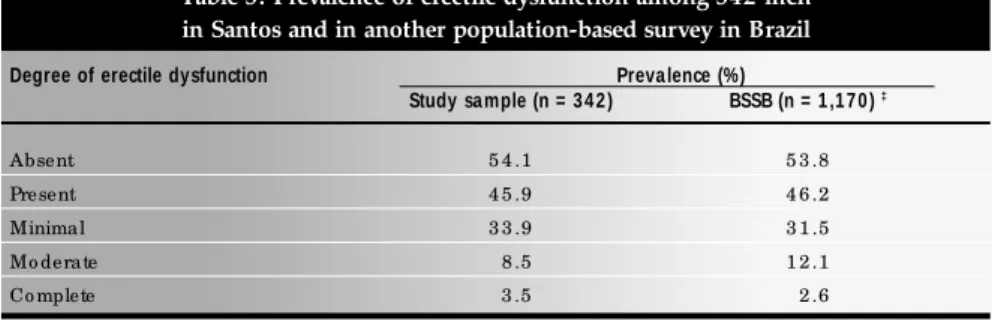
Overall, 45.9% (95%, CI = 40.5-51.4) of the men reported some degree of erectile dysfunction; the frequencies of minimal, moderate and complete dysfunction were 33.9% (95%, CI = 28.9-39.2), 8.5% (95%, CI = 5.8-12.0) and 3.5% (95%, CI = 1.8-6.0), respectively (Table 3). The relationship of erectile dysfunction prevalence to the age of study subjects is depicted in Figure 1. T he combined prevalence of moderate and complete erectile dysfunction increased with age, from 3.4% in men aged 40-49 to 16.7% in men aged 50-59 to 39.6% in men aged 60-70. An estimated 65% of the men had no erectile dysfunction at age 40 years, de-creasing to 15% at age 60 years. The association between age and erectile dysfunction was always statistically significant (p < 0.0001) when tested by multivariate analysis along with other possible predictors of erectile dysfunction.
Bivariate age-adjusted associations T he age-adjusted bivariate associations between erectile dysfunction and potential co-variates are shown in Table 4. None of the sociodemographic variables was significantly associated with moderate or severe erectile dys-function. Obesity, defined as a body mass in-dex greater than 30.0 kg/m2, was significantly associated with increased prevalence of erectile dysfunction, as well as smoking 40 cigarettes or more/day. An alcohol consumption of up to 3 drinks/day was inversely associated with erectile dysfunction. Men reporting a medical diagnosis of diabetes or hypertension were more likely to present erectile dysfunction, while those with a history of heart disease, depression, benign prostatic hyperplasia or peptic ulcer were not. Depressive symptoms, as measured by CES-D scale, correlated significantly with erectile dysfunction prevalence (Table 4).
Multivariate model
Table 5 presents the results found in the multivariate analysis final model. Age was strongly correlated to erectile dysfunction (OR = 1.17; 95%, CI = 1.11-1.24) for each yearly increment in age. Heavy smoking remained associated with erectile dysfunction, while obesity and moderate alcohol consumption
did not. Similar to the results of the age-adjusted bivariate analysis, self-reports of dia-betes or hypertension were significantly asso-ciated with erectile dysfunction, and heart disease, depression, benign prostatic hyper-plasia and peptic ulcer were not.
Health-seeking attitudes and behaviors with respect to erectile dysfunction
Subjects were probed about their attitudes toward seeking medical care for erectile dysfunction. First, they were asked whether, if they had erectile dysfunction, they would feel comfortable consulting a doctor or other
health professional, and 82% said they would. Then, we asked “would you tell your doctor or any health professional about erectile dysfunction even if he/she did not ask about it?” and 94% said they would. However, of the 157 men actually reporting some degree of erectile dysfunction, only 16 (10.2%) had been treated for this condition.
○ ○ ○ ○ ○ ○ ○ ○ ○ ○ ○ ○ D ISC U SSIO N○ ○ ○ ○ ○ ○ ○ ○
Our data indicate a high prevalence of erectile dysfunction in a sample of men from southeastern Brazil. Applying these rates to the
Table 3. Prevalence of erectile dysfunction among 342 men in Santos and in another population-based survey in Brazil
Degree of erectile dysfunction Preva lence (%)
Study sa mple (n = 3 4 2 ) BSSB (n = 1 ,1 7 0 ) ‡
Absent 5 4 .1 5 3 .8
Present 4 5 .9 4 6 .2
Minimal 3 3 .9 3 1 .5
Mo derate 8 .5 1 2 .1
Co mplete 3 .5 2 .6
‡ Brazilian Study o f Sexual Behavio r (BSSB)1 1
Table 4. Age-adjusted prevalence odds ratios for moderate or complete versus none or minimal erectile dysfunction of selected characteristics in 342 men, Santos, Brazil, 1999-2000
Cha ra cteristic OR (9 5 % CI) †
Marital status
N ever married 1 (reference)
Married o r living with partner 1 .2 (0 .2 to 6 .0 )
Divo rced, wido wed, separated 3 .1 (0 .5 to 1 8 .2 )
Educatio n
Primary scho o l co mpleted o r less 1 (reference)
Hig h scho o l (inco mplete o r g raduated) 0 .5 (0 .1 to 1 .7 )
Co lleg e (inco mplete o r g raduated) 0 .9 (0 .4 to 2 .0 )
Relig io us affiliatio n (any)
N o ne 1 (reference)
Any 0 .5 (0 .1 to 2 .6 )
O besity (bo dy mass index > 3 0 .0 kg / m2) 3 .0 (1 .3 to 7 .4 )
Mo nthly inco me < 3 minimum wag es 1 .7 (0 .7 to 4 .1 )
Cig arette smo king
N ever smo ked 1 (reference)
Past smo kers 1 .4 (0 .6 to 3 .4 )
Current smo kers 1 .6 (0 .6 to 4 .3 )
Heavy smo king (≥ 4 0 cig arettes/ day) 3 .1 (1 .2 to 8 .2 )
Alco ho l co nsumptio n
N o ne 1 (reference)
≤ 3 drinks/ day 0 .4 (0 .2 to 0 .9 )
> 3 drinks/ day 0 .8 (0 .3 to 2 .4 )
CES-D scale‡ (fo r each unit increase) 1 .2 (1 .0 to 1 .3 )
Medical co nditio ns
Diabetes 1 2 .3 (4 .5 to 3 3 .5 )
Hypertensio n 3 .2 (1 .5 to 6 .7 )
Heart disease 0 .7 (0 .2 to 2 .9 )
Benig n pro state hyperplasia 0 .8 (0 .3 to 2 .5 )
Peptic ulcer 1 .0 (0 .4 to 2 .6 )
Depressio n 2 .1 (0 .6 to 7 .1 )
Brazilian population, we estimate that cur-rently over 9 million men aged 40 years or older present some degree of erectile dys-function, and 3.5 million have moderate to complete dysfunction. Thus, the data suggests that erectile dysfunction is a common con-dition and a public health concern in Brazil. T he prevalence of erectile dysfunction (45.9%) we found is virtually equal to the prevalence of 46.2% reported in another population-based study of 1,170 men conducted in nine major cities in Brazil.11 These rates are also comparable to those reported in two studies done in the United States: 52% in the Massachusetts Male Aging Study,10 a survey in a random sample of 1,290 men aged 40 to 70 living in cities and villages near Boston, Massachusetts; and 46.3% in a population-based survey of approximately 1,650 men aged 50 to 76 in a rural zone in New York State.3
Similar erectile dysfunction rates were also found in France, where 39% of men aged 18 to 70 reported erectile dysfunction,21 and in Thailand, where a study using a sample of 1,250 men aged 40 to 70 revealed an erectile dys-function prevalence of 37.5%.22
In our survey, as in other previous studies to date, such as the National Health and Family Life Survey (NHFLS),23 and the Massachusetts Male Aging Study,10 increasing age is correlated with both increasing prevalence of erectile dysfunction overall and with increasing severity. This remained true after controlling for all other significant corre-lates of erectile dysfunction.
Obesity, defined as a body mass index greater than 30.0 kg/m2, was a predictor of erectile dysfunction in the bivariate age-adjusted analysis, but not after adjusting for other potential confounders using multivariate
ana-lysis. The probabilities of erectile dysfunction were not dependent on body mass index or waist-to-hip ratio (an index of fat localization) in the Massachusetts Male Aging Study,10 although the prospective data from this study found that overweight exerted a strong inde-pendent effect on erectile dysfunction.24 In a study of 325 consecutive patients with erectile dysfunction, Chung et al.25 showed that obesity in itself does not seem to be an underlying factor, but does impose a risk of vasculogenic erectile dysfunction through the development of chronic vascular disease.
We found erectile dysfunction to be dependent on smoking dosage (cigarettes per day). In the Massachusetts Male Aging Study, no general effect was noted from current cigarette smoking, but the association of erectile dysfunction with certain risk factors was greatly amplified among current cigarette smokers.10 Cigarette smoking was also an independent risk factor for erectile dysfunction in a cross-sectional study including 4,462 US Army Vietnam-era veterans aged 31-49 years.26 Derby et al.27 showed smoking to be associated with increased erectile dysfunction risk in the prospective data from the Massachusetts Male Aging Study. The effect of smoking on erectile dysfunction may be mediated by the systemic changes induced by smoking, which include hypercoagulability, enhanced platelet aggregation, an imbalance between thromboxane and prostacyclin con-centrations, and direct toxic effects on the vas-cular endothelium.28
Alcohol consumption of three drinks per day or less was inversely correlated with erectile dysfunction in our population in the bivariate, but not in the multivariate model. Rimm et al.,29 in the Health Professionals Follow-up Study, also found that moderate drinkers (one to two drinks per day) had a lower prevalence of erectile dysfunction than either non-drinkers or heavy non-drinkers. In the prospective data from the Massachusetts Male Aging Study, a change in heavy drinking status was not associated with reduced risk of erectile dysfunction,27 suggesting that chronic heavy alcohol consumption may have an irreversible effect on erectile function because of neu-rological damage.30
Erectile dysfunction has been shown to be more prevalent in diabetic individuals, with estimates ranging from 35 to 75%.31-33 We found moderate/complete erectile dysfunction in 53.8% of the participants with diabetes. There is controversy as to which of the several characteristics of diabetes is the direct causal agent of erectile dysfunction. Vascular disease
Table 5. Multivariate logistic regression model, prevalence odds ratios for moderate or complete versus none or minimal erectile dysfunction, Santos, Brazil, 1999-2000
Cha ra cteristic OR (9 5 % CI) †
Ag e, o ne-year increments 1 .1 7 (1 .1 1 to 1 .2 4 )
Heavy smo king , ≥ 4 0 cig arettes/ day 3 .6 (1 .2 to 1 1 .0 )
Alco ho l co nsumptio n
≤ 3 drinks/ day 0 .4 (0 .2 to 1 .0 )
> 3 drinks/ day 0 .7 (0 .2 to 2 .4 )
CES-D scale‡ (fo r each unit increase) 1 .1 3 (0 .9 7 to 1 .3 1 )
Medical co nditio ns
Diabetes 8 .9 (2 .9 to 2 6 .9 )
Hypertensio n 2 .3 (1 .0 to 5 .4 )
Heart disease 0 .5 (0 .1 to 2 .4 )
Benig n pro state hyperplasia 0 .8 (0 .2 to 2 .8 )
Peptic Ulcer 1 .0 (0 .3 to 2 .9 )
Depressio n 1 .9 (0 .5 to 7 .0 )
† O dds ratio — O R — (9 5 % co nfidence interval — CI) fo r the variables included in the final mo del.
is frequently mentioned34 and, in addition, autonomic neuropathy, gonadal dysfunction and vascular endothelium or neurogenic im-pairment of penile smooth muscle relaxation have also been implicated.33,35
Cardiovascular disease has been implicated in erectile dysfunction.24,36 Our data showed an association between erectile dysfunction and history of hypertension, but failed to demonstrate a significant relationship with histories of heart disease. As we had to rely on self-reporting, it is possible that medical conditions that are frequently asymptomatic or underdiagnosed have been underreported by subjects not aware of their existence. This would likely result in non-differential misclassification and bias the results towards the null.
Presence of depression symptoms was associated with erectile dysfunction in our study population, irrespective of age and the presence of other risk factors for erectile dysfunction, but the same was not true for the self-reporting of a diagnosis of depression. Similarly, Araujo et al.,37 using the Massachusetts Male Aging Study follow-up data, found a strong association between erectile dysfunction and the presence of depression symptoms. Despite the corre-lation between erectile dysfunction and depression being well documented, the causal relationship between the two is sometimes imprecise and most probably bi-directional, i.e. erectile dysfunction may follow depression and also, depression may be a consequence of this sexual dysfunction.38,39
When asked whether, hypothetically, they would feel comfortable consulting a health professional about erectile dysfunction, a high percentage of subjects (82%) said they would, but this was not reflected in the actual behavior of men with erectile dysfunction, of whom only (10.2% ) had actually been treated. Educating physicians and laymen about the
potential for treating erectile dysfunction would, we believe, lead to better treatment of this distressing condition.
Merits and limitations
The main strength of this study was the assessment of erectile dysfunction presence by the subject himself in terms of a single global question (based strictly on criteria enunciated by the National Institutes of Health Consensus Conference on Impotence). The determination of erectile dysfunction by self-reporting has enabled our results to be compared with most of the epidemiological studies performed on erectile dysfunction. In addition, the anonymous and private approach to data collection allowed us to explore potential correlates of erectile dysfunction with minimal informational and observational bias. T he response rate achieved (47.6%) in this study is remarkably higher than the average 1-5% rates reported for similar mail surveys in Brazil (Aglaé Diament, personal communication). Although this might be considered a strength, the large number of men who refused to participate may have biased our results, particularly if those losses were differential. Nevertheless, our estimates were consistent with a previous large population-based survey done elsewhere in Brazil,11 thus suggesting that they are reliable. The main limitation of this study is that, due to its cross-sectional design, data collection was carried out solely via a self-completed questionnaire. Thus, the assessment of medical conditions was limited to self-reporting. Commonly asymptomatic or oligosympto-matic diseases may have been substantially underreported, which is likely to have resulted in non-differential classification error and attenuation of associations measured. Another limitation of our study is that, because of our sampling strategy, men in our survey tended
to have higher educational attainment than the average Brazilian male. Since our data and previous studies23, 37 have suggested that education is inversely related to erectile dysfunction prevalence, this imbalance in the composition of our study sample would, if anything, have biased our results towards a lower estimate of erectile dysfunction prevalence.
○ ○ ○ ○ ○ ○ ○ ○ ○ ○ ○C O N C LU SIO N S○ ○ ○ ○ ○ ○ ○ ○ ○
Erectile dysfunction is a common condition in Santos, Brazil, whose prevalence and severity increases with age. The correlates of erectile dysfunction identified in our population are consistent with some, but not all, other previous studies on the epidemiology of this sexual dysfunction. Future research should include the objective assessment of the presence of medical conditions potentially associated with erectile dysfunction, particularly those frequently asymptomatic or underdiagnosed (e.g. diabetes, hypertension, heart disease etc.). In addition, studies on erectile dysfunction incidence based on populations are warranted in order to pros-pectively test the hypothesis generated by the associations encountered dysfunction in this cross-sectional study. We hope that correlates of erectile dysfunction identified here may help health professionals in the individual assessment of erectile dysfunction patients or, among patients presenting with erectile dysfunction, such correlates may induce investigation of underlying potential comorbidities.
Our data show that only one-tenth of the men with some degree of erectile dysfunction are being treated, although a majority say they would seek such treatment if they had an erectile disorder. Physicians need to be aware of a possible reluctance of men to discuss erectile dysfunction and to initiate discussions accordingly.
1. National Institutes of Health Consensus Conference.
Impotence. National Institutes of Health Consensus Development Panel on Impotence. JAMA 1993;270:83-90.
2. Boolell M, Gepi-Attee S, Gingell JC, Allen MJ. Sildenafil, a
novel effective oral therapy for male erectile dysfunction. Br J Urol 1996;78:257-61.
3. Ansong KS, Lewis C, Jenkins P, Bell J. Epidemiology of erectile
dysfunction. A community-based study in rural New York State. Ann Epidemiol 2000;10:293-6.
4. Koskimaki J, Hakama M, Huhtala H, Tammela TL. Effect of
erectile dysfunction on frequency of intercourse: A population-based prevalence study in Finland. J Urol 2000;164:367-70.
5. Kongkanand A. Prevalence of erectile dysfunction in Thailand.
Thai Erectile Dysfunction Epidemiological Study Group. Int J
○ ○ ○ ○ ○ ○ ○ ○ ○ ○ ○ ○ ○ ○ ○ ○ ○ ○ ○ ○ ○ ○ ○ ○ ○ ○ ○ ○ ○ ○ ○ ○ ○ ○ ○ ○ ○ ○ ○ ○ ○ ○ ○ ○ ○ ○ ○ ○ ○ ○ ○ ○ ○ ○ ○ ○ R EFER EN C ES○ ○ ○ ○ ○ ○ ○ ○
Androl 2000;23 Suppl 2:77-80.
6. Parazzini F, Menchini Fabris F, Bortolotti A, et al. Frequency
and determinants of erectile dysfunction in Italy. Eur Urol 2000;37:43-9.
7. Pinnock CB, Stapleton AM, Marshall VR. Erectile dysfunction
in the community: A prevalence study. Med J Aust 1999;171:353-7.
8. Laumann EO, Paik A, Rosen RC. Sexual dysfunction in the United
States: Prevalence and predictors. JAMA 1999;281:537-44.
9. Dunn KM, Croft PR, Hackett GI. Sexual problems: A study of
the prevalence and need for health care in the general population. Fam Pract 1998;15:519-24.
10. Feldman HA, Goldstein I, Hatzichristou DG, Krane RJ, McKinlay JB. Impotence and its medical and psychosocial
correlates: Results of the Massachusetts Male Aging Study. J Urol 1994;151:54-61.
11. Moreira Jr ED, Abdo CHN, Torres EB, Lôbo CFL, Fittipaldi JAS. Prevalence and correlates of erectile dysfunction: Results of the Brazilian Study of Sexual Behavior. Urology 2001;58:583-588. 12. Krane RJ, Goldstein I, Saenz de Tejada I. Impotence. N Engl J
Med 1989;321:1648-59.
13. Heaton JP, Morales A, Adams MA, Johnston B, el-Rashidy R. Recovery of erectile function by the oral administration of apomorphine. Urology 1995;45:200-6.
14. Morales A, Heaton JP, Johnston B, Adams M. Oral and topical treatment of erectile dysfunction: Present and future. Urol Clin North Am 1995;22:879-86.
CONTEXTO: Inquéritos populacionais recentes sugerem que a prevalência de disfunção erétil é de 30% a 56% entre homens acima de 40 anos. Entretanto, a maioria desses estudos foi realizada nos Estados Unidos ou Europa. É preciso estimar disfunção erétil a partir de amostras da população brasileira, uma vez que sociedades com diferenças étnicas, culturais e econômicas também podem diferir com respeito a fatores de risco para disfunção erétil.
OBJET IVO: Este estudo visa determinar a prevalência de disfunção erétil e potenciais fatores correlatos em Santos, sudeste do Brasil.
TIPO DE ESTUDO: Estudo de prevalência ou transversal.
LOCAL: Cidade de Santos, Estado de São Paulo.
PARTICIPANTES: Um inquérito, com ques-tionário auto-administrado, enviado pelo correio, foi realizado numa amostra de base populacional.Monitores treinados distribuíram o questionário da pesquisa a homens de 40 a 70 anos, num envelope pré-endereçado e selado. Dos 718 homens convidados, 342 (47,6%) enviaram de volta o questionário completo.
VARIÁVEIS ESTUDADAS: Os dados foram
coletados por meio de questionário estruturado com informações referentes a características demográficas, história médica pregressa e hábitos de vida. O grau de disfunção erétil foi categorizado como “nenhum”, “mínimo”, “moderado” ou “completo” de acordo com a capacidade do indivíduo em “ter e/ou manter uma ereção satisfatória para relações sexuais”. Análises bivariada ajustada para idade e multivariada foram realizadas para calcular a razão de chances (odds ratio) e intervalos de confiança de 95%.
○ ○ ○ ○ ○ ○ ○ ○ ○ ○ ○ ○ ○ ○ ○ ○ ○ ○ ○ ○ ○ ○ ○ ○ ○ ○ ○ ○ ○ ○ ○ ○ ○ ○ ○ ○R ESU M O○ ○ ○ ○ ○ ○
RESULTADOS: A prevalência de algum grau de disfunção erétil foi de 45,9% (mínima, 33,9%; moderada, 8,5%; completa, 3,5%), aumen-tando com a idade. Na análise bivariada, com-parando-se os homens sem ou com disfunção erétil mínima versus aqueles com disfunção erétil moderada ou completa, história de dia-betes ou hipertensão, sintomas de depressão, tabagismo (³ 40 cigarros/dia) e obesidade (índice de massa corpórea > 30,0 kg/m2) foram
significativamente associados com prevalência aumentada de disfunção erétil (p < 0,05), enquanto que o consumo moderado de álcool foi inversamente associado com disfunção eré-til. No modelo multivariado, idade foi um preditor forte de disfunção erétil, enquanto história de diabete ou hipertensão e tabagismo permaneceram significativamente associados com disfunção erétil.
CONCLUSÃO: Consistentemente com outros estudos de prevalência de disfunção erétil, encontramos alta proporção (45,9%) de ho-mens acima de 40 anos no Brasil com algum grau de disfunção erétil, aumentando a preva-lência e a gravidade de disfunção erétil com a idade. As variáveis de estilo de vida e de con-dições de saúde associadas à disfunção erétil podem alertar os médicos acerca de pacientes sob risco de disfunção erétil, como também oferecem pistas quanto à etiologia da disfunção erétil. Profissionais de saúde deveriam sempre perguntar aos seus pacientes sobre saúde sexual e disfunção erétil, uma vez que uma grande proporção da população experimenta tais problemas.
PALAVRAS-CHAVE: Disfunção erétil. Impo-tência. Prevalência. Fatores de risco. Brasil.
Ack now ledgm ents: W e a re inde b te d to Mrs. Elia na Barreto To rres and Mr. Luiz Fernando Marques da Silva fo r helping with data analysis, and to Mrs. Isabella Rebo uças Arapiraca fo r her secretarial assistance.
Edson Dua rte M oreira -Júnior, M D, M Ph, PhD. Epide-mio lo g y a nd Sta tistic s Unit, G o nç a lo Mo niz Re se a rc h Center, O swaldo Cruz Fo undatio n, Salvado r, Bahia, Brazil and Scientific Bo ard o f Ho spital São Rafael, Salvado r, Bahia, Braz il.
W a lter Jorge Besta ne, M D. Besta ne Uro lo g y Clinic , Santo s, Braz il.
Ela ine Besta ne Ba rtolo. Psycho lo g ist. Lusíada Fo undatio n o f States, Santo s, Braz il.
Joã o Antônio Sa ra iva Fittipa ldi, M D. Pfiz er La b o -rato ries, São Paulo , Braz il.
Sources of funding: Suppo rted by a Research G rant fro m Pfiz er Labo rato ries, Braz il.
Conflict of interest: N o t declared
Da te of first subm ission: 2 1 June 2 0 0 1
La st received: 2 6 December 2 0 0 1
Accepted: 2 8 December 2 0 0 1
Address for correspondence
Edso n Duarte Mo reira R. W aldemar Falcão , 1 2 1
Salvado r/ BA – Brasil - CEP 4 0 2 9 5 -0 0 1 Tel. (+5 5 7 1 ) 3 5 6 -8 7 8 1 Ext. 2 4 3 Fax (+5 5 7 1 ) 3 5 6 -2 1 5 5 E-mail: edso n@ cpqg m.fio cruz.br
CO PYRIG HT© 2 0 0 2 , Asso ciação Paulista de Medicina ○ ○ Pu b l i sh i n g i n f o r m a t i o n○ ○ ○ ○ ○ ○ ○ ○ ○ ○ ○ ○ ○ ○ ○ ○ ○ ○
BZ. Assessing depressive symptoms in five psychiatric populations: A validation study. Am J Epidemiol 1977;106:203-14. 16. Feldman HA, Goldstein I, Hatzichristou DG, Krane RJ,
McKinlay JB. Construction of a surrogate variable for impotence in the Massachusetts Male Aging Study. J Clin Epidemiol 1994;47:457-67.
17. Derby CA, Araujo AB, Johannes CB, Feldman HA, McKinlay JB. Measurement of erectile dysfunction in population-based studies: The use of a single question self-assessment in the Massachusetts Male Aging Study. Int J Impot Res 2000;12:197-204. 18. Rosen RC, Riley A, Wagner G, Osterloh IH, Kirkpatrick J,
Mishra A. The international index of erectile function (IIEF): A multidimensional scale for assessment of erectile dysfunction. Urology 1997;49:822-30.
19. O’Leary MP, Fowler FJ, Lenderking WR, et al. A brief male sexual function inventory for urology. Urology 1995;46:697-706. 20. Instituto Brasileiro de Geografia e Estatística. Anuário estatístico
do Brasil — 1996. Rio de Janeiro: Ministério Brasileiro do Planejamento e Orçamento; 1997.
21. Virag R, Beck-Ardilly L. Nosology, epidemiology, clinical quantification of erectile dysfunctions. Rev Med Interne 1997;18(Suppl 1):10s-13s.
22. An epidemiological study of erectile dysfunction in Thailand (Part 1: Prevalence). Thai Erectile Dysfunction Epidemiological Study Group (TEDES). J Med Assoc Thai 2000;83:872-9.
23. Laumann EO, Paik A, Rosen RC. The epidemiology of erectile dysfunction: Results from the National Health and Social Life Survey. Int J Impot Res 1999;11(Suppl 1):S60-4. 24. Feldman HA, Johannes CB, Derby CA, et al. Erectile dysfunction
and coronary risk factors: Prospective results from the Massachusetts male aging study. Prev Med 2000;30:328-38. 25. Chung WS, Sohn JH, Park YY. Is obesity an underlying factor
in erectile dysfunction? Eur Urol 1999;36:68-70. 26. Mannino DM, Klevens RM, Flanders WD. Cigarette smoking:
An independent risk factor for impotence? Am J Epidemiol 1994;140:1003-8.
27. Derby CA, Mohr BA, Goldstein I, Feldman HA, Johannes CB, McKinlay JB. Modifiable risk factors and erectile dysfunction: Can lifestyle changes modify risk? Urology 2000;56:302-6. 28. Bornman MS, du Plessis DJ. Smoking and vascular impotence:
A reason for concern. S Afr Med J 1986;70:329-30. 29. Rimm EB, Bacon CG, Giovannucci EL, Kawachi I. Body
weight, physical activity, and alcohol consumption in relation to erectile dysfunction among U.S. male health professionals free of major chronic diseases. In: Proceedings of the American Urological Association 95th Annual Meeting, Atlanta, April 29-May 4, 2000. J Urol 2000;163(4)Suppl:15.
30. Lemere F, Smith JW. Alcohol-induced sexual impotence. Am J Psychiatry 1973;130:212-3.
31. Fedele D, Bortolotti A, Coscelli C, et al. Erectile dysfunction
in type 1 and type 2 diabetics in Italy. On behalf of Gruppo Italiano Studio Deficit Erettile nei Diabetici. Int J Epidemiol 2000;29:524-31.
32. Kayigil O, Atahan O, Metin A. Multifactorial evaluation of diabetic erectile dysfunction. Int Urol Nephrol 1996;28:717-21. 33. Cummings MH, Alexander WD. Erectile dysfunction in patients
with diabetes. Hosp Med dysfunction 1999;60:638-44. 34. Jevtich MJ, Edson M, Jarman WD, Herrera HH. Vascular factor
in erectile failure among diabetics. Urology 1982;19:163-8. 35. Saenz de Tejada I, Goldstein I, Azadzoi K, Krane RJ, Cohen
RA. Impaired neurogenic and endothelium-mediated relaxation of penile smooth muscle from diabetic men with impotence. N Engl J Med 1989;320:1025-30.
36. Andersson K, Stief C. Penile erection and cardiac risk: Pathophysiological and pharmacological mechanisms. Am J Cardiol 2000;86:23F-26F.
37. Araujo AB, Johannes CB, Feldman HA, Derby CA, McKinlay JB. Relation between psychosocial risk factors and incident erectile dysfunction: Prospective results from the Massachusetts Male Aging Study. Am J Epidemiol 2000;152:533-41. 38. Seidman SN, Roose SP. The relationship between depression
and erectile dysfunction. Curr Psychiatry Rep 2000;2:201-5. 39. Shabsigh R, Klein LT, Seidman S, Kaplan SA, Lehrhoff BJ, Ritter