247
Communication/Comunicação
1.Laboratório Diptera, Instituto Oswaldo Cruz, Fundação Oswaldo Cruz, Rio de Janeiro, RJ.
Address to: Dr. Jeronimo Alencar. Lab. Diptera/IOC/FIOCRUZ. Av. Brasil 4365, Manguinhos, 21040-360 Rio de Janeiro, RJ, Brasil.
Tel: 55 21 2562-1450 e-mail: [email protected] Received in 04/05/2010 Accepted in 10/01/2011
Revista da Sociedade Brasileira de Medicina Tropical 44(2):247-248, mar-abr, 2011
New report on the bionomics of
Coquilletidia venezuelensis
in temporary
breeding sites (Diptera: Culicidae)
Novo relato sobre a bionomia de
Coquilletidia venezuelensis
em criadouros temporários
(
Diptera: Culicidae
)
Jeronimo Alencar
1, Juliana Barreto Pacheco
1, Fabiana Fagundes Correa
1, Júlia dos Santos Silva
1and
Anthony Érico Guimarães
1ABSTACT
Introduction: Findings of immature forms of Coquilletidia venezuelensis in temporary breeding sites, without the presence of aquatic plants or other submerged plant tissue are reported. Methods: A systematic scooping technique to collect specimens was used at the breeding site. Results: Immature forms of Coquilletidia venezuelensis, Anopheles rangeli, An. evansae
and Culex sp. were collected from areas of the hydroelectric power station of São Salvador, State of Goiás. Conclusions: his is a novel inding relating to the bioecology of Cq. venezuelensis, a species of medical interest that has been found naturally infected with arboviruses, including Oropouche and West Nile virus.
Keywords: Culicidae. Coquillettidia venezuelensis. Immature forms. Transitory breeding sites.
ReSuMo
Introdução: Relata-se o encontro de formas imaturas de Coquilletidia venezuelensis em criadouros temporários, sem presença de plantas aquáticas ou outros tecidos vegetais submersos. Métodos: Realizaram-se coletas com a técnica de conchadas sistemáticas na margem do criadouro. Resultados: Foram coletados imaturos de Coquilletidia venezuelensis, Anopheles rangeli,
An. evansae e Culex sp., em áreas da Usina Hidrelétrica de São Salvador, Estado de Goiás. Conclusões: Trata-se de observação inédita sobre a bioecologia de Cq. venezuelensis, espécie de interesse médico, que tem sido encontrada naturalmente infectada com arbovírus, inclusive Oropouche e
West Nile.
Palavras-chaves: Culicidae. Coquilletidia venezuelensis. Formas imaturas. Criadouros transitórios.
he breeding sites for species of Coquilletidia consist of medium to large water accumulations, such as lakes, stagnant pools, swamps and backwaters of rivers. he eggs are deposited in groups under the leaves of aquatic plants, particularly grassy plants1, and the larvae
atach themselves to the roots and take oxygen directly from the aeriferous parenchyma. hese plants have the capacity to increase their biomass rapidly, through sexual or asexual reproduction, thus constituting an excellent substrate for many animals2.
Coquillettidia are hematophagous, aggressive and voracious
insects, with a preference for nocturnal activity. he epidemiological significance of the group comes from the fact that they have
been found naturally infected by dangerous arboviruses, such as Oropouche1,3. In the speciic case of Coquilletidia venezuelensis,
specimens infected with the virus that causes West Nile fever were recently isolated in studies that are being conducted at Laguna de los Patos, municipality of Cumana, State of Sucre, Venezuela (personal communication from Glenda Velásquez, MSc, Health Investigation Division, INSALUD, Ministry of Health, Venezuela).
he present study aimed to characterize indings of immature forms of culicids by rearing them in transitory breeding sites.
It was conducted as part of the process of vector monitoring in areas under direct inluence from the reservoir of the hydroelectric power station of São Salvador, municipality of Minaçu, State of Goiás, at the coordinates 13˚18’12’’ S and 48˚09’18”’ W, and at an altitude
of 307m. he collection locality presented vegetation of riverbank forest type that was reasonably well preserved.
In June and April 2010, immature forms were systematically collected along the edges of the breeding sites with the aid of entomological scoops (BioQuip®). he water was poured into
polyethylene trays and any larvae and insects that were present were removed with the aid of a thin brush. Following this, the larvae and pupae were pipeted to pack them into 250ml plastic bags (Whirl-Pak Bags) for transportation. In the laboratory, the larvae were screened for transfer to small individual pots, where they were maintained in water taken from the breeding site that was topped up periodically with distilled water. he larvae were maintained alive in an atempt to continue with the life cycle. he pupae were transferred to small tubs, where they remained until reaching the adult stage.
he culicids were identiied by direct observation of morphological characteristics, which were evident under an optical microscope, based on dichotomous keys4-6. A toal of 319 specimens of Culicidae
were collected, consisting of Cq. venezuelensis (239), Anopheles
rangeli (21), An. evansae (3)and Culex sp. (49). It should be noted
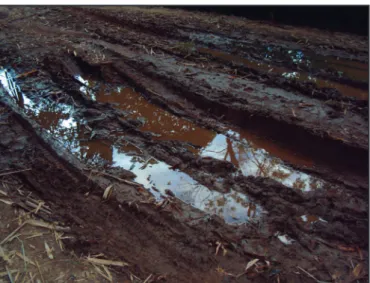
that the locality where the specimens of Cq. venezuelensis were collected was water accumulation produced by rain. No loating or partially immersed macrovegetation was present or formed part of the breeding site community and the closest river (the Traíra
river) was 10 meters below the level of the sampling point and at a distance of 100m away, with a medium speed of current low. hus, we rejected the hypothesis that these immature forms might have been displaced, arriving at the breeding site in question because of the river overlowing due to excess rainwater (Figure 1).
248
he authors declare that there are no conlicts of interest. CONFLICT OF INTEREST
REFERENCES
Alencar J et al - Bionomics of Coquilletidia venezuelensis in temporary breeding sites
FIGuRe 1 - Appearance of the temporary breeding site in which the immature forms of Coquilletidia venezuelensis were found.
Despite the total lack of aquatic vegetation, observation conirmed that the immature forms must have been at the site for at
least 238h prior to collection. At the time of sampling, the water at this site was cloudy, the temperature was 24°C and the pH was 7.0. In studies7 conducted to determine the diversity of mosquito
fauna in three diferent wetlands in Maryland, United States, which also presented breeding sites in temporary pool areas, a total of 14 species were collected. Ten of the species were collected at both the larval and adult development stages, while no immature forms were collected for three species: Aedes albopictus (Skuse), Coquilletidia
perturbans (Walker) and Culex restuans heobald.
Coquilletidia breeding sites consist of medium to large water
accumulations and the eggs are deposited in agglutinated clusters underneath leaves in the water. Ater eclosion, the larvae migrate to open areas and locate the roots of loating plants (Eichornia, Pistia,
Salvinia, Typha and grassy plants) or other submerged plant tissue5.
his patern was not at all compatible with the present observations. In this case, the lack of aquatic vegetation was not a factor limiting the occurrence of immature forms of Cq. venezuelensis.
Although information regarding the habits of immature forms of Cq. venezuelensis is scarce, slightly diferentiated behavior has also been observed among sedges of the species Fuirena umbellata,
in swamps and low-lying areas adjacent to the City of Salvador1. In
this case, although sedges are not aquatic plants, the immature forms were able to atach themselves to the roots of these plants because they were at the botom of water accumulations.
In experiments conducted in a laboratory8 to reproduce the
development cycle of Cq. richiardii, the larvae were reared on a substrate of soybean bran or algal cultures, in the presence or absence of aquatic plants (Myriophyllum or watercress), which would allow the larvae to become atached. here was almost total mortality on day ive (only four out of 56 larvae were still alive), in the medium without plants. In the presence of plants, the duration of the cycle was eight to ten days.
According to observations made while collecting the specimens
of Cq. venezuelensis, they presented completely diferent behavior
regarding their choice of breeding site, showing no association with aquatic plants or other plant material. hus, in light of this observation, consideration must be given to the fact that the larval community appears to have adapted to breeding sites with no association with aquatic vegetation.
Recent evidence has indicated9 that some human activities may
contribute towards the expansion of the distribution area of certain species into regions where they had previously not been present. his phenomenon is generally known as biological invasion and it can occur through either deliberate or accidental introduction.
he risks associated with global climatic changes need to be taken into consideration within the context of the globalization of human activities. he impact of such activities is oten indirect and mediated by modiications to the environment, such as changes to ecosystems and biogeochemical cycles, which may increase the incidence of infectious diseases10. Given that global climatic changes bring new
challenges regarding infectious disease control11 and that many
pathogenic agents and vectors are highly sensitive to climatic factors (temperature and rainfall) that cause health risks, the negative efects resulting from warming of the climate are potentially enormous.
1. Forattini OP. Entomologia Médica, Culicini: Culex, Aedes e Psorophora. Vol. 3. São Paulo: Universidade de São Paulo; 1965.
2. Poi De Neif A. Estructura de la fauna asociada a tres hidróitos lotantes em ambientes leníticos del nordeste argentino. Comunicaciones Cientificas. Centro de Ecología Aplicada del Litoral; 1977.
3. Hervé JP, Dégallier N, Travassos da Rosa APA, Pinheiro FP, Sá Filho GC. Arboviroses - Aspectos ecológicos. In: Instituto Evandro Chagas-50 anos de contribuição às ciências biológicas e à medicina tropical. Vol. 1. Belém: Fund Serv Saúde Pública; 1986.
4. Lane J. Neotropical Culicidae. TribeCulicini, Deinocerites, Uranotaenia, Mansonia, Orthopodomyia, Aedomyia, Aedes, Psorophora, Haemagogus, tribe Sabethini, Trichoprosopon, Wyeomyia, Phoniomyia, Limatus and Sabethes. Vol. 2. São Paulo: Universidade de São Paulo; 1953.
5. Consoli AGB, Oliveira RL. Principais mosquitos de importância sanitária no Brasil. Rio de Janeiro: Editora da Fundação Oswaldo Cruz; 1992.
6. Foratini OP. Culicidologia Médica. Vol. 2.São Paulo: Universidade de São Paulo; 2002.
7. Wagner VE, Eford AC, Williams RL, Kirby JS, Grogan WL. Mosquitoes associated with US Department of Agriculture Managed Wetlands on Maryland’s Delmarva Peninsula. J Am Control Assoc 2007; 23:346-350.
8. Colas-Belcour J. L’oeuf et la ponte de Taeniorhynchus (Coquilletidia) richiardii Ficalbi. Bull Soc Pat Exot 1943; 36:101-105.
9. Marcondes CB. Doenças transmitidas e causadas por artrópodes. 1ª ed. São Paulo: Atheneu; 2009.
10. Ministério da Saúde. Mudanças climáticas e ambientais e seus efeitos na saúde: cenários e incertezas para o Brasil- Brasil. Brasília: Ministério da Saúde. Organização Pan-Americana da Saúde; 2008. p. 1- 40.