AR
TICLE
1 Escola Nacional de Saúde Pública, Fiocruz. R. Leopoldo Bulhões 1480, Manguinhos. 21041-210 Rio de Janeiro RJ Brasil. [email protected]
Mental health care for Brazilian juvenile offenders
Abstract This paper analyzes the use of psy-choactive drugs by juvenile offenders in Brazil in socio-educational facilities (USEs). It describes the guidelines of the national public policy and the quality of mental healthcare coordination by subnational public governments. This work draws on the hypothesis that USEs vertical governance is associated with the use of psychoactive medica-tion. This is comparative study of two cases in Rio Grande do Sul and Minas Gerais. Data resulted from a sample of medical records and interviews with key informants. The paper shows that verti-cal governance observed in Rio Grande do Sul is directly associated with high prevalence of men-tal health disorder diagnosis, use of psychoactive medication and psychiatric medicalization by juvenile offenders deprived of liberty. These find-ings indicate that sanctions of imprisonment for illegal acts are producing a set of medicalization decisions that undermine juveniles’ health rights. The national mental health policy guidelines en-courage cautious decisions. Psychotherapies and rehabilitation actions are the advocated first-line interventions. The poor management of the psy-chopharmacological intervention favors multiple prescriptions.
Key words Juvenile offenders, Mental health
care, Medicalization psychoactive drugs, Gover-nance, Socio-educational facility
C
osta NR, Introduction
This paper describes the public policy of mental health care of adolescents admitted to Socio-ed-ucational Facilities (USEs), with emphasis on the analysis of the prescription and use of psychoac-tive drugs condition. The paper drew on
infor-mation provided by the research Situational
di-agnosis of mental health care in Brazilian socio-ed-ucational facilities1.
In Brazil, the Statute of the Child and Adoles-cent (ECA) established by Law Nº 8.069 of July 13,
19902 defines as children as people under twelve
years of age and adolescents as those from 12 to under 18 years of age. Children and adolescents are subject to a special process of accountabili-ty when they commit an infraction, leading to compliance with socio-educational measures in
facilities under State government’s governance3.
It should be noted that civilian adulthood does not prevent adolescents over 18 years of age from complying with socio-educational measures, and their release at age 21 is compulsory.
The socio-educational measures established in the ECA carry a gradation that must take into account adolescents’ ability to comply with them, the circumstances and the severity of the offence, as follows: warning, obligation to repair the dam-age, perform community services, probation, semi-confinement scheme and admission to an educational institution (socio-educational facili-ties).
The implementation of measures aimed at adolescent offenders is regulated by Law Nº
12.594/20124, which establishes the National
Sys-tem of Socio-Educational Care (SINASE). SINASE is coordinated by the Federal Government and composed of States, Municipalities and Federal District, responsible for the development of ado-lescent care programs to which socio-educational measures are applied, with freedom of organiza-tion and funcorganiza-tioning, under the terms of this Law. In 2012, there were 20,595 adolescents in compliance with socio-educational measures of hospitalization, temporary hospitalization and semi-liberty. The State of Minas Gerais was among the States that least applied such so-cio-educational measures (there were 69 adoles-cents in restrictive freedom measures per 100,000 inhabitants in 2012). The State of Rio Grande do Sul was very close to the national rate of imple-mentation of these measures: 92 adolescents de-prived of their liberty per 100,000 inhabitants in the same year. The national rate was 100 adoles-cents per 100,000 inhabitants. Notwithstanding,
socio-educational facilities were overcrowded3 in
both states.
At the beginning of the current decade, the re-socialization conditions of adolescents de-prived of their liberty were admittedly deplor-able in most of the state USEs. A report from the Federal Executive Branch pointed to the need for more state investments in the structure of hos-pitalization establishments. It found that many physical facilities were inadequate, with serious shortages of human resources and environments conducive to the re-education of adolescents and
their reintegration into society5. Thus, it is not
surprising that the proportion of repeat
offend-ers was 44% in 20125.
It is recognized in the international literature that adolescents in situations of restricted free-dom show a significant set of problems in the
mental health sphere6,7. Karnik et al.8 report that
there is higher prevalence of diagnosed mental disorders in adolescents in a closed regimen than in adolescents in probation programs.
Despite the magnitude of the adolescent cus-todial population, national studies on the subject
are surprisingly scarce. Martins and Pillon9 study
identified a high prevalence of mental disorders diagnoses (75%) among the population of 218 adolescents deprived of their liberty hospitalized in Bahia.
Another national study found that the Bra-zilian socio-educational system responds to the high prevalence of mental disorders among ad-olescents in compliance with socio-educational measures of hospitalization, with the extensive and cumulative use of different classes of
psychi-atric medication10.
It is thus not fortuitous that Article 64 of
Law Nº 12.594/20124, which establishes the
SI-NASE explains that “the treatment to which the adolescent is subject must observe the provisions of Law Nº 10.216/2001, which provides for the protection and rights of people with mental dis-orders and redirects the mental health care mod-el” (Brazil, Presidency of the Republic, Law Nº 12.594/2012).
It is important to point out that this align-ment of SINASE with the psychiatric reform agenda presupposes the governmental assurance:
e C
ole
tiv
a,
22(5):1467-1478,
2017
(2) regarding the articulation of socio-edu-cational programs with the local mental health care network, and the health network, in general, aiming at the inter-institutional building of per-manent social reintegration programs for adoles-cents with mental disorders;
(3) regarding prohibiting adolescents with mental disorders from being confined to special wards or spaces, where social reintegration of these adolescents is the permanent goal of the so-cio-educational service and health teams;
(4) regardimg the treatment of mental disor-ders by clinical criteria (never punitive or admin-istrative), and treatment is decided jointly with the patient, their relatives and the
multi-profes-sional team11.
People agree that Law Nº 10.216/2001 trans-formed the original objectives of the Brazilian mental health care reform into public policy, with substantial success in reducing beds in psy-chiatric hospitals and developing community
care alternatives12.
Since then, Brazilian mental health policy has been building on four guidelines: 1) ensuring the civil rights of people with mental disorders; 2) eliminating the asylum model; 3) protecting pa-tients against being cared for at psychiatric hos-pitals; and 4) developing a diverse and commu-nity-based network to provide access for people
with mental disorders13.
While late, because prisons and socio-educa-tional devices were not the object of institution-al deconstruction, the 2012 SINASE guidelines indicate the necessary subordination of mental health care to the proposals of the psychiatric reform.
Faced with this institutional norm, the theo-retical issue that guides this paper concerns the antinomy of the mental health policy (decentral-ized and community-based) guidelines before the insulation of adolescent custody institutions within state governments.
In the hypothesis of this paper, USEs’ verti-cal governance may be associated with the use of specific rules to address the health needs of ad-olescents in deprivation of liberty, often making decisions that are not consensual in the external world. Hence, international experience reveals that the internal rules of closed institutions usu-ally challenge the legal and normative frame-work of public policies proposed for the external
world14.
Thus, when the Ministry of Health places the restructuring of mental health care for ad-olescent offenders on the public agenda, USEs’
state managers have to deal with the institutional challenge of developing a new governance of the organization of their services. Two ideal types of governance are recognized in the field of social sciences: vertical (command and control) and
horizontal governance15.
Choosing the governance mechanism in pub-lic management is directly associated with trans-action costs that managers are willing to shoul-der in the relationship with third parties, that is, in sharing responsibilities with other public agents. If managers have the assurance that the partners will behave cooperatively or appropri-ately to their expectations and values, they will use horizontal governance and seek articulation with other levels of government or society for the development of the activity for which they are responsible. Otherwise, they will maintain vertical management in their own governmental
body16. The guidelines of the Psychiatric Reform
that normatively informs SINASE’s proposition directly address the hegemonic vertical gover-nance of the organization of mental health care of adolescents deprived of their liberty.
This verticalization reflects the level of dis-trust that government agents place on third par-ties or the costs of contractualizing which they are willing to pay to account for social respon-sibility.
Nevertheless, it is possible to suppose that the governments operate in constant negotiation on the optimal scale of verticalization in which they intend to operate their production or provision of mental health services in the socio-education-al system. They can choose to verticsocio-education-alize the pro-duction or provision of services to minimize the problem of the agent, that is, the excessive power of third parties that jeopardizes the preferences or coalitions of interest around the development
of socio-educational activities16.
Vertical integration of mental health care may be the preferential governance option of the state level in situations of uncertainty in relation to municipal governments, strengthening the trend towards organizational closure of state cus-tody devices. It remains to be answered whether the preferential choice of state governments fa-vors the well-being condition of the adolescent population under their responsibility.
Methodology
de-C
osta NR, scribe the pattern of mental health care in the
so-cio-educational hospitalization facilities (USEs). The use of psychoactive drugs is a marker of the adequacy and quality of mental health care to the adolescent in restricted freedom.
The analytical category medicalization
in-cludes situations in which an individual or col-lective problem is defined in medical terms, often as disease or disorder, or strictly uses a medical
intervention to treat it17. Recent publications
have highlighted the pharmaceutical component of medicalization, labeling it pharmaceuticaliza-tion. The term designates the process by which social, behavioral and bodily conditions are treated or considered in need of medical
treat-ment by doctors, patients or both18.
We used a cross-sectional study with a case study design. The case study facilitated the de-scription of the governance pattern of the so-cio-educational installations in two Brazilian states, typifying the experiences investigated, as
Gerring19 suggests, due to the typology of the
ver-tical governance model of Rio Grande do Sul and the deviant model (Minas Gerais) in relation to the hegemonic national pattern.
In addition to the descriptive statistics and analysis of the differences between proportions, this paper demonstrates the odds of adolescents under mental health treatment prior to the so-cio-educational measure of deprivation of lib-erty receiving a diagnosis, being on medication, under mental health treatment during hospital-ization, having undergone the isolation measure and receiving emergency medication. The paper assumes that the incidence coefficient of an event is a risk measure of a population group in any
context20.
Data were collected through the following strategies:
1) Interview with a structured instrument with the responsible for the management of USEs.
2) Transcription of medical records informa-tion of adolescents under a restricted freedom system in the facilities to a structured form.
3) Open interviews with key informants: cen-tral level managers of the socio-educational sys-tem, facility managers, and psychiatric.
We informed each responsible institutional participant about the purpose of the study, the is-sue of confidentiality and the non-mandatory par-ticipation. Those who agreed to participate signed the Informed Consent Form (ICF). The identity of the adolescents was kept confidential and infor-mation confidentiality and privacy was assured.
The research ethics committee, Oswaldo Cruz Foundation, National School of Public Health approved the study.
The Rio Grande do Sul case study
Most of the medical records drawn in the USEs sample from Porto Alegre were male ad-olescents serving socio-educational measures (Table 1). The Regional Socio-Educational Care Center of Porto Alegre I (POA I), which is re-sponsible for the admission of adolescents in the city of Porto Alegre, concentrated more than half of the records analyzed (56.5%). Among the ad-olescents whose information was analyzed, those who lived in Porto Alegre (62%), white (53%) and very low schooling predominated (87% did not finish elementary school).
The proportion of recidivist adolescents was also very high (55%). The percentage of adoles-cents who underwent mental health treatment before admission achieved two digits (19%), in-dicating the relevance of the issue in the custodial population, although there was no statistically sig-nificant association between recidivism and men-tal health treatment before admission. The main offence that resulted in deprivation of liberty in Porto Alegre was robbery followed by homicide,
following the national standard3. The relevance
of mental health care in Porto Alegre’s USEs is re-vealed by the fact that 86% of the medical records reported that adolescents had undergone some treatment during the current admission (Table 1). The research considered as “mental health treat-ment” both the use of psychiatric medication and other care modalities, such as psychological care or participation in therapeutic workshops.
The strictly internal mental health treatment that is performed in the USEs themselves pre-dominated in the Porto Alegre facilities (72.5% of the adolescents being treated). Only 25 ado-lescents underwent external treatment, mainly in some type of CAPS (88%) in Porto Alegre. There were no referrals in mental health in the PHC structures for any of the adolescents whose med-ical records were analyzed.
We should reiterate that the socio-education-al system of Rio Grande Sul was chosen for the case study due to the vertical governance of men-tal health care in place.
e C
ole
tiv
a,
22(5):1467-1478,
2017
As observed in the visits of the research team, outpatient services are provided in the physical space of the facilities. Another characteristic of vertical organization of mental health care within FASE is the strong presence of psychiatrists who work in the very socio-educational installation and are recruited through a medical cooperative,
which is a common procedure in Rio Grande do Sul, and is widely used by municipalities. In FASE, contracts of psychiatrists through cooperatives have been around for 10 years (Interview with Central Level Manager. Porto Alegre, June 2, 2015).
Psychologists working in FASE are dedicated to the management of crimes in the sphere of reso-cialization. They make brief interventions towards change of life project, accountability for the crime and development of self-criticism. There are no therapies or groups. Facilities lack treatment alter-natives, besides medication (Interview with Psy-chiatric. Porto Alegre, June 3, 2015).
The provision of services in the network of mental health and PHC of Porto Alegre for adoles-cents is also restricted. CAPS ADs in Porto Alegre only deal with serious cases mainly related to the use of cocaine and crack. CAPSI rarely manages FASE adolescents (Interview with Central Level Manager. Porto Alegre, June 2 2017).
Patients’ profiles are selected by the different CAPS of the city, which hampers the referral of adolescents, who are usually available for treat-ment due to the secondary gains associated with the momentary exit of the prison environment and the possibility of a ride or flight (Interview with Psychiatric. Porto Alegre, June 2, 2015).
Currently, FASE emergency cases – usual-ly psychotic and suicide risk – are referred to the mental health emergency unit of the Cruzeiro do Sul emergency room. If hospitalization is required, adolescents are referred to 2 private clinics (São José and Gramado) (Interview with Central Level Manager. Porto Alegre, June 2, 2015). In general,
disciplinary agitation cases are monitored with-in the very USEs and are evaluated by the health team, with part-time nurses and nursing techni-cians on a 24/7 basis, with active participation of socio-educational workers. If necessary, psychi-atric medication is used. Emergency prescription occurs without a doctor. Restraint cuffs may be used at first. Another option also used is by fabric straps containment.
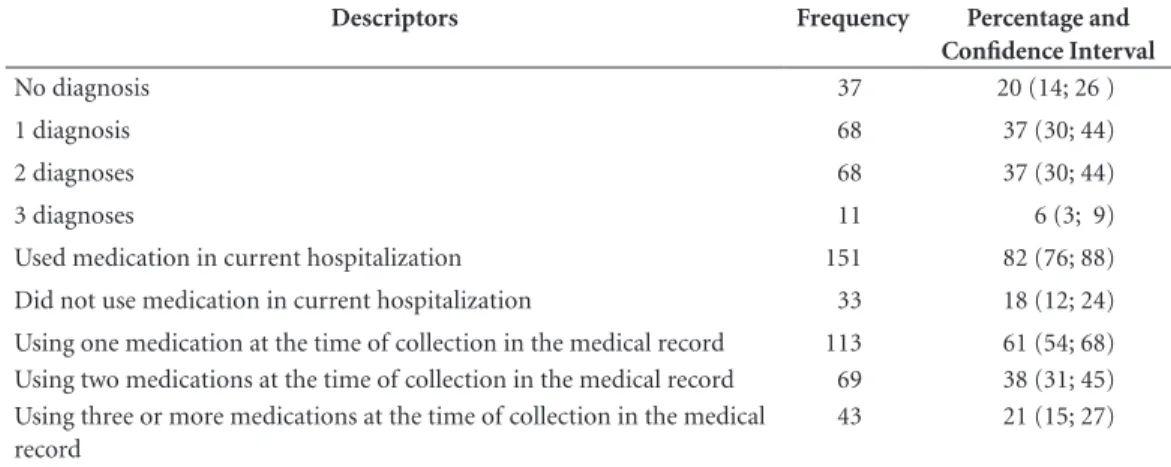
The vertical regime acts in the face of the conditions of high prevalence of mental disor-der identified in the population guarded by the USEs. As already mentioned, 19% of adolescents had a history of mental health treatment prior to the deprivation of liberty measure. Table 2 also shows that 80% of the adolescents admitted in Porto Alegre had at least one (1) mental health diagnosis in the medical records. The review of medical records also showed that 37% of the ad-olescents received two (2) psychiatric diagnoses.
The most frequent psychiatric diagnosis was conduct disorder, received by 73 adolescents (40%). The second most frequent diagnosis was that of dis-orders resulting from the use of psychoactive sub-stances (27%). The third was that of adjustment disorders (21%). There is no doubt that there is the diffuse and innocuous understanding that adapta-tion disorders are usually due to the instituadapta-tional- institutional-ization itself with loss of freedom. In general, the diagnosis of conduct disorder is attributed to young people who have difficulty with social rules (Inter-view with Psychiatric, Porto Alegre, June 3, 2015). Research on medication use shows that 151 (82%) adolescents received some type of psychi-atric medication during their admission in Porto Alegre, of which 113 (61.4%) used medication on the day their medical records were examined (Table 2).
The research in Porto Alegre points to con-vergent patterns in the [high] prevalence of the prescription of psychoactive drugs of facilities
Table 1. Distribution of adolescents in mental health care in Porto Alegre USEs.
Facility Name Hospitalized Adolescents (A) Adolescents with Mental Health Care Record (B) B/A*100
POA I 104 81 77.9
CASE 20 18 90.0
CSE 60 59 98.3
Total 184 158 85.9
C
osta NR, surveyed. In the CSE (male facility), only one
adolescent out of 60 in compliance with depriva-tion of liberty had not used psychoactive medica-tion during hospitalizamedica-tion. The same pattern oc-curs in the female establishment, where only two (2) adolescents of the 20 people admitted had not used medication (10%). In POA I, the pro-portion of adolescents using psychoactive drugs was somewhat less dramatic, although it reached 71% of the medical records reviewed.
Table 2 shows the simultaneous use of mul-tiple psychoactive drugs by 38% of the adoles-cents at the time of the study, confirming the ev-idence obtained by the national research already
commented10. Table 2 also shows that 21.3% of
adolescents in deprivation of liberty were be-ing medicated with three or more psychotropic drugs concomitantly.
The high level of pharmaceuticalization calls into question the context of the activities of so-cio-educational workers who mention work overload in insufficient numbers and in an un-healthy environment, without pedagogical activ-ities and in a continuous overcrowding situation. Overall, rates of psychiatric diagnoses and drug prescriptions have increased sharply in recent years, partly due to greater acceptance of men-tal disorders and increased access to care, but also due to the proliferation of diagnoses and
over-treatment21.
In any case, there may an expectation from part of the internal team that the adolescent be medicat-ed and even smedicat-edatmedicat-ed (Interview with Central Level Manager. Porto Alegre, June 2, 2015).
In this context, the prescription of emergen-cy medication both orally and intramuscularly (in the medical jargon “If necessary” or “SOS”) allows the team to use psychiatric medication without the presence of the doctor. The survey found that 71 medical records (39%) had a re-cord of this prescription mode. The most com-mon justifications in the Porto Alegre facilities were insomnia (38 out of 71) and agitation (24 out of 71).
The Minas Gerais Case Study
The medical records surveyed in Belo Hori-zonte, as was the case of Porto Alegre, belonged predominantly to male adolescents – 173 (80%) out of a total of 215. Belo Horizonte dwellers medical records totaled 135 (63%) and 33 (19%) were whites. Adolescents reportedly black were predominant and 90% of adolescents did not complete elementary school. In relation to of-fences ensuing admission at the institution, the most frequent cause was robbery (60%), fol-lowed by homicide (11%). Recidivists totaled 17.7% of the sample.
Medical records’ information show that 88 (40.9%) of the adolescents had undergone some mental health treatment during the current hos-pitalization (Table 3). The use of psychiatric medication and other mental health care modes (mainly visits by a psychologist) were deemed mental health treatment. Fifty-seven adolescents (26.5%) performed some type of non-drug treat-ment. The provision of mental health care varied
Table 2.Characteristics of mental health care in the socioeducative facilities of Porto Alegre in 2014 (N = 184).
Descriptors Frequency Percentage and
Confidence Interval
No diagnosis 37 20 (14; 26 )
1 diagnosis 68 37 (30; 44)
2 diagnoses 68 37 (30; 44)
3 diagnoses 11 6 (3; 9)
Used medication in current hospitalization 151 82 (76; 88) Did not use medication in current hospitalization 33 18 (12; 24) Using one medication at the time of collection in the medical record 113 61 (54; 68) Using two medications at the time of collection in the medical record 69 38 (31; 45) Using three or more medications at the time of collection in the medical
record
43 21 (15; 27)
e C
ole
tiv
a,
22(5):1467-1478,
2017
significantly among the facilities studied. In the Horto unit, the proportion is 23.4% of patients, but reached 64% of the adolescents in the São Jerônimo women’s facility, where 20% of female adolescents had a history of mental health treat-ments.
External services were the most used for the treatment of adolescents (59%). Only 24% of those who requested them were exclusively treat-ed only within the scope of the USEs. A residual portion of 15% of adolescents received care both internally and externally.
Family health facilities are the most im-portant reference for external care (33% of ad-olescents received care in these municipal struc-tures). Qualitative interviews indicated that mental health care in family health units, at the time of the research, was still being consolidated.
Work direction had already been aiming at linking mental health care to the provision of the Unified Health System a few years earlier. One measure to step up this guideline was the gradual transfer of psychiatrists from the USEs’ teams to the Municipal Health Secretariat (Interview with Central Level Manager. Belo Horizonte, August 10, 2015).
The residual CAPS participation in the at-tendance is noteworthy: only seven adolescents attended a CAPS AD (Minas Gerais Drug Addic-tion Center – CMT) and five in the only children and youth CAPS (CERSAMI) in the city. In total, 16 adolescents were attended in a private facility (linked to public service) specialized in the care of issues related to the use of alcohol and other drugs (Center for Care and Protection to Young Drug Users - CAPUT).
At the time of the research, the CAPUT was being disconnected from the SUS and, therefore, from the service to adolescents. Qualitative inter-views indicated that the decision was controver-sial among managers and displeased adolescents. The CAPUT was the main reference for problems
associated with the use of psychoactive substanc-es. Finally, seven adolescents had records of care in a psychiatric hospital (Psychological Center for Adolescence and Childhood – CEPAI), which provides emergency and outpatient services for people aged up to 18 years.
In the USEs studied, the situations that gen-erate the mental health treatment initiative are associated with the acute conditions produced by anguish caused by the prison environment, which leads, in some cases, to even attempted suicide by hanging (especially with the use of bed sheets). A protocol of referral to CEPAI (psychi-atric emergency) is applied in these cases, where the adolescent can be medicated, returning to the facility. This type of situation ensues a sub-sequent demand to the mental health network.
In other cases, the adolescent is monitored in the mental health network and commits an of-fence. In this case, he is automatically remanded to the location where he was receiving care. If ad-olescents were from the inland of the State, treat-ment could be performed at the CEPAI (state psychiatric facility with emergency and ambula-tory services).
Another reason for care is the complaint of insomnia. Insomnia conditions lead to the use of medication. As a strategy to reduce the use of medication, an insomnia group (conversation wheel) was created at the São Jerônimo facility, which tries to unlink the insomnia issue from the use of psychotropic drugs. Notwithstanding, when mental suffering is more related to caution, there are attempts to manage it within the facility, but internal psychological care has low availabili-ty because professionals are very concerned with judicial matters.
Even another type of motivation for referral to psychiatric care stems from agitated or aggressive behavior, which interferes with the routine of the establishment (Interview with Psychiatric. Belo Horizonte, August, 11, 2015).
Table 3. Distribution of adolescents under mental health treatment in the USEs of Belo Horizonte in 2015.
Facility Total Hospitalized Adolescents (A) Total under mental health treatment (B) B/A*100
Horto 64 15 23.4
Santa Clara 70 27 38.6
CEAD 39 19 48.8
São Jerônimo 42 27 64.3
Total 215 88 41
C
osta NR, It is when somehow the facility affirms its
safety device nature and thus resorts to psychi-atric services.
In February 2015, the Municipality of Belo Horizonte was empowered to receive the in-centive for Comprehensive Health Care for Ad-olescent Offenders. As already mentioned, the Municipal Operational Plan for Comprehensive Health Care to adolescents offenders mainly aims at targeting the treatment of adolescents to the SUS Health Care Network. With regard to mental
health, it is hoped to discontinue the circuit
So-cio-educational Facilities – CEPAI, which shows an intervention focused on urgency and hospital-ization (Interview with Central Level Manager. Belo Horizonte, August 10, 2015).
The issues of agenda coordination and oper-ational hurdles to external service delivery were highlighted in the interviews. Most USEs’ direc-tors emphasized the lack of readiness of family health scheduling (only the Santa Clara facility did not raise the issue). Another critical opera-tional limitation to external care is associated with unavailable transportation to transfer ad-olescents in the city, with loss of scheduled vis-its. The operational limitation is aggravated by shortage of staff to accompany young people on commutes.
Table 4 shows that the proportion of adoles-cents in deprivation of liberty with a psychiatric diagnosis in Belo Horizonte is relatively low. Es-pecially, the situations of adolescents with infor-mation of two or more diagnosis in the medical records are residual (5% of the cases).
The health teams choose not to formalize the diagnoses in Belo Horizonte. In case discussions, the diagnostic hypotheses of adolescents are men-tioned, but not recorded in medical records. One of the possible causes is a caution regarding the stig-matizing way in which the legal system addresses the issue and that ends up further damaging the identity of the adolescents. This prevalence may in-dicate the care of the mental health team in avoid-ing the effect of diagnostic labelavoid-ing on the future of the adolescent (Interview with Central Level Man-ager. Belo Horizonte, August 10, 2015.
The influence of psychoanalysis on the ed-ucation of professionals possibly contributes to the caution of the mental health team. Psycho-analysis has a more structural rather than a phe-nomenological view of diagnosis and, therefore, the classic diagnostic categories of psychiatry lose
their meaning22.
The health team’s parsimony produces an impact that deserves careful reflection because,
among the 88 adolsecents who underwent men-tal health treatment, 54 had no records of di-agnosis in the electronic medical records of the Municipal Health Secretariat or in the medical records of the socio-educative units surveyed. In addition, four adolescents that had diagnos-tic records in the medical records were not under mental health care.
It is important to consider that, among the four indicators of health monitoring and eval-uation defined for the Municipal Plan for Ad-olescent Care, two involve the production of diagnoses – percentage of diagnosis of mental disorder under follow-up in the Psychosocial Care Network and percentage of adolescents di-agnosed for alcohol and other drugs abuse and/ or addiction.
Among the 14 adolescents diagnosed with schizophrenia, 12 underwent mental health treatment during hospitalization and all received indication of medication use. At the time of the research, eight (8) were actually taking medica-tion and six (6) underwent some form of non-drug treatment.
Table 4 reports that 35.9% of adolescents used psychoactive medication at some point in the current hospitalization, while 22.8% were us-ing it at the time of the research team’s visit. The description of the information by socio-educa-tive facility points to a slightly different pattern in the use of medication. Two facilities (Santa Clara and CEAD) reported a proportion of use in little more than 1/3 (36%) of the adolescents. In the female facility of São Jerônimo, 45% of female users received psychiatric medication during hospitalization. Prevalence at the Horto facility was well below that observed in the other facili-ties in Belo Horizonte, with 26.6% of adolescents with medication use during hospitalization.
The qualitative interview indicates that the ex-planation for the low medication use in the Horto CSE is that its deprivation of liberty regime is soft because it allows exits and many external activi-ties. It is also a more recent facility already planned within a less restrictive philosophy of interaction of adolescents with the external social environment. There is also a greater propensity for external re-ferrals, seeking a less medication-prone approach
(Interview with Socioeducative Facility. Belo Horizonte, August 11, 2015).
e C
ole
tiv
a,
22(5):1467-1478,
2017
and external interactions – and the presence of the psychiatrist attending within the scope of own facility.
Table 4 confirms the minimalist pattern of medication found in USEs in the city. We can observe that cumulative medication reaches a re-sidual proportion of adolescents (12%) who used medication at the time of the research.
The restraint protocol due to aggressiveness and agitation includes the use of handcuffs and referral to the psychiatric emergency as a last re-sort. CEPAD alone acts with an individual cell within the restraint strategy. The São Jerônimo facility has three individual rooms, but is not using them in restraint strategies. Socio-edu-cational agents and duty coordinator most of-ten administer the restraint procedure (this is a preliminary procedure in the sphere of safety). Under prevailing rules, teenagers cannot sleep/ stay handcuffed in accommodations. Therefore, if the crisis is not resolved, they will be referred to a psychiatric emergency. During handcuff re-straint, the teenager is in a more isolated environ-ment (at the Horto facility, in the visitors’ room). Isolation procedures are standardized and are evaluated by a disciplinary committee. The most common are restrictions on activities such as sports activities, television and exits. Vocational and school activities cannot be suspended.
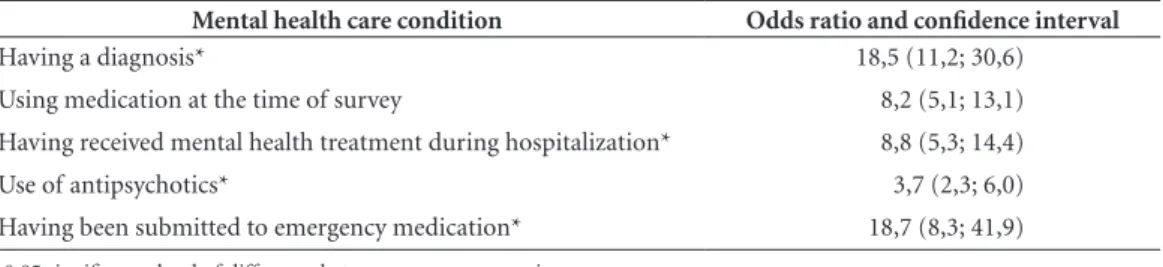
Table 5 confirms the strong association be-tween the vertical governance regime and the in-tensive mental health care standard of diagnostic production and use of psychoactive medication. The cross-product ratio shows that adolescents deprived of their liberty in Porto Alegre were sig-nificantly more likely to have received diagnosis, psychoactive medication and mental health care and to be submitted to emergency psychiatric
medication than adolescents in the same condi-tion in Belo Horizonte. Regarding the use of psy-choactive drugs, the probability was eightfold the observed in Belo Horizonte. With regard to emer-gency medication use situation, Porto Alegre was 19 times more likely than Belo Horizonte.
Discussion
The concept of governance applied to the de-velopment of this paper captured the Brazilian governments’ experiences in which cooperation and mediation of municipal power favored clin-ical choices of less emphasis on the prescription of drugs in mental health care to adolescents de-prived of their liberty.
The national guidelines, in line with academ-ic studies and clinacadem-ical guidelines, in situations of deprivation of liberty, propose cautious conduct regarding medication. Psychotherapies and re-habilitation actions should be used as first-line interventions. Pharmacological management should be used when these interventions are
in-sufficient8.
From a normative perspective, studies show that use of medication should include a perma-nent assessment of risks and benefits. Poor man-agement of psychopharmacological intervention can lead to situations where adolescents are sub-mitted to multiple prescriptions without a clear understanding of their interactions and possible
adverse effects21.
Regarding psychiatric diagnoses, studies show a confluence regarding the prevalence of mental disorders in populations of adolescent offenders in situations of deprivation of liberty. It is still possible to consider the possibility of increased
Table 4. Characteristics of mental health care in the socioeducative facilities of Belo Horizonte (N = 215).
Descriptors Frequency Percentage and
Confidence Interval
No diagnosis 177 82 (77; 87)
1 diagnosis 27 13 (9; 17)
2 diagnoses 7 3,5 (1; 5)
3 diagnoses 4 2 (0; 4)
Used medication in current hospitalization 77 36 (29; 43)
C
osta NR,
symptoms before the situation of imprisonment. It should be emphasized that a prevalent
diagno-sis in Porto Alegre – that of conduct disorders – is
a redundant definition of the very reasons that
lead to the institutionalization of adolescents23.
The situations of highly medicated adoles-cents, as observed in the model of vertical at-tention, hamper the detection of disorders. One cannot rule out the existence of serious undiag-nosed mental disorders, which is not uncommon in clinical practice with adolescents. It is possible that more severe conditions are masked by sub-stance addiction or by oppositional behavior that is more easily identifiable than other mental
dis-orders24.
Similarly, prescription of medication below what would be advisable may affect the well-be-ing of adolescents. In many cases, proper med-ication is a crucial relief resource. Prescription medications for acute conditions (e.g. psychotic symptoms or suicide risk) are not only
accept-able but an ethical imperative25.
This paper further argues that the option for horizontal governance is a non-trivial insti-tutional challenge for municipalities and states due to the prescriptive nature of national policy in the field of mental health care. Ensuring civil rights of people with mental disorders is a crucial
guideline13.
The text demonstrates that mental health care in the vertical environment of the socio-ed-ucational system of the State of Rio Grande do Sul is associated with the high prevalence of di-agnosis and use of psychoactive medication. This high prevalence seems to indicate that sanctions of deprivation of liberty for infractions may fa-vor, in the vertical environment, medicalization and pharmaceuticalization decisions that affect the rights of adolescents in the field of mental
health23.
Vertical governance structures that have limited provision of care within national policy guidelines should shift mental health care from inpatients to other devices. It is necessary to discuss where care should be performed, espe-cially before acute mental health intercurrences during hospitalizations in the socio-educational system. Although the PNAISARI guidelines for articulation between federative bodies are very recent, the actions of matriciation between mu-nicipal health and the socio-educational system are a strategic procedure for the reform of men-tal health care in Brazilian custodial institutions that seems extremely promising. The case study on horizontal cooperation, as observed in Minas Gerais, offers encouraging evidence toward a sec-torial reform within the feasible and ethically ap-propriate federative pact.
Table 5. Impact of the governance regime on mental health care in USEs in Porto Alegre compared to the condition in Belo Horizonte.
Mental health care condition Odds ratio and confidence interval
Having a diagnosis* 18,5 (11,2; 30,6)
Using medication at the time of survey 8,2 (5,1; 13,1) Having received mental health treatment during hospitalization* 8,8 (5,3; 14,4)
Use of antipsychotics* 3,7 (2,3; 6,0)
Having been submitted to emergency medication* 18,7 (8,3; 41,9) * 0.05 significance level of difference between governance regimes.
e C
ole
tiv
a,
22(5):1467-1478,
2017
Collaborators
C
osta NR, References
1. Costa NR, Silva PRF. Diagnóstico Situacional da Aten-ção em Saúde Mental nas Unidades Socioeducativas
Bra-sileiras. Rio de Janeiro: Fiocruz, Ministério da Saúde;
2016.
2. Brasil. Lei 8.069, de 13 de julho de 1990. Dispõe sobre o Estatuto da Criança e do Adolescente e dá outras provi-dências. Diário Oficial da União 1990; 16 jul.
3. Brasil. Secretaria Geral da Presidência da República.
Mapa do Encarceramento. Brasília: Secretaria Geral da
Presidência da República; 2014.
4. Brasil. Lei nº 12.594, de 18 de janeiro de 2012. Institui o Sistema Nacional de Atendimento Socioeducativo (Sinase), regulamenta a execução das medidas socio-educativas destinadas a adolescente que pratique ato infracional; e altera as Leis nos 8.069, de 13 de julho de 1990 (Estatuto da Criança e do Adolescente); 7.560, de 19 de dezembro de 1986, 7.998, de 11 de janeiro de 1990, 5.537, de 21 de novembro de 1968, 8.315, de 23 de dezembro de 1991, 8.706, de 14 de setembro de 1993, os Decretos-Leis nos 4.048, de 22 de janeiro de 1942, 8.621, de 10 de janeiro de 1946, e a Consolidação das Leis do Trabalho (CLT), aprovada pelo Decreto-Lei no 5.452, de 1o de maio de 1943. Diário Oficial da União
2012; 20 jan.
5. Brasil. Conselho Nacional de Justiça (CNJ). Panorama Nacional. A Execução de Medida Socioeducativa de In-ternação. Brasília: CNJ; 2012
6. Vermeiren R, Jespers I, Moffitt T. Mental health prob-lems in juvenile justice populations. Child Adolesc
Psy-chiatr Clin N Am 2006; 5(2):333-351.
7. Wasserman GA, McReynolds LS, Lucas CP, Fisher P, Santos L. The voice DISC-IV with incarcerated male youths: Prevalence of disorder. J Am Acad Child Adolesc
Psychiatry 2000; 41(3):314-321.
8. Karnik NS, Soller MV, Steiner H. Psychopharmacolo-gy and Juvenile Delinquency. In: Kessler CL, Kraus LS, editors. The Mental Health Needs of Young Offenders -
Forging Paths toward Reintegration and Rehabilitation.
Cambridge: Cambridge University Press; 2007. p. 308-339.
9. Martins MC, Pillon SC. A relação entre a Iniciação do Uso de Drogas e o Primeiro Ato Infracional entre Adolescentes em Conflito com a Lei. Cad Saude Publica
2008; 24(5):1112-1120.
10. Brasil. Ministério da Saúde (MS). Levantamento Nacio-nal da Atenção em Saúde Mental aos Adolescentes Pri-vados de Liberdade e Sua Articulação com as Unidades Socioeducativas. Brasília: MS; 2008.
11. Brasil. Presidência da República. Secretaria Especial dos Direitos Humanos. Sistema Nacional De Atendimento
Socioeducativo – SINASE. Brasília: Conanda; 2006
12. Costa NR, Siqueira SV, Uhr D, Silva PRF, Molinaro AA, Reforma Psiquiátrica, Federalismo e Descentra-lização da saúde pública no Brasil. Cien Saude Colet
2011; 16 (12):4603-4614.
13. Alves DSN, Silva PRF, Costa NR. Êxitos e Desafios da Reforma Psiquiátrica no Brasil. 22 Anos Após a Decla-ração de Caracas. Medwave 2012; 12(10):45-55. 14. Goffman E. Manicômios, prisões e conventos. São Paulo:
Perspectiva; 1974.
15. Pierre J, Peters BG. Governance, Politics and the State. London: Macmillan Press Ltd; 2000.
16. Epstein D, O’Halloran S. Delegating Powers. Cam-bridge: Cambridge University Press; 1999.
17. Conrad P. The shifting engines of medicalization. J
Health Soc Behav 2005; 1(6):3-14.
18. Bell SE, Figert AE. Medicalization and Pharmaceutical-ization at the intersections: a commentary on Bell and Figert. Soc Sci Med 2012; 75(5):775-783.
19. Gerring, J. Case Selection for Case-Study Analysis In: Box-Steffensmeier JM, Brady HE, Collier D, editors.
The Oxford Handbok of Political Methodology. Oxford:
Oxford University Press; 2008. p. 645-684.
20. Dever GEA. Epidemiologia na Administração dos Ser-viços de Saúde. São Paulo: Pioneira Ed.; 1998. 21. Frances A, Raven M. The Need for Caution in
Diagnos-ing and TreatDiagnos-ing Mental Disorders. Am Fam Physician
2013; 88(8):490C-490D.
22. Figueiredo AC, Machado OMR. O Diagnóstico em Psicanálise: Do fenômeno à estrutura. Ágora 2000; III(2):65-86.
23. Stahlberg O, Anckarsater, H, Nilsson T. Mental Health Problems in Youths Committed to Juvenile Institu-tions: Prevalences and Treatment Needs. Eur Child Ad-olesc Psychiatry 2010; 19(12):893-903.
24. Erickson CD. Using Systems of Care to Reduce Incar-ceration of Youth with Serious Mental Illness. Am J
Community Psychol 2012; 49(3-4):404-416.
25. Desai RA, Goulet JL, Robbins J, Chapman JF, Migdole SJ, Hoge MA. Mental Health Care in Juvenile Detention Facilities: A Review. J Am Acad Psychiatry Law 2006; 34(2):204-214.
Article submitted 01/07/2016 Approved 12/09/2016