AR
TICLE
1 Unidade Técnica de Exposição Ocupacional, Ambiental e Câncer, Coordenação de Prevenção e Vigilância, INCA. R. Marquês de Pombal 125/5º, Centro. 20230-240 Rio de Janeiro RJ Brasil. [email protected]
Analysis of individuals with leukemia:
cancer surveillance system limitations
Abstract Cancer is the second leading cause of death in the world with great impact on public health and leukemia is a hematological cancer di-rectly related to different exposures at work. This study aimed to describe the occupational profile of individuals diagnosed with leukemia. This is a cross-sectional study of cases registered between 2007 and 2011 in the Integrador RHC database. Individuals from 26 Brazilian states, aged 20 years or older, were included. Of the 7,807 cases of leukemia, Minas Gerais recorded the highest occurrence (1,351). Only 52% of the cases had information on occupation. Occupations with the greatest number of cases of leukemia were agricul-tural, forestry and fishing workers; services, stores and markets vendors; and workers in the produc-tion of industrial goods and services. These occu-pations are exposed to substances considered by literature as carcinogenic agents to humans. There was a high underreporting of occupational data, compromising the quality of information and, therefore, the effectiveness of the Brazilian health surveillance system. The RHC also does not pro-vide information about the agent used during the working day, the exposure time during working life and data from previous occupations.
Key words Leukemia, Occupational exposure,
Hospital-based cancer records
Elisane Silveira Moraes 1
Marcia Sarpa de Campos Mello 1
Fernanda de Albuquerque Melo Nogueira 1
Ubirani Barros Otero 1
M
o
ra
Introduction
Cancer has been considered a disease of devel-oped countries for four decades. However, this situation is changing and we can observe in-creased number of cases in developing countries
that have few or medium resources1. In Brazil,
this is one of the most complex problems faced by the Unified Health System (SUS) due to its ep-idemiological, social and economic magnitude, although a third of all new cases occurring
annu-ally in the world could be avoided2.
The World Health Organization (WHO) has estimated 75 million people living with cancer by 2030, with 21 million new cases of the dis-ease and 13 million deaths worldwide except for non-melanoma skin cancer. Currently, some 14 million new cases are estimated with 8 million
deaths from cancer3. In Brazil, estimates for 2016,
which apply for 2017, indicate that there are ap-proximately 600,000 new cases of cancer, includ-ing non-melanoma skin cancer cases, reinforc-ing the magnitude of the cancer problem in the country. For all types of leukemia, the estimate for this type of cancer in Brazil is 5,540 new cases
in men and 4,530 in women4. In the world
rank-ing, among the most incident cancers, leukemia
types hold 11th place, and with regard to death by
cancer mortality, 10th place3.
Leukemia types are divided into four groups: acute and chronic, which are subdivided into my-eloid and lymphoid. Acute leukemia types are ag-gressive diseases that originate in hematopoiesis stem cells, characterized by increased production speed, decreased apoptosis, cell differentiation blockage, resulting in accumulated primitive hematopoietic cells, called blasts, and leading to bone marrow failure. Its diagnosis is defined by more than 20% of blasts in the blood or bone
marrow5.
According to Fritschi & Driscoll6,
approxi-mately 10.8% of cancer cases in men and 2.2% of cancer cases in women, excluding non-mela-noma skin cancer, are caused by exposure in the occupational environment.
The International Agency for Research on Cancer (IARC) seeks to identify environmental factors that may increase the risk of cancer in humans and, by 2014, identified 32 occupational agents and 11 circumstances of exposure classified as carcinogenic to humans. In addition, it identi-fied 27 agents and 6 exposure conditions as
poten-tially carcinogenic to humans7. Of the more than
100 carcinogens identified by the IARC,
approxi-mately 25% induce leukemia or lymphomas8.
The elimination or significant reduction of exposure to carcinogenic agents in the occupa-tional environment in countries with a high hu-man development index is considered the cause of the prevention of thousands of cancer cases
in the world9. On the other hand, due to poor
working conditions and the use of obsolete tech-nology, occupational exposure to carcinogens is believed to be higher in workers from developing
countries10.
According to the Brazilian National Cancer
Institute (INCA)11, work environments have
sev-eral carcinogenic agents, the effects of which can be enhanced with exposure to other cancer risk factors, such as environmental pollution, a trans-fats-rich diet, alcohol abuse, biological agents and smoking.
Among exposures in the occupational envi-ronment, the main risk factors for the develop-ment of leukemia are solvents such as benzene, tetrachlorethylene, styrene and chlorophenols, aromatic amines, ionizing radiation, electromag-netic fields, creosote, chromium, arsenic, eth-ylene oxide, asbestos, some antineoplastic agents
and agrochemicals11,12. According to IARC’s most
recent report (2014)7, butadiene and
formalde-hyde gases 1-3 used in the plastic, rubber and textile industries are also classified as group 1 occupational carcinogens, that is, carcinogenic to human beings.
Because cancer is a long-standing latent dis-ease, the retrospective assessment of exposure to carcinogenic risk factors requires tools that retrieve information about the individual expe-riences in the distant or recent past vis-à-vis the
diagnosis10.
Completing occupational data in medical records is a means of obtaining information re-garding past exposures, including in the occupa-tional environment. The recorded data serve as a basis for planning the physical structure itself and can also be used as a source of information for administrative planning, clinical research
and survival analysis13, as well as is an important
health surveillance tool.
While knowingly relevant, such information is still scarcely recorded in epidemiological stud-ies, hampering the establishment of possible as-sociations between pathology and occupational
exposure14. It is of the utmost importance that
aúd
e C
ole
tiv
a,
22(10):3321-3332,
2017
The Hospital-based Cancer Records (RHC) is a database that collects information about the diagnosis, treatment and development of cases of neoplasms serviced in general or specialized oncology hospitals. This database allows the elaboration of surveillance actions and health care planning, promoting the establishment of preventive measures, therapeutic decisions and
other control measures11. The importance of this
database is its contribution to cancer epidemi-ological surveillance actions in Brazil because it contains standardized, updated and quality
in-formation11.
However, RHC still has low quality occutional records, and only the current work of pa-tients is considered at the time of collecting this information, with no concern as to the former occupational exposures throughout their
work-ing life11. In a hospital-related case series study
conducted in the mountain region of Rio de Janeiro in 2011, authors pointed out failures in completing occupational information in 45% of
the medical records analyzed14.
Due to the lack of recognition by health pro-fessionals regarding the completion of the oc-cupational-related field in medical records, the
publication “Guidelines for Work-Related Cancer
Guidelines” provides models for recording occu-pational history, reinforcing the need to record not only the current occupation, but also all pre-vious to agents or substances to which the
indi-vidual was exposed11.
In view of the above, this study aimed to describe the occupational profile of individuals diagnosed with leukemia in the Brazilian states, based on the RHC in order to critically evaluate the completion of work-related information in RHC.
Methodology
This is a cross-sectional observational study that used the database of the Hospital-related Cancer Records in the 5-year period from 2007 to 2011. We included individuals aged 20 years and over from all 26 Brazilian states, registered in the con-solidated Integrador-RHC database. The state of Amapá was not included in this study because it did not evidence cases registered during the study period.
Data were collected in April 2014 and vari-ables occupation and histological type were con-sidered for all leukemia types (acute leukemia, leukemic, basophilic, hairy cells, chronic, Burkitt
cells, lymphosarcomatous cells, mast cells, plas-ma cells, eosinophilic, acute lymphoblastic, chronic lymphoblastic, aleukemic lymphoid, sub-acute lymphoid, lymphoid, acute mega-karyoblastic, acute myeloid, aleukemic myeloid, chronic myeloid, sub-acute myeloid, myeloid, acute myelomonocytic, chronic myelomonocyt-ic, acute monocytmyelomonocyt-ic, chronic monocytmyelomonocyt-ic, aleuke-mic monocytic, sub-acute monocytic, moncytic, prolymphocytic, acute promyelocytic, sub-acute, leukemia, adult T-cell lymphoma leukemia). The occupations were classified according to the Brazilian Occupational Classification (CBO) (Chart 1).
This is a cross-sectional, secondary da-ta-based study using data from the Hospital-related Cancer Records of the Integrating Module of Cancer Hospital Records made available by the National Cancer Institute José Alencar Gomes da Silva (INCA). Records include 239 hospital fa-cilities located in all Brazilian regions. All cases recorded with histological type leukemia in the period 2007-20111 were included. Cases diag-nosed in São Paulo were excluded from the study because they had other coordination than that of the Integrador.
Data review
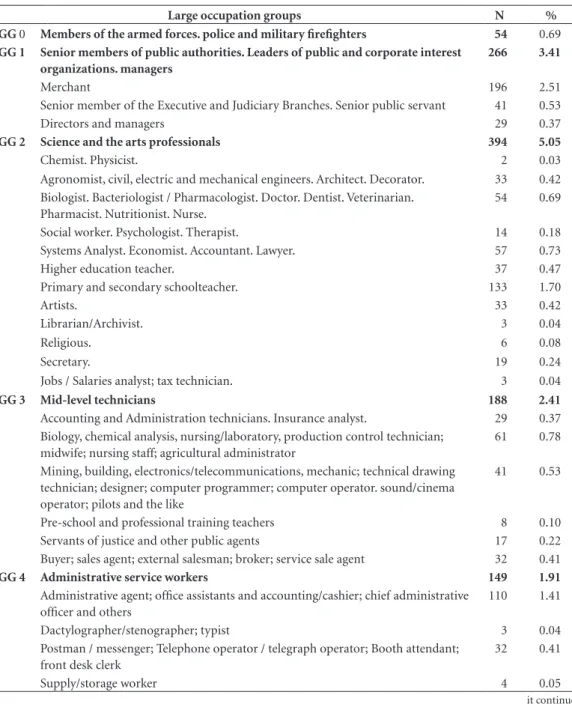
In order to discuss the quality of data comple-tion in the RHC, we calculated the frequency of occupational data of the cases that evidenced leu-kemia types as histological type in the RHC per federative unit. Subsequently, the prevalence of leukemia types in the large occupational groups, according to CBO was calculated in relation to the total number of cases due to this neoplasm in the period 2007-2011.
Results
Seven thousand eight-hundred and seven cases of leukemia were found in Brazil between 2007 and 2011. The state with the highest number of cases was Minas Gerais (1,351), followed by Rio Grande do Sul (1,082) and Rio de Janeiro (1,047). The most frequently recorded occu-pational group was service workers, store and market vendors (259), followed by agricultural, forestry, hunting and fishing workers (249) and workers in the production of industrial goods and services (181).
occupa-M
o
ra
tion of individuals (Table 1). The state of Sergipe did not include any occupational data records regarding the cases of leukemia diagnosed in the period. Table 2 shows the prevalence of leukemia by large occupation groups and subgroups, as per CBO. Among the large occupational groups, the most important ones regarding leukemia prev-alence were service workers, store and market vendors (12.80%), agricultural, forestry hunting and fishing workers (13, 15%) and workers in the production of industrial goods and services (10.86%) (Table 2). When analyzing the prev-alence of AML leukemia by occupational sub-groups, we can observe that in the large group 5, domestic and domestic service workers ac-count for more than 50% of cases of AML found (6.64%). In the large group 6 (Agricultural, for-estry, hunting and fishing workers) the highest prevalence of AML (10.26%) was found in the subgroup of livestock and agricultural workers.
In the large group 7, two subgroups were highlighted: professionals such as masters in civil construction; workers of mineral extraction and beneficiation, molding machine workers; cera-mists and other glass/ceramic workers; brick-work/parquetry worker; glaziers; other civil con-struction workers; civil concon-struction machine operators; works and metal structures painter; other painters; (3.93%) and drivers of vehicles, train driver/stoker; maneuvering agent/assistant; animal drivers and other drivers (3.03%) with a total prevalence of leukemia in the large group of 7%.
Discussion
This study evidenced a prevalence of leukemia types among occupations of the large group 6 of 13.15%. This result probably occurred due to exposure to the use of pesticides during work ac-tivities.
Pesticides are defined as “substances or agents of physical, chemical or biological processes with the purpose of modifying the composition of the flora or fauna in order to preserve them from the harmful action of living beings harmful to the
ag-ricultural activity”15. They act as primers (when
binding to DNA) or tumor promoters (cell di-vision stimulator of a started/mutated cell). The appearance of neoplastic cells will depend on the
absorption route and individual susceptibility16.
Although its use in food production along with fertilizers has increased agricultural pro-ductivity, exposure to these substances is asso-ciated with environmental and human health issues such as acute poisoning and chronic disor-ders in the neurological, reproductive and endo-crine systems, in addition to the development of
cancer in humans17,18.
In March 2015, the IARC published the monograph, volume 112, in which, after evaluat-ing the carcinogenicity of five active evaluat-ingredients of pesticides by a team of researchers from 11 countries, including Brazil, they classified herbi-cide glyphosate and insectiherbi-cides malathion and diazinon as probable carcinogens for humans (Group 2A) and insecticides tetrachlorvinphos
Chart 1. Large occupation groups, according to the Brazilian Classification of Occupations (CBO) (Adapted
from CBO 2010).
CBO - Brazilian Classification of Occupations 0 Members of the armed forces, police and military firefighters
1 Senior members of public authorities, leaders of public and corporate interest organizations, managers 2 Science and the arts professionals
3 Mid-level technicians 4 Administrative service workers 5 Service, shop and market sellers workers 6 Agricultural, forestry and fishing workers
7 Workers in the production of industrial goods and services(a)
8 Workers in the production of industrial goods and services(b)
9 Workers in repair and maintenance services
aúd
e C
ole
tiv
a,
22(10):3321-3332,
2017
and parathion as possible carcinogenic agents for humans (Group 2B). It is noteworthy that Malathion, diazinon and glyphosate are autho-rized and widely used in Brazil as insecticides in public health campaigns for vector control and
as herbicides in agriculture, respectively19. The
indiscriminate use of pesticides exposes rural workers, their families and the general popu-lation to the harmful effects of the use of such
substances20.
According to the WHO21, developing
coun-tries consume 20% of all pesticides produced in the world. Brazil is the world’s largest consumer of pesticides since 2008, accounting for 86% of
consumption in Latin America22.
The indiscriminate use of pesticides is a risk to workers’ health, mainly due to the lack of knowl-edge about the potential effects on their health, improper use, low use or misuse of personal pro-tective equipment and inadequate package
dis-posal methods23. Some researchers have already
found a positive association between leukemia types and the occupational use of
organophos-phorus and arsenical pesticides24,25.
Concerning the occupations of the large group 5, which include domestic workers, we found a prevalence of leukemia of 12.80%. This finding may be explained possibly by expo-sure to substances such as domestic sanitizers. According to the National Health Surveillance
Table 1. Absolute and relative frequency of completion of occupational data, by federation unit (UF), in
the period 2007-2011, Brazil.
UF of origin Leukemia Cases No occupation
records
Occupation records
available % completion
Acre 29 17 12 41.4
Alagoas 131 57 74 56.5
Amapá 9 5 4 44.4
Amazonas 70 24 46 65.7
Bahia 414 199 215 51.9
Ceará 304 158 146 48.0
Distrito Federal 12 5 7 58.3
Espírito Santo 253 121 132 52.2
Goiás 8 2 6 75.0
Maranhão 143 83 60 42.0
Mato Grosso 98 53 45 45.9
Mato Grosso do Sul 89 56 33 37.1
Minas Gerais 1351 629 722 53.4
Para 217 135 82 37.8
Paraiba 207 101 106 51.2
Parana 870 359 511 58.7
Pernambuco 241 150 91 37.8
Piauí 223 124 99 44.4
Rio de Janeiro 1047 383 664 63.4
Rio Grande do Norte 267 204 63 23.6
Rio Grande do Sul 1082 597 485 44.8
Rondônia 8 5 3 37.5
Roraima 3 0 3 100.0
Santa Catarina 624 239 385 61.7
Sergipe 10 10 0
-Tocantins 97 34 63 64.9
Total 7.807 3.750 4.057 52.0
M
o
ra
Agency26, household sanitizers are substances
or preparations intended for household sanita-tion, disinfection or disinfestasanita-tion, in collective or public environments, in places of common use and in water treatment. They are subdivided into four groups: cleaning products (detergents, dishwashers, coconut soap, etc.); antimicrobial agents’ products (such as disinfectants, sterilants, deodorants used in various environments); dis-infectants (e.g. rodenticides or insecticides) and homemade organic products (such as those used
to remove organic matter from boxes of fat), in addition to including products used in hospitals or clinics to clean surfaces (floors, walls etc.) and to sanitize instruments and medical and dental articles.
Domestic workers deal daily with a multiplic-ity of chemicals, such as detergents, waxes, dis-infectants, powdered soaps, among others, which contain toxic chemicals in their composition,
making this occupation prone to health risks27.
Scientific research to date is still inconclusive as
it continues
Large occupation groups N %
GG 0 Members of the armed forces. police and military firefighters 54 0.69
GG 1 Senior members of public authorities. Leaders of public and corporate interest
organizations. managers
266 3.41
Merchant 196 2.51
Senior member of the Executive and Judiciary Branches. Senior public servant 41 0.53
Directors and managers 29 0.37
GG 2 Science and the arts professionals 394 5.05
Chemist. Physicist. 2 0.03
Agronomist, civil, electric and mechanical engineers. Architect. Decorator. 33 0.42
Biologist. Bacteriologist / Pharmacologist. Doctor. Dentist. Veterinarian. Pharmacist. Nutritionist. Nurse.
54 0.69
Social worker. Psychologist. Therapist. 14 0.18
Systems Analyst. Economist. Accountant. Lawyer. 57 0.73
Higher education teacher. 37 0.47
Primary and secondary schoolteacher. 133 1.70
Artists. 33 0.42
Librarian/Archivist. 3 0.04
Religious. 6 0.08
Secretary. 19 0.24
Jobs / Salaries analyst; tax technician. 3 0.04
GG 3 Mid-level technicians 188 2.41
Accounting and Administration technicians. Insurance analyst. 29 0.37
Biology, chemical analysis, nursing/laboratory, production control technician; midwife; nursing staff; agricultural administrator
61 0.78
Mining, building, electronics/telecommunications, mechanic; technical drawing technician; designer; computer programmer; computer operator. sound/cinema operator; pilots and the like
41 0.53
Pre-school and professional training teachers 8 0.10
Servants of justice and other public agents 17 0.22
Buyer; sales agent; external salesman; broker; service sale agent 32 0.41
GG 4 Administrative service workers 149 1.91
Administrative agent; office assistants and accounting/cashier; chief administrative officer and others
110 1.41
Dactylographer/stenographer; typist 3 0.04
Postman / messenger; Telephone operator / telegraph operator; Booth attendant; front desk clerk
32 0.41
Supply/storage worker 4 0.05
aúd
e C
ole
tiv
a,
22(10):3321-3332,
2017
to the carcinogenic potential of the household cleaning sanitizers, since their chemical compo-sition varies greatly in each product. However, it is important to highlight that some detergents
contain benzene, which is considered by the International Agency for Research on Cancer to be a myelotoxic agent, that is, highly toxic and
carcinogenic to bone marrow7.
it continues
Large occupation groups N %
GG 5 Service. shop and market sellers workers 999 12.80
Domestic / Domestic service workers 518 6.64
Building services workers 106 1.36
Sales manager. Salesperson. Ambulant / day laborer. Other trade professionals 159 2.04
Hairdresser/beauty worker; launderer/dyer 48 0.61
Police officer; firefighter; security guard; Other security workers 94 1.20
Customs broker/public transport inspector 6 0.08
Butler / housekeeper; cook; waiter; commissioner; workers in building administration services; travel agent / tour guide
51 0.65
Other works/services 17 0.22
GG 6 Agricultural. forestry and fishing workers 1027 13.15
Farming workers 427 5.47
Agricultural workers 533 6.83
Livestock workers 11 0.14
Forestry workers 1 0.01
Fishing workers 55 0.70
Table 2. continuation
GG 7 Workers in the production of industrial goods and services 848 10.86
Master of civil construction; miner / construction site worker; other mineral extraction and beneficiation workers; molding machine workers; ceramist and other glass/ceramic workers; brickwork/parquetry worker; glazier; other civil construction workers; civil construction machine operator; works and metal structures painter; other painters; mason/plasterer.
307 3.93
Wood treatment workers; other chemical workers; joiner; wood plowing machine operator; carpenter and other woodworking workers
57 0.73
Weaver; knitwear weaver; textile finishing worker; other textile workers; leather/ skin tanner; tailor/dressmakers; modeler/cutter; serial-couturier; embroiderer/ serger; Other sewing workers; shoemaker; shoe manufacturing and finishing workers.
98 1.26
Toolmaker/modeler; turner/milling machine worker; machine-tool operator; Metal sharpening and polishing workers; other machining work; mechanical adjuster; Machine builder
23 0.29
Electric and electronic assemblers; installations electrician and other electrical workers
39 0.50
Plumber / pipe installer; Welder / flame cutter; plating/boiler worker; assembler of metal structures; jeweler/goldsmith
41 0.53
Typographic composer; typographic printer; photographic laboratory worker; other graphic works
9 0.12
Stevedore / loader; Other commodity handlers; Other manual workers 34 0.44
Vehicle driver. Train driver/stoker; maneuvering agent/assistant; animal drivers and other drivers
M
o
ra
Regarding the professional categories with the highest prevalence of leukemia (7%) in group 7, they include activities related to civil construc-tion, mining, ceramics, glazing, painting (3.93%) and driving, train driver/stoker; maneuvering agent/assistant; animal drivers and other drivers (3.03%). While civil construction-related activi-ties mainly use silica and asbestos, classified by IARC as Group 1 carcinogens, for raw material, final product or by-product of the cement,
ce-ramics, mineral extraction industry11, there is no
scientific evidence to date that reveal their associ-ation with hematological cancers, such as leuke-mia. Since 1997, literature has shown that occu-pational exposure to silica is strongly associated with the development of lung cancer. The risk of this type of cancer occurring varies according to the type of activity developed in the work sector – the industrial sector and how crystalline silica
appears7.
A possible explanation of the higher preva-lence of leukemia in the professional categories of group 7 highlighted above is the greater ex-posure to solvents, especially benzene, which is widely used in this type of industrial activity. Benzene belongs to the group of polycyclic ar-omatic hydrocarbons and is a known carcino-genic. It is found in gasoline and automotive ex-haust, among other uses, such as paint industry, lacquers, varnishes, adhesives, glue, degreasing agents, cleaning products and detergents and are
used in the production of dyes, plastic, agricul-tural products, pharmaceutical products and
fab-ric industries12,28-30.
According to Uzma et al.31, humans absorb
about 50% of inhaled benzene depending on their concentration in the atmosphere and the level of exposure. The most evident changes due to chronic exposure to this substance occur in the hematopoietic system, and may be the cause
of AML32. This solvent induces toxic effects on
blood and bone marrow, causing leucopenia, pancytopenia and aplastic anemia. Even at low exposure levels, benzene is an established carcin-ogen in the pathcarcin-ogenesis of leukemia types, and
myeloid leukemia is the most common type33,34.
Several other authors have found an associ-ation between leukemia types and occupassoci-ational
exposure to solvents35-38.
In the systematic review study and
me-ta-analysis conducted by Khalade et al.39, a
sig-nificant increase in the risk of AML and chronic lymphocytic leukemia (CLL) was identified by exposure to benzene in the workplace. The stud-ies analyzed indicated sufficient evidence that benzene exposure increases the risk of leukemia with dose-response patterns. However, in the meta-analysis, no association was found between occupational exposure to benzene and risk of chronic myeloid leukemia (CML).
Strom et al.40, in a control case study
conduct-ed in Texas with 638 adults diagnosconduct-ed with AML
GG 8 Workers in the production of industrial goods and services 64 0.82
Fusion oven operator; other metallurgy/steel workers; glass oven operator 23 0.29
Sugar manufacture and refining worker; food industry worker; baker/ confectioner; Cachaça, beer, wine and other beverage manufacture workers;
other food manufacture and preservation workers. 26 0.33
Fixed machine operator 15 0.19
GG 9 Workers in repair and maintenance services 68 0.87
Vehicles, aircraft and machinery maintenance mechanics; other mechanical
work. 66 0.85
Railway agent 2 0.03
Total completed 4057 52.00
Not applicable 556 7.12
Work not classified according to occupation 1627 20.84
Without information 1567 20.07
Total not completed 3750 48.00
Total 7807 100.00
Source: own elaboration based on the classification adopted by the CBO.
A high proportion of “not applicable”, “not classified according to occupation” and “without information” was observed.
Table 2. continuation
aúd
e C
ole
tiv
a,
22(10):3321-3332,
2017
and 636 controls found a positive association be-tween occupational exposure to solvents, even at low levels, and acute myeloid leukemia (AML), for both genders. Regarding males, the occupa-tional activities with the highest risk of leuke-mia were auto mechanics, fuel industry workers (petroleum), chemical industry workers and gas station operators; for women, main occupa-tions were hairdressers, rubber industry workers, chemists and cosmetics.
Completion of the occupational data in the RHC is of extreme importance as a tool to iden-tify possible exposures arising from the work process that may be associated with the cancer investigated and provide more in depth investi-gations about the occupation/activity-cancer re-lationship. With regard to leukemia and consid-ering the period of the study, we can define such completion as incipient. In addition, because it is a secondary database, we are unable to affirm whether this information was filled correctly or not.
According to the “Hospital-based Cancer
Records – Planning and Management” manual41,
variable “main occupation” corresponds to the activity that the patient performed the longest, provided there is no time interval greater than ten years between termination of the former ac-tivity and the current date or retirement date in case of inactive status. However, the registration of the current occupation – and not the longest one – can lead to error regarding the attribution of a possible causal association between occu-pation and cancer. It is worth mentioning that a large period of latency between exposure and onset of disease is required for the vast majori-ty of cancers (mean of 20 years for solid tumors and between 1.5 and 15 years for those of the
hematopoietic system)42. Hence the difficulty of
establishing the causal link between occupational exposures and the occurrence of cancer.
The main sources of errors regarding the use of secondary information databases are the lack of complete information during the period un-der study, the loss of exposure information or other variables of interest, lack of uniform data
and ambiguous or inconsistent information. Therefore, its use implies limitations, especially when the researcher has little control over the quality of data for the period studied, the defi-nition of the terms used and the nature of the
information10.
Nevertheless, in our study, it was possible to observe the higher prevalence of leukemia in groups exposed to substances known to be leu-kemogenic. Several authors have observed the occurrence of leukemia in specific professional categories, recognizing them as more exposed to carcinogenic agents such as solvents,
house-hold sanitizers, formaldehyde and pesticides12,39.
According to Chagas et al.38, the main
occupa-tional carcinogenic agents (ionizing radiation, benzene, ethylene oxide), work sectors and processes, such as rubber industry and the shoe manufacturing and repair are risk factors for the development of leukemia types.
Conclusion
This study demonstrated the main occupation-al activities recorded in RHC, where individuoccupation-als were diagnosed with AML, which included ser-vice workers, store and market vendors, agricul-tural, forestry, hunting and fishing workers and workers in the production of goods and services.
M
o
ra
Collaborators
aúd e C ole tiv a, 22(10):3321-3332, 2017 References
1. Ginsburg OM, Hanna TP, Vandenberg T, Joy AA, Clemons M, Game M, Maccormick R, Elit LM, Rosen B, Rahim Y, Geddie W, Sutcliffe SB, Gospodarowicz M. The global cancer epidemic: opportunities for Canada in low- and middle-income countries. CMAJ 2012; 184(15):1699-1704.
2. Instituto Nacional de Câncer (INCA). ABC do câncer:
Abordagem básica para o controle do câncer. 2 ed. Rio de
Janeiro: INCA; 2012.
3. World Health Organization (WHO). Haematopoietic and lymphoid malignancies. In: International Agency for Ressearch on Cancer (IARC). World Cancer Report. Lyon: IARC; 2014. p. 703-722.
4. Instituto Nacional de Câncer (INCA). Estimativa
2016: Incidência de câncer no Brasil [Internet]. Rio de
Janeiro, 2016 [acesso 2017 maio 20]. Disponível em: http://www.inca.gov.br/estimativa/2016/estimativa-2016-v11.pdf
5. Hoffbrand AV, Moss PAH. Fundamentos da hematolo-gia. 6ªed. Porto Alegre: Artmed; 2013.
6. Fritschi L, Driscoll T. Cancer due to occupation in Australia. Aust N Z J Public Health 2006; 30(3):213-219. 7. International Agency for Research on Cancer (IARC).
A review of human carcinogens – Part F: Chemical
agents and related occupations. Lyon: IARC; 2012. IARC
Monographs on the Evaluation of Carcinogenic Risks to Humans.
8. Eastmond DA, Keshava N, Sonawane B. Lymphohematopoietic cancers induced by chemicals and other agents and their implications for risk evalua-tion: An overview. Mutat. Res.: Rev. Mutat. Res. (2014); 761:40-64.
9. Vineis P, Wild CP. Global cancer patterns: causes and prevention. Lancet 2014; 383(9916):549-557.
10. Ribeiro FSN, Wunsch-Filho V. Avaliação retrospectiva da exposição ocupacional a cancerígenos: abordagem epidemiológica e aplicação em vigilância em saúde.
Cad Saúde Pública 2004; 20(4):881-890.
11. Instituto Nacional do Câncer (INCA). Diretrizes para vigilância do câncer relacionado ao trabalho. Rio de Janeiro: INCA; 2012.
12. Polychronakis I, Dounias G, Makropoulos V, Riza E, Linos A. Work-related leukemia: a systematic review. J
Occupational Med Toxicol 2013; 8(14):
13. Andrade CT, Magedanz AMPCB, Escobosa DM, Tomaz WM, Santinho CS, Lopes TO, Lombardo V. A impor-tância de um banco de dados para gestão dos serviços de saúde. Einstein 2012; 10(3):360-365.
14. Tabalipa MM, Boccolin PMM, Simões DR, Chrisman JR, Otero UB, Garbin HBR, Turci SR, Meyer A. Informação sobre ocupação em registros hospitala-res de câncer no estado do Rio de Janeiro. Cad. Saúde Colet. 2011; 19(3):278-286.
15. Brasil. Lei nº 7802, de 11 de julho de 1989. Dispõe so-bre a pesquisa, a experimentação, a produção, a emba-lagem e rotuemba-lagem, o transporte, o armazenamento, a comercialização, a propaganda comercial, a utilização, a importação, a exportação, o destino final dos resíduos e embalagens, o registro, a classificação, o controle, a inspeção e a fiscalização de agrotóxicos, seus compo-nentes e afins, e dá outras providências. Diário Oficial
da União 1989; 12 jul.
16. Miranda ALF. Mortalidade por neoplasias potencial-mente associadas à atividade agrícola no estado do Rio de
Janeiro [dissertação]. Rio de Janeiro: Escola Nacional
de Saúde Pública Sergio Arouca; 2012.
17. NP Oliveira, GP Moi, M Atanaka-Santos, Silva AM, Pignati WA. Malformações congênitas em municípios de grande utilização de agrotóxicos em Mato Grosso, Brasil. Cien Saude Colet 2014; 19(10):4123-4130. 18. Medeiros MNC, Medeiros MC, Silva MBA. Intoxicação
aguda por agrotóxicos anticolinesterásicos na cidade do Recife, Pernambuco, 2007-2010. Epidemiol. Serv.
Saúde [online] 2014; 23(3):509-518.
19. IARC Monographs. Volume 112:evaluation of five
orga-nophosphate insecticides and herbicides. [acessado 2017
maio 29]. Disponível em: https://www.iarc.fr/en/me-dia-centre/iarcnews/pdf/MonographVolume112.pdf 20. Moisés M. Reflexões e contribuições para o Plano
Integrado de Vigilância em Saúde de Populações Expostas
a Agrotóxicos do Ministério da Saúde (MS) [tese]. Rio
de Janeiro: Escola Nacional de Saúde Pública Sergio Arouca; 2012.
21. Carneiro FF, Rigotto RM, Augusto LGS, Friedrich K, Búrigo AC. Dossiê Abrasco: um alerta sobre os im-pactos dos agrotóxicos na saúde. São Paulo: Editora Expressão Popular; 2015.
22. Instituto Brasileiro de Geografia e Estatística (IBGE).
Indicadores de Desenvolvimento Sustentável. Rio de
Janeiro: IBGE; 2010. Estudos e Pesquisas. Informação Geográfica número 7.
23. Jobim PFC, Nunes LN, Giugliani R, Cruz IBM.Existe uma associação entre mortalidade por câncer e uso de agrotóxicos? Uma contribuição ao debate. Cien Saude
Colet 2010; 15(1):277-288.
24. Mahajan R, Blair A, Lynch CF, Schroeder P, Hoppin JA, Sandler DP, Alavanja MC. Fonofos exposure and can-cer incidence in the agricultural health study. Environ
Health Perspect 2006; 114(12):1838-1842.
25. Hansen ES, Lander F, Lauritsen JM. Time trends in cancer risk and pesticide exposure, a long-term fol-low-up of Danish gardeners. Scand J Work Environ
Health 2007, 33(6):465-469.
26. Agência Nacional de Vigilância Sanitária. Resoluçãono 336, de 22 de julho de 1999. Dispões sobre Registro de Produtos Saneantes Domissanitários e Afins, de Uso Domiciliar, Institucional e Profissional. Diário Oficial
da União 1999; 23 jul.
27. Robazzi MLCC, Luis MAV, Lavrador MAS, Gobbo AFF. Substâncias químicas, trabalho e alterações neurológi-cas: possíveis relações entre estas variáveis. Rev
Latino-Am. Enfermagem 1999; 7(1):39-48.
28. NIOSH. Organic solvents. [acessado 2017 maio 20]. Disponível em: https://www.cdc.gov/niosh/topics/or-gansolv/default.html
29. Hayes RB, Songnian Y, Dosemeci M, Linet M. Benzene and lymphohematopoietic malignancies in humans.
Am J Ind Med 2001; 40(2):117-126.
30. Moen BE, Steinsvag K, Braveit M. What do we know about chemical hazards in offshore work? Tidsskr Nor
M
o
ra
31. Uzma N, Kumar SB, Hazari MAH. Exposure to benzene induces oxidative stress, alters the immune response and expression of p53 in gasoline filling workers. Am J
Ind Med 2010; 53(12):1264-1270.
32. IARC Monographs Volume 100F. Chemical Agents and
Related Occupations – Benzene. [acessado 2017 maio
20]. Disponível em: http://monographs.iarc.fr/ENG/ Monographs/vol100F/index.php
33. Sarma SN, Kim YJ, Ryu JC. Gene expression profiles of human promyelocytic leukemia cell lines exposed to volatile organic compounds. Toxicology 2010; 271(3):122-130.
34. Bonates CC, Silva NF, Teixeira TA, Cortez EA, Valente GSC, Braga ALS, Silvino ZR. O benzeno como agen-te carcinogênico: identificação e prevenção de riscos a saúde do trabalhador. Revista de Pesquisa: Cuidado é
fundamental online 2010; 2(3):1184-1190.
35. Clapp RW. Mortality among US employees of a large computer manufacturing company: 1969-2001.
Environ Health 2006; 5:30-39.
36. Clapp RW, Jacobs MM, Loechler EL. Environmental and occupational causes of cancer: new evidence 2005-2007. Rev Environ Health 2008; 23(1):1-37.
37. Yang M. A current global view of environmental and occupational cancers. J Environ Sci Health C Environ
Carcinog Ecotoxicol Rev. 2011; 29(3):223-249.
38. Chagas CC, Guimarães RM, Boccolini, PMM. Câncer relacionado ao trabalho: uma revisão sistemática. Cad.
Saúde Colet. 2013; 21(2):209-223.
39. Khalade A, Jaakkola MS, Pukkala E, Jaakkola JJK. Exposure to benzene at work and the risk of leukemia: a systematic review and meta-analysis. Environmental
Health 2010; 9:31.
40. Strom SS, Oum R, Gbito KYE, Garcia-Manero G, Yamamura Y. De Novo acute myeloid leukemia risk factors. Cancer 2012; 118(18):4589-4596.
41. Instituto Nacional do Câncer (INCA). Registros
Hospitalares de Câncer. Planejamento e Gestão. 2º ed.
Rio de Janeiro: INCA; 2010.
42. Brasil. Ministério do Trabalho e Emprego (MTE).
Classificação Brasileira de Ocupações. 3ª ed. Brasília:
MTE; 2010.
Article submitted 30/05/2017 Approved 26/06/2017