Bonding brackets on white spot lesions pretreated by
means of two methods
Julia Sotero Vianna1, Mariana Marquezan2, Thiago Chon Leon Lau3, Eduardo Franzotti Sant’Anna4
Objective: The aim of this study was to evaluate the shear bond strength (SBS) of brackets bonded to demineralized enamel pretreated with low viscosity Icon Infiltrant resin (DMG) and glass ionomer cement (Clinpro XT Varnish, 3M Unitek) with and without aging. Methods: A total of 75 bovine enamel specimens were allocated into five groups (n = 15). Group 1 was the control group in which the enamel surface was not demineralized. In the other four groups, the surfaces were submitted to cariogenic challenge and white spot lesions were treated. Groups 2 and 3 were treated with Icon Infiltrant resin; Groups 4 and 5, with Clinpro XT Varnish. After treatment, Groups 3 and 5 were artificially aged. Brackets were bonded with Transbond XT adhesive system and SBS was evaluated by means of a universal testing machine. Statistical analysis was performed by one-way analysis of variance followed by Tukey post-hoc test. Results: All groups tested presented shear bond strengths similar to or higher than the control group. Specimens of Group 4 had significantly higher shear bond strength values (p < 0.05) than the others. Conclusion: Pretreatment of white spot lesions, with or without aging, did not decrease the SBS of brackets.
Keywords:Dental caries. Orthodontic brackets. Shear bond strength.
1 Private practice, Rio de Janeiro, Rio de Janeiro, Brazil.
2 Postdoc resident, Universidade Federal do Rio de Janeiro (UFRJ), Department
of Pediatric Dentistry and Orthodontics, Rio de Janeiro, Rio de Janeiro, Brazil. Dentist, Universidade Federal de Santa Maria (UFSM), Department of Restorative Dentistry, Santa Maria, Rio Grande do Sul, Brazil.
3 PhD resident, Universidade Federal do Rio de Janeiro (UFRJ), Rio de Janeiro,
Rio de Janeiro, Brazil.
4 Professor, Universidade Federal do Rio de Janeiro (UFRJ), Rio de Janeiro, Rio
de Janeiro, Brazil.
DOI: http://dx.doi.org/10.1590/2177-6709.21.2.039-044.oar
How to cite this article: Vianna JS, Marquezan M, Lau TCL, Sant’Anna EF. Bonding brackets on white spot lesions pretreated by means of two methods. Dental Press J Orthod. 2016 Mar-Apr;21(2):39-44.
DOI: http://dx.doi.org/10.1590/2177-6709.21.2.039-044.oar
Submitted: November 25, 2014 - Revised and accepted: October 14, 2015
» The authors report no commercial, proprietary or financial interest in the products or companies described in this article.
Contact address: Eduardo Franzotti Sant’Anna E-mail: [email protected]
Introdução: o objetivo do presente estudo foi avaliar a resistência ao cisalhamento de braquetes colados ao esmalte des-mineralizado e pré-tratado com uma resina infiltrante de baixa viscosidade (Icon, DMG) ou com um selante ionomérico (Clinpro XT Varnish, 3M Unitek), com e sem envelhecimento. Métodos: setenta e cinco (75) amostras de esmalte bovino foram divididas em cinco grupos (n = 15). No Grupo 1 (controle), a superfície do esmalte não foi desminerali-zada. Nos outros quatro grupos, as superfícies foram submetidas ao desafio cariogênico e as lesões de manchas brancas foram tratadas previamente à colagem de braquetes. Nos Grupos 2 e 3, as lesões foram tratadas com a resina Icon; nos Grupos 4 e 5, com o selante Clinpro XT Varnish. Após o tratamento, os Grupos 3 e 5 foram envelhecidos artificialmente. Os braquetes foram colados, sobre as lesões tratadas, utilizando-se o sistema adesivo Transbond XT, e a resistência ao ci-salhamento foi avaliada em máquina universal de ensaios. A análise estatística foi realizada por meio da análise de variância e, posteriormente, pelo teste post-hoc de Turkey. Resultados: todos os grupos testados apresentaram resistência ao cisa-lhamento semelhante ou maior do que o grupo controle. As amostras do Grupo 4 apresentaram valores de resistência ao cisalhamento significativamente maiores (p < 0,05) do que as dos demais grupos. Conclusão: o tratamento das manchas brancas, com ou sem envelhecimento, não diminuiu a resistência ao cisalhamento dos braquetes.
INTRODUCTION
White spot lesions around orthodontic brackets are a clinical problem arising during and ater orthodontic treatment.1 They are associated with plaque
accumula-tion due to increased diiculty maintaining oral hygiene in the presence of orthodontic appliances, and modiica-tion of the quantity and quality of oral microbiota ater appliance placement.2 It is believed that approximately
50% of orthodontic patients develop these lesions,3 and
several studies have reported a signiicant increase in the prevalence and severity of tooth demineralization in pa-tients during orthodontic treatment.4-11
The traditional method for treating white spots is to remineralize incipient lesions with the use of luorides.12
The remineralization process involves difusion of calci-um and phosphate ions into the subsurface lesion to re-store the lost tooth structure.13 Fluoride helps to reharden
the sotened tooth structure by increasing the percent-age of mineral deposition, but there is controversy about whether this treatment improves the milky color of the porous enamel, or whether it only rehardens the surface layer with less efect on its appearance.14 Treatment
mo-dalities aimed to mask white spots and render them less visible have been developed over the years.15-18 The most
recent treatment modality is based on the application of low viscosity inlitrant resins to the afected area.
Rebonding brackets is a common procedure during orthodontic treatment19 because of the high debonding
rates of orthodontic brackets resulting from mechani-cal and thermal stresses, or because orthodontists need to change the position of brackets.20 White spot lesions
may be found on the buccal surface of teeth during rebonding. This would lead the orthodontist to being concerned about the adequacy of the bonding proce-dure to these surfaces, and only a few studies have dem-onstrated the inluence of white spot lesion treatment on the shear bond strength of brackets.20-23
The need for bonding brackets to surfaces treated with fluoride material or infiltrant resins may also arise in cases of orthodontic retreatment. The influ-ence of the time elapsed between white spot lesion treatment and the bonding procedure has not been previously investigated.
The purpose of this in vitro study was to evaluate the shear bond strength of brackets bonded to demineral-ized and pretreated enamel surfaces immediately ater white spot lesion treatment and ater aging procedure.
MATERIAL AND METHODS
A total of 75 bovine incisor crowns were debrided, rinsed and stored in distilled water with 0.1% thymol to prevent dehydration and bacterial growth. Crowns were refrigerated at 5 °C before the experiment. The teeth were embedded in cylindrical molds (25 mm in diameter, Tigre, Joinville, Brazil). The labial sur-faces of the crowns were pressed against a glass plate, and the molds were illed with self-curing acrylic resin (JET-Classic, Campo Limpo, Brazil). The enamel sur-faces were ground lat and progressively polished with 400, 600 and 1200 grit abrasive papers (Polishing Ma-chine model PLF-Fortel industry and trade LTDA, São Paulo/SP, Brazil) to obtain a lat surface. Aterwards the specimens were stored in distilled water.
The samples were randomly assigned into ive groups (n = 15, calculated by one-tailed Student’s-t test with 90% power and 5% signiicance level). In Group 1 (control), the enamel surface was not demineralized. In the other four groups, the surfaces were submitted to cariogenic challenge, and white spot lesions were treated. The specimens received a mask to standard-ize the demineralization area. The remaining tooth surfaces were covered with acid-resistant varnish (nail varnish).24 A demineralizing solution (0.05 mol/L
ac-etate bufer, pH 5.0, containing 1.28 mmol/L Ca, 0.74 mmol/L Pi and 0.03 μg F/mL)25,26 was used to induce
caries-like lesions on enamel. The teeth were subjected to the pH-cycling caries reversal model.25,26 The aspect
of the white spot lesions may be observed in Figure 1. After demineralization, the specimens were stored in artificial saliva at 37 °C for 56 hours.20
The composition of artificial saliva was hydrogen carbonate (22.1 mmol/L), potassium (16.1 mmol/L), sodium (14.1 mmol/L), hydrogen phosphate (2.6 mmol/L), boric acid (0.8 mmol/L), calcium (0.7 mmol/L), thiocyanate (0.4 mmol/L) and mag-nesium (0.2 mmol/L), with pH ranging between 7.4 and 7.8.29 Artificial saliva may have induced some
degree of remineralization of the lesions by incor-poration and precipitation of minerals12 during this
time interval, which may also happen to white spots in a natural oral environment.
Figure 1 - Aspect of the enamel after cariogenic challenge. Compare white spot lesion with healthy enamel (lower portion) previously pro-tected with nail polish.
Figure 2 - Enamel treated with Icon infiltration treatment (A) and ClinproXT Varnish (B).
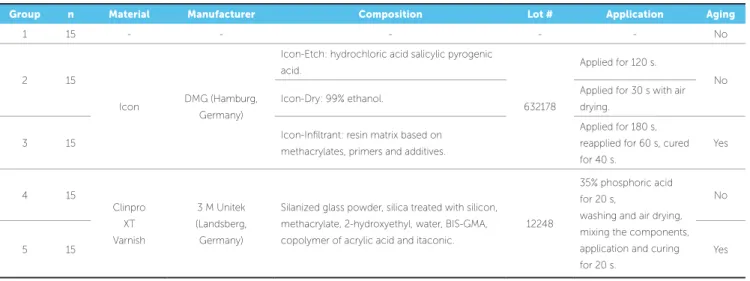
Unitek, Landsberg, Germany), a glass ionomer ce-ment (Fig 2B). Pretreatce-ment and application of prod-ucts were performed according to the respective manufacturers’ instructions (Table 1).
Ater white spot lesion treatment, Groups 3 and 5 were submitted to artiicial aging. The aging process was achieved by exposure to an ultraviolet irradiation lamp and a tungsten ilament mercury vapor atmo-sphere27 with a wavelength of 365 nm, at 45 °C and
relative humidity of 65% in a particular machine (Dark-room, Model SL-204, Solab, Piracicaba, Brazil)28 for 24
hours, which is equivalent to ive years of natural aging.
In sequence, brackets were bonded. Before the bond-ing procedures, the enamel was polished with a rubber cup and luoride-free pumice, sprayed with water and then dried with oil-free compressed air stream. Stain-less steel brackets for maxillary central incisors (Edge-wise standard, slot 0.022 x 0.028-in, 12.25 mm2 of area,
Morelli, Sorocaba, Brazil) were used. The teeth were etched (35% phosphoric acid gel, 30 seconds), washed with water, and dried by air blowing. Transbond XT system (3M Unitek, Landsberg, Germany) was ap-plied following the manufacturer’s instructions. A pa-per mask was manufactured to standardize the bracket
Group n Material Manufacturer Composition Lot # Application Aging
1 15 - - - No
2 15
Icon DMG (Hamburg, Germany)
Icon-Etch: hydrochloric acid salicylic pyrogenic acid.
632178
Applied for 120 s.
No Icon-Dry: 99% ethanol. Applied for 30 s with air
drying.
3 15 Icon-Iniltrant: resin matrix based on methacrylates, primers and additives.
Applied for 180 s, reapplied for 60 s, cured for 40 s.
Yes
4 15
Clinpro XT Varnish
3 M Unitek (Landsberg,
Germany)
Silanized glass powder, silica treated with silicon, methacrylate, 2-hydroxyethyl, water, BIS-GMA, copolymer of acrylic acid and itaconic.
12248
35% phosphoric acid for 20 s,
washing and air drying, mixing the components, application and curing for 20 s.
No
5 15 Yes
Table 1 - Groups, material and application protocols used in the present experiment.
bonding area: a square with 16 mm2. The brackets were
placed in position with their bases parallel to the loor, pressed irmly against the enamel surface, and excess adhesive was removed with a probe. The samples were light-cured for 60 seconds (15 seconds each from cervi-cal, incisal, mesial and distal directions) by means of Op-tilux appliance (Demetron Research, Danbury, USA), with a power output of 850 mW/cm2, determined by
means of a Demetron radiometer (Model 100, Dem-etron, Danbury, USA). Finally, the specimens were stored in distilled water (37 °C) for 24 hours.
The specimens were placed in a custom-made stabi-lizing stand to ensure consistency of the point of force application and direction of the debonding force. Subse-quently, they were subjected to a shear load test in a uni-versal testing machine (DL10.000, EMIC, São José dos Pinhais, Brazil). A knife-edged shearing rod was used for the test at a crosshead speed of 0.5 mm/min, and a 50 kgf load cell was used for the shear bond strength test.30 Force was applied parallel to the buccal surface at
the bracket base-enamel interface, and the shear load at the point of failure was recorded in MPa.
Statistical analysis was performed with SPSS 20.0 sotware (SPSS Inc, Chicago, Ill). Intergroup compari-sons were made by one-way analysis of variance (ANO-VA) and post hoc Tukey. The level of statistical signii-cance was set at 0.05.
RESULTS
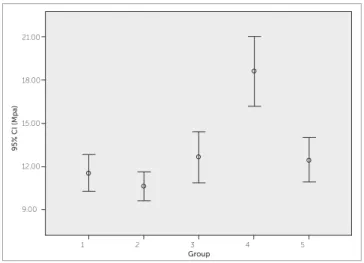
The results of the shear bond strength tests of brackets bonded to the treated surfaces showed that for specimens in Group 2, treated with Icon, the val-ues were similar to those of the control group. In con-trast, specimens in Group 4, treated with Clinpro XT Varnish, showed higher SBS values than those of the control group (p < 0.05). The aging process performed in Groups 3 and 5 did not adversely afect the SBS of brackets. Descriptive statistics are presented in Table 2.
DISCUSSION
In this study, an endeavor was made to simulate the clinical conditions of bonding or rebonding brackets to areas with white spot lesions treated with Clinpro XT Varnish and Icon Iniltrant. An aging process was also performed, so as to simulate material remaining in the mouth for ive years and evaluate the bonding proce-dure to enamel treated for white spots in the past.
Clinpro XT Varnish is a glass ionomer cement that releases luorine calcium and phosphate, and is widely indicated for treating dentinal hypersensitivity. It is an ionomer sealant that can also be used for
prevent-ing31,32,33 and treating33 white spot lesions, and is useful
for application around orthodontic appliances,31,32 as
suggested by the manufacturer. However, this product may not solve the esthetic problem of white spot le-sions on the labial surface of teeth. Icon is a very low viscosity resin, with refractive optical properties simi-lar to those of healthy enamel, speciically indicated for cosmetic improvement and interruption of incipi-ent caries. It is known that color stability of the Icon resin lasts for up to 12 months,34 and its efectiveness
in arresting the progression of noncavitated caries may continue for over three years ater application.35 Belli et
al24 applied abrasion tests on Icon iniltrated areas and
did not note any diferences in vertical wear loss when compared with original enamel.
Group Mean (SD)
1 11.54 (2.31) a
2 10.61(1.82) a
3 12.65 (3.20) a
4 18.60 (4.37) b
5 12.46 (2.79) a
Table 2 - Mean (standard deviation) of shear bond strength (MPa) and ANO-VA/Tukey results.
Figure 3 - Box plot for results of shear bond strength. Different letters indicate statistical significance (p < 0.05).
21.00
18.00
12.00 15.00
9.00
1 2 3 4
Group
95% CI (Mpa)
The results of the shear bond strength tests of brackets bonded to the treated surfaces showed that for specimens in Group 2, treated with Icon, the val-ues were similar to those of the control group. These results are compatible with those obtained by Wie-gand et al21 and Attin et al.20 In contrast, specimens in
Group 4, treated with Clinpro XT Varnish, showed higher SBS values than those of the control group (p < 0.05). Attin et al20 tested another luoride product
(Clinpro White Varnish, 3M Espe, Landsberg, Ger-many) and found lower values than those found in this study. The diference in the results is probably due to methodological diferences. In this study, the tooth surface was cleaned with rubber and prophylactic paste ater the application of luoride varnish and before acid etching. Attin et al20 did not perform this step.
Ac-cording to the manufacturer of the product, it can be removed by professional cleaning using pumice. Thus, it is possible that the varnish has been removed wholly or partially from the enamel surface prior to bonding; thus, exposing the previously demineralized surface. Consequently, bond strength increased. It was decided to carry out prophylaxis prior to bonding following the methodology described by a previous study,36 and
be-cause dentists perform this procedure routinely at the clinical practice before bracket bonding. Kimura et al36
studied the efect of luoride varnish treatment in the bond strength of brackets bonded to enamel using conventional and self-etching adhesives. They found no diference among groups. However, the enamel was not demineralized before luoride varnish treatment, difering from the present study.
The accelerated artiicial aging procedure was ap-plied to Groups 3 and 5 to simulate the clinical condi-tion in which patients had undergone white spot lesion treatment in the past; and later the orthodontist decided to bond a bracket to the iniltrated area. Accelerated aging can change the mechanical properties of resin material and reduce hardness by hydrolysis of the resin matrix. The storage solution usually used is distilled wa-ter or artiicial saliva, which can iniltrate and reduce
frictional forces between the polymer chains, a process known as plasticizing.37 However, Groups 3 and 5
pre-sented SBS values close to those of the control group. This indicated that the process of aging iniltrated areas did not adversely afect the SBS of brackets.
The infiltrated surfaces were etched with 35% phosphoric acid before the application of primer and Transbond XT, according to the recommended bonding protocol. One should take into consider-ation that phosphoric acid has an erosive potential on infiltrants. Thus, etching is able to partially remove the layer of the infiltrated area. However, Hammad et al38 showed that the erosion of the infiltrated area
exposed to Coke, which contains phosphoric acid, was lower than the erosion caused by natural enam-el exposed to the same substance. Neverthenam-eless, the erosion of the infiltrated surface did not appear to be capable of changing the SBS of brackets, because conventional adhesives, such as Transbond XT, are able to penetrate into carious lesions to some extent. Primer monomer formulations with increased TEG-DMA (triethylene glycol dimethacrylate) and HEMA (2-hydroxyethyl methacrylate) content have a high penetration capability,39 which most likely allows
a chemical connection of the resin infiltrant to the primer.38 Thus, it is assumed that the primer may also
partially penetrate into the demineralized enamel and strengthen the outermost part of the Icon-infiltrated enamel when it is applied after preconditioning.23
The results of this study indicate that white spot le-sion treatment with the tested dental material did not afect bracket bonding. The results should be extrapo-lated to clinical practice with caution, as this is a labora-tory study. Further clinical researches are suggested to conirm the indings.
CONCLUSIONS
1. Moreira TC, Sampaio RKL. Efeitos do tratamento ortodôntico sobre o esmalte: desmineralização e pigmentação. Rev Dental Press Ortod Ortop Facial. 2001 Mar-Abr;6(2):41-8.
2. Freitas AO, Marquezan M, Nojima MC, Alviano DS, Maia LC. The inluence of orthodontic ixed appliances on the oral microbiota: a systematic review. Dental Press J Orthod. 2014 Mar-Apr;19(2):46-55.
3. Souza-e-Silva CM, Parisotto TM, Steiner-Oliveira C, Kamiya RU, Rodrigues LK, Nobre-dos-Santos M. Carbon dioxide laser and bonding materials reduce enamel demineralization around orthodontic brackets. Lasers Med Sci. 2013 Jan;28(1):111-8.
4. Benson PE, Shah AA, Millett DT, Dyer F, Parkin N, Vine RS Fluorides, orthodontics and demineralization: a systematic review. J Orthod. 2005 Jun;32(2):102-14. 5. Boersma JG, van der Veen MH, Lagerweij MD, Bokhout B, Prahl-Andersen B.
Caries prevalence measured with QLF after treatment with ixed orthodontic appliances: inluencing factors. Caries Res. 2005 Jan-Feb;39(1):41-7. 6. Ahn SJ, Lim BS, Lee YK, Nahm DS. Quantitative determination of adhesion
patterns of cariogenic streptococci to various orthodontic adhesives. Angle Orthod. 2006 Sept;76(5):869-75.
7. Kerbusch AE, Kuijpers-Jagtman AM, Mulder J, van der Sanden WJ. Prevention of white spots during orthodontic treatment with ixed appliances. Ned Tijdschr Tandheelkd. 2010 May;117(5):283-7.
8. Shungin D, Olsson AI, Persson M. Orthodontic treatment-related white spot lesions: a 14-year prospective quantitative follow-up, including bonding material assessment. Am J Orthod Dentofacial Orthop. 2010 Aug;138(2):136.e1-8; discussion 136-7.
9. Tufekci E, Dixon JS, Gunsolley JC, Lindauer SJ. Prevalence of white spot lesions during orthodontic treatment with ixed appliances. Angle Orthod. 2011;81(2):206-10.
10. Lucchese A, Gherlone E. Prevalence of white-spot lesions before and during orthodontic treatment with ixed appliances. Eur J Orthod. 2013;35(5):664-8. 11. Julien KC, Buschang PH, Campbell PM. Prevalence of white spot lesion
formation during orthodontic treatment. Angle Orthod. 2013;83(4):641-7. 12. Ten Cate JM, Buijs MJ, Miller CC, Exterkate RAM. Elevated luoride products
enhance remineralization of advanced enamel lesions. J Dent Res. 2008;87(10):943-47.
13. Cochrane NJ, Cai F, Huq NL, Burrow MF, Reynolds EC. New approaches to enhanced remineralization of tooth enamel. J Dent Res. 2010;89(11):1187-97. 14. Poosti M, Ahrari F, Moosavi H, Najjaran H. The efect of fractional CO2 laser
irradiation on remineralization of enamel white spot lesions. Lasers Med Sci. 2014;29(4):1349-55.
15. Paris S, Meyer-Lueckel H, Cölfen H, Kielbassa AM. Resin iniltration of artiicial enamel caries lesions with experimental light curing resins. Dent Mater J. 2007 July;26(4):582-8.
16. Meyer-Lueckel H, Paris S. Improved resin iniltration of natural caries lesions. J Dent Res. 2008 Dec;87(12):1112-6.
17. Mueller J, Meyer-Lueckel H, Paris S, Hopfenmuller W, Kielbassa AM. Inhibition of lesion progression by the penetration of resins in vitro: inluence of the application procedure. Oper Dent. 2006 May-Jun;31(3):338-45.
18. Ogodescu A, Ogodescu E, Talpoş S, Zetu I. Resin iniltration of white spot lesions during the ixed orthodontic appliance therapy. Rev Med Chir Soc Med Nat Iasi. 2011 Oct-Dec;115(4):1251-7.
19. Jimenez EEO, Hilgenberg SP, Rastelli MC, Rsatelli MC, Pilatti GL, Orellana B, et al. Rebonding of unused brackets with diferent orthodontic adhesives. Dental Press J Orthod. 2012 Mar-Apr;17(2):69-76.
20. Attin R, Stawarczyk B, Keçik D, Knösel M, Wiechmann D, Attin T. Shear bond strength of brackets to demineralize enamel after diferent pretreatment methods. Angle Orthod. 2012 Jan;82(1):56-61.
REFERENCES
21. Wiegand A, Stawarczyk B, Kolakovic M, Hämmerle CH, Attin T, Schmidlin PR. Adhesive performance of a caries iniltrant on sound and demineralised enamel. J Dent. 2011 Feb;39(2):117-21.
22. Ekizer A, Zorba YO, Uysal T, Ayrikcila S. Efects of demineralizaton-inhibition procedures on the bond strength of brackets bonded to demineralized enamel surface. Korean J Orthod. 2012 Feb;42(1):17-22.
23. Naidu E, Stawarczyk B, Tawakoli PN, Attin R, Attin T, Wiegand A. Shear bond strength of orthodontic resins after caries iniltrant preconditioning. Angle Orthod. 2013 Mar;83(2):306-12.
24. Belli R, Rahiotis C, Schubert EW, Baratieri LN, Petschelt A, Lohbauer U. Wear and morphology of iniltrated white spot lesions. J Dent. 2011 May;39(5):376-85. 25. Queiroz CS, Hara AT, Paes Leme AF, Cury JA. pH-cycling models to evaluate the
efect of low luoride dentifrice on enamel de- and remineralization. Braz Dent J. 2008;19(1):21-7.
26. Maia LH, Filho HL, Araújo MV, Ruellas AC, Araújo MT. Incorporation of metal and color alteration of enamel in the presence of orthodontic appliances. Angle Orthod. 2012 Sept;82(5):889-93.
27. Doray PG, Wang X, Powers JM, Burgess JO. Accelerated aging afects color stability of provisional restorative materials. J Prosthodont. 1997 Sept;6(3):183-8. 28. Moreira AD, Mattos CT, de Araújo MV, Ruellas AC, Sant’anna EF. Chromatic
analysis of teeth exposed to diferent mouthrinses. J Dent. 2013 Nov;41 Suppl 5:e24-7.
29. Göhring TN, Zehnder M, Sener B, Schmidlin PR. In vitro microleakage of adhesive-sealed dentin with lactic acid and saliva exposure: a radio-isotope analysis. J Dent. 2004 Mar;32(3):235-40.
30. Pithon MM, Oliveira MV, Ruellas AC, Bolognese AM, Romano FL. Shear bond strength of orthodontic brackets to enamel under diferent surface treatment conditions. J Appl Oral Sci. 2007 Apr;15(2):127-30.
31. Yap J, Walsh LJ, Naser-Ud Din S, Ngo H, Manton DJ. Evaluation of a novel approach in the prevention of white spot lesions around orthodontic brackets. Aust Dent J. 2014 Mar;59(1):70-80.
32. O’Reilly MT, De Jesús Viñas J, Hatch JP. Efectiveness of a sealant compared with no sealant in preventing enamel demineralization in patients with ixed orthodontic appliances: a prospective clinical trial. Am J Orthod Dentofacial Orthop. 2013 Jun;143(6):837-44.
33. Kantovitz KR, Pascon FM, Nociti FH Jr, Tabchoury CP, Puppin-Rontani RM. Inhibition of enamel mineral loss by issure sealant: an in situ study. J Dent. 2013 Jan;41(1):42-50.
34. Feng CH, Chu XY. Eicacy of one year treatment of icon iniltration resin on post-orthodontic white spots. Beijing Da Xue Xue Bao. 2013 Feb 18;45(1):40-3. 35. Meyer-Lueckel H, Bitter K, Paris S. Randomized controlled clinical trial on
proximal caries iniltration: three-year follow-up. Caries Res. 2012;46(6):544-8. 36. Kimura T, Dunn WJ, Taloumis LJ. Efect of luoride varnish on the in vitro bond
strength of orthodontic brackets using a self-etching primer system. Am J Orthod Dentofacial Orthop. 2004 Mar;125(3):351-6.
37. Ferracane JL, Berge HX, Condon JR. In vitro aging of dental composites in water--efect of degree of conversion, iller volume, and iller/matrix coupling. J Biomed Mater Res. 1998 Dec 5;42(3):465-72.
38. Hammad SM, Enan ET. In vivo efects of two acidic soft drinks on shear bond strength of metal orthodontic brackets with and without resin iniltration treatment. Angle Orthod. 2013 July;83(4):648-52.