CLINICAL SCIENCE
Associations of exposure to noise with physiological
and psychological outcomes among post-cardiac
surgery patients in ICUs
Suh-Meei Hsu,IWen-Je Ko,IIWen-Chun Liao,III Sheng-Jean Huang,II Robert J. Chen,IVChung-Yi Li,V
Shiow-Li HwangVI
IDepartment of Nursing, Mackay Memorial Hospital, Taipei, Taiwan.IIDepartment of Surgery, National Taiwan University Hospital, Taipei, Taiwan.
IIISchool of Nursing, Chun Shan Medical University, Taichung, Taiwan.IVCheng-Hsin Hospital, Heart Center, Taipei, Taiwan.VDepartment of Public
Health, National Cheng Kung University, Tainan, Taiwan.VISchool of Nursing, National Taipei University of Nursing and Health Sciences, Taipei, Taiwan.
OBJECTIVES: This study sought to study the associations of noise with heart rate, blood pressure, and perceived psychological and physiological responses among post-cardiac surgery patients in ICUs.
METHODS: Forty patients participated in this study after recovering from anesthesia. A sound-level meter was placed at bedsides to measure noise level for 42 hours, and patients’ heart rate and blood pressure were recorded every 5 minutes. Patients were also interviewed for their perceived psychological/physiological responses.
RESULTS:The average noise level was between 59.0 and 60.8 dB(A) at the study site. Annoyance and insomnia were the respective psychological and physiological responses reported most often among the patients. Although noise level, irrespective of measures, was not observed to be significantly associated with the self-assessed psychological and physiological responses, it was significantly associated with both heart rate and blood pressure.
CONCLUSIONS: Our study demonstrated that the noise in ICUs may adversely affect the heart rate and blood pressure of patients, which warrants the attention of hospital administrators and health care workers.
KEYWORDS: Noise; ICUs; Cardiac surgery; Psychological response; Physiological response.
Hsu SM, Ko WJ, Liao WC, Huang SJ, Li CY, Hwang SL. Associations of exposure to noise with physiological and psychological outcomes among post-cardiac surgery patients in ICUs. Clinics. 2010;65(10):985-989.
Received for publication onMay 12, 2010;First review completed onJune 13, 2010;Accepted for publication onJuly 15, 2010 E-mail: [email protected]
Tel.: 886-2-28227101 ext. 2000, 2003
INTRODUCTION
Hospitals are, supposedly, a place that provides patients with a safe and quiet environment for treatment and recovery. However, hearing contamination in intensive care units (ICUs) as a result of the continually growing use of medical instruments and equipment was found to have an impact on patients’ sleep and recovery.1,2 Studies of ICU noise have shown that the mean 24-hour noise level in ICU ranged from 55-65 dB(A), with a maximum level of 80-90 dB(A),3,4apparently exceeding the noise tolerance level for hospitalized patients. The acceptable sound levels suggested by the U.S. Environmental Protection Agency (EPA)5are around 40-45 dB(A) for daytime and 35 dB(A) for nighttime.
Noise refers to a powerful, unorganized, irregular, or unwanted sound. It is an unpleasant and hazardous sound
that may affect work performance and cause physiological and psychological stress.6 It has a tremendous impact on
physiological responses, including tachycardia, hyperten-sion, dyspnea, anorexia, insomnia, thyroxin, and adrenaline increases; delayed wound healing; increased complications; and prolonged hospitalization.7,8Noise may also pose psy-chological stress and symptoms such as annoyance, impatience, rage, discontent, excitement, frustration, and uneasiness.7-9 Such unfavorable physiological and psycho-logical effects are expected to disturb the recovery of ICU patients.
Cardiovascular disease is the leading cause of mortality in most developed countries. Cardiac surgery has become a standard treatment for some patients with heart disease. The ICU is a place that, supposedly, provides post-operative care for patients receiving cardiac surgery. To closely monitor patients’ conditions, various instruments and monitoring devices are attached to the patients. Unfortunately, the noise generated by these instruments and devices becomes a potential stressor to patients and might, therefore, result in adverse influences on patients’ recovery.10,11 Additionally, limited information is available concerning the noise level in ICUs and its impact on patients’ heartbeats and blood Copyrightß2010CLINICS– This is an Open Access article distributed under
pressure.12,13This study sought to measure the noise level in ICUs and to investigate the influences of noise on post-cardiac surgery patients’ heart rate, blood pressure, and perceived physiological and psychological responses.
METHODS
Subjects
The subjects purposively sampled in this study were patients treated at cardiac surgical units of a tertiary medical center in Northern Taiwan. Participants were required to be aged 18-75 years with clear consciousness, have experienced first-time cardiac surgery in the absence of surgical complications, be able to communicate verbally without visual or auditory defects, and have their pain well controlled. The exclusion criteria included use of mechan-ical circulatory support (e.g. intraaotic balloon pumping or extracorporeal membrane oxygenation), use of respirator of FiO2§ 50%, having inotrope equivalent§10, arrhythmia
requiring anti-arrhythmia drugs, psychiatric illness or cognitive impairment, hemorrhage (chest tube drainage §
100 ml/hr), liver dysfunction (AST §100 U/L or ALT §
100 U/L, or total bilirubin.3 mg/dL), kidney dysfunction (BUN.50 mg/dL, creatinine§3 mg/dL, or dialysis), and
use of tranquilizers.
Instruments
A sound-level meter (SLM) (NL-22 Type II, RION, Tokyo, Japan) was used to measure noise level in dB(A). The measuring range of the SLM is 20-130 dB(A), with a precision of¡1.0 dB(A).
In consideration of the ill-health and frailty of cardiac patients who were recovering from surgery, most of the existing questionnaires designed to assess psychological and physiological responses are considered too complex and time-consuming to be administered to these vulnerable patients. Thus, the authors developed the Impact of Noise Perception (INP) questionnaire, which is simple and straightforward, to assess psychological and physiological responses to ICU noise in cardiac surgical patients. The INP comprises 7 items for the assessment of psychological responses (annoyance, startle, anxiety, anger, nervousness, fear, and depression) and 9 items to assess physiological responses (insomnia, tachycardia, easy fatigue, breath dis-tress, dizziness, headache, muscle sdis-tress, anorexia, and hearing loss). The study patients were asked to indicate the perceived impact associated with each of the above psycho-logical and physiopsycho-logical items with anchors of 1 (not affected at all) to 5 (severely affected). Prior to its implementation in the study, the INP was assessed for its validity, and some revisions were made accordingly to improve the validity and reliability of the INP. Six experts with expertise in nursing and surgery were invited to verify the necessity and accuracy of each item. The internal consistency reliability coefficient (Cronbach’sa) of the INP based on the data of this study was estimated at .84 and .85 for the psychological and physiolo-gical responses, respectively.
The vital parameters, including heart rate (HR), systolic arterial blood pressure (SABP), diastolic blood pressure (DABP), and mean arterial blood pressure (MABP), were measured and recorded using a physiologic monitor (Hewlett-Packard M1166A, Model 66S, USA). Physiologic monitors are tested and calibrated annually by bioengineer-ing departments.
Procedures
After being comprehensively informed, all study partici-pants gave informed consent on the day prior to surgery. Audiometer screening was assessed on the same day to exclude those who had a hearing impairment.
The study participants were prescribed morphine HCL (10 mg/ml) PRN Q4H/IV 1A soon after surgery. Additional prescriptions were administered thereafter every 4 hours if necessary. Two hours after completion of surgery, all study participants had recovered from anesthesia and regained full consciousness. The collection of noise level experienced by each patient and measurements of patients’ vital parameters started around 17:00-20:00 after making sure that subjects were free of complications. The SLM was placed at the bedside some 30 cm away from patients’ heads to measure the noise level every second continuously for 42 hours. The noise at the study sites was, generally, caused by devices (such as ventilators, infusion pumps, and monitors) that are used during the delivery of care, often to support or optimize the patient’s physiological status. Additionally, medical bleeps, telephones ringing, and alarms triggering clinical devices can also be a source of noise in the study ICUs, and the frequency of ICUs was, essentially, constant during the patients’ stay in ICUs. Patients’ HR and BP were measured every 5 minutes during the same time period within which the noise was measured. Two investigators (SMH and SLH) operated and monitored the collection of noise level and patients’ vital parameters.
Patients’ psychological and physiological responses were also assessed on the day of discharge from the study ICU. Face-to-face interviews were conducted to obtain informa-tion on psychological and physiological responses, and all interviews were carried out by the principal investigator (SMH) to avoid biased information. The study protocol was reviewed and approved by the Institutional Review Board of the collaborative hospital.
Statistical analysis
Data were analyzed using SPSS for Windows 12.0. Descriptive statistics were used to characterize the patients’ demographic characteristics, exposure to noise level, and psychological/physiological responses. Spearman’s rank order correlation was used to assess the relationships between noise level and psychological and physiological responses. Over the 42-hr period, the mean (Leq) noise level was calculated as the average of the hourly mean noise levels, while the maximum (Lmax) and minimum (Lmin) are the average of the hourly maximum and minimum noise level, respectively.
Noise level was, further, calculated separately for seven 6-hr time periods following patients’ recovery. The Leq, Lmax, and Lmin of noise levels were calculated for each time period. Cross-sectional time-series regression14 was used to examine the relationships between vital parameters and noise levels. Since nine cases were discharged from the study ICU less than 42 hours after noise measurement began, they were excluded from this regression analysis.
RESULTS
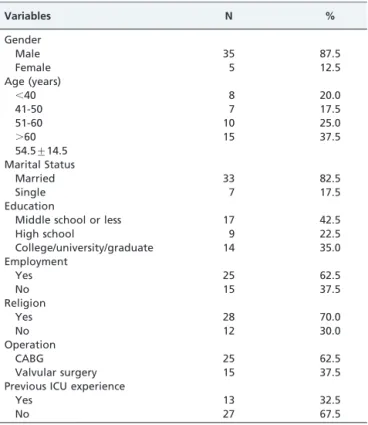
study subjects were married, employed, and without prior ICU experience. One-third of the subjects underwent coronary artery bypass graft surgery, and the others had valvular surgeries (Table 1).
Data on noise level were divided into seven 6-hr time periods (Figure 1). The average hourly noise level (Leq) calculated for each time period ranged from 59.0 to 60.8 dB(A); the average hourly maximum (Lmax) and minimum (Lmin) noise level was in the range of 77.3-81.3 dB(A) and 53.4-55.3 dB(A), respectively.
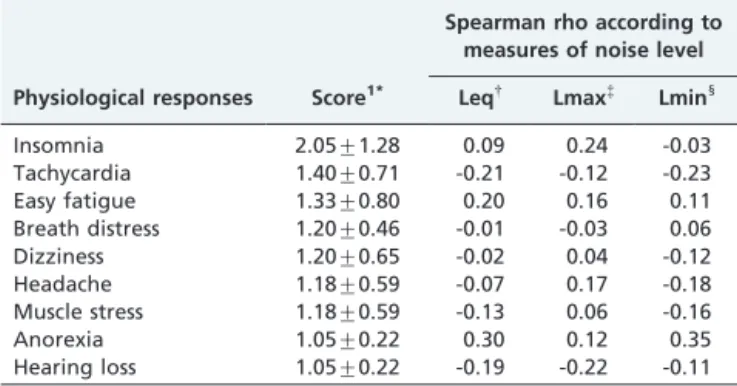
Patients in ICUs perceived minor psychological responses to noise. The top 3 psychological responses were annoyance, startle, and anxiety. However, the measured noise level was not significantly associated with any of the psychological responses (Table 2). The top 3 physiological responses to noise were insomnia, tachycardia, and easy fatigue. Again, the noise level determined in ICUs was not significantly associated with any of the physiological responses of interest (Table 3).
The results of the time-series regression on noise levels and heart rate and blood pressure showed that an increase in noise level was positively and significantly associated with heart rate (HR), systolic arterial blood pressure (SABP), diastolic blood pressure (DABP), and mean arterial blood pressure (MABP) (Table 4). A one dB(A) increase in noise level in the ICU was associated with an increase of HR, SABP, DABP, and MABP by 0.07 beats/min, 0.58 mmHg, 0.15 mmHg, and 0.53 mmHg on average, respectively (Table 4). The standardized beta tended to indicate that noise may have greater influences on SABP (b= 0.26) and MABP (b= 0.24) than on the other vital parameters.
DISCUSSION
A quiet environment is essential for patients to recover from illness. Therefore, noise level control is crucial in hospitals, especially in ICUs. Cardiac surgical patients usually encounter tremendous physical and psychological threats from surgery. To maintain and monitor their vitals, they are attached to many different instruments and devices, such as a respirator, electrocardiograph, blood pressure meter, central venous pressure meter, pulmonary
artery catheter, and so on. Noise generated by these instruments and devices becomes a potential stressor and brings negative effects to patients. This study found that the mean sound level in the study ICU was in the range of 59.0-60.8 dB(A). Although this sound level was similar to3,15-17or even lower18,19than the findings reported by some previous studies, it is much higher than the regulatory sound level [40-45 dB(A) and 35 dB(A) during daytime and nighttime, respectively].5 Additionally, the sound level was fairly consistent in different time periods over the study period, indicating that cardiac patients tended to be constantly exposed to a noisy environment. Because medical technol-ogy advances with time, there has been an increasing amount of equipment and instruments used in ICUs, so
Figure 1 - Noise level in study ICUs on and after the day of operation.
Leq: Average of hourly mean noise levels. Lmax: Average of hourly maximum noise levels. Lmin: Average of hourly minimum noise levels. OP: Operation.
POD: Post-operative day
Table 1 -Characteristics of the study participants (n = 40).
Variables N %
Gender
Male 35 87.5
Female 5 12.5
Age (years)
,40 8 20.0
41-50 7 17.5
51-60 10 25.0
.60 15 37.5
54.5¡14.5 Marital Status
Married 33 82.5
Single 7 17.5
Education
Middle school or less 17 42.5
High school 9 22.5
College/university/graduate 14 35.0
Employment
Yes 25 62.5
No 15 37.5
Religion
Yes 28 70.0
No 12 30.0
Operation
CABG 25 62.5
Valvular surgery 15 37.5
Previous ICU experience
Yes 13 32.5
No 27 67.5
CABG: Coronary artery bypass grafting, ICU: intensive care unit
Table 2 -Scores of psychological responses and their correlations with noise level, indicated by Spearman rho coefficients (n = 40).
Spearman rho according to measures of noise level Psychological responses Score* Leq{
Lmax{
Lmin1
Annoyance 1.83¡1.22 0.20 0.27 0.08
Startle 1.63¡1.03 0.01 0.20 -0.05
Anxiety 1.58¡1.11 0.06 0.21 0.01
Anger 1.55¡1.08 0.22 0.20 0.23
Nervousness 1.50¡0.96 0.01 0.17 -0.01
Fear 1.45¡0.81 0.08 0.15 0.03
Depression 1.30¡0.85 0.09 0.25 -0.01
*Impact score (1-5), 1: not affected at all; 5: severely affected
{Leq: Average of hourly mean noise levels
{
Lmax: Average of hourly maximum noise levels
1
clinicians and hospital administrators should consider control strategies that can effectively reduce patients’ exposure to such a high noise level to ensure a quiet environment for cardiac patients to rest and recover, especially during the late night period.
Noise is an important factor in making people feel discomfort. Annoyance, startle, and anxiety were the top three psychological responses observed in our sample patients, which is similar to the findings of some other previous studies that found that the patients in ICUs were likely to be irritated and disturbed with impatient, distressed, anxious, or angry emotions.20-22 On the other hand, insomnia, tachycardia, and easy fatigue were the top three perceived physiological responses in our patients, which is also similar to those reported in previous studies.23,24 Despite that, the potential influence of noise on patients’ psychological and physiological responses found in our patients seemed minor (between not affected at all to mildly affected). Our study found little association between noise level and psychological and physiological responses. Perceived psychological and physiological responses to noise are often complicated and can be affected by an individual’s age, culture, social factors, and personal susceptibility. The interpretation of and feeling about noise differ with the type of sound, past experience with the same sound, and individual adaptation.25-27 Patients in Taiwan might recognize that noise is, surely, accompanied by treatment procedures; hence, it is acceptable and
unavoid-able. This could be responsible for the little association between noise level and psychological and physiological responses of the patients. Furthermore, our study was limited in noise level measurement to only 2 days, and the information concerning the potential influences of noise exposure for a longer period of time was not available in our study.
Noise may stimulate the hypothalamus-pituitary-adrenal gland system to trigger a series of stress hormones that affect tissue synthesis and metabolism in human bodies.7,28,29 Physiological effects from exposure to noise include increased peripheral vascular resistance, heart rate, and blood pressure leading to enforced ventricular con-tractility, hypertension, and subsequent cardiac hypertro-phy; hence, it increases the risk of ischemic heart disease.12,13,30,31 To our knowledge, our study is the first to monitor and examine the effects of noise on heart rate and blood pressure continuously for as much as 42 hours. A number of previous studies were conducted to examine the physiological effects of noise on patients. The findings of those studies are, however, neither consistent nor convin-cing. Garvin et al.32 investigated the cardiovascular responses of cardiac ICU patients when communicating with nurses, physicians, and families and found that noise may significantly increase maximum heart rate, while the influence of noise on minimum heart rate or BP (diastolic and systolic) was not statistically significant. Baker12 investigated the effect of noise on the heart rate of 28 surgical ICU patients. The noise in ICUs and the heart rate of patients were measured continuously for 6 hours. The results showed that the noise increased heart rate in 68% patients and decreased it in 11%. In another study, Baker13 selected 20 cardiac ICU patients to further investigate the effect of noise on heart rate and blood pressure and found that the maximum heart rate was positively and signifi-cantly associated with noise level, while no significant associations between noise and minimum heart rate or blood pressure were noted. Our study demonstrated that the vital parameters including HR, SABP, DABP, and MABP were all positively and significantly associated with an increase in ICUs noise levels. Comparisons between our study findings and those previously reported might be difficult mainly because the potential physiological influ-ence of noise might be affected by the disease and demographic characteristics of patients and by factors related to health care.
Although we did not record the load of morphine received by each of the study participants, the potential influence of sedative load on patients’ perception is unlikely to confound the relationships between noise level and vital parameters because the dosage of morphine prescribed for the study participants should be unrelated to the noise level experienced by the study participants. Additionally, because all of the study participants were at full conscious-ness and free of complications at the time of interview, failure to adjust for sedatives load would not have a notable influence on our findings.
Our study showed that annoyance and insomnia are the major psychological and physiological responses in cardiac patients in ICUs. Although noise level was not significantly associated with the perceived psychological and physiolo-gical responses of ICU patients, our study did demonstrate that the noise generated by ICU medical devices was positively and significantly associated with increased heart
Table 3 -Scores of physiological responses and their correlations with noise level, indicated by Spearman correlation coefficients (n = 40).
Spearman rho according to measures of noise level Physiological responses Score1* Leq{
Lmax{
Lmin1
Insomnia 2.05¡1.28 0.09 0.24 -0.03
Tachycardia 1.40¡0.71 -0.21 -0.12 -0.23
Easy fatigue 1.33¡0.80 0.20 0.16 0.11
Breath distress 1.20¡0.46 -0.01 -0.03 0.06
Dizziness 1.20¡0.65 -0.02 0.04 -0.12
Headache 1.18¡0.59 -0.07 0.17 -0.18
Muscle stress 1.18¡0.59 -0.13 0.06 -0.16
Anorexia 1.05¡0.22 0.30 0.12 0.35
Hearing loss 1.05¡0.22 -0.19 -0.22 -0.11
*Impact score (1-5), 1: not affected at all; 5: severely affected
{
Leq: Average of hourly mean noise levels
{
Lmax: Average of hourly maximum noise levels
1
Lmin: Average of hourly minimum noise levels
Table 4 -Time-series regression analysis of the
associations of noise level (Leq) with heart rate and blood pressure (n = 31).
Variables B SE P
HR* 0.07 0.02 .001**
SABP{
0.58 0.24 ,.001***
DABP{ 0.15 0.09
,.001*** MABP1
0.53 0.34 .046*
*HR: heart rate
{
SABP: systolic arterial blood pressure
{DABP: diastolic blood pressure
1
MABP: mean arterial blood pressure
*p
rate and blood pressure, which warrants attention from health care workers and hospital administrators, who should consider a strategy that can effectively control the noise level in ICUs.
REFERENCES
1. Hilton BA. Noise in acute patient care areas. Research in Nursing & Health. 1985;8:283-91.
2. Kahn DM, Cook TE, Carlisle CC, Nelson DL, Kramer NR, Millman RP. Identification and modification of environmental noise in an ICU setting. Chest. 1998;114:535-40, doi: 10.1378/chest.114.2.535.
3. Balogh D, Kittinger E, Benzer A, Hackl JM. Noise in the ICU. Intensive Care Medicine. 1993;19:343-46, doi: 10.1007/BF01694709.
4. Bentley S, Murphy F, Dudley H. Perceived noise in surgical wards and an intensive care area: an objective analysis. British Medical Journal. 1977;2:1503-6, doi: 10.1136/bmj.2.6101.1503.
5. Environmental Protection Agency. Information on levels of environ-mental noise requisite to protect public health and welfare with an adequate margin of safety. Washington, DC: Government Printing Office. 1974.
6. Thomas HF. Noise & Health. New York: The New York Academy of Medicine. 1991.
7. Cantrell RW. Physiological effects of noise. Otolaryngologic Clinics of North America. 1979;12:537-49.
8. Goines L, Hagler L. Noise pollution: a modem plague. Southern Medical Journal. 2007;100:287-94.
9. Morrison WE, Haas EC, Shaffner DH, Garrett ES, Fackler JC. Noise, stress, and annoyance in a pediatric intensive care unit. Critical Care Medicine. 2003;31:113-9, doi: 10.1097/00003246-200301000-00018. 10. Byers JF, Smyth KA. Effect of a music intervention on noise annoyance,
heart rate, and blood pressure in cardiac surgery patients. American Journal of Critical Care. 1997;6:183-91.
11. McLaughlin A, McLaughlin B, Elliott J, Campalani G. Noise levels in a cardiac surgical intensive care unit: a preliminary study conducted in secret. Intensive & Critical Care Nursing. 1996;12:226-30, doi: 10.1016/ S0964-3397(96)80106-6.
12. Baker CF. Discomfort to environmental noise: heart rate responses of SICU patients. Critical Care Nursing Quarterly. 1992;15:75-90. 13. Baker CF, Garvin BJ, Kennedy CW, Polivka BJ. The effect of
environ-mental sound and communication on CCU patients’ heart rate and blood pressure. Research in Nursing & Health. 1993;16:415-21.
14. Poikolainen K, Leppa¨nen K, Vuori E. Alcohol sales and fatal alcohol poisonings: a time-series analysis. Addiction. 2002;97:1037-40, doi: 10. 1046/j.1360-0443.2002.00177.x.
15. Buemi M, Allegra A, Grasso F, Mondio G. Noise pollution in an intensive care unit for nephrology and dialysis. Nephrology Dialysis Transplantation. 1995;10:2235-9.
16. Moore MM, Nguyen D, Nolan SP, Robinson SP, Ryals B, Imbrie JZ, et al. Interventions to reduce decibel levels on patient care units. The American Surgeon. 1998;64:894-9.
17. Christensen M. Noise levels in a general intensive care unit: a descriptive study. Nursing in Critical Care. 2007;12:188-97, doi: 10.1111/j.1478-5153. 2007.00229.x.
18. Tsiou C, Eftymiatos D, Theodossopoulou E, Notis P, Kiriakou K. Noise sources and levels in the Evgenidion Hospital intensive care unit. Intensive Care Medicine. 1998;24:845-7, doi: 10.1007/s001340050676. 19. Akansel N, Kaymakci S. Effects of intensive care unit noise on patients: a
study on coronary artery bypass graft surgery patients. Journal of Clinical Nursing. 2008;17:1581-90, doi: 10.1111/j.1365-2702.2007.02144.x. 20. Borsky PN. Sociopsychological factors affecting the human response to noise exposure. Otolaryngologic Clinics of North America. 1979;12:521-35. 21. Laffal JA. A concept dictionary of English. New York: John Wiley & Sons.
1973.
22. Gast PL, Baker CF. The CCU patient: anxiety and annoyance to noise. Critical Care Nursing Quarterly. 1989;12:39-54.
23. Freedman NS, Gazendam J, Levan L, Pack AI, Schwab RJ. Abnormal sleep/wake cycles and the effect of environmental noise on sleep disruption in the intensive care unit. American Journal of Respiratory and Critical Care Medicine. 2001;163:451-7.
24. Stanchina ML, Abu-Hijleh M, Chaudhry BK, Carlisle CC, Millman RP. The influence of white noise on sleep in subjects exposed to ICU noise. Sleep Medicine. 2005;6:423-8, doi: 10.1016/j.sleep.2004.12.004.
25. McLean EK, Tarnopolsky A. Noise, discomfort and mental health. A review of the socio-medical implications of disturbance by noise. Psychological Medicine. 1977;7:19-62, doi: 10.1017/S0033291700023138. 26. Broadbent DE. Noise in relation to annoyance, performance, and mental
health. The Journal of the Acoustical Society of America. 1980;68:15-7, doi: 10.1121/1.384481.
27. Stansfeld SA, Matheson MP. Noise pollution: non-auditory effects on health. British Medical Bulletin. 2003;68:243-57, doi: 10.1093/bmb/ ldg033.
28. Selye H. The stress of life. New York: McGraw-Hill Book Co. 1956. 29. Ising H, Kruppa B. Health effects caused by noise: evidence in the
literature from the past 25 years. Noise and Health. 2004;6:5-13. 30. Willich SN, Wegscheider K, Stallmann M, Keil T. Noise burden and the
risk of myocardial infarction. European Heart Journal. 2006;27:276-82, doi: 10.1093/eurheartj/ehi658.
31. Marshall LA. Patient reaction to sound in an intensive coronary care unit. Communicating Nursing Research. 1972;5:81-92.