journal homepage: www.scielo.br/ne ISSN: 1519-566X
ECOLOGY, BEHAVIOR AND BIONOMICS
The Importance of Odor in Nest Site Selec
Ɵ
on by a Lodger Bee,
Centris
bicornuta
Mocsáry (Hymenoptera: Apidae) in the Dry Forest of Costa Rica
SB V
®ÄÝÊÄ
1, GW F
ÙÄ»®
2, A R
Ê
11Dept of Entomology, Texas A&M University,College StaƟ on, TX, USA 2College of Natural Resources, Univ of California, Berkeley, CA, USA
Keywords
Nest iniƟ aƟ on, nesƟ ng site locaƟ on, provision odor
Correspondence
S BÙ½®¦« V®ÄÝÊÄ, Dept Entomology, Texas A&M University, College StaƟ on, TX 22843; [email protected]
Edited by Kleber Del Claro – UFU
Received 24 November 2009 and accepted 15 June 2010
Abstract
The more common lodger bee occurring in the dry forest of Costa Rica, Centris bicornuta Muscáry), has been observed nesting in new
nest cavities drilled into wooden blocks placed next to cavities used by another female within 2-3 days. In contrast, new nest cavities placed in similar areas with no nesting Centris nearby were not
used for weeks. These observations suggest that the presence of nesting bees may play a role in nest site selection. To con irm our observations, new nest cavities were placed in areas with or without nesting. We found nest initiation in newly placed nest cavities only in areas where bees were actively nesting. To examine the possibility that nesting locations are not unique, we placed new nest cavities in new locations either with (a) a number of completed nest cavities or (b) placed alone. Within three days we only found bees nesting in the newly placed nest cavities in situation “a”. The results suggested that odor might be involved. We next compared nesting in new cavities placed alone with cavities contaminated with either (a) nest entrance plug material, (b) nest nectar, (c) nest pollen or (d) a combination of pollen and nectar. Nesting was signi icantly low in cavities placed next to cavities with nest entrance plug material (a), and high in cavities placed next to cavities “b, c, or d”. The results suggest that pollen and /or nectar odor play a role in the location of potential nest sites.
Introducti on
Nidi ication studies on several twig nesting or lodger bees in the genus Centris have been conducted in Costa
Rica (Frankie et al 1988, 1989, Vinson et al 1993, 1996,
2006, Vinson & Frankie 2000) and in Brazil (Morato et al
1999, Pereira et al 1999, Jesus & Garófalo 2000, Morato &
Campos 2000, Aguiar et al 2006, Mendes & Rego 2007).
In Costa Rica, we (SBV & GWF) have focused on a group of wild wood-hole nesting Centris that nest in dry forest
during the dry season. These studies have provided information on the structure of nests, as well as, nesting materials needed, cavity diameters preferred and some
information on provisions (Vinson et al 2010, Frankie et al 1993) also provided information regarding the
nesting-habitat preferences of this group of Centris bees. In most
all of these studies, trap nests consisting of bundles of 12 wooden sticks with holes of several sizes drilled into them (Bee Nest Monitoring Bundles [BNMB]) were used (Frankie et al 1988, 1993, Vinson & Frankie 2000).
in within a day or two. This brought up a question: are these nesting bees attracted to the activity of other bees or is it possible that an odor might play a role? We had observed that some ground nesting Centris species tend
to aggregate (Vinson et al 1987) while others do not
(Vinson & Frankie 1977). It is also well known that bees use both visual and olfactory cues in their location and recognition of their own active nests (Wcislo 1990, 1992). However, Inouye (2000) looked at the role of visual and odor cues in nest recognition and suggested that odor did not appear to play a role. There is even less known about the possible role of vision, sound or odors in nest site discovery, particularly if the bees tend to aggregate.
In looking at the literature and a review by Morato & Martins (2006) concerning proximate factors affecting the nesting behavior of solitary wasps and bees indicated that little has been done or reported regarding the role odor in in luencing the location of nesting sites or the location of potential nesting cavities for solitary wood cavity nesting species. Torchio (1984) observed that
Osmia lignaria Cresson (Megachilidae) preferred to nest
near, but not in old nest cavities. In contrast, Megachile rotundata (F.) was found to prefer to nest in used nesting
boards rather than new ones (Fairey & Lieverse 1986, Fairey & Le kovitch 1993). The response by M. rotundata
appeared to be due to the odors of old nest contents (Stephen & Torchio 1961). Pitts-Singer (2007) reported that female O. lignaria were attracted in a “Y–tube” only
to female cocoons. In contrast, M. rotundata was attracted
to intact nest cells, fecal material on the outside of cocoons, leaf pieces used to line cells and extracts of the leaf pieces while Megachile pugnata Say were attracted
to paper straw nesting material with cocoons and feces (Pitts-Singer 2007).
We setup a study to see if odor or bee activity (sight or sound) might play a role in stimulating one of the more common wood-hole nesting species, C. bicornuta,
in the dry forest to initiate a nest in an unused trap nest stick that was or was not placed next to a nested-in trap nest stick.
Material and Methods
The study reported here was conducted during the month of February 2009 in riparian areas of the dry forest, along small rivers in Guanacaste Province of Costa Rica about 8.5 km northwest of the Town of Bagaces. This area is known as Hacienda Montverde. Within this area, we had four locations (sites) that we have used for several years and in which several species of lodger bees were nesting. Within the above dry forest, we picked 12 new potential nesting sites for the study that were located approximately 0.1 to 0.3 km apart.
We initially used BNMB that consist of 11.5 x 2.03 x 2
cm wooden sticks drilled lengthwise to a depth between 7.0 cm to 11 cm depending on the following ive cavity (hole) diameters: 4.5, 6.5, 8, 9.5 and 11 mm. As cavity diameters increased so did the cavity depth. To form the BNMB, two sticks of each cavity diameter (except we used four of the 8 mm cavity diameter sticks) were bundled together using masking tape and twine. The sticks were bundled into two stacks with the largest cavity diameters at the bottom and smallest at the top. As the stack was formed, the pair of sticks of the same cavity size was stacked next to each other so that the cavity of one was next to the back or non-cavity end of the companion stick (see Frankie et al 1993 for details).
To determine if female C. bicornuta prefer to nest in
wooden cavities near other nesting Centris lodger bees,
we initially took unused BNMB and placed them in two situations. For the irst situation, we placed four unused BNMB at each of three sites (total of 12 BNMB’s were placed) that we had used for several years and where we already had some BNMB’s in place and in which bees were actively nesting. We also placed four unused BNMB’s in three other sites (total of 12 BNMB’s) not previously used that were at least a 100 m from one of our active sites, but were in the same forest.
The BNMB’s from both situations were collected four days later to con irm what we had noted before; that the cavities in the newly placed BNMB were nested in when placed with actively nesting BNMBs, but these cavities were not nested in when placed away from such nesting activity (see results for details). The completed BNMB’s were returned to the laboratory where the sticks with completed nests of C. bicornuta, as evidenced by a nest
plug coated with a distinctive thick yellowish oil-like material, were removed. Since C. bicornuta prefers to nest
in the 8 mm and 9.5 mm cavities (personal observations) we focused on these cavity sizes and recorded the number with bee nests and without for each site and situation. For our second study to con irm the importance of the presence of a completed nest next to an available nest cavity, we placed available cavities next to or separate from a completed nest in a cavity. For this we used cavity diameters of 8 mm and 9.5 mm that were completed from the above study. These were re-bundled for test two into a number of stacks each consisting of ive sticks, one on top of the other and alternating the completed nest entrances. We also formed a number of stacks of ive sticks as described, but of unused sticks only. These bundled stacks of unused ive nest sticks, as well as, bundled stacks containing ive sticks with nests were placed in ten sites at two different unused locations (a total of 20 sites).
second situation (situation B) one unused stick bundle was hung on another tree, as described earlier, but by its self. Each situation had 50 nest cavities. The two situations were at least 15 m to 25 m away within each of the locations. Three days later the unused stick bundles were monitored for bee nesting activity in both situations and compared using an independent two-sample t-test (Table 1).
Based on the results of the above test, we setup a study to determine if the nest plug’s oily material (Fig 1) or some other components (provisions) of a completed nest might attract potential nesting females. We irst collected the nest plug material with the aid of a small spatula and placed the contents into a small wide mouth vial that was capped between collections. The nest sticks were split length-wise and the nectar (See Vinson et al
2006) was collected with the aid of a 50 μl capillary tube in which the contents of the tube could be sucked in and out with the aid of a small rubber bulb attached. This material was also placed into a wide mouth vial that was capped between collections. The interface between the nectar and the nectar moist pollen was collected with another small spatula and placed into another small wide mouth vial capped between collections. The cream colored pollen at the back of the cell was packed hard and appeared dry. This pollen was extracted from the cell wall with tweezers, cleaned of any nectar or cell wall material. This pollen was removed as chunks that were placed in a watch glass and were broken apart with the aid of a nail head. The crushed pollen mass was then scraped into a wide-mouth vial and capped between collections.
Each of these nest materials were collected repeatedly until we had about ten ml’s of each. To determine if these nest materials had any activity in attracting C. bicornuta,
we irst took two sticks with 8 mm cavities and bundled them together with the cavities facing the same direction. A small cotton plug was placed in the cavity of one of the pair of sticks about 4 mm deep. These paired sticks (one with a cotton plug and one unplugged) were taken to the ield to be placed in another ten different sites at two locations (total of 20 tests of each situation), as described above. In each site, four pairs of sticks were hung on a nail as described earlier with each pair placed on a different tree that were six to twelve meters apart. Just before hanging, the sticks with the cotton plug were charged by placing approximately 25 μl of one of the
four nest materials on the plug. These were applied to the cotton plug of the pair of sticks. The nest plug oily material was applied with a spatula while both the nectar and nectar-pollen mixtures were applied with a capillary tube as described above. The pollen was mixed with a little water to form a paste that was applied with a spatula. Each pair of sticks was marked as to the treatment they received and hung on four different trees at each site, as described above. This was repeated until we had four pairs of sticks each with a different material applied to the plug and placed at each site.
They were examined three days later for evidence on nesting by C. bicornuta in the hole next to each of the
four different treatments. The results were compared (nest plug oily material, pollen, nectar, and nectar + pollen) using a Kruskal Wallis mean rank sum test for independent samples.
Results and Discussion
For test one each BNMB had six of the 8 mm and 9 mm cavities for a total of 72 placed in each situation. Of the 72 cavity nest sticks removed from the BNMB at the site with nesting bees, 43 either had completed nests or the nests were nearing completion. These completed nest sticks were set aside so they could be used for the next set of experiments.
In contrast, of the 72 cavity nest sticks removed from the BNMB’s that we had placed in sites that to our knowledge were not being used by nesting bees only one had a cavity with a nest started, as evidenced by a cell in the back of the cavity with pollen. These results con irmed what we had observed in the past, that nest sticks placed
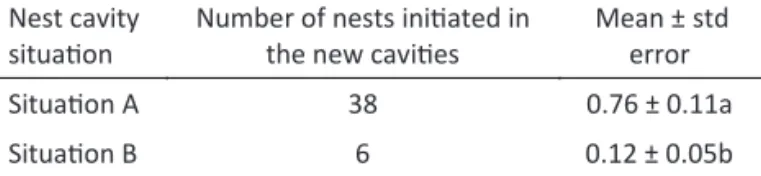
Table 1 Comparison of the use of unused nest cavity bundles when placed in a new potential nesting area next to a newly completed nest cavity bundle (situation A) or when placed alone (situation B).
Means followed by different letters are signi icantly different according to two sample t-test.
Nest cavity situaƟon
Number of nests iniƟated in the new caviƟes
Mean ± std error
SituaƟon A 38 0.76 ± 0.11a
SituaƟon B 6 0.12 ± 0.05b
Fig 1 Completed nest stick of Centris bicornuta
split to show the two cells at the back and the nest plug (PL) in the entrance. The cells consist of a cell wall (CW) with cream to yellowish pollen (PO) packed at the back overlaid with a layer on nectar (N) followed by a space (S) before the cell cap.
CW PO PL
N
near nesting bees are more likely used than nest sticks placed in a new location. But this could be due to odor or to the activity of the nesting bees that are lying around the nests (movement) and creating buzzing sounds.
In our second test where we placed unused ive stick nest bundles (unused cavities) either alone or with a completed ive stick nest bundle (cavities with bee nests), signi icantly more bee nests were initiated in the unused nest cavities that were placed next to previously completed nest cavities than nest cavities that were placed alone as shown in Table 1 (t = -5.25, df = 98, P < 0.0001). In both cases the sites had not been used in the past for any of our on-going studies. These results eliminated sound or bee activity as a factor and suggested that odor might be involved.
In the third study where we placed an unused nest cavity next to an unused nest cavity that we had added a cotton plug a 2-3 mm from the entrance and to which we either added the nest entrance oil-like material used to seal a completed nest or some of the provisions (nectar, pollen and a combination of nectar and pollen), the results are shown in Table 2. In this test the nest plug oil-like material was signi icantly less attractive resulting in less nesting in the adjourning cavity as compared to the other materials (Kruskal Wallis rank sum test, H = 15.35, df = 3, P < 0.0002). There were no signi icant differences between the pollen or nectar or a combination of the two. In fact all three appeared to be active as 93% of the available cavities associated with these three situations were being nested in. It is not clear if the same odors are involved in the pollen and nectar samples or if different odors are involved. If the latter is true, one might expect a heightened or synergistic response, but the results do not indicate any such effect.
Unlike the Xylocopidae that can make their own cavities in wood (Gerling 1989), some bees, including the species studied here, nest in wooden cavities but are unable to make their own cavities. In fact, they depend on many wood-boring insects that play an important role in providing the wooden cavities that the lodger bees
need. Further a number of the larger wood boring insects, such some Cerambycidae, tend to aggregate (Allison et al 2004, Akbulut et al 2008, see picture 2 at http:www.
birderslounge.com/2009/05/the-mystery-of-the-wood-boring-insect/). Thus, a female wood cavity nesting bee that can detect and respond to another female bee that is nesting or has just completed a nest would have a high probability of locating cavities that have not yet been used. Odor of other nesting females could thus play an important role in inding such aggregations of wooden holes generally produced by various species of wood boring insects.
The discovery that some Centris are attracted to the
odor associated with nests in progress may also have some important implications in the management of certain wood hole nesting solitary bees. Particularly in attracting certain solitary wood-cavity nesting solitary bees initially to arti icial wood hole or cavity nesting units such as those described by O’Dell (1997).
The results also suggest that the nest entrance oil-like material is less active in attracting nesting females and supports the suggestion (Vinson & Frankie 2000) that the nest plug material is important in preventing nest cavity usurpation of newly completed nests.
Acknowledgments
We wish to express our deep gratitude to D A S Stewart for allowing us to conduct our research on his ranch. We also express our appreciation to both Dr Jerome G Rozen, Jr and Rollin Coville for their help in splitting the nest sticks to make notes on the various cells and pass them on to us to collect the contents of the newly completed nest cells for our study. We thank Texas Agrilife, Texas A&M University and the California Agricultural Experimentation Station for partial support.
References
Aguiar CML, Garófalo CA, Almeida GF (2006) Nesting biology of Centris (Hemisiella) trigonoides Lepeletier (Hymenoptera,
Apidae, Centridini). Rev Bras Zool 23: 323-330.
Akbulut S, Keten A, Stamps WT (2008) Population dynamics of
Monochamus galloprovincialis Oliver (Coleoptera: Cerambycidae)
in two pine species under laboratory conditions. J Pestic Sci 81: 115-121.
Allison JD, Borden JH, Seybold JS (2004) A review of the chemical ecology of the Cerambycidae (Coleoptera). Chemoecology 14: 123-150.
Frankie GF, Newstrom L, Barthell JF, Vinson SB (1993) Nesting-habitat preferences of selected Centris bee species in Costa Rican
dry forest. Biotropica 25: 322-333.
Frankie GW, Vinson SB, Newstrom LE, Barthell JF (1988) Nest site Table 2 Source of an odor in attracting female bees to an
unused nest cavity given a choice of nesting if placed next to a nest cavity with just nest plug oil-like material, or nectar, or nectar + pollen, or pollen suggests a signi icant effect of the treatment.
Means followed by the same letters are not signi icantly different according to Kruskal Wallis Rank Sum test.
Choice
Nest plug oil-like material
Nest nectar
Nest nectar
+ pollen Nest pollen
Number of new nests iniƟated
and habitual preferences of Centris bees in Costa Rican dry forest.
Biotropica 20: 301-310.
Frankie GW, Vinson SB, Williams HJ (1989) Ecological and evolutionary sorting of 12 sympatric species of Centris bees in
Costa Rican dry forest, p.535-549. In Bock JH, Linhart YB (eds) the evolutionary ecology of plants. Bolder, Colorado, Westview Press, 600p.
Fairey DT, Lieverse JAC (1986) Cell production by the alfalfa leafcutting bee (Megachilerotundata F.) in new and used wood
and polystyrene nesting materials. J Appl Entomol 102: 148-153.
Fairey DT, Le kovitch LP (1993) Arrangement of new and used nesting materials in leafcutting bee, Megachile rotundata (F.)
(Hym. Megachilidae), shelters to maximize cell production. J Appl Entomol 115: 62-65.
Gerling G (1989) Bionomics of the large carpenter bees of the genus
Xylocopa. Annu Rev Entomol 34: 163-190.
Inouye BD (2000) Use of visual and olfactory cues for individual nest hole recognition by a solitary bee Epicharis metatarsalis
(Apidae, Anthophorinae). J Insect Behav 13: 231-238.
Jesus BMV, Garófalo CA (2000) Nesting behavior of Centris
(Heterocentris) analis (Fabricius) in southeastern Brazil
(Hymenoptera, Apidae, Centridini). Apidologie 31: 503-505. Morato EF, Campos LA (2000) Efeitos da fragmentação lorestal
sobre vespas e abelhas solitárias em uma área da Amazônia Central. Rev Bras Zool 17: 429-444.
Morato EF, Garcia MVB, Campos LA (1999) Biologia de Centris fabricius (Hymenoptera, Anthophoridae) em matas contíguas
e fragmentos na Amazônia Central. Rev Bras Zool 16: 1213-1222.
Morato EF, Martins RP (2006) An overview of proximate factors affecting the nesting behavior of solitary wasps and bees (Hymenoptera: Aculeta) in preexisting cavities in wood. Neotrop Entomol 35: 285-298.
Mendes FN, Rego MMC (2007) Nidi ication of Centris (Hemisiella) tarsata Smith (Hymenoptera: Apidae, Centridini) in trap nests in
Northeast Maranhao, Brazil. Rev Bras Entomol 51: 382-388. O’Dell C (1997) Grow your own disease-resistant pollinators.
American Fruit Growers, Feb.: 24-26.
Pereira M, Garófalo CA, Camillo E, Serrano JC (1999) Nesting biology of Centris (Hemisiella) vittata Lepeletier in southeastern Brazil
(Hymenoptera, Apidae, Centridini). Apidologie 30: 327-338. Pitts-Singer TL (2007) Olfactory response of megachilid bees, Osmia
lignaria, Megachile rotundata and M. pugnata, to individual cues
from old nest cavities. Environ Entomol 36: 402-408.
Stephen WP, Torchio PF (1961) Biological notes on the leaf-cutter bee, Megachile (Eutricharaea) rotundata (Fab.). Pan-Pac Entomol
32: 85-92.
Torchio PF (1984) Field experiments with the pollinator species,
Osmia lignaria propinqua Cresson (Hymenoptera: Megachilidae),
in apple orchards: III, 1977 studies. J Kans Entomol Soc 57: 517-521.
Vinson SB, Frankie GW (1977) Nests of Centris aethyctera
(Hymenoptera: Apoidea: Anthophoridae) in the dry forest of Cost Rica. J Kans Entomol Soc 50: 301-311.
Vinson SB, Frankie GW (2000) Nest selection, usurpation, and a function for the nest entrance plug of Centris bicornuta
(Hymenoptera: Apidae). Ann Entomol Soc Am 93: 54-260. Vinson SB, Frankie GW, Barthell J (1993) Threats to the diversity of
solitary bees in a Neotropical dry forest in Central America, p.53-81. In LaSalle J, Gauld ID (eds) Hymenoptera and biodiversity. Wallingford, C.A.B. International, 348p.
Vinson SB, Frankie GW, Cônsoli R (2010) Description, comparison and identi ication of nests of cavity-nesting Centris bees
(Hymenoptera: Apidae: Centridini) in Guanacaste Province, Costa Rica. J Kans Entomol Soc 83: 25-46.
Vinson SB, Frankie GW, Coville RE (1987). Nesting habitats of Centris
ϔlavofasciata (Hymenoptera: Apoidea: Anthophoridae). J Kan
Entomol Soc 60: 249-263.
Vinson SB, Frankie GW, Williams HJ (1996) Chemical ecology of bees of the genus Centris (Hymenoptera: Apidae). Fla Entomol
79: 109-129.
Vinson SB, Frankie GW, Williams HJ (2006) Nest liquid resources of several cavity nesting bees in the genus Centris and the
identi ication of a preservative, levulinic acid. J Chem Ecol 32: 2013-2021.
Wcislo WT (1990) Olfactory cues in nest recognition by solitary bees (Lasigoglossum ϔigueresi Halictidae) as a preadaptation for the
evolution of kin associates, p.412-413. In Veeresh GK, Mallik B, Viraktamath CA (eds) Social insects and the environment. New Delhi, Oxford & IBH Publishing Co. PV.T., 765p.
Wcislo WT (1992) Nest localization and recognition in a solitary bee, (Dialictus) ϔigeresi Wcislo (Hymenoptera: Halictidae), in