CASE STUDY
QUINTA DA BICHINHA – A CASE OF A PORTUGUESE
“BORN-GLOBAL” IN THE WINE INDUSTRY
Silvia Tavares de Sousa
Project submitted as partial requirement for the conferral of Master in International Management
Supervisor:
Prof. Alvaro Rosa, Assistant Professor, ISCTE Business School, Departamento de Gestão
In Vino Veritas”
(There is truth in Wine) Latin Proverb
Along with technological breakthroughs and an increasingly globalized economy, it has become easier for Small and Medium Enterprises and creative entrepreneurs to penetrate once unreachable foreign markets or within reach of only multinational corporations.
Throughout the years, China has become an extremely appealing market that many companies worldwide aspire to penetrate.
This case study proposes to analyze the entry mode and international marketing strategies adopted by a Portuguese entrepreneur. Given the opportunity to penetrate the Chinese market, the development of a basic infrastructure to accommodate a sustainable business model and a successful entry to this market was achieved based on the exportation of Portuguese wine.
An overview of the business model used and the inherent intercultural challenges as a consequence of the very distinct cultural and social-economic differences between Home (Portugal) – Host (China) countries will also be part of the core purpose of this study.
Resumo
Com os avanços tecnológicos e uma economia cada vez mais globalizada, tornou-se mais fácil para as pequenas e médias empresas e empreendedores criativos, penetrar em mercados estrangeiros anteriormente inacessíveis ou exclusivamente reservados a empresas Multinacionais.
A China tem-se tornado ao longo dos anos um Mercado extremamente apelativo, no qual empresas de todo o mundo aspiram penetrar.
Este caso pretende analisar e expôr a estratégia de entrada e de marketing Internacional adoptada por um empreendedor português. Uma vez exposta a oportunidade de penetrar este mercado, foi desenvolvida num curto espaço de tempo uma infraestrutura passível de acomodar um modelo de negócio sustentável, baseado na exportação de vinho Português.
Uma visão global acerca do modelo de negócio utilizado e os inerentes desafios interculturais resultantes de diferenças notáveis do foro cultural e socio-económico entre os dois países: “Home” (Portugal) e “Host” fará igualmente parte desta análise.
Acknowledgements
First and foremost, I would like to thank my family for all the help and support throughout this International Management Masters, culminating in the writing of this case study.
To my wonderful mother, for her unconditional love and support, Maria for her enthusiasm and caring, Sandra for, as always, being my inexhaustible source of strength and motivation.
To Fernanda and Jose, for inspiring me not only as caring and generous individuals, but also as successful and shrewd business people and founders of “Quinta da
Bichinha”.
My special thanks to Diogo. Firstly, for having the determination and boldness of plunging into China in this remarkable adventure. Secondly, for being generous and available at all times throughout this project, providing me with all the necessary information and support.
To Chris, for his willingness and kindness to help me at a critical stage.
Finally, I would like to thank Professor Alvaro Rosa, for his flexibility, knowledge and guidance that, even from a distance, made this project viable and achievable.
List of Abbreviations
BCM Beijing Century Mission Technology
Development Ltd
CYN China Yuan Renminbi
FDI Foreign Direct Investment
MNC Multinational Corporation
MNE Multinational Enterprises
SME Small Medium Enterprises
WWI World War I
WWII World War II
QB Quinta da Bichinha
List of Tables
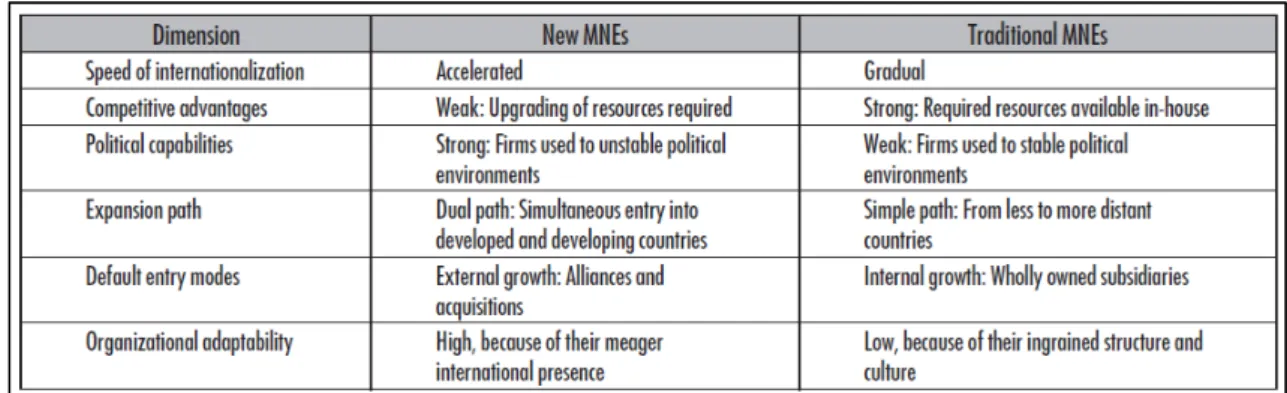
Table 1 The New MNEs Compared to Traditional Multinationals, Guillen et al (2009) ... 9
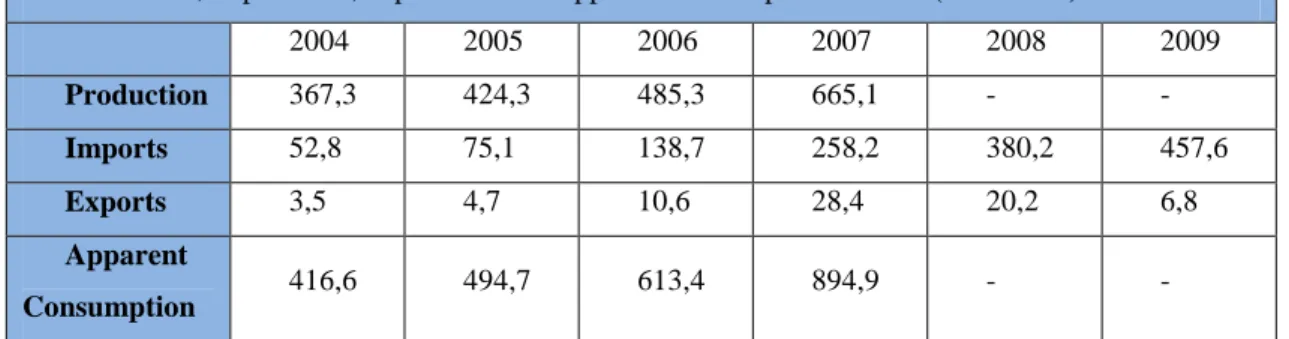
Table 2 Apparent Consumption of Wine in China. Source: Euromonitor International/World Trade Atlas, 2009 ... 26
Table 3 Sales by type of wine in millions of litres (bottled), Euromonitor International ... 31
Table 4 China Total Import Tax Rates on Wine, source: Redfern Associates (2010) ... 40
Table 5 QB current Product Portfolio ... 42
Table 6 Segmentation of QB Premium Wines by price ... 43
Table 7 Summary of global marketing issues, impact, and implications for China, Agarwal et al (2003) ... 59
List of Figures
Figure 1 Types of International New Ventures, in “International new ventures”, Oviatt et al.
(2004)... 14
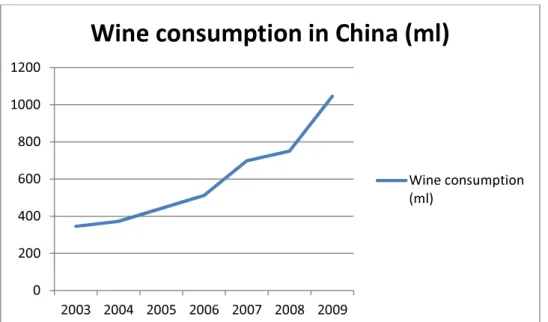
Figure 2 – Wine Consumption in China trend between 2003 and 2009 in million litres, (source: WTA) ... 25
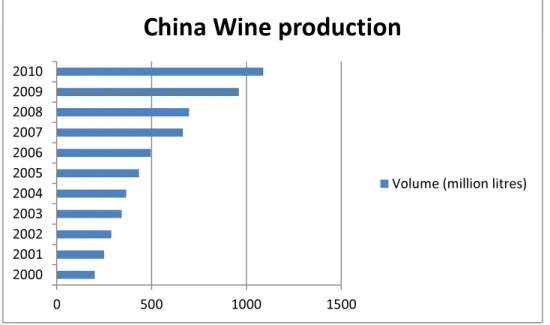
Figure 3 - China Wine Production (Source: Wine China online & Wines-info.com) ... 27
Figure 4 - Bottle Wine Imports to China by Volume - Calendar Year 2010, Australia Government/Australia Unlimited, 2010) ... 29
Figure 5 Breakdown of imported wine price segments in China (Currency: CYN). Source: Sub-sector repot: Wine Market in China, EU SME Centre,2011 ... 30
Figure 6 - Major Players ( IBIS World, 2010) ... 32
Figure 7 Quinta da Bichinha’s Logo ... 33
Figure 8 QB location, premises and surroundings ... 34
Figure 9 Extract of QB Premium Wines Promotional Brochures... 36
Figure 10 Overview of Work flow and Business Relationship QB / Beijing Century Mission 38 Figure 11 Total Exported Wine by QB up to present date (June 2012) ... 43
Figure 12 Average Price of QB’s Exported Bottled wine up to date (June 2012) ... 44
Figure 13 Wine Tasting Event in a Wine Shop at Henan, 2012 ... 45
Figure 14 QB’s Booth at China National Food, Wine & Spirits Fair in Chengdu, March 2012 ... 46
Figure 15 Extract from a QB’s Flyer ... 46
Table of Contents
Chapter 1 - Introduction ... 1
Chapter 2 - Literature Review ... 3
2.1. Evolution of International Business – A brief chronological overview ... 4
2.1.1. Late XIXth century to early XXth century (before 1st World War) ... 4
2.1.2. Interwar period (1914-1945) ... 5
2.1.3. Post World War II ... 6
2.1.4. 1970’s Onwards ... 7
2.2. Internationalization: Motives & Entry Modes Strategies ... 10
2.2.1. Motives ... 10
2.2.2. Entry mode Strategies ... 12
2.3. International new ventures – Born Globals & International entrepreneurship ... 13
2.4. China: Country Attractiveness & Institutional Changes ... 15
Chapter 3 - Methodology ... 20
Chapter 4 - Case study: Quinta da Bichinha – A Portuguese Wine “Born-Global” ... 23
4.1. Context: Home country... 23
4.2. Context: Host country ... 24
4.3. The Wine market in China ... 25
4.3.1. Market Size & Consumption ... 25
4.3.2. Domestic Wines ... 26
4.3.3. Imported Wines ... 28
4.3.4. Major Players ... 31
4.4. The Company ... 33
4.5. Business Model ... 37
4.5.1. Customer Segments/Consumer Profiles ... 37
4.5.2. Value Chain Analysis - Stakeholders ... 38
4.5.3. Marketing Mix – Price, Product, Promotion, Place ... 41
4.5.4. SWOT Analysis ... 49
4.6. Discussion ... 51
Chapter 5 - Conclusions ... 54
Chapter 6 - Bibliography ... 55
Chapter 1 - Introduction
Today, international business is no longer the exclusive preserve of multinational enterprises.
Along with technological breakthroughs and an increasingly globalized economy, it has become easier for Small and Medium Enterprises [SMEs] and creative entrepreneurs to penetrate into once unreachable foreign markets.
In recent years, China in particular has become an appealing market that many companies worldwide aspire to penetrate.
Going through a deep metamorphosis for the past thirty years, this country has evolved from a closed economy to a welcoming market for Foreign Direct Investment (FDI). Similarly, Chinese companies are now breaking boundaries and expanding overseas.
Evolving from strict and heavily regulated policies, where foreign investment was restricted largely to alliances with struggling state-owned companies in early 1980 (Mckinsey, 2003), this country later became synonymous with low cost manufacturing in the 90’s, thanks to its massive population and cheap labour.
From the beginning of the century, with China’s entry into the World Trade Organisation by 2001 and increasingly liberalized policies introduced by the Chinese Government, inward and outward FDI has increased significantly.
Today, the market tendency has been shifting again due to an empowered economy with growing purchasing power. China is swiftly becoming a pulsing and appealing market, with 1.4bn consumers, with an eager interest for westernized products.
This fact is attracting not only Multinational Corporations [MNCs] but also SMEs and entrepreneurs from relatively stagnated markets in developed countries that find in the east the opportunity to expand or, in some cases, survive given the recent years recession affecting Europe and the United States.
However, intercultural challenges from structurally different cultures and the chosen entry mode in this country are two factors closely linked to the success or failure of such new ventures (Johnson & Tellis, 2008).
Therefore, I propose exposing and studying the case of a Portuguese wine exporter entrepreneur, “Quinta da Bichinha”, from its very conception to its successful penetration into the Chinese Market.
The main focus of this study will be on the chosen entry mode and international marketing strategies used to enter this market successfully and expand.
Moreover, an assessment from an entrepreneurial perspective will also be made, as “Quinta da Bichinha” [QB] represents an interesting “Born-Global” company applied to the Portuguese wine industry.
Thus, an overview of the business model used and the inherent intercultural challenges as a consequence of the very distinct social-economic differences between Home (Portugal) – Host (China) countries will also be assessed throughout this case study.
As this case study unfolds, hopefully, it will be of relevance for Portuguese entrepreneurs and SME’s looking into exploring China as a potential target for new business endeavors.
Chapter 2 -
Literature Review
Here, a brief overview of the origins, history and most remarkable milestones of international business will be provided. The purpose is to analyze the evolution of business since the very first concepts of foreign investments up to today’s “free market” concepts and liberalized policies. In an increasingly global economy, today’s “Born-Global” companies & international entrepreneurship represent the culminating point in international business.
Using as support for this assessment important contributions to existing literature by renowned names such as Johanson, Vahlne, Frynas, Root, Cox, Hill, Guillen, Garcia-Canal amongst others, it is intended to establish a chronographic chain of events.
Through this exercise, one hopes to shed further light and understanding not only on international business itself but intrinsically related subjects, such as entry modes, international marketing strategies as well as intercultural challenges inherent in the process of expanding abroad.
Lastly, considerations of the specifics of the Chinese market and its own institutional/regulatory changes throughout the past thirty years will also be part of this assessment as an introductory and supportive note of relevance to the case study.
2.1.
Evolution of International Business – A brief chronological
overview
Throughout history, doing business (Alternative: the manner of conducting business transactions) between countries has undergone a remarkable metamorphosis from its early days until today.
The most significant changes in business patterns are a consequence of the volatility of the markets and perhaps more decisively, the shifts of the external factors (political, economic, social and technological), which are bound to impact substantially the way of doing business.
Consequently, four distinct periods can be identified (Jones, The Evolution of
International Business: An Introduction, 1996): Late XIXth century to early XXth century (Industrial Revolution); the interwar period; post WWII (1940’s to 1960’s) and finally, from the 1970’s onwards. Below, a brief overview of each of these periods will be provided as well as an introduction to today’s international business context.
2.1.1. Late XIXth century to early XXth century (before 1st World War)
The years before the outbreak of WWI saw different forms of foreign investment - portfolio, free-standing companies (i.e. local enterprises owned by foreign syndicates) and multinational corporations - emerge, with Europe, and especially Britain, making the major contribution to international investment flows.
Portfolio investments and passive investment in securities, (which does not entail active management or control of the securities’ issuer by the investor) were mainly orientated towards trade-related activities in the pre-industrialised world. Free-standing companies, as termed by Wilkins (1988), appeared as a genuine form of British foreign investment. Despite sharing in common with portfolio investments the fact that the stakeholder who subscribed to these joint stock companies did not exert control over the company’s activities, their affairs were nevertheless frequently managed by a board of directors based in Britain. This form of investment was typically oriented more towards mining and utilities. Like the portfolio investments during this period, most of these investments would flow from European countries towards the “Imperial Territories” or “Colonies”.
Finally, the multinational corporations remained relatively small before the WWI These predominantly manufacturing investments showed a much greater tendency to seek market opportunities in the industrialised regions of Europe and the United States.
2.1.2. Interwar period (1914-1945)
By 1918, the period of rapid expansion of FDI and growth of international business suffered an abrupt fall as an immediate consequence of the war.
In fact, many multinational corporations saw some of their foreign assets suddenly lying in enemy territory which led in most cases to a process of repatriation.
This setback was closely experienced by many European companies looking to the previously appealing Russian market that experienced severe losses with the rise of Bolshevism and to German companies, who saw their business interests seized by the Allied nations.
However, elsewhere in Europe, the period between the wars witnessed the international development of major firms, such as The Nestle and Anglo-Swiss Condensed Milk Company or Dutch electrical giant Philips as a result of the loss of markets by German competitors.
During this period, International cartels flourished with the purpose of circumventing the national restrictions surrounding international trade. By definition, firms form a cartel when they agree to restrict output or set prices (Levestein, Margaret; Suslow, V; International Cartels, in 2 Issues in Competition Law and Policy 1107 (ABA Section of Antitrust Law 2008)). They may set target or minimum prices, rig bids at auctions, set volume or market share quotas, allocate markets geographically or allocate major customers to specific member firms. International cartels are distinguished by the fact that the cartel members are comprised of firms from more than one country. This way, in place of competition, national firms in many industries relied on international cartels, namely chemicals, plate glass, iron and steel and electric goods.
Indeed, by the middle of the twentieth century, international cartels affected a wide range of goods.
In the case of Asia, it was Japan’s export industries that took advantage of the withdrawal of European goods from these markets (Hardach, 1977) mainly in the Chinese market, where by the end of the 1920’s, Japan became China’s joint highest inward investor together with Britain (Remer, 1931).
The growth of Japanese influence in Asia and that of U.S. firms in Latin America during the 1920’s represented the beginning of a process of economic regionalism that was a major characteristic of international business between wars and which came increasingly to the fore after the Great Crash of 1929.
This tendency amongst investment flows was also replicated amongst countries such as Great Britain and other European countries that became much more focused on the “Empire economies”. This was also true for countries whose currency remained linked to sterling and who together with the Empire countries formed the so-called Sterling Area.
It was also during this period that the American multinationals first emerged, with vertically integrated companies, developing both supply-oriented and market-oriented investments across a wide range of industries, namely, oil, although the notion of “global corporations” would recede into a mere reminiscence of a seemingly bygone age (Cox, 1997).
2.1.3. Post World War II
The concept of multinational companies has, in fact existed for centuries. Indeed, the famous East India Company, in the XVIIth century represents one of the well-known early international ventures. Later on in the beginning of the XXth century, Ford Motor Company was also created as what seemed to be an international new venture (Wilkins and Hill, 1964).
However, after the Second World War, the hegemony of North-America with its wielding economic power has propelled the concept of Multinational Enterprises (MNEs). Due to a very large and prolific domestic market, the American companies had already developed expertise in distribution and marketing across the country.
Hence, these skills would be easily adapted to other markets leading to the concept of MNEs.
The concept of MNEs as the primary engine for growth was described then as a “quintessentially American form of business Enterprise”, (Cox, 1997).
Moreover, their organisational capacity could be replicated in their foreign subsidiaries, giving them the necessary structure to manage the process of vertical integration effectively in those industries where this was an important source of competitive advantage. Thus, most MNEs have flourished from large, mature domestic firms.
British, North American and continental European firms expanded around the world on the basis of intangible assets such as technology, brands and managerial expertise. The climax of their worldwide expansion was reached during the 1950s and ‘60s as trade investment barriers gradually fell around the world (Guillen et al., The American Model of Multinational Firm and the “New” Multinationals from emerging companies, 2009).
Works developed by authors such as Dunning or Hymer around this time were of the utmost importance in explaining the so called “American Concept” of multinationals. The latter achieved an important reorientation on this matter by effectively linking two essential features of multinationals: Oligopolistic firms managing and controlling operations located abroad.
Hymer also introduced the concept of Foreign Direct Investment (FDI), i.e., international capital flows with which investors retained direct responsibility for managing their foreign investments namely through the creation of subsidiary companies registered abroad.
The main goals of FDI was and still remains, to access markets; access production factors; production efficiency, knowledge and political safety (Cox, Evolution of International business Enterprise).
Intrinsically related with MNEs came the perception that these developed from large, mature, domestic firms (Chandler, 1986), an assumption to be increasingly challenged over recent years.
2.1.4. 1970’s Onwards
During the 1970s, The “Keynesian” theories became popular and with them, the view that “private sector decisions sometimes lead into inefficient macroeconomic
outcomes which require active policy responses by the public sector” (Wikipedia, 2012) ultimately culminating in the view that multinationals represented a pernicious element in the world economic system. As such, MNEs would act as alternative centers of power in leading to unequal distribution of wealth between the industrialized and less developed countries Cox, 1997).
This period was deeply shaped by a fast growth in the services industry and saw the rise of Japanese multinationals during the 1970s and ‘80s, adding yet more diversity to the global population of multinational corporations and firms expanding from relatively rich and technologically advanced countries tended to share a core set of features.
Chief among them were their technological, marketing and managerial strengths which enabled them to overcome the so-called liability of foreignness in a variety of markets. This was achieved by investing for the most part in wholly or majority-owned subsidiaries, transferring technology, products and knowledge from head-quarters to far-flung operations around the globe and relying on elaborate bureaucratic and financial integration. Moreover, it was deeply marked by strategic partnerships among firms of different nationalities.
In the late 70s, an important milestone in international business studies was achieved via the research work developed by Uppsala University, namely through Johanson and Wiedersheim-Paul (1975) and Vahlne (1977).
A model describing the internationalization process of companies based on empirical research was created, commonly referred to as the “Uppsala Model”. This work depicted the internationalization process of companies that first and foremost would gain experience from the domestic market before they moved to foreign markets. At a later stage, they would focus “on the gradual acquisition, integration and use of knowledge about foreign markets and operations and on incrementally increasing commitments to foreign markets”. The expansion would also start in neighboring countries or countries with small “psychic distance”.
From the 1980s, the establishment of new ventures, international by inception, became increasingly common. These start-ups managed to compete with many established competitors worldwide by raising capital swiftly and manufacturing and selling products with an international scope and a fast approach to the markets (as opposed to the previously described gradual and “cautious” strategies).
Moreover, since the 1990s, the global competitive landscape has started to become increasingly populated by MNEs originating in countries that are not among the most advanced in the world.
These so-called “new” MNEs come mainly from upper-middle-income economies, emerging countries, developing countries and oil-rich countries They are of different sizes, from different industries and penetrate markets by using multiple entry modes, ranging from alliances and joint ventures to wholly owned subsidiaries. Below, the main features of the new MNEs in comparison with the traditional MNEs are exposed (Guillen et al, 2009).
The above reinforces the need to challenge the theoretical framework surrounding the creation and proliferation of MNEs, previously referred to as the Uppsala model, which detected staged development, scale and homogeneous and stable market condition as some of the necessary requirements for a successful expansion of multinational corporations.
In fact, much of the economic growth seen in emerging markets, namely in South America and Asia, over the past decade has been driven by governments. Big investments in infrastructure resulted in high levels of economic growth year after year.
However, as the economy grew, so did company valuations and property prices. Emerging market investing used to be dominated by the BRIC nations; Brazil, Russia, India and China. Similarly, the new MNEs from the BRIC countries have made great inroads into the global economy. Brazil for example, has seen companies across different industries such as Companhia Vale do Rio Doce (Mining and steel), Natura (Cosmetics) or Embraer (aviation), successfully emerge into the international stage and become market leaders at an international level in their specific fields.
As these economies have continued to grow, some argue they are no longer as “emerging” as they once were, as new areas promising high return investments are uncovered.
Over the next few years, acronyms such as MINT (Mexico, Indonesia, Nigeria and Turkey) and CIVETS (Colombia, Indonesia, Vietnam, Egypt, Turkey and South Africa) are likely to become increasingly more common and potentially, they may start gathering inward FDI. By the same token, it is likely similar patterns will be seen in new MNEs emerging from these increasingly appealing economies (Bramford, 2012).
2.2.
Internationalization: Motives & Entry Modes Strategies
The internationalization of companies has been the subject of scrutiny and thorough analysis throughout the years. In fact, the focus in Internationalization processes has been intensified in recent literature. With increasingly open economies and stagnation of some of the mature markets on the so-called “Developed” countries, opportunities to cross borders have seemed to become not only appealing to companies, but, in some cases a matter of survival.
Therefore, it is hardly a surprise to see the underlying motives, current processes used and, perhaps more emphatically, the ways to penetrate such markets gather increasingly generalized interest.
Thus, an explanatory description of the most important elements of the Internationalization process is proposed, as they introduce important concepts to be explored later in the upcoming case study.
2.2.1. Motives
According to Frynas et al. (2005) the “Internationalization stimuli are those internal and external factors that influence a firm’s decision to initiate, develop and sustain international business activities”.
The reasons behind a firm’s decision to operate across borders can be attributed to mainly two sets of factors and have been summarized by Frynas, Mellahi & Finlay (2005) as below:
The Organizational factors, internal to the firm are: from a “Decision-maker” nature, i.e., top management decisions driven typically by the manager’s exposure to foreign markets either by experience abroad, background, foreign language proficiency or simply personal characteristics (Reid, 1981); Firm-specific factors, specifically, its size (typically large firms tend to internationalize more than smaller ones) or International appeal, usually related with unique products likely to be marketable in international environments.
The Environmental factors, external to the firm, are typically in the form of unsolicited proposals, “Bandwagon effect”, Attractiveness of host country.
Unsolicited proposals can be largely attributed to the company’s networking, either through the form of foreign governments, distributors or clients. Unarguably, the Internet has been playing a major part as it allows companies an easy exposure to otherwise unreachable business opportunities.
The “bandwagon effect” on the other hand, comes as direct result of benchmarking amongst competitors that see on the “pioneers’” strategies the opportunity to follow and penetrate typically the very same markets aiming at optimization of products, economies of scale or cheaper materials in order to gain competitiveness on the host market.
Finally, the attractiveness of the host market, either by market size, similarities to domestic market or high purchasing power are some of the drivers encapsulate within this factor.
Whilst the latter is perhaps closer to a proactive approach (pull factors) the stimuli of the two previously referred motives is often a reactive approach to the changing conditions of the market (push factors) (Cavusgil, 1982).
Regardless of the specific motives driving the firm’s plan to internationalize, the activities to exploit in light of the market opportunities must be clear.
2.2.2. Entry mode Strategies
The decision to internationalize, whilst driven by motives described above, must be supported by three main entry questions (Hill,2007): which market, when to enter such market and with which level of commitment.
Once these key decisions are made, the question of how to penetrate the market intrinsically follows.
In fact, the entry mode strategy often determines the success or failure of the firm’s internationalization plan.
Root (1994) provides a complete survey of the observed modes of market entry, later segregated and grouped by Johnson & Tellis (2008) into the following classes, ordered by increasing control:
•Export: a firm’s sales of goods/services/products in the home market and sold
in the host country through an entity in the host country. It is often regarded as the first step towards international markets as it provides experiential knowledge with minimal risks or strong commitment and enables sales expansion so as to achieve economies of scale. Cavusgil (1984) identified three different exporter categories according to firms’ level of export involvement: experimental
involvement, where the firm initiates restricted export marketing activity; active involvement, where the firm systematically explores a range of export market
opportunities; and committed involvement, where the firm allocates its resources on the basis of international marketing opportunities.
•License and Franchise: a formal permission or right offered to a firm or agent
located in a host country to use a home firm’s proprietary technology or other knowledge resources in return for payment. Franchising involves longer-term commitment while License is oriented towards shorter term commitments.
•Alliance: agreement and collaboration between a firm in the home market and
a firm located in the host country. Hill (2007) identifies, “Turnkey projects” as a specific entry mode strategy. This market entry is mostly used in industries such as construction, petrochemical refining, pharmaceutical, metal or chemicals and relies on a “symbiotic” relationship between both parties where typically one firm possesses the resources but lacks the technological know-how and vice-versa.
C
o
n
t
r
o
l
•Joint Venture: shared ownership of an entity located in a host country by two
partners, one located in the home country and the other located in the host country.
•Wholly owned subsidiary: complete ownership of an entity located in a host
country by a firm located in the home country to manufacture or perform value addition or sell goods/services in the host country.
2.3.
International new ventures – Born Globals & International
entrepreneurship
As defined by Oviatt and McDougall (2004), an “international new venture is a
business organization that, from inception, seeks to derive significant competitive advantage from the use of resources and the sale of outputs in multiple countries”.
There are several reasons explaining the increasing emergence of born global firms as described by Blomstermo and Sharma (2003):
1. The increasing role of niche markets, especially in industrialized countries; 2. Recent advances in process technology;
3. Recent advances in communication technology;
4. Inherent advantages of small companies -faster decision-making, quicker response time, and adaptability. Small importers exporters are more flexible at adapting to international tastes and international standards.
5. The means of internationalization-knowledge, technology, tools, facilitating institutions etc. – have become more accessible to all firms and there are an increasing number of institutions and ways by which various governments, organizations like the European Union etc. try to develop international business and co-operation between SMEs from various countries.
6. A trend towards global networks (Hakansson 1989 and Thorelli 1990).
In contrast to organizations that evolve gradually from domestic firms to MNEs, these new ventures begin with proactive international strategy. In fact, the ability to discover and take advantage of business opportunities is no longer an exclusive asset of large mature enterprises, as stated by Oviatt at al. (2004).
Low-cost communication technology and transportation intertwined with the openness and flexibility of investments are enabling entrepreneurs and SME to have a
C
o
n
t
r
o
l
share of the market otherwise exclusive to large and mature MNEs. Strategic alliances as opposed to Foreign Direct Investments (FDIs) are now possible alternatives whilst looking for foreign resources such as manufacturing capacity or marketing.
Successful international commerce today is increasingly facilitated through partnerships with foreign business – distributors, trading companies, subcontractors, as well as more traditional buyers and sellers.
Inexperienced managers can improve their chances at succeeding in international business if they take the time to build mutually beneficial, long-term alliances with foreign partners.
In “international new ventures”, Oviatt and McDougall have successfully identified four necessary elements for sustainable international new ventures
1. Internalization of some transactions
2. Alternative governance structures,
3. Foreign location advantage
4. Unique resources
In the same study, and based on the elements described above, the different types of international new ventures distinguished by the number of value chain activities are included in summary table below:
Figure 1 Types of International New Ventures, in “International new ventures”, Oviatt et al. (2004)
Quadrants I and II focus on international new markets – import and export start-ups (serve few nations with which the entrepreneur is familiar) and multinational
traders(serve an array of countries and are constantly scanning for trading opportunities where their networks are established and/or can quickly set up).
Quadrant III, geographically focused start-ups (focus on the specialized needs of a particular region of the world through the use of foreign resources) find their competitive advantage in the coordination of multiple value chain activities (e.g. R&D, HR, production).
Quadrant IV, global start-ups, is the most radical manifestation of the international new venture, because it derives significant competitive advantage from extensive coordination among multiple organizational activities, the locations of which are geographically unlimited.
Aligned with the core purpose of this work, Quadrant I companies – import/export start-ups - will be further scrutinized as an introductory and necessary assessment for the forthcoming study.
McDougall and Oviatt (2000, p.903) defined international entrepreneurship as “ a combination of innovative, proactive and risk-seeking behavior that crosses national borders and is intended to create value in organizations”. This definition has been one of the most widely accepted.
Afterwards, they embraced a deeper concept of entrepreneurship, defining it as the discovery, enactment, evaluation and exploitation of opportunities across national borders to create future goods and services (McDougall & Oviatt, 2005).
2.4.
China: Country Attractiveness & Institutional Changes
Using the definition from the Barron’s Marketing Dictionary, country attractiveness refers to “measuring the profit possibilities that lie within the structure of a particular industry or market.
The most important factors considered to determine a country’s attractiveness are: market size; market growth; market seasons and fluctuations, competitive conditions, market prohibitive conditions, economic and political stability.
On the other hand, factors such as market share, marketing ability and capacity, product fit, contribution margin, image, technology position, product quality, market support, quality distribution and service are defined as the country’s competitive
strengths (International Marketing and Export Management, Albaum, G; Strandshov, J; Duerr, E; Dowd, L.
Whereas China represented in the earlier years of its growth mainly low cost manufacturing and diversifying sources of supply (Vernon,W and Rangan 1996), the rising wealth of 1.4 billion Chinese is now driving market-seeking behaviours.
A set of economic reform and the start of an open-door policy placed this country as one of the lead key-players in the global economy. Hitherto, China’s extraordinary economic growth has positioned this country as the second largest economy of the world, after that of the United States, surpassing Japan in 2010 with a gross domestic product of $5.8 trillion.
If we assume that the 2011 growth rates for both China and the USA (10% and 3% respectively) are maintained, China will become the world’s biggest economy by 2024.
According to the Foreign Investment Bulletin, in January-December, 2011, the number of newly approved foreign-funded enterprises in China totaled 27,712, up by 1.12% year on year; and actual foreign investment reached US$116.011 billion, up by 9.72% year on year.
By 2001, after 15 years of negotiations, China finally joined the World Trade Organization. The WTO frameworks rest on three basic principles: uniformity, transparency and judicial reviewability. The main impacts and implications of this process were analyzed by Agarwal and Wu (2003) and are reproduced in Annex I.
After becoming a member of the WTO, China became a more welcoming market for business. Expectedly, in the months following the country’s entry into the WTO, a remarkable 29.06% increase in the FDI was registered and this tendency has been consolidated over the past ten years. More importantly, entry to the WTO encouraged firms to adopt a longer term view of operations in China.
Nonetheless, according to Child & Tse (2001) and Luo (2006) these changes don’t imply that host country factors were less influential. China is intrinsically complex due to its size and internal variation. The state still exercises control over the terms of foreign entry into different sectors and the business systems.
A major issue that caused many failures is that of “cultural differences”. Cultural differences are often overlooked as they are intangible factors that are difficult to visualize and measure.
An inability to determine the exact cultural cost leads to neglectfulness of its importance.
Mahoney (Mahoney, Trigg, Griffin & Pustay, 2001) suggests ownership advantages, location advantages and internationalization advantages. Breth and White (Breth et al., 2002) suggests companies that had entered the Chinese market had used the following criteria for their decision making process:
•••• The amount of capital a company is prepared to commit to the Chinese market; this has previously been wrongly perceived as being at a low level of costs.
•••• The degree of control a company wishes to have over its China operations which plays a crucial role in effectiveness management;
•••• The company’s attitude towards risk taking and its assessment of risk in China. Chinese business culture is developed on a gradual, progressive basis during a period of time, rather than rushed. Companies that underestimate the period of time required to achieve such progress may also experience an exhaustion of capital. Decisions are either rushed or forced which in both cases will lead to an unsatisfactory outcome.
The cultural variable, often ommited, is now begining to be recognized as a major cost driver in international business activities.
For countries like China, with significant cultural differences from western cultures, this is an important factor to take into consideration as risks of faulty information collection or cross-cultural management problems are likely to occur.
Contributors such as Hofstede(2001), Trompenaars (1993) or Hall (1976) have developed important work towards measuring and understanding the impact of cultural differences in iInternational business.
In reality, entering the Chinese market is carried out largely in the form of joint ventures.
Although the performance of these joint ventures has not been satisfactory, the stability has been relatively high (Beamish, 1993). The major reason for forming joint ventures is the attraction of the Chinese partners’ local knowledge. However, this does not allow for the dysfunctional aspects of cross-cultural management from home to host countries.
Increasing attention is being paid to the importance of cultural differences and there is the recognition of “cultural differences as the biggest barrier” to succesful
international operations (Pan et al., 2004). However, there are still no satisfactory answers from research to many of the cultural related problems associated with international investment.
The results of an analysis done by Chung (2004), support the argument that the entry mode should be selected after firstly considering cultural differences and the ability of the investing organisation to adapt as required because where cultural differences are larger and the organization is inflexible, the risks are higher. Thus it is important to analyse the national culture of the country and the degree of adaptation required prior to making serious investments decisions.
According to the same source, it appears that the mode of entry could be used as an implementation consideration in cross-cultural expansion strategy rather than a strategic focus in itself.
The approach that national culture should be used as an initial and important criterion in the strategic decision making process would improve the chances of successful penetration in as the strategies would be tailored to the market of the specific culture. With this approach, post implementation adjustments relating to cultural costs will be limited to fine tuning rather than major strategic adjustments.
Grant (2008) identifies customer relationships as access to knowledge about the customers and thereby analyzes how the differences of individual characteristics and preferences affect the profit contribution. Furthermore, the author describes how the firm can adapt its marketing attract customers in the local market. When a firm has an intermediary as sales channel, the intermediary establishes, mainatins and develops these relationships and it possesses the knowledge about the customer. However, one dilemma if a firm chooses to establish its own sales channel in China, is how it can overtake the relationships that the distributor has already established.
For every firm in China relationships are of importance, no matter what industry the firm is in. In China these relationships are built directly between people, but they influence whole business networks (Jansson, 2007).
Therefore, a firm has to be aware of the importance of these relationships in order to perform and develop its business in the emerging country market. Another aspect of the relationship building in China is a firm’s adaption to local networks. Everyone in these networks has to be aware of Guanxi, which is very important for the Chinese people. Guanxi is practised in networks and goes beyond professional friendships,
“ It is typically that [...] people are distrusted until they have proven they can be trusted, therefore most often {business relationships} start with a good personal relationship: only thereafter does the business relationship start.”. – Jansson (2007:68). Furthermore, in order to build organizational capabilities, different types of resources are required (Grant,2008). The resources consist of tangible, intangible and human resources, which are owned or acquired by the firm.
When entering a new market, a valuable capability is the ability to understand the new market and learn how to integrate with the business networks.
Establishing customer relationships is crucial in order to be competitive and succesful in China. As mentioned earlier, the importance of trust is recognised in Chinese business networks. Many western companies presume that trust is present from the beginning of the relationship, but in the Chinese business culture trust is built gradually. Therefore, the creation of succesful relationships is central for firms to become succesful by gradually adaping to the Chinese business culture (Yang, 2004). If a firm does not comply with the importance of trust and Guanxi, it can face severe failure in the market as well as harming the firm’s ability to do business in other business networks. Holmqvist et al. (2009).
Chapter 3 - Methodology
A case study is a method used to approach a complex instance, and provide comprehensive understanding through extensive description and analysis of that instance, placed within a particular context (Morra et al, 2009).
It involves what methodologists refer to as “thick descriptions”. This term involves an in-depth description of the entity being evaluated, the circumstances under which it is used, the characteristics of the people involved in it, and the nature of the community in which it is located. It also involves interpreting the meaning of demographic and descriptive data such as cultural norms and mores, community values, ingrained attitudes, and motives.
This methodology is often used in social sciences and life sciences and is believed to be first introduced into social science by Frederic Le Play in 1829 as a handmaiden to statistics in his studies of family budgets (Les Ouvriers Europeens (2nd edition, 1879)).
There are typically three types of Case studies – Explanatory, Descriptive and Combined Methodology (Morra et al.,2009):
• Explanatory: mainly used when the purpose is to explore causation in
order to find underlying principles and or related relationships among program components. These can be namely:
• Program effects – Examining causality and usually involving
multisite multimethod assessments
• Program implementation – Investigating operations, often at
several sites, often normatively.
• Descriptive: With a narrower focus than the explanatory cases. These
can be:
• Illustrative – Intended to add realism and in-depth examples to
other information about a program, project or policy.
• Exploratory – Aimed at generating hypothesis for later
investigation rather than being illustrative
• Critical instance – Examining a single instance of unique
interest or serving as a critical test of an assertion about a program, project, problem or strategy
• Combined: as the names suggests, bring forward both explanatory and
descriptive approaches:
• Cumulative – Bring together findings from many case studies to answer
an evaluation question, whether descriptive, normative or cause-and-effect.
In spite of the formats described above, there are no rigid protocols whilst developing case-study methods. They tend to be an in-depth, longitudinal examination of a single instance or event which comprises the case.
By providing a systematic way of looking at events, collecting data and analyzing information, the researcher is enabled not only to gain an in-depth understanding of the subject but also what might become important to look at more extensively in future research (Flyvbjerg,2011)
Case studies can also be looked at as a research strategy, an empirical inquiry that
investigates a phenomenon within its real-life context, where there is little control over the events. This method enables the researcher to answer “when” or “how” questions, whilst seeking a holistic understanding of the event or situation in question using logical reasoning from specific to more general terms.
Case studies, can include quantitative evidence, rely on multiple sources of evidence, and benefit from the prior development of theoretical propositions.
In brief, the added value of this methodology case study lies on the fact that, and quoting Hans Eysenck (1976, p. 9) , “sometimes we simply have to keep our eyes open and look carefully at individual cases – not in the hope of proving anything, but rather in the hope of learning something!”.
The adopted methodology, intends in this case to provide a comprehensible understanding of this particular participant - QB - by making a thorough description of the context surrounding the participant.
An assessment of all related variables is required as it is bound to affect the outcomes and performance of the participant. Therefore, the research in this case will be subdivided into both qualitative and quantitative data, based on readily available information such as previous literature, existing articles and research in this specific field.
Consequently, the proposed approach for this case will achieve these goals by having a standard structure that includes five main stages:
Ultimately, the purpose is to obtain a clear, unbiased description and subsequent analysis of the case within the existing environment.
It is not part of the chosen methodology to obtain, based on an initial hypothesis, generalized truths or expose cause-effect relationship.
Moreover, one aims after subsequent analysis and discussion of the case to enable further future research with direct relevance to the case by identifying potential issues and/or synergies worth analyzing within the current context.
Discuss Questions/Results and Propose Recommendations
Future medium long-term sustainability of this business model? What are probable risks/dangers
Describe & Analyze Business Model- Value Chain Analysis
Key Partners, Activities, Resources & Value Proposition Stakeholders, Decision-Making Process
Distribution Channels, Support Mechanisms, Customers, Regulations
Market Analsysis
Size & Consumption Segmentation, Major Players
Identify the Context/ Opportunities
Chapter 4 - Case study: Quinta da Bichinha – A Portuguese Wine
“Born-Global”
4.1.
Context: Home country
Portugal is a country with a long tradition of wine making. Its mild weather and inviting river shores make it an ideal location for vineyards. In addition, the long coastline and easy access to ports facilitated the export of wine from around the XIIth century, initially, mainly to England.
The production of wine in Portugal has come a long way since its very early days. It experienced a first significant change when Salazar and the “Estado Novo”, a military regime, came to power in Portugal by 1933. By 1935, the wine cooperatives were first founded and an initial effort towards standardization of production and quality was beginning to take place.
After the “Carnation Revolution” in 1974 and especially after the entry of Portugal into the EU by 1986, the wine industry went through a deep restructuring process, seeing an increased modernization with new technology throughout the industry, thus resulting in an impressive quality improvement of Portuguese wines as a whole.
This improvement has resulted in growing recognition and awards at an international level with wines such as Aveleda, Altas Quintas, Bonifacio and Vidigal amongst others, gathering top marks by respected wine critics and magazines.
In 2011, Portugal exported an estimated 7.340.000 hl1 of wine, coming 10th place in the world’s top wine exporters.
Today, the well-known financial crisis throughout the Eurozone has placed Portugal as one of the countries currently facing a deep recession with some of the highest unemployment rates in Europe.
In spite of Portugal being the 4th largest wine consumer in Europe, there is currently an increasing interest in expanding and promoting Portuguese products overseas as the domestic market stagnates and, in fact, lately has been experiencing a retraction. Indeed, domestic sales dropped 1.4% in 2011 in comparison with the previous year to €485,000,000. On the other hand, wine exports increased 7% over the same period, totaling €700,000,000 according to consultant DBK, adding up to an already reported increase of 14% in the previous year (2010).
1
Products such as wine, olive oil and cork are some of the prime products with potential to boost the exports market overseas.
4.2.
Context: Host country
Whereas Europe continues to struggle, the BRIC2 countries continue to show impressive growth, in particular China, which is having a huge knock-on effect on the wine market.
China recently reported that its economic growth had slowed but was still at 8.9% in the fourth quarter of 2011.
China’s rapid growth has seen a significant amount of new wealth developing in the country, thus breeding a new affluent class who are unafraid to show it off.
The rising middle-class population in some of the largest emerging markets – including, but not limited to China- suggests an opportunity to sell greater volumes of goods and services to new consumers. The demographics in many of these emerging markets are leaning towards growing affluence where regions previously consisted of farming communities, there are now new cities. More city dwellers mean a greater demand for luxury goods and other items that tend to form the trappings of wealth.
Although the wine market is still quite small in China (especially when comparing with the beer market, the preferred alcoholic beverage of the Chinese), it has very high potential.
In recent years there a large quantity of fine wine has been consumed in China. The effect is twofold; not only is there a greater demand which drives up prices but also the more that gets drunk, the rarer it becomes, which again impacts on value.
This particular context generates undeniable opportunities between Home (Portugal) -Host (China) countries which are to be further explored and exposed through this case.
4.3.
The Wine market in China
4.3.1. Market Size & Consumption
The acceptance (consumption) of wine in China has been increasing gradually. The influence of western eating and drinking habits alongside an increase of average incomes has been driving the change of behaviors: China's urban household average per capita annual disposable income increased from CNY 1,510 (approx. EUR 168) in 1990 to CNY 19,109 (EUR 2,127) in 2010.
Wine is now a favored drink amongst China’s elite as it is perceived as fashionable and sophisticated.
The wine market has nearly tripled its market value since 2003. Throughout this growth, there has been also an increasing demand for greater quality, as the Chinese consumer grows more sophisticated.
Figure 2 – Wine Consumption in China trend between 2003 and 2009 in million litres, (source: WTA)
Despite a significant increase of annual per capita wine consumption (0.26l in 2003 to 0.80 l in 2009),wine still accounts for less than 5 % of the total alcohol retail consumption in China. There is however, an expected growth between 2009 and 2014 of 12.5 % per annum3, according to a Chinese government study.
3
Source: Euromonitor International 0 200 400 600 800 1000 1200 2003 2004 2005 2006 2007 2008 2009
Wine consumption in China (ml)
Wine consumption (ml)
Available data from Euromonitor International/World Trade Atlas shows a conspicuous increase of the apparent consumption of wine, dissected as follows:
Production, importation, exportation and apparent consumption of wine (Mill. USD)
2004 2005 2006 2007 2008 2009 Production 367,3 424,3 485,3 665,1 - - Imports 52,8 75,1 138,7 258,2 380,2 457,6 Exports 3,5 4,7 10,6 28,4 20,2 6,8 Apparent Consumption 416,6 494,7 613,4 894,9 - -
Table 2 Apparent Consumption of Wine in China. Source: Euromonitor International/World Trade Atlas, 2009
As per the table above, it is clear that the wine market is clearly dominated by domestic production. In fact, the National Bureau of Statistics of China revealed that the wine consumption in China by 2009 was distributed as follows: 83% domestic wine production, 9% imported bottled wine and 8% bulk wine. The last named bulk wine has been decreasing during recent years, whereas imported bottled wine is currently increasing.
In North China, Beijing and its surrounding cities and coastal cities like Dalian stand out as growing markets.
4.3.2. Domestic Wines
Unsurprisingly, the wine industry in China has been experiencing considerable growth, side by side with the increase in demand. Although it is a relatively new industry in China– The first dry white wine dates back to 1978, and the first lot of dry red wine dates back to 1983 - the quality and brand strength of some domestic wines is increasing. Indeed, it is reaching a level where it can compete on price with imported wines and an export market seems to be developing.
Due to the shift in Chinese consumer preferences from spirit products to wine, baijiu grain spirit companies have been driven to enter the wine market. Maotai and Wuliangye have recently set up wine businesses making full use of their
well-There are currently over 940 Chinese wineries in operation, with at least ten classed as major producers4.
Figure 3 - China Wine Production (Source: Wine China online & Wines-info.com)
With an impressive growth in domestic production from 201million litres to 1089 million litres between 2000 and 2010, Chinese companies currently control the domestic wine market (in Volume) benefitting from brand recognition, customer loyalty and a well-defined niche market5.
It is however, important to note that most Chinese consumers only consume domestic products. Moreover, as the wine market in China is at a nascent stage, quality regulations are not particularly strict. In fact, it is common practice for producers to blend wines from different vintages and countries, which may be associated with the fact that a large majority of consumers are “uneducated” new wine tasters.
However, Chinese wine price is on the upward trend generally. With the popularization of the wine culture and gradual improvement in the consumption concept and capacity, the prices of mainstream wines in China have risen from 20-40 CNY/bottle (750ml) to 30-60 CNY/bottle (750ml) by 2010.
4
http://www.wines-info.com/html/2011/2/1-36742.html
5 In Webinar: Opportunities in the Chinese Wine Industry, China Agribusiness & Food & Beverage
Team, May 2011 0 500 1000 1500 2000 2001 2002 2003 2004 2005 2006 2007 2008 2009 2010
China Wine production
4.3.3. Imported Wines
Wine imports into China date back to 1980, when France was the first mover into this market. At that time, the first joint-venture, Dynasty Wine Ltd. was established.
Imported wine in the Chinese market generally falls into one of three main categories:
• Imported bottled wine with original packing,
• Imported bottled wine filled in China (foreign wine, foreign brand and filled in China)
• Imported base wine blended and bottled by domestic wine enterprises and labeled with domestic brand (blending of foreign and domestic wine, Chinese domestic brand).
In China, imported wine is distributed mainly by wholly foreign-funded or joint- venture sales companies and domestic small traders or distributors. Presently, sales of imported bottled wine account for over 5% of the Chinese wine market, which is mainly supplied in high-end markets such as star hotels and high-end clubs. The inclusion in the figures of imported base wine, blended and bottled by domestic wine enterprises and labeled with domestic branding, takes the share of imported wine to over 15% of the total Chinese market.
With advantages in raw material quality and cultural content, imported wine has dominated the Chinese high-end wine market. Imported wine brands in the Chinese market are mainly from France, Italy, Spain, Germany, USA, Chile, Argentina and Australia. The imported wine volumes from France, Australia, Chile, USA, Italy and Spain, etc rank among the top in China as per the graphic provided below.
In recent years, Portuguese wine has also started to gain some visibility in this market as exports continue to increase.
France still has a hegemonic hold of/dominates the import market, in overall sales, with an impressive 47% of the market.
Overall, whilst the sales volume of bulk wine imports dropped 23% between 2008 and 2009, imported bottled wine continues to increase, reaching a total of $377,420,000, or 82.48% of total imported wine sales.
Imported wines dominate this niche market in tier 1 cities Beijing, Shanghai, Guangzhou and Shenzhen.
This product is sold through exclusive distributors who have competitive advantages and established sales networks with hotel, restaurant and café (HORECA) channels.
See below, a distribution of countries exporting wine into China is provided (2010 data).
Figure 4 - Bottle Wine Imports to China by Volume - Calendar Year 2010, Australia Government/Australia Unlimited, 2010)
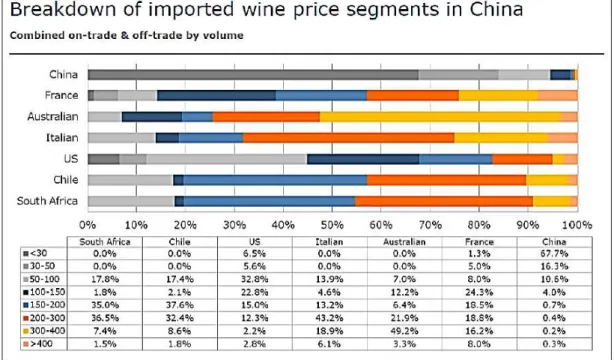
France also holds the third highest CIF6 ($4.46USD/l, 2009), after New Zealand ($8.07USD/l, 2009) and Germany ($4.95USD/l, 2009). French wine’s renowned quality and credibility provides the “status” sought by the Chinese elite. French wines have managed to create and sustain a high-end market position, followed closely in cost terms by Australia ($4.29USD/l, 2009), Chile ($3.54USD/l, 2009) and Italy ($3.58USD).
The chart below provides an interesting overview of the main importers’ price positioning in the market.
Although France is the market leader in the most expensive wines (8%, >400) it shows an even coverage throughout all price ranges.
Australian and Italian wines focus more intensively in the mid to high end (CNY 200-400) whereas South African and Chilean wines focus on the mid-range (CNY
6 Cost,insurance and freight price. Price of a good delivered at the frontier of the importing country,
150-300). Finally, US wine, in spite of an eclectic presence throughout all price ranges, has got a stronger presence in the low to mid-range (CNY 50-150).
Figure 5 Breakdown of imported wine price segments in China (Currency: CYN). Source: Sub-sector repot: Wine Market in China, EU SME Centre,2011
Red wine is by far the favoured wine by Chinese consumers.
It is drunk almost exclusively as table wine accompanying a meal. One of the reasons for this could be related with the association of red with fortune and power. Future industry growth relies heavily on the development of the “meal occasion” market and Chinese consumers’ taste for new foreign products. Expensive bottles of red wine have become a trophy drink of the Chinese new rich to demonstrate wealth and good taste.
Below, sales by type of wine between 2004 and 2009 show that by 2009, red wines represented 73% of the market, clearly supporting the market preference for this type of wine.
Sales by wine type (bottled) (Millions of litres) 2004 2005 2006 2007 2008 2009 Total 489,7 547,1 609,6 789,1 967,5 1131 Red 314,8 360,3 409,7 552,0 692,1 821,4 White 131,7 141,6 152,8 188,1 224,8 257,2 Rose 43,2 45,2 47,1 48,9 50,6 52,3 Sparkl ing 0,9 0,9 1,1 1,3 1,6 1,9
Table 3 Sales by type of wine in millions of litres (bottled), Euromonitor International
4.3.4. Major Players
The top selling brands in China are domestic products. This fact is unsurprising, given that the majority of Chinese consumers only consume domestic products.
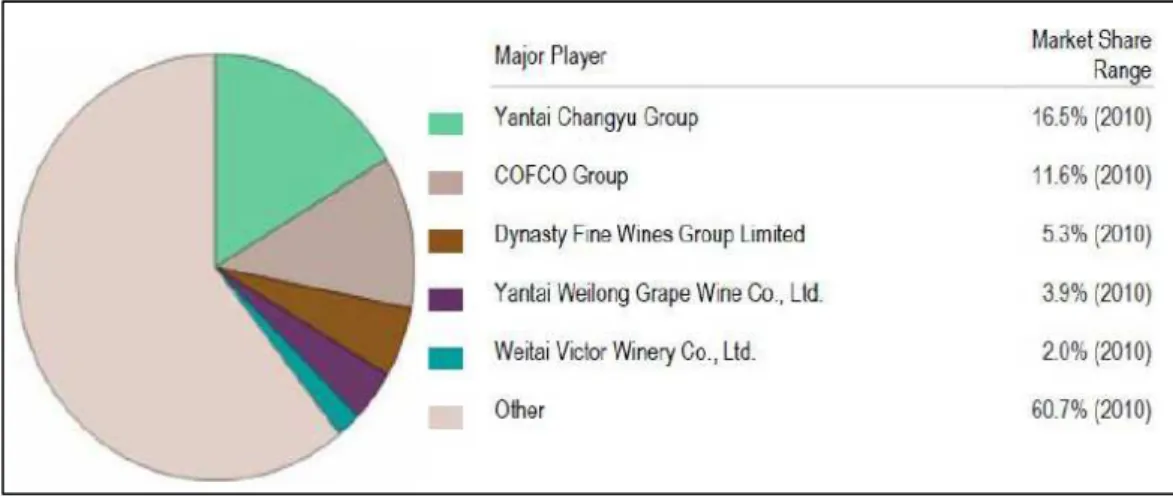
Hence, Yantai Changyu Group holds an estimate 16.5% of the market (2010) with a diversified market portfolio that includes: dry red wine, dry white wine, sweet wine, sparkling wine, brandy wine and “healthy” wine. COFCO Group, which holds the brand China Great Wall Wine comes second, followed by Dynasty Fine Wines Group Ltd. In fact, these three Chinese brands have become the leaders in their own regional markets. ChangYu occupies an ascendant position in Shandong, Guangdong; Great Wall leads the wine market in north China and Dynasty has realized the high market share in Shanghai.
Many regional wine brands in China also enjoy high-speed development, including Weilong and Harvest in central and south China, Suntime and Yunnan Red in west China and Tonghua dry red wine in northeast China.
Figure 6 - Major Players ( IBIS World, 2010)
Regarding top selling imported foreign brands by sales volume, Castel Freres and Rochemazet from France, Felix Solis from Spain, Jacobs Creek from Australia and Concha Y Toro from Chile have led the imports market since 2008.
The ease of market entry for new players is affected by government regulation and availability of other alcoholic beverages. Wine is vulnerable to the threat from its substitutes, such as spirits and beer, due to low switching costs and different consumption patterns. The degree of rivalry is considered moderate in this market.
The Chinese wine market is mainly occupied by medium-end and low-end domestic wines. Imported wines impact home-made wines in price, quality and variety as well as encourage the improvement in the overall consumption level and volume of Chinese wine market.
In 2009, the Chinese wine market was dominated mainly by full grape juice wine. Dry and semi-dry wines accounted for over 50% of the market. Among dry wines, dry red wines occupied 80% of the market, while the remaining 20% was taken up by dry white wines.