UNIVERSIDADE OF
BEIRA INTERIOR
DEPARTAMENTO DE CIÊNCIAS AEROESPACIAIS
DRAG REDUCTION OF AIRFRAME
AND
NON-LIFTING ROTATING SYSTEMS
Gonçalo Alexandre da Graça Pereira
DISSERTATION TO OBTAIN THE DEGREE OF MASTER IN
AERONAUTICAL ENGINEERING
Gonçalo Alexandre da Graça Pereira
DRAG REDUCTION OF AIRFRAME
AND
NON-LIFTING ROTATING SYSTEMS
Dissertation of Master in Aeronautical Engineering presented to the University of Beira Interior, 2009
Thesis developed under coordination of
Professor Eng. André Resende Rodrigues Silva
To Rute
ABSTRACT
iv
Abstract
Acting as a bridge for the development of the aeronautics sector in the European Union, the Clean Sky project is being developed in partnership with leading European manufacturers of aircraft and their components. Taking into account all the environmental problems addressed during the recent past, this project has the goal of revolutionizing the industry through the construction and operation of aircraft with a low environmental impact. Consequently, the development of this dissertation focuses on the Green Rotorcraft (GRC2) project that is part of the mentioned European programme, which aims to shorten the time to market for new solutions tested on heavy-sized utility aircraft, aerodynamically improved to reduce fuel consumption and consequent emissions.
The present work shows, through a literature search focused on guidelines and studies for active and passive control methodologies, a theoretical review of methods to reduce the parasite drag of the fuselage and non-lifting rotating systems with the objective to implement them on heavy-sized helicopters, which can ensure the achievement of the primary objectives established by the European Commission for the Clean Sky programme. Consequently, design guidelines are shown with practical examples demonstrated, to give evidence and enable the development of this project.
An analytical work is performed in this thesis, divided into two distinct areas: Active Horizontal Stabilizer, to trim the fuselage; and Cooling Systems, improved to reduce their net ram drag. Optimization solutions are presented in this research, showing the theoretical benefits obtained from the implementation of such changes.
v
Resumo
Actuando como ponte para o desenvolvimento do sector aeronáutico na União Europeia, o projecto Clean Sky está a ser desenvolvido em parceria com os principais construtores europeus de aeronaves e respectivos componentes. Tendo em consideração todos os problemas ambientais abordados nos últimos anos, este projecto tem como objectivo revolucionar a indústria aeronáutica através da construção e operação de aeronaves com reduzido impacto ambiental. Desta forma, o desenvolvimento desta dissertação incide sobre o projecto Green Rotorcraft (GRC2) que faz parte do programa europeu mencionado, visando à redução do tempo de construção de novos conceitos para uma aeronave da categoria Utilitário pesado melhorada aerodinamicamente de forma a reduzir o consumo de combustível e consequentes emissões poluentes.
O presente trabalho mostra, através de uma pesquisa bibliográfica focada em directrizes e estudos para métodos de controlo activo e passivo, uma revisão teórica de métodos para redução da resistência ao avanço parasita da fuselagem e de sistemas rotativos que não produzam sustentação com o objectivo de os implementar helicópteros pesados utilitários, assegurando assim o alcance dos principais objectivos estabelecidos pela Comissão Europeia para o programa Clean Sky. Assim sendo, são propostas directrizes de projecto com exemplos práticos demonstrados que comprovem e viabilizem o desenvolvimento deste projecto.
Nesta tese é realizado um estudo analítico, dividido em duas áreas distintas: Estabilizador Horizontal Activo, para trimar a fuselagem; e Sistemas de Arrefecimento, melhorados de forma a reduzirem a sua resistência ao avanço. Durante este estudo são apresentadas optimizações, mostrando os benefícios teóricos obtidos da implementação destes sistemas.
ACKNOWLEDGEMENTS
vi
Acknowledgements
I would like to take this opportunity to express my thanks and appreciations to my academic coordinator, Professor André R. R. Silva, and to my industry coordinator, Nigel Scrase, for their advice and guidance during all the steps of this work as well as the constant availability through the development stage.
This work was made possible through the collaboration between University of Beira Interior, CEIIA and Agusta Westland.
I am grateful for all the support given from my colleagues at the Aerodynamics Department in Agusta Westland, with a special thanks to John Carmichael, Cristina Garcia, George Gardner, Edward Power and David Tring for all the assistance.
I would also like to thank to Jon Hamm, Mathew Horwood and Stephen Dymott for all the analytical research support.
I would like to extend a special acknowledgement to my girlfriend Rute and to my parents, for all the support and confidence throughout my academic path.
Gonçalo Pereira Covilhã, 2009
vii
Table of Contents
List of Acronyms and Abbreviations...ix
Nomenclature...x List of Figures...xi List of Tables...xiv Chapter 1 INTRODUCTION...1 1.1 Objectives...1 1.2 Clean Sky...1 1.3 Parasitic Power...7 1.4 Engine Installation...8 Chapter 2 LITERATURE SEARCH...11 2.1 Introduction...11
2.2 Sources of Performance Loss...14
2.2.1 Fuselage...14
2.2.2 Protuberances...16
2.2.3 Cooling Systems...18
2.2.4 Engine Installation Performance...18
2.3 Performance Improvement Methods...20
2.3.1 Passive Drag Reductions...20
2.3.1.1 Design Aspects...20
2.3.1.2 Spoiler...21
2.3.1.3 Strake/Deflector...23
2.3.1.4 Vortex Generators...25
2.3.2 Active Drag Reductions...27
2.3.2.1 Synthetic Jet Actuators...27
2.3.2.2 Active Dimples...29
2.3.3 Anti-Torque Control Systems...31
2.3.3.1 Fenestron...31
TABLE OF CONTENTS
viii
2.3.3.3 Vectored Thrust Ducted Propeller System...34
2.3.4 Considerations for Engine Installation Performance Improvements...36
2.4 Industry Examples...38
2.4.1 Westland Lynx - Helicopter World Speed Record...38
2.4.2 Sikorsky S-76...41 2.4.3 Sikorsky X2...43 2.4.4 Aerospatiale SA 365N Dauphin...44 2.4.5 Mil Mi-38...46 2.4.6 Kamov Ka-92...47 Chapter 3 ANALYTICAL RESEARCH...50 3.1 Active Tailplane...50 3.1.1 Introduction...50 3.1.2 Simulation...51 3.1.3 Savings...57 3.1.4 Analysis...58 3.2 Cooling Systems...58 3.2.1 Introduction...58
3.2.2 Results and Savings...61
3.2.3 Analysis...62 Chapter 4 CONCLUSIONS...64 Recommendations...A References...B Appendix A...G Appendix B...M
ix
List of Acronyms and Abbreviations
EU - European Union
JTI - Joint Technology Initiative
ITD - Integrated Technology Demonstrator
ACARE - Advisory Council for Aeronautics Research in Europe GTOW - Gross Takeoff Weight
SFC - Specific Fuel Consumption ECS - Environmental Control System VG - Vortex Generators
SJA - Synthetic Jet Actuators
CFD - Computational Fluid Dynamics RANS - Reynolds Average Navier-Stokes EAP - Electro Active Polymer
CG - Centre of Gravity
SL - Sea Level
OAT - Outside Air Temperature MGB - Main Gearbox
IPCS - Instrument Panel Cooling System ACCS - Avionics Cabinet Cooling System MCSP - Merlin Capability Sustainment Program APU - Auxiliary Power Unit
NOMENCLATURE x
Nomenclature
f - flat-plate area WF - Weight of Fuel δ - Pressure Ratio θ - Temperature RatioCD0 - Drag coefficient based on frontal area α - Fuselage Angle of Attack
D - Drag Force
q - Dynamic Pressure
D100 - Drag Force, in pounds, corrected to a speed of 100ft/sec at SL and Standard Conditions
xi
List of Figures
Figure 1.1. European Commission's Seventh Research Framework Programme1...3
Figure 1.2. Environmental goals sets by ACARE1...4
Figure 1.3. Integrated Technology Demonstrator’s1...5
Figure 1.4. Areas of Technology Development for the Green Rotorcraft ITD1...6
Figure 1.5. Predictions of main rotor power in forward flight (Ballin, 1987)...7
Figure 1.6. Drag breakdown for typical 20,000lb single rotor helicopter (Keys & Wiesner, 1975)...8
Figure 1.7. Normalized specific fuel consumption and fuel flow for a notional turbo-shaft engine (Leishman, 2006)...9
Figure 2.1. Helicopter/fixed-wing aircraft drag trends (Keys & Wiesner, 1975)...11
Figure 2.2. Effect of fuselage cross-section shape on drag (Keys & Wiesner, 1975)...15
Figure 2.3. Effect of streamlining on antenna drag (Keys & Wiesner, 1975)...17
Figure 2.4. Effect of BO-105 spoiler on lift and drag during cruise flight (Keys & Wiesner, 1975)...22
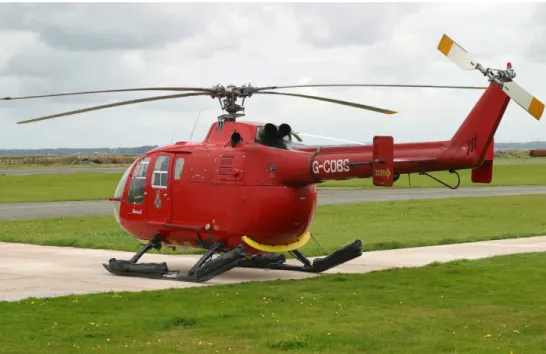
Figure 2.5. MBB BO-105 with a spoiler device implemented2...23
Figure 2.6. Effect of Strakes on the CH-46 helicopter fuselage drag (Keys & Wiesner, 1975)...24
Figure 2.7. Effect of deflectors on helicopters upsweep (Seddon, 1983)...25
Figure 2.8. Schematics of velocity profile and flow around VG at the fuselage upsweep...26
Figure 2.9. “Diagram Sketch” of a zero-mass synthetic jet actuator (Hassan et al, 1998)...27
1 Figures taken from the official website of the project, www.cleansky.eu 2
LIST OF FIGURES
xii
Figure 2.10. US Army/Boeing MDX Active Flow Control wind tunnel model showing jet slot
configuration (Hassan et al, 2005)...28
Figure 2.11. Principle of actuation of a dimple (Dearing et al, 2007)...30
Figure 2.12. Example of a Fenestron installation device on the Eurocopter EC-155B2...32
Figure 2.13. Schematic picture of the NOTAR anti-torque system3...34
Figure 2.14. Sikorsky X-49 concept flight test, based on the S-602...35
Figure 2.15. Image showing common engine installation mounted ahead, on the EC725 (left), and behind, on the S76 (right), of the main transmission2...36
Figure 2.16. EH-101 showing two different types of engine installation2...37
Figure 2.17. Westland World Speed Record G-Lynx in forward flight4...40
Figure 2.18. Sikorsky S-76 in hover condition where is possible to notice the various design particularities of this model2...41
Figure 2.19. The multirole combinations for the Sikorsky X2 Technology Demonstrator5...43
Figure 2.20. Eurocopter AS-365N (SA 365N)2...44
Figure 2.21. Mil Mi-38 during a product exhibition flight2...47
Figure 2.22. Kamov Ka-92 mock-up concept to demonstrate the project guidelines5...48
Figure 3.1. Variation of the fuselage pitch attitude depending on airspeed for three CG positions....51
Figure 3.2. Graph representation of the fuselage pitch attitude, depending on: a) airframe drag, b) fuselage lift, c) horizontal stabilizer lift and d) horse-power required; flying at SL with middle CG position...52
3
Figure taken from the website commons.wikimedia.org/wiki/File:NOTAR_System.svg 4 Figure provided by Agusta Westland
5
xiii
Figure 3.3. Graph representation of the fuselage pitch attitude, depending on: a) airframe drag, b) fuselage lift, c) horizontal stabilizer lift and d) horse-power required; flying at SL with forward CG position...53
Figure 3.4. Graph representation of the fuselage pitch attitude, depending on: a) airframe drag, b) fuselage lift, c) horizontal stabilizer lift and d) horse-power required; flying at SL with after CG position...54
Figure 3.5. Graph representation of the fuselage pitch attitude, depending on horse-power required, for: a) middle CG position, b) forward CG position and c) after CG position; comparing the data obtained between SL and 4000ft...55
Figure 3.6. Graph representation of the fuselage pitch attitude, depending on fuel flow, for: a) middle CG position, b) forward CG position and c) after CG position; comparing the data obtained between SL and 4000ft...56
Figure 3.7. Picture of the port side of the fuselage showing the flush ambient air intake2...59 Figure 3.8. Picture of the avionics cabinet cooling system intake used2...60
LIST OF TABLES
xiv
List of Tables
Table 2.1. Drag audit of an hypothetical, recently designed, heavy-sized helicopter...12
Table 2.2. Drag Breakdown at 216kts with a -6⁰ Fuselage Pitch Attitude (Perry, 1987)...39
Table 2.3. Airframe Parasite Drag Reduction on SA 365N (Roesch, 1980)...46
Table 3.1. Variable input values used to evaluate the Active Horizontal Stabilizer simulation..51
Table 3.2. Presentation of the optimum horizontal stabilizer angle for each flight configuration analysed, with the respective fuel flow and horse-power required and saved...57
Table 3.3. Properties of the Cooling Systems considered for this research...61
Table 3.4. Theoretical improvements that can be made on Cooling Systems, globally and for each group...61
Table A.1. FDS program simulation data for middle CG position at SL...G
Table A.2. FDS program simulation data for forward CG position at SL...H
Table A.3. FDS program simulation data for rearward CG position at SL...I
Table A.4. FDS program simulation data for middle CG position at 4000ft...J
Table A.5. FDS program simulation data for forward CG position at 4000ft...K
Table A.6. FDS program simulation data for rearward CG position at 4000ft...L
1
Chapter 1
INTRODUCTION
1.1 ObjectivesThe purpose of this work is to give an overview through all the technology available nowadays that could help to get a solution for the last major problem faced by the Aeronautic Market, to bring the latest EU demands into reality. In this document, priority will be given to the reduction in airframe drag of medium to heavy-helicopters by gathering all the information available in literature cited. Continuing with this subject, various academic and industry methods are presented to improve the aerodynamic characteristics for the Rotorcrafts.
The next step is to make an analytical research of helicopter efficiency, divided into two main subjects. During the first study, consideration will be given to the possibility of implementing an Active Horizontal Stabilizer that can optimise the pitch attitude during forward flight. The second topic is to examine current diverse Cooling Systems implemented on heavy-sized helicopters with the objective of producing a theoretical way of making one global Cooling System that could improve the overall drag characteristics.
1.2 Clean Sky
Air Transport Systems, nowadays, are one of the most important elements for society, having a decisive role in making the world a global community through interaction of different cultures and promoting economic growth across the globe.
INTRODUCTION
2
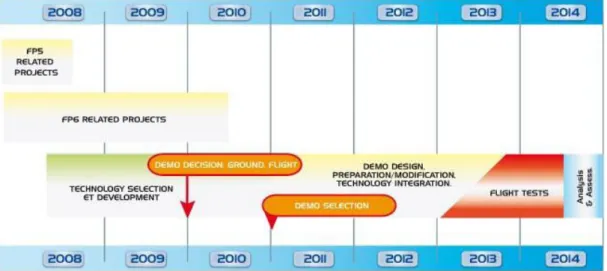
The Clean Sky project is a “Joint Technology Initiative” (JTI)6 which will develop some new technology solutions to reduce the negative impact of the air transport on the environment. This is one of the largest European research projects to date, supported equally by the European Commission and Industry partners with a budget estimated at 1.6 billion Euros, where 160 million of them are intended to the rotorcraft Integrated Technology Demonstrator (ITD), managed over the period 2008-2015, representing 86 organizations and 16 countries. The concepts developed through this initiative will provide technological breakthrough developments and will frame them in market scenarios with solutions tested on Full Scale Demonstrators (established in 2013-14).
Therefore, Clean Sky JTI will try to implement new, radically greener Air Transport products that will:
• Provide a quick response to the Aeronautics Industry in the delivery of technology to markedly improve the environmental impact of the air quality; • Improve the European Industry competitively, in order to contribute to the
European Union objectives;
• Take leadership that serves to inspire the rest of the aviation world to provide greener products.
The next figure represents a diagram of what will be the framework schedule expected for the Clean Sky project, specifying the years with their respective task, giving an overall understanding of this initiative.
6
“JTI is a type of project created by the European Commission for funding research in Europe to allow the implementation of ambitious and complex activities, including the validation of technologies at a high readiness level. The size and scale of JTI requires the mobilisation and management of very substantial public and private investment and human resources.”
3
Figure 1.6. European Commission's Seventh Research Framework Programme
Content
This quick research process, offered by Clean Sky, represents an unprecedented opportunity for accelerated advance in the implementation of green technology in the Aircraft Industry.
During the time granted for this project, technology breakthroughs will be demonstrated and validated in order to make major steps towards the environmental sets by the Advisory Council for Aeronautics Research in Europe (ACARE) – the European Technology Platform for Aeronautics & Air Transport and to be achieved by 2020.
In the figure below are shown the three different goals sets by ACARE to improve the environmental aspect involved on this project, linked with each group of technology domain required to achieve the objectives.
INTRODUCTION
4
Figure 1.7. Environmental goals sets by ACARE
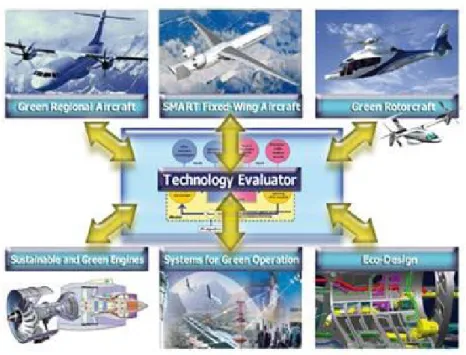
The Clean Sky JTI is made up of six Integrated Technology Demonstrators (ITD):
• SMART Fixed Wing Aircraft: development of an active wing technology and a new aircraft configuration for breakthrough performance;
• Green Regional Aircraft: proposal for low-weight aircraft with smart structures, coupled with low external noise configuration, as well as the implementation of other ITDs technologies (such as engines, energy management and new system architectures);
• Green Rotorcraft: improvements around innovative rotor blades and engine installation for noise reduction, reduced airframe drag, integration of diesel engine technology and advanced electrical systems for elimination of noxious hydraulic fluids and fuel consumption reduction (which constitutes a teaming of Eurocopter/AgustaWestland leader initiative);
• Sustainable and Green Engines: produce five engine demonstrators to integrate technologies for low noise and lightweight low pressure systems, high efficiency, low NOx and low weight cores and novel configurations such as open rotors and intercoolers;
• Systems for Green Operations: attention made to all-electrical equipment and systems architecture, thermal management, capacity to accomplish “green”
5
trajectories/missions and improved ground operations to reach extensive benefits of Single European Sky;
• Eco-Design: focus on green design and production activities, withdrawal, and recycling of aircraft, through an optimized use of raw materials and energies thus improving the environmental impact of the whole products life cycle.
In figure 2.3 is possible to understand the working flow implemented for the interaction between the six independent ITD’s and the simulation facility - Technology Evaluator.
Figure 1.8. Integrated Technology Demonstrator’s
All of the developments will be assessed by the Technology Evaluator, which is a simulation facility that will assess the performance of the technologies following their review. This provides a process of looking at trade-offs, as some technologies may prove to have a more significant impact than others. The evaluation process will additionally enable the program to have coherent, unified and efficient development and structure.
INTRODUCTION
6
Green Rotorcraft
Progressively, rotorcraft operations are growing to meet the demands of the European population. This effect can be seen in the following areas: medical service for safe and quick transport of patients and living organs for transplantation, passenger transport from city heliports to airports, and also between cities or areas where an efficient surface transport network cannot be developed for geographical or economical reasons.
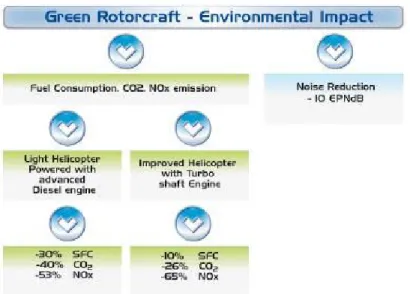
The figure 1.4 outlines the goals to be achieved by the Green Rotorcraft ITD at the end of the Clean Sky project.
Figure 1.9. Areas of Technology Development for the Green Rotorcraft ITD
The Rotor blades designed or modified by the Green Rotorcraft initiative are expected to have enhanced capabilities by passive methods and active control techniques to reduce impulsive air loads and as a consequence, the radiated noise. At the same time, attention will be given to the turbo-shaft engine installation, improved with both the re-design of air intakes and exhaust nozzles to minimize the noise especially in hover and low speed flight conditions.
With the same weight of importance, “cleaner and more efficient power use” provides a need for development of aerodynamic subjects such as:
7
• Design of features on the airframe for the reduction of aerodynamic drag and download in cruise flight conditions;
• Engine integration through the adaptation of Diesel engine technology to light helicopters and turbo-shaft engine installation optimised for minimal power loss; • Innovative electrical systems architectures enabling energy management optimisation on helicopters, implementing generic principles within the Eco-Design ITD.
1.3 Parasitic Power
One of the most important subjects related to helicopter performance is the parasitic power (or parasite drag). During the past years, a major effort has been taken to try to reduce this contribution for “dirty” designs. The parasitic power is known as a power loss generated from the viscous shear effects and flow separation on the airframe, tail, rotor hub, and various other sources on the aircraft frame/structural components. Through the overview of the next graph on Figure 1.5, this source of drag can be very significant as the helicopter advances at higher forward flight speeds, because helicopter airframes are much less aerodynamic than equivalent fixed-wing counterparts.
INTRODUCTION
8
At the present time, it is usual to see values of f (equivalent wetted area or equivalent flat-plate area) - ranging from 10ft2 on light helicopters to 50ft2 on medium/heavy helicopter designs (Leishman, 2006 (1)).
The next figure illustrates the parasite drag portions produced by each component, or group of components, for current production configurations and for new designs.
Figure 1.6. Parasite Drag breakdown for typical 20,000lb single rotor helicopter (Keys & Wiesner, 1975)
The power required in forward flight is also a function of helicopter weight. Normally, the final performance results are represented in terms of gross takeoff weight (GTOW) because the fraction of fuel carried, relative to gross weight, is very small. Thereby, the excess power available becomes progressively less with the increase of GTOW, and it’s more perceptible at lower speeds where the induced power constitutes a larger portion of the total power.
1.4 Engine Installation
Within the helicopter industry, there are three different types of turbine engine installation. For the two first approaches, the engine is mounted either directly ahead or behind the main transmission, depending on if they are frontly or rearly driven
9
respectively; the engines could also be mounted on both sides of the transmission with the addition of angle drive gearboxes. For any of these configurations, there are advantages and disadvantages.
When the turbine engines are mounted forward or aft, an increase on the cross sectional area is avoided to accommodate them, but there are known complications with both inlets and exhausts. It is common to use simple pitot intakes on front mounted engines, but the exhausts end being directed sideways, which incurs an inherent moment drag; the rear mounted engines normally involve double bends in their inlet ducts with attendant power losses.
A different option is to have turbine engines mounted on both sides, which are preferable in terms of accessibility, balance and battle damage points of view. This type of engine configuration does not place any restrictions on the inlet or exhaust design; however this installation tends to increase frontal area and interference drag (particularly on the rotor hub).
Knowledge of the engine fuel burn is always required for an easy understanding of various performance problems, such as the range and endurance type of calculations. Engine performance data are usually expressed in terms of specific fuel consumption SFC (in units of lb/hp.hr or kg/kW.hr) versus shaft power (in units of hp or kW) as it can be seen on Figure 1.6 below.
Figure 1.7. Normalized specific fuel consumption and fuel flow for a notional turbo-shaft engine (Leishman, 2006)
INTRODUCTION
11
Chapter 2
LITERATURE SEARCH
2.1 IntroductionThe current in-service helicopters hold parasite drag levels are far in excess of equivalent fixed wing aircraft. As shown by Keys & Wiesner (1975), a 20,000 lb helicopter would have approximately ten times the parasite drag of a turboprop airplane with the same gross weight, and at a speed of 150 knots this drag accounts for 45 percent of the total power required. Therefore the importance of reducing helicopter cruise power requirements is increasingly evident in light of the higher speed demanded of new helicopter designs and the current energy crisis (Leishman, 2006 (1)).
The graphic represented on figure 2.1 is a way of showing the benefits that can be reached in terms of drag through a proper guideline for drag reduction on future production helicopters.
LITERATURE SEARCH
12
Regarding an actual vehicle design, there are many varied design requirements with associated geometric constraints which may adversely affect the drag. In most cases they are not entirely rigid and may be traded off to a certain extent with the generally conflicting criteria for low drag. Unfortunately, this trade-off may be very difficult to quantify in terms of the estimated drag reduction with its anticipated benefits versus the possible penalties. The capability to adequately examine and quantify the effect of a design change becomes available to the industry through improved mathematical modelling techniques (Williams & Montana, 1975). There are available data on helicopter parasite drag reduction but relatively little flight test data. Although the tunnel data drag reduction experiences already made rarely progresses to production mainly because the customer does not set a very high priority on low drag in his specification (Gatard et al, 1997).
It is widely known that the fuselage is the largest airframe component on a helicopter (although if well designed can have relatively low drag), so its aerodynamic characteristics can have a significant impact on the performance of the helicopter as a whole. Practical constraints, such as the need for rear loading doors, means that the shapes that are typical of helicopter fuselage designs often tends to flow separation and high drag. In addition, the airframe often operates in the main rotor wake, which changes the aerodynamic characteristics compared to those obtained without the rotor (Wilson & Ahmed, 1991).
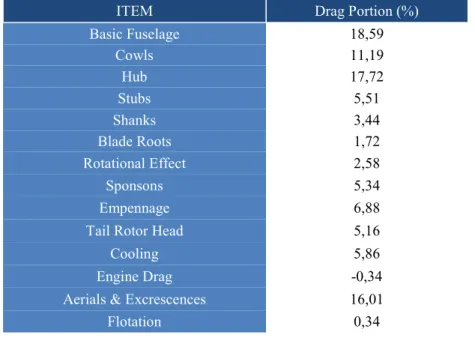
Table 2.1. Drag audit of an hypothetical, recently designed, heavy-sized helicopter
ITEM Drag Portion (%)
Basic Fuselage 18,59 Cowls 11,19 Hub 17,72 Stubs 5,51 Shanks 3,44 Blade Roots 1,72 Rotational Effect 2,58 Sponsons 5,34 Empennage 6,88
Tail Rotor Head 5,16
Cooling 5,86
Engine Drag -0,34
Aerials & Excrescences 16,01
13
Through the overview of the drag audit presented on the table above, on recent production medium to heavy-sized helicopters, it is usual to find fuselage parasite drag values, with all of the components fitted, accounting for 60-70% of the total parasite drag.
A prospective improvement in helicopter capability due to a decrease in drag and a consequent increase in efficiency appears to be very substantial. In addition to the more obvious aspects of increased range, payload, and maximum speed, there are several additional payoffs which are not as apparent. One of these is the reduction in aircraft size and gross weight needed to perform a given one mission. An increase in efficiency due to a reduction in drag produces an associated reduction in power required which in turn reduces engine/drive system size and results in reduced weight. The reduced size and weight further reduces power required, and so on until the design process converges. This multiplicative effect is only possible if a drag reduction is introduced in the early design stages – before the aircraft configuration is frozen (Gormont, 1975); (Hermans et al, 1997).
The consequence of a considerable reduction in parasite drag must be assessed from the point of view of the entire aircraft system. The possible benefits are strongly dependent on the particular helicopter mission/role; for instance, each of the five primary “performance missions” – range, payload, speed, endurance and hover have somewhat separate implications for drag. Adding the performance aspects, there are numerous operational requirements which should also be assessed in terms of drag. Each of these is amenable to design compromise so that the aerodynamic drag can be minimized while still permitting maximum operational effectiveness.
Another critically important factor is the cost trade-off – design / development / production / maintenance and operational costs (which include both direct fuel and fuel logistics costs). It can be demonstrated that, for many missions, it is entirely possible to develop smaller, lighter and cheaper aircrafts by designing for low drag; however, this only happens if a low drag philosophy is implemented in the initial design stage (Duhon, 1975).
One aerodynamicist is always trying to find ways to reduce drag, but his ideas usually cost money and weight. Therefore he has to sell his ideas to the weight and cost people. Any effort to reduce helicopter parasite drag must be evaluated in terms of its
LITERATURE SEARCH
14
effect on the helicopter’s weight, cost to manufacture, and cost to operate. Two factors in the current environment – Design to Cost and the soaring price of fuel – make it more important than ever to look carefully at the value of a particular drag reduction approach. Design to Cost is a factor not only in military procurement, but is also deeply involved in the competitive field of commercial helicopter sales. Therefore any added cost attributed to drag reduction must balance favourably against the overall benefits it brings. Fuel costs, which used to be almost negligible in the total cost of owning and operating a helicopter, are now quite significant, and thus emphasis are added on improving cruise efficiency. Undoubtedly now, more than ever before, the stage is set for a vigorous attack on parasite drag reduction (Stroub & Rabbot Jr., 1975); (Wiesner, 1977).
The most important effect of drag on rotorcraft flight, of course, relates to vehicle performance. Although efforts to minimize drag are directed substantially toward maximizing speed and fuel economy, it is worthwhile, and often essential, to consider the relationship between drag and flight dynamics characteristics.
Given that drag reduction procedure impacts aircraft stability, variations in the vehicle design will probably be indicated to correct the stability modification. Design variations like this should be anticipated so their cost, weight, and other factors can be considered in assessing the merit of the drag reduction procedure.
As soon as analysis and test programs are instigated for the study and improvement of the rotorcraft drag problem, the activities should be conducted to gather the most useful technical information for the cost. For that reason, when an analysis or test is designed specifically to consider drag issues, minimal additional effort would yield extremely useful stability information. Measuring fuselage stability derivatives as part of a drag measurement wind-tunnel test is a good example. In order to carry the stability and control aspects of drag reduction along the projected course, it is first necessary to identify connections between the problems (Hoffman, 1975); (Gleize et al, 2001).
15
2.2 Sources of Performance Loss
2.2.1 Fuselage
Beginning with the Nose Section, the major problem is concerning to the corner radii adopted to any model, in order to achieve a low drag nose shape. Therefore, every time the corner radius to fuselage width ratios reaches values below 0.1, there will be a noticeable increase in drag. In the other way, the Nose Section is relatively insensitive to contour (symmetrical/asymmetrical) from a drag point a view.
In the Cabin Section, when the aircraft flies with negative incidence, the drag rise of a square section is four times greater than a circular. Simultaneously with this, windows and doors located at the Cabin Section can produce drag by themselves if they are not flush with the surface contours.
The chart in the next figure shows two principal theoretical cross-sections with the intention of comparing it with a typical helicopter fuselage shape.
LITERATURE SEARCH
16
One of the most critical sections of helicopters is the After-Body. This region represents the largest drag contributing area of the airframe. Supporting this, if a contraction ratio (l/D - contraction length/equivalent cabin diameter) below 2.0 is reached, will be present a flow separation increasing the after-body pressure drag. Another important design issue to look here is the negative after-body camber (which shifts the fuselage zero angle of attack) and the minimum drag point angle for cruise conditions, because this has a tendency to increase the drag and cruise download (Clar & Wilson, 1980); (Polz & Quentin, 1981); (Seddon, 1982); (Epstein et al, 1994).
Regarding to the overall airframe, any sudden changes in curvature such as rivets or sharp edges around doors are likely to increase parasite drag values due to unnecessary flow separation. Apart from this, all the leakages such as holes and recesses or large size and number of bluff-body surfaces, like fairing designs, will be penalized with a drag increment (Gaudet, 1987).
Another usual source of parasite drag is the Cowls. As these are additional items added to the basic fuselage, they create drag by the increment of the frontal area and change of profile. One common reason for this implementation is for stability purposes, but the main drawback to a full fairing is the increase in mass, along with the complexity of access (growing maintenance time to remove/refit fairings and thus costs). But on the other hand, we can find a high base drag on side mounted engine cowls that could be responsible for almost 50% of general cowling drag.
One of the last design improvements achieved in the wake around the hub is the pylon fairing, which is closely linked to the aerodynamics of the rotor head. Implementing this pylon geometry in the aircraft, the interference drag between hub and fuselage is decreased, but the frontal area of this fairing creates drag by itself (maximizing the adverse pressure gradient when the pylon largest frontal area is before of the rotor hub.
Parallel with the overall design of the airframe, the landing gear is an important item when the parasite drag subject is approached. When the option of implementing a skid gear is taken, additional drag will be added because of the increment on frontal area. Still, the use of this concept is 40% lower in drag than fixed wheeled gear (Harrington, 1954).
A common decision adopted on the latest heavy-sized helicopters is the use of sponsons. But as this item can be seen as a protuberance, it reduces the aerodynamic
17
efficiency of the fuselage adding weight and drag to the airframe. When this component lacks aerodynamic design, large drag penalties will be added to the airframe.
With the same importance, the empennage is another vital design item that needs extremely care . So, the effectiveness of a lifting surface here, such as a fin or a tail plane, can suffer as a result of a gap between the surface and the fuselage or a cut-out in the leading edge. Such is the case when providing ventilation for an intermediate gearbox. Together, where a tail plane or a tail rotor gearbox fairing is located on the fin, particularly if there is an interference with the leading edge, there is a danger of flow breakdown which can reduce fin effectiveness and create excessive drag. Finally, a less careful shape design in the horizontal stabilizer and the vertical fin will increase normal tail download condition and tail rotor fin drag, respectively.
2.2.2 Protuberances
The main problem of this group of items is the quantity that can be found on any modern helicopter, reaching a considerable percentage of parasite drag.
Aerials have a negligible effect on drag individually, but can be significant due to the numerous amounts of them on aircraft. As they, normally, are not taken into account to be aerodynamically efficient, a bad positioning of externally mounted antennas could result in a considerable increment to parasite drag (Lowson, 1980).
This graph presented on figure 2.3 demonstrates the influence of aerials (Antenna) on the helicopter drag, giving the example of two different sections.
LITERATURE SEARCH
18
Figure 2.3. Effect of streamlining on antenna drag (Keys & Wiesner, 1975)
As an optional item for helicopters, the radome is one of the most problematic issues in relation to drag. The main factors affecting radome drag are: a) radome diameter, b) radome depth, c) radome location (aft of nose), d) lower edge radius, e) presence or otherwise of splitter. The factors (a) and (b) are governed by the radome size requirements and little can be done to influence the dimensions. The radome location is usually dictated by practical (structural) considerations but does have a small effect on drag. A radome can cause stability problems by vortex shedding especially when placed under the nose.
In the excrescences, any external component that is not retractable or flush with the fuselage will add drag penalties to the project as with careless undercarriage doors design. For the components located on the exterior of the aircraft that shows considerable frontal area and hence the drag area, as well as incorrect positioning, will create instabilities in the design and therefore increasing drag. The airflow over the fuselage varies considerably in speed from one location to another. The same item fitted in a region of high speed flow will create far more drag than if it were fitted in a region of slow moving air (Greenwell, 1997).
When one helicopter model is designed for Navy roles, it is common to incorporate a flotation system. Normally this system is divided in four inflatable bags,
19
two on both aft sides and another two on either sides of the nose. Therefore, when these components are not fitted flush on the airframe, they increase the pressure drag. In external applications, there will be drag penalties for the changed structural design shapes.
2.2.3 Cooling Systems
One of the most important matters for all the mechanical and electronic components in the aircraft is the cooling systems. Environmental Control Systems (ECS) of the aircraft require ducts to drain the air, which will tend cause spillage and ram drag, and at the same time there is potential for drag to be caused by the exhaust system of the cooling but the effect will vary based on the direction of the outlet. One of the best examples to verify this effect is on the cooling intake and exhaust areas for the intermediate and tail rotor gearbox mounted on the empennage, where excessive intake areas will penalize the design with excessive spillage and ram drag.
2.2.4 Engine Installation Performance
It is well known that the engine installation on helicopters is a very sensitive method, where any decision has pros and cons. Depending on size and number of engines that one model can include, there are various different configurations that can be adopted on the upper surface of the airframe, but parasite drag will be increased for any of those configurations at least by bigger frontal area influence. Location is also important to obtain sufficient flow and avoid the ingestion of hot air from exhausts or cooling outlets, therefore increasing the power losses (Perry, 1979).
The performance around engine installations on helicopters airframe generally results in deteriorated properties when compared to the engine manufacturer’s performance specifications. It is normally settled that the engine installation losses can be divided into inlet losses, exhaust losses, and losses due to bleed air extraction (Stepniewski & Keys, 1984). A succinct discussion of each of these three subjects is presented next:
LITERATURE SEARCH
20
• Inlet losses usually occur with either a rise in temperature or a pressure drop at the inlet. During hover flight, the principal effect is the temperature rise due to the recirculation of hot exhaust gases which happens mainly in ground effect. It is also seen that, for installations with the gearbox located in front of the inlet, a noticeable rise in inlet air temperature can be identified. Pressure losses generally result from flow disturbances or separation at, or ahead of, the inlet; this is especially noticed in forward flight, where flow separation may end in sizeable pressure losses; however, these losses are often offset by a decrease in flow velocity and an increase in air pressure as it enters the inlet (ram recovery). When particle separators or screens are installed, additional considerable losses may occur both in hover and forward flight.
• Exhaust losses are commonly caused by backpressure normally resulting from a redirection or rerouting of the exhaust air flow, from the installation of equipment such as an infrared suppressor, or from nozzeling to reduce parasite drag.
• Extra losses are added to the installation if bleed air is extracted from compressor for anti-ice protection of the engine inlets when operating under cold ambient temperatures or for cabin or cockpit air-conditioning systems under hot ambient conditions.
The engine installation losses are minimized for designs having podded engines because the engines are essentially detached from the airframe. With flight test data experiences, the power losses for this type of installation are generally less than one percent. Consequently, the one-percent loss assumed that there is no increase in the power available due to ram recovery effects in forward flight.
The presumably loss of power due to the inlet pressure drop (as a result of engine installation) also leads to a consequent decrease in fuel flow. Typically, a loss in pressure will result in a reduction in fuel flow of 0.5 percent or less for each one-percent decrease in power available, thus resulting in a net increase in SFC. On the other side, a temperature rise will produce approximately equal power and fuel flow reductions without any net SFC change.
21
2.3 Performance Improvements Methods
2.3.1 Passive Drag Reductions
2.3.1.1 Design Aspects
In order to achieve an optimal airframe concept, there are several practical design guidelines to follow so the helicopter can be as efficient as all the means available nowadays allows it to be. Therefore, will be presented next a group of particularities that can make the difference on the design:
• The corner radii of the nose shape should be kept with corner radius to fuselage width ratio below 0.1 in order to avoid drag increments;
• It is preferable to use a cabin cross-section almost circular, so the drag rise can be minimized when the aircraft face negative fuselage incidences;
• Windows and doors should be flush with the surface contours and door tracks recessed to reduce the flow discontinuities along the fuselage;
• Make a carefully tapering of the after body lines gradually to avoid flow separation, contraction ratio of at least 2.0 is required to obtain minimum after-body pressure drag;
• Effort should be made to avoid negative after-body camber (shifts the fuselage zero angle of attack) and the minimum drag point to more positive angles because it tends to increase the drag and download on cruise conditions;
• Any sudden changes in curvature such as rivets, or sharp edges around doors, should be implemented as flush as possible;
• Attention should be given to leakages such as holes and recesses, size and number of bluff body surfaces and fairing designs of high frontal area;
• In terms of airframe aerodynamics, ideally, the landing gear should be implemented as retractable with flush covering doors so no drag can be associated to it;
• Inverse cambered horizontal stabilizer and a cambered vertical fin to minimize drag of the normal tail download condition and the tail rotor fin combination, respectively, in cruise flight;
LITERATURE SEARCH
22
• Try to fit in some aerials embedded in the tail plane or even change their cross section would reduce their aerodynamic impact;
• The use of fairings and selective positioning can result in a sizeable drag reduction on protuberances because for components located on the exterior of the aircraft it is good practice to minimise the frontal area and hence the drag area, and it is also a good idea to place components behind one another so that the latter excrescence is in the wake of the preceding;
• Any component that is external to the fuselage should ideally be retractable into the fuselage, the undercarriage should be retractable as well and should be used undercarriage doors to minimize drag even further;
• The Flotation System should be as flush as possible through the fuselage in order to don’t produce pressure drag;
• The inclusion of a splitter, located behind the radome, reduces drag and gives better, steadier flow behind the radome.
2.3.1.2 Spoiler
As an additional item (excrescence), the Spoiler is a device mainly used for stability purposes, deflecting the turbulent fuselage wake away from the tail plane increasing their directional stability and consequent effectiveness. Another consequence obtained from it, is a positive camber effect that can be beneficial for drag. Normally this device is located at the after-body region, where upsweeping is due to start. Because of the added lifting effect of the spoiler at cruise speeds, this creates nose down moments which, unless another devices are added to counteracts, could lead to an undesirable effect.
The next figure represents the aerodynamic study made on the spoiler implementation for the BO-105, in terms of drag and lift.
23
Figure 2.4. Effect of BO-105 spoiler on lift and drag during cruise flight (Keys & Wiesner, 1975)
While negative camber provides an unfavourable increase in drag, positive camber can be employed to shift the drag bucket to a desired nose down cruise angle of attack. An industry example is the spoiler installation on the BO-105, which was designed to deflect the turbulent fuselage wake and trailing vortices away from the tail rotor, thereby improving directional stability. This installation consists of a 2 ft2 flat plate mounted on the lower portion of the fuselage. As shown in the following Figure x, the positive camber effect caused by this installation reduced the fuselage drag by an amount equal to the pressure drag of the spoiler, and resulted in no drag penalty at the -7o cruise angle of attack.
The image shown on figure 2.5 is the rear view of the BO-105 where is possible to notice the yellow spoiler device, implemented on the upsweep.
LITERATURE SEARCH
24
Figure 2.5. MBB BO-105 with a spoiler device implemented
2.3.1.3 Strake/Deflector
There are two additional techniques to reduce the drag of cambered rear loading after-bodies, which are the installation of strakes and the use of deflectors.
Strakes have the purpose to reduce drag by forcing the two fuselage vortices formed by the intersection of air from the side and bottom of the after-body off the surface and downstream. The suction created by vortices is reduced by displacing them from the surface. Drag reductions associated with strake installations were verified during wind tunnel tests of a CH-46 and a Belfast CMK1. As can be seen in Figure x, presented on a research work made by Boeing Vertol Company*, the implementation of Strakes provide approximately 8% of drag reduction to the basic fuselage, and at the same time gives also an improvement in directional stability (Keys & Wiesner, 1975).
The next figure shows the benefits taken from the implementation of strakes on heavy-sized helicopters (CH-46), in order to reduce the fuselage parasite drag.
25
Figure 2.6. Effect of Strakes on the CH-46 helicopter fuselage drag (Keys & Wiesner, 1975)
Another interesting study is the one developed by John Seddon. This work performed and investigation into strakes on a Lynx fuselage and concluded that the results were unimpressive. However, with the use of deflectors, the results were much better and the experiment revealed that there was no change between vortex and eddy flow causing a larger drag. These deflectors are of small profile and likely to be of reduced mass. The increase in drag shown in the figure below for the results without the deflectors is due to the change in flow type, which with deflectors can be seen that the change in flow type, between vortex and eddy flow, does not occur (Seddon, 1983).
In the figure below can be seen a chart obtained by an aerodynamic analysis performed in order to understand the benefits taken from the use of deflectors on helicopters upsweep.
LITERATURE SEARCH
26
Figure 2.7. Effect of deflectors on helicopters upsweep (Seddon, 1983)
2.3.1.4 Vortex Generators
In this section will be presented a research on aerodynamic drag reduction, made by Mitsubishi Motors, to a roof end in a sedan vehicle and then easily adapted to the helicopter example.
Since the aircraft height to the lower region of the aircraft, in the after-body section, becomes progressively higher as the flow moves upstream, an expanded airflow is formed here. This causes the upstream pressure to low, which in turn creates reverse force acting against the main flow and generates reverse flow at upstream point C. No reverse flow occurs at point A located further downstream of point C because the momentum of the boundary layer is prevailing over the pressure gradient (dp/dx). Between points A and C, there is separation point B, where the pressure gradient and the momentum of the boundary layer are balanced. As shown in Figure x, in the lower zone close to the aircraft’s surface within the boundary layer, the airflow quickly loses momentum as it moves upstream due to the viscosity of air. The purpose of adding VGs is to supply the momentum from the lower region where as large momentum to higher region where has small momentum by stream wise vortices generated from VGs located just before the separation point, as shown in Figure x. This allows the separation point to shift further upstream. Shifting the separation point upstream enables the expanded
27
airflow to persist proportionately longer, the flow velocity at the separation to become slower, and consequently the static pressure to become higher. The static pressure at the separation point governs over all pressures in the entire flow separation region. It works to reduce drag by increasing the back pressure. Shifting the separation point upstream, therefore, provides dual advantages in drag reduction: one is to narrow the separation region in which low pressure constitutes the cause of drag; another is to raise the pressure of the pressure of the flow separation region. A combination of these two effects reduces the drag acting on the aircrafts (Koike et al, 2004).
The next figure schematizes the boundary layer behaviour at a body upsweep and then shows the effect of the streamwise vortex generated by the VG.
Figure 2.8. Schematics of velocity profile and flow around VG at the fuselage upsweep
However, the VGs that are installed for generating streamwise vortices bring drag by themselves. The actual effectiveness of installing VGs is therefore deduced by subtracting the amount of drag reduction that is yielded by shifting the separation point downstream. Larger-sized VGs increase both the effect of delaying the flow separation and the drag by itself. The effect of delaying the flow separation point however, saturates at a certain level, which suggests that there must be an optimum size for VGs.
Within this area, there are various shapes that can be implemented as VGs. But it is normal to found two main usual shapes: delta-wing and bump shaped. For the literature used in this report, we can assume that the delta-wing shaped VGs are the more effective, and it can be explained as follows: delta-wing-shaped VGs have a smaller frontal projection area, which means that they themselves create smaller drag.
LITERATURE SEARCH
28
Moreover, the vortex generated at the edge of a delta-wing-shaped VG keeps its strength in the flow upstream of the edge since it barely interferes with the VG itself because of the VG’s platy form. With the bump shaped VGs, on the other hand, the vortex is generated at a point close to the upstream edge of the bump, which causes the vortex to interfere with the bump and lose its strength.
2.3.2 Active Drag Reductions
2.3.2.1 Synthetic Jet Actuators
Currently, it is easy to find helicopters that are designed for specific mission profiles but not purely optimised for aerodynamic efficiency. For instance, helicopters that have utility ramps usually have an upsweep at the rear of the fuselage limiting how streamlined the helicopter could be. Synthetic jet actuators located on the rear of the fuselage, for example, could be used to improve the airflow around the upsweep. The SJA’s control the flow by taking in air of low momentum and ejecting it at high momentum thus accelerating the transition from laminar to turbulent flow, the advantage of these devices is that they require no extra plumbing to supply the air as the actuator sucks in the fluid itself, however power will have to be supplied to the device (Hassan et al, 1998); (Ben-Hamou et al, 2007). The diagram below is a representation of a typical SJA; however they can vary in size and geometry.
The figure below exemplifies the diagram of a zero-mass (theoretical) synthetic jet actuator with its resultant mode of operation.
29
Figure 2.9. “Diagram Sketch” of a zero-mass synthetic jet actuator (Hassan et al, 1998)
A research paper by Boeing looked into the application of these actuators on a helicopter fuselage with the objective of reducing both the aft fuselage cruise download and drag. Boeing tested these actuators by placing 12 horizontal and vertical slots on the rear of the fuselage.
The figure 2.10 shows the rear view of the US Army/Boeing MDX wind tunnel model where can be seen the synthetic jet actuators configuration adopted on the rear fuselage upsweep.
Figure 2.10. US Army/Boeing MDX Active Flow Control wind tunnel model showing jet slot configuration (Martin et al, 2005)
LITERATURE SEARCH
30
The Boeing used the idea that a number of SJA’s can be operated collectively or independently to control the natural flow separation and reduce the drag caused by the after-body upsweep. The speed of the flow and the number of active slots would be controlled by a computerized system based on a function of flight conditions the helicopter is experiencing at that time.
Wind tunnel results found up to 10% drag reduction and 40% reduction in cruise download, which Boeing state outweighs the additional components required for SJA’s, this percentage value is related to the baseline drag coefficient for the fuselage and hub including interference. However work needs to be done on scaling this to a full size helicopter, as an investigation would need to look into suitable actuators and location configurations could be less optimal than others. Utilising the full potential of SJA’s would therefore require both a lot of wind tunnel and the use of CFD testing for different fuselage configurations, a badly configured system, could potentially result in undesirable performance characteristics and provide a detrimental effect due to the added mass of the system. This testing would likely be costly and has perhaps prevented previous attempts to look into the problem. Advanced CFD methods such as RANS solutions, are going some way to making the use of CFD a viable option, however this would require a good level of confidence in the output of the CFD before it can reduce significantly the amount of wind tunnel testing, which would require a thorough validation of the technique (Martin et al, 2005).
For commercial impact understanding, the University of Manchester performed an investigation into optimizing the scaling of the system for an Airbus aircraft for use with increasing maximum lift. Their conclusions found that, over the ¼ chord flap, the weight of the actuators was 34kg and power generation produced an effective 6kg, with other components creating a total of 50kg. It should be noted however that a helicopter would be much smaller than the Airbus, therefore the area that SJA’s are placed on the helicopter would likely be less than the Airbus, actuation velocity will also likely be less (0.3 mach tested by Boeing is roughly 100m/s), therefore the power required and additional mass will likely be much less than the Airbus. Their SJA’s, at the optimal 70m/s, were shown to produce 15% efficiency with 1.08W electricity to 0.168W mean
31
fluid power at 2.5Khz of frequency (maximum 130m/s 3W power, produced 7% efficiency) (Gomes et al, 2006).
2.3.2.2 Active Dimples
Recently presented on an Imperial College paper, this topic looked into the use of active dimples through electro active polymers, with the eventual idea of using it in airframe structures. The basic principle of electro-active polymers is that they can produce immediate vortex generator’s, by the use of controlled circular diaphragm on the surface of the polymer that displaces downwards upon activation. This leads to a reduction in the skin friction, by injecting high momentum fluid into the lower part of the boundary layer.
The image represented in the figure below is a scheme that shows the principle of actuation of a dimple.
Figure 2.11. Principle of actuation of a dimple (Dearing et al, 2007)
This technology can therefore be used to control the flow separation experienced with bluff body’s (rear upsweep as an example) by manipulation of the critical Reynolds number. Due to the system being active, the height of the EAP’s can be altered therefore controlling the point where flow separation occurs. This can then produce a single vortex of known strength for a required amount of time. As the skin
LITERATURE SEARCH
32
friction is sensitive to the height of the dimple, an active system would need to be employed. Another reason for an active system is that it is stated within the paper, that dimples are most efficient in a transient state, supplying energy to the system. The system can be an open loop system, however a closed loop control system would be ideal as there would be feedback into the system with use of sensors.
This research paper concluded that, although it is still in its infancy, this concept appears suitable for flow applications in realistic environments. The results showed that of the vertical sided and smooth dimples, the former generate a pair of persistent horseshoe vortices that have common flow towards the surface. It should be noted that such a system would create extra stresses and strains up to 500KPa for a 30% strain; this would need to be taken into account in structural design phases. It concluded that the vertical-sided dimples are more likely to be appropriate for open-loop forcing applications such as flow separation control; however these would be harder to implement as the feedback would need to be analysed. However, due to the nature of vortices, the current actuators are not responsive enough, and therefore a closed-loop control system would give better results. If such a system were to be implemented into an aircraft fuselage, the ideal placement would likely be before an upsweep (Dearing et al, 2007).
However Wind Tunnel testing would require the use of different sizes of EAP’s, therefore this would bring about scaling problems for use on a full scale helicopter. There would likely be an added weight and additional power required for the actuators. This would need to be assessed against the drag benefits to understand if such a design would be beneficial.
2.3.3 Anti-Torque Control Systems
2.3.3.1 Fenestron
Shrouded or ducted fan anti-torque designs, which are known as “fenestrons”, “fan-in-fin”, or “fantail” designs, have been frequently considered over conventional tail rotors, especially for smaller and lighter helicopters, partly for aerodynamic improvement.
33
The figure below illustrates an industry example for the Fenestron installation device, on EC-155B.
Figure 2.12. Example of a Fenestron installation device on the Eurocopter EC-155B
The Fan-in-fin designs have lower power requirements than an open tail rotor to produce the same amount of thrust. Alternatively, this means the fan-in-fin design can give the same anti-torque and yaw authority with a smaller and perhaps lighter design compared to a conventional tail rotor.
In forward flight the fan-in-fin is shielded from the external flow and the main rotor wake and, consequently, its performance is usually more predictable. The vertical fin surrounding the fan is designed to provide a side force in forward flight and so most of the anti-torque. The aerodynamics of “sense of rotation” and the interference effects of the assembly, which are important for conventional tail rotor, are less important for the fan-in-fin design. However, the possibility of flow separation at the inlet lip of the shroud must be kept in mind, and usually the lip is carefully contoured to avoid such effects (Vuillet & Morelli, 1986).
From a safety perspective, the shrouded nature of the fan-in-fin reduces the possibilities of blade strikes during low-altitude flight operations and also the risk of injury to personnel on the ground.
LITERATURE SEARCH
34
The larger number of blades on a fan-in-fin design increases the frequency of the rotor noise and this can appear in the helicopter noise spectrum over a range of frequencies to which the human ear is more sensitive. However, at greater distances these higher frequency sounds are more readily absorbed in the atmosphere. Efforts to reduce the noise of fan-in-fin designs through phase modulation using unequal blade spacing have made the fan-in-fin sound subjectively less noisy.
Such a system has the particularity of reducing the frontal area, when compared to a conventional Anti-Torque Control System, and consequently reduce the parasite drag values.
2.3.3.2 NOTAR
There are a number of no tail rotor solutions (NOTAR) that have been developed for helicopters and these can potentially operate in two ways.
The first uses the airflow that is blown onto the tail boom by the main rotors. This is ducted into a system where a variable pitch fan powered by the main gearbox, gives rearward momentum to the airflow, which is exhausted at the end of the tail boom. Using Coanda effect, the airflow passes over the tail boom producing a net force in an anti-torque direction, thus acting as a tail plane. However this system is likely to cause a larger download.
An alternative system is exhaust based and uses main engine exhaust to power an anti-torque capability at the end of the tail boom. Of these two, the exhaust solution would likely be optimal; it uses the engine power more efficiently (20% had been quoted previously for tail rotor power) and there would be no extra download caused by the requirement for an extra air duct. However the problem would likely come from the control system point of view, as the main rotor thrust is not proportional to the tail rotor thrust at all speeds, also there would likely be an added mass due to extra plumbing. This could perhaps be remedied by vectoring the exhaust thrust; this would require a complex and robust design. However, it would likely produce optimal results (Sampatacos et al, 1983).
35
In figure 2.13 is presented a schematic picture of a NOTAR anti-torque system implemented on the MD500, with description of the direct components involved in the installation.
Figure 2.13. Schematic picture of the NOTAR anti-torque system
Of the two methods, the airflow based one is the only one developed and proven with McDonald Douglas MD520/600/900 proving the concept. These aircrafts also benefit from improved safety and improved vibration and noise performance; however they have reduced lifting capabilities.
Should be kept in mind that in this concept, no added drag will be addressed to the aircraft because of the use of an hidden anti-torque control system (relatively to an external flow frontal area).
LITERATURE SEARCH
36
2.3.3.3 Vectored Thrust Ducted Propeller System
An alternative system that has been developed is a vectored thrust ducted propeller system in the X-49 (Sikorsky Concept). This essentially turns the tail rotor in a rearwards direction, and produces an anti-torque force via the addiction of a rudder.
In the figure below is presented the Sikorsky X-49 concept during a flight test, in forward flight attitude, where is possible to see the two most significant adaptations, the vectored thrust ducted propeller system placing the tail rotor and an additional pair of wings mounted in the fuselage.
Figure 2.14. Sikorsky X-49 concept flight test, based on the S-60
The theory is that the required anti-torque force produced by a tail rotor at higher speeds is reduced; therefore more engine power is directed towards the main rotor. With a ducted propeller system however, the rudder will simply straighten up producing a more forward thrust as well as reduced anti-torque force. The ducted propeller system will lead to less engine power used for lift and more for thrust, so the aircraft would likely fly at a more positive incidence. The reduction in lift led to the need for larger wings on the X-49. At high speeds the helicopter may produce superior results as there