F
ACULDADE DEC
IÊNCIASD
EPARTAMENTO DEB
IOLOGIAA
NIMALFACTORS AFFECTING THE ABUNDANCE OF THE LITTLE
BUSTARD TETRAX TETRAX: IMPLICATIONS FOR
CONSERVATION
JOÃO PAULO CAMPBELL ALVES DA SILVA
DOUTORAMENTO EM BIOLOGIA
ESPECIALIDADE DE ECOLOGIA
F
ACULDADE DEC
IÊNCIASD
EPARTAMENTO DEB
IOLOGIAA
NIMALFACTORS AFFECTING THE ABUNDANCE OF THE LITTLE
BUSTARD TETRAX TETRAX: IMPLICATIONS FOR
CONSERVATION
JOÃO PAULO CAMPBELL ALVES DA SILVA
TESE ORIENTADA POR:
PROFESSOR DOUTOR JORGE MANUEL MESTRE PALMEIRIM
DOUTOR FRANCISCO MANUEL RIBEIRO FERRARIA MOREIRA
DOUTORAMENTO EM BIOLOGIA
ESPECIALIDADE DE ECOLOGIA
Recommended citation of this thesis:
Silva, J.P. 2010. Factors affecting the abundance of the little bustard Tetrax tetrax: Implications for conservation. PhD Thesis, University of Lisbon, Lisbon, Portugal.
This research was funded by Fundação para a Ciência e Tecnologia, through a PhD grant (SFRH/BD/28805/2006).
A presente tese apresenta resultados de trabalhos já publicados ou submetidos para publicação (capítulos 2 a 5), de acordo com o previsto no nº 1 do artigo 41º do Regulamento de Estudos Pós-Graduados da Universidade de Lisboa, publicado no Diário da República II série nº 209, de 30 de Outubro de 2006. Tendo os trabalhos sido realizados em colaboração, o candidato esclarece que participou integralmente na concepção dos trabalhos, obtenção dos dados, análise e discussão dos resultados e redacção dos manuscritos dos artigos, com excepção do artigo V do capítulo 3, em que não participou na recolha dos dados, e do artigo VI do capítulo 5, em que não liderou os aspectos de análise dos dados.
Tendo em conta que esta tese integra diversos artigos científicos, o padrão de formatação apresentado em cada um varia de acordo com as normas de cada revista em que os artigos se encontram publicados, submetidos ou em preparação para serem publicados.
Lisboa, 2 Setembro de 2010
A
GRADECIMENTOSAntes de mais quero agradecer aos meus orientadores, Francisco Moreira e Jorge Palmeirim, por terem aceite orientar este doutoramento. Em particular tenho a agradecer o vosso apoio e disponibilidade, o pragmatismo, a criatividade demonstrada e espírito sempre construtivo ao longo da tese. É um imenso prazer trabalhar com vocês.
À Beatriz Estanque pelo companheirismo, dedicação e boa disposição ao longo do trabalho de campo dirigido às fêmeas de sisão; esse sentido de orientação nos transectos foi determinante.
Aos proprietários que, sem excepção, mostraram sempre boa vontade e livre acesso às suas propriedades. Tenho a agradecer aos Srs. Victor e Francisco Castanho, o Sr. Moura, os Srs. Barradas e Caixeirinha, ao Engº Gonçalves. Um apreço especial aos Srs. Rodrigues e Ramalho pela enorme alegria e interesse com que “acolheram o pessoal dos pássaros”.
A todos os que ajudaram no trabalho de campo, a vossa energia e entusiasmo foram determinantes para o sucesso do trabalho: Joana Galego, Ana Pereira, Luís Venâncio, Elisabete Freitas, Vanessa Gil, Anais André, Nuno Faria, Nigel Collar, Miguel Saragoça, Raquel Pingo, Pedro Pereira, Leonor Martins e aos meus sobrinhos Laura e João Maria.
A todo o pessoal que colaborou no projecto Life Sisão, pela possibilidade de utilizar os dados aí recolhidos: Domingos Leitão, Miguel Lecoq, Francisco Moreira, Márcia Pinto, Eduardo Santos; Teresa Catry, Rui Pedroso, Ivan Prego, Inês Henriques, Ana Delgado e Patrícia Silva.
Agradeço aos meus colegas de doutoramento Ana Rainho, Ricardo Correia e Ana Leal pelo entusiasmo com que sempre me acolheram na Faculdade e pela disponibilidade em ajudar. Obrigado Ana pela prontidão em rever textos à última da hora.
À Sara e Rui, companheiros de longa data, pela vossa prontidão em ajudar e pelos textos revistos. Obrigado pela vossa amizade, o vosso apoio e entusiasmo foram fundamentais em muitas ocasiões.
revisão da tese.
Ao Luís Venâncio quero agradecer o companheirismo, o interesse e amizade ao longo destes últimos anos.
À Márcia Pinto, pelo entusiasmo que sempre demonstrou ao longo da tese, pelas notas da fenologia do sisão e por ter partilhado, vezes sem conta, a imensa experiência com as estepárias.
Ao António Mira pela permanente disponibilidade, pela ajuda com a estatística e outras dúvidas de fundo.
Ao Pedro e à Ana pelo interesse e incentivo que sempre demonstraram.
Ao Nigel Collar pela sua amizade, disponibilidade e pela excelente revisão do artigo. Aos meus chefes do ICNB, Armando Carvalho, Fernando Queirós e Maria da Paz, pela compreensão e flexibilidade que sempre demonstraram ao longo deste projecto. Aos meus colegas do ICNB, Paula, João, Luís e Franco, que ficaram sobrecarregados com a minha saída, obrigado pela vossa compreensão.
À minha sogra, pelo interesse e vontade em ajudar e pelo desenho da figura 1, “requisitado” à última da hora.
Aos meus pais e irmã pelo interesse, apoio e incentivo que foram mostrando ao longo deste percurso.
Resumo ……….. 9
Abstract ……… 13
Chapter 1 - General introduction ... 14
1.1. Habitat selection studies at different scales: Importance for conservation ... 15
1.2. The little bustard: general overview ... 18
1.2.1. Worldwide and national distribution ... 18
1.2.2. Breeding system ... 22
1.2.3. Habitat preferences ... 23
1.2.4. Movements along the yearly cycle ... 24
1.2.5. Population trends and major threats ... 26
1.3. Aims and outline of the thesis ... 28
1.4. References ... 31
Chapter 2 - Large scale pattern of occurrence of the little bustard in Portugal …….... 39
Paper I - Landscape-level inference of habitat composition and bird densities in Iberian steppes: Do little bustards prefer heterogeneous landscapes?... 41
Chapter 3 - Little bustard breeding habitat selection ... 65
Paper II - Higher breeding densities of the threatened little bustard Tetrax tetrax occur in larger grassland fields: implications for conservation ... 67
Paper III - Patterns of grassland use by female little bustard during lek attendance, nesting and brood-rearing ... 85
Chapter 4 - Little bustard post-breeding habitat selection ………. 107
Paper IV - Summer habitat selection and abundance of the threatened little bustard in Iberian agricultural landscapes ……… 109
Paper V - Habitat selection of the little bustard during the beginning of an agricultural year………... 129
Chapter 5 - Effects of high tension power lines on little bustard breeding densities . 143 Paper VI - Estimating the influence of overhead transmission power lines and landscape context on the occurrence of little bustard Tetrax tetrax breeding population ………... 145
Chapter 6 - General discussion ... 176
6.1. Habitat selection at different scales and along the yearly cycle ………….. 177
6.1.1. Regional landscape scale ………... 177
6.1.2. Plot scale ………... 178
6.1.3. Micro-habitat scale ………... 180
6.2. Implications for little bustard conservation .………. 180
6.3. Conclusion ……… 182
6.4. Future challenges for research .……… 183
O sisão Tetrax tetrax é actualmente uma das aves mais ameaçadas da Europa, dependendo, em larga medida, dos meios agrícolas extensivos para a sua sobrevivência. Apresenta uma distribuição Paleárctica muito fragmentada, abrangendo, de forma descontínua, uma vasta área que se estende desde a Península Ibérica e Marrocos até ao Cazaquistão, Nordeste da China e Este da Mongólia. A Península Ibérica alberga mais de metade da população mundial, encontrando-se principalmente associado aos sistemas cerealíferos extensivos. Em Portugal a distribuição do sisão coincide principalmente com a região do Alentejo, onde ocorre nas densidades mais elevadas conhecidas para a espécie, tanto à escala local como regional. As causas do seu declínio estão principalmente associadas à perda de competitividade económica dos sistemas agrícolas de que dependem, sendo por isso altamente susceptíveis à perda ou degradação do habitat resultante de processos de intensificação agrícola nos solos mais produtivos, ou de abandono ou florestação nos solos menos produtivos. Estudos recentes também têm evidenciado outras problemáticas associadas à conservação desta ave como sejam a colisão com linhas aéreas de distribuição e transporte de energia e a influência das questões climáticas nas densidades de machos reprodutores.
Esta dissertação tem por objectivo contribuir para o conhecimento dos requisitos de habitat do sisão em áreas bem conservadas, num contexto de alta densidade. Foi prestada particular atenção à avaliação das suas preferências de habitat a diferentes escalas que possam reverter em efectivas medidas de gestão da espécie.
Os padrões de ocorrência do sisão durante o período reprodutor foram estudados à escala regional da paisagem, no capítulo 2. Em particular, procurou-se testar a hipótese de que o factor que mais contribui para a ocorrência de maiores densidades de sisão é a disponibilidade do uso preferido (pousios e pastagens) e não a diversidade da paisagem e pequena propriedade, como tem vindo a ser descrito pela maioria dos trabalhos realizados com a espécie em Espanha e França. De facto, em Portugal, ao contrário dos outros países, são registadas densidades muito elevadas num contexto de grande propriedade, o que faz supor que esta questão não está totalmente compreendida e que varia geograficamente. As densidades de sisão foram estudadas em 81 áreas (medindo em média 2900 ha cada), abrangendo uma porção considerável da sua distribuição em Portugal. Os índices de composição da paisagem foram calculados para cada área e as suas relações com a densidade de sisões foram
10
facto, as maiores densidades foram de facto encontradas em paisagens mais homogéneas, onde se observava uma maior proporção de pousios e pastagens. As áreas mais heterogéneas foram associadas à intensificação agrícola, e revelaram-se menos adequadas à espécie. Este estudo põe em evidência a necessidade de políticas agrícolas que assegurem a manutenção de vastas áreas de pousio ou pastagens nas regiões dominadas pela grande propriedade.
Os machos e fêmeas de sisão foram estudados à escala da parcela no capítulo 3. Procurou-se entender de que forma o tamanho da parcela de pousio/pastagem e respectiva estrutura da vegetação fazem variar a presença/ausência de machos e fêmeas assim como a densidade de machos. No caso das fêmeas ainda se procurou compreender como variavam as densidades e as preferências de habitat ao longo da época de reprodução e a diferentes escalas. Para o efeito distinguiram-se três fases: i) visitação dos leks; ii) nidificação e iii) famílias. Foram estudados os pousios/pastagens afastados de factores de perturbação humana, tais como casas habitadas e estradas alcatroadas. A área de estudo abrangeu uma área de 360 km2, no Alto Alentejo e
incluiu três Zonas de Protecção Especial (ZPE) com elevadas densidades de machos territoriais. As parcelas de pousio/pastagem foram modeladas em função da presença/ausência de machos e fêmeas usando a regressão logística. Numa segunda fase, modelaram-se os pousios/pastagens em função da densidade de machos, usando apenas as parcelas onde foi registado a sua presença. Os modelos logísticos resultantes para machos e fêmeas foram coincidentes: preferem as parcelas maiores, que apresentam uma estrutura da vegetação baixa. De facto, a localização dos ninhos foi encontrada significativamente na proximidade dos machos, possivelmente como consequência de uma estratégia de anti-predação. O tamanho da parcela foi a única variável que influenciou a densidade de machos, contudo este resultado deve ser interpretado no contexto das parcelas que são favoráveis à sua ocorrência e portanto apresentam uma estrutura da vegetação compatível com a sua actividade reprodutora. O facto de se ter encontrado uma maior heterogeneidade da altura da vegetação, em parcelas maiores, parece favorecer a ocorrência simultânea de ambos os sexos, uma vez que apresentam requisitos de micro-habitat distintos. Por último, foram encontradas diferenças significativas nos requisitos das fêmeas, ao nível do micro-habitat, nas diferentes fases do período reprodutor, pelo que a heterogeneidade verificada nas parcelas maiores parece favorecer igualmente a ocorrência de fêmeas ao longo do período de reprodução. Desta forma deve ser dada prioridade em termos de conservação, às propriedades com as parcelas maiores, deve-se garantir um
de sisão e ainda equacionar junto dos proprietários a manutenção da maior área contínua de pousios/pastagens possível.
Durante o período pós-reprodutor entre o Verão e o Outono (capítulo 4), o sisão foi estudado também à escala da parcela, mas agora com o objectivo de compreender os factores que influenciaram a sua ocorrência, numa altura do ano onde é esperado que a disponibilidade alimentar diminua significativamente (plantas verdes) devido ao clima seco. Foram seleccionadas três áreas geograficamente distintas e com diferentes graus de intensificação agrícola, no Alentejo. Os dados foram recolhidos ao longo de transectos pedestres, resultando em dados de presença/ausência, com os quais se construíram modelos preditivos usando a regressão logística. No caso particular do Outono ainda se analisaram as preferências ao nível do micro-habitat usando Modelos Aditivos Generalizados. Adicionalmente, no Verão foram estimadas as abundâncias de sisão em 19 áreas do Alentejo e Estuário do Tejo, coincidindo com ZPE ou com áreas conhecidas de dispersão. Ao contrário do que se tem verificado no período reprodutor, o sisão evitou o pousio/pastagem durante o Verão. De acordo com o modelo preditivo do Verão, o sisão preferiu locais com solos mais produtivos, com maior disponibilidade de plantas verdes e onde a altura da vegetação era relativamente baixa, possivelmente favorecendo alguma protecção e visibilidade de eventuais ameaças. No que respeita às abundâncias, os resultados indicam que uma parte significativa da população reprodutora dependente de sistemas agrícolas extensivos (que geralmente coincidem com os solos menos produtivos) utilizam outras áreas com maior disponibilidade alimentar durante o período seco do Verão. Esta tendência tende a prolongar-se durante o Outono, em que o sisão volta a ocorrer nos pousios, assim como nos restolhos e em solos mais produtivos, na proximidade de linhas água (com mais vegetação verde). Ao nível do micro-habitat selecciona áreas de vegetação baixa, possivelmente devido às características da vegetação que apresentam uma maior disponibilidade de matéria vegetal verde. Assim sendo, os esforços de conservação durante o período pós-reprodutor devem centrar-se em manter áreas abertas com sistemas agrícolas extensivos, sobretudo nos locais coincidentes com os solos mais produtivos e na proximidade de áreas prioritárias para a reprodução do sisão. Um nível moderado de intensificação pode ser considerado adequado, com o regadio de culturas que sejam da sua preferência, como sejam as leguminosas, desde que representem menos de 5% da área em causa, à semelhança do que foi observado na área de estudo mais frequentada pela espécie, durante o Verão.
12
aves bem documentado, são praticamente desconhecidos os efeitos que estas infra-estruturas podem ter na distribuição das aves. No capítulo 5 as densidades de sisão foram estudadas à escala da parcela, especificamente para analisar o efeito da proximidade das linhas aéreas de transmissão de energia. No total, a partir de 23 áreas de estudo, localizadas na proximidade de linhas de transmissão, fizeram-se 934 contagens de machos reprodutores em pontos de escuta (circunferências com um raio de 250 m). Os dados foram analisados utilizando uma metodologia de modelação estocástico-dinâmica (StDM). Em áreas favoráveis à ocorrência do sisão, a proximidade de linhas aéreas de transmissão foi o factor que mais contribuiu para explicar as variações de densidade de machos reprodutores. Consequentemente as linhas de muito alta tensão tendem a ser evitadas, possivelmente fragmentando o habitat. O modelo desenvolvido permite analisar os efeitos cumulativos das alterações de habitat, que podem, em última instância, conduzir à extinção local da espécie. Tendo em conta o efeito que estas linhas têm na distribuição e mortalidade do sisão, os novos traçados de linhas de transmissão devem evitar áreas prioritárias para a sua conservação. Nestas áreas e para as linhas já existentes, sempre que possível, deve ser considerado o seu desmantelamento, por forma a melhorar o habitat de reprodução. O modelo desenvolvido pode servir de apoio aos estudos de impacto ambiental, para novas linhas que atravessem habitat potencial de reprodução do sisão.
Como conclusão, os resultados obtidos nesta tese realçam a importância de Portugal para a conservação da espécie, contribuindo para a compreensão dos principais factores que influenciam a ocorrência das densidades mais elevadas conhecidas para a espécie, a diferentes escalas. Caracteriza os requisitos de habitat das fêmeas durante as diferentes fases do período reprodutor, num contexto de alta densidade e identifica uma ameaça que até ao momento era desconhecida, susceptível de afectar significativamente a sua distribuição e abundância. Por último, comprova a alteração do padrão de ocorrência durante o período pós-reprodutor possivelmente como consequência da falta de disponibilidade de alimento. Ao nível da gestão do habitat o sistema agrícola que melhor responde às necessidades biológicas do sisão, ao longo do ciclo anual, é o sistema cerealífero extensivo.
Palavras chave: Tetrax tetrax; selecção de habitat; período reprodutor; período não
The little bustard is a grassland bird with more than half of its population concentrated in the Iberian Peninsula. It has declined dramatically over the last decades, mainly due to changes in agricultural practices and is now one of Europe’s most threatened species. Being so reliant on human active management, it is essential to understand the main factors that influence its abundance, from where sound agricultural practices can be identified and reverted into agro-environmental prescriptions. The main objective of this thesis is to analyze these factors along the yearly cycle and at different scales, within a population that still occurs in high densities.
At a regional landscape scale it was demonstrated that the highest densities were found in less heterogeneous landscapes with greater availability of continuous grasslands, their preferred breeding habitat, rather than in heterogeneous landscapes with small agricultural fields, as stated in previous works. At the plot scale, female and male habitat preferences, were found to be similar, preferring to occur in larger grassland fields with short vegetation. Male density was found to vary only with grassland field size. Larger grassland fields presented higher levels of vegetation heterogeneity, which possibly favors the occurrence of both males and females, at a micro-habitat scale. During the post-breeding season important population shifts were recorded, due to the abandonment of their breeding grounds towards areas with more productive soils, with greater availability of green plants i.e. food availability. Particularly during the summer season the little bustard was found to avoid grasslands, showing that their habitat preferences vary seasonally. The agricultural system that better fits the little bustard’s habitat needs along the yearly cycle is the extensive cereal farming. Finally, the presence of overhead transmission power lines was identified as a new threat for the species, by creating an avoidance effect, negatively affecting its distribution and abundance
Key words: Tetrax tetrax; habitat selection; breeding season; post-breeding season;
habitat composition; field size; avoidance effect. .
14
C h a pt e r
1
15
1.
G
ENERALI
NTRODUCTION1.1. HABITAT SELECTION STUDIES AT DIFFERENT SCALES: IMPORTANCE FOR CONSERVATION
One of the major goals in ecology is to improve our understanding of the factors that determine the patterns of distributions of organisms (MacArthur, 1972). This information is of vital importance for the promotion of effective wildlife management and conservation actions (Morris et al., 2008).
Optimal habitat choices provide animals with refugia from predators and determine access to suitable food and habitat resources of different kinds in different places. These choices are strongly determined by the demands of conspecific and interspecific relations (Morris, 2003; Chalfoun and Martin 2007). However, we have to bear in mind that the present distribution and abundance of organisms is a result of their life histories, which were set in motion millions of years ago, influenced by climate, plate tectonics and competition (Heglund, 2002). Habitat selection studies have, therefore, the premise that predictable relations exist between the occurrence of a species and certain features of the environment (Heglund, 2002) and that the current distributions have adaptive significance (Rosenzweig, 1981; Morris, 1989; Ricklefs, 2004).
The ecological niche characterizes the position of the species within an ecosystem, comprising both its requirements and function role (Heglund, 2002). The modern concept of niche was introduced by Hutchinson (1957), defining it as an n-dimensional “hypervolume” of ecological space influenced by a species’ requirements to reproduce and survive. Each dimension (or axes) represents an environmental variable potentially important for the species persistence. Hutchinson (1957, 1959) also added to his view of niche a dynamic perspective by assuming that the presence of one species constrains the presence of another by interspecific competition and therefore modifying the species niches position in the multidimensional space. As a result, two niches are distinguished: the fundamental niche, corresponding to the largest niche, in which a species persists in the absence of adverse interactions with other species (Hutchinson, 1957; Pulliam, 2000; Suberón, 2007) and the realized niche (generally smaller), which additionally includes biotic interactions and competitive exclusion (Malanson, 1997).
16
The development of predictive models on species distributions, regardless of scale, is founded on the concept of niche (sensu Hutchinson, 1957).
In wildlife management and conservation ecologists use empirical models to describe spatially explicit resource use. Resource-selection functions are used to identify “critical habitat” of threatened species and aid to understand the consequences of a changing land-use and climate (Morris et al., 2008). Our ability to predict ecological phenomena depends on the relationship between spatial and temporal scales of variation (Weins, 1989). For this reason, scale has been recognized, over the last 20 years, as an important determinant in the assessment and prediction of a species occurrence (e.g. Weins, 1989; Kotliar and Weins, 1990; Levin, 1992; Heglund, 2002; Wagner and Fortin, 2005; Choulfon and Martin, 2007). Scale varies between the smallest scale that an organism responds to a patch structure (grain) and the largest scale an organism responds to, which is heterogeneity (extent) (Kotlier and Weins, 1990). However, spatial scales used for analysis are arbitrary (Weins, 1989) and should be chosen based on the ecology of the focal species and indices of habitat preference and fitness (Chalfon and Martin, 2007). If studies are conducted at a single or inappropriate scale, then key species-environmental factors may not be detected (Orians and Wittenberger, 1991). Because organisms respond to multiple temporal and spatial scales in their environments, empirical studies should have an multiscale approach (Kotliar and Weins, 1990; Orians and Wittembery, 1991; Chaulfoun and Martin, 2007; Moreira et al., 2005). This is also a key conservation issue since the knowledge on how a species responds to different scales enables the implementation of accurate conservation measures. A Portuguese study with grassland wintering birds (Moreira et al., 2005), for example, clearly shows that by only considering responses at the scale of the agricultural field would result in ineffective measures in securing the conservation values, missing many that are related to habitat fragmentation at a landscape scale. On the other hand, considering only the landscape level would miss the key role of field management in improving conditions for several species with unfavorable conservation status.
At the regional scale, the most common modeling approach to estimate a species’ distribution is through presence / absence as a response variable (and only rarely with species abundance), and that is usually determined by the distribution of particular habitats (Heglund, 2002). At a local level, habitat selection involves immediately operative factors, where species-environmental models are based on the assumption
17
that an individual selects a general location according to a certain landscape or topography (Heglund, 2002). Within the local scale, some studies have considered the microhabitat level, comprising some of the species’ biological needs such as foraging or protection from predators (e.g. With and Crit, 1995; Martin 1998; Martínez and Tapia, 2002; Morales et al., 2008).
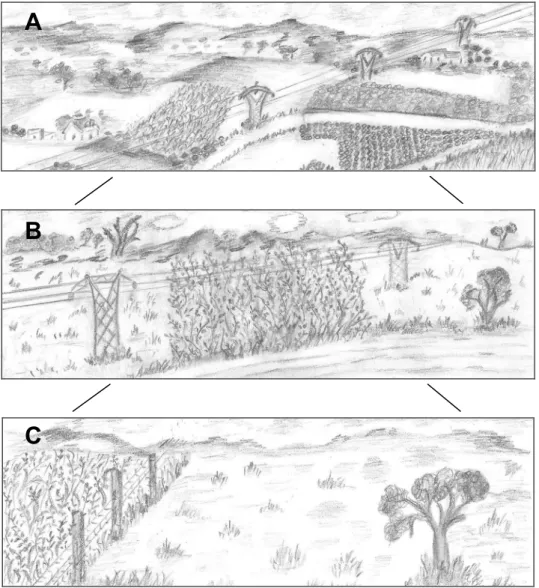
This thesis focuses on the habitat requirements of a threatened grassland bird, the little bustard (Tetrax tetrax, Linnaeus 1758), which were studied at three different spatial scales (Figure 1): i) regional landscape - regional approach that includes the whole
landscape mosaic of land uses; ii) plot - corresponding to the agricultural parcel and iii) microhabitat - vegetation structure within the parcel.
Figure 1 - Schematic representation of the three scales used to study the little bustard’s abundance.
A - regional landscape scale; B - plot scale and C - micro-habitat scale. Particular attention was given to transmission power lines at the plot scale in chapter 5.
A
B
18 1.2. THE LITTLE BUSTARD: GENERAL OVERVIEW
The little bustard is a medium sized grassland bird of the Otididae family that in Europe has adapted to open landscapes dominated by extensive agriculture and pastures (Cramp and Simmons, 1980; De Juana and Martínez, 2001; Morales et al., 2006a).
1.2.1. Worldwide and national distribution
This is the smallest bustard of the western Palearctic (Cramp and Simmons, 1980), presently covering a large geographic range with a highly fragmented distribution, from the Iberian Peninsula and Morocco to north-western China and western Mongolia (Figure 2; Del Hoyo et al., 1996; BirdLife, 2008).
Figure 2. World distribution of the little bustard (after BirdLife International, 2008). Brown thick lines
represent areas with resident populations. Red thick lines delimitate breeding populations, while red thin lines stand for non breeding populations.
19
Currently this species is mainly restricted to two main breeding nuclei: one in Western Europe encompassing the Iberian Peninsula, a few remaining areas of Morocco, parts of France (mainly southern France) and Italy (principally Sardinia) and another vast nuclei in the east covering parts of Ukraine, Sothern Russia, Kazakhstan Mongolia and China (Del Hoyo et al. 1996; BirdLife, 2008). The northern breeding populations (including the French Atlantic population) are fully migratory, while southern populations are migratory or resident (Cramp and Simmons, 1980; Del Hoyo et al. 1996; BirdLife, 2008). More than half of the world’s population occurs in the Iberian Peninsula with between 70,000 and 150,000 individuals (García de la Morena et al., 2006), while in the East, Kazakisntan and Russia seem to have the most important breeding nuclei (BirdLife, 2008).
Little bustard densities during the breeding season vary greatly across the species’ range. In Italy densities vary between 2.0 and 2.8 males/100 ha (Petretti, 2006), while at the French threatened Atlantic migratory population has a density of between 0.2 and 0.6 males/100 ha (Jolivet et al., 2007), although locally they can reach up to 2 males/100 ha (Jiguet et al., 2002). In the southern Mediterranean population, in La Crau, mean density is higher, varying between 2.7 and 3.5 males/100 ha (Jolivet, 2007). However, it is in the Iberian Peninsula that the highest densities are found, with up to 11 males/100 ha in Extremadura (García de la Morena et al., 2006) and Castilla y León (García et al., 2007). In Portugal densities of up to 13 males/100 ha were recorded in Vila Fernando (Schulz, 1985a) and between 9 and 10 males/100 ha in Castro Verde (Delgado and Maoreira, 2000; Silva and Pinto, 2006). Locally, exceptional high densities were found in Castro Verde’s grasslands fields, with up to 39 males/100 ha (Moreira and Leitão, 1996).
In Portugal approximately 85% of the distribution range of little bustard occurs in the Alentejo region, which includes between 90 and 95% of the national breeding population (Silva et al., 2006). In 2003-2006 a breeding census was carried out in this region (Silva and Pinto, 2006). Areas that presented high densities were classified as IBAs (Figure 3; Silva and Pinto, 2006).
20 Figure 3. Breeding study area of the little bustard in Alentejo (after Silva and Pinto, 2006). Dark red
represents the sampling areas within IBA (red shadowed areas), while green polygons stand for sampling areas within the areas considered with potential occurrence for the species (green shadowed areas). The
purple polygons represent agricultural areas.
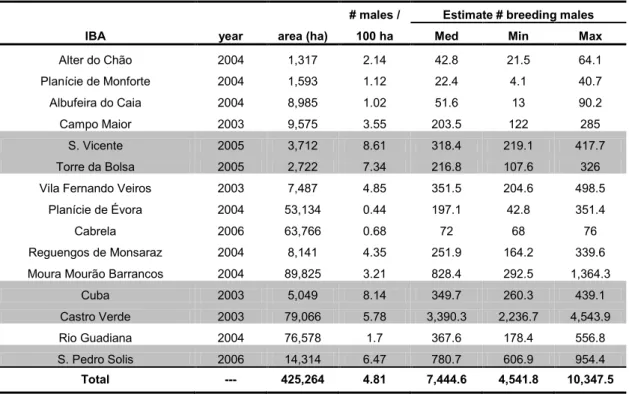
This breeding census resulted in an estimate of 17,515 males, 7,445 of which within Important Bird Areas (IBA, Costa et al., 2003) areas with a mean density of 4.8 males/100 ha (Table 1.), and 10,071 outside IBA areas presenting a mean density of 1.4 males/100 ha. This means that if we assume a sex-ratio of 1:1, the national population estimate would be of 35,030 individuals, however this figure must be used with caution, since degraded sites tend to present a biased sex ratio (Inchausti and Bretagnolle, 2005; Morales et al., 2005b, 2008). The results of the national census show that Portugal has some of the highest regional densities of the species. Therefore, it is likely that the Portuguese population assumes international importance regarding its conservation (Silva et al., 2006), only comparable to that of some areas in the Spanish Extremadura (Garcia de la Morena et al., 2006). Another important remark is that, due to its widespread distribution across Alentejo, only 42% of the little bustard
21
population is within IBA areas and 38% in legally protected Special Protection Areas (SPA). Castro Verde stands out as the most important breeding area for the species in Portugal, with 19% of the total breeding population and more than half of the population within protected sites (Silva and Pinto, 2006).
Table 1. Number of estimated breeding males per Important Bird Area (IBA) (Silva and Pinto, 2006). The
shadowed lines indicate IBAs with breeding densities over 5 males/100 ha.
IBA year area (ha)
# males / Estimate # breeding males
100 ha Med Min Max
Alter do Chão 2004 1,317 2.14 42.8 21.5 64.1 Planície de Monforte 2004 1,593 1.12 22.4 4.1 40.7 Albufeira do Caia 2004 8,985 1.02 51.6 13 90.2 Campo Maior 2003 9,575 3.55 203.5 122 285 S. Vicente 2005 3,712 8.61 318.4 219.1 417.7 Torre da Bolsa 2005 2,722 7.34 216.8 107.6 326
Vila Fernando Veiros 2003 7,487 4.85 351.5 204.6 498.5
Planície de Évora 2004 53,134 0.44 197.1 42.8 351.4
Cabrela 2006 63,766 0.68 72 68 76
Reguengos de Monsaraz 2004 8,141 4.35 251.9 164.2 339.6
Moura Mourão Barrancos 2004 89,825 3.21 828.4 292.5 1,364.3
Cuba 2003 5,049 8.14 349.7 260.3 439.1
Castro Verde 2003 79,066 5.78 3,390.3 2,236.7 4,543.9
Rio Guadiana 2004 76,578 1.7 367.6 178.4 556.8
S. Pedro Solis 2006 14,314 6.47 780.7 606.9 954.4
Total --- 425,264 4.81 7,444.6 4,541.8 10,347.5
Previous estimates of the little bustard breeding population in Portugal varied between 10,000 and 20,000 individuals (Goriup, 1994). The recent breeding census presented by Silva and Pinto (2006) is not adequate to show population trends between surveys, due to the different methods used. However contrasting distributions shown in the last two national bird breeding Atlas seem to indicate some regional population declines (Equipa Atlas, 2008).
If we take into account the latest little bustard world estimate, between 120,000 and 230,000 individuals (De Juana and Martínez, 2001), Portugal holds approximately 10% of the world population. However this proportion is likely to be higher in view of the new Spanish estimate that suggests a population between 43,000 and 71,500 individuals, substantially lower than the previous estimate between 100,000 and 200,000 individuals (De Juana and Martínez, 1996; BirdLife, 2008).
22 1.2.2. Breeding system
The little bustard is described to have an exploded lek mating system, where males establish territories in an aggregated manner, which are attended by females with the single purpose of mating and where all parental care is provided by the female (Schulz, 1985a; Jiguet et al., 2000, 2002; Jiguet and Bretagnolle 2006).
According to the most recent published behavior study, the little bustard fits most of the theoretical models that explain the origin and maintenance of leks (Jiguet and Bretagnolle, 2006). These are, according to Jiguet and Bretagnolle (2006): i) female preference model, which assumes that there is preference of females for clumped males, with advantages in the male selection process and avoidance of predators; ii) hotshot male model, where females prefer to mate with the best quality male, while the hotshot male also attracts other males, which try to parasitize their attractiveness, and iii) black hole model, where females, assumed to be highly mobile, mate in the males’ territory where they finally happen to be present and therefore male nearest-neighbor distances tend to be at their shortest.
The only model that did not fit the little bustard’s mating system was the hotspot model, where male territories are set up at the sites where female density is highest and therefore where males maximize their chance of encountering females (Höglund and Alatalo, 1995; Jiguet and Bretagnolle, 2006). This observation is the result of an experiment using female decoys that were recognized as conspecific but failed to attract new males (Jiguet and Bretagnolle, 2006). However, some authors defend that males might establish their territories at sites within resources potentially used by females (Jiguet et al., 2002; Jiguet and Bretagnolle, 2006). Jiguet and Bretagnolle (2006) in view of these results suggest that the three models that supported the definition of the little bustard mating system actually fit within each other.
However, these behavioral studies were conducted at sites with some degree of agricultural intensification and with low breeding densities. Therefore, they may not hold true for other little bustard populations, especially for those with a higher mean lek size (Jiguet and Bretagnolle, 2006).
23 1.2.3. Habitat preferences
The little bustard’s original habitat was the steppe grassland (Cramp and Simmons, 1980), and later adapted to low intensity agricultural schemes and pastures (Cramp and Simmons, 1980; Martínez, 1994).
Studies conducted at a large scale show that the greenness of the vegetation (NDVI - normalized difference vegetation indices) extracted from satellite imagery is the most important predictor of the little bustard distribution during the breeding season in the Iberian Peninsula (Suárez-Seoane et al., 2002) and that birds avoid the proximity of the main paved roads (Suárez-Seoane et al., 2002, 2004). However, these large scale studies are based on presence absence data, limiting the quality of the information. In the Iberian Peninsula the little bustard is well adapted to extensive cereal farming (Martínez, 1994, 1998; Campos and López, 1996; Morales et al., 2005a, 2006; Silva et al., 2004; García et al., 2007). This agricultural rotational system, also called pseudosteppe, includes several land uses such as cereal crops, dry legumes and fallow land and pastures that are usually grazed (Suárez et al., 1997; Delgado and Moreira, 2000). The little bustard is a sexually dimorphic bird during the breeding season, and because of the male’s nuptial plumage characterized by a striped black and white neck and conspicuous behavior during this season, the large majority of ecological studies and censuses have been directed to males. Females, on the other hand, show a very secretive behavior and efficient cryptic plumage. During the breeding season the little bustard has been mainly associated to fallow lands and extensive pastures (Martínez, 1994; Moreira, 1999; Delgado and Moreira, 2000; Morales et al., 2006a; Petretti, 2007).
Little bustard density is thought to increase with landscape heterogeneity (e.g. Martínez 1994; Morales et al., 2005a; García et al., 2007), amount of surface devoted to cereal farmland (Morales et al., 2005a), and proportion of fallow land (Wolff et al., 2002; Morales et al., 2005a; García et al., 2005). However, inter-annual population variations are not always explained by these factors (Morales et al., 2005a). In fact, two recent studies revealed the influence of climatic features on male density, where winter precipitation plays a major role in limiting food availability and adequate breeding habitat (Delgado et al., 2009; Delgado and Moreira, 2010).
24
Most studies found little bustard density to be associated to small fields and habitat heterogeneity (Martínez, 1994; Campos and López, 1996; Salamolard et al., 1996; García et al., 2007). Contrarily, exceptional high breeding densities were found in Castro Verde’s large grassland fields (Moreira and Leitão, 1996), suggesting that this issue varies geographically and is not fully understood.
At a micro-habitat level, males prefer sites with low vegetation, between 20 and 30 cm high (Martínez, 1994; Campos and López, 1996; Moreira, 1999; Salamolard and Moreau, 1999), which balances its needs for courtship and visibility of conspecifics, and acts as a cover against predators and other threats (Martínez, 1994; Salamolard and Moreau, 1999; Martínez and Tapia, 2001; Morales et al., 2008). Females respond differently, preferring more dense vegetation, presumably due to the need of surveillance and shelter (Morales et al., 2008). During the winter season, mixed male and female flocks, are found at sites with mid-height and mid-density vegetation, preferring hilltops, suggesting that the little bustard chooses locations that balance the two contrasting effects of protective and obstructive cover (Silva et al., 2004).
1.2.4. Movements along the yearly cycle
In recent years little bustard’s movements have been studied with conventional and satellite tracking in both Portugal and Spain (García de la Morena et al., 2009). Movements of this species gained particular interest from researchers when important Iberian population oscillations were noticed in key breeding areas (Silva, 2006; Delgado and Moreira, 2010), along with the proved capability of these birds to perform extensive movements. This became evident when, in 1999, a first satellite telemetry study found French birds wintering in Spanish Extremadura (Villiers et al., 2010). A first approach to the study of this bird’s movements in the Iberian Peninsula combined all the locations obtained by telemetry studies by several research teams (71 tracked birds), between the years 2000 and 2008 (García De La Morena et al., 2009), from Catalonia to Castro Verde, resulting in the identification of four distinct patterns of movement: i) only 11% of the birds were found to be sedentary, not moving more than 8 km from their breeding sites. This result was not expected since literature described this species as being mostly sedentary (Cramp and Simmons, 1980); ii) the most
25
common pattern identified implied a significant movement during summer, and a return to the breeding grounds between the end of summer and winter; iii) the third pattern is characterized by cyclic movements between breeding, summer and wintering sites; iv) the last type of movement observed occurs when a bird uses one place both as a breeding and a summer site, usually performing large movements to wintering grounds during autumn.
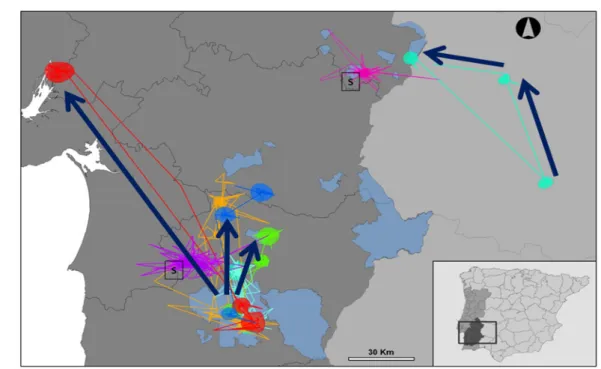
In Portugal a first study of the little bustard’s movements took place between 2000 and 2007 with conventional satellite tracking (Silva, 2006; Figure 4). A total of eight birds were tracked for a variable amount of time, between two months and five years. Those birds were captured at three breeding and one wintering sites. The first three patterns of movement described previously for the Iberian Peninsula were found in Portugal (Figure 4). During summer all five breeding males tagged in Castro Verde, in their breeding sites, performed significant movements towards North and Northwest, mainly to the Beja region and the Tagus Estuary, returning between the end of summer and winter. The two males that were tagged in Ervidel and Vila Fernando were found to be sedentary, and a female captured while wintering next to Campo Maior showed two major movements towards summer and wintering sites respectively.
Figure 4. Movements by little bustard’s tracked by satellite telemetry (after Silva, 2006). Arrows show the
main movements performed by the birds, starting at their breeding grounds. Areas in blue represent steppic Spatial Protection Areas, while colored lines and areas show for movements and home ranges of
26
What triggers these movements and whether their habitat preferences out of the breeding season are distinct from the well known breeding requisites are important unanswered questions regarding the ecology and conservation of this species.
1.2.5. Population trends and major threats
Since the late nineteenth century, this bustard has experienced a severe decline in most of its range. Local extinctions were observed in several countries of Central and Eastern Europe and North Africa (Schulz, 1985; BirdLife, 2008). Presently the most worrying situation is that of the French population which suffered a dramatic decline of 92 % between 1980 and 2004 (Inchausti and Bretagnolle, 2005). Recent studies conducted in Spain also show a contraction of the species range (García De La Morena et al., 2003) and severe local declines of over 50% in the regions of Extremadura (De Juana, 2009) and Madrid (Morales et al., 2006b). In Portugal its distribution has contracted in the Ribatejo region (Equipa Atlas, 2008) and local declines are known for some sites within Special Protection Areas (SPA) such as S. Marcos in Castro Verde (Delgado and Moreira, 2010) and most studied nuclei in Moura, Mourão Barrancos (Silva et al., in prep.).
Due to the little bustard’s significant decline and reduction in range, it is catalogued as globally Near Threatened (BirdLife, 2008) and Vulnerable in Europe (BirdLife, 2004). It is also classified as a priority species for conservation by the European Birds Directive (2009/147/CE), which has lead to protection of many sites as SPA. Both in Portugal (Cabral et al., 2005) and Spain (García De La Morena et al., 2003), within the species’ world stronghold, it is listed as Vulnerable.
Habitat loss and degradation due to agricultural intensification is thought to be the main cause of decline of the species (Schulz, 1985b; Goriup, 1994; Suárez et al., 1997; De Juana and Martínez, 2001). Agricultural intensification, in general, leads to the creation of much simpler habitats due to the disappearance of minor less profitable crops, decrease of medium-long fallows, and increase the size of landholdings (Stoate et al., 2001; Martínez and Tapia, 2002). The concentration of landholdings of small fields and consequent reduction of heterogeneity has been described to negatively affect little bustard’s density in some regions (De Juana et Martínez, 2001; Martínez and Tapia, 2002; Morales et al., 2006a; García et al., 2007). Irrigation schemes can also strongly
27
reduce habitat quality for the species (Brotons et al., 2004). Generalized intensification practices in France resulted in a dramatic decline of little bustards due to critical loss of insects and to nest destruction during harvesting (Inchausti and Bretagnolle, 2005). Insects are an essential food resource for this species, particularly for the chicks, which feed almost exclusively on Orthoptera and Coleoptera during the first two or three weeks of life (Cramp and Simmons, 1980; Schulz, 1985a; Jiguet, 2002). In a context of large farms, a recent study demonstrates that the loss of grassland fields (i.e. fallow land and pastures) which constitutes the main breeding grounds, is a major cause of male density decline (Delgado and Moreira, 2010). Agricultural specialization through the conversion to permanent crops causes, in the short term, total habitat loss and fragmentation (De Juana et Martínez, 2001; Silva, 2005). While, in the range of the species, there is a general tendency towards agricultural intensification in the most productive soils, in the less productive ones, farms tend to be afforested or abandoned (Suárez et al., 1997), leading to habitat loss and fragmentation.
Collision with overhead power lines is the most significant known cause of non-natural mortality, causing the mortality of over 1.5% of the national Portuguese population annually (J.P. Silva, unpublished data). This is one of the most susceptible birds to collide with overhead power lines (Bavenger, 1998; Janss, 2000; Infante et al., 2005; Neves et al., 2005; Marques et al., 2007). The little bustard is known to avoid the proximity of roads (Suárez-Seoane et al., 2002; Silva et al., 2004; Osborne and Suárez-Seonane, 2006 with proved reduction of male density next to this infrastructure (Garcia, 2004). This effect, known as avoidance effect, is still unevaluated for overhead power lines, despite the crossing of hundreds of kilometers of high tension power lines over potential breeding habitat for the little bustard, including priority conservation sites in Portugal.
Finally, climate change is probably having impacts on the species. Rainfall has been shown to have a strong effect on density breeding male density in regions of Spain and Portugal (Delgado et al., 2009; Delgado and Moreira, 2010), since it influences the growth and structure of vegetation and consequently arthropod availability, which constitutes trophic resources for both adults and chicks. The lack of precipitation can therefore affect the settlement of individuals (Delgado et al., 2009). These results showed that the little bustard responds rapidly to meteorological fluctuations and therefore can be highly vulnerable to climate change (Delgado et al., 2009; Delgado and Moreira, 2010).
28 1.3. AIMS AND OUTLINE OF THE THESIS
The little bustard’s world stronghold is located in the Iberian Peninsula, where it is mostly dependent on extensive agricultural schemes for survival. Because this species is highly reliant on man-manipulated landscapes understanding which factors affect its distribution along the yearly cycle is essential to promote sound agricultural practices and ultimately to reverse its declining tendency.
The general aim of this thesis is to improve our knowledge of this species’ ecology within its main stronghold area, where it still occurs at high breeding densities. Particular emphasis is given to evaluating its habitat requirements at different scales, which may result in effective management recommendations towards its conservation. Each of the following specific objectives corresponds to a chapter of the thesis: i) to determine the large scale pattern of occurrence of the little bustard in Portugal (chapter 2); ii) to assess the importance of environmental features for the little bustard’s habitat selection during the breeding season (chapter 3); iii) to understand the main factors that influence the occurrence of this species during the post-breeding stage (chapter 4) and iv) to understand the effects of overhead high tension power lines on the little bustard’s abundance (chapter 5). Each chapter comprises one or two papers, in preparation, submitted or already published in international peer-reviewed journals. In chapter 6 the main findings of the papers are synthesized and discussed, emphasizing the importance of the information obtained for conservation, and where the main conclusions of the thesis are delineated.
In the remainder of this first chapter, a brief summary of the other chapters is presented, including the specific objectives and methodological approaches used, as well as authorship and journals.
Paper I - Moreira, F., Silva, J.P., Estanque, B., Palmeirim, J.M., Lecoq, M., Pinto,
M., Leitão, D., Alonso, I., Pedroso, R., Santos, E., Catry, T., Silva, P., Henriques, I., Delgado, A. Landscape-level inference of habitat
29
composition and bird densities in Iberian steppes: Do little bustards prefer heterogeneous landscapes? Submitted for publication.
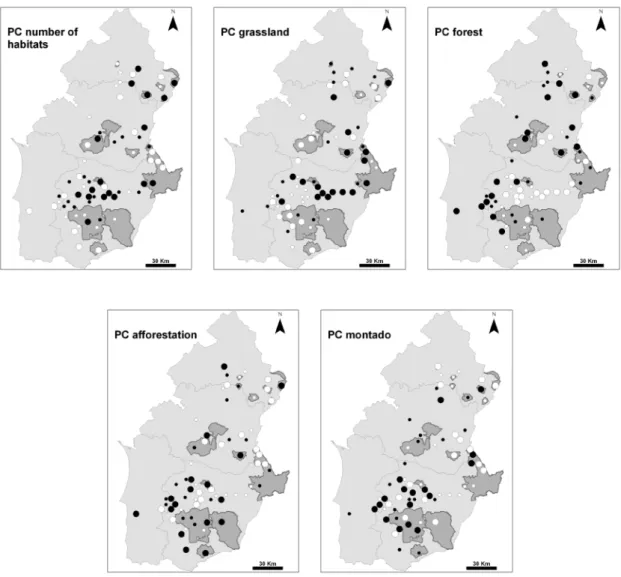
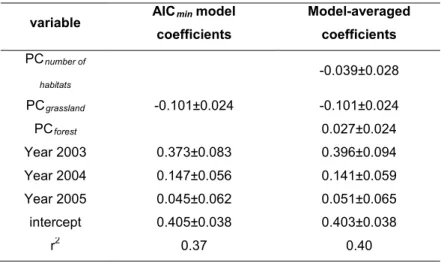
Using most of the species’ range in Portugal, in the Alentejo region, in this paper we present a large scale analysis, using a whole landscape approach to test the hypothesis that male densities are related primarily to the availability of their preferred habitat - grasslands - rather than landscape diversity. Landscape composition and diversity indices were computed for each site and the relationships between little bustard densities and landscape variables were explored using a theoretic-information approach.
Paper II - Silva, J. P., Palmeirim, J.M., Moreira, J., in press. Higher breeding
densities of the threatened little bustard Tetrax tetrax occur in larger grassland fields: implications for conservation. Biological Conservation, doi:10.1016/j.biocon.2010.06.023
Chapter 3 - Little bustard breeding habitat selection
Paper III - Silva, J.P., Estanque, B., Moreira, F., Palmeirim, J.M. Patterns of
grassland use by female little bustard during lek attendance, nesting and brood-rearing. In preparation.
This chapter aims to understand why very high densities of little bustard occur in Alentejo. In particular we test whether grassland field size together with vegetation structure influences male and female occurrence and male density. This chapter further studies female habitat preferences at different stages of the breeding season and at different scales: grassland field and vegetation structure within the field. We analyze and model presence/absence of male and female little bustard in grassland fields (which are the agricultural manageable unit), as well as male density, using Logistic Regression and Generalized Linear Model. A univariate approach was used to analyze variations in male and female distribution and density during the different stages of the breeding season, as well as female microhabitat preferences for the same period of time.
30 Paper IV - Silva, J. P., Faria, N., Catry, T., 2007. Summer habitat selection of the
threatened little bustard (Tetrax tetrax) in Iberian agricultural landscapes. Biological Conservation, 139, 186-194.
Chapter 4 - Little bustard post-breeding habitat selection
Paper V - Faria, N., Silva, J.P., accepted. Habitat selection of the little bustard
during the beginning of an agricultural year. Ardeola.
The major aim of the work described in this chapter is to understand the main factors influencing the little bustard’s occurrence during the post-breeding season, which corresponds to a period in which food availability is expected to diminish significantly. Three distinct study areas were selected representing different agricultural intensification levels. Both univariate and multivariate analysis were used to analyze the data at a landscape level. Particularly for the autumn season, a modeling procedure was carried out to analyze the data at a microhabitat level. Additionally the little bustard’s abundance was studied during the summer season at important breeding areas and at sites with previous knowledge of its occurrence.
Paper VI - Silva, J.P., Santos, M., Queirós, L., Leitão, D., Moreira, F., Pinto, M.,
Lecoq, M., Cabral, J.A. 2010. Estimating the influence of overhead transmission power lines and landscape context on the density of little bustard Tetrax tetrax breeding populations. Ecological Modelling, 221, 1954-1963.
Chapter 5 - Effects of high tension power lines on little bustard breeding densities
In this chapter we hypothesize that overhead transmission power lines may affect the abundance of the little bustard. For this purpose we used a simulation approach, based on Stochastic Dynamic Methodology, to analyse the effects of power lines on the little bustard distribution, using a landscape perspective and simulating population trends as a response to power line installation and habitat changes induced by agricultural shifts in southern Portugal.
31 1.4. REFERENCES
Bevanger, K., 1998. Biological and conservation aspects of bird mortality caused by electricity power lines: a review. Biological Conservation 86, 67-76.
BirdLife Internacional, 2004. Birds in Europe: Population Estimates, Trends and Conservation Status. BirdLife Conservation Series nº10, BirdLife International, Cambridge.
BirdLife International 2008. Tetrax tetrax, in: IUCN 2010. IUCN Red List of Threatened Species. Version 2010.2. Available from: www.iucnredlist.org, as posted on 20.08.2010.
Brotons, L., Mañosa, S., Estrada, J., 2004. Modelling the effects of irrigation schemes on the distribution of steppe birds in Mediterranean farmland. Biodiversity and Conservation, 13 1039–1058
Cabral, M.J., Almeida, J., Almeida, P.R., Dellinger T., Ferrand de Almeida, N., Oliveira, M.E., Palmeirim, J.M., Queiroz, A.I., Rogado, L. and Santos-Reis, M., 2005. Livro Vermelho dos Vertebrados de Portugal. Instituto de Conservação da Natureza, Lisboa. Campos, B., López, M., 1996. Densidad y selección de hábitat del Sisón (Tetrax tetrax) en el Campo de Montiel (Castilla – La Mancha), España, in: Fernández Gutiérrez, J., Sanz-Zuasti, J. (Eds.), Conservación de Las Aves Esteparias y su Hábitat. Junta de Castilla y León, Valladolid, pp. 201-208.
Chalfoun, A.D., Martin, T E., 2007. Assessments of habitat preferences and quality depend on spatial scale and metrics of fitness. Journal of Applied Ecology 44, 983-992. Costa, L.T., Nunes, M. Geraldes, P., Costa, H., 2003. Zonas Importantes para as Aves em Portugal. Sociedade Portuguesa para o Estudo das Aves. Lisboa.
Cramp, S., Simmons, K. E. L., 1980. The Birds of the Western Paleartic. Oxford University Press, London.
De Juana, E. 2009. The dramatic decline of the Little Bustard Tetrax tetrax in Extremadura (Spain). Ardeola 56, 119-125.
32
De Juana, E., Martínez, C., 2001. Little bustard (Tetrax tetrax), in: Schaffer, N., Gallo-Orsi, U. (Eds.), European Union action plans for eight priority bird species. European Commission, Luxembourg, pp. 1-17.
Del Hoyo, J., Elliot, A., Sargatal, J., 1996. Handbook of the birds of the world. Barcelona, Lynx Editions.
Delgado, M.P., Morales, M.B., Traba, J., García de la Morena, E.L., 2009. Determining the effects of habitat management and climate on the population trends of a declining steppe bird. Ibis 151, 440-451.
Delgado, A., Moreira, F., 2000. Bird assemblages of an Iberian cereal steppe. Agriculture, Ecosystems and Environment 78, 65-76.
Delgado, A., Moreira, F., 2010. Between-year variations in Little Bustard Tetrax tetrax population densities are influenced by agricultural intensification and rainfall. Ibis 152, 633-642.
Equipa Atlas, 2008. Atlas das Aves Nidificantes em Portugal. 2008. Instituto da Conservação da natureza e da Biodiversidade, Sociedade Portuguesa para o Estudo das Aves, Parque Natural da Madeira e Secretaria Regional do Ambiente e do Mar. Assírio and Alvim. Lisboa.
Garcia, G., 2004. Impacte da Auto-Estrada A2 na Zona de Protecção Especial de Castro Verde: Efeitos na Distribuição e Densidade de Sisão (Tetrax tetrax). Institute of Agronomy, Technical University of Lisbon. Master thesis, unpublished.
García de la Morena, E.L., De Juana, E., Martínez, C., Morales, M. B., Suárez, F., 2003. Sisón Común, Tetrax tetrax. In Martí, R., del Moral, J.C. (Eds.), Atlas de las aves reproductoras de España. Dirección General de Conservación de la Naturaleza - Sociedad Española de Ornitología, Madrid, pp. 232-233.
García de la Morena, E.L., Bota, G. Ponjoan, A., Morales, M.B., 2006. El Sisón Común en España. Primer Censo Nacional (2005). SEO-BirdLife. Madrid.
García de la Morena, E.L., Bota, G., Silva, J.P., Ponjoan, A., De Juana, E., Suárez, F., Mañosa, S., Morales, M.B., 2009. Patrones de movimiento estacional del sisón
33
común (Tetrax tetrax) en la Península Ibérica. IV Congreso Ibérico de Ornitología. Elvas, Portugal.
García J., Suárez-Seoane, S., Miguélez, D., Osborne, P.E., Zumalacárregui, C., 2007. Spatial analysis of habitat quality in a fragmented population of little bustard (Tetrax tetrax): implications for conservation. Biological Conservation 137, 45-56.
Goriup, P., 1994. Little Bustard Tetrax tetrax, in: Tucker, G.M., Heath, M.F. (Eds.), Birds in Europe: their Conservation Status. BirdLife International, Cambridge, pp. 236-237.
Heglund, P.J. 2002. Foundations of species-environment relations. In
Höglund, J., Alatalo, R.V., 1995. Leks. Princeton University Press, Princeton, New Jersey.
Predicting species occurrences: issues of scale and accuracy. Island Press, Washington, D.C.
Hutchinson, G.E., 1957. Concluding remarks, Cold Spring Harbor Symposium. Quantitative Biology 22, 415-427.
Hutchinson, G.E., 1959. Homage to Santa Rosalia or why are there so many kinds of animals?" American Naturalist 93, 145-159.
Inchausti, P., Bretagnolle, V., 2005. Predicting short-term extinction risk for the declining Little Bustard (Tetrax tetrax) in intensive agricultural habitats. Biological Conservation 112, 375–384.
Infante, S., Neves, J., Ministro, J., Brandão, R., 2005. Impacts of medium and high tension power lines on birds in Portugal. Quercus Associação Nacional de Conservação da Natureza and Sociedade Portuguesa para o Estudo das Aves. Unpublished report.
Janss, G.F.E., 2000. Avian mortality from power lines: a morphologic approach of a species - specific mortality. Biological Conservation 95, 353-359.
Jiguet, F., Arroyo, B., Bretagnolle, V., 2000. Lek mating systems: a case study in the little bustard Tetrax tetrax. Behavioural Processes 51, 63-82.
34
Jiguet, F., Jaulin, S., Arroyo, B., 2002. Resource defence on exploded leks: do male little bustards, T. tetrax, control resources for females? Animal Behaviour 63, 899-905. Jiguet, F., Bretagnolle, V., 2006. Manipulating Lek Size and Composition Using Decoys: An Experimental Investigation of Lek Evolution Models. The American Naturalist 168, 758-768.
Jolivet, C., 2007. The situation of the Little Bustard in France, in: Leitão, D., Jolivet, C., Rodriguez, M., Tavares, J. (Eds.), Bustard conservation in Europe in the last 15 years: current trends, best practice and future priorities. RSPB/BirdLife, Bedfordshire, pp. 61-64.
Jolivet, C., Bretagnolle, V., Bizet, D., Wolff, A., 2007. Statut de l'Outarde canepetière Tetrax tetrax
Levin, Simon A. 1992. The Problem of Pattern and Scale in Ecology: The Robert H. MacArthur Award Lecture. Ecology 73, 1943-1967.
en France en 2004 et mesures de conservation. Ornithos 14, 80-94.
MacArthur, R., 1972. Geographical ecology. Princeton University Press, Princeton, N.J. Morris, D.W., 1989. Habitat-dependent estimates of competitive interaction. Oikos 55, 111-120.
Malanson, G.P., 1997. Simulated responses to hypothetical fundamental niches. Journal of Vegetation Science 8, 307-316.
Martin, T.E., 1998. Are microhabitat preferences of coexisting species under selection and adaptive? Ecology 79, 656-665.
Martínez, C., 1994. Habitat selection by the Little Bustard Tetrax tetrax in cultivated areas of Central Spain. Biological Conservation 67, 125-128.
Martínez, C., 1998. Selección de Microhábitat del Sisón Común Tetrax tetrax Durante la Estación Reproductora. Ardeola 45, 73-76.
Martínez, C., Tapia, G.G., 2002. Density of the Little Bustard Tetrax tetrax in relation to agricultural intensification in Central Spain. Ardeola 49, 301-304.
35
Marques, A.T., Rocha, P., Silva, J.P., 2007. Monitoring the effects of a very high tension power line on Great Bustards, mortality and flight frequencies
Morales, M.B., Bretagnolle, B., Arroyo, B., 2005b. Viability of the endangered Little bustard Tetrax tetrax population of western France. Biodiversity and Conservation 00, 1-16.
. Instituto da Conservação da Natureza. Unpublished report.
Morales, M.B., García, J.T., Arroyo, B., 2005a. Can landscape composition changes predict spatial and annual variation of little bustard male abundance? Animal Conservation 8, 167-174.
Morales, M.B., García de la Morena, E.L., Delgado, M.P., Traba, J. 2006b. Tendencia reciente y viabilidad futura de las poblaciones de sisón común (Tetrax tetrax) en la Comunidad de Madrid. Anuario Ornitológico de Madrid 11, 40-55.
Morales, M.B., Suárez, F., García de La Morena, E.L., 2006a. Réponses des oiseaux de steppe aux différents niveaux de mise en culture et d'intensification du paysage agricole: une analyse comparative de leurs effets sur la densité de population et la sélection de l'habitat chez l'outarde canepetiere Tetrax tetrax et l'outarde barbue Otis tarda. Revue d'Ecologie (Terre et Vie) 61, 261-270.
Morales, M.B., Traba, J., Delgado, M.P., García de la Morena, L.E., 2008. Sexual differences in microhabitat selection of breeding little bustards Tetrax tetrax: Ecological segregation based on vegetation structure. Acta Oecologica 34, 345-353.
Moreira, F., Leitão D.,1996. A comunidade de aves nidificantes nos pousios da região de Castro Verde. Ciência e Natureza 2, 109-113.
Moreira, F., 1999. Relationships between vegetation structure and breeding bird densities in fallow cereal steppes in Castro Verde, Portugal. Bird Study 46, 309-318. Moreira, F., Beja, P., Morgado, R., Reino, L., Gordinho, L., Delgado, A., Borralho, R., 2005. Effects of field management and landscape context on grassland wintering birds in Southern Portugal. Agriculture, Ecosystems and Environment 109, 59-74.
Morris, W.M., 2003. Toward an ecological synthesis: a case for habitat selection. Oecologia 136, 1-13.
36
Morris, W.M., Clark, R.G., Boyce, M.S., 2008. Habitat and habitat selection: theory, tests, and implications. Israel Journal of Ecology & Evolution 54, 287-294.
Neves, J., Infante, S., Ministro, J., 2005. Impacts of very high tension power lines on birds in Portugal. Sociedade Portuguesa para o Estudo das Aves and Quercus Associação Nacional de Conservação da Natureza. Unpublished report.
Orians, G.H., Wittenberger, J.F., 1991. Spatial and temporal scales in habitat selection. American Naturalist 137, 29-49.
Petretti, F., 2007. The situation of the Little Bustard in Italy, in: Leitão, D., Jolivet, C., Rodriguez, M., Tavares, J. (Eds.), Bustard conservation in Europe in the last 15 years: current trends, best practice and future priorities. RSPB/BirdLife, Bedfordshire, pp. 65-69.
Pulliam, R. 2000. On the relationship between niche and distribution. Ecological Letters 3, 349–361.
Kotlier, N.B., Wiens, J.A., 1990. Multiple scales of patchiness and patch structure: a hierarchical framework for the study of heterogeneity. Oikos 59, 253-260.
With, K.A., Crist, T.O. Critical thresholds in species' responses to landscape structure. Ecology 76, 2446-2254.
Ricklefs, R.E., 2004. A comprehensive framework for global patterns in biodiversity. Ecology Letters 7, 1-15.
Rosenzweig, M.L., 1981. A theory of habitat selection. Ecology 62, 327-335.
Salamolard, M., Bretagnolle, V., Boutin, J. M., 1996. Habitat use by Montagu’s Harrier, Little Bustard and Stone Curlew in Western France: crop types and spatial heterogeneity. In: Fernández Gutiérrez, J., Sanz-Zuasti, J. (Eds.), Conservación de Las Aves Esteparias y su Hábitat. Junta de Castilla y León, Valladolid, pp. 209-220.
Salamolard, M., Moreau, C., 1999. Habitat selection by Little Bustard Tetrax tetrax in a cultivated area of France. Bird Study 46, 25- 33.
37
Schulz, H., 1985a. Grundlagenforschung zur Biologie der Zwergtrappe Tetrax tetrax. Braunschweig. PhD thesis, Staatlichen Naturhistorischen Museum, Braunschweig, Germany.
Schulz, H., 1985b. A review of the world status and breeding distribution of the Little Bustard. Bustard Studies 2, 131-152.
Silva, J.P., Pinto, M., Palmeirim, J.M., 2004. Managing landscapes for little bustard Tetrax tetrax: lessons from the study of winter habitat selection. Biological Conservation 117, 521-528.
Silva, J.P., 2005. Modelling the breeding habitat selection of the little bustard (Tetrax tetrax) in an Iberian fragmented landscape. University of Évora. Master thesis. Unbuplished.
Silva, J.P., 2006. Sisão. Seguimento de aves via satélite. Available from: http://seguimentodeaves.domdigital.pt/sisao/, as posted on 20.08.2010.
Silva, J.P., Leitão, D., Santos, E., Moreira, F., Prego, I., Pinto, M., Lecoq, M., Catry, T., Pedroso, R., 2006. Preliminary results of the Little Bustard’s census in Alentejo (Portugal), in: Leitão, D., Jolivet, C., Rodriguez, M., Tavares, J. (Eds.), Bustard conservation in Europe in the last 15 years: current trends, best practice and future priorities. RSPB/BirdLife, Bedfordshire, pp. 55-59.
Silva, J.P., Pinto, M., 2006. Final report of Action 2 of the Project LIFE02NAT/P/8476: Conservation of the little bustard in Alentejo. Institute for Nature Conservation. Available from: http://portal.icnb.pt/NR/rdonlyres/783CA43B-7C0E-4FA4-8286-F4EB120C4A49/0/Life_SISAO.pdf, as posted on 20.08.2010.
Stoate, C., Boatman, N.D., Borralho, R.J., Rio Carvalho, C., Snoo, G.R., Eden, P. 2001. Ecological impacts of arable intensification. Journal of Environmental Management 63, 337-365.
Suárez, F., Naveso, M.A., De Juana, E., 1997. Farming in the drylands of Spain: birds of the pseudosteppes, in: Pain, D. J., Pienkowski, M. W. (Eds.), Farming and birds in
38
Europe. The Common Agricultural Policy and its implication for bird conservation. Academic Press, London, pp. 297-330.
Suárez-Seoane, S., Osborne, P.E., Alonso, J.C., 2002. Large-scale habitat selection by agricultural steppe birds in Spain: identifying species–habitat responses using generalized additive models. Journal of Applied Ecology 39, 755-771.
Suárez-Seoane, S., Osborne, P.E., Rosema, A., 2004. Can climate data from Meteosat improve wildlife distribution models?. Ecography 27, 629-636.
Suberón, J., 2007. Grinnellian and Eltonian niches and geographic distributions of species. Ecology Letters 10, 1115-1123.
Villers A., Millon A., Jiguet F., Lett J.M., Attie C., Morales M.B., Bretagnolle V., 2010. Migration of wild and captive-bred little bustards Tetrax tetrax: releasing birds from Spain threatens attempts to conserve declining French populations. Ibis 152, 254-261 Wagner, H.H., Fortin, M.J., 2005. Spatial analysis of landscapes: concepts and statistics. Ecology 86, 1975-1987.
Weins, J.A., 1989. Spatial Scaling in Ecology. Functional Ecology 3, 385-397.
Wolff, A., Dieulevent, T., Martin, J.L., Bretagnolle, V., 2002. Landscape context and little bustard abundance in a fragmented steppe: implications for reserve management in mosaic landscapes. Biological Conservation 107, 211-220.
C h a pt e r
2
L
ARGE SCALE PATTERN OF OCCURRENCE
40