Repositório ISCTE-IUL
Deposited in Repositório ISCTE-IUL:
2019-01-10
Deposited version:
Post-print
Peer-review status of attached file:
Peer-reviewed
Citation for published item:
Ehrenberg, N., Silva, J. L. & Campos, P. (2018). SENSE-SEAT: challenging disruptions in shared
workspaces through a sensor-based SEAT. In 12th International Conference on Tangible, Embedded,
and Embodied Interaction, TEI 2018. (pp. 260-265). Stockholm: ACM.
Further information on publisher's website:
10.1145/3173225.3173278
Publisher's copyright statement:
This is the peer reviewed version of the following article: Ehrenberg, N., Silva, J. L. & Campos, P.
(2018). SENSE-SEAT: challenging disruptions in shared workspaces through a sensor-based SEAT. In
12th International Conference on Tangible, Embedded, and Embodied Interaction, TEI 2018. (pp.
260-265). Stockholm: ACM., which has been published in final form at
https://dx.doi.org/10.1145/3173225.3173278. This article may be used for non-commercial purposes
in accordance with the Publisher's Terms and Conditions for self-archiving.
Use policy
Creative Commons CC BY 4.0
The full-text may be used and/or reproduced, and given to third parties in any format or medium, without prior permission or charge, for personal research or study, educational, or not-for-profit purposes provided that:
• a full bibliographic reference is made to the original source • a link is made to the metadata record in the Repository • the full-text is not changed in any way
The full-text must not be sold in any format or medium without the formal permission of the copyright holders. Serviços de Informação e Documentação, Instituto Universitário de Lisboa (ISCTE-IUL)
Av. das Forças Armadas, Edifício II, 1649-026 Lisboa Portugal Phone: +(351) 217 903 024 | e-mail: [email protected]
SENSE-SEAT: Challenging Disruptions
in Shared Workspaces Through a
Sensor-Based Seat
Nils Ehrenberg
Madeira-ITI, Funchal, Portugal [email protected]
José Luís Silva
Madeira-ITI, Funchal, Portugal Instituto Universitário de Lisboa (ISCTE-IUL), ISTAR-IUL, Lisboa, Portugal
Pedro Campos Universidade da Madeira Madeira-ITI, Funchal, Portugal [email protected]
Permission to make digital or hard copies of part or all of this work for personal or classroom use is granted without fee provided that copies are not made or distributed for profit or commercial advantage and that copies bear this notice and the full citation on the first page. Copyrights for third-party components of this work must be honored. For all other uses, contact the owner/author(s).
Copyright held by the owner/author(s). TEI ’18, March 18–21, 2018, Stockholm, Sweden ACM 978-1-4503-5568-1/18/03.
https://doi.org/10.1145/3173225.3173278
Abstract
Creative industries’ workers are becoming more prominent as countries move towards intellectual-based economies. Consequently, the workplace needs to be reconfigured so that creativity and productivity can be better promoted at shared workspaces. We report on a study based on diaries, interviews and probes, with 8 creative industries’ profes-sionals at a co-working space, with the goal of understand-ing their advantages and disadvantages, and causes for cognitive disruptions. Findings indicate that temperature, noise and coworkers’ requests are the main causes for dis-ruptions in the work processes. The insights are used to inform the design process of SENSE-SEAT, a seat with em-bedded sensors and tangible actuators, as a contribution to reimagining the role of tangible and embedded interac-tion in intelligent furniture. We are currently at a prototyping stage, with 3D prints and 3D renders and we explain the design process and outlining the early results.
Author Keywords
Tangible interaction; sensor-based furniture; interaction de-sign;
Introduction
This paper introduces the design and prototyping of a new seat for relaxation and productivity, which fuses the digi-tal and the analog in a futuristic piece of furniture, targeted
at workspaces, in particular creative co-working spaces. This interactive seat, with embedded sensors and actua-tors, aims at reimagining the role of interactive technolo-gies in the workspace of the future by challenging disrup-tions in shared workspaces through a multi-sensory design approach. SENSE-SEAT aims to explore the balance be-tween social interruptions and social benefits of the creative workspace. Creative industriesâ ˘A ´Z workers are becoming more prominent as countries move towards intellectual-based economies. Consequently, the nature and essence of the workplace needs to be reconfigured so that creativity and productivity can be better promoted at these spaces. We will introduce initial interview studies, a co-creative workshop - both of which informed the design - and early renders and 3D prints of our prototype. We also present the rational for how the design has been developed and our initial findings from the prototyping efforts.
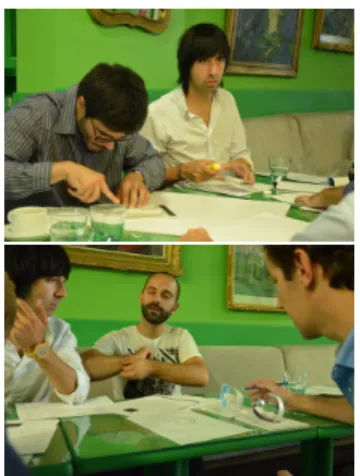
Figure 1: Prototyping in the co-creative workshop
Related Work
There has been great progress in terms of gaining a better understanding of the interplay between the work environ-ment and the creativity, or productivity, of office workers. Creativity is the production of novel and potentially useful ideas for solving problems, developing new artifacts and ac-complishing tasks. In organizations, employee’s creativity can be translated into innovative products, services, pro-cesses, systems, work methods, etc. [3]. Workplace cre-ativity is usually seen as a result of a creative personality or individual skillsets [4], dependent on intrinsic motivations, such as personal interest, satisfaction, or the challenge of the work itself. However, there are also studies that suggest that other factors, such as socio-organizational (e.g., job design, team work, rewards, time pressure, and leadership) are also factors in motivating creative work [3][1][4], even in contexts such as kindergarten [2]. Typical physical envi-ronment improvements, that affect employee’s creativity in
a positive way, as suggested by various researchers, are: a non-crowded workspace, presence of plants, the use of in-spiring colors on the walls, a new carpet in the office, more pictures and posters on the walls, windows with outside view, privacy, dim lightning, etc. [1]. Aiello and his team [1] did research on the effects of workspace crowding over em-ployee’s creativity, and they concluded that crowding could have negative effects, regardless of crowded subjects inter-personal distance preference, which showed a lower level of creativity than their non-crowded counterparts. Also, Stokols and his team [5] observed that high levels of envi-ronmental distraction, such as noise or prolonged exposure to crowded environments, were associated with less per-ceived support for creativity at work, and they furthermore suggested that private or non-overcrowded workspaces could have a counter effect, i.e. it could boost employee’s creativity. Zelinksky [7] underlines the importance of rec-ognizing that workspaces need to be inspiring places. Vis-cher’s [6] research shows how people are affected by the environment on their workplace. Many factors contribute to these quite subjective productivity levels. Sometimes it is the room temperature, other the surrounding noise but even visuals play a role (e.g. if the work desk is messy and clut-tered). Previous work has also explored how technological artifacts could be used to address work interruptions, e.g. Züger [8] who proposes FlowLight, a device that combines a physical traffic-light like LED with an automatic interrupt-ibility measure based on computer interaction data, which exhibited very good results, having reduced the interrup-tions of participants by 46%. As well as industry work such as LiveOS1which collect data to optimize the workspace, and the Kokon2stress reduction pod. The approach of SENSE-SEAT is to provide a tool for reducing stress in
1
https://www.hermanmiller.com/products/smart-office/smart-furnishings/live-os/
tasks that require focus, or when the work environment is too chaotic.
Challenging Disruptions in Shared Workspaces
The original idea for building SENSE-SEAT was to provide a place for relaxation, focus and creativity, something ex-tremely difficult in today’s fast-paced offices. To gain an initial understanding of these factors, we conducted a pi-lot study with eight participants (six men and two women) from a local co-working space, who we invited to take part in an interview, four (two men and two women) of which agreed to also submit a diary over disruptions in their work over two weeks’ time. We distinguish between interrup-tions and disrupinterrup-tions because of the negative connotation which is typically inherent to interruptions - a disruption can actually be positive for the user, whereas it is never a pos-itive thing to be interrupted. Each of the interviews took approximately 30 minutes and were conducted with two in-terviewers, one leading the interview and one recording, taking notes, speaking the local language and translating as needed. The study aimed to explore what they perceived as both positive and negative factors with working in a co-working space. As all participants were currently co-working in a co-working space, it should be expected that they feel that the positive aspects outweigh the negative. In the interview, they were asked about what they perceived as interrupt-ing their work, but also how they interact with others in the space. In the diary that followed the interview, we compared how their perception of interruptions match up with how their documented interruptions. The comparison was done by looking at what kind of disruptions they mentioned in the different inquiries, as well as how severe they were by the description.
The participants focused on two areas, the physical and the social space. The majority of the frustrations expressed
was in regards to the physical space, too warm, noisy, un-comfortable, or otherwise not suited for certain tasks, such as calls or meetings, while the spaces dedicated for meet-ings were not deemed sufficient due to both lack of avail-ability and the air-quality. In the discussion of the social space, where the majority of participants expressed that the coworkers were a major positive factor, they also expressed that it was the largest distraction, though not always a neg-ative one. Joining others for a coffee when struggling with a difficult or tedious task helped maintain focus, although some would have offices that allowed them to close the door when needed. The pilot study suggests that there is a conflict between the public and private in interactions, where the social aspects is at the same time a source of inspiration and motivation, but also interruptions.
Prototyping and Co-creative Workshop
In a second phase, we started our prototyping, working to-gether with a team of interior designers, architects, HCI researchers, software and hardware engineers (See Fig-ure 1). We held a 1-day co-creative workshop which em-ployed brainstorming and product ideation techniques with 16 participants, six of them part of the SENSE-SEAT project team, the remaining were creative industries’ profession-als who had no previous contact or any information about the project. Figure 1 shows the overall aspect of this co-creative workshop, as well as some of the low-tech proto-typing tools and materials which were used.
In this workshop, we brought together design professionals, researchers, and developers with the explicit goal of creat-ing concepts together. We asked them to explore their view on smart furniture through a multi-sensory approach, us-ing sketchus-ing, and low fidelity prototypus-ing. While the type of furniture was left open-ended, a seat or bed was the gen-eral topic of discussion, rather than furniture that was acted
on, such as desks. The participants each set out to indi-vidually create multiple concepts that were then explored in groups where they combined their ideas, and prototyped them using low-fidelity materials such as paper, foam-core and pencils. The final concepts which were produced by the different groups of participants involved:
Figure 2: 3D-renders of the design
• a Work-life chair, a semi-open pod which can be ad-justed for relaxation, lighting, as well as placed into groups for collaboration;
• an all-in-one chair that focuses on the physical com-fort, such as sitting still for too long, or on resting when needed;
• a ’sleeper bed’ that senses both the environment and the position of the sleeper, but also communicates with its surrounding environment.
The common theme expressed by the participants is relax-ation or stress, this suggests that a future design could re-flect the need to be able to relax, rather than stressing pro-ductivity or focus. Both the work-life chair and the sleeper bed are intended as parts of a larger environment, rather than as a stand-alone piece.
A multi-sensorial approach
SENSE-SEAT has the overall goal of promoting user focus-ing and the ability for temporary separation through the use of a pod-like chair (see Figure 2 for 3D renders). The aim is a design that allows the user to remain in the office, and approachable if necessary while also communicating that they are working on something that requires focus. Sensors and smart technology can detect and respond to the person seated, what they are working on (which software they are using, posture, or focus).
When exploring solutions for the challenges of creative workspaces, we have taken a multi-sensorial approach, in order to explore how different senses, such as hearing or sight can affect productivity. Our design approach is ground in terms of function, technology and form. While the function concerns are relatively straightforward (con-nected workspace, relaxing, personal), the form concerns we are addressing include achieving a contemporary, ver-satile, modular piece of technological furniture that can also bring a timeless, elegant comfort to the workplace. In terms of technology, a reclining seat will provide body positions values that can provide ergonomic feedback to the user. Di-rectional sound provides relaxing soundtracks according to the user’s preference, the same applies to the LED interior ’mood’ lighting.
By sensing the position of the user, the SENSE-SEAT can improve the ergonomics of the chair using adjustable seat-ing, it can also remind the user to take a break through gen-tly adjusting the internal lighting. It helps the user manage interruptions by letting others know externally through out-side LED-lighting that a person is working. The aim is to provide simple, effortless interactions.
For the final prototype, we are using pressure-sensitive con-ductive sheets (Velostat) sewed to woven concon-ductive fabric with a thin conductive thread to build two squares (matrix) for the seat and its back. These allow to track the user’s posture and presence. Afterwards, we added an electret microphone amplifier and an air-quality sensor. Both will be used to check if external factors such as noise and oxygen levels polluted would interfere with the productivity of users. A temperature and humidity sensor was added so that the system can check the outside air temperature and trigger a ventilation to adjust the inside temperature. In terms of actuators, we added programmable RGB-LED strips to the
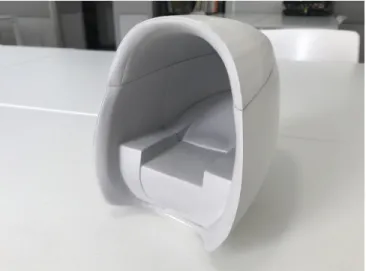
Figure 3: SENSE-SEAT’s 3D print.
sides and back of the chair as well as a directional sound beacon just above. Overall, the final prototype will regis-ter when a user is sitting down, the ergonomic posture (if posture is correct, the pressure will be distributed along the pressure-sensitive pads), the noise, outside air tempera-ture and air quality (this data would then be cross-checked by the team in terms of minutes against the times when a user would be writing or typing, to see if those had any in-fluence). Finally, the ambient sound and the LED coloring will be adjusted to test what users would prefer for their two main activities (relax and work). Figure 3 exhibits a 3D print of the prototype, including a cross section that includes a ’cap’. This can be used to allow different configurations of the seat, e.g. relaxing configuration, ’Conference-call’ con-figuration, etc.
Conclusions
SENSE-SEAT brings up several research questions which will be assessed once it becomes a fully usable product: firstly, it introduces tangible and embedded systems as an approach to resolve the challenge of the physical chal-lenges found at creative workplaces. Secondly, how do we explore the balance between social interruptions and so-cial benefits of the space? Interactive furniture could play a decisive role in the near future (e.g. a smart meeting table could invite other people to join an interesting discussion). Thirdly, it raises some privacy issues: what happens when the office place has a seat like this, where ergonomics data from users is being constantly gathered? In any workspace, there’s a dichotomy between the company and the private. How much time and effort does the employee owe the com-pany, what loyalty? Personal calls during work hours are often frowned upon, but if the call is important the borders soften. If the employer supplies a phone, the employee may receive work email and calls even after hours. While there is no obligation to answer, it is common for employees to respond if they feel it’s urgent, or if not, the mere existence causes mental workload.
In a co-working space, there is an added dimension of what is public. There are many aspects that can be explored; for example, which spaces may be used by anyone? Where is it appropriate to chat and to have coffee? To what extent should one share advice or thoughts with someone from another company? When creating technology for Smart Workspaces, the intent of various stakeholders shape the needs and requirements for new technology. Small changes in existing designs, sometimes drastically change the na-ture of the product. Thus, within collaborative workspaces, there’s a need to find the right balance between the need for privacy and support for social interaction. As such, col-laborative work environments require spaces, furnishings
and technologies that facilitate, not only for collaborative work, but also to focus work that fosters solo creativity and productivity.
Future Work
The next step of the SENSE-SEAT project is to establish the final technical requirements to build a full-scale proto-type. This work will require taking the 3D-model from prints and building first a full-scale paper prototype, and after that adjust and build a seat in fiberglass. Aside from the physi-cal prototype, we will also set the techniphysi-cal requirements for an initial set of sensors, and assemble the electronics. The physical seat and the initial sensors will be tested and cali-brated to explore the how the pod affects work in a creative workspace.
Acknowledgements
This project was funded by Regional and European funds through IDE-RAM (ProCiência), project reference M1420-01-0247-FEDER-000001.
REFERENCES
1. John R. Aiello, Donna T. DeRisi, Yakov M. Epstein, and Robert A. Karlin. 1977. Crowding and the Role of Interpersonal Distance Preference. Sociometry 40, 3 (sep 1977), 271–282.DOI:
http://dx.doi.org/10.2307/3033534
2. Pedro Campos and Sofia Pessanha. 2011. Designing Augmented Reality Tangible Interfaces for Kindergarten Children. Springer, Berlin, Heidelberg, 12–19.DOI: http://dx.doi.org/10.1007/978-3-642-22021-0_2 3. Jan Dul and Canan Ceylan. 2014. The Impact of a
Creativity-supporting Work Environment on a Firm’s
Product Innovation Performance. Journal of Product Innovation Management 31, 6 (nov 2014), 1254–1267. DOI:http://dx.doi.org/10.1111/jpim.12149 4. Beth A. Hennessey and Teresa M. Amabile. 2010.
Creativity. Annual Review of Psychology 61, 1 (jan 2010), 569–598.DOI:http://dx.doi.org/10.1146/ annurev.psych.093008.100416
5. Daniel Stokols, Chip Clitheroe, and Mary Zmuidzinas. 2002. Qualities of Work Environments That Promote Perceived Support for Creativity. Creativity Research Journal 14, 2 (apr 2002), 137–147.DOI:
http://dx.doi.org/10.1207/S15326934CRJ1402_1 6. Jacqueline C. Vischer. 2008. Towards an
Environmental Psychology of Workspace: How People are Affected by Environments for Work. Architectural Science Review 51, 2 (jun 2008), 97–108.DOI: http://dx.doi.org/10.3763/asre.2008.5114 7. Marilyn Zelinsky. 2002. The Inspired Workspace:
Interior Designs for Creativity & Productivity. Rockport Publishers. 160 pages.
8. Manuela Züger, Will Snipes, Christopher Corley, André N. Meyer, Boyang Li, Thomas Fritz, David Shepherd, Vinay Augustine, Patrick Francis, and Nicholas Kraft. 2017. Reducing Interruptions at Work. In Proceedings of the 2017 CHI Conference on Human Factors in Computing Systems - CHI ’17. ACM Press, New York, New York, USA, 61–72.DOI: