RESUMO.- [Principais problemas sanitários e seu im-pacto econômico em bovinos de corte criados em di-ferentes tipos de confinamento no Brasil.] No presente estudo coletou-se e se interpretou dados sobre os princi-pais problemas sanitários, bem como a respeito dos
cus-tos com os tratamencus-tos de bovinos de corte confinados em dois sistemas diferentes: o tradicional, isto é, aquele que objetiva produzir animais prontos para o abate e o siste-ma de produção de touros destinados à venda destes como reprodutores. A porcentagem de bovinos confinados para o abate e que adquiriram problemas sanitários foi consi-deravelmente maior do que nos sistemas que os confinam para a venda como futuros reprodutores. As pneumonias e os transtornos digestórios foram os principais problemas diagnosticados no confinamento para o abate e os custos com os tratamentos foram elevados e, em média, represen-taram entre 9,7 e 20,9 kg de peso vivo ou o equivalente de 7 a 15% das arrobas ganhas durante o período confinado. O crescimento exagerado e a aglutinação (paraqueratose) das papilas ruminais foram os principais achados macros-cópicos nos rúmens dos bovinos confinados para o abate. Devido à maior ingestão de grãos, o pH ruminal e fecal foi sempre menor, enquanto que a osmolaridade ruminal e o
Major health problems and their economic impact on beef
cattle under two different feedlot systems in Brazil
1Pedro Malafaia2*, Tiago Alvin Lima Granato3, Rogério Magnoli Costa4, Vinícius Carneiro de Souza5, Diogo Fleury Azevedo Costa6 and Carlos Hubinger Tokarnia2
ABSTRACT.- Malafaia P., Granato T.A.L., Costa R.M., Souza V.C., Costa D.F.A. & Tokarnia C.H. 2016. Major health problems and their economic impact on beef cattle under two dif-ferent feedlot systems in Brazil. Pesquisa Veterinária Brasileira 36(9):837-843. Departa-mento de Nutrição Animal e Pastagem, Instituto de Zootecnia, Universidade Federal Rural do Rio de Janeiro, Seropédica, RJ 23890-000, Brazil. E-mail: [email protected]
This study aimed to describe the diagnosis of health problems and to evaluate the cost of their treatment for cattle raised in feedlots to be slaughtered or to be sold as sires for cow--calf systems. Bovine respiratory disease and digestive disorders were the main problems diagnosed in the feedlot for slaughter; the cost for treatment was high, accounting for 9.7 to 20.9 kg of live weight (LW) or the equivalent of 7 to 15% of total LW gained over the days on feed. Due to the high intake of starch-rich concentrate, rumen and fecal pH was lower, whilst rumen osmolarity and blood lactate were higher in cattle fed for slaughter. Cattle affected by digestive disorders spent on average four additional days in the feedlot. Diseases and cost of treatments were associated with lower average daily gain and considerable economic losses. Health problems commonly observed in the feedlots for slaughter were not observed in the feedlots for males to be sold as sires. The most likely reason for this observation was the more careful nutrition and prophylactic health management in sire production systems, which produce animals of much higher selling price. Results from this study suggest that health problems found in feedlots for slaughter may not only reduce animal productivity and profitability, but also the welfare of the animals. The systemic understaffing of livestock cattle workers and veterinarians in large feedlots in Brazil results in under reporting of di-seases and lack to understand epidemiological context and disease prevention.
INDEX TERMS: Beef cattle, feedlot systems, Brazil, diseases of cattle, sires.
1 Received on June 30, 2016.
Accepted for publication on July 12, 2016.
2 Departamento de Nutrição Animal e Pastagem, Universidade Federal Rural do Rio de Janeiro (UFRRJ, Seropédica, RJ 23851-970, Brazil. * Corre-sponding author: [email protected]
3 Biotec Reprodução Animal e Consultoria Pecuária, Av. Tancredo Neves Q37, L13, Nova Crixás, GO 76520-000, Brazil.
4 Exito Rural Consultoria em Pecuária, Av. Mario Covas 2747, Araçatuba, SP16025-100, Brazil.
5 Departamento de Zootecnia, Universidade Estadual Paulista (Unesp), Rodovia Prof. Paulo Donato Castellane Km 5, Jaboticabal, SP 14884-900, Brazil.
lactato sanguíneo foi sempre maior nos animais confina -dos para o abate. O tempo de permanência no confinamen -to foi maior, em média 4 dias, para os animais que adquiri-ram qualquer problema digestório. Isso, aliado ao fato de também terem os menores ganhos de peso diários, pode resultar em um considerável prejuízo. Os ganhos de peso diários foram similares para os animais confinados (que ingeriram mais de 85% de concentrados) para o abate e para os que foram confinados para a venda como reprodu -tores, que consumiram cerca de 50% de concentrados em sua dieta.
TERMOS DE INDEXAÇÃO: Bovinos de corte, confinamentos, Bra -sil, doenças de bovinos, touros.
INTRODUCTION
Raising cattle in feedlots is an important alternative for beef production, in particular for the provision of high quality meat for more demanding markets. In Brazil, finishing cat -tle in feedlots became more significant from the 1980s. In 2014, about 2.35% of the Brazilian beef cattle herd (198.7 million head) were finished in feedlots, what is equivalent to10.8% of the 43.3 million head officially slaughtered na -tionwide (Anualpec 2014).
In addition to economic and market challenges, there is considerable health issues associated with feedlot cattle. After respiratory diseases, nutritional disorders are the se-cond cause of losses in American beef cattle feedlots (Naga-raja & Lechtenberg 2007). Among these, ruminal acidosis is the most common condition caused by high intake of grains rich in starch and low consumption of physically effective fiber (Malafaia et al. 2011).
In Brazil, little is known about the incidence and pre-valence of respiratory diseases, ruminal acidosis and their impact on health, production and costs in feedlot cattle. In the country, cattle are raised in feedlots for two purposes: (1) rapid fattening before slaughter or (2) to allow faster growth of males to be sold as sires for cow-calf systems. The finishing feedlot is called traditional, and the second one is known as sire production system. This study aimed to describe the diagnosis of the main health problems and to evaluate the cost for their treatment, with the interpreta-tion of rumen, blood and fecal parameters for cattle raised in both systems.
MATERIALS AND METHODS
Finishing feedlot (traditional system). Data were collec-ted in 2012 and 2013 from a feedlot locacollec-ted in the state of Goiás,
which bought and finished about 80,000 head per year. The fee
-dlot finished straight and crossbred Nellore cattle. The diets were
composed by 80 to 85% grains and by-products, and by 15 to 20%
of mombaça (Panicum maximum cv. Mombaça) as roughage on a
dry matter (DM) basis. The feeding period varied from 90 to 110
days. Two adaptation diets (A1 and A2) with decreasing amounts
of roughage were used and fed for one week each. At the end of
the second week (A2 phase), the cattle were fed a finishing diet (F)
with 80 to 85% concentrate until their slaughter. The concentrate
consisted mainly of flaked corn or sorghum, soybean meal, whole
cottonseed, molasses, lime, urea, mineral mix and monensin. The proportion of these ingredients in the concentrate varied with
their availability and prices over the year. The total ration was fed daily at 8:00, 10:00, 12:00, 14:00, 16:00 and 20:00 hours.
The cattle were kept in open-dirt pens, each containing 230 to
250 animals (10-12m2/head). Each pen had a covered bunk area
and a water trough. Pens were scraped every 15 to 20 days in or-der to remove the accumulated feces. Each pen had a sprinkler system installed in the center to assist animals with cooling down to minimize problems related to heat stress and also to decrease dust formation. Cattle were sent for slaughter when they reached 480 to 510 kg live weight (LW).
Twice daily, four staff members, trained in health care, obser-ved each pen carefully looking for animals showing any sign of
health problem (e.g. isolation from rest of the group, atypical
pos-ture, diarrhea, bunk avoidance). In such cases, the staff team im-mobilized the animals and contacted a veterinarian to perform a clinical examination. All information gathered during clinical exa-mination was to achieve a diagnosis with subsequent treatment. In cases of suspected rumen acidosis, the cattle were subjected to
specific clinical examination according to Dirksen (1981) recom -mendationsfor diseases of the digestive system.
After two hours post-feeding, approximately 10mL of rumen
fluid of ten animals of the A1, A2 and F group were collected by
rumenocentesis, as described by Kleen et al. (2004), to measure rumen pH and osmolarity. These parameters were immediately analyzed with a portable pH meter and an osmometer. Ten
sam-ples of feces (50-100g) were randomly collected from the floor of
the pens from A1, A2 and F groups during each phase. Each fecal
sample was collected from the top, leaving the part touching the soil behind in order to avoid contamination. The fecal pH and os-molarity was immediately measured and the samples were then
identified, stored in plastic bags and frozen for further analyses.
Blood lactate was evaluated in thirty randomly selected ani-mals from all groups (10 per group) using fresh venous blood collected from the jugular vein. Lactate was measured with test strips for lactate using a portable analyzer.
About 400 to 500 finished cattle were sent for slaughter
daily. Two random slaughtering were selected (5/10/2012 and 8/5/2013), in which rumens were randomly collected at the abattoir (about 30% of total slaughtered animals), and were emp-tied, washed with water and examined for macroscopic lesions or changes (rumenitis, ulcers, scars, exaggerated papillary growth and coalescence of rumen papillae [parakeratosis]). Any positive cases were recorded and expressed in percentage of all examined
rumens. Sixteen fragments of about 5cm2 of rumen wall at the
level of saccus caecus caudodorsalis were sampled from rumens
with rumenitis, parakeratosis or with excessive papillae growth. These fragments were immediately immersed into a phosphate
buffer solution (0.79g NaCl; 0.223g Na2HPO4; 0.0524g NaH2PO4
and H2O 100mL) and cooled down to 3 to 5oC to preserve
biolo-gical characteristics. In the laboratory, each rumen fragment was
cut to about 1cm2 and rumen papillae were sectioned at their base
with the use of a scalpel blade. The length and number of papillae
per cm2 were evaluated in rumens with rumenitis, parakeratosis
or excessive papillae growth. After counting, papillae were placed into a beaker with 20mL of distilled water. Subsequently twelve
papillae of each type of macroscopic findings were randomly sam
-pled to have their images scanned and areas (mm2/surface area)
estimated through Image software (Schneider et al. 2012). Animals were weighed after fasting, at the beginning of the feedlot period (12 hours water and feed curfew) and again befo-re transportation for slaughter. All carcasses webefo-re weighed and carcass yield (CY) calculated after 24 hours cooling. Each animal
received a traceability earring on the first day in order to gather
information about breed type, diseases, drug administered, initial
Data of diagnosis and any treatments that a specific animal
received were easily processed since the feedlot operators used a traceability system. As this feedlot system used only traceable animals for beef export to high quality markets, it was required to inform and describe any diagnosis and treatments used for any
disease that a given cattle had during the finishing phase. These
data allowed estimation of the costs for disease treatment.
Feedlots to feed males selected as sires. Data were collec-ted on two farms locacollec-ted in Valparaiso/SP (NC Farm) and Guara-rapes/SP (BA Farm) respectively. The farms raised straight bred Nellore cattle and sell 150 to 180 sires per year. The selection pro-cess was based on calf pedigree and their weight at 120 and 210 days (at weaning). After weaning the animals were raised on pas-ture until they were 480 to 500 kg LW. Afterwards, they were fed in pens for 120 to 150 days and reach 650 to 680 kg LW at which time they were sold as sires.
In these systems, groups containing 30 to 40 cattle were
allo-cated into open-dirt pens (40-45m2/head) with a non-covered
bunk line and a water trough. The pens were scraped every 15 to 20 days to remove accumulated feces.
The ration was provided twice a day (at 8:00 and16:00 h). The feedlots used 15 to 65% of concentrate on a DM basis. The con-centrate had citrus pulp, soybean hulls, urea, soybean or cottonse-ed meal. Roughage consistcottonse-ed of either corn or sorghum silage and eventually sugarcane bagasse.
Experimental observations and collections were performed like in the traditional system. However because of the much hi-gher price when sold as sires (an equivalent value of 3.5 to 5.0
times of finished cattle for slaughter), these animals were not ru
-men biopsied nor was it possible to obtain ru-men fluid via rumi -nocentesis. Each animal was weighed after 12 hours fasting at the beginning and at the end of the feedlot period. Like in the traditio-nal system, a veterinarian diagnosed any condition and provided treatment as required. Using that data, it was possible to estimate
the costs for specific disease treatments.
Reference data from animals raised exclusively on pastu-re. Samples of rumen fluid (obtained by ruminocentesis), feces
(taken directly from the rectum) and venous blood were
collec-ted from eight adult cattle raised exclusively on Urochloa
decum-bens or U. brizantha pastures. The animals were subjected to a previous clinical examination, and were diagnosed as healthy. The samples were used to provide a reference value for rumen and fecal pH and osmolarity and blood lactate in healthy cattle.
Refe-rence samples of rumen fragments of about 5cm2 of rumen wall
at the level of saccus caecus caudodorsalis were sampled from
he-althy animals after slaughter. These samples were preserved and processed as the ones from the feedlot systems.
Data analysis. For each type of feedlot, diagnoses were
estab-lished in absolute as well as in relative numbers, i.e. the number
of times that a particular case of a disease occurred, divided by the total number of animals exposed to predisposing factors for a particular disease. Performance data were evaluated for homosce-dasticity of variances and normality. After meeting these premises, analysis of variance was performed using GLM procedure of SAS (2003). Least square means were estimated and compared using
the Tukey test adopting a 5% level to assess statistical significance.
There was no application of hypothesis test for ruminal variables,
so all means were described together with a confidence interval of 95%. The estimated 95% confidence intervals (95% CI) were pre -sented as follows: µx ± (U-L)/2; Where μ is the mean of a variable, x;
and U and L are the upper and lower limits of the 95% confidence
interval respectively.
Compliance with ethical standards. All procedures were conducted in accordance with the guidelines of the Animal Care and Use Committee of Universidade Federal Rural do Rio de Ja-neiro, Brazil.
RESULTS
In the traditional system of feedlots, bovine respiratory di-sease (BRD) and digestive disorders were the two main he-alth problems, accounting, respectively, for 44.1 to 46.7% and 31.0 to 32.7% of all cases diagnosed during the two ye-ars of data collection (Table 1). It was not possible to obtain information on the mortality rate of all animals diagnosed with BRD and submitted for treatment.
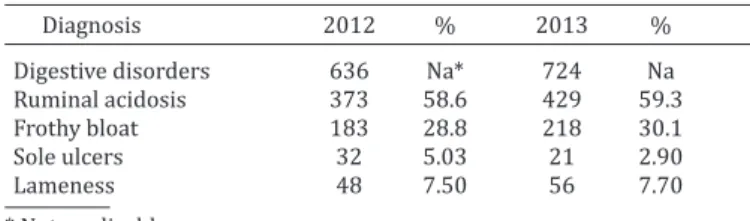
In the group of animals affected by digestive disorders, rumen acidosis and frothy bloat were the two main proble-ms in finishing cattle during 2012 and 2013 (Table 2).
For two consecutive years, in both feedlots which pro-duced males to be sold as sires, only one animal had to be removed and euthanized due to a traumatic injury.
The costs for treatments of the major health problems in cattle finished for slaughter are shown in Table 3. The
Table 1. Cattle finished for slaughter and number of animals
diagnosed and treated for different problems in 2012 and 2013
2012 2013
Total of cattle finished per year 61126 83214
Total of cattle diagnosed and treated 1942 (3.18) 2337 (2.81) Treated for BRD* 856 (44.1) 1092 (46.7) Treated for digestive disorders 636 (32.7) 724 (31.0) Treated for other problems 450 (23.2) 521 (22.3) (as abscess, trauma, haematoma,
urolithiasis, skin diseases.)
Cases per day (average) 5.32 6.40
* Bovine respiratory disease. Values in brackets are given as percentages.
Table 2. Digestive disorders in cattle finished for slaughter
in 2012 and 2013
Diagnosis 2012 % 2013 %
Digestive disorders 636 Na* 724 Na Ruminal acidosis 373 58.6 429 59.3
Frothy bloat 183 28.8 218 30.1
Sole ulcers 32 5.03 21 2.90
Lameness 48 7.50 56 7.70
* Not applicable.
Table 3. Average and confidence interval (CI 95 %) for
treatment costs of the main health problems of feedlot cattle for slaughter
Problems 2012 2013
Cost Cost Cost Cost
(US$/animal) (in kg LW) (US$/animal) (in kg LW)
Frothy bloat 31.8 ± 8,1 20.9 22.2 ± 8.2 13.7 BRD 21.3 ± 1,1 14.0 21.7 ± 1.6 13.4 Ruminal acidosis 17.3 ± 2.3 11.4 17.8 ± 3.8 11,0 Sole ulcers 22.8 ± 5.6 15.0 23.3 ± 7.0 14.4 Lameness 15.5 ± 3.2 10.2 15.7 ± 4.4 9.7 1.52 and 1,62 US$/kg LW were used for the estimation of cost in kg of LW
complexity and little effect of drugs used to treat frothy blo-at generblo-ated the greblo-atest treblo-atment expenses. The reason attributed for the lower expenses with treatment of frothy bloat in 2013 was because the veterinarian had adopted a cheaper therapeutic approach (Table 3). In Brazil, the tar-get LW gain is 140 kg over 100 days in the feedlot. There-fore, it can be estimated that the negative monetary impact for treatment of various problems in feedlot cattle may re-present by 7 to 15% of LW gained over the feeding period (Table 3).
The exaggerated growth (length) of rumen papillae, as-sociated with hyperpigmentation, was the main finding in
the rumens of finished cattle in 2012 and 2013 (Table 4 and 5). The reduction in the surface area of atrophic papillae (parakeratotic) in relation to the papillae of cattle raised exclusively on pastures or those with elongated papillae was 3.4 to 7 times fold, respectively (Table 5).
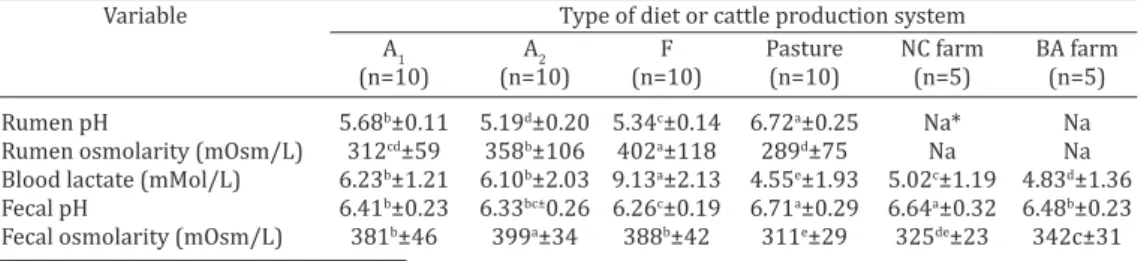
Cattle fed for slaughter were offered adaptation diets with high amounts of grains and by-products and low rou-ghage. Thus, the pH of the rumen fluid was higher in the diet A1 than in diets A2 and F (Table 6). However, even a pH of 5.68 for A1 diet was considered to be near the critical value of 5.60 that is in range for chronic rumen acidosis (Owens et al. 1998). The osmolarity of the rumen fluid followed a rising pattern as the diets had more concentrate in their composition (Table 6).
Blood lactate concentration was always higher in cattle finished for slaughter. The ones raised on pastu-re, followed by animals of BA and NC farms, were those that had the lowest blood lactate concentrations (Table 6). The animals finished for slaughter had feces with the highest osmolarities and the animals raised on pastures had feces with slightly larger osmolarity than the blood, between 280 and 300mOsm (Table 6). The fecal pH of cattle finished for slaughter was consistently lower than the pH of feces of the animals fed to be sold as sires or the ones raised on pastures (Table 6). Since the cattle selected to be sires fed at the specialized feedlots, were more valuable and it was not possible to obtain rumen fluid by ruminocentesis to evaluate their ruminal pH (Table 6).
During the slaughterhouse inspection, cattle without macroscopic findings in the rumen were those which gai -ned more weight and spent less time in the feedlot (Table 7). Costs for additional days on feed resulting from digesti-ve disorders, should also be added to costs for treatments
Table 5. Average and confidence interval (CI 95%) for
number, length and surface area of rumen papillae of cattle
of cattle finished for slaughter
Type of rumen papillae
Parakeratotic With excessive From pasture
growth diet
Number (papillae/cm2) 64.2a± 2.5 39.1c± 3.1 48.7b± 3.8 Length (mm) 8.44b± 1.5 13.2a± 2.7 7.72b± 1.8 Surface area (mm2) 5.46c± 1.1 39.2a± 4.3 18.7b± 2.8
Different lower case letters indicate difference by Tukey test (P≤0.05).
Table 7. Average and confidence interval (CI 95%) for main digestive disorders and its effects in days on feed (DOF), average daily gain (ADG), cooled carcass weight (CCW), carcass yield
(CY) and daily carcass gain (DCG) of cattle finished for slaughter
Type of DOF Initial weight Final weight ADG CCW CY DCG*
animal (kg) (kg) (kg) (kg) (%) (kg)
1 95.7 ± 1.1 343.5 461.4 1.23a ± 0.25 245.3a 53.2 0.768a 2 102.4 ± 20.1 348.7 458.2 1.07b ± 0.26 247.4a 54.1 0.713a 3 99.3 ± 9.8 347.8 444.3 0.972b ± 0.21 237.3a 53.4 0.638b 4 96.2 ± 12.1 352.0 403.2 0.532c ± 0.22 Na5 Na Na
Different lower case letters indicate difference by Tukey test (P≤0.05). * Calculated as cooled carcass weight (ini -tial weight/2))/days on feed. 1 With no macroscopic findings in the rumen (n=86), 2 With parakeratosis (n=79), 3 Treated for ruminal acidosis (n=63), 4 Treated for ruminal acidosis without recovery and subsequent release
to pasture (n=68), 5 Not applicable.
Table 6. Average and confidence interval (CI 95%) for physical-chemical parameters
measured in cattle in different feedlot systems and pasture diet
Variable Type of diet or cattle production system
A1 A2 F Pasture NC farm BA farm
(n=10) (n=10) (n=10) (n=10) (n=5) (n=5)
Rumen pH 5.68b±0.11 5.19d±0.20 5.34c±0.14 6.72a±0.25 Na* Na Rumen osmolarity (mOsm/L) 312cd±59 358b±106 402a±118 289d±75 Na Na Blood lactate (mMol/L) 6.23b±1.21 6.10b±2.03 9.13a±2.13 4.55e±1.93 5.02c±1.19 4.83d±1.36 Fecal pH 6.41b±0.23 6.33bc±0.26 6.26c±0.19 6.71a±0.29 6.64a±0.32 6.48b±0.23 Fecal osmolarity (mOsm/L) 381b±46 399a±34 388b±42 311e±29 325de±23 342c±31
* Na = not analyzed. Different lower case letters indicate difference by Tukey test (P≤0.05). Table 4. Main ruminal macroscopic findings from cattle
finished for slaughter
Date of slaughter
5/10/2012 8/5/2013
Total of examinated rumens 214 % 171 % Exaggerated growth of rumen papillae, 163 76.2 121 70.8 associated with hyperpigmentation
Hyperemic mucosae 98 45.8 71 41.5
Rumen mucosae with ulcers or ruminitis 67 31.3 34 19.9 Rumen mucosae with scars 47 22.0 38 22.2
of others health problems, which accounted for an equiva-lent of 9.7 to 20.9 kg of live weight (Table 3).
Interestingly, cattle that were affected by digestive di-sorders had no decrease in carcass yield but spent more time on feed (Table 7). The animals diagnosed with ru-minal acidosis and those which had rumens with parake-ratosis gained less 0.258 and 0.160 kg/day, respectively (Table 7). Animals fed to be sold as sires, had ADG similar to cattle finished for slaughter, despite the lower concen -trate proportion in their diet but without rumen disor-ders (Table 8).
DISCUSSION
During two years of field observation and data collection became evident that the number of cattle diagnosed for any disease and treated during the finishing period in the tra -ditional feedlot systems did not represent the real number of diseased animals. The discrepancy between the number of problems observed by staff and the number of animals examined and treated professionally by a veterinarian su-ggests that disease diagnosis and treatment are not mana-ged effectively in large scale Brazilian feedlots. Most likely, many cases were not even identified. Chronic understaffing, i.e. four technical staff and one veterinarian on one side and large cattle numbers (80.000 or more) on the other side, are a reality in traditional feedlot systems. Unfortunately, this increases the probability that symptoms will be overlooked and treatment of diseases will not be undertaken. For exam-ple, professionals stated that during data collection it was a common practice to identify sick animals during a round within a group of 240 cattle and continue the observations in other pens. Since there was only short time to observe all pens, staff chose to contact the veterinarian only for speci-fic cases. Professional medical assistance was sought when they thought an animal would not improve without veteri-nary interference and disregarded professional help when they considered that the animal had no chances of recovery. This approach is certainly questionable but is believed to describe the reality in large scale Brazilian feedlots.
Another remarkable aspect was that many cattle were found dead overnight or even between visits of health care. The sudden death syndrome (SDS) of feedlot cattle is still underdiagnosed in Brazilian feedlots. Deaths occur sud-denly and unexpectedly, i.e. there are no preceding clinical signs (Pierson et al. 1976, Glock & DeGroot 1998). Under these circumstances necropsy is the only tool available and the lack of clinical signs and epidemiological data do not allow an accurate diagnosis. In several cases of SDS, the ma-croscopic findings during necropsy were not coherent or
meaningful. The etiology of SDS is not yet fully understood. The high prevalence of SDS was probably caused by seve-re stseve-ress due to travel several days under poor conditions (e.g. heat stress, dehydration, dust), high stocking densities in pens and a diet with high percentage of grains and low intake of physically effective fiber. Unfortunately, for this study data of animals that died by SDS were unavailable.
The scientific literature on Brazilian feedlots does not report statistics on prevalence of morbidity and mortality of feedlot cattle which became ill and were treated during their stay in feedlots. Sometimes there are some reports, in non-scientific journals or websites, about morbidity and mortality rates, but it is difficult to obtain reliable con -clusions from these sources. Edwards (1996) studied the morbidity of beef cattle in the US based on a survey with feedlot managers, and found that respiratory diseases were diagnosed in 67 to 82% of the cases and digestive disorders accounted for 3 to 7% of total diagnoses. These values are quite different from those found in the feedlots evaluated in this study which used data from real observations; e.g. always made in the presence of cattle.
The feedlot for slaughter evaluated in this study pur-chased cattle that were transported by trucks for several days under adverse conditions such as heat, dehydration and dust, until they reached their final destination. Stress during transport together with increased levels of concen-trate in A1, A2 and F diets are considered to be the major predisposing factors for the numerous cases of BRD obser-ved in this feedlot (Table 1).
The health problems commonly observed in the feedlot for slaughter have not been diagnosed in those systems which fed animals to be sold as sires. This was most likely because the selling price of an animal of this system is very high, so the nutrition and the prophylactic health manage-ment put in place in those types of feedlots is very deman-ding. It would be disastrous, for example, if a farmer bought a sire with lameness caused by high intake of concentrate during the feeding phase prior of having the bull serving cows in a breeding season. The cow-calf systems in Brazil are predominantly under an extensive management. Thus, an animal with claw injury or sequelae does not have the same mating efficiency than a healthy one.
Snowder et al. (2006) estimated that the average cost on BRD treatment in US feedlots was about US$ 13.9 per cattle; much less than the average of US$ 21.5 found in this study. It appears that there are no publications related to costs with treatment of these problems in beef cattle con-fined under Brazilian conditions. In the study of Ferreira et al. (2004), costs for the treatment of sole ulcers in free-stall dairy cows was US$ 72.6.
The exaggerated papillary growth, associated with hyperpigmentation, may not mean an actual increase in ruminal absorptive capacity, as this finding has also been observed in rumens of animals with ulceration, scars and parakeratosis. Variations in the incidence of these macros-copic changes between years (Table 4) are due to changes in diet composition. In 2012 the animals received only mombaça silage (pH 4.7) as roughage and in 2013 they had 11.6% of this silage and 10.1% of sugar cane bagasse in the
Table 8. Average and confidence interval (CI 95%) for
feedlot to produce sires
NC farm (n=89)
Days on feed Initial weight (kg) Final weight (kg) ADG (kg) 166 459.9±37.1 680.8±51.2 1.33b±0.25
BA farm (n = 73)
Initial weight(kg) Final weight (kg) ADG (kg)
131 466.4±37.7 625.5±36.1 1.21a±0.14
DM basis. The latter source of drier roughage most likely stimulated more rumination, improving rumen health by increasing saliva production.
In chronic ruminal acidosis, initially the rumen papillae grow excessively in numbers (Table 5) and then become coalescent to form relatively cohesive blocks. The agglu-tination of the papillae, associated with their atrophy, is a macroscopic finding that if investigated histologically may reveal parakeratosis. Ruminal parakeratosis negatively affects the absorption of volatile fatty acids (VFAs). The loss in absorptive capacity causes accumulation of VFAs in the rumen fluid, what further aggravates the process of ruminal acidosis. Gaebel et al. (1987) found values from 8 to 9 mm2 and 31 to 35 mm2 for the area of rumen papillae of sheep fed a diet containing exclusively hay and 10% hay and 90% con-centrate diet, respectively. The largest surface area of rumen papillae in animals ingesting more concentrate (Table 5) was considered to be in response to an increased production of VFAs, especially butyrate, which has trophic effect on ru-minal epithelium cells and stimulates the papillary growth.
Ruminal fluid values above 350mOsm/L may adverse -ly affect food intake and rumination (Welch, 1982). High ruminal osmolarity also inhibits the action of rumen mi-croorganisms, increase the rate of passage of digesta and, due to higher concentration of intraruminal solutes, cau-se osmotic diarrhea with considerable loss of water and electrolytes. Ruminants on pasture had ruminal osmolarity ranging from 240 to 265mOsm/L that contrasted with 280 to 300mOsm/L found in animals receiving high concentra-te diets (Garza et al. 1989). Another deleconcentra-terious effect of the rapid influx of water into the ruminal environment is the detachment of rumen papillae, which creates conditions for VFAs, generated by the fermentation of non-fibrous car -bohydrates, what damages the rumen wall causing rumi-nitis and, as a consequence, rumen microorganisms reach the liver and may cause liver abscesses (Owens et al. 1998).
A result of 9.13mmol lactate/L blood found in cattle in the traditional feedlot system was potentially dangerous, being a predisposing factor for systemic metabolic acido-sis (Glock & Degroot 1998), and could be the cause of the sudden death cases. During data collection it was observed that several animals were seen separated from the others, but with no changes or signs of any problems and, after a certain time, were found dead by staff members. Unfor-tunately, no cases where the animal was in extremis were found, so that that blood was collected and lactate could be estimated. Maruta & Ortolani (2002) induced ruminal aci-dosis in Jersey and Gir cattle and found 11.7 and 6.8mmol/L of lactate, respectively, for the two breeds.
The highest fecal osmolarities found in animals finished for slaughter reflects the highest concentration of feed so -lutes, which reach the large intestine, probably due to the higher rate of passage of digesta from the rumen to small intestine. These cattle had diarrheic feces with higher os-molarity. The animals fed for sale as sires had two patterns of fecal osmolarity - a higher value in May (a month that they were offered more concentrated (50-65% DM)) and a lower value in April (at the beginning when they had less concentrate in their diet (20-30% DM)).
The lowest fecal pH in cattle finished for slaughter is probably due to the higher rate of passage of digesta throu-gh the gastrointestinal tract and the larger amount of in-gested starch that escaped ruminal digestion and reached the large intestine, where it was then fermented by the mi-croorganisms in this compartment and converted to VFAs, which are the cause of dropin the fecal pH (Table 6). The starch intake was low in the systems that produce cattle for sale as sires, because the concentrate contained mainly citrus pulp and soybean hulls, which are rich in pectin what is not fermented in the rumen to lactic acid like starch. This type of feedstuffs associated with a higher intake of physi-cally effective fiber resulted in fecal pH highest for the ani -mals raised as sires (Table 6).
Assuming that an animal with a digestive disorder re-mained confined for four additional days on feed, and the daily cost of a feedlot was US$1.68/head (or equivalent to 1.1 kg/day of LW), one can estimate the extra costs ofUS$ 6.72 per animal finished. Therefore, the costs with extra days on feed should be considered by nutritionists before deciding to use high grain diets; e.g. more than 80 to 85% of concentrate in the composition. If the diet is balanced to ensure rumen health (suitable ratio of concentrate to physically effective fiber, along with sufficient adaptation time), the animals would be less likely to develop digestive disorders; consequently Brazilian feedlots would have less effective operational costs (Table 7).
When performing the economic viability of cattle finished for slaughter it is also important to take into account that many animals treated for digestive disorders do not respond to therapy and have to be removed from the feedlot and pla-ced back into pasture. Unfortunately, it was not possible to access statistics on this topic; we just had the reports of these cases by the veterinarian. This approach most likely results in a considerable loss of revenue, because beside of cost of treat-ments, there are other expensive costs during the time spent on feed. These animals are commonly called “railers” (Lardy 2013), which means that an animal is removed before the end of the feeding program and taken back to pasture. Feeding costs since the beginning of the feedlot program until the rele-ase of these “railers” to pasture should be considered to calcu-late the effective operational costs of Brazilian feedlots. In the pasture, these animals recover slowly and almost never re-turn to gain weight properly because the sequelae of chronic ruminal acidosis (rumen scars and loss of ruminal absorptive capacity) negatively affects the nutrient absorption capacity.
Despite the lower concentrate proportion in the diet animals fed to be sold as sires, had ADG similar to cattle fi -nished for slaughter (Table 8). This is due to the fact that to raise cattle as sires, besides a higher genetic merit, a careful nutrition is needed to ensure that no digestive disorders happen and guarantee a long and productive life. Also these cattle are raised and confined on the same ranch until they reach proper weight to be sold as sires. This, along with a lower stocking density, as in head per square meter of the confinement, reduces the negative impacts that cause stress in feedlot animals.
los-ses of 0.14 to 0.33 kg for animals that were affected by BRD during the finishing phase. Unfortunately, specific data on the negative impacts that digestive disorders may have on average daily gain of cattle finished for slaughter, were not available in the Brazilian literature.
CONCLUSIONS
Cattle finished for slaughter had considerably more he -alth problems than those in systems that fed sires.
Bovine respiratory disease and digestive disorders (ru-minal acidosis and frothy bloat) were the main health pro-blems diagnosed in cattle finished for slaughter.
Treatment costs were high, accounting, on average, from 7 to 15% of the target live weight to be gained during the finishing period of the traditional system.
The exaggerated growth of rumen papillae and parake-ratosis were the main macroscopic findings in rumens of feedlot cattle for slaughter.
The rumen and fecal pH were always lower, and the rumen osmolarity and blood lactate higher in animals fini -shed for slaughter.
The time spent on feed was longer for cattle affected by digestive problems as a result of the lower weight gain.
Results from this study suggest that health problems may not only reduce animal productivity and profitability, but also the welfare of animals.
The systemic understaffing of animal workers and veteri -narians in large feedlots in Brazil results in under reporting of diseases, lack of understanding of epidemiological context and disease prevention. A cost benefit study would probably help to further examine scientifically these parameters.
Expected savings of costs and application of higher ani-mal welfare standards would better prepare market orien-ted feedlots for competitive international trade.
Acknowledgements.- We gratefully acknowledge Dr. Axel Colling (AAHL, CSIRO, Australia) and Professor John Gaughan (SAFS, UQ, Australia) for valuable suggestions and reviewing the English version of the manuscript.
REFERENCES
Anualpec 2014. Custo da pecuária intensiva/semi-intensiva em 25 regi-ões pecuárias. Anuário da Pecuária Brasileira. Editora FNP, São Paulo, SP, p.145-183.
Dirksen G. 1981. Indigestiones en el Bovino. Schnetztor-Verlag GmbH, Konstanz, p.1-79.
Edwards A.J. 1996. Respiratory diseases of feedlot cattle in the central USA. Bovine Pract. 30:5-7.
Ferreira P.M., Leite R.C., Carvalho A.U., Facury Filho E.J., Souza R.C. & Fer-reira M.G. 2004. Custo e resultados do tratamento de sequelas de lami-nite bovina: relato de 112 casos em vacas em lactação no sistema free--stall. Arq. Bras. Med. Vet. Zootec. 56:589-594.
Gaebel G., Martens H., Suendermann M. & Galfi P. 1987. The effect of diet,
intraruminal pH and osmolarity on sodium, chloride and magnesium absorption from the temporarily isolated and washed reticulo-rumen of sheep. Quart. J. Exp. Physiol. 72:501-511.
Garza J.D., Owens F.N. & Breazile J.E. 1989. Effects of diet on ruminal li-quid and on blood serum osmolarityandhematocritin feedlot heifers. Okla. Agricult. Exp. Stn <www.beefextension.com/research_reports/ 1989rr/89_13.pdf> Accessed on March 30, 2016.
Glock R.D. & Degroot B.D. 1998. Sudden death of feedlot cattle. J. Anim. Sci.76:315-319.
Kleen J.L., Hooijer G.A., Rehage J. & Noordhuizen J.P. 2004. Rumenocentesis (rumen puncture) a viable instrument in herd health diagnosis. Dtsch. Tierärztl. Wochenschr. 111:458-462.
Lardy G. 2013. Cattleman’s guide to terminology feedlot <http:// www.ag.ndsu.edu/publications/landing-pages/livestock/cattle-mans-guide-to-feedlot-terminology-as-1161> Accessed on March 30, 2016.
Malafaia P., Barbosa J.D., Tokarnia C.H. & Oliveira C.M.C. 2011. Distúrbios comportamentais em ruminantes não associados a doenças: origem,
significado e importância. Pesq. Vet. Bras. 31:781-790.
Maruta C.A. & Ortolani E.L. 2002. Susceptibilidade de bovinos das raças Jersey e Gir à acidose láctica ruminal: Acidose metabólica e metaboliza-ção do lactato. Ciência Rural 32:61-65.
Nagaraja T.G. & Lechtenberg K.F. 2007. Acidosis in feedlot cattle. Vet. Clin. Food Anim. 23:333-350.
Owens F.N., Secrist D.S., Hill W.J. & Gill D.R. 1998. Acidosis in cattle: a re-view. J. Anim. Sci. 76:275-286.
Pierson R.E., Jensen L.H., Lauerman D.A., Saari P.M., Braddy A.E. & Chesney M.C. 1976. Sudden death in yearling feedlot cattle. J. Am. Vet. Med. Assoc. 169:527-529.
SAS 2003. Statistics (Release 9.1). Users Guide. SAS Inst. Inc., Cary, NC. Schneider C.A., Rasband W.S. & Eliceiri K.W. 2012. NIH Image to ImageJ: 25
years of image analysis. Nature Methods 9:671-675.
Smith R.A. 1998. Impact of disease on feedlot performance: a review. J. Anim. Sci. 6:272-274.
Snowder G.D., VanVleck L.D., Cundiff L.V. & Benett G.L. 2006. Bovine res-piratory disease in feedlot cattle: environmental, genetic, and economic factors. J. Anim. Sci. 84:1999-2008.