Full paper published online: November 30, 2009 ISSN 1678-9199.
BIOTIN-AVIDIN SANDWICH ELISA WITH SPECIFIC HUMAN ISOTYPES IgG1 AND IgG4 FOR Culicidae MOSQUITO BLOOD MEAL IDENTIFICATION FROM AN
EPIZOOTIC YELLOW FEVER AREA IN BRAZIL
Marassá AM (1), Paula MB (2), Gomes AC (2), Consales CA (3)
(1) Adolfo Lutz Institute, São Paulo, São Paulo State, Brazil; (2) Department of
Epidemiology, School of Public Health, University of São Paulo, USP, São Paulo,
São Paulo State, Brazil; (3) Pasteur Institute, São Paulo, São Paulo State, Brazil.
ABSTRACT: With a view toward investigating the feeding behavior of Culicidae
mosquitoes from an area of epizootic yellow fever transmission in the municipalities of Garruchos and Santo Antônio das Missões, Rio Grande do Sul State, Brazil, specimens were collected by aspiration from September 2005 to April 2007. The engorged females were submitted to blood meal identification by enzyme-linked immunosorbent assay (ELISA). A total of 142 blood-engorged samples were examined for human or monkey blood through species-specific IgG. Additional tests for specificity utilizing isotypes IgG1 and IgG4 of human monoclonal antibodies showed that only anti-human IgG1 was effective in recognizing blood meals of human origin. The results indicated a significant difference (p = 0.027) in detection patterns in samples of Haemagogus leucocelaenus recorded from human blood meals at Santo Antônio das Missões, which suggests some degree of exposure, since it was an area where epizootic outbreaks have been reported.
KEY WORDS: Culicidae, ELISA, feeding habits, isotypes, yellow fever.
CONFLICTS OF INTEREST: There is no conflict.
FINANCIAL SOURCE: Secretary of Health Surveillance, Brazilian Ministry of Health
and Pan American Health Organization, Proc. N. 25000.022.005/2004-56.
CORRESPONDENCE TO:
ANA MARIA MARASSÁ, Laboratório de Parasitoses Sistêmicas, Instituto Adolfo
INTRODUCTION
Forest canopy mosquitoes of the genera Haemagogus and Sabethes are known to
transmit yellow fever and have recently been involved in major outbreaks of the
disease in Brazil (1). Understanding their blood-feeding habits is thus of the utmost
importance and permits the estimation of the degree of the human-vector contact
significant to epidemiological studies.
In recent years, several investigators have adapted the enzyme-linked
immunosorbent assay (ELISA) to identify hosts from which mosquitoes had taken a
blood meal (2-6). In addition, the biotin-avidin sandwich ELISA assay has also been
included in analyses of mosquito feeding habits and other arthropod-borne diseases
(7-10).
This study sought to evaluate species-specific immunoglobulin IgG and human
isotypes IgG1 and IgG4 through the use of monoclonal antibodies and exploit the
specificity attainable for to identify human blood meals consumed by mosquitoes in
an area of epizootic yellow fever transmission in the state of Rio Grande do Sul,
Brazil.
MATERIALS AND METHODS
Study Area and Culicidae Sampling
Field studies were conducted at two localities in Rio Grande do Sul state, namely
Santo Antônio das Missões (55o21’W, 28o29’S) and Garruchos (55o45’W, 28o17’S),
from September 2005 to April 2007. Garruchos, situated on the western side of the
Uruguay River, is a rural municipality 13 km from Santo Antônio das Missões.
A large-bore aspirator was utilized to collect resting mosquitoes from vegetation at
two sites in Garruchos – one of them located on Cachoeirinha farm and the other in
the São José Velho area – while in Santo Antônio das Missões, only one site was
selected for investigation (11). Engorged female samples were placed individually in
microtubes, transported to the laboratory and stored at –20oC until the ELISA test
could be performed. Mosquitoes were identified to the species level in accordance
with Consoli and Oliveira (12) and Forattini (13).
Blood Meal Analyses
Blood-fed mosquitoes were identified using the biotin-avidin ELISA by the
The behavior of feeding on humans or monkeys was investigated using host-specific
anti-human IgG (6284-00, Zymed, USA); anti-monkey IgG (617-101-012, Rockland,
USA); conjugated anti-human IgG (6284-40, Zymed, USA); and
biotin-conjugated anti-monkey IgG (617-106-012, Rockland, USA). All the tests carried out
with extracts that were positive for human or monkey blood, by ELISA, included
human IgG1 and IgG4 monoclonal antibodies.
ELISA Assay Optimization
Reagent concentrations were optimized by checkerboard titrations to determine the
highest sensitivity and lowest background of mosquito suspensions. Ninety-six-well
microplates (Nunc®, Maxisorp, Denmark) were coated with 50 µL/well of anti-human
IgG1 (05-3300, Zymed, USA) and anti-human IgG4 (05-3800, Zymed, USA) diluted
in PBS at concentrations of 20, 10, 5, 2.5, 1.25 and 0.625 µg/mL and incubated
overnight at 4oC. The plates were blocked with PBS/1% gelatin (Difco, Laboratory
Inc., USA) and kept covered at room temperature for three hours.
Each plate was washed five times with PBS 0.05% Tween-20 (P-1379, Sigma, USA);
then the competitive reaction was carried out in two consecutive wells by the addition
of 50 µL/well of PBS/0.1% gelatin and 50 µL/well of positive control pool on each
plate. The pool of 14 females that had fed on a human for artificial xenodiagnosis
was diluted from 1:2 to 1:64. After 18 hours at 4oC, biotin-conjugated anti-human
IgG1 (05-3340, Zymed, USA) and biotin-conjugated anti-human IgG4 (05-3840,
Zymed, USA) were added. After one hour at room temperature, 50 µL/well of
avidin-alkaline phosphatase conjugate (A7294, Sigma, USA) in PBS/0.1% gelatin was
added in each well. After another hour, the enzymatic reaction was obtained by
adding p-nitrophenyl phosphatase (Sigma Chemical, USA) to diethanolamine buffer.
Absorbance was measured by spectrophotometry (Multiskan® EX, Thermo Scientific,
USA) at a wavelength of 405 nm.
Data Analyses
The chi-squared (χ2) test for proportions was calculated with Excel® (Microsoft, USA)
for Windows XP to ascertain whether frequencies of human and monkey samples
RESULTS
The ELISA system for human and monkey blood meals was evaluated for specificity
by testing a total of 142 blood-engorged specimens of Culicidae mosquitoes
collected at the two municipalities. According to Tables 1, 2 and 3, polyclonal
anti-human IgG and anti-monkey IgG cross-reacted and could not provide the higher
specificity needed for the detection of human or monkey blood meals.
Table 1. Distribution by purified antibody (IgG) of Culicidae samples from Santo
Antônio das Missões, RS, collected between September 2005 and April 2007
Species
Purified antibody
Ae. crinifer Ae. serratus
Ae. scapularis Cx. (Cx.)
sp
.
Cx. (Mel.)
spp
.
Hg.
leucocelaenus Sa. albiprivus
Sa.
quasicyaneus
Ps. ferox
Anti-human IgG 2/2 3/4 8/8 1/1 2/2 17/17 6/6 1/1 4/4
Anti-monkey IgG 2/2 2/4 3/8 1/1 2/2 8/17 2/6 1/1 3/4
Anti-human IgG1 1/2 3/4 8/8 0/1 0/2 17/17 6/6 1/1 3/4
Total 2 4 8 1 2 17 6 1 4
Total positive (human) 1 3 8 0 0 17 6 1 3
Total positive (monkey) 1 1 0 1 2 0 0 0 1
Ae.: Aedes; Cx. (Cx.): Culex (Culex); Cx. (Mel.): Culex (Melanoconion); Hg.: Haemagogus; Sa.
Table 2. Distribution by purified antibody (IgG) of Culicidae samples from Cachoeirinha, Garruchos, RS, collected between September 2005 and March 2007
Species
Purified antibody
Ae. crinifer Ae. serratus
Ae. scapularis
Hg.
leucocelaenus Sa. albiprivus Sa. chloropterus
Sa. quasicyaneus
Ps. albigenu Ps. ferox
Anti-human IgG 1/1 8/8 18/18 11/11 5/5 1/1 1/1 4/4 12/12
Anti-monkey IgG 1/1 6/8 11/18 7/11 2/5 0/1 1/1 3/4 8/12
Anti-human IgG1 0/1 8/8 18/18 11/11 5/5 1/1 1/1 4/4 11/12
Total 1 8 18 11 5 1 1 4 12
Total positive (human) 0 8 18 11 5 1 1 4 11
Total positive (monkey) 1 0 0 0 0 0 0 0 1
Ae.: Aedes; Hg.: Haemagogus; Sa. quasicyaneus: Sabethesquasicyaneus;Ps.: Psorophora.
Table 3. Distribution by purified antibody (IgG) of Culicidae samples from São José
Velho, Garruchos, RS, collected between September 2005 and March 2007
Species
Purified antibody Ae. crinifer Ae. scapularis Cx. (Cx.) spp. Hg. leucocelaenus Sa. albiprivus Ps. ferox
Anti-human IgG 1/1 17/17 3/4 7/7 5/5 2/2
Anti-monkey 1/1 17/17 4/4 6/7 5/5 1/2
Anti-human IgG1 1/1 14/17 0/4 5/7 4/5 2/2
Total 1 17 4 7 5 2
Total positive (human) 1 14 0 5 4 2
Total positive (monkey) 0 3 4 2 1 0
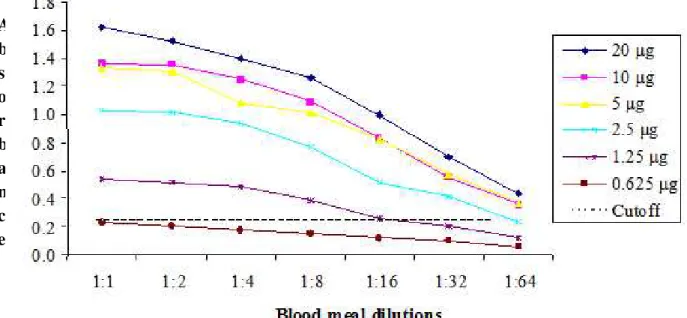
Additional tests for specificity were assayed with monoclonal antibodies, anti-human
IgG1 and IgG4. Checkerboard titrations were undertaken to determine the highest
specificity and lowest background of mosquito suspensions and the results are
shown in Figures 1 and 2.
A
b
s
o
r
b
a
n
c
e
Figure 1. ELISA optimization with monoclonal anti-human IgG1.
A
b
s
o
r
b
a
n
c
e
The absorbance value that determined the cutoff point to optimize the
immunoenzymatic capture technique against IgG1 mAb was 0.207 (Figure 1). By
contrast, absorbance values detected by ELISA against IgG4 mAb did not exceed
the cutoff value of 0.200 to identify human blood meal samples (Figure 2).
The optimum concentration of anti-human IgG1 mAb for coating the plates was 5
µg/mL and according to what had been previously established for blood-fed
specimens of Culex quinquefasciatus, dilution of biotin-anti-human IgG1 mAb and
avidin was incorporated (8).
Serum dilutions from the primates Cebus spp. and Alouatta spp. were tested against
IgG1 mAb, and were not detected by ELISA. The absorbance values for both Cebus
spp. and Alouatta spp. were less than 0.030 while the mean absorbance cutoff for
human blood meal samples was 0.207.
During processing of field-collected mosquitoes, samples investigated for human or
monkey blood meal sources comprised specimens of: Aedes crinifer, Aedes serratus,
Aedes scapularis, Culex (Culex) spp., Culex (Melanoconion) spp., Haemagogus
leucocelaenus, Psorophora ferox, Psorophora albigenu, Sabethes albiprivus,
Sabethes chloropterus and Sabethes quasicyaneus.
At Santo Antônio das Missões, Haemagogus leucocelaenus, Aedes scapularis and
Sabethes albiprivus were the species that most frequently fed on humans (Table 1).
At Cachoeirinha, Garruchos, the results indicated that Aedes scapularis and
Haemagogus leucocelaenus had also consumed human blood (Table 2) whereas in
the area of São José (Table 3) the frequency was not so evident and no difference
was observed between these two sites (p < 0.05).
The present data reveal a significant difference only among samples of Haemagogus
leucocelaenus that had fed on human and monkey blood at Santo Antônio das
Missões (p = 0.027).
DISCUSSION
Knowledge of mosquito host-feeding patterns is an important indicator for the
estimation of species vector potential in disease transmission cycles, and is of great
value in the establishment of control measures.
Currently, methods for the identification of insect blood meals have included ELISA,
which has been employed to determine host preference and has proven useful for
ELISA has also been applied to determine sand fly and mosquito blood meal sources
(7-10).
Further, sensitivity and specificity are conditions that must be taken into
consideration when detecting small amounts of blood consumed by these insects.
Thus, monoclonal antibodies offer the advantage of accuracy and have been
successfully used in numerous investigations (14-18).
In the present study, the limitations of anti-human IgG and anti-monkey IgG, which
revealed cross-reaction with human and monkey blood meals employed in the
identification process, were overcome when responses to mAb isotypes were
observed.
This was the first report in which anti-human IgG1 and IgG4 were evaluated to
identify mosquito blood meals; and our results indicated that only anti-human IgG1
was effective in recognizing blood meals of human origin. Since IgG1 levels were
higher (60-70%) than those of IgG4 (2-6%) in human sera and given the small
amounts of blood consumed by mosquitoes – ascertained as being 3.46 mg for
Anopheles quadrimaculatus and 2.75 mg for Aedes aegypti – these factors could
explain the non-detection of IgG4 (19, 20).
The fact that serum samples from the non-human primates Cebus sp. and Alouatta
sp. presented negative absorbance values indicates that human blood meals can be
accurately identified, which reinforces the concept that the number and properties of
isotypes vary greatly among species, a fact that could be exploited by means of
monoclonals in any application (21). Furthermore, the most important improvement of
the technique was the ability to detect of human blood to estimate the exposure to
Haemagogus leucocelaenus in areas where the yellow fever virus has been isolated.
Subsequent tests that incorporated IgG1 to evaluate field-collected mosquitoes
showed a significant difference among samples of Haemagogus leucocelaenus, from
Santo Antônio, that had fed on human blood. This behavior may suggest
human-vector contact and since the yellow fever virus was isolated in monkeys from the two
municipalities of Rio Grande do Sul, the detection patterns recorded for samples of
Haemagogus leucocelaenus emphasize the risk of yellow fever transmission and
ACKNOWLEDGEMENTS
We wish to thank the Secretary of Health Surveillance, Ministry of Health, for the
research funds; Maria Dulce Bianchi Rosa and Aristides Fernandes for their
assistance in the laboratory; and Rodrigo Sportello for his help with the figures.
REFERENCES
1. Vasconcelos PFC, Sperb AF, Monteiro HAO, Torres MAN, Sousa MRS,
Vasconcelos HB, et al. Isolations of yellow fever virus from Haemagogus
leucocelaenus in Rio Grande do Sul State, Brazil. Trans R Soc Trop Med Hyg.
2003;97(1):60-2.
2. Chow E, Wirtz RA, Scott TW. Identification of blood meals in Aedes aegypti by
antibody sandwich enzyme-linked immunosorbent assay. J Am Mosq Control Assoc.
1993;9(2):196-205.
3. Muturi EJ, Muriu S, Shililu J, Mwangangi JM, Jacob BG, Mbogo C, et al.
Blood-feeding patterns of Culex quinquefasciatus and other culicines and implications for
disease transmission in Mwea rice scheme, Kenya. Parasitol Res.
2008;102(6):1329-35.
4. Richards SL, Ponnusamy L, Unnasch TR, Hassan HK, Apperson CS. Host-feeding
patterns of Aedes albopictus (Diptera: Culicidae) in relation to availability of human
and domestic animals in suburban landscapes of Central North Carolina. J Med
Entomol. 2006;43(3):543-51.
5. Service MW, Voller A, Bidwell DE. The enzyme-linked immunosorbent assay
(ELISA) test for the identification of blood-meals of haematophagous insects. Bull Ent
Res. 1986;76:321-30.
6. Zinser M, Ramberg F, Willott E. Culex quinquefasciatus (Diptera: Culicidae) as a
potential West Nile virus vector in Tucson, Arizona: blood meal analysis indicates
feeding on both humans and birds. J Insect Sci. 2004;4(20):1-3.
7. Marassá AM, Consales CA, Galati EAB. Padronização da técnica
imunoenzimática do ELISA de captura, no sistema avidina-biotina para a
identificação de sangue ingerido por Lutzomyia (Lutzomyia) longipalpis (Lutz &
8. Marassá AM, Consales CA, Galati EAB, Nunes VLB. Identificação do sangue
ingerido por Lutzomyia (Lutzomyia) longipalpis (Lutz & Neiva, 1912) e Lutzomyia
(Lutzomyia) almerioi (Galati & Nunes, 1999) pela técnica imunoenzimática do ELISA
de captura, no sistema avidina-biotina. Rev Soc Bras Med Trop. 2006;39(2):183-6.
9. Marassá AM, Rosa MDB, Gomes AC, Consales CA. Biotin/avidin sandwich
enzyme-linked immunosorbent assay for Culicidae mosquito blood meal
identification. J Venom Anim Toxins incl Trop Dis. 2008;14(2):303-12.
10. de Oliveira AG, Marassá AM, Consales CA, Dorval MEC, Fernandes CE, de
Oliveira GR, et al. Observations on the feeding habits of Lutzomyia longipalpis (Lutz
& Neiva, 1912) (Diptera: Psychodidae: Phlebotominae) in Campo Grande, an
endemic area of visceral leishmaniasis in Mato Grosso do Sul, Brazil. Acta Trop.
2008;107(3): 238-41.
11. Nasci RS. A light weight battery-powered aspirator for collecting resting
mosquitoes in the field. Mosq News. 1981;41:808-11.
12. Consoli RAGB, Oliveira RL. Principais mosquitos de importância sanitária no
Brasil. Rio de Janeiro: Editora da Fundação Oswaldo Cruz; 1994. 225 p.
13. Forattini OP. Culicidologia Médica. São Paulo: Edusp; 2002. 860 p. 2 vol.
14. Achkar SM, Sinhorini IL, Ribeiro OG, Carrieri ML, Ceretta RS, Consales CA.
Immunopathology of rabies infection in mice selected for high or low acute
inflammatory reaction. J Venom Anim Toxins incl Trop Dis. 2007;13(1):39-55.
15. Gould EA, Buckley A, Cammack N. Use of the biotin-streptavidin interaction to
improve flavivirus detection by immunofluorescence and ELISA tests. J Virol
Methods.1985;11(1):41-8.
16. Pazarbasi A, Alptekin D, Luleyap HU, Kasap M, Kasap H. Use of enzyme-linked
immunosorbent assay for detection of natural Leishmania infections in phlebotomine
sand flies from southeastern Turkey. J Med Entomol. 2006;43(2):248-51.
17. Rambozzi L, Menzano A, Lavin S, Rossi L. Biotin-avidin amplified ELISA for
detection of antibodies to Sarcoptes sacabiei in chamois (Rupicapra sp). Vet Res.
2004;35(6):701-8.
18. Remoue F, Alix E, Cornelie S, Sokhna C, Cisse B, Doucoure S, et al. IgE and
IgG4 antibody responses to Aedes saliva in African children. Acta Trop.
2007;104(2-3):108-15.
19. Parslow TG, Stites DP, Terr AI, Imboden JB. Imunologia Médica. 10th ed. Rio de
20. Jeffery GM. Blood meal volume in Anopheles quadrimaculatus, A. albimanus and
Aedes aegypti. Exp Parasitol. 1956;5(4):371-5.
21. Tizard IR, Schubot RM. Veterinary immunology: an introduction. 6th ed.
Philadelphia: W.B. Saunders; 2000. p. 139-48.
22. Sallis ES, de Barros VL, Garmatz SL, Fighera RA, Graça DL. A case of yellow
fever in a brown howler (Alouatta fusca) in Southern Brazil. J Vet Diagn Invest.