1 Recebido para publicação em 20.2.2012 e aprovado em 3.4.2012.
2 Centro de Ciências Agrárias, Universidade Federal de Alagoas – UFAL, Rio Largo, AL, 57100-000, Brazil, <[email protected], [email protected], [email protected]>; 3 Dep. de Fitopatologia, Universidade Federal de Viçosa – DFP/UFV, 36570-000 Viçosa, MG, Brasil, <[email protected], [email protected]>; 4 Engo-Agro., Dep. de Fitotecnia, DFT/UFV, <[email protected]>.
FURTHER MOLECULAR CHARACTERIZATION
OF WEED-ASSOCIATEDB
EGOMOVIRUSES INB
RAZIL WITH ANE
MPHASIS ONSida
spp.
1Caracterização Molecular Adicional de Begomovírus Associados a Plantas Daninhas no Brasil,
com Ênfase em
Sida
spp.
TAVARES, S.S.2,3, RAMOS-SOBRINHO, R.3, GONZÁLEZ-AGUILERA, J.4, LIMA, G.S.A.2, ASSUNÇÃO, I.P.2 and ZERBINI, F.M.3
ABSTRACT - Begomoviruses are whitefly-transmitted, single-stranded DNA viruses that are often associated with weed plants. The aim of this study was to further characterize the diversity of begomoviruses infecting weeds (mostly Sida spp.) in Brazil. Total DNA was extracted from weed samples collected in Viçosa (Minas Gerais state) and in some municipalities of Alagoas state in 2009 and 2010. Viral genomes were amplified by RCA, cloned and sequenced. A total of 26 DNA-A clones were obtained. Sequence analysis indicated the presence of 10 begomoviruses. All viral isolates from Blainvillea rhomboidea belonged to the same species, Blainvillea yellow spot virus (BlYSV), thereby suggesting that BlYSV may be the only begomovirus present in this weed species. Four isolates represent new species, for which the following names are proposed: Sida yellow blotch virus (SiYBV), Sida yellow net virus (SiYNV), Sida mottle Alagoas virus (SiMoAV) and Sida yellow mosaic Alagoas virus (SiYMAV). Recombination events were detected among the SiYBV isolates and in the SiYNV isolate. These results constitute further evidence of the high species diversity of begomoviruses in Sida spp. However, the role of this weed species as a source of begomoviruses infecting crop plants remains to be determined.
Keywords: geminivirus, recombination, Blainvillea rhomboidea, Sida micrantha, Sida urens, Sida santaremnensis
RESUMO - Begomovírus são vírus de DNA circular fita simples transmitidos por mosca branca, os quais são frequentemente associados com plantas daninhas. O objetivo deste trabalho foi caracterizar a diversidade de begomovírus infectando plantas daninhas (principalmente Sida spp.) no Brasil. DNA total foi extraído a partir de plantas daninhas coletadas em Viçosa (Minas Gerais) e em alguns municípios do estado de Alagoas em 2009 e 2010. Os genomas virais foram amplificados por RCA, clonados e sequenciados. Um total de 26 clones de DNA-A foram obtidos. A análise das sequências indicou a presença de dez diferentes begomovírus. Todos os isolados originários de Blainvillea rhomboidea pertencem a uma única espécie viral, Blainvillea yellow spot virus (BlYSV), sugerindo que o BlYSV pode ser o único begomovírus presente nesta espécie de planta invasora. Quatro isolados representam espécies novas, para as quais os seguintes nomes são propostos: Sida yellow blotch virus (SiYBV), Sida yellow net virus (SiYNV), Sida mottle Alagoas virus (SiMoAV) e Sida yellow mosaic Alagoas virus (SiYMAV). Eventos de recombinação foram detectados entre isolados de SiYBV e no isolado de SiYNV. Estes resultados constituem uma evidência adicional da alta diversidade de espécies de begomovírus em Sida spp. Contudo, o possível papel dessas plantas daninhas como fonte de begomovírus para plantas cultivadas ainda permanece indeterminado.
INTRODUCTION
Viruses belonging to the family Geminiviridae have a genome comprised of circular ssDNA encapsidated in a twinned icosahedral capsid (Rojas et al., 2005). The family is divided into four genera (Mastrevirus, Curtovirus, Topocovirus and Begomovirus) according to the insect vector, host range, genome organization and phylogeny (Brown et al., 2011). Viruses classified within the genus Begomovirus are transmitted by whiteflies (Bemisia tabaci - Homoptera: Aleyrodidae) in a persistent circulative manner and infect dicotyledonous plants. Begomovirus species that occur in the “Old World” have only one genomic component and are often associated with a DNA satellite known as DNA beta or betasatellite (Mansoor et al., 2003). Begomoviruses found in the “New World” have two components known as DNA-A and DNA-B. The DNA-A contains genes involved in the replication and encapsidation of viral progeny, while the DNA-B contains genes responsible for intra- and intercellular movement (Brown et al., 2011). Both components are required for systemic infection.
The identification of a begomovirus species is based on the determination of the complete nucleotide sequence of the DNA-A. The Geminiviridae Study Group of the ICTV has established a species demarcation threshold of 89% identity for the full-length DNA-A (Brown et al., 2011). Recently, Inoue-Nagata et al. (2004) developed a simple method for cloning full-length begomovirus genomic components using rolling-circle amplification (RCA). This method has facilitated the cloning and sequencing of genomes for a large number of isolates, allowing studies on viral genetic variability on a population scale (Lefeuvre et al., 2007b; Owor et al., 2007; Harkins et al., 2009; Varsani et al., 2009; Prasanna et al., 2010; Silva et al., 2011a,b).
Sida spp. has been described as a host of several begomoviruses throughout the Americas (Frischmuth et al., 1997; Hofer et al., 1997; Roye et al., 1997; Echemendía et al., 2004; Fiallo-Olive et al., 2010, 2011) including Brazil (Castillo-Urquiza et al., 2008). Despite reports of begomoviruses infecting weeds in
Brazil dating as far back as the 1950s (Costa & Bennett, 1950), it was only recently that the molecular characterization of these isolates has started to receive attention (Jovel et al., 2004; Jeske et al., 2010). Silva et al. (2011a, b) observed a high species diversity in begomoviruses infecting leguminous weeds such as Macroptilium spp., while a single viral species was detected in the weed Cleome affinis (although with a high degree of intraspecies genetic variability). The characterization of viral populations infecting weeds provides important information about the ecological and evolutionary aspects of these viruses, and may also provide clues as to whether they can infect and become established in crop plants.
The aim of this study was to characterize the diversity of begomoviruses infecting economically important weeds in Brazil, with a special focus on Sida spp., as a step to assess their importance as sources of novel viruses for crop plants.
MATERIAL AND METHODS
Sample collection and storage
Weed samples were collected in locations throughout the states of Alagoas (AL) and Minas Gerais (MG) in 2009 and 2010. Plants displaying symptoms of mosaic, yellowing and stunting typical of begomovirus infection were preferentially collected. Samples were press-dried and stored at room temperature as herbarium-like specimens.
DNA amplification and cloning
DNA was extracted from dried leaves according to Doyle & Doyle (1987). Full-length viral genomes were amplified by rolling-circle amplification (RCA) (Inoue-Nagata et al., 2004), cloned in pBLUESCRIPT KS+ (Stratagene) after monomerization with the restriction enzymes Apa I, BamH I, EcoR V, HindIII, Pst I, Sac Ior Kpn I, and sequenced commercially (Macrogen Inc., Seoul, South Korea) by primer walking.
Sequence comparisons and phylogenetic analysis
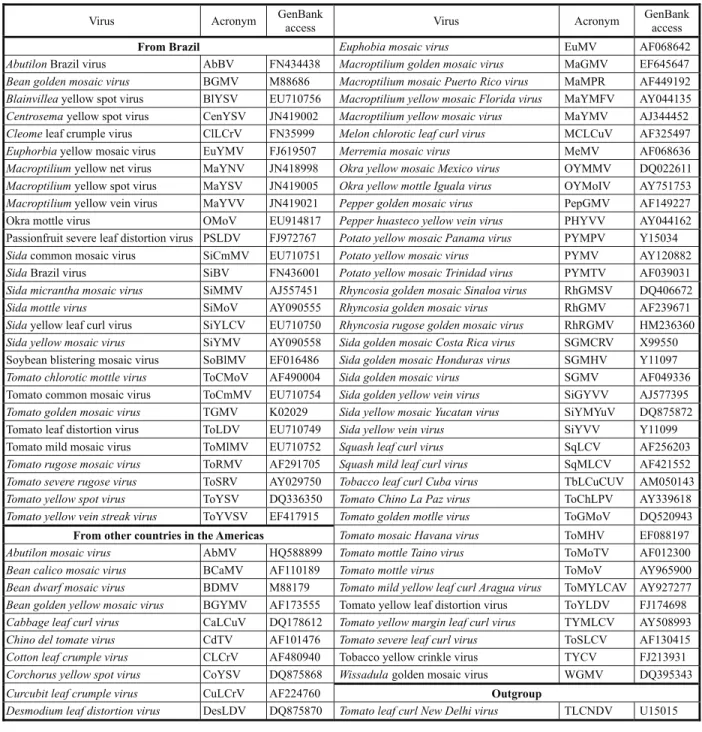
species assignment based on the 89% threshold level established by the Geminiviridae Study Group of the ICTV (Brown et al., 2011). Additional pairwise nucleotide sequence comparisons were made with DNAMan v. 6.0 using the Optimal Alignment option with the following parameters: Ktuple = 2, Gap penalty = 7, Gap open = 10, Gap extension = 5. The nucleotide sequences of begomoviruses used in the phylogenetic analysis (isolates obtained in the current study and begomoviruses previously described in the Americas, including Brazil; Table 1) were aligned using the MUSCLE module in Mega 5.05 (Tamura et al., 2011). A phylogenetic tree based on the DNA-A alignment was constructed with Mega 5.05 using the neighbor-joining method and the Tamura-Nei nucleotide substitution model. Bootstrap analysis (5,000 replications) was carried out to verify the significance of each tree branch.
Recombination analysis
Phylogenetic network analysis was performed with the neighbor-net method implemented in the program SplitsTree4 (Huson & Bryant, 2006). Analysis of potential recombination events was carried out using the Recombination Detection Program (RDP) v. 3.0 (Martin et al., 2010) using default parameters. Recombination analysis included viruses that represented new species obtained in the current study and begomoviruses previously described in Brazil.
RESULTS
Sequence comparisons and phylogenetic analysis
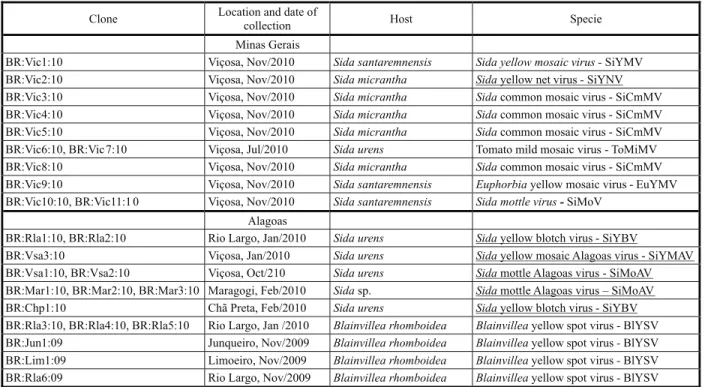
A total of 67 samples were collected: 10 samples of B. rhomboidea (family Asteraceae) and 10 of Sida spp. (family Malvaceae) in different municipalities of AL, and 47 samples of Sida spp. in Viçosa, MG. A total of 26 DNA-A clones were obtained: 11 from MG and 15 from AL. BLAST analysis and pairwise sequence comparisons of the DNA-A clones indicated the presence of 10 begomovirus species (Table 2; Figure 1).
The clone BR:Vic1:10 obtained from S. santaremnensis corresponds to an isolate of
Sida yellow mosaic virus (SiYMV), with a 97.5% identity with SiYMV access number AY090558. Clones BR:Vic3:10, BR:Vic4:10, BR:Vic5:10 and BR:Vic8:10 obtained from S. micrantha (syn. Sidastrum micranthum) correspond to isolates of Sida common mosaic virus (SiCmMV), with a 94-97.1% identity with SiCmMV EU710751. Clones BR:Vic6:10 and BR:Vic7:10 from S.urens correspond to isolates of Tomato mild mosaic virus (ToMlMV), with a 95.1% identity with ToMlMV EU710752. The clone BR:Vic9:10 obtained from S.santaremnensis corresponds to an isolate of Euphorbia yellow mosaic virus (EuYMV), with a 96.4% identity with EuYMV FJ619507. Clones BR:Vic10:10 and BR:Vic11:10 obtained from S. santaremnensis correspond to isolates of Sida mottle virus (SiMoV), with a 95.4% identity with SiMoV AY090555. Clones BR:Rla3:10, BR:Rla4:10, BR:Rla5:10, BR:Jun1:09, BR:Lim1:09 and BR:Rla6:09 obtained from B. rhomboidea correspond to isolates of Blainvillea yellow spot virus (BlYSV), with a 92.1-95.3% identity with BlYSV EU710756.
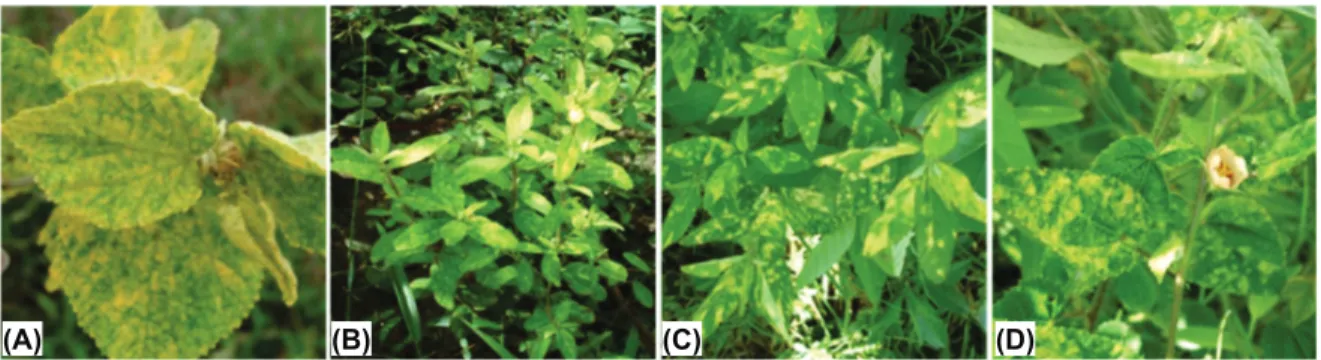
The clone BR:Vic2:10 obtained from S. micrantha (Figure 2A) represents a novel species that is most closely related to Tomato yellow spot virus (ToYSV) and SiMoV (DQ336350 and AY090555, with 87.3 and 87.2% identity, respectively) for which the name Sida yellow net virus (SiYNV) is proposed. Clones BR:Vsa1:10 and BR:Vsa2:10, obtained from S. urens, and BR:Mar1:10, BR:Mar2:10 and BR:Mar3:10 obtained from Sida sp. (Figure 2B), also correspond to a new species that is most closely related to Tomato leaf distortion virus (ToLDV EU710749, with 83.3-83.6% identity) for which the name Sida mottle Alagoas virus (SiMoAV) is proposed. A third new species is represented by clones BR:Rla1:10, BR:Rla2:10 and BR:Chp1:10 obtained from S. urens (Figure 2C), most closely related to SiMoAV (with 83.5-88.4% identity) for which the name Sida yellow blotch virus (SiYBV) is proposed. The clone BR:Vsa3:09 obtained from S. urens (Figure 2D) also corresponds to a new species most closely related to SiCmMV (EU710751, with 79.9% identity) for which the name Sida yellow mosaic Alagoas virus (SiYMAV) is proposed.
Table 1 - Begomoviruses used for pairwise sequence comparisons, phylogenetic and recombination analyses
Virus Acronym GenBank
access Virus Acronym
GenBank access
From Brazil Euphobia mosaic virus EuMV AF068642
AbutilonBrazil virus AbBV FN434438 Macroptilium golden mosaic virus MaGMV EF645647
Bean golden mosaic virus BGMV M88686 Macroptilium mosaic Puerto Rico virus MaMPR AF449192
Blainvilleayellow spot virus BlYSV EU710756 Macroptilium yellow mosaic Florida virus MaYMFV AY044135
Centrosemayellow spot virus CenYSV JN419002 Macroptilium yellow mosaic virus MaYMV AJ344452
Cleomeleaf crumple virus ClLCrV FN35999 Melon chlorotic leaf curl virus MCLCuV AF325497
Euphorbiayellow mosaic virus EuYMV FJ619507 Merremia mosaic virus MeMV AF068636
Macroptiliumyellow net virus MaYNV JN418998 Okra yellow mosaic Mexico virus OYMMV DQ022611
Macroptiliumyellow spot virus MaYSV JN419005 Okra yellow mottle Iguala virus OYMoIV AY751753
Macroptiliumyellow vein virus MaYVV JN419021 Pepper golden mosaic virus PepGMV AF149227
Okra mottle virus OMoV EU914817 Pepper huasteco yellow vein virus PHYVV AY044162
Passionfruit severe leaf distortion virus PSLDV FJ972767 Potato yellow mosaic Panama virus PYMPV Y15034
Sidacommon mosaic virus SiCmMV EU710751 Potato yellow mosaic virus PYMV AY120882
SidaBrazil virus SiBV FN436001 Potato yellow mosaic Trinidad virus PYMTV AF039031
Sida micrantha mosaic virus SiMMV AJ557451 Rhyncosia golden mosaic Sinaloa virus RhGMSV DQ406672
Sida mottle virus SiMoV AY090555 Rhyncosia golden mosaic virus RhGMV AF239671
Sidayellow leaf curl virus SiYLCV EU710750 Rhyncosia rugose golden mosaic virus RhRGMV HM236360
Sida yellow mosaic virus SiYMV AY090558 Sida golden mosaic Costa Rica virus SGMCRV X99550
Soybean blistering mosaic virus SoBlMV EF016486 Sida golden mosaic Honduras virus SGMHV Y11097
Tomato chlorotic mottle virus ToCMoV AF490004 Sida golden mosaic virus SGMV AF049336
Tomato common mosaic virus ToCmMV EU710754 Sida golden yellow vein virus SiGYVV AJ577395
Tomato golden mosaic virus TGMV K02029 Sida yellow mosaic Yucatan virus SiYMYuV DQ875872
Tomato leaf distortion virus ToLDV EU710749 Sida yellow vein virus SiYVV Y11099
Tomato mild mosaic virus ToMlMV EU710752 Squash leaf curl virus SqLCV AF256203
Tomato rugose mosaic virus ToRMV AF291705 Squash mild leaf curl virus SqMLCV AF421552
Tomato severe rugose virus ToSRV AY029750 Tobacco leaf curl Cuba virus TbLCuCUV AM050143
Tomato yellow spot virus ToYSV DQ336350 Tomato Chino La Paz virus ToChLPV AY339618
Tomato yellow vein streak virus ToYVSV EF417915 Tomato golden motlle virus ToGMoV DQ520943
From other countries in the Americas Tomato mosaic Havana virus ToMHV EF088197
Abutilon mosaic virus AbMV HQ588899 Tomato mottle Taino virus ToMoTV AF012300
Bean calico mosaic virus BCaMV AF110189 Tomato mottle virus ToMoV AY965900
Bean dwarf mosaic virus BDMV M88179 Tomato mild yellow leaf curl Aragua virus ToMYLCAV AY927277
Bean golden yellow mosaic virus BGYMV AF173555 Tomato yellow leaf distortion virus ToYLDV FJ174698
Cabbage leaf curl virus CaLCuV DQ178612 Tomato yellow margin leaf curl virus TYMLCV AY508993
Chino del tomate virus CdTV AF101476 Tomato severe leaf curl virus ToSLCV AF130415
Cotton leaf crumple virus CLCrV AF480940 Tobacco yellow crinkle virus TYCV FJ213931
Corchorus yellow spot virus CoYSV DQ875868 Wissadulagolden mosaic virus WGMV DQ395343
Curcubit leaf crumple virus CuLCrV AF224760 Outgroup
Desmodium leaf distortion virus DesLDV DQ875870 Tomato leaf curl New Delhi virus TLCNDV U15015
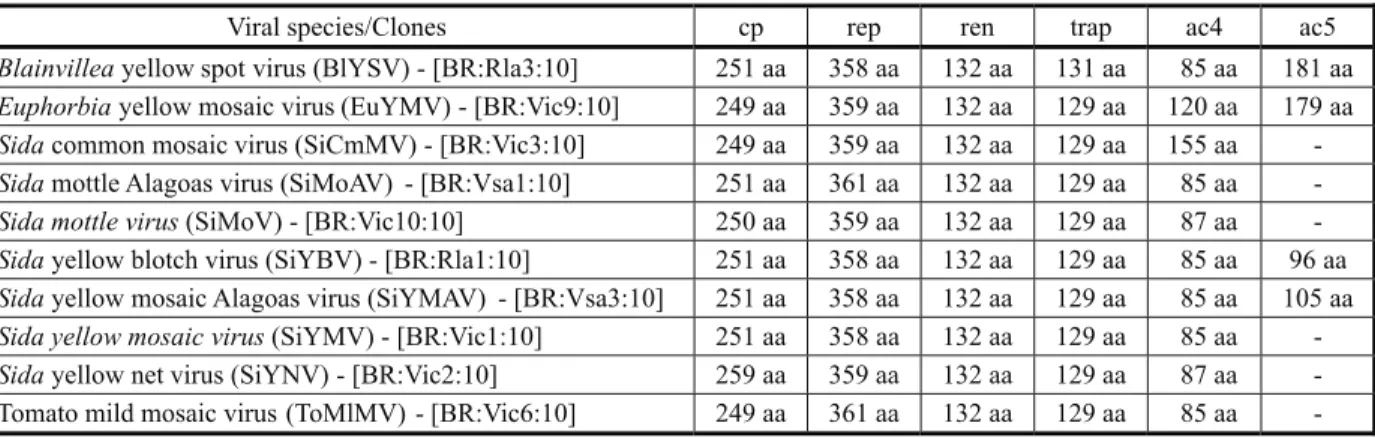
themselves (Figure 1) and the genomes of all the new species show a typical bipartite, New World begomovirus organization, with five ORFs in the DNA-A. Some isolates contained an additional AC5 ORF (Table 3). The common regions (CR) have the conserved nonanucleotide (5’TAATATT/AC3’) as part of a stem-loop structure at the origin of replication.
Table 2 - Taxonomic classification of begomovirus isolates obtained from weed samples collected in Minas Gerais and Alagoas states, Brazil, in 2009 and 2010. Viral species being reported for the first time in this study are underlined
Clone Location and date of
collection Host Specie
Minas Gerais
BR:Vic1:10 Viçosa, Nov/2010 Sida santaremnensis Sida yellow mosaic virus -SiYMV
BR:Vic2:10 Viçosa, Nov/2010 Sida micrantha Sidayellow net virus-SiYNV
BR:Vic3:10 Viçosa, Nov/2010 Sida micrantha Sidacommon mosaic virus - SiCmMV
BR:Vic4:10 Viçosa, Nov/2010 Sida micrantha Sidacommon mosaic virus - SiCmMV
BR:Vic5:10 Viçosa, Nov/2010 Sida micrantha Sidacommon mosaic virus - SiCmMV
BR:Vic6:10, BR:Vic7:10 Viçosa, Jul/2010 Sida urens Tomato mild mosaic virus - ToMiMV
BR:Vic8:10 Viçosa, Nov/2010 Sida micrantha Sidacommon mosaic virus - SiCmMV
BR:Vic9:10 Viçosa, Nov/2010 Sida santaremnensis Euphorbiayellow mosaic virus - EuYMV
BR:Vic10:10, BR:Vic11:1 0 Viçosa, Nov/2010 Sida santaremnensis Sida mottle virus-SiMoV
Alagoas
BR:Rla1:10, BR:Rla2:10 Rio Largo, Jan/2010 Sida urens Sidayellow blotch virus - SiYBV
BR:Vsa3:10 Viçosa, Jan/2010 Sida urens Sidayellow mosaic Alagoas virus - SiYMAV
BR:Vsa1:10, BR:Vsa2:10 Viçosa, Oct/210 Sida urens Sidamottle Alagoas virus - SiMoAV
BR:Mar1:10, BR:Mar2:10, BR:Mar3:10 Maragogi, Feb/2010 Sidasp. Sidamottle Alagoas virus – SiMoAV
BR:Chp1:10 Chã Preta, Feb/2010 Sida urens Sidayellow blotch virus - SiYBV
BR:Rla3:10, BR:Rla4:10, BR:Rla5:10 Rio Largo, Jan /2010 Blainvillea rhomboidea Blainvilleayellow spot virus-BlYSV
BR:Jun1:09 Junqueiro, Nov/2009 Blainvillea rhomboidea Blainvilleayellow spot virus-BlYSV
BR:Lim1:09 Limoeiro, Nov/2009 Blainvillea rhomboidea Blainvilleayellow spot virus-BlYSV
BR:Rla6:09 Rio Largo, Nov/2009 Blainvillea rhomboidea Blainvilleayellow spot virus-BlYSV
together with begomovirus species mostly from Central and North America. Cluster II includes the BlYSV isolates obtained from B. rhomboidea, which formed a monophyletic branch supported by a bootstrap value of 99%. Isolates of the new species SiMoAV and SiYBV, cloned from S. urens, formed distinct branches in Cluster III supported by a bootstrap value of 98%. Cluster III also included the new species SiYMAV and SiYNV and the isolates of SiCmMV, SiMoV, SiYMV and ToMlMV.
Recombination analysis
Phylogenetic relationships inferred by neighbor-net analysis based on a data set consisting of the new begomovirus species described here and other Brazilian begomoviruses revealed clear evidence of multiple recombination events (Figure 4). Strong evidence for recombination was found in Cluster II, containing the three SiYBV isolates, the two SiMoV isolates and the SiYNV isolate. Weaker evidence was observed in Clusters I, III, and IV.
To further investigate these putative recombination signals, the same set of
sequences was analyzed using the RDP3 package. To omit unreliable signals, only recombination events supported by at least four different methods were considered. Two putative recombination events evidenced by the neighbor-net analysis were strongly supported by RDP. BR:Rla1:10 and BR:Rla2:10 (SiYBV) were identified as recombinants, with BR:Chp1:10 (also SiYBV) and one unknown virus as putative parents and recombination breakpoints at the Rep ORF and the common region (CR) (Table 4). A second recombination event was detected for BR:Vic2:10 (SiYNV), with BR:Vsa2:10 (SiMoAV) and SiMoV as putative parents and breakpoints also at the Rep ORF and the CR (Table 4).
DISCUSSION
Figure 1 - Two-dimensional plot representing pairwise nucleotide sequence comparisons of the full-length DNA-A of the
begomoviruses described in this work and other Brazilian begomoviruses.
(A) (B) (C) (D)
Figure 2 - Symptoms in weed samples from which new begomoviruses were obtained. (A) Reticulate yellow mosaic in the Sida micrantha sample from which isolate BR:Vic2:10 (Sida yellow net virus, SiYNV) was obtained; (B) Yellow mottle in the Sida sp.
sample from which isolate BR:Vsa1:10 (Sida mottle Alagoas virus, SiMoAV) was obtained; (C) Yellow blotch symptoms in the
Sida urens sample from which isolate BR:Rla1:10 (Sida yellow blotch virus, SiYBV) was obtained; (D) Yellow mosaic in the Sida urens sample from which isolate BR:Vsa3:09 (Sida yellow mosaic Alagoas virus, SiYMAV) was obtained.
of plants and is highly mobile, being able to fly over short distances or traveling up to several kilometers when assisted by the wind (Byrne, 1999). These characteristics facilitate the transmission of indigenous begomoviruses to new cultivated hosts, increasing the probability of novel, recombinant variants
A total of 10 begomovirus species were found out of 26 DNA-A clones. Nine species were obtained from malvaceous samples, including four new species: SiYNV isolated from S. micrantha, SiYBV and SiYMAV from S.urens and SiMoAV from S.urens and Sida sp. In addition, isolates of five previously described viruses were found. The total number of new species was greater in AL (three) than in MG (one). This is probably due to the fact that surveys have been carried out previously in MG (Castillo-Urquiza et al., 2008), but not in AL. In sharp contrast to what was observed for malvaceous weeds, Blainvillea rhomboidea, it seems, hosts only BlYSV. Silva et al. (2011a,b) reported analogous results, with Macroptilium spp. as a natural reservoir of different begomovirus species, while Cleome affinis hosts only Cleome leaf crumple virus (ClLCrV). Therefore, it seems that while some wild hosts harbor a rich diversity of virus species, others are infected by only one or two species. Whether or not this has significance in terms of the emergence of novel viruses in crop species still remains to be determined. However, it is reasonable to speculate that in those wild species harboring different viruses, the probability of recombination or pseudo-recombination events generating novel viruses would be much higher.
Results from phylogenetic analysis based on DNA-A sequences indicated that EuYMV (BR:Vic9:10) grouped with species that are phylogenetically closer to begomoviruses found in Central and North America rather than South America (including Brazil). The fact that
some “Brazilian” viruses cluster with “Central American” viruses has been previously observed (Castillo-Urquiza et al., 2008; Silva et al., 2011a) and suggests a common origin for these two begomovirus lineages. The significance of this observation lies in the fact that begomoviruses in Central and South America are clearly segregated, and have never mixed. For example, Bean golden mosaic virus (BGMV) occurs only in South America and has never been reported north of the Equator, while the exact opposite is true for Bean golden yellow mosaic virus (BGYMV). This cluster of South and Central American viruses, which includes EuYMV, ToCmMV, SiYLCV and Abutilon Brazil virus (AbBV) is, therefore, unique.
Several studies have shown that recombination plays an important role in the generation of genetic variability in begomoviruses in Brazil (Galvão et al., 2003; Inoue-Nagata et al., 2006; Ribeiro et al., 2007; Silva et al., 2011a,b) and worldwide (Pita et al., 2001; Monci et al., 2002; García-Andrés et al., 2006, 2007a, b). Recombination analysis showed the occurrence of inter- and intraspecific recombination events in the Rep, CP and CR of the viral isolates detected in Sida spp. Lefeuvre et al. (2007a) proposed that coding regions are less susceptible to recombination. However, the regions encoding the Rep and CP of begomoviruses have been shown to be recombination hotspots (García-Andrés et al., 2007b; Lefeuvre et al., 2007b; Silva et al., 2011a,b), in agreement with the results obtained in this work.
Table 3 - Open reading frames, with their respective amino acid (aa) length, detected in the DNA-A of the begomovirus species
described in this work
-Our findings indicate that Sida spp. (including the synonym Sidastrum micranthum) are natural reservoirs of several begomoviruses in Brazil, similarly to what has been observed in Central America and the Caribbean (Frischmuth et al., 1997; Hofer et al., 1997; Roye et al., 1997; Echemendía et al., 2004; Fiallo-Olive et al., 2010; Fiallo-Olivé et al., 2011). However, the true role of these species in the epidemiology of begomovirus diseases in crop plants is still unclear. Hofer et al. (1997) described Sida golden mosaic Costa Rica virus (SiGMCRV), which is capable of infecting tomatoes and beans under experimental conditions. Durham et al. (2010) described an isolate of Sida golden mosaic virus (SiGMV) in Florida that is capable of naturally infecting beans. Roye et al. (1997) described SiGMV infecting Sida sp. and Macroptilium lathyroides in Jamaica, but none of these viruses was associated with crops such as beans, tomatoes and peppers in that country.
Begomovirus epidemics in Brazil occur mostly in beans and tomatoes, and to a lesser extent in peppers (Faria et al., 2000; Zerbini et al., 2005; Nozaki et al., 2010). Beans are infected almost exclusively by BGMV, which has a host range limited to leguminous species. In tomatoes, a large number of viral species have been described (Zerbini et al., 2005). Some of them (such as ToMlMV) have also been detected in Sida spp., while viruses such as Sida micrantha mosaic virus (SiMMV) have been detected in tomatoes (Castillo-Urquiza et al., 2010). Based on these observations, we propose three hypotheses regarding the epidemiological significance of Sida spp. as a source of viruses for solanaceous crops such as tomatoes and peppers. First, viruses in Sida could be poorly adapted to solanaceous plants and thereby Sida spp. would not be relevant to epidemics in tomatoes, with only the occasional detection of Sida viruses in tomato and vice versa. According to this hypothesis, the source of the tomato viruses would be other unidentified (possibly symptomless) wild hosts. In this regard, it is noteworthy that Tomato severe rugose virus (ToSRV) has been reported to infect
solanaceous weeds such as Nicandra
physaloides in the field (Barbosa et al., 2009). Second, Sida spp. could be the source of begomoviruses to solanaceous crops, with the viruses currently found in tomato having
Figure 3 - Phylogenetic tree based on the alignment of complete
DNA-A sequences of the begomovirus isolates from weeds collected in Minas Gerais and Alagoas states and other
begomoviruses from the Americas, including Brazil. Tomato
Table 4 - Recombination events detected among begomoviruses from weeds described in this work and previously described begomoviruses from Brazil
Parent Breakpoint p Value
Clone
Major Minor Initial End R2/ G B M C S 3S
BR:Rla1:10 BR:Chp1:10 Unknown1/ 2001 64 1,9 x 10⁻²⁵ 2,7 x 10⁻²⁵ 2,5 x 10⁻²⁵ 2,2 x 10⁻¹⁹ 2,7 x 10⁻²¹ 2,0 x 10⁻²² -3/ BR:Rla2:10 BR:Chp1:10 Unknown 2001 2648 1,9 x 10⁻²⁵ 2,7 x 10⁻²⁵ 2,5 x 10⁻²⁵ 2,2 x 10⁻¹⁹ 2,7 x 10⁻²¹ 2,0 x 10⁻²²
-BR:Vic2:10 BR:Vsa2:10 SiMoV 37 2217 - - - 8,1 x 10-07 6,9 x 10-07 3,4 x 10⁻¹⁸ 2,1 x 10⁻¹⁸
1/ No parent identified. 2/ Programs: R, RDP; G, GeneConv; B, Bootscan; M, MaxChi; C, CHIMAERA; S, SisScan; 3S, 3SEQ. 3/ Recombination
event not detected.
Figure 4 - Phylogenetic evidence of recombination among begomovirus isolates from weeds described in this work and other
evolved from viruses in Sida spp. Support for this hypothesis comes from the aforementioned detection of ToMlMV and SiMMV in both tomato and Sida spp. Also noteworthy is ToYSV, which is closely related to begomovirus species from Sida spp. (Andrade et al., 2006). However, these three viruses have been detected only sporadically in tomatoes, which would favor the first hypothesis. Third, and more intriguingly, Sida spp. could be infected by heterogeneous begomovirus populations, with rare variants that would not be easily detected by RCA-based cloning. Upon transmission of these heterogeneous populations to tomato plants by the insect vector, the rare variants would become predominant (and thus would be detected at high frequency) due to their better adaptation to the new host. The deep sequencing of viral populations in naturally-infected Sida and tomatoes could provide support for this hypothesis.
ACKNOWLEDGEMENTS
This work was carried out under the framework of a CAPES PROCAD-NF (no. 93-2008) collaborative project between UFAL, UFRPE, and UFV, and was additionally funded by FAPEMIG-PRONEX grant CAG-949-09 to FMZ.
LITERATURE CITED
ANDRADE, E. C. et al. Tomato yellow spot virus, a
tomato-infecting begomovirus from Brazil with a closer relationship to viruses from Sida sp., forms pseudorecombinants with
begomoviruses from tomato but not from Sida. J. Gen. Virol., v. 87, n. 12, p. 3687-3696, 2006.
BARBOSA, J. C. et al. Natural infection of Nicandra physaloides by Tomato severe rugose virus in Brazil. J. Gen. Plant Pathol., v. 75, n. 6, p. 440-443, 2009.
BROWN, J. K. et al. Family Geminiviridae. In: KING, A. M.
Q. et al (Ed.). Virus Taxonomy. 9th Report of the International Committee on Taxonomy of Viruses. London: Elsevier Academic Press, 2011. p. 351-373.
BYRNE, D. Migration and dispersal by the sweet potato whitefly, Bemisia tabaci. Agric. For. Meteorol., v. 97, n. 4, p. 309-316, 1999.
CASTILLO-URQUIZA, G. P. et al. Genetic structure of infecting begomovirus populations in two tomato-growing regions of Southeastern Brazil. In:
INTERNATIONAL GEMINIVIRUS SYMPOSIUM, 6.; INTERNATIONAL SSDNA COMPARATIVE VIROLOGY WORKSHOP, 4.,2010,Guanajuato, Mexico. Program and Abstracts in CD-ROM. Guanajuato, Mexico: 2010.
CASTILLO-URQUIZA, G. P. et al. Six novel begomoviruses infecting tomato and associated weeds in Southeastern Brazil. Arch. Virol., v. 153, n. 10, p. 1985-1989, 2008.
COSTA, A. S.; BENNETT, C. W. Whitefly transmitted mosaic of Euphorbia prunifolia. Phytopathology, v.40, n. 3, p. 266-283, 1950.
DOYLE, J. J.; DOYLE, J. L. A rapid DNA isolation
procedure for small amounts of fresh leaf tissue. Phytochem. Bulletin, v. 19, n. 1, p. 11-15, 1987.
DURHAM, T. C. et al. First report of Sida golden mosaic virus infecting snap bean (Phaseolus vulgaris) in Florida.
Plant Dis., v. 94, n. 4, p. 487, 2010.
ECHEMENDÍA, A. L. et al. First report of Sida golden yellow vein virus infecting Sida species in Cuba. Plant Pathol., v. 53, n. 2, p. 234, 2004.
FARIA, J. C. et al. Situação atual das geminiviroses no Brasil. Fitopatol. Bras., v. 25, n. 1, p. 125-137, 2000.
FIALLO-OLIVE, E. et al. Complete nucleotide sequence of
Sida golden mosaic Florida virus and phylogenetic
relationships with other begomoviruses infecting malvaceous weeds in the Caribbean. Arch. Virol., v. 155, n. 9,
p. 1535-1537, 2010.
FIALLO-OLIVÉ, E. et al. Begomoviruses infecting weeds in Cuba: Increased host range and a novel virus infecting Sida rhombifolia. Arch. Virol., v. 157, n. 1, p. 141-146, 2012.
FRISCHMUTH, T. et al. Nucleotide sequence evidence for the occurrence of three distinct whitefly-transmitted, Sida
-infecting bipartite geminiviruses in Central America. J. Gen. Virol., v. 78, n. 10, p. 2675-2682, 1997.
GALVÃO, R. M. et al. A naturally occurring recombinant DNA-A of a typical bipartite begomovirus does not require the cognate DNA-B to infect Nicotiana benthamiana
systemically. J. Gen. Virol., v. 84, n. 3, p. 715-726, 2003.
GARCÍA-ANDRÉS, S. et al. Founder effect, plant host, and recombination shape the emergent population of
begomoviruses that cause the tomato yellow leaf curl disease in the Mediterranean basin. Virology, v. 359, n. 2, p. 302-312, 2007a.
GARCÍA-ANDRÉS, S. et al. Begomovirus genetic diversity in the native plant reservoir Solanum nigrum: Evidence for
the presence of a new virus species of recombinant nature. Virology, v. 350, n. 2, p. 433-442, 2006.
HARKINS, G. W. et al. Experimental evidence indicating that mastreviruses probably did not co-diverge with their hosts. Virol. J., v. 6, p. 104, 2009.
HOFER, P. et al. Nucleotide sequence of a new bipartite geminivirus isolated from the common weed Sidarhombifolia
in Costa Rica. J. Gen. Virol., v. 78, n. 7, p. 1785-1790, 1997.
HUSON, D. H.; BRYANT, D. Application of phylogenetic networks in evolutionary studies. Molec. Biol. Evol., v. 23, n. 2, p. 254-267, 2006.
INOUE-NAGATA, A. K. et al. A simple method for cloning the complete begomovirus genome using the bacteriophage phi 29 DNA polymerase. J. Virol. Methods, v. 116, n. 2, p. 209-211, 2004.
INOUE-NAGATA, A. K. et al. New species emergence via recombination among isolates of the Brazilian tomato infecting Begomovirus complex. Pesq. Agropec. Bras., v. 41, n. 8, p. 1329-1332, 2006.
JESKE, H. et al. In planta cloning of geminiviral DNA: The true Sida micrantha mosaic virus. J. Virol. Methods, v.163, n. 2, p. 301-308, 2010.
JOVEL, J. et al. Sida micrantha mosaic is associated with a complex infection of begomoviruses different from Abutilon mosaic virus. Arch. Virol., v. 149, n. 4, p. 829-841, 2004.
LEFEUVRE, P. et al. Avoidance of protein fold disruption in natural virus recombinants. PLoS Path., v. 3, n. 11, p. 181, 2007a.
LEFEUVRE, P. et al. Begomovirus ‘melting pot’ in the south-west Indian Ocean islands: molecular diversity and evolution through recombination. J. Gen. Virol., v. 88, n. 12, p. 3458-3468, 2007b.
MANSOOR, S. et al. Geminivirus disease complexes: An emerging threat. Trends Plant Sci., v. 8, n. 3, p. 128-134, 2003.
MARTIN, D. P. et al. RDP3: A flexible and fast computer program for analyzing recombination. Bioinformatics, v. 26, n.19, p. 2462-2463, 2010.
MONCI, F. et al. A natural recombinant between the geminiviruses Tomato yellow leaf curl Sardinia virus and
Tomato yellow leaf curl virus exhibits a novel pathogenic
phenotype and is becoming prevalent in Spanish populations. Virology, v. 303, n. 2, p. 317-326, 2002.
MORALES, F. J. History and current distribution of begomoviruses in Latin America. Adv. Virus Res., v. 67, p. 127-162, 2006.
NOZAKI, D. N. et al. Begomovírus infectando a cultura de pimentão no estado de São Paulo. Summa Phytopathol., v. 36, n. 3, p. 244-247, 2010.
OWOR, B. E. et al. Genetic analysis of Maize streak virus
isolates from Uganda reveals widespread distribution of a recombinant variant. J. Gen. Virol., v. 88, n. 11, p. 3154-3165, 2007.
PITA, J. S. et al. Recombination, pseudorecombination and synergism of geminiviruses are determinant keys to the epidemic of severe cassava mosaic disease in Uganda. J. Gen. Virol., v. 82, n. 3, p. 655-665, 2001.
PRASANNA, H. C. et al. The population genomics of begomoviruses: Global scale population structure and gene flow. Virol. J., v. 7, p. 220, 2010.
RIBEIRO, S. G. et al. Molecular and biological
characterization of Tomato chlorotic mottle virus suggests that recombination underlies the evolution and diversity of Brazilian tomato begomoviruses. Phytopathology, v. 97, n. 6, p. 702-711, 2007.
ROJAS, M. R. et al. Exploiting chinks in the plant’s armor: Evolution and emergence of geminiviruses. Ann. Rev. Phytopathol., v.43, p. 361-394, 2005.
ROYE, M. E. et al. Genetic diversity among geminiviruses associated with the weed species Sida spp., Macroptilium lathyroides, and Wissadula amplissima from Jamaica. Plant Dis., v. 81, n. 11, p. 1251-1258, 1997.
SILVA, S. J. C. et al. High genetic variability and recombination in a begomovirus population infecting the ubiquitous weed Cleome affinis in northeastern Brazil. Arch. Virol., v. 156, n. 12, p. 2205-2213, 2011a.
SILVA, S. J. C. et al. Species diversity, phylogeny and genetic variability of begomovirus populations infecting leguminous weeds in Northeastern Brazil. Plant Pathol., doi 10.1111/ j.1365-3059.2011.02543.x, 2011b.
TAMURA, K. et al. MEGA5: Molecular evolutionary genetics analysis using maximum likelihood, evolutionary distance, and maximum parsimony methods. Molec. Biol. Evol., v. 28, n. 10, p. 2731-2739, 2011.
VARSANI, A. et al. A highly divergent South African geminivirus species illuminates the ancient evolutionary history of this family. Virol. J., v. 6, n. 1, p. 36, 2009.