GEAMA Journal
The Journal of environment
Scientific Article
Legal aspects of waste disposal in landfills in Brazil
Elizabete Buonora de Souza Lira B.Sc.
a, Cartiele Rosale Borges Noronha B.Sc.
b,
Fernando Cartaxo Rolim Neto D.Sc.
c, Amanda Rodrigues Santos Costa B.Sc.
da Departamento de Estudos, Projetos e Pesquisas Ambientais da Secretaria de Meio Ambiente Urbano e Natural de
Olinda.
b,c,d Departamento de Tecnologia Rural,, Universidade Federal Rural de Pernambuco.
__________________________________________________
*Corresponding author: E-mail: [email protected]
ABSTRACT
Urbanization and population migration to urban centers is becoming a major
global challenge, especially to reduce and give correct destination to solid waste.
The waste generated in large cities are usually collected by the municipal
government and taken to dumps or landfills. The latter have the advantage of
minimizing the environmental impact by urban solid waste disposal technique
in soil using engineering principles. The National Solid Waste Policy highlights
some goals to stimulate the reduction, reuse and recycling of waste, in order to
reduce the quantity that is sent for final disposal environmentally appropriate.
These practices of urban solid waste disposal in the soil minimize environmental
impacts, using engineering principles. Some technical standards are established
to define technical engineering applications minimizing environmental impacts.
Nevertheless, this technique does not eliminate possible environmental damage
in the area where the landfill will be installed. Degradation occurs when there
are changes of chemical, physical or biological order. This paper aims to describe
the environmental impacts caused by the implementation of a landfill site and
the importance of the recovery of degraded areas in these places.
Keywords: landfill, environmental damage, solid wastes.
INTRODUCTION
Urbanization and population migration to urban centers is becoming a major global challenge,
especially to reduce and give correct destination to solid waste. The emergence and development of human society have always been related to the generation of solid waste from various activities
(MATOS et al., 2011).
Geological natural processes and inadequate exploitation of natural resources in various agricultural, industrial and construction activities have led to the emergence of degraded areas that attacks its soil, water, relief and unique biodiversity (CAPECHE et al., 2008).
In cities of developing countries, with very rapid urbanization, deficits occur in the financial and administrative capacity in providing infrastructure and essential services such as water, sanitation, collection and proper disposal of waste and housing, and to ensure safety and quality control environment for the population (JACOBI & BESEN, 2011).
According to the Brazilian Ministry of Cities, the smaller the municipality, the more critical the situation is. In Brazil 63.3% of municipalities, have populations of up to 15,000 inhabitants, which generate a daily amount of 13,967 tons of waste, almost 10% of the total generated in the country. Of this total, 70.4% are taken to landfills (MINISTÉRIO DAS CIDADES, 2003).
The waste generated in large cities are usually collected by the municipal government and taken to dumps or landfills. The latter has the advantage of minimizing the environmental impact, since it consists of final disposal technique of solid waste on the ground, through confinement in covered layers with inert material, usually the soil itself, according to specific rules in order to avoid damage or risks to health and safety (GONÇALVES, 2014).
There are many agents and environmental factors to which humans are exposed and that may adversely affect their health and quality of life. However, some have received more attention, such as hazardous chemicals, ionizing and non-ionizing
radiation, the major industrial or technological accidents and natural disasters (NADOCCI, 2013).
In Brazil, the systematic service of urban cleaning has started officially on November 25, 1880 in the city of San Sebastian in Rio de Janeiro, when it was capital of the country (SOUZA, 2007). On that day, the Emperor Dom Pedro II signed Decree 3024, approving the contract of "cleaning and irrigation" of the city, which was run by Aleixo Gary and later by Luciano Francisco Gary, whose surname originates from the word gari, which is known today as workers of urban sanitation in many Brazilian cities (MONTEIRO et al., 2001).
According to the Law 11.445 / 2007, Article 3, which sets national guidelines for basic sanitation, considers that: "C) urban sanitation and solid waste management: is the set of activities, infrastructure and operating facilities for collection, transport, transhipment, treatment and disposal of household waste and waste originating from sweeping and public parks cleaning and public roads” (BRASIL, 2007).
The production of solid waste is related to the development of the region, being a directly proportional relationship, since the higher the purchasing power of the population, the greater the volume of waste produced (AMARAL et al., 2013).
According to the UN report for the Environment (UNEP, 2002), food consumption levels, natural resources and energy are extrapolated by 40%, indicating that the biosphere is above its restoration capacity. This deficit is being increased by 2.5% per year.
When disposed of improperly, the solid waste may cause pollution of water, air and soil, and create favorable environment for proliferation of macro and micro vectors that cause diseases (BESEN, 2011).
Currently some studies have been done about the environmental impacts of the areas of landfill for non-hazardous and industrial wastes. According to Vieira et al. (2015), the landfill is the most appropriate way of waste disposal. However, this technique is responsible for the formation of slurry, which is the liquid produced by organic waste mass during the process of biological degradation and methane gas emissions into the atmosphere.
Since the adoption of the law establishing the National Policy on Solid Waste (PNRS), began an intensive debate relating to areas suitable to receive the landfills. This law establishes rules and obligations to society, intensifying the reduction, reuse, recycling, solid waste treatment and final disposal of waste in an environmentally correct way. Due to the mandatory disposal of waste in landfills, it is anticipated the increase in the number of this type of construction, also increasing demand areas for its facilities and increasing environmental degradation (Vieira et al., 2015).
The National Solid Waste Policy, established by Federal Law 12,305 of August 2, 2010, has as its main goals the reduction, reuse and recycling, in order to reduce the amount of waste and tailings. The latter should be sent for final disposal in landfills, environmentally appropriate, for the elimination of garbage dumps. This law also provides for the recovery of areas contaminated by waste in old dumps (BRAZIL, 2010).
According to Abrelpe (2014), about 58.4% of the waste collected in Brazil, had proper disposal, being sent to landfills. The remaining 41.6%, corresponding to 81,000 tons per day, which are sent to dumps or controlled landfills, which slightly differ from dumps, since both do not have the set of
systems and procedures needed to protect the environment from damage and degradations.
This paper aims to describe legal aspects on the disposal of waste in landfills in Brazil, through a literature review.
REVIEW
1. Landfill
According to Barros (2013), the landfill is a form of treatment and final disposal of municipal solid waste, consisting of a sanitary safe solution to public health and the environment. This is due to the design requirements, operations required to process and licensing provided by standard and relevant regulations. This same author says that such design requirements include compliance with the following criteria: location in relation to topographical, hydrogeological and geotechnical conditions; monitoring system of groundwater; drainage system with burning or gas energy recovery; leachate treatment system (slurry mixed with infiltrated water); internal coating with compressed clay and / or geomembrane; closure plan; etc.
To build a landfill, the ABNT (Brazilian Technical Standards Association) NBR 15849 recommends sites where occur naturally low permeability soils, such as clayey, sandy clay or silty clay soils (ABNT, 2010).
The landfill of non-hazardous waste, called landfill is only a form of treatment and final disposal for waste Class II and Class II B, according to the classification of the ABNT NBR 10004 (2004a). These wastes are mostly urban solid waste, which constitute household waste and waste from street cleaning.
According to the ABNT NBR 8419 (ABNT, 1992), item 3, landfill of urban solid waste is a disposal
technique of solid waste in the soil, in order to minimizing environmental impacts. Engineering principles are used to confine the waste to the smallest possible area and reduce them to the lowest permissible volume, covering them with a layer of soil at the conclusion of each working day, or at shorter intervals if necessary.
The ABNT NBR 15.849 / 2010, makes mention of four (4) types of small landfill construction, namely:
Small Landfill in ditches - landfills for disposal and final treatment of the urban solid waste in the soil, whose depth is limited and variable width and confined on all sides, so that the non-mechanized operation execution is possible;
Small Landfill in trenches - in the case of landfills in the trenches there is no limitation on the depth and width, and the confinement takes place in three (3) sides and the operation is mechanized - NBR 15849/2010 (ABNT, 2010f);
Small Landfill in slope - the existing embankments are used. In general these type of landfill is implanted in natural depression areas or undulations and slopes of hills, with depth of layers of up to five (5) meters - NBR 15849/2010 (ABNT, 2010f);
Landfill small in area - landfills in the area are characterized by the provision of urban solid waste in flat areas above the natural terrain elevation, with heights of layers of up to five (5) meters - NBR 15849/2010 (ABNT, 2010f);
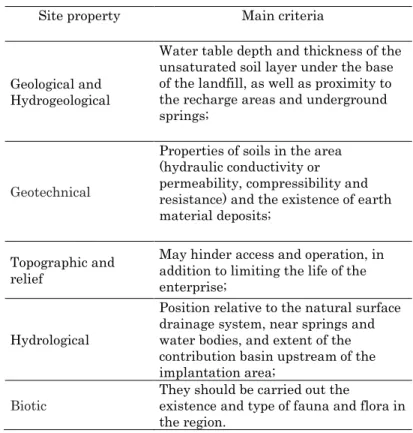
Some criteria must be evaluated in the selection of areas when landfills need to be installed (Table 1). Table 1. Main criteria to be evaluated in the selection of
areas for installation of landfills. Source: ReCESA 2008.
Site property Main criteria
Geological and Hydrogeological
Water table depth and thickness of the unsaturated soil layer under the base of the landfill, as well as proximity to the recharge areas and underground springs;
Geotechnical
Properties of soils in the area (hydraulic conductivity or permeability, compressibility and resistance) and the existence of earth material deposits;
Topographic and relief
May hinder access and operation, in addition to limiting the life of the enterprise;
Hydrological
Position relative to the natural surface drainage system, near springs and water bodies, and extent of the contribution basin upstream of the implantation area;
Biotic They should be carried out the existence and type of fauna and flora in the region.
According to Machado (2013), usually in Brazil, conventional landfills are implanted where the waste is deposited above ground level to subsequently be compressed (Figure 1); and landfill in ditches (Figure 2), where the waste is deposited in trenches to facilitate the formation of cells and layers and maintenance.
Figure 01. Conventional landfill. Source: Machado, 2013.
2. Implementation of Landfill and its Environmental Impacts
Despite efforts to reduce, reuse and recycle the materials related to the production of municipal solid waste, landfills are the main disposal of solid waste worldwide, with a few exceptions (Braga et al., 2010). Still, it does not eliminate the possible environmental degradation in the area where the landfill is installed. According to Vasquez (2010), the degradation sources are variable and with respect to the damage caused to the urban environment, there has been great thinning for the development of urban áreas, resulting in microclimate changes and fauna removal.
In most municipalities are installed small landfills because they are theoretically intended only to municipal solid waste. With regard to small landfills for disposal of urban solid waste (USW), the guidelines for design, implementation, operation and closure are defined in ABNT NBR 15849. Also refers to the duration of small landfills must be at least fifteen (15) years. According to Barros (2012), the disabled landfill areas have restricted use after
closing, should be contemplated use after the landfill closure plan, seeking to maximize the use of it.
In Resolution CONAMA 404/2008 (CONAMA, 2008), are regarded as small landfills, those with daily provision of up to 20 ton. (Twenty tons) of USW. As the size and character of the enterprise, and based on the information produced in the environmental assessment of its area of influence, are evaluated the possible environmental changes that the region will suffer, considering the physical, biotic and socioeconomic aspects (GONTIJO, 2013).
In general, degradation will occur when the following changes occur: chemical changes (accumulation of metals in soil or water bodies, variation of parameters such as pH or dissolved oxygen); physical (silting of river beds, compaction and sealing of soils); or biological (bioaccumulation, reduction in biodiversity, species extinction, elimination and fragmentation of forest cover, reduction in bank seedlings and seeds in the ground).
On this MORALES (2002) and TARTARI (2003) state that the soil acts as one of the final deposits of heavy metals, originated from waste and thus constitutes a means of insertion and / or bioaccumulation of these pollutants over the food chain.
According to NBR 13896/97, which provides the criteria for the design, implementation and operation of non-hazardous waste landfills, there may be various conditions of use of technology in order to minimize environmental damage. One of the key steps is the sealing of the drainage system.
The absence of these steps can lead to harmful changes to soil and water resources. In studies by Matos et al. (2011) it was found that the lack of waterproofing may alter the BOD (Biochemical
Oxygen Demand) and COD (Chemical Oxygen Demand) of water, influencing negatively on fauna and flora, macro and microscopic, reaching the aquifer. There may be pollution of wells and cause endemic diseases, if there is any pathogenic organismo.
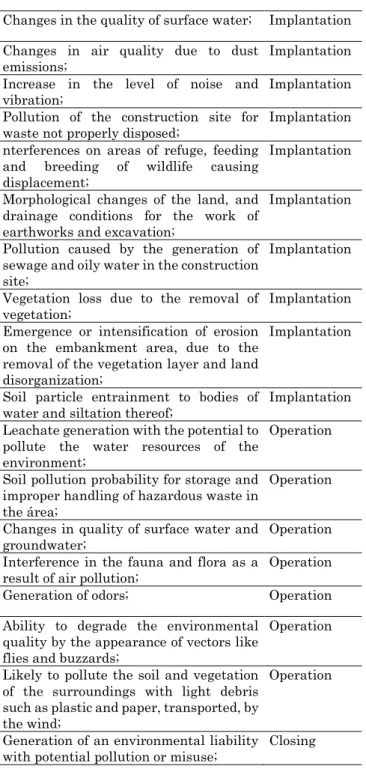
Table 02. Possible negative impacts on the implementation of a landfill. Source: HID, 2013.
Among the contaminants that can pose a hazard if they are found in rivers or underground aquifers, there are toxic, carcinogenic compounds, suspended solids and substances that have a high demand BOD and COD (FREITAS et al., 2015). Toxic materials may be retained by the soil and assimilated by plants. In this case, not recommended the cultivation of crops for food. Polluting substances such as heavy metals and toxic organic compounds can also be directly assimilated by the soil.
For Lima (2004), the decomposition process of solid waste through the action of micro-organisms produces biological gas, which consists of hydrogen, nitrogen, hydrogen sulfide, carbon dioxide and methane. The latter is highly flammable and with air can form an explosive mixture. So it is common to spontaneous combustion waste dumps in the open. It notes that methane and carbon dioxide contribute to the intensification of the greenhouse effect (SISINNO, 2002).
The use of soil conservation, it is highly effective in controlling erosion and reclamation (CAPECHE et al., 2008).
FINAL CONSIDERATIONS
Since the establishment of the National Solid Waste and its National Policy Plan, the government has to be aware of the importance of solid waste management in urban, domestic, industrial and consumer electronics origin.
There has been a development in municipal management, especially with the participation of the public prosecutor overseeing and supporting the municipalities in order that the goals and deadlines are met.
IMPACT PHASE
Changes in the quality of surface water; Implantation Changes in air quality due to dust
emissions; Implantation
Increase in the level of noise and
vibration; Implantation
Pollution of the construction site for
waste not properly disposed; Implantation nterferences on areas of refuge, feeding
and breeding of wildlife causing displacement;
Implantation Morphological changes of the land, and
drainage conditions for the work of earthworks and excavation;
Implantation Pollution caused by the generation of
sewage and oily water in the construction site;
Implantation Vegetation loss due to the removal of
vegetation; Implantation
Emergence or intensification of erosion on the embankment area, due to the removal of the vegetation layer and land disorganization;
Implantation
Soil particle entrainment to bodies of
water and siltation thereof; Implantation Leachate generation with the potential to
pollute the water resources of the environment;
Operation Soil pollution probability for storage and
improper handling of hazardous waste in the área;
Operation Changes in quality of surface water and
groundwater; Operation
Interference in the fauna and flora as a
result of air pollution; Operation
Generation of odors; Operation
Ability to degrade the environmental quality by the appearance of vectors like flies and buzzards;
Operation Likely to pollute the soil and vegetation
of the surroundings with light debris such as plastic and paper, transported, by the wind;
Operation
Generation of an environmental liability
The demand for solutions to an environmentally proper disposal is continually increasing and the demands being more specific in the context of solid waste management. In contrast, the search for sites for the implementation of sanitary landfills for hazardous and non-hazardous waste also often grows. According to the laws and technical standards, it must be followed each term established in the installation, operation and monitoring of landfills.
It is a current tendency to problematize the implementation of landfills, due to the lack of public spaces available for installation in addition to the requirements that are set forth in the technical standards. Municipalities are seeking the installation of intercropping landfills with the private sector in order to reduce costs in waste management and in every stage of operation, such as maintenance, monitoring of cells and leachate treatment plants and settling ponds.
Due to the current demand and lack of financial resources and available space, another aggravating factor is the environmental degradation of the land where the landfill will be installed. This has caused several aggravating environmental problems, since most of the time there is vegetation with native species and also the presence of some endemic animals of certain biomes.
Even if the laws and technical standards require the construction and operation of landfills, there is possibility of environmental degradation.
REFERENCES
ABNT. ASSOCIAÇÃO BRASILEIRA DE NORMA TECNICA. NBR 10.004. 2004. Disponível em: <
http://www.videverde.com.br/docs/NBR-n-10004-2004.pdf>. Acesso em 15 abr. 2016.
ABNT. ASSOCIAÇÃO BRASILEIRA DE NORMA TECNICA. NBR 8419. 1992. Disponível em:
<http://licenciadorambiental.com.br/wp-content/uploads/2015/01/NBR-8.419-NB-843 apresentac%C3%A3o-de-Projetos-de-Aterros-Sanitarios-RSU.pdf>. Acesso em 24 mai. 2016.
ABNT. ASSOCIAÇÃO BRASILEIRA DE NORMA TECNICA. NBR 15.849, 24 p., 2010f.
ABRELPE. Panorama dos resíduos sólidos no brasil.
2014. Disponível em: <
http://www.abrelpe.org.br/Panorama/panorama201 4.pdf>. Acesso em 20 abr. 2016.
AMARAL, T.; MEDEIROS, A. G.; MANCINI, S. D.; GUANDIQUE, M.E.G.; COIMBRA, V. P.; RIBEIRO, A.I. Diagnóstico e gestão dos resíduos gerados em aterro sanitário. Engenharia Ambiental. v. 10, n. 3, p. 3-13, 2013.
BARROS, R.M. Tratado sobre resíduos sólidos: gestão uso e sustentabilidade. Rio de Janeiro: Interciência. cap. 9, 230-288p. 2013.
BESEN, G. R. Coleta seletiva com inclusão de catadores: construção participativa de indicadores e índices de sustentabilidade. São Paulo, 2011. 275p. Tese (Doutorado) -Faculdade de Saúde Pública, Universidade de São Paulo.
BRASIL. Presidência da República. Casa Civil. Lei 12.305, de 02 de agosto de 2010. Institui a Política Nacional de Resíduos Sólidos; altera a lei nº 9605, de
12 de fevereiro de 1998; e dá outras providências. Diário Oficial da União, Brasília, 3 ago. 2010. BRASIL. Presidência da República. LEI Nº 11.445, DE 5 DE JANEIRO DE 2007. Estabelece diretrizes nacionais para o saneamento básico. Diário Oficial da União, Brasília, 5 de janeiro de 2007.
BRAGA, M. C. B.; RAMOS, S. I. P.; DIAS, N.C. Gestão de Resíduos sólidos para a sustentabilidade. IN: POLETO, C. Introdução ao gerenciamento ambiental. Rio de Janeiro: Interciência. cap.8, p. 269-336, 2010.
CAPECHE, C. L.; MACEDO, J. R.; PRADO, R. B.; PIMENTA, T. S.; MELO, A. S. DEGRADAÇÃO DO SOLO E DA ÁGUA: Impactos da erosão e estratégias de controle. IN:
B
ALIEIRO, F. C. Curso derecuperação de áreas degradadas: a visão da ciência do solo no contexto do diagnóstico, manejo, indicadores de monitoramento e estratégias de recuperação. Rio de Janeiro: Embrapa Solos, cap. 5, p. 105-132, 2008.
CONAMA. Conselho Nacional de Meio Ambiente. Resolução nº 404.2008. Disponível em: < http://www.mma.gov.br/port/conama/legislacao/CO NAMA_RES_CONS_2008_404.pdf>. Acesso em: 23 mai. 2016.
DIDONET, M. Águas – Goles de Pura Informação. Livro zero, 1, 2, 3, 4. 6. ed. Rio de Janeiro: CIMA, 32 p., 1997.
FERREIRA, J. A. Resíduos Sólidos e Lixo Hospitalar: Uma Discussão Ética. Caderno de Saúde Pública, v. 11, n° 2, p. 314-320, 1995.
FREITAS, G. P.; SILVA, K. A.; SÁ, G. B.; SEGUNDO, S. T. L. R.; DANTAS, M. K. L. Identificação de impactos ambientais em empreendimento ou atividade de indústria química. Revista Verde. Vol. 10 nº 5, p. 66-70, 2015.
GONÇALVES, C. M. O impacto ambiental: Discutindo os fatores de degradação do solo causado pelos lixões do Roger e o aterro sanitário. Monografia, 2014.
GONTIJO, R. N.; SANTOS, W.J. C.; TEIXEIRA, P. R.; ALCÂNTARA, J.; TAVARES, I. B. Avaliação de impacto ambiental (aia) do aterro sanitário do município de conceição do Araguaia-PA através do método da matriz de Leopold. IV Congresso Brasileiro de Gestão Ambiental Salvador/BA. IBEAS – Instituto Brasileiro de Estudos Ambientais. 2013.
Disponível em: <
http://www.ibeas.org.br/congresso/Trabalhos2013/V-023.pdf>. Acesso em 15 mai. 2016.
HID. Planejamento Ambiental LTDA. Implantação de central de tratamento de resíduos sólidos em área rural do município de Caruaru. Empesa. 72 p. 2013.
Disponível em: <
http://www.cprh.pe.gov.br/downloads/RIMA-CTRCARUARU.pdf>. Acesso em: 30 abr. 2016.
JACOBI, P. R.; BESEN, G. R. Gestão de resíduos sólidos em São Paulo: desafios da sustentabilidade. Estudos Avançados, v.25, p. 135 – 158, 2011.
LIMA, M. Q. Lixo: Tratamento e biorremediação. São Paulo: Hemus. 3ª ed. 265 p., 2004.
MACHADO, G. B. Aterro Sanitário. Portal Resíduos
Sólidos. 2013. Disponível em:
<http://www.portalresiduossolidos.com/aterro-sanitario/>. Acesso em 20 mai. 2016.
MATOS, F. O.; MOURA, Q. L.; CONDE, G. B.; MORALES, G. P.; BRASIL, E. C. Impactos ambientais decorrentes do aterro sanitário da região metropolitana de Belém-PA: aplicação de ferramentas de melhoria ambiental. Caminhos de Geografia. Uberlândia v. 12, n. 3, p. 297 – 305. 2011. MINISTÉRIO DAS CIDADES. Informe analítico da situação da gestão municipal de resíduos sólidos no brasil – avaliação 2002. Brasília, 2003. Disponível em:<http://www.bvsde.paho.org/bvsacd/cd65/brasil. pdf>. Acesso em: 11 jul. 2016.
MORALES, G. P. Avaliação ambiental dos recursos hídricos, solos e sedimentos na área de abrangência do Depósito de Resíduos Sólidos do Aurá. (Tese de Doutorado).Universidade Federal do Pará. 2002.
MONTEIRO, J. H. P. Manual de Gerenciamento Integrado de resíduos sólidos. Rio de Janeiro: IBAM, 200 p., 2001.
MOREIRA; P. R. Manejo do solo e recomposição da vegetação com vistas a recuperação de áreas degradada pela extração de bauxita, Poços de Caldas, MG. 2004. 155 f. Tese (Doutorado em Biologia Vegetal) - Instituto de Biociências da Universidade Estadual Paulista Julio de Mesquita Filho, São Paulo, 2004.
NARDOCCI, A. C. Avaliação de risco em toxicologia ambiental. 159p. IN: SISINNO, C. L. S.; OLIVEIRA-FILHO, C.E. Toxicologia ambiental. Interciência. cap. 9, p. 157-169.
RECESA. Resíduos Sólidos: projeto, operação e monitoramento de aterros sanitários: guia do profissional em treinamento. Ministério das Cidades. Secretaria Nacional de Saneamento Ambiental (org.). Belo Horizonte: ReCESA. n. 2, 120 p., 2008.
RUFO, R. C; Avaliação de impactos ambientais e proposta de remediação do lixão do município de Porto Nacional – TO. IN: Congresso Interamericano de Engenharia Sanitária e Ambiental, 23. Anais...Campo Grande, MS, 2005.
SISINNO, C. L. S.; MOREIRA, J. C. Avaliação da contaminação e poluição ambiental na área de influência do aterro controlado do Morro do Céu, Niterói, Brasil. Cadernos de Saúde Pública, v. 12 p. 515-523, 1996.
SOUZA, C. M. Recuperação de áreas degradadas em Aterros Sanitários. 2007. 40 f. Monografia (Graduação em Engenharia Florestal) – Instituto de Florestas da Universidade Federal Rural do Rio de Janeiro, Seropédica 2007.
TARTARI, L.C. Avaliação do processo de tratamento
do chorume do aterro sanitário de
Novo Hamburgo. Universidade Luterana do Brasil, 2003. (Dissertação de Mestrado).
UNEP. UNITE NATIONS ENVIRONMENT
Production and Consumption. 2002. Disponível em:<
http://www.agrifood-forum.net/doc/UNEPagripub.pdf>. Acesso em: 11 jul. 2016.
VASQUEZ, B. A. F. Recuperação de áreas
degradadas. IN: POLETO, C. Introdução ao
gerenciamento ambiental. cap. 6, p. 183-237, 2010.
VIEIRA, G. E. G.; CAMPOS, C. E. A.; TEIXEIRA, L. F.; COLEN, A. G. N. Produção de biogás em áreas de aterros sanitários: uma revisão. Revista Liberato, Novo Hamburgo, v. 16, n. 26, p. 101-220, 2015.