Indicators for the assessment of social resilience in flood-affected
communities – A text mining-based methodology
R. Jacinto, E. Reis, J. Ferrão
PII:
S0048-9697(20)34502-2
DOI:
https://doi.org/10.1016/j.scitotenv.2020.140973
Reference:
STOTEN 140973
To appear in:
Science of the Total Environment
Received date:
1 April 2020
Revised date:
12 July 2020
Accepted date:
12 July 2020
Please cite this article as: R. Jacinto, E. Reis and J. Ferrão, Indicators for the assessment
of social resilience in flood-affected communities – A text mining-based methodology,
Science of the Total Environment (2020),
https://doi.org/10.1016/j.scitotenv.2020.140973
This is a PDF file of an article that has undergone enhancements after acceptance, such
as the addition of a cover page and metadata, and formatting for readability, but it is
not yet the definitive version of record. This version will undergo additional copyediting,
typesetting and review before it is published in its final form, but we are providing this
version to give early visibility of the article. Please note that, during the production
process, errors may be discovered which could affect the content, and all legal disclaimers
that apply to the journal pertain.
Journal Pre-proof
Indicators for the assessment of social resilience in flood-affected communities
– a
text mining-based methodology.
Authors:
JACINTO, R.1; REIS, E.1, FERRÃO, J.2
(1) Universidade de Lisboa, Centro de Estudos Geográficos, IGOT, Lisboa, Portugal ([email protected])
(2) Instituto de Ciências Sociais, Universidade de Lisboa, Lisboa, Portugal
Keywords
Social Resilience; Floods; Resilience Indicators; Text Mining; Experts’ opinions
Abstract:
This work turns the social resilience concept into a practical and tangible set of dimensions and indicators for social resilience assessment. It further provides an analysis of the social resilience concept in the context of flood risk governance.
Floods are a worldwide recurring phenomenon that causes severe social, economic and environmental losses. In the context of global change, it is very difficult to accurately predict extreme events that may increase disaster frequency; hence the implementation of social resilience is essential to lessen the losses. Indeed, the right balance between natural and social factors and indicators is yet to be found.
Social resilience has been debated extensively for decades, both in scientific and political contexts. It has been a concern in disaster risk reduction and risk governance fields, both of which have strived to implement it. The enlarged conceptual discussion regarding this topic has resulted in some based assessments that hardly reflect the conceptual discussion developed so far. These indicator-based approaches still lack accurate inclusion of social dynamics and the capacity to learn from experience.
In order to contribute to a comprehensive approach (concept and methods) for assessing social resilience to floods, the evolutionary resilience concept (Davoudi, Simin; Shaw, Keith; Haider, L. Jamila; Quilnlan, Allyson E; Petterson, Garry D.; Wilkinson, Cathy; Fünfgeld, Hartmut; McEvoy, Darryn; Porter, 2012) was considered as a reference in this work, as it can include dimensions that are difficult to evaluate (non-static time and learning-capacity in multi-dimensional systems).
This work addresses the challenge of a conceptual overview of social resilience to include key factors and indicators. Our methodology uses text mining, experts’ surveys and bibliography reviews to generate an indicators database.
Journal Pre-proof
The contribution of this article to the scientific debate on social resilience assessment is twofold. First, the key-concepts, words and expressions in this field are identified, which provides the basis to build a comprehensive and coherent analytical framework. Secondly, an original indicators database is proposed in line with that framework. The results of a text mining-based methodology and an online survey, involving experts from different countries, show that four of the six dimensions of the indicators database refer to social aspects of risks (Individuals, Society, Governance, and Built Environment), while the remaining two refer to the Environment and Disaster. The results obtained so far suggest the need for a next step aiming to validate the dimensions and the indicators of this database through its application to real case studies.
1. Introduction
The losses caused by worldwide extreme events have escalated in recent decades (Abdulkareem and Elkadi, 2018; Saja et al., 2018). Application of the resilience concept to a social-ecological context emerged as the means to bring about a shift in the disaster risk reduction approaches designed to improve the safety of humans and their well-being (Chuang et al., 2018). In this paper, floods are the natural hazard included in a social resilience assessment.
The concept of resilience in disaster risk management and social-ecological fields has been evolving progressively. Some authors (Alexander, 2013a; Ayyoob Sharifi, 2016; Davoudi et al., 2012b; Folke, 2006) have pointed out that its origin is the Latin word ‘resilire’ or ‘resi-lire’ which means bounce, which in this context means to bounce or to spring back (Alexander, 2013a; Davoudi, Simin; Shaw, Keith; Haider, L. Jamila; Quilnlan, Allyson E; Petterson, Garry D.; Wilkinson, Cathy; Fünfgeld, Hartmut; McEvoy, Darryn; Porter, 2012). Holling’s work has given a major spur to the inclusion of the resilience concept in the social-ecological field (Holling, 1973). For several years thereafter, this inclusion of the resilience concept was based on the comparison between resilience and vulnerability (Cutter et al., 2014; Dyah Kusumastuti et al., 2014; Graziano and Rizzi, 2016; I. Kelman et al., 2015; Schelfaut et al., 2011; Usamah et al., 2014), and between resilience and adaptation/ adaptive capacity (Cutter et al., 2014; Davoudi et al., 2013; Ilan Kelman et al., 2015; Schelfaut et al., 2011; Tanner et al., 2014; Ungar, 2011). The evolution of this inclusion process has progressed through the referred phases up to the most recent evolutionary classification of the concept of social-ecological resilience - evolutionary resilience (Abdulkareem and Elkadi, 2018; Boschma, 2015; Davoudi et al., 2016, 2013; Hogarth and Wójcik, 2016; Sgrò et al., 2011).
A special focus is given in our approach to the evolutionary resilience concept (Abdulkareem and Elkadi, 2018; Davoudi et al., 2016, 2013; Sgrò et al., 2011), as it embeds the challenge of including two dimensions in the social resilience assessment which are not trivial to measure the individuals and communities: 1) evolving capacity with a non-stable time view; and 2) learning ability, the aptitude to respond to changes (Chuang et al., 2018). Hence the idea of equilibrium/stability is put aside by the inclusion of the system’s natural tendency to change (Davoudi, Simin; Shaw, Keith; Haider, L. Jamila; Quilnlan, Allyson E; Petterson, Garry D.; Wilkinson, Cathy; Fünfgeld, Hartmut; McEvoy, Darryn; Porter, 2012).
Journal Pre-proof
Currently, politicians and international organizations (Cutter et al., 2014; Davoudi et al., 2012a) are pushing for the application and inclusion of resilience-based approaches and assessments (SEI, 2016; UNISDR, 2015) in disaster risk reduction actions and planning, especially since the launch of the Sendai Framework in 2015 (Saja et al., 2018). However, SR still lacks clarity in its conceptual frame(Davoudi, Simin; Shaw, Keith; Haider, L. Jamila; Quilnlan, Allyson E; Petterson, Garry D.; Wilkinson, Cathy; Fünfgeld, Hartmut; McEvoy, Darryn; Porter, 2012) as well as accurate methods of assessment and procedure (Adini et al., 2017; Ayyoob Sharifi, 2016; Barnett et al., 2016; Béné et al., 2017; Chuang et al., 2018; Cutter et al., 2014; Michel-Kerjan, 2015). Quantitative methods are essential whenever observing or analysing any kind of system (Holling, 1973). This lack of accuracy in the assessment methods is more evident when comparing the methods to assess social resilience with, for instance, the methods to assess social vulnerability. The latter has far more applications in many countries around the world, namely in Portugal where this research is being conducted (Gall et al., 2015; Ilan Kelman et al., 2015; Rufat et al., 2017; Sá, Luis; Vicêncio, 2011).
This paper addresses a scientific gap identified through bibliography reviews i.e. the need for a clear conceptual framework that can provide quantitative assessments of social resilience at a given time rather than only in post-disaster situations (Adini et al., 2017; Ayyoob Sharifi, 2016; Béné et al., 2017; Cutter et al., 2014; Davoudi, Simin; Shaw, Keith; Haider, L. Jamila; Quilnlan, Allyson E; Petterson, Garry D.; Wilkinson, Cathy; Fünfgeld, Hartmut; McEvoy, Darryn; Porter, 2012; Linkov et al., 2014; Saja et al., 2018). The aforementioned gap is due to the fact that the resilience concepts and approaches in risk governance developed so far are too broad, since they apply to many different fields (Adini et al., 2017) and therefore are not focused on a specific scientific area or type of disaster.
This paper presents the results of social resilience in flood-affected communities. These results consist of a stable set of keywords, key dimensions and the means to measure them – indicators, framed within a type of disaster such as floods. To reach such results, the proposed methodology included scientific peer-reviewed papers, experts’ opinions, and text mining. This work is a contribution to the stabilization of social resilience assessment in the risk governance field, as it presents a scientific basis to outline an indicators database.
A conceptual overview, regarding the state of the art and this work view regarding this concept, is found in section 2. The state of the art concerning indicator-based studies on social resilience is presented in section 3. The description of the proposed methodological approach can be seen in section 4. The results and their consequent discussion are explained in section 5. The main assumptions and next steps are in the Conclusion section.
2. Social Resilience
2.1. Overview and main scientific gaps addressed
Despite the widespread discussion amidst the scientific community regarding the concept of SR applied to disaster risk management (Chuang et al., 2018; Cutter et al., 2014), several scientific gaps remain that prevent its wider application. Some of these gaps are identified in scientific publications, the theoretical and methodological proposal of this paper being a contribution to the much-needed enhancement and advancement (Béné et al., 2017) of SR assessment.
Journal Pre-proof
SR, just like any social science field, finds its topmost difficulty in the non-static and non-easily quantifiable nature of the study-object - communities and individuals (Saja et al., 2018). The nature of the study-object, the wide conceptual discussion combined with its lack of conceptual clarity and its few robust practical applications (Davoudi, Simin; Shaw, Keith; Haider, L. Jamila; Quilnlan, Allyson E; Petterson, Garry D.; Wilkinson, Cathy; Fünfgeld, Hartmut; McEvoy, Darryn; Porter, 2012), turn SR into a scientific area with large methodological gaps (Pizzo, 2015). SR applies to communities that are groups of individuals (Kwok et al., 2016) with interconnected practices in which social and natural processes take place (Davoudi, Simin; Shaw, Keith; Haider, L. Jamila; Quilnlan, Allyson E; Petterson, Garry D.; Wilkinson, Cathy; Fünfgeld, Hartmut; McEvoy, Darryn; Porter, 2012). Time dependence must, somehow, be contemplated, but the dependence might not be linear given the intrinsic learning capability (Holling, 1973) of communities and individuals. Another question arises about the independence of SR from disasters (Adini et al., 2017), although this is a social and, therefore, a non-spatial phenomenon (Saja et al., 2018). Resilience promotion has a somewhat ‘preparedness’ facet, which tends to frame SR studies according to some disaster/hazard or threat to the individuals and communities. The purpose of its study is to contribute to resilience promotion within a certain location where individuals are exposed to floods. The third question under consideration concerns the main components that can determine the indicators of SR assessment (Khalili et al., 2015a).
Despite the still inaccurate conceptualization, resilience has become part of the political agenda worldwide (Cutter et al., 2014; Davoudi, Simin; Shaw, Keith; Haider, L. Jamila; Quilnlan, Allyson E; Petterson, Garry D.; Wilkinson, Cathy; Fünfgeld, Hartmut; McEvoy, Darryn; Porter, 2012; Wilson, 2012), and this might result in a two-sided problem: first, the lack of dialogue between academia and politicians (Béné et al., 2017) and secondly, the excessive interdependence between research and political needs. Given the importance of using SR, it is necessary to identify the determinants (Madewell and Ponce-Garcia, 2016) and dimensions to be included in its assessment. For example, an index suitable to respond to the different phases of disaster governance (pre-disaster/prevention, response and recovery) (Khalili et al., 2015a), or an index just to monitor resilience, since it is necessary to find indicators and assessment methods that go beyond the post-risk stage (Davoudi, Simin; Shaw, Keith; Haider, L. Jamila; Quilnlan, Allyson E; Petterson, Garry D.; Wilkinson, Cathy; Fünfgeld, Hartmut; McEvoy, Darryn; Porter, 2012).
2.2.
Overview: framing decades of discussion into tendencies
The definition and dimensions of SR may change according to the perspective or field in which SR is used (Saja et al., 2018). Figure 1 shows a summary of some interpretations of the resilience concept within the social-ecologic context over time.
Several works (Alexander, 2013a; Ayyoob Sharifi, 2016; Davoudi et al., 2012b) have described the evolution of the concept of resilience and its inclusion under the disaster risk reduction field. The main scientific tendencies are presented in Figure 1, using some of the mentioned reviews as references, to compare and identify the main differences and similarities amongst them.
Journal Pre-proof
Figure 1 - The resilience concept theoretical influences across time and perspectives (Alexander, 2013a; Chuang
et al., 2018; Davoudi, Simin; Shaw, Keith; Haider, L. Jamila; Quilnlan, Allyson E; Petterson, Garry D.; Wilkinson, Cathy; Fünfgeld, Hartmut; McEvoy, Darryn; Porter, 2012; Folke, Carl; Carpenter, Steve; Elmqvist, Thomas;
Gunderson, Lance; Hollling, CS; Walker, 2002; Holling, 1973)
Figure 1 shows quotations from different works at different periods that facilitate the comparative analysis of distinct views of the concept of resilience and its integration into the social-ecological field. Those quotations show that, as a cycle, the recently named evolutionary resilience, as proposed by Davoudi (2012), is very similar to the Ecology – Systems Theory proposed by Holling in 1973. In fact, both refer to the ability to change or to absorb change and to the relationships between organizations inside the systems, that were also referred to by Folke et al. (2002)(Davoudi et al., 2012a; Folke, Carl;
Since latin root of the term to 19th century
• |Engeneering view| of the concept of resilience: “In the first half of the nineteenth century, resilience was still used in the sense of rebounding.’ (Alexander, 2013, p. 1262)
2nd half of 20th century to -1st decade of the 21st
century
• |Systems Theory View|- application of resilience to ecology
'It is useful to distinguish two kinds of behaviour. One can be termed stability, which represents the ability of a system to return to an equilibrium state after a temporary disturbance; the more rapidly it returns and the less it fluctuates, the more stable it would be. But there is another property, termed resilience, that is a measure of the persistence of systems and of their ability to absorb change and disturbance and still maintain the same relationships between populations or stable variables.’ (Holling, 1973, p.14)
• |Socio-Ecology View | ‘Resilience, for social-ecological systems, is related to (a) the magnitude of shock that the system can absorb and remain within a given state, (b) the degree to which the system is capable of self-organization, and (c) the degree to which the system can build a capacity for learning and adaptation.’ (Folke et al., 2002, p. 438).
‘Building social-ecological resilience requires understanding of ecosystems that incorporates the knowledge of local users.’ (Folke et al., 2002, p.438)
21st century
• |Community View| - centred on society/community aspects of resilience
‘The purpose of disaster resilience research is to enhance the ability of a community to prepare and plan for, absorb, recover from, and adapt to adverse events in a timely and efficient manner, including the recovery and improvement of basic functions and structures of social systems.’ (Chuang et al., 2018, p.354)
‘That is, a resilient community depends on sustainable livelihoods, and the loss of resilience is associated with negative impacts on livelihoods.’ (Chuang et al, 2018, p.354)
• |Evolutionary View |- of the Systems Theory for social-ecological systems
‘I concur with the latter view and call it evolutionary resilience. In this perspective, resilience is not conceived of as a return to normality, but rather as the ability of complex socio-ecological systems to change, adapt, and, crucially, transform in response to stresses and strains (Carpenter et al., 2005). Systems are conceived as “complex, non-linear, and self-organising, permeated by uncertainty and discontinuities”' (Berkes & Folke, 1998, p. 12). (…) It suggests that faced with adversities, we hardly ever return to where we were. This in itself is not such a ground breaking idea. What is new is the acknowledgment that such regime shifts are not necessarily the outcome of an external disturbance and its linear and proportional cause and effects.’ (Davoudi, 2012, p.302)
Journal Pre-proof
Carpenter, Steve; Elmqvist, Thomas; Gunderson, Lance; Holling, CS; Walker, 2002; Holling, 1973). However, there are several works, such as the ones by Alexander in 2013, that compared or overlapped resilience with adaptation or vulnerability(Alexander, 2013b). It might be an attempt to integrate this new and not yet quantifiable concept into existing, established concepts. According to Holling (1973), the main ideas behind the evolutionary view are that time is non-linear; that society has a self-organizing capacity derived from its relationships that can be described as learning capability and it must be taken into consideration, and that resilience is intrinsic and does not emerge only in the face of danger. The recent conceptual approach of evolutionary resilience is, after all, not so different from the one presented by Holling (Holling, 1973) (see table 1), as both recognize the social-ecological systems as being unstable and ever-changing. Therefore, we agree to call it evolutionary resilience, though acknowledging it as being based on the systems theory as proposed in 1973 by Holling.
Chuang et al. (2018) presented a comparison between ecological resilience and community resilience and found that the main difference concerns the approach to scales(Chuang et al., 2018). The authors also concluded that the application of ecological resilience to community quantitative assessment may be a good way to manage change in systems that include human and natural dimensions and interactions(Chuang et al., 2018). Therefore, it can be assumed that as in any territorial phenomena concerning social-ecological relations, the problem of scales is also a challenge in social resilience to floods.
2.3. Adopted conceptual frame
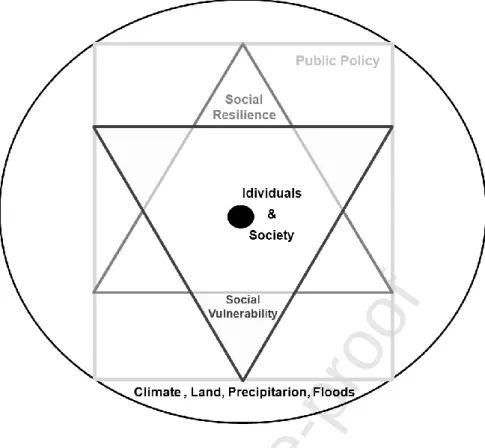
Having presented a short review of literature highlighting some of the ideas on social resilience, as referred by Alexander (2013), it becomes clear that it is so extensive as to make a full review an almost impossible task (Alexander, 2013a); therefore, a conceptual framework is presented herein. This research theoretical framework of social resilience – considers SR (see Figure 2) as a relevant dimension of risk governance, whose central concern are the individuals and their sustainability and security. SR is an inherent characteristic of individuals and, therefore, of communities and society. SR is part of a social-ecological context where risk and territory governance are put into practice via public policy actions and agents. In this context, individuals, communities and society present: (i) social resilience – positive characteristics or enhancement of inherent capacities (Asadzadeh et al., 2017) that promote well-being and recovery, as well as the ability to learn; and (ii) social vulnerability – debilities that intensify the possibility of damage or the susceptibility to harm (Jacinto et al., 2015), and a lack of sustainability for the individuals and communities, especially when facing a disastrous event.
Journal Pre-proof
Figure 2 - Conceptual framework
Source: author's elaboration
3. Social Resilience Assessment: a review of indicator-based studies
The measurement of resilience has been pointed out as one of the scientific gaps in this field (Davydov et al., 2010; J. J. W. Liu et al., 2017), as well as the major difficulty for the implementation of the Sendai Framework (SEI, 2016). Measurement/quantification methods need to be developed to: i) evaluate beyond the post-event in the normal state, ii) reveal the multidimensional reality of individuals and communities, which are composed of multiple systems, and iii) capture the reality at different scales (individual, family, community, society). (Allen et al., 2014; Asadzadeh et al., 2017; J. J. W. Liu et al., 2017). The approaches developed so far to assess resilience are indicator-based. As previously mentioned, the political contexts and policy requirements now call for the implementation of resilience assessments. The development of such approaches is of great importance not only to the scientific advancement in the field but also because it may help people and institutions to deal with uncertainties (Folke, Carl; Carpenter, Steve; Elmqvist, Thomas; Gunderson, Lance; Holling, CS; Walker, 2002). These approaches are now starting to use composite indicators (Asadzadeh et al., 2017) and be compared concerning the dimensions they include (Saja et al., 2018). A summary of the main results and conclusions of the ongoing challenge of measuring resilience is presented in this section, by showing different indicator/measurement-based studies over the last decade, and of the resilience assessment in the disaster governance field.
FREEMAM project (Schelfaut et al., 2011), developed from May 2009 to September 2011, was one of the first that attempted to apply the resilience concept to the flood risk management field in Europe. It focuses on three case studies, Flanders (Belgium), Niedersachsen (Germany) and Calabria (Italy), in which the use of indicators was made for three dimensions: the interplay of institutions, flood risk
Journal Pre-proof
communication, and flood modelling tools. The increase of both stakeholders participation and bottom-up investments was considered as a crucial point to be strengthened.
Davoudi et al. (2012) regarded the studies that assessed resilience solely by means of indicators, such as time of emergency response, as reductionist approaches (Davoudi et al., 2012b). The authors presented a conceptual model in which the main components/variables to manage a pasture social-ecological system were treated in an integrated way. These main components/variables are external controls (such as climate change, political and social instability, civil war, insurgency and migration), social-ecological system slow-changing components, and social-ecological system fast-changing components.
Focussing on the social dimension of disaster resilience, Khalili and Morley (2015) developed indicators for the pre-disaster, response and recovery phases. They included technical, economic, organizational and social dimensions in the framework of resilience. In this study, resilience indicators were listed based on scientific bibliography reviews. They applied a semi-structured interview to the subject matter experts (SMEs) to gather data about resilience indicators and measurement methods. They concluded that some indicators – such as ‘Sense of community, Education, Community Participation, Social Support, Learning, Trust, Exchange of information, Shared information' (Khalili et al., 2015a) – have more impact in the measurement of SR and that those indicators should be considered in the different phases of disaster resilience management. Their conclusion highlighted the need to research the impact of social networks on social resilience within communities to improve community evaluations.
Restemeyer et al. (2015) proposed ‘A strategy-based framework for assessing the flood resilience of cities’ using a case study-based approach. They concluded that holistic resilience building requires boosting social and political capital and therefore, ‘policy-makers should consider social justice and equity aspects.’ (Restemeyer et al., 2015).
A framework of eight steps to generate composed indicators was presented by Asadzadeh et al. (2017). Their study showed, through a comparison of different frameworks, that there are mainly two types of methodologies to assess resilience: i) deductive/hierarchical, e.g., usage of expert surveys, and ii) inductive, e.g., Principal Components Analysis. A reference is made in the literature review section to the absence of the environmental dimension in the resilience measurements (Asadzadeh et al., 2017).
The work ‘Squaring the Circle: Reconciling the Need for Rigor with the Reality on the Ground in Resilience Impact Assessment’, Béné et al. (2017) show the process and the results of a 3-year programme (Béné et al., 2017). In order to enhance resilience, they presented a log frame with indicators grouped by nature, level of intervention and data collection frequency. The data frequency varies with the required inputs of the model (treatment group and control group are required) and with the impact and stressor in the following order: evaluation/initial state - evaluation/final state. The level of intervention varies from the input (some need data before the event, therefore the approach varies depending on the available data) to the impact: programme, individual, household, community or
Journal Pre-proof
system levels. According to their nature, indicators can be classified as input measurable indicators, activity/outputs measurable indicators, resilience capacity indicators, effective resilience response indicators, wellbeing indicators, and shock/stressor indicators (Béné et al., 2017). This approach included a control group and a treatment group for validation. The authors noted that resilience assessments are still in the starting phase.
In 2017, Wickes et al. presented indicator-based research, in which the level of stability, the collective efficacy and the social capital of a neighbourhood were analysed in two different periods, before and after a disaster, in order to verify if the analysed community dimensions could persist after a significant shock – flood (Wickes et al., 2017). Some of the main findings of this research were: neighbourhood measurements are very stable across time, regardless of whether the neighbourhood is affected by floods or not; collective efficacy is a dormant characteristic that appears to be activated only when needed. They also suggested that the social processes are relevant at the neighbourhood level and highlighted the need for preparation of non-affected neighbourhoods against risk.
Chuang et al. (2018) presented a comparison of different quantitative methods to access community resilience. They grouped these methods into Place-based resilience metrics (that focus the ‘spatial aspects of community resilience and attempted to quantify’ it), Coupled social-ecological metrics (which combine system dynamics and system complexity tools to analyse how the components of social-ecological systems interrelate with each other) and Teleconnection metrics (that evaluate the non-linear dynamics in a nested system and is mainly a qualitative analysis, that allows ‘to explore and quantify the magnitude of reinforcing and stabilizing feedbacks in a system’)(Chuang et al., 2018). According to the recent history of resilience assessment, several studies show the need to clearly define the variables to be measured to better understand resilience and even to improve its definition. Several works show results about possible dimensions and indicators, based on theoretical discussions or specific case studies. This work’s contribution is to set standard dimensions and to present, for each dimension, a group of different indicators based on scientific literature and experts’ opinions. The methodology developed in this research is explained in the next section.
4. Methods
In order to reach new conclusions, different perspectives and methods must be attempted. Several questions related to resilience measurement and to the current state of the art need answering. Some of those questions are: i) which dimensions and which indicators pertaining to each dimension should be chosen/selected; ii) which weight should be assigned to the various dimensions, which indicators and dimensions weights are more adequate for each reality, and how to include the natural learning and adaptive capacities of individuals and communities (Béné et al., 2017; Saja et al., 2018; Tyshchuk and Wallace, 2018).
This paper aims to propose a set of indicators based on the state of the art and organized according to resilience dimensions that may compose a social resilience index. The methodology consisted of the selection of scientific papers for the application of text mining and the selection of experts to take part
Journal Pre-proof
in a survey. The obtained results are used as a control to validate and compare with the text mining results.
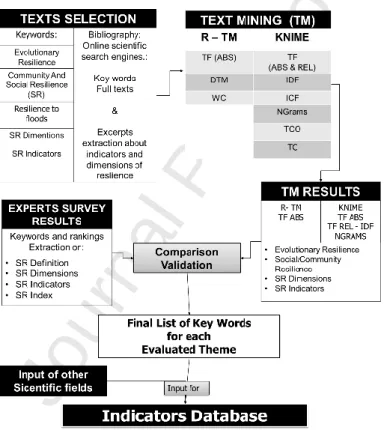
The selection of a set of scientific papers was done through online search engines, mainly Science Direct and Web of Knowledge. The following keywords (Figure 3) were used in the search and selection of papers: ’evolutionary resilience’, ‘community resilience’, ‘social resilience’, ‘resilience to floods’, ‘resilience assessment’ and a combination of the previous keywords. A set of articles considered to be representative of the state of the art and of the thematic were selected for analysis through the application of text mining (TM).
Figure 3Error! Reference source not found. shows the methodological flowchart. Selected scientific texts to be analyzed with TM were then organized in two ways: 1. full articles about the two main issues: i) evolutionary resilience, and ii) social and community resilience; and 2. Excerpts about social/community or floods resilience: a) indicators and b) dimensions.
Figure 3 - Methodological flowchart
Source: author's elaboration
4.1. Text Mining
The text mining (TM) approach was chosen to ensure an objective method that takes into account the keywords and key dimensions selection. It was applied to identify the frequency with which terms and expressions occurred in the group of pre-selected, fully or partially extracted, texts of scientific articles.
Journal Pre-proof
Text mining (TM) has been used in social sciences and has also been applied, for instance, in Lake Basin Governance studies (Emmanuel Cookey et al., 2017).
Extraction of data was achieved by means of TM application on selected texts. Two software were used, KNIME and R Studio – TM package.
Having applied KNIME and R Studio for term frequency absolute (TF ABS) – the number of times a term appears in a set of texts – the results of the two software were compared. Post-processing of the results was implemented to remove outlier keywords as well as to remove duplicates.
For each TF ABS results, the selection criteria consisted in adopting the 15 most frequent terms since the analysis of the 3rd quartile showed large differences in the number of words between Knime and R (see Table 1). This lack of correlation between the results, resulting from the application of two different software, determined that only one could be used for other indicators. KNIME was chosen to analyze TF ABS and other variables. This means that the selection of bi-grams (a combination of two adjacent terms and the analysis of its frequency in the set of texts), as well as the term frequency relative (TF Rel) (number of times the term appears compared to the other terms in the set of texts) were implemented only on KNIME.
Table 1- Comparison of the absolute term frequency in Q3 for KNIME and R Studio in Evolutionary Resilience texts
Software Q3 | Nr terms
Knime 14
R-tm package 203
Source: author's elaboration
This research methodology involved selecting keywords and included the comparison of the 15 most frequent terms in KNIME and R-tm, out of which only the five most frequent ones were selected. The term ‘resilience’ was maintained as part of the results, meaning that many composed keywords – bi-grams – contain this term.
Amongst the 15 most frequent bi-grams, the six most frequent ones contained two or at least one of the five selected keywords.
It is important to refer that this research methodology has some limitations, namely, it doesn’t contemplate all the literature on social resilience, it is also conditioned by the keywords and the search engine used to collect the original texts as well as by the authors' selected excerpts. Nevertheless, the adopted research methodology is impartial as the authors' excerpts used to in the current work were not subjected to personal interpretations.
4.2. Experts Survey
Expert opinions were collected via an online survey using eSurvey Creator (www.esurveycreator.com; currently SurveyHero – www.surveyhero.com). The selection of experts was done through literature review and an online search of authors profile in the scientific Academia network. The authors of the
Journal Pre-proof
pre-selected texts were contacted and asked to complete a questionnaire. Adini et al. (2017) used a comparable approach, by applying an online survey of experts to extract resilience concepts, approaches and practices (Adini et al., 2017).
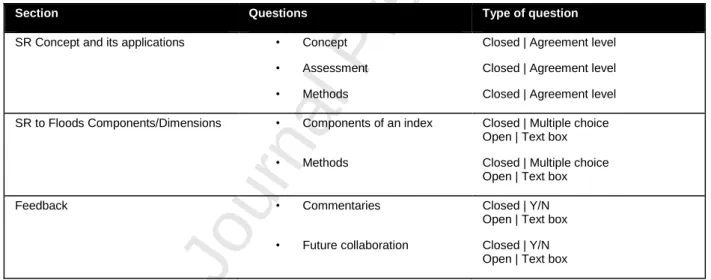
Data collected through the online survey gathered the tendencies and keywords on how experts define, assess and evaluate social resilience (SR). Further to the pre-selected options, the experts had the opportunity to express their own ideas using the open and feedback fields (see Table 2). Survey questions 1, 2 and 3 requested experts to convey their level of agreement (options: disagree; partially disagree; partially agree; agree) to a set of pre-defined sentences. Questions 1-3 dealt respectively with resilience concept (see Figure 4 - the appendix 1), resilience assessment (data and scale of analysis required to evaluate social resilience in flood-affected communities), and methodologies to assess social resilience. Question 4.1. required the selection of one or more dimensions of resilience calculation from a pre-defined list of resilience dimensions and provided the possibility to add other options/dimensions. Question 4.2 was an open question that encouraged experts to give their opinion on whether the dimensions had the same weight.
Table 2 - Experts Survey Structure
Section Questions Type of question
SR Concept and its applications • Concept • Assessment • Methods
Closed | Agreement level Closed | Agreement level Closed | Agreement level
SR to Floods Components/Dimensions • Components of an index
• Methods
Closed | Multiple choice Open | Text box Closed | Multiple choice Open | Text box
Feedback • Commentaries
• Future collaboration
Closed | Y/N Open | Text box Closed | Y/N Open | Text box
Eleven experts from seven countries, mostly in Europe (U.K.: 5; Germany: 2; Australia: 1; Portugal: 1; Sweden: 1; U.S.A.: 1), provided complete answers. Results from the experts’ survey were used for validation of the selected keywords and bi-grams. The number of complete answers was expected to be larger, nevertheless, it was already relevant that some of the answers were from widely cited authors which articles have been in the base of this research theoretical frame.
4.3. Other scientific fields
As referred in the first three sections of this research, social resilience assessment must be multi-scale and observe both individual and collective/community indicators. Most of the scientific works that used
Journal Pre-proof
TM and the majority of the experts who contributed to the applied survey were from the geography and disaster risk management scientific fields. A literature review of other scientific fields revealed that social psychology provides the most useful information regarding the need for an evolutionary resilience approach. A social psychology approach to resilience confirms the need for multiple scales of analysis: individuals, community, multiple spheres of the same reality (such as individual resilience, family resilience) and neighbourhood, as well the following dimensions: geographical, health, society, environment; and evolving time concept (Bhana and Bachoo, 2011; Davydov et al., 2010; D. Liu et al., 2017). This review was very useful in the selection of indicators to evaluate the resilience of individuals and social networks (see Table 3).
4.4. Validation through the comparison of TM and ES
Only the five sentences from the experts’ survey (ES) that scored the highest number of “totally agree” and “partially agree” choices were selected.
A comparison of the lists of results (words and expressions/bi-grams and top agreement options) of TM and ES was made in order to validate the results of TM, and this comparison resulted in the acceptance of the TM results with a satisfactory certainty. Out of the total TM keywords and key-expressions extracted from the referred lists, 95% had correspondence with the ES results.
The comparison of the two approaches – TM and experts surveys – provided key information to establish the social resilience to floods dimensions and, therefore, the type of indicators to be included in an indicators database (Figure 5).
The results of the text mining-based methodology depend on the papers selected for analysis. A systematic mapping of articles related to social resilience assessment allows a broad and comprehensive spectrum of perspectives, representative of different approaches and publication dates.
The results of the experts’ survey depend on the responses received. In this case, it was not possible to assure identical representativeness of different approaches, since the completion of the survey depends on the availability of the experts who were contacted. However, there was a significant convergence between the answers given by experts of seven countries, which suggests that the results are robust.
Besides, there is a significant consistency between the results of the two methodologies used.
5. Results
The main result of this paper is a database of indicators organized by dimensions. The indicators were collected from peer-reviewed papers and international projects outputs and reports; the source/reference is presented together with each indicator (see Table 3). The resulting SR to floods dimensions is an output of the comparison of TM with ES as previously explained (see Figure 5). These dimensions are independent of the type of risk to which the community/individual are exposed, as it generally includes the disaster/shock/stressor dimension/indicator; it further includes the propensity of the community/individual to be affected.
Journal Pre-proof
The results show, through the application of TM and ES, that four of the six dimensions refer to the social aspect of the risks (1. Individuals, 2. Society, 3. Governance, 4. Built Environment) and that two relate to the environment and to disaster.
Figure 5 - Social Resilience to Floods Dimensions and Indicators results from TM and ES. Source: author's elaboration
Another result of this work is an enlarged set of indicators organized per dimension – see Table 3, that were extracted from published scientific articles and grouped by dimension according to the results presented in Figure 5. The transition from Figure 5 to Table 3 was done keeping the identified dimensions and using the ‘type of indicators’ as categories to group indicators extracted from the literature. In order to shorten the table, some indicators were re-written, or simply grouped in one line, as they were considered equivalent and might be chosen or dismissed according to the reality of the case study where it should be applied.
Table 3 - Summarized Database of Dimensions and Indicators for Social Resilience Assessment
Dim ensi
on Category Indicator References
nr Name nr Name General Based on
1 Individuals 1.1
Psychology - Adaptive Capacity
Confidence
(Bobby Rahman et al., 2016; Davydov et al., 2010; J. J. W. Liu et al., 2017)
Social Skills
Journal Pre-proof
al., 2014)Capacity to deal with changes and stress, self-control and regulation
(Béné et al., 2017; Bobby Rahman et al., 2016; Davydov et al., 2010; J. J. W. Liu et al., 2017; Madewell and Ponce-Garcia, 2016; Tanner et al., 2014)
Security and feeling of control over one's own life (Madewell and Ponce-Garcia, 2016)
Positiveness (Madewell and Ponce-Garcia, 2016)
Individual health (Cutter et al., 2014; Khalili et al., 2015a)
Motivation (Madewell and Ponce-Garcia, 2016)
Knowledge
(Béné et al., 2017; Bobby Rahman et al., 2016; Davydov et al., 2010; Khalili et al., 2015a; Madewell and Ponce-Garcia, 2016; Schelfaut et al., 2011; Tyshchuk and Wallace, 2018)
Sense of belonging
(Davydov et al., 2010; Tyshchuk and Wallace, 2018)
1.2 Health/disability Health care
(Cutter et al., 2014; Edwards et al., 2017; Khalili et al., 2015a; J. J. W. Liu et al., 2017; Madewell and Ponce-Garcia, 2016)
1.3 Age and Demography Demography
(Cutter et al., 2014; Davydov et al., 2010; Khalili et al., 2015a)
Household
(Béné et al., 2017; Kelman, 2017; Khalili et al., 2015a)
Household resources (Cutter et al., 2014; Khalili et al., 2015a)
1.4 Migration Native language proficiency (Cutter et al., 2014)
Place attachment (Cutter et al., 2014)
Population diversity
(Cutter et al., 2014; Edwards et al., 2017; Wickes et al., 2017)
2 Society 2.1 Associativism Volunteerism
(Béné et al., 2017; Butler and Walker-springett, 2016)
2.2 Social networking Sense of community & collective efficacy
(Béné et al., 2017; Butler and Walker-springett, 2016; Khalili et al., 2015a; Wickes et al., 2017)
Community building
(Bobby Rahman et al., 2016; Butler and Walker-springett, 2016; Cutter et al., 2014; Khalili et al., 2015a)
Informal safety net
(Béné et al., 2017; Butler and Walker-springett, 2016)
2.3 Institutions Governance
(Adger, 2000; Béné et al., 2017; Butler and Walker-springett, 2016; Cutter et al., 2014; Schelfaut et al., 2011)
Interaction involving formal and informal actors (Adini et al., 2017)
2.4 Livelihood conditions Household characteristics
(Adger, 2000; Béné et al., 2017; Cutter et al., 2014; Khalili et al., 2015a; Tanner et al., 2014)
2.5 Insurance Insurance capacity (Cutter et al., 2014; Khalili et al., 2015a)
3 Governance 3.1
Planning and
Governance Strategies
(Adini et al., 2017; Béné et al., 2017; Bobby Rahman et al., 2016; Cutter et al., 2014)
Policy/governance approach
(Adini et al., 2017; Bobby Rahman et al., 2016; Khalili et al., 2015a; Tanner et al., 2014)
Journal Pre-proof
Community involvement
(Béné et al., 2017; Bobby Rahman et al., 2016; Tanner et al., 2014)
Research
(Béné et al., 2017; Bobby Rahman et al., 2016; Cutter et al., 2014; I. Kelman et al., 2015)
Risk governance – prevention
(Adini et al., 2017; Béné et al., 2017; Bobby Rahman et al., 2016; Butler and Walker-springett, 2016)
4 Built
Environment 4.1 Infrastructures Technologies (Adini et al., 2017)
Transportation (Béné et al., 2017; Cutter et al., 2014)
Services
(Adini et al., 2017; Béné et al., 2017; Cutter et al., 2014)
4.2 Buildings resistance Types and conservation of buildings (Adini et al., 2017; Cutter et al., 2014)
5.
Natural
Environment 5.1.
Hazard, susceptibility and exposition
analysis Hazard assessment and proxy indicators
(Bobby Rahman et al., 2016; Cutter et al., 2014)
5.2. Natural environment
(Adger, 2000; Béné et al., 2017; Cutter et al., 2014)
6. Disaster 6.1
Learning from the
past Resilience and DRR evaluation
(Adini et al., 2017; Béné et al., 2017; Cutter et al., 2014; I. Kelman et al., 2015; Khalili et al., 2015a)
6.2.
Disasters and
recovery Assistance to citizens (Adini et al., 2017; Béné et al., 2017)
Recovery
(Adger, 2000; Bobby Rahman et al., 2016)
Action during crisis (Adini et al., 2017; Béné et al., 2017)
Risk Communication (Béné et al., 2017)
Source: author's elaboration
6. Discussion
The question ‘Resilience for whom?’ arises from the conclusions of Asadzadeh et al. (2017). When setting the conceptual foundation of a framework to assess resilience, it is important to know whose resilience will be boosted (Asadzadeh et al., 2017). In this paper’s conceptual frame, individuals and community are the central elements (section 2.3). This can be seen as a two-sided argument to deal with when choosing the indicators and components weight if they are to be used in one index/composed indicator or any quantitative method. Indeed, the characteristics of individuals and community might be given more weight since it is important to boost their resilience. Conversely, if we want to boost the resilience of individuals and institutions, we need to put in place adequate policies and infrastructures to protect the community and individuals. Pizzo (2015) considered that most resilience studies focussed on the hazard, whereas few studies addressed the multidimensional reality of resilience that includes different dimensions (Pizzo, 2015). This research results showed that multiple dimensions met this requirement. The scientific gaps identified so far show the need to apply the results of this paper to different case studies with different weights, to try to find a standard way of applying such indicators to a given context.
Journal Pre-proof
Table 3 is a useful database of indicators. Its enlarged version is shown in appendix 2, as it is a comprehensive descriptive set of indicators organised by dimension and category (indicator). It is an example of data to be collected (specific indicators). Its usage must comply with certain analysis and there must be critical opinions about what the researchers/institutions wish to focus on; according to Asadzaeh et al. (2017), whether the focus is on the social skills and capacities of resilience or on the infrastructures and assets. Another way to analyse the table is to focus on certain aspects of the resilience cycle/time frame (when) or ‘persistence (robustness), recovery (constancy), and adaptive capacity (transformative)’(Asadzadeh et al., 2017). It might also be the case that the indicators are applied with a focus on resilience management, in which instance scaling should be seen from this perspective not only regarding each indicator (Holling 1973) but also in a regional rather than a local context (Holling, 1973). The database contains duplicates of examples concerning the type of data collected (specific indicators), e.g., the individual dimension and the social dimension both relate to the characteristics of households. The causes of these duplicates are: (i) the usage of scientific works with different scales of analysis and distinct focuses: individuals and community; and (ii) limited experience in applying the dimensions to case studies. It would be useful to know which data (individual/community) and scale are available and to identify to which dimension a higher weight/relevance should be assigned to accurately reflect the reality of each case study. The choice was to leave the duplicates, as it allows for greater freedom of discussion and for making different combinations when creating scientific research applications.
The usage of this database requires the inclusion of the aforementioned dimensions and the testing of the indicators in different types of case studies in order to set types of resilience approaches, to test the weight of indicators and dimensions, and to have real-world experience about the available data and the adequacy of each indicator to the reality under analysis. The next step of this research will focus on these unsolved issues.
Definition of the most adequate indicators to each social-ecological context depends on its testing in case studies. The adoption of a social resilience index needs knowledge acquired from other case studies. The analysis of social resilience in flood-affected communities through such indicators will also need to be tested regarding the conciliation of objective and subjective indicators, and statistical and spatial indicators. There’s no universal practice for the choice of the procedures for data transformation, categorization, aggregation, visualization and validation (Asadzadeh et al., 2017), therefore case studies are required to validate such approaches.
The next steps of the current research will deal with the application of this indicators database to different case studies in Portugal, to test which are the most suitable indicators for the Portuguese context taking into account the type of floods that occur in each case study area.
7. Conclusions
For several decades, the wide debate surrounding the resilience concept and its applicability to social-ecological systems have drawn attention to the need to find tangible ways to assess social resilience and include it in risk governance strategies and plans. The current state of the art in this field points to
Journal Pre-proof
an evolutionary resilience concept based on the systems theory. The social-ecological systems are multiple coupled systems. According to this view, time is not linear as the systems evolve and learn across time. Consequently, challenges arise to assess multiple dimensions of these multi-systems and to find the key dimensions and indicators that will reshape the concept of social resilience.
This paper, therefore, presents a methodology to compile and summarize the dimensions that should be included in risk governance of social resilience, combining literature review, text mining, and experts’ opinions. The obtained results (see Figure 5 and Table 3) show that text mining can be an appropriate tool to support decision making and research in social fields and theoretical research, as its results converge with the opinions of experts. The combination of the two methods has lent robustness and certainty to the results (see Figure 5), and confidence to organize a database of indicators based on scientific literature review. The information provided by the experts’ survey was used to compare and validate the text mining-based methodology: (i) the 5 most mentioned words in the answers to each of the questions; and (ii) the categories 'totally agree' and 'partially agree'. The selected words were synthesized in key expressions. The later plus the sum of the categories 'totally agree' and 'partially agree' correspond to more than 90% of the answers given by the experts (high internal coherence). In order to validate the results of text mining, a comparison was made with the results of the experts` survey. Out of the total of keywords and key expressions extracted through the text mining-based methodology, 95% corresponded to the results of the experts` survey (high external coherence).
Comparing evolutionary resilience with social and community resilience highlights the changing and learning capacity of individuals and communities through time. The challenge is to find the dynamic indicators that adequately reflect this capacity of individuals and communities. The solution might be the inclusion of psychological indicators through social media (Hernantes et al., 2017). Collecting psychological data requires intensive fieldwork, social media is accessible worldwide and it is massively used by individuals on a daily basis to share their life and emotions.
This research findings point out the next steps: the need for real world cases as any indicator-based approach requires its application to specific case studies, while the generalization and standardization of such approaches require the application to as many diverse real-world cases as possible.
Acknowledgements: This research was funded by the FCT - Fundação para a Ciência e Tecnologia
(Portuguese Foundation for Science and Technology), I.P. [grant number SFRH/BD/119228/2016 to Rita Jacinto; UIDB/00295/2020 + UIDP/00295/2020].
Bibliography
Abdulkareem, M., Elkadi, H., 2018. From engineering to evolutionary, an overarching approach in identifying the resilience of urban design to flood. Int. J. Disaster Risk Reduct. 28, 176–190. https://doi.org/10.1016/j.ijdrr.2018.02.009
Journal Pre-proof
Adger, W.N., 2000. Social and ecological resilience : are they related ? 3, 347–364.Adini, B., Cohen, O., Eide, A.W., Nilsson, S., Aharonson-Daniel, L., Herrera, I.A., 2017. Striving to be resilient: What concepts, approaches and practices should be incorporated in resilience management guidelines? https://doi.org/10.1016/j.techfore.2017.01.020
Alexander, D.E., 2013a. Resilience and disaster risk reduction: An etymological journey. Nat. Hazards Earth Syst. Sci. 13, 2707–2716. https://doi.org/10.5194/nhess-13-2707-2013
Alexander, D.E., 2013b. Resilience and disaster risk reduction: an etymological journey. Nat. Hazards Earth Syst. Sci. Discuss. 1, 1257–1284. https://doi.org/10.5194/nhessd-1-1257-2013
Allen, C.R., Angeler, D.G., Garmestani, A.S., Gunderson, L.H., Holling, C.S., 2014. Panarchy: Theory and Application. Ecosystems 17, 578–589. https://doi.org/10.1007/s10021-013-9744-2
Asadzadeh, A., Kötter, T., Salehi, P., Birkmann, J., 2017. Operationalizing a concept: The systematic review of composite indicator building for measuring community disaster resilience. Int. J. Disaster Risk Reduct. 25, 147–162. https://doi.org/10.1016/j.ijdrr.2017.09.015
Ayyoob Sharifi, 2016. A critical review of selected tools for assessing community resilience.
Barnett, J., Tschakert, P., Head, L., Adger, W.N., 2016. A science of loss. Nat. Publ. Gr. 6, 976. https://doi.org/10.1038/nclimate3139
Béné, C., Al-Hassan, R.M., Amarasinghe, O., Fong, P., Ocran, J., Onumah, E., Ratuniata, R., Tuyen, T. Van, McGregor, J.A., Mills, D.J., 2016. Is resilience socially constructed? Empirical evidence from Fiji, Ghana, Sri Lanka, and Vietnam. Glob. Environ. Chang. 38, 153–170. https://doi.org/10.1016/j.gloenvcha.2016.03.005
Béné, C., Chowdhury, F.S., Rashid, M., Dhali, S.A., Jahan, F., 2017. Squaring the Circle: Reconciling the Need for Rigor with the Reality on the Ground in Resilience Impact Assessment. World Dev. 97, 212–231. https://doi.org/10.1016/j.worlddev.2017.04.011
Bhana, A., Bachoo, S., 2011. The determinants of family resilience among families in low-and middle-income contexts: a systematic literature review. South African J. ofPsychology 41, 131–139.
Bobby Rahman, M., Susana Nurhasanah, I., Purwo Nugroho, S., 2016. ScienceDirect Community resilience: learning from Mt Merapi eruption 2010. Procedia -Social Behav. Sci. CITIES 227, 387–394. https://doi.org/10.1016/j.sbspro.2016.06.090 Boschma, R., 2015. Towards an Evolutionary Perspective on Regional Resilience. Reg. Stud. 49, 733–751.
https://doi.org/10.1080/00343404.2014.959481
Butler, C., Walker-springett, K., 2016. Social and Political Dynamics of Flood Risk , Recovery and Response : A Report on the Findings of the Winter Floods Project.
Chuang, W.C., Garmestani, A., Eason, T.N., Spanbauer, T.L., Fried-Petersen, H.B., Roberts, C.P., Sundstrom, S.M., Burnett, J.L., Angeler, D.G., Chaffin, B.C., Gunderson, L., Twidwell, D., Allen, C.R., 2018. Enhancing quantitative approaches for assessing community resilience. J. Environ. Manage. 213, 353–362. https://doi.org/10.1016/j.jenvman.2018.01.083 Cutter, S.L., Ash, K.D., Emrich, C.T., 2014. The geographies of community disaster resilience. Glob. Environ. Chang. 29, 65–
77. https://doi.org/10.1016/j.gloenvcha.2014.08.005
Davoudi, Simin; Shaw, Keith; Haider , L. Jamila; Quilnlan, Allyson E; Petterson, Garry D.; Wilkinson, Cathy; Fünfgeld, Hartmut; McEvoy, Darryn; Porter, L., 2012. Resilience: A Bridging Concept or a Dead End? Plan. Theory Pract. 13. https://doi.org/10.1080/14649357.2012.677124
Davoudi, S., Brooks, E., Mehmood, A., 2013. Planning Practice & Research Evolutionary Resilience and Strategies for Climate Adaptation Evolutionary Resilience and Strategies for Climate Adaptation 283, 307–322. https://doi.org/10.1080/02697459.2013.787695
Davoudi, S., Shaw, K., Haider, L.J., Quinlan, A.E., Peterson, G.D., Wilkinson, C., F??nfgeld, H., McEvoy, D., Porter, L., 2012a. Resilience: A Bridging Concept or a Dead End? “Reframing” Resilience: Challenges for Planning Theory and Practice Interacting Traps: Resilience Assessment of a Pasture Management System in Northern Afghanistan Urban Resilience: What Does it Mean in Planni. Plan. Theory Pract. 13, 299–333. https://doi.org/10.1080/14649357.2012.677124
Davoudi, S., Shaw, K., Haider, L.J., Quinlan, A.E., Peterson, G.D., Wilkinson, C., Fünfgeld, H., McEvoy, D., Porter, L., 2012b. Resilience: A Bridging Concept or a Dead End? “Reframing” Resilience: Challenges for Planning Theory and Practice Interacting Traps: Resilience Assessment of a Pasture Management System in Northern Afghanistan Urban Resilience: What Does it Mean in Planni. Plan. Theory Pract. 13, 299–333. https://doi.org/10.1080/14649357.2012.677124
Davoudi, S., Zaucha, J., Brooks, E., 2016. Evolutionary resilience and complex lagoon systems. Integr. Environ. Assess. Manag. 12, 711–718. https://doi.org/10.1002/ieam.1823
Davydov, D.M., Stewart, R., Ritchie, K., Chaudieu, I., 2010. Resilience and mental health. Clin. Psychol. Rev. 30, 479–495. https://doi.org/10.1016/J.CPR.2010.03.003
Dyah Kusumastuti, R., Ananto Husodo, Z., Suardi, L., Nastiti Danarsari, D., 2014. Developing a resilience index towards natural disasters in Indonesia. https://doi.org/10.1016/j.ijdrr.2014.10.007
Journal Pre-proof
With Physical Disabilities: A Longitudinal Study. Arch. Phys. Med. Rehabil. 98, 329–336. https://doi.org/10.1016/j.apmr.2016.09.123
Emmanuel Cookey, P., Darnsawasdi, R., Ratanachai, C., 2017. Text mining analysis of institutional fit of Lake Basin water governance. Ecol. Indic. 72, 640–658. https://doi.org/10.1016/j.ecolind.2016.08.057
Folke, Carl; Carpenter, Steve; Elmqvist, Thomas; Gunderson, Lance; Hollling, CS; Walker, B., 2002. Resilience and Sustainable Development : Building Adaptive Capacity in a World of Transformations. R. Swedish Acad. Sci. 31, 437–440. https://doi.org/10.1579/0044-7447-31.5.437
Folke, C., 2006. Resilience: The emergence of a perspective for social-ecological systems analyses. Glob. Environ. Chang. 16, 253–267. https://doi.org/10.1016/j.gloenvcha.2006.04.002
Gall, M., Nguyen, K.H., Cutter, S.L., 2015. Integrated research on disaster risk: Is it really integrated? Int. J. Disaster Risk Reduct. 12, 255–267. https://doi.org/10.1016/j.ijdrr.2015.01.010
Graziano, P., Rizzi, P., 2016. Vulnerability and resilience in the local systems: The case of Italian provinces. Sci. Total Environ. 553, 211–222. https://doi.org/10.1016/j.scitotenv.2016.02.051
Hernantes, J., Labaka, L., Turoff, M., Roxanne Hiltz, S., Bañuls, V.A., 2017. Moving forward to disaster resilience: Perspectives on increasing resilience for future disasters. Technol. Forecast. Soc. Chang. 121, 1–6. https://doi.org/10.1016/j.techfore.2017.05.011
Hogarth, J.R., Wójcik, D., 2016. An evolutionary approach to adaptive capacity assessment: A case study of Whitehouse, Jamaica. J. Rural Stud. 43, 248–259. https://doi.org/10.1016/j.jrurstud.2015.12.005
Holling, C.S., 1973. Resilience and Stability of Ecological Systems.
Jacinto, R., Grosso, N., Reis, E., Dias, L., Santos, F.D., Garrett, P., 2015. Continental Portuguese Territory Flood Susceptibility Index – contribution to a vulnerability index. Nat. Hazards Earth Syst. Sci. 15, 1907–1919. https://doi.org/10.5194/nhess-15-1907-2015
Kelman, I., 2017. Pacific island regional preparedness for El Niñ o. Environ. Dev. Sustain. https://doi.org/10.1007/s10668-017-0045-3
Kelman, I., Gaillard, J.C., Lewis, J., Mercer, J., 2015. Learning from the history of disaster vulnerability and resilience research and practice for climate change. Nat. Hazards 82, 129–143. https://doi.org/10.1007/s11069-016-2294-0
Kelman, Ilan, Gaillard, J.C., Mercer, J., 2015. Climate Change ’ s Role in Disaster Risk Reduction ’ s Future : Beyond Vulnerability and Resilience 21–27. https://doi.org/10.1007/s13753-015-0038-5
Khalili, S., Harre, M., Morley, P., 2015a. A temporal framework of social resilience indicators of communities to flood, case studies: Wagga wagga and Kempsey, NSW, Australia. Int. J. Disaster Risk Reduct. 13, 248–254. https://doi.org/10.1016/j.ijdrr.2015.06.009
Khalili, S., Harre, M., Morley, P., 2015b. A temporal framework of social resilience indicators of communities to flood, case studies: Wagga wagga and Kempsey, NSW, Australia. Int. J. Disaster Risk Reduct. 13, 248–254. https://doi.org/10.1016/j.ijdrr.2015.06.009
Kwok, A.H., Doyle, E.E.H., Becker, J., Johnston, D., Paton, D., 2016. What is ‘social resilience’? Perspectives of disaster researchers, emergency management practitioners, and policymakers in New Zealand. Int. J. Disaster Risk Reduct. 19, 197–211. https://doi.org/10.1016/j.ijdrr.2016.08.013
Linkov, I., Bridges, T., Creutzig, F., Decker, J., Fox-Lent, C., Kröger, W., Lambert, J.H., Levermann, A., Montreuil, B., Nathwani, J., Nyer, R., Renn, O., Scharte, B., Scheffler, A., Schreurs, M., Thiel-Clemen, T., 2014. Changing the resilience paradigm. Nat. Clim. Chang. 4, 407–409. https://doi.org/10.1038/nclimate2227
Liu, D., Li, Y., Fang, S., Zhang, Y., 2017. Influencing factors for emergency evacuation capability of rural households to flood hazards in western mountainous regions of Henan province, China. Int. J. Disaster Risk Reduct. 21, 187–195. https://doi.org/10.1016/j.ijdrr.2016.12.008
Liu, J.J.W., Reed, M., Girard, T.A., 2017. Advancing resilience: An integrative, multi-system model of resilience. Pers. Individ. Dif. 111, 111–118. https://doi.org/10.1016/j.paid.2017.02.007
Madewell, A.N., Ponce-Garcia, E., 2016. Assessing resilience in emerging adulthood: The Resilience Scale (RS), Connor-Davidson Resilience Scale (CD-RISC), and Scale of Protective Factors (SPF). Pers. Individ. Dif. 97, 249–255. https://doi.org/10.1016/j.paid.2016.03.036
Michel-Kerjan, E., 2015. We must build resilience into our communities. Nature 2015. https://doi.org/10.1038/524389a
No, U.P.S., 2015. UNU-EHS PUBLICATION SERIES No. 22 | December 2015 Livelihood resilience in a changing world – 6 global policy recommendations for a more sustainable future.
Pizzo, B., 2015. Problematizing resilience: Implications for planning theory and practice. Cities 43, 133–140. https://doi.org/10.1016/j.cities.2014.11.015
Restemeyer, B., Woltjer, J., Van Den Brink, M., 2015. A strategy-based framework for assessing the flood resilience of cities – A Hamburg case study. Plan. Theory Pract. 16, 45–62. https://doi.org/10.1080/14649357.2014.1000950
Journal Pre-proof
Rufat, S., Tate, E., Burton, C.G., Sayeed Maroof, A., 2017. Social vulnerability to floods: Review of case studies and implications for measurement. https://doi.org/10.1016/j.ijdrr.2015.09.013
Sá, Luis; Vicêncio, H., 2011. RISCO DE INUNDAÇÕES - UMA METODOLOGIA PARA A SUA CARTOGRAFIA. Territorium 18, 227–230.
Saja, A.M.A., Teo, M., Goonetilleke, A., Ziyath, A.M., 2018. An inclusive and adaptive framework for measuring social resilience to disasters. Int. J. Disaster Risk Reduct. 28, 862–873. https://doi.org/10.1016/j.ijdrr.2018.02.004
Schelfaut, K., Pannemans, B., van der Craats, I., Krywkow, J., Mysiak, J., Cools, J., 2011. Bringing flood resilience into practice: The FREEMAN project. Environ. Sci. Policy 14, 825–833. https://doi.org/10.1016/j.envsci.2011.02.009
SEI, 2016. The Sendai Framework: A catalyst for the transformation of disaster risk reduction through adaptive governance? https://doi.org/10.13140/RG.2.2.13860.48006
Sgrò, C.M., Lowe, A.J., Hoffmann, A.A., 2011. Building evolutionary resilience for conserving biodiversity under climate change. Evol. Appl. 4, 326–337. https://doi.org/10.1111/j.1752-4571.2010.00157.x
Tanner, T., Lewis, D., Wrathall, D., Bronen, R., Cradock-Henry, N., Huq, S., Lawless, C., Nawrotzki, R., Prasad, V., Rahman, M.A., Alaniz, R., King, K., McNamara, K., Nadiruzzaman, M., Henly-Shepard, S., Thomalla, F., 2014. Livelihood resilience in the face of climate change. Nat. Clim. Chang. 5, 23–26. https://doi.org/10.1038/nclimate2431
Tyshchuk, Y., Wallace, W.A., 2018. Modeling Human Behavior on Social Media in Response to Significant Events. IEEE Trans. Comput. Soc. Syst. 1–14. https://doi.org/10.1109/TCSS.2018.2815786
Ungar, M., 2011. Community resilience for youth and families: Facilitative physical and social capital in contexts of adversity. https://doi.org/10.1016/j.childyouth.2011.04.027
UNISDR, 2015. Sendai Framework for Disaster Risk Reduction 2015 - 2030 1.
Usamah, M., Handmer, J., Mitchell, D., Ahmed, I., 2014. Can the vulnerable be resilient? Co-existence of vulnerability and disaster resilience: Informal settlements in the Philippines. Int. J. Disaster Risk Reduct. 10, 178–189. https://doi.org/10.1016/j.ijdrr.2014.08.007
Wickes, R., Britt, C., Broidy, L., 2017. The resilience of neighborhood social processes: A case study of the 2011 Brisbane flood. Soc. Sci. Res. 62, 96–119. https://doi.org/10.1016/j.ssresearch.2016.07.006
Wilson, G.A., 2012. Community resilience, globalization, and transitional pathways of decision-making. Geoforum 43, 1218– 1231. https://doi.org/10.1016/j.geoforum.2012.03.008
Journal Pre-proof
APPENDIX 1Figure 4- Experts Survey question 1
Source: author's elaboration APPENDIX 2
Dimension Category Indicator References nr Name nr Name General E.g. data to collect Based on
1 Individuals 1.1 Psychology - Adaptive Capacity
Confidence Strong sense of purpose (Bobby Rahman et al., 2016; Davydov et al., 2010; J. J. W. Liu et al., 2017)