____________________________________
1 Bióloga, Pesquisador Colaborador, FEAGRI/UNICAMP, Campinas - SP, Fone: (0XX19) 3521.1139, [email protected]. 2 Enga Civil, Prof. Colaborador, FEAGRI/UNICAMP, Campinas - SP, [email protected].
3 Desenhista Industrial, Estudante de Doutorado, FEAGRI/UNICAMP, Campinas - SP, [email protected]. 4 Estudante de Graduação, FEAGRI/UNICAMP, Campinas - SP, [email protected].
5 Médica Veterinária, FEAGRI/UNICAMP, Campinas - SP ,[email protected].
6 Enga Agrônoma, Prof. Dr., FEAGRI/UNICAMP, Campinas - SP, [email protected].
7 Zootecnista, Professor, Universidade Federal de Grande Dourados - UFGD, Dourados - MS, [email protected]. FUNCTION OF BROILER BREEDERS AGE
MARTA DOS S. BARACHO1, IRENILZA DE A. NÄÄS2, DIEGO P. NEVES3, JULIANO DE A. CASSIANO4, FABIANA G. LIMA5, DANIELLA J. DE MOURA6,
RODRIGO G. GARCIA7
ABSTRACT: This research aimed to compare two female broiler breeder ages during the incubation period regarding management using the Analytic Hierarchy Process method (AHP). This method is characterized by the possibility of analyzing a multicriteria problem and assists a decision making. This study was carried out on a commercial hatchery located in São Paulo, Brazil. Two ages of broiler breeder (42 and 56 weeks) were compared relative to production rate. Production index data were the same in both ages and were submitted to multicriteria decision analysis using the AHP method. The results indicate that broiler breeders of 42 weeks presented better performance than those of 56 week-old. The setter phase (incubation) is more critical than the hatcher. The AHP method was efficient for this analysis and can serve as a methodological basis for future studies to improve the hatchability of broilers eggs.
KEYWORDS: Multi-stage incubator, Multi criteria analysis, broiler breeders’ production.
ESTIMANDO OS CRITÉRIOS MAIS IMPORTANTES PARA INCUBAÇÃO DE OVOS FÉRTEIS EM FUNÇÃO DA IDADE DE MATRIZES PESADAS
RESUMO: Este trabalho teve como objetivo comparar matrizes pesadas na fase de incubação em incubatório, utilizando o método Analytic Hierarchy Process (AHP). Esse método é uma técnica de
análise de decisão e planejamento de múltiplos critérios. O trabalho foi conduzido em incubatório comercial localizado no Estado de São Paulo, Brasil. Duas idades de matrizes pesadas (42 e 56 semanas) foram comparadas em relação a dados/taxa de produção. Dados de índice de produção foram submetidos à análise de decisão utilizando o método AHP. Os resultados indicaram que as matrizes de frangos de corte de 42 semanas apresentaram melhor desempenho do que aquelas de 56 semanas. A fase da incubadora é mais crítica do que a fase do nascedouro. O método AHP foi eficiente para a análise e pode ser utilizado como base metodológica para estudos futuros para melhorar a eclodibilidade.
INTRODUCTION
Poultry technology has developed in the last decades leading to significant improvements in Brazilian production. Amongst them, there are the strains’ genetic improvements of broiler breeders. The incubation is a critical stage in the production cycle, and it is directly related to the broilers breeders’ farm management. Problems related to the hatchery may affect embryo development, and hatchability of eggs, as it interferes in the internal characteristics of the egg and eggshell quality (PEDROSO et al., 2005; HAMIDU et al., 2007; DE SMITH et al., 2008; PINEDA et al., 2012).
Incubation is a process that needs ideal environmental conditions for the development of embryo in fertile eggs. It needs to be homogeneous and adequate in a way that hatchability and the pullet’s final quality are not affected (GIGLI et al., 2009). As the embryo is continuously affected by the environment, variables such as temperature, humidity, air velocity CO2, concentration, egg turning and egg position should be intensively controlled to obtain optimum incubation (DECUYPERE & BRUGGEMAN, 2007; ONAGBESAN et al., 2007; WILLEMSEN et al., 2008; BARACHO et al., 2010; MENEZES et al., 2010; KING`ORI, 2011).
VAN BRECHT et al. (2005) noted that some small deviations in this range produce variation in incubation process time, because embryo's metabolic rate is directly related to this temperature. The relative humidity (RH) is another critical point to be taken into account, since it determines the rate of moisture that is lost during incubation (DECUYPERE et al., 2003).
The modern industrial food system may result in undesired or unanticipated outcomes that pose a health hazard for consumers, so to minimize these impacts it is essential.
The AHP (Analytic Hierarchy Process) is a multi criteria method of decision analysis that works by organizing and analyzing difficult decisions. The process allows any hierarchically structured complex problem with multiple criteria and multiple decision makers. This method has been used in several areas of knowledge (PARRA-LÓPEZ et al., 2008; HALMAR et al., 2009; ROSADO JR. et al., 2011; RUIZ et al., 2012) including broiler production (ALMEIDA PAZ et al., 2010; GARCIA et al., 2012). The methodology focus on the decision to choose which alternative meets the goals set in a more appropriate way (SAATY, 1991). This technique has been used in planning aiming at minimizing failures and focusing on decision-making processes (VIDAL et al., 2010; MARCHEZETTI et al., 2011).
This study had the objective of estimating the performance of broiler breeders at two different ages, using the most relevant criteria during the production cycle of eggs incubated in multistage hatchery, which is usually used in Brazil.
MATERIAL AND METHODS Pullets and hatchery data
This study was carried out on a commercial hatchery located in São Paulo, Brazil. Two ages of Cobb® 500 broiler breeder (42 and 56 weeks) were compared relative to production rate. In multistage incubator, the eggs are placed on trays with a capacity of 96 eggs, which were incubated for 18 days, at a temperature of 37.5 °C. This machine had forced vertical ventilation from the top to bottom to maintain the inside temperature conditions. The eggs were moved from the incubator to the hatcher, which consists of another machine where the eggs are also arranged in trays under a temperature of 35.8 °C until the birth of the chicks in the end of three days. Production index data were the same in both ages and were submitted to multicriteria decision analysis using the AHP method.
Multi criteria analysis
established, starting from the main objective, going through evaluation criteria down to the lowest hierarchical level. A matrix was built, starting at the lowest hierarchical level and comparing the importance of each pair of alternatives relative to level immediately above. The parameters for pairwise comparison followed a 1-9 scale (Table 1).
TABLE 1. Adopted scale of importance for solving the multi criterial problem.
Intensity of Importance Definition
1 Equal importance
3 Moderate importance
5 Strong importance
7 Very strong or demonstrated importance
9 Extreme importance
2; 4; 6; 8 Intermediate values
Reciprocals of above If factor i has one of the above numbers assigned to it when
compared to factor j, then j has the reciprocal value when
compared with i
Source: GARCIA et al., 2012.
The weight of component i compared to component j relative to the parent component is
determined using Saaty’s scale (Table 1). The weight is then assigned to the (i, j)th position of the
pairwise comparison matrix (SAATY, 1990) in order to support comparisons within a limited range, but with sufficient sensitivity. The reciprocal of the assigned number is assigned to the (j, i)th
position.
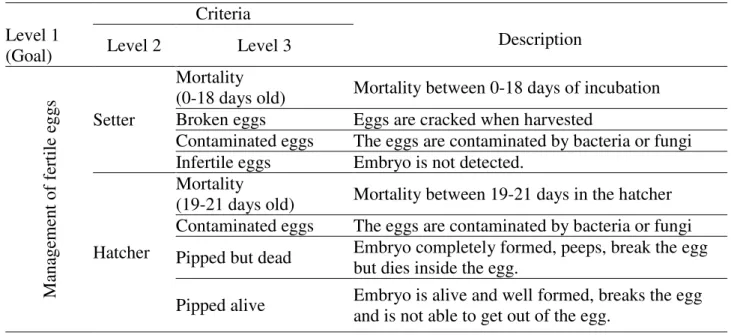
The criteria were established (Table 2) and given proper weight (Figure 1) based on field data and knowledge base on the subject (KARLSSON, 1998). The software MakeItRational® (MIR, 2010) was used for processing the data.
TABLE 2. Description of the concepts of established criteria used in the AHP analysis. Criteria
Description Level 1
(Goal) Level 2 Level 3
M
an
ag
em
en
t o
f f
er
ti
le eg
gs Setter
Mortality
(0-18 days old) Mortality between 0-18 days of incubation Broken eggs Eggs are cracked when harvested
Contaminated eggs The eggs are contaminated by bacteria or fungi Infertile eggs Embryo is not detected.
Hatcher
Mortality
(19-21 days old) Mortality between 19-21 days in the hatcher Contaminated eggs The eggs are contaminated by bacteria or fungi Pipped but dead Embryo completely formed, peeps, break the egg but dies inside the egg. Pipped alive Embryo is alive and well formed, breaks the egg
Level 1 Level 2 Level 3 M a na ge m e nt of fer ti le eg g
s Setter (73,1)
Mortality (0-18 days old) (30) Broken eggs (10)
Contaminated eggs (18) Infertile eggs (16)
Hatcher (26,9)
Mortality (19-21 days old) (4) Contaminated eggs (2) Pipped dead (10) Pipped alive (10)
FIGURE 1. Local weight (%) of the main criteria (Level 2) and secondary criteria (Level 3) for selecting the best breeder age for broiler incubation eggs.
RESULTS AND DISCUSSION
For the main criteria (level 2), the most weight was established for "Setter" (73.1%) relative to the "Hatcher" (26.9%). These results agree with the current literature (ALDA, 2003; BOLELI, 2003) where the phase of incubation is considered the critical period of the embryo development. Failure in this phase, may seriously compromise hatching results. It was reported by the manager of the commercial hatchery that, during incubation, there is a serious concern concentrated on management, which led to the given weight previously attributed to the criteria.
The criterion "Setter" had also a higher weight (Table 3), especially “Mortality (0-18 days)” (30%), “Contaminated eggs” (18%) and “Infertile eggs” (16 %). According to ALMEIDA et al. (2008) embryo mortality rates must be reduced to improve hatching rates. It is essential to determine the causes, and to solve the problems that may occur from laying to hatching. Several variables are reported to influence embryo development. Amongst them there are genetics, health, breeders’ management (MAULDIN et al., 2007), and incubator environment, in which temperature seems the most valuable item to be recorded. KING`ORI (2011) reports that incubator temperate should be maintained between 37.2 - 37.7 °C, and the acceptable range is 36- 38.9 °C.
TABLE 3. Weight of criteria (%) and results (%) of both female breeders’ ages (42 and 56 week-old).
Setter Hatcher Total
Ma
in
cr
ite
ria Weight 73.1 26.9 100
42 wks 56.3 11.7 68.0
56 wks 16.8 15.2 32.0
S eco nd ar y c ri ter ia M or ta lity 0-18 da ys ol d B roke n e ggs C ont am ina te d eggs I In fer ti le eg gs M or ta lity 19-21 da ys ol d C ont am ina te d eggs H P ippe d de ad P ippe d a li ve
Global weight 30.0 10.0 18.0 16.0 4.0 2.0 10.0 10.0 100 Local weight 41.0 13.0 24.0 22.0 16.0 8.0 38.0 37.0
42 wks 83.3 80.0 66.7 75.0 66.7 50.0 50.0 25.0 56 wks 16.7 20.0 33.3 25.0 33.3 50.0 50.0 75.0
*wks = week-old.
Characteristics related to hatchability, such as fertility, the time required to rupturing the internal and external membranes, and proper hatching can be influenced by the age of the female breeder (PEDROSO et al., 2005). It was also established that the embryo development is slower in the eggs of younger hens than in the eggs of older (APPLEGATE, 2002; YASSIN et al., 2009).
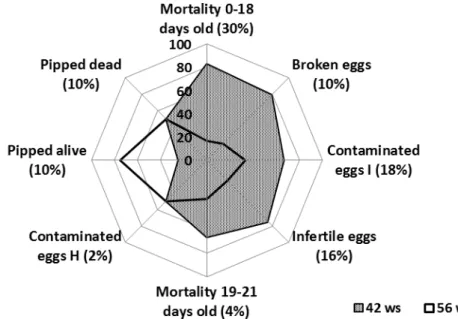
This multi criteria concept allowed some prompt analysis of the process beyond the final score (Figure 2): 1) the two analyzed ages had a tie on the criteria "Contaminated eggs" (in "Hatcher") and "Pipped but dead"; and 2) the only criterion that breeders of 56 week-old was better was "Pipped and alive." For all other criteria, the breeder with 42 week-old had better results.
FIGURE 2. Weight of the secondary criteria and their values weighed in relation to the breeder age analyzed (42 and 56 days).
PEDROSO et al. (2005) observed that fertile eggs from older female breeder led to greater pullets’ mortality especially in the period after pullets break the egg internal membrane. It has been noted that mortality at the early incubation stage tends to decrease as breeder age advances (O’SULLIVAN et al., 1991), but this did not occur in the experiment related by PEDROSO et al. (2005).
Embryo mortality is reported to be greater in eggs from 32-week-old breeders, than in those from younger female breeders, resulting in less hatchability (PEDROSO et al., 2005). Eggs laid by old breeders presented higher infertility and total embryo mortality, resulting in lower hatching percentage (ALMEIDA et al., 2008) and young breeders frequently lay eggs with greater embryo mortalities (APPLEGATE et al., 1998). Eggs from young female breeder have small yolk and consequently less yolk lipid available for the embryo (APPLEGATE, 2002). In old female breeders the increase in the eggs’ weight lead to reduction of hatching capacity, as the embryos developed in larger eggs are less tolerant to the excessive heat that occurs in the end of the incubation period (ROCHA et al., 2008). Young female breeders produce eggs with weight more uniform than older female breeders (ALMEIDA et al., 2006). According to TANURE et al. (2009) both the effect of the female breeders’ age and the time of fertile eggs storage tend to increase as the age of the female increases. This assumption disagrees with the results found by SANTOS et al. (2007) who did not find a significant difference in the fertile eggs weight as the female breeders aged. When the effect of age on the egg weight is known, commercial incubators should classify fertile eggs before the incubation process taking into account the age of the female breeders.
CONCLUSIONS
Results of this study suggest that female broiler breeders with 42 week-old had a better performance (68%) than those with 56 week-old (32%). The setter phase (incubation) is more critical than the hatcher. The AHP method was efficient for this analysis and may serve as a methodological basis for future studies to improve the hatchability of broilers eggs.
ACKNOWLEDGEMENTS
The authors thank CNPq for financial support. REFERENCES
ALDA, T.R.B.L. Gerenciamento de incubatório. In: MACARI, M.; GONZALES, E. (Ed.). Manejo
da incubação. 2.ed. Campinas: Fundação APINCO de Ciência e Tecnologia Avícolas, 2003.
p.499-514.
ALMEIDA, J. G. DAHLKE, F.; MAIORKA, A.; FARIA FILHO, D. E.; OELKE, C. Efeito da idade da matriz no tempo de eclosão, tempo de permanência do neonato no nascedouro e o peso do pintainho. Archives of Veterinary Science, Paraná, v.11, n.1, p.45-49, 2006.
ALMEIDA, J.G.; VIEIRA, S.L.; REIS, R.N.; BERRES, J.; BARROS, R.; FERREIRA, A.K.; FURTADO, F.V.F. Hatching distribution and embryo mortality of eggs laid by broiler breeders of different ages. Revista Brasileira de Ciência Avicola, Campinas, v.10, n.2, p.89-96, 2008.
ALMEIDA PAZ, I.C.L.; GARCIA, R.G.; BERNARDI, R.; NÄÄS, I.A.; CALDARA, F.R.; FREITAS, L.W.; SENO, L.O.; FERREIRA, V.M.O.S.; PEREIRA, D.F.; CAVICHIOLO, F. Selecting appropriate bedding to reduce locomotion problems in broilers. Brazilian Journal of
Poultry Science, Campinas, v.12, n.3, p.189-195, 2010.
APPLEGATE, T. J. Reproductive maturity of turkey hens: egg composition, embryonic growth and hatchling transition. Poultry and Avian Biology Reviews, St. Joseph, v.13, n.1, p.31-41, 2002. APPLEGATE, T.J.; HARPER, D.; LILBURN, M.S. Effects of on production age on egg
composition and embryo development in commercial Peking ducks. Poultry Science, Champaign,
v.77, n.11, p.1608-1612, 1998.
BARACHO, M. S.; NÄÄS, I. A.; GIGLI, A. C. S. Impacto das variáveis ambientais em incubatório de estágio múltiplo de frangos de corte. Engenharia Agrícola, Jaboticabal, v.30, n.4, p.563-577,
2010.
BOLELI, I. C. Estresse, mortalidade e malformações embrionárias. In: MACARI, M.; GONZALES, E. Manejo da incubação. Campinas: FACTA, 2003. p.472-498.
DECUYPERE E.; BRUGGEMAN, V. The endocrine interface of environmental and egg factors affecting chick quality. Poultry Science, Champaign, v.86, n.5, p.1037-1042, 2007.
DECUYPERE, E.; MALHEIROS, R. D.; MORAES, V. M. B.; BRUGGEMAN, V. Fisiologia do Embrião. In: In: MACARI, M.; GONZÁLES, E. Manejo da incubação. Campinas: FACTA, 2003.
p.65-94. 2003.
DE SMITH, L.; BRUGGEMAN, V.; DEBONNE, M.; TONA, J.K.; KAMERS, B.; EVERAERT, N.; WITTERS, A.; ONAGBESAN, L.; BAEDEMAEKER, S. DECUYPERE, E. The effect of no ventilation during early incubation on the embryonic development of chicks of two commercial broiler strains differing in ascites susceptibility. Poultry Science, Champaign, v.87, n.3, p.551-560,
2008.
GIGLI, A. C. S.; BARACHO, M. S.; NÄÄS, I. A.; SALGADO, D.D.; ALVARENGA, D.P. Environmental conditions in broiler multi-stage setter - a case study. Scientia Agricola, Piracicaba,
v.66, n.2, p.145-149, 2009.
HALMAR, H.; STIGEBRANDT, A.; REHBEIN, M.; MCKINNON, A.D. Developing a decision support system for sustainable cage aquaculture. Environmental Modeling & Software, The
Netherlands, v.24, n.6, p.694-702, 2009.
HAMIDU, J. A.; FASENKO, G. M.; FEDDES, J. J. R.; O`DEA, E. E.; OUELLETTE, C. A.; WINWLAND, M. J.; CHRISTENSEN, V. L. The effects of broiler breeder’s genetic strain and parent flock age and eggshell conductance and embryonic metabolism. Poultry Science,
Champaign, v.86, n.11, p.2420-2432, 2007.
KARLSSON, J. A systematic approach for prioritizing software requirements. 1978. Disstertation
(Ph.D) - Linkoping University, Sweden, 1998.
KING`ORI, A. M. Review of the factors influence eggs fertility and hatchability in poultry.
International Poultry Science, Pakistan, v.10, n.6, p.483-492, 2011.
MARCHEZETTI, A. L.; KAVISKI, E.; BRAGA, M. C. B. Aplicação do método AHP para a hierarquização das alternativas de tratamento de resíduos sólidos domiciliares. Ambiente
Construído, Porto Alegre, v.11, n.2, p.173-187, 2011.
MAULDIN, J. M.; KUZNIAK, S. F.; GARDINO, T. L. Comparisons of hatchability measures in Jamesway platinum single stage incubators with Jamesway multistage incubators in a commercial
broiler hatchery in Georgia. Georgia: UG, 2007. 42 p.
MENEZES, A.G; NÄÄS, I.A; BARACHO, M.S. Identification of critical points of thermal environment in broiler production.Revista Brasileira de Ciência Avícola, Campinas, v.12, n.1,
p.21-29, 2010 .
MIR. Make it rational. Disponível em: <http://www.poultry.uga.edu/about/ documents/ProgramReview2009.pdf. Acesso em: 20 abr. 2011.
ONAGBESAN, O.; BRUGGEMAN, V.; SMIT, L.D.; DEBONNE, M.; WITTERS, A.; TONA, K.; EVERAERT, N.; DECUYPERE, E. Gas exchange during storage and incubation of avian eggs: effects on embryogenesis, hatchability, chick quality and post-hatch growth. Worlds Poultry
Science Journal, Cambridge, v.63, n.5, p.557-573, 2007.
O’SULLIVAN, N. P.; DUNNINGTON, E. A.; SIEGEL, P. B. Relationships among age of dam, egg component, embryo lipid transfer and hatchability of broiler breeder eggs. Poultry Science,
Champaign, v.70, n.10, p.2180-2185, 1991.
PARRA-LÓPEZ, C.; CALATRAVA-REQUENA, J.; HARO-GIMÉNEZ, T. A systemic
comparative assessment of the multifunctional performance of alternative olive systems in Spain within an AHP-extended framework. Ecological Economics, Amsterdam, v.64, n.4, p.820-834,
2008.
PEDROSO, A. A.; ANDRADE, M. A.; CAFÉ, M. B.; LEANDRO, N. S.; MENTEN, J. F.; STRINGHIN, J. H. Fertility and hatchability of eggs laid in the pullet-to-breeder transition period and in the initial production period. Revista Brasileira de Zootecnia, Viçosa, v.90, n.3-4, p.355-364,
2005.
PINEDA, L.; SAWOSZ, E.; HOTOWY, A.; ELNIF, J.; SAWOSZ, F.; ALI, A; CHWALIBOG, A. Effect of nanoparticles of silver and gold on metabolic rate and development of broiler and layer embryos. Comparative Biochemistry and Physiology, Cambridge, v.161, n.3, p.315-319, 2012.
saco vitelino. Arquivo Brasileiro Medicina Veterinária e Zootecnia, Belo Horizonte, v.60, n.4,
p.979-986, 2008.
ROSADO, J. R. A. G.; LOBATO, J.F.P.; MULLER, C. Building consolidated performance indicators for an agribusiness company: A case study. Revista Brasileira de Zootecnia, Viçosa,
v.40, n.2, p.454-461, 2011.
RUIZ, M.C. E.; ROMERO, E.; PÉREZ, M.A.; FERNÁNDEZ, I. Development and application of a multi-criteria spatial decision support system for planning sustainable industrial areas in Northern Spain. Automation in Construction, Amsterdam, v.22, n.1, p.320-333, 2012.
SAATY, T.L. Método de análise hierárquica. São Paulo: McGraw-Hill, Makron. 1991.
SANTOS, J. R. G.; FORNARI , C. M.; TÉO M. A. Influência da qualidade da casca do ovo sobre índices de produtividade de um incubatório industrial. Ciência Rural, Santa Maria, v.37, n.2,
p.524-527, 2007.
TANURE, C.B.G.S.; CAFÉ, M.B.; LEANDRO, N.S.M.; BAIÃO, N.C.; STRINGHINI, J.H.; GOM, N.A. Efeitos da idade da matriz leve e do período de armazenamento de ovos incubáveis no
rendimento de incubação. Arquivo Brasileiro Medicina Veterinária e Zootecnia, Belo Horizonte,
v.61, n.6, p.1391-1396, 2009.
VAN BRECHT, A.; HENS, H.; LEMAIRE, J. L.; AERTS, J. M.; DEGRAEVE, P.; BERCKMANS, D. Quantification of the heat exchange of chicken eggs. Poultry Science Association, Belgium,
v.84, n.3, p.353-361, 2005.
VIDAL, A. L.; SAHIN, E.; MARTELLI, N.; BERHOUNE, M.; BONAN, B. Applying AHP to select drugs to be produced by anticipation in chemotherapy compounding unit. Journal Experts
Systems with Applications, Adelphi, v.37, n.2, p.1528-1534, 2010.
WILLEMSEN, H.; EVERAERT, N.; WITTERS, A.; DE SMIT, L.; DEBONNE, M.;
VERSCHUERE, F.; GARAIN, P.; BERCKMANS, D.; DECUYPERE, E.; BRUGGEMAN, V. Critical assessment of chick quality measurements as an indicator of posthatch performance.
Poultry Science, Champaign, v.87, v.11, p.2358-2366, 2008.